
Jump to section
- Table of Contents
- When a Douyin Scraper Hits Its First Real Wall
- Why proxy choice comes first
- What Residential Backconnect Proxies Are
- What backconnect adds
- Douyin Scraping and the Proxy Decision That Matters Most
- How Backconnect Rotation Works in Practice
- The gateway is your control surface
- Misconfigurations that cause avoidable failures
- Rotation Patterns Built for Douyin’s Rate Limits
- A simple routing decision
- Layering Proxies With Signatures and Browser Context
- Keep identity layers aligned
- What Residential Proxies Cannot Fix on Their Own
- A Pre-Build Checklist for a Douyin Scraping Pipeline
Your Douyin scraper works perfectly in a small test. Then production traffic starts returning captchas, empty payloads, and 429 responses. The instinct is to rewrite the parser or regenerate the signature, but the first failure often sits lower in the stack. Douyin sees a correlated group of requests from similar networks, device fingerprints, and timing patterns, and the scraper loses access before its extraction logic gets a fair test.
That makes proxy infrastructure a design decision, not a final configuration step. A residential backconnect setup affects session persistence, request pacing, retry behavior, signature validity, and the way Douyin evaluates the reputation of your traffic. The platform’s scale explains why reliable collection matters. Douyin launched in September 2016 and had exceeded 150 million daily active users in China by mid-2018. By 2018, the company said it had reached 500 million monthly active users worldwide and was available in more than 150 countries and regions, as summarized by Marketing to China’s Douyin statistics overview.
Table of Contents
Open Table of Contents
- When a Douyin Scraper Hits Its First Real Wall
- What Residential Backconnect Proxies Are
- Douyin Scraping and the Proxy Decision That Matters Most
- How Backconnect Rotation Works in Practice
- Rotation Patterns Built for Douyin’s Rate Limits
- Layering Proxies With Signatures and Browser Context
- What Residential Proxies Cannot Fix on Their Own
- A Pre-Build Checklist for a Douyin Scraping Pipeline
When a Douyin Scraper Hits Its First Real Wall
A team usually notices the problem in the queue, not in the code. The scraper has collected public video metadata for two days through a small group of datacenter exits. Then response bodies become suspiciously short. Some requests return challenge pages, others contain empty lists, and the remaining traffic begins producing 429 responses. The workers keep retrying, so the queue grows while successful records fall.
The obvious diagnosis is excessive volume. That explanation is incomplete. Douyin can correlate traffic through ASN concentration, TLS behavior, request cadence, cookies, device identifiers, and signature patterns. A datacenter pool may provide plenty of bandwidth while still presenting a narrow, easily classified cohort. Once that cohort earns a poor reputation, changing only the user agent rarely changes the outcome.
Practical rule: Treat the exit network as part of the scraper’s identity. If every worker shares the same network characteristics, concurrency can amplify the signal that gets you blocked.
The first useful test separates transport failure from application failure. Send a controlled sample through different exit classes, keep the request shape stable, and record status codes, response size, challenge markers, latency, and parsing success. Don’t increase concurrency until you know whether the target is rejecting the IP, the session, the signature, or the request sequence.
Why proxy choice comes first
A proxy isn’t a magic bypass. It determines whether your other controls have a credible foundation. Sticky sessions depend on predictable exit behavior. Captcha recovery depends on isolating the affected session. Signature handling may depend on keeping an IP, cookie jar, and device profile aligned. A poor network choice makes each of those layers harder to diagnose.
For teams designing a production collector, the relevant question isn’t how to bypass IP bans in web scraping. It’s which traffic pattern Douyin should see, how long an identity should persist, and what the system should do when an exit becomes unhealthy.
Residential backconnect proxies are useful because they move pool selection and rotation behind a single gateway while exposing controls for persistence and geography. They won’t repair inconsistent signatures or unlawful collection, but they give the scraper a more credible transport layer to build on.
What Residential Backconnect Proxies Are
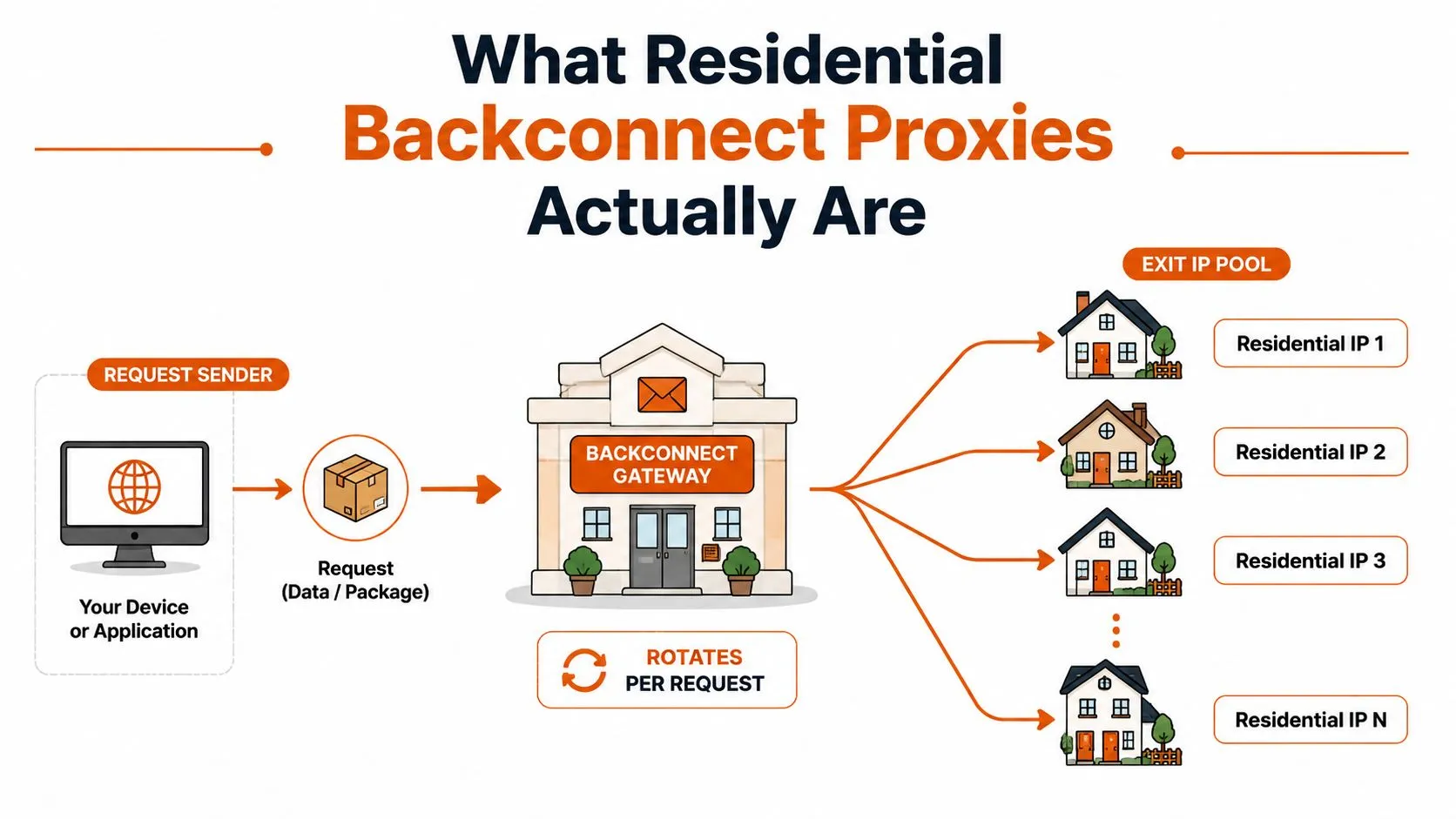
A Douyin scraper can connect to one stable gateway while its requests leave through different residential IP addresses. The provider manages the exit pool, so application code does not need to maintain every proxy node directly.
A residential backconnect proxy has several working parts:
- The gateway is the single endpoint your scraper uses. Workers send traffic there instead of tracking individual exits.
- The residential IP pool contains consumer ISP addresses, often supplied through peer networks or opt-in software development kits.
- Rotation logic selects an exit per request, keeps one for a session, or applies geography and health preferences.
- A sticky session retains an address for related requests during a chosen period or until the session ends.
- Health handling removes an exit that times out or returns challenge responses, while the application keeps using the same gateway.
What backconnect adds
A static residential proxy gives the scraper one residential exit. Your code then handles replacement, health checks, and pool inventory. Backconnect moves those routing tasks behind the gateway, while the provider selects an exit according to the configured policy.
The abstraction changes what the application must manage. Session affinity, failures, request pacing, and signature consistency still belong in the scraper. Maintaining a complete list of individual residential nodes no longer needs to be the primary routing task. That matters during long batches, when exits disappear, degrade, or become unavailable.
Backconnect rotation also affects Douyin’s defenses. Frequent IP changes can help distribute request load, but they can conflict with session cookies, device context, and signature validation. A sticky exit may support a coherent identity for related calls, while per-request rotation can provide weaker continuity. The right policy depends on the endpoint and request sequence, not on the pool size alone.
Visibility is the main trade-off. A large pool may conceal address composition, replacement rules, upstream routing, and geographic distribution. Residential traffic can cost more than datacenter traffic, add latency, and produce less predictable throughput. Test connection limits, sticky-session behavior, provider support, privacy terms, and actual Douyin response quality before committing to a supplier.
For background on proxy categories, types of India proxy servers explains residential, datacenter, and mobile approaches, although Douyin collection may require another geography. Teams comparing suppliers can also consult this guide to the best proxy servers for web scraping, then validate its general guidance with Douyin-specific tests.
Douyin Scraping and the Proxy Decision That Matters Most
Proxy classes behave differently against the signals a Douyin scraper creates. Datacenter exits are usually efficient and inexpensive, but concentrated ownership and recognizable ASN patterns can make a large worker group look automated. Mobile exits often carry stronger consumer-network plausibility, yet their throughput and price make them a poor default for broad metadata collection.
ISP proxies sit between those extremes. They use static residential-looking addresses hosted in datacenters, which can help with session persistence but may still expose concentrated infrastructure under sustained concurrency. Rotating residential backconnect proxies usually offer the most practical balance for discovery, profile, and video metadata workloads. Mobile routes remain useful when a particularly sensitive endpoint rejects otherwise coherent residential traffic.
| Proxy Type | IP Reputation | ASN Clustering Risk | Best Douyin Endpoint | Trade-off |
|---|---|---|---|---|
| Residential backconnect | Generally plausible consumer-network identity | Lower when the pool has genuine geographic and network diversity | Broad public discovery and video metadata | Variable latency, pool transparency, and cost |
| Datacenter | Often easy to provision but may be recognized as hosting traffic | High when workers cluster in related networks | Low-volume development and controlled testing | Fast and economical, but weak for sustained automated traffic |
| Mobile | Strong consumer-network context | Often lower from an IP-reputation perspective | Sensitive authenticated or live-related requests | Better trust signals, with lower throughput and higher operating cost |
| ISP static residential | Residential appearance with stable routing | Moderate under sustained concurrency | Session-heavy profile or account workflows | Stable identity, but can fail when concurrency exposes infrastructure concentration |
IP reputation isn’t the only issue. Douyin can also compare TLS and HTTP behavior, session stickiness, request ordering, and generated parameters. A residential exit with an obviously inconsistent client fingerprint still looks automated. Conversely, a clean client can still lose access if too many requests arrive through a narrow, poorly regarded network group.
The best default depends on endpoint sensitivity and data freshness. Use residential backconnect for a wide public corpus, preserve sessions where the endpoint expects continuity, and reserve mobile capacity for traffic that has demonstrated a transport-level rejection. The distinctions in static versus rotating proxies are helpful here, but Douyin requires testing the interaction between rotation and application state rather than selecting a category in isolation.
How Backconnect Rotation Works in Practice
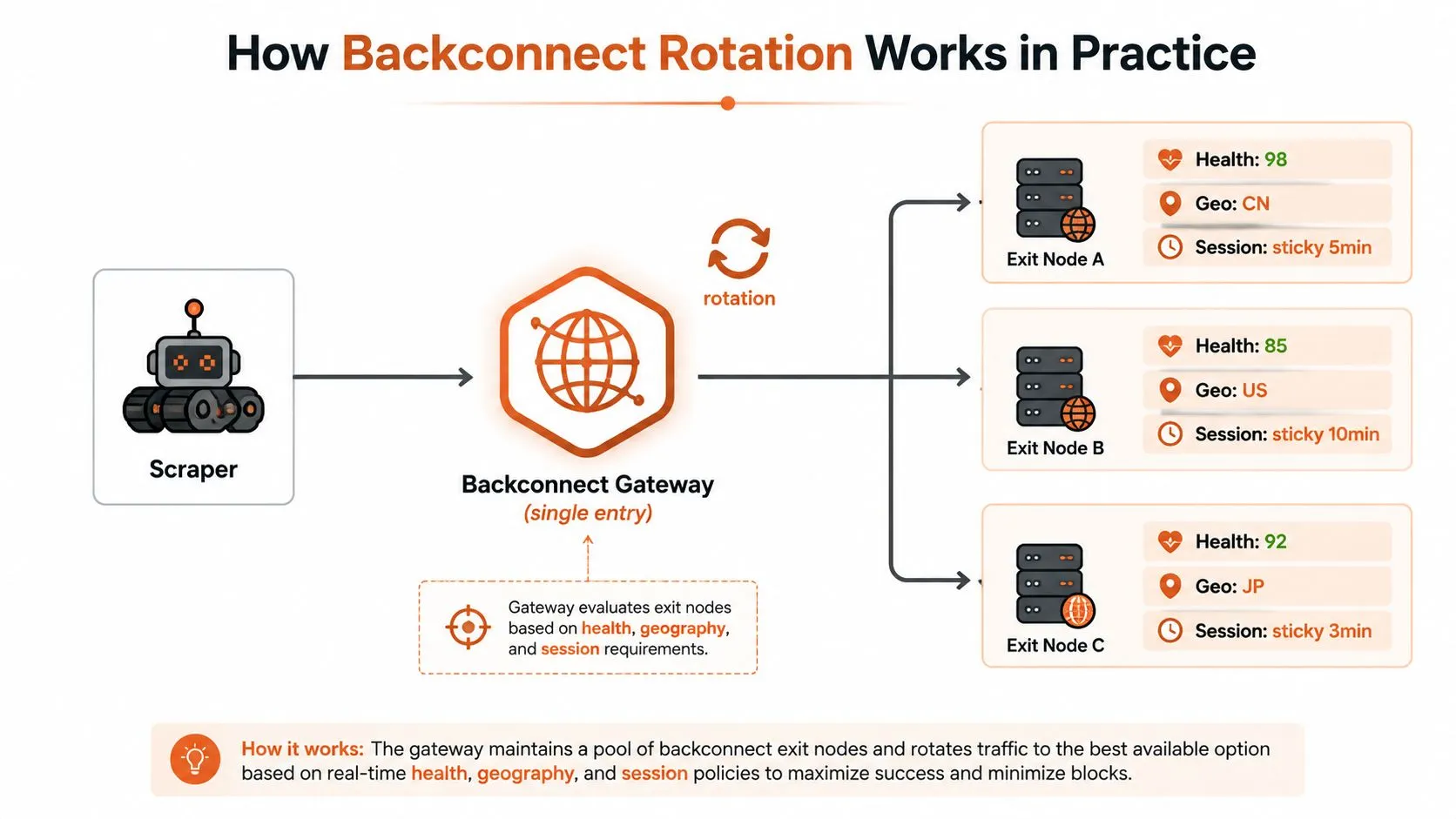
Your scraper connects to a single gateway. The gateway selects an exit node, forwards the request, and returns the response. Selection may consider exit health, geography, and session affinity, but those decisions happen outside the worker’s ordinary request code.
The gateway is your control surface
A direct proxy pool makes the application responsible for choosing an exit. A backconnect gateway turns that into a policy problem. The worker asks for a connection, applies its session key if needed, and lets the gateway route traffic. That means retries must be written around request outcomes, not around a specific IP address that may no longer be available.
Suppose ten workers issue ten independent unauthenticated discovery requests at roughly the same time. With per-request rotation enabled, the gateway may place those requests on ten different healthy residential exits. The scraper doesn’t need ten proxy configurations or a manual allocation table. It does need to log the gateway session, selected region when exposed, response status, latency, and whether the payload was valid.
This model also changes concurrency math. A gateway can impose its own connection or request limit, while the target can impose a separate application-layer quota. The documented developer-facing Douyin interface described at Douyin’s developer documentation exposes a limit of 30 requests per minute, along with headers for the limit, remaining quota, and reset time. That quota must be treated as a pacing constraint even when the proxy pool appears healthy.
Misconfigurations that cause avoidable failures
- Rotating every request inside a sticky workflow: Login, cookies, and signature-bearing traffic can depend on continuity. Per-request rotation may invalidate that state.
- Ignoring gateway limits: A healthy exit pool doesn’t mean the gateway can accept unlimited concurrent connections.
- Keeping dead exits in application state: An exit can fail during a batch. Let the gateway quarantine it, and let your worker retry with bounded backoff.
- Retrying empty payloads aggressively: An empty response may indicate a challenge or policy response, not a transient network timeout.
Use separate policies for discovery, authenticated sessions, comments, and any live-related collection. The gateway simplifies routing, but observability still belongs in your pipeline.
Rotation Patterns Built for Douyin’s Rate Limits
Rotation should follow the identity model of the endpoint. A public discovery request can often tolerate a new exit, while a signed, authenticated request may need the same IP, cookies, device profile, and request context for the session’s lifetime.
The documented 30 requests-per-minute application-layer limit is a clear reason to pace requests rather than treating proxy rotation as permission to increase volume. Headers exposing remaining quota and reset time should feed the scheduler, while 429 and captcha responses should trigger isolation instead of immediate parallel retries.
| Endpoint type | Auth state | Recommended pattern | Typical sticky window | Failure mode avoided |
|---|---|---|---|---|
| Public discovery | Unauthenticated | Per-request or short-batch rotation | None or brief batch affinity | Concentrated request cadence |
| Video metadata | Unauthenticated or lightly stateful | Small batch affinity with health-based replacement | Short, workload-specific window | Repeated retries through a degraded exit |
| Comments and replies | Session-dependent | Sticky session with bounded concurrency | Long enough to finish pagination | Token and cookie drift |
| Profile or account workflow | Authenticated | User-scoped sticky session | Session lifetime | Cross-account identity mixing |
| Live-related endpoint | Authenticated or sensitive | Stable session, with a reserved fallback pool | Session lifetime | Aggressive IP changes and challenge escalation |
The exact window should be measured, not copied from a provider’s default. A short sticky interval can preserve the relationship between cookies and exit IP without trapping a worker on a deteriorating address. A longer session may be necessary when the endpoint returns paginated data under a signed context.
A simple routing decision
Start with three questions:
- Does the endpoint require authentication or a signature tied to device state? If yes, use a sticky session.
- Is the request public discovery with low state? If yes, per-request rotation can reduce concentration.
- Did the exit return a 429, captcha, empty payload, or malformed response? If yes, move it into a cooldown pool and retry through a separate session.
A cooldown pool prevents one noisy worker from burning through the same exits. The quarantine duration should be an operational configuration based on observed recovery, not an arbitrary promise of invisibility. Keep the pool’s health state separate from the scraper’s parsing state so a parser bug doesn’t mark every proxy as bad.
Layering Proxies With Signatures and Browser Context
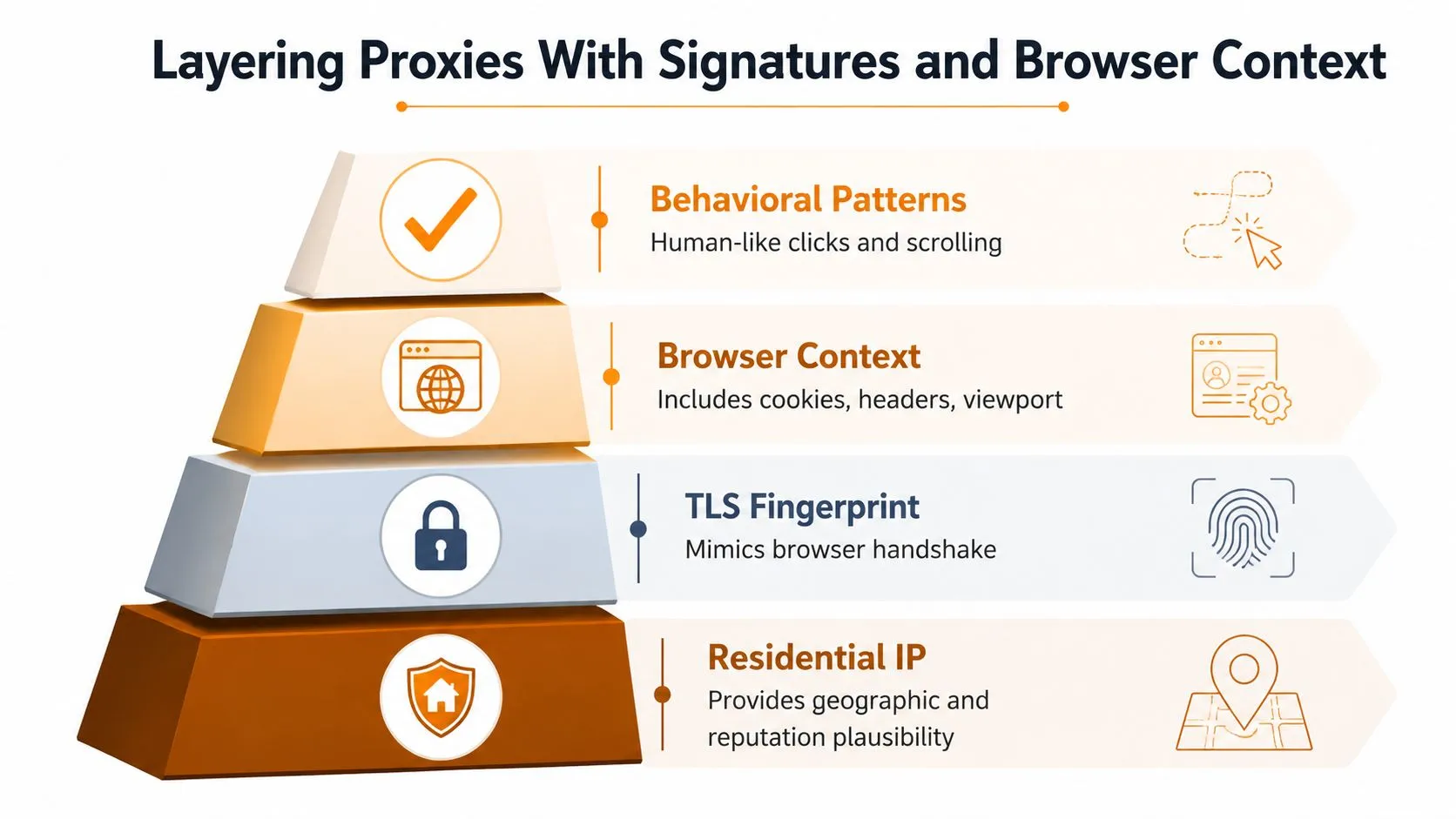
A residential IP is the bottom layer, not the complete anti-detection system. It provides a plausible network location and reputation context. Above it, the client must present a coherent TLS and HTTP profile, maintain consistent cookies and device properties, generate accepted application parameters, and behave in a way that doesn’t contradict its supposed identity.
One documented implementation describes Douyin’s a_bogus parameter as involving SM3 hashing, RC4 encryption, custom Base64-like encoding, random-string generation, and obfuscated request parameters. The implementation also describes proxy and account rotation as part of reducing blocks, which illustrates the central dependency: signature generation and transport identity have to be designed together. See the documented anti-scraping implementation for the technical outline.
Keep identity layers aligned
The practical stack looks like this:
- Residential IP: Establishes geographic and network plausibility.
- TLS and HTTP profile: Keeps the handshake, protocol behavior, headers, and user agent internally consistent.
- Signature layer: Generates parameters from the actual request body, headers, timestamps, and device context.
- Browser context: Supplies cookies, viewport properties, JavaScript execution, and device signals when the endpoint requires a real browser.
A perfect signature sent through a suspicious datacenter cohort can fail quickly. A clean residential exit paired with a signature generated for the wrong body can fail just as quickly. Rotating IPs while retaining one device identifier links the entire pool to a single virtual device. Rotating device identifiers while pinning one exit creates a different anomaly, a collection of unrelated identities repeatedly emerging from one address.
A useful diagnostic order is transport, client consistency, signature correctness, then browser execution. If several unrelated device profiles fail only on one exit group, investigate the network. If one profile fails across clean exits, inspect request construction and signature inputs. Browser automation should be added when JavaScript or browser state is required, not as a substitute for fixing malformed requests.
Teams building media-analysis workflows can apply the same separation between acquisition and downstream processing found in a YouTube Transcript API developer guide. For Douyin, the acquisition layer still needs its own request validation and policy handling. The broader anti-detection principles in this Playwright anti-bot measures guide are relevant, but they shouldn’t be treated as proof that a browser alone will solve Douyin-specific validation.
What Residential Proxies Cannot Fix on Their Own
Residential routing improves transport, but it does not make a Douyin scraper invisible or automatically compliant. Application signatures still expose automation when timestamps, encrypted parameters, request order, or device fields fail validation. Changing the proxy location cannot repair a malformed signature.
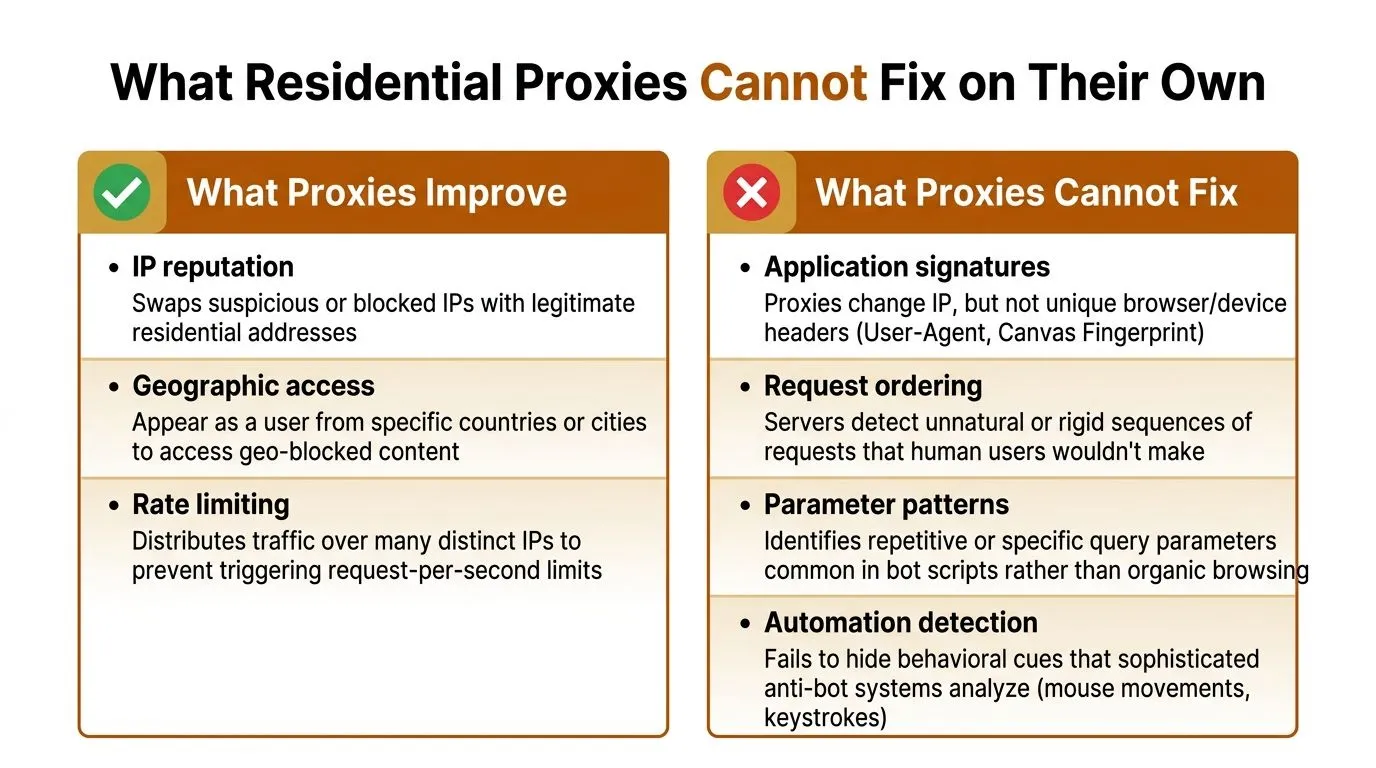
Browser identity needs internal consistency. User agent, TLS behavior, cookies, device properties, graphics signals, language, and timezone should describe the same client. Account-level risks remain, including shared credentials, recycled device identities, unrealistic interaction patterns, and sessions that move between incompatible regions.
Evidence quality creates a separate blind spot. If a brand-protection team must show that content was copied or removed, a parsed HTML record may not suffice. Independent reporting describes a Douyin lawsuit involving alleged copying of 50,000 short videos. Legal analysis also emphasizes preserving screen recordings, URLs, fan counts, likes, comments, timestamps, and related context, as discussed in China IP Today’s reporting on Douyin scraping and repost disputes. A defensible workflow records provenance and collection context, rather than retaining only normalized fields.
A residential proxy is a transport control, nothing more. Compliance, signature generation, evidence systems, and observability remain your responsibility.
Operational constraints matter. Residential bandwidth is variable, providers enforce concurrency limits and retention policies, and upstream routing changes without notice. Before collection, assess copyright, database rights, privacy obligations, contracts, platform terms, minimization, retention, and deletion procedures. Consult qualified counsel when the use case requires it.
A Pre-Build Checklist for a Douyin Scraping Pipeline
Before buying proxy traffic, define the dataset and the rules around it. Write down the fields, refresh requirement, acceptable freshness, jurisdictions, lawful basis, retention period, access controls, and deletion process. Decide whether the source is public, authenticated, logged in, or consented, and keep those categories separate in code and operations.
Then run a small, controlled feasibility test:
- Measure the response: Record status codes, challenge markers, response size, latency, parse success, and field drift.
- Test the pool: Check geographic coverage, sticky-session duration, concurrent connections, DNS and TLS behavior, replacement policy, privacy terms, and support quality.
- Model the workload: Estimate request weight and concurrency from observed samples, then size workers and bandwidth against the actual budget.
- Isolate state: Give each worker its own cookie jar, device profile, signature context, pacing policy, and bounded retry budget.
- Add circuit breakers: Quarantine exits returning 429s, captchas, empty payloads, or malformed responses instead of retrying them indefinitely.
- Monitor production: Track block rate, successful records by proxy session, cost per record, response anomalies, and queue lag.
Launch with canary workers and explicit stop conditions. Long-running collection needs ownership after launch, because selectors, response schemas, signatures, policy labels, and delisted content can change. A practical long-term scraper maintenance guide reinforces the operational point: reliability comes from monitoring, controlled changes, and recovery procedures, not from purchasing a larger proxy pool.
In February 2026, China’s internet regulator said platforms removed more than 13,000 accounts and 543,000 pieces of content for failing to label AI-generated material, according to MLex’s report on China’s crackdown on unlabeled AI content. A Douyin pipeline therefore needs historical handling for label changes, content removals, and policy-driven delistings, rather than assuming that a record missing today was never present.
A sound architecture starts with a measured transport layer, matches rotation to session state, generates signatures from real request context, and preserves evidence when the use case demands it. Residential backconnect proxies can provide the foundation, but the pipeline earns reliability through disciplined pacing, identity consistency, observability, and lawful scope.
WebscrapingHQ can scope and operate Douyin-focused data pipelines with proxy management, monitoring, retries, schema controls, and scheduled structured delivery. If you need a managed feasibility review or a production extraction workflow, visit WebscrapingHQ and discuss the fields, cadence, geography, and compliance requirements with the team.
Want this done for you?
Send us the URLs. We'll quote it in 24 hours.
Paste the URL(s) you want scraped. We'll reply within 24 hours with a feasibility check and a ballpark quote.