
Jump to section
- Why Most Scrapers Get Blocked in 2026
- Volume is only one signal
- Building a Compliance-First Request Control Loop
- Put policy evaluation ahead of scheduling
- Make every decision auditable
- Designing Requests for Behavioral Consistency
- Keep identity coherent
- Ramp instead of guessing
- Proxy Pools, Geo Distribution, and Header Rotation
- Match origin to declared identity
- Know when the tactic earns its cost
- Browser Fingerprinting and CAPTCHA Response Decisions
- Rendering isn’t the same as authorization
- Monitoring Block Quality, Not Just Block Rates
- Build quality gates into collection
- Prevent silent degradation
- Legal and Ethical Baselines as a Throughput Advantage
- Use a production checklist
Your scraper works locally, then production starts returning 403 responses. You slow the queue, rotate a few IPs, change the User-Agent, and try again. The next run receives a challenge page instead of product data, while the logs still report successful HTTP requests.
That pattern is why how to avoid getting blocked while scraping can’t be reduced to proxy rotation. Reliable collection depends on authorization, request discipline, consistent client behavior, and checks that prove the returned data is complete. Since 2019, production scraping has made one lesson clear: a polite, observable pipeline usually outlasts an evasion-heavy one, especially on enterprise targets.
Why Most Scrapers Get Blocked in 2026
Cloudflare reported that bots represented 31.2% of all application traffic it processed in 2024, a level that had remained near 30% for approximately three years. Of the identified bots, 93% weren’t on Cloudflare’s verified-bot list and were classified as potentially malicious according to its 2024 application security report.
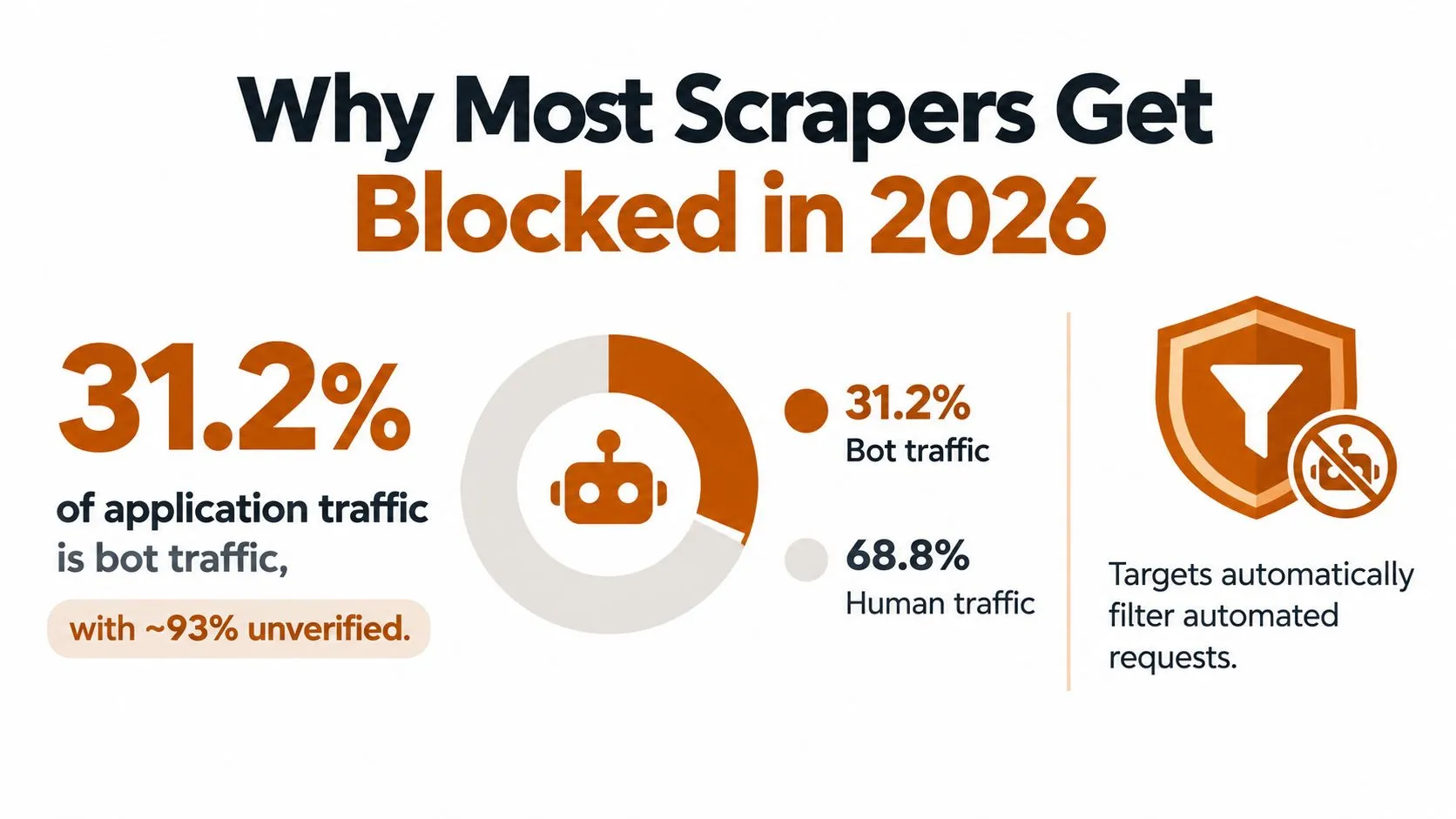
That changes the starting assumption. A scraper isn’t approaching an idle website and hoping not to be noticed. It’s entering an environment where roughly one in three application requests is automated and where most detected bots are unverified. Defensive systems therefore have a strong reason to challenge unfamiliar clients before a site owner investigates the individual workload.
Volume is only one signal
Fast repetition remains an obvious problem, but low volume alone doesn’t make a collection job acceptable. A client that changes geography, headers, protocol behavior, cookies, and concurrency without a coherent explanation can look riskier than a slower, clearly identified crawler. Cloudflare describes bot detection as a combination of multiple engines and signals, with outcomes that can include allowing, blocking, challenging, or rate-limiting traffic in its bot detection documentation.
Proxy rotation won’t repair a poor request pattern. Header tricks won’t make disallowed access legitimate. A scraper that keeps retrying after a refusal may just spread the same abusive behavior across more addresses.
Production rule: Reduce the work the target must perform, identify the client honestly, and stop when the source signals that collection isn’t welcome.
This is also why enterprise teams should separate feasibility from scale. A narrow trial should establish whether the source permits the intended fields, paths, geography, and frequency before a larger queue starts. The enterprise web scraping guide is useful context for treating extraction as an operated data service rather than a disposable script.
The stable foundation is a compliance-first request controller. It decides whether a URL should be requested, how long the hostname should wait, when retries should stop, and what evidence the team retains when access changes.
Building a Compliance-First Request Control Loop
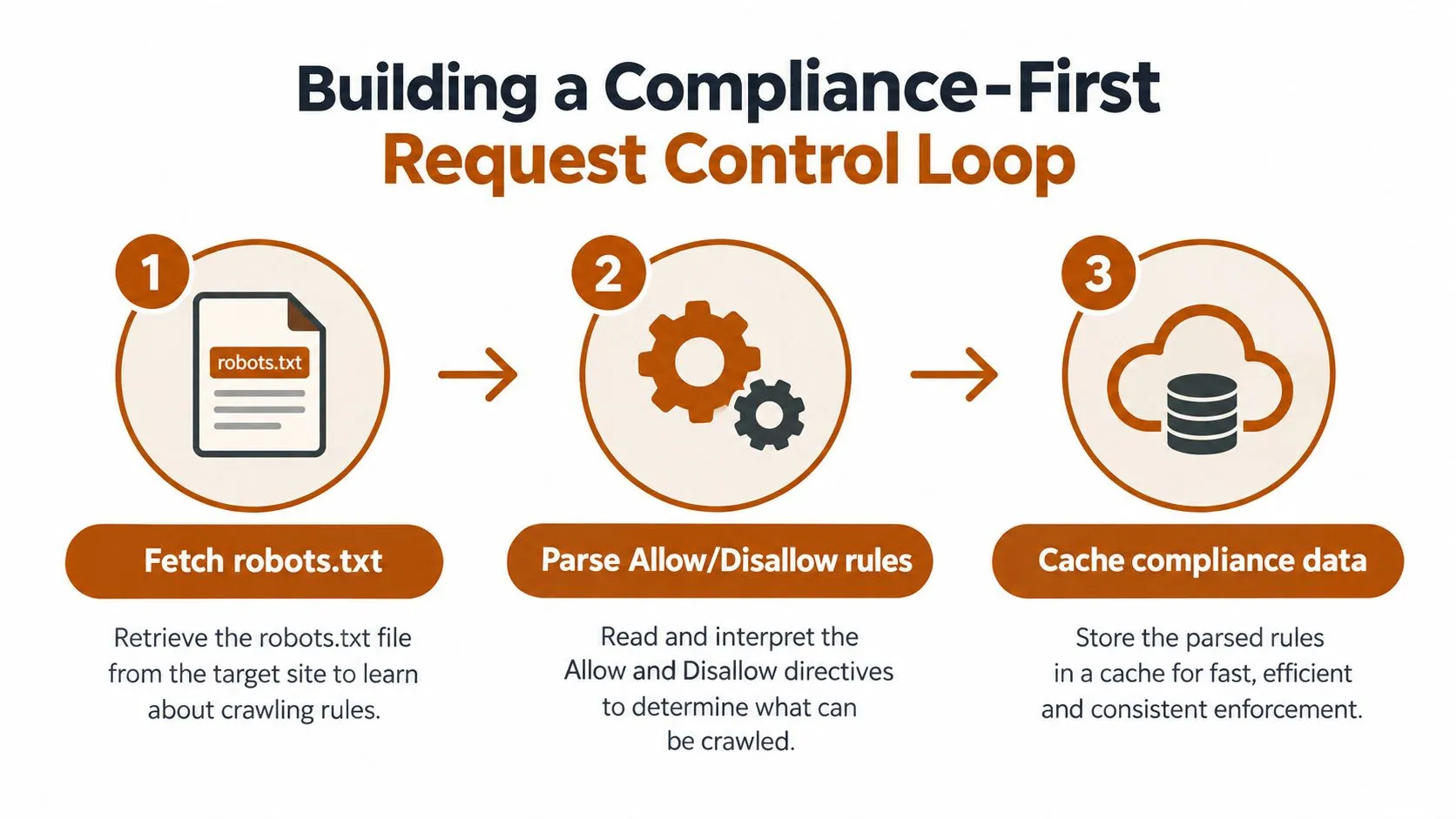
Start before the first content request. Fetch the target domain’s /robots.txt, cache the result, and evaluate the relevant User-agent, Allow, and Disallow rules under RFC 9309. The Robots Exclusion Protocol originated in 1994 and was formally standardized as IETF RFC 9309 in September 2022, so this isn’t a new workaround. It’s a long-standing part of web architecture.
Put policy evaluation ahead of scheduling
A useful controller follows this sequence:
- Fetch and cache policy. Retrieve
/robots.txtfor each hostname and retain the parsed rules with the retrieval time and policy version. Don’t download the file before every page request. - Match the crawler identity. Select the applicable user-agent group, apply path-specific rules, and use the most specific matching rule when multiple rules apply.
- Apply a host-level floor. If a site publishes crawl guidance, treat it as the minimum interval for that hostname.
Crawl-delayis a non-standard extension, so implement it as a site-specific policy rather than assuming every server supports it. - Start conservatively. Begin with one worker per hostname. Measure response time, status classes, and error rates before increasing concurrency.
- Control failures. Treat HTTP 429 and temporary 503 responses as instructions to slow or stop, not as invitations to retry immediately. Honor
Retry-Afterwhen supplied, pause the affected queue, then resume with capped exponential backoff and randomized jitter.
When no retry interval exists, a practical controller can calculate wait = random(0, min(120, 2^attempt)). The exact implementation matters less than the behavior: repeated failures should lengthen the pause, reduce concurrency, and eventually open a host-level circuit breaker.
Make every decision auditable
Log the request timestamp, hostname, URL path, policy decision, response status class, retry reason, wait duration, and host-level success and error rates. Those records help distinguish throttling from a layout change, a temporary outage, or a policy update.
Common failures are predictable:
- Path blindness: applying a domain-wide rule while ignoring more specific
AllowandDisallowmatches. - Global pacing: using one delay for every domain, regardless of published guidance or observed server behavior.
- Immediate retries: sending another request directly after a 429 or temporary 503.
- False concurrency control: assigning a delay to each worker while parallel workers collectively overwhelm the host.
Robots.txt isn’t an access-control mechanism, and it doesn’t override authentication boundaries, terms of service, or an explicit denial. Treat unavailable or malformed policy files conservatively, avoid account, checkout, administrative, and private paths, and escalate ambiguous cases through legal or client review. The broader principles behind this operating model are also reflected in guidance on ethical data collection.
Designing Requests for Behavioral Consistency
A stable request envelope is more useful than a rotating collection of disguises. Modern defenses can combine machine-learning classification with headers, session characteristics, browser signals, client fingerprints, JavaScript behavior, and account analytics. Cloudflare documents a 1–99 Bot Score as one example of multi-signal classification in its bot detection system.
Keep identity coherent
Use a clearly identified User-Agent that names the organization or project and provides a contact channel where appropriate. Keep cookies and sessions coherent within the job that created them. If the pipeline claims to represent one client in one region, sudden changes in geography, protocol, browser family, or header combinations create contradictions that a defense can evaluate.
Request only the page types and fields you need. Cache immutable assets and pages that haven’t changed, and avoid refreshing challenge pages. A product-monitoring job shouldn’t repeatedly download images, scripts, and stylesheets when its actual requirement is a structured availability field.
The same principle applies to browser automation. A Playwright session shouldn’t claim one browser stack in its headers while exposing incompatible browser-side properties. Guidance on anti-bot measures in Playwright provides useful background, but hardening a browser doesn’t create permission to access a restricted source.
Ramp instead of guessing
Production concurrency should be earned through observation:
- Start with one request at a time.
- Increase concurrency only while 2xx rates remain stable and 429, 403, and challenge rates stay near the established baseline.
- Reduce concurrency automatically when those indicators worsen.
- Open a circuit breaker when errors persist, then require a deliberate resume decision.
A successful fetch isn’t proof that the workload is safe. Behavioral systems can inspect traversal paths, request sequences, dynamic-element interaction, and session history. A scraper may receive an HTTP 200 response containing an interstitial, an incomplete render, or a challenge shell.
Operational insight: Status codes describe the transport outcome. They don’t certify that the response contains the data your pipeline requested.
This approach trades some peak throughput for repeatability. That’s usually the right trade on a source where a blocked queue, polluted dataset, or manual recovery process costs more than the requests saved by aggressive concurrency.
Proxy Pools, Geo Distribution, and Header Rotation
Proxies have a legitimate role, but they should support an authorized, low-load workflow rather than conceal excessive volume. Choose the network type according to the source’s actual requirements, expected geography, and tolerance for infrastructure overhead.
| Proxy type | Best fit scenario | Main risk to manage |
|---|---|---|
| Datacenter | Public, low-friction sources and controlled testing | Shared reputation and obvious hosting-network origin |
| Residential | Sources with active geographic or reputation filtering | Consent, provenance, cost, and inconsistent connection quality |
| Mobile | Highly restrictive environments where mobile origin is genuinely expected | Scarcity, instability, and greater operational cost |
| ISP | A middle ground requiring stable consumer-network association | Availability, geographic fit, and provider policy |
Match origin to declared identity
Geo distribution should reflect the collection requirement. If the job needs localized retail results, route requests through the intended market and keep the session, language, timezone, and content expectations coherent. Randomly switching countries isn’t “natural” behavior. It’s an unexplained identity change.
Header rotation should follow the same rule. Rotate only when the declared client stack changes as a complete, internally consistent profile. A server-side HTTP client shouldn’t claim to be a desktop browser while sending an incompatible header set or browser behavior. Randomized fingerprints can become a stronger signal than a stable one.
For teams evaluating structured extraction beyond ordinary HTML, an automated document processing guide can help compare API-led workflows with maintaining a browser fleet. That decision often reduces unnecessary page visits because the pipeline requests a defined document or field set instead of reproducing a full browsing journey.
Know when the tactic earns its cost
Datacenter proxies are often sufficient for public sources where reputation controls are light. Residential or ISP networks may be appropriate when regional presentation matters. Mobile networks should be reserved for cases with a documented need, not treated as a universal answer.
None of these options repairs prohibited paths, excessive concurrency, or repeated retries. Proxy pools also introduce their own monitoring burden: address reputation, session continuity, geography, failure rates, and provider terms all need observation. The practical guidance on proxy servers for web scraping is most useful when proxies are treated as one layer in a controlled stack, not as the stack itself.
Browser Fingerprinting and CAPTCHA Response Decisions
Some targets move beyond HTTP metadata and inspect the browser environment itself. Fingerprinting systems can evaluate canvas and WebGL output, font availability, audio context, navigator properties, screen characteristics, and timing behavior across script execution.

Rendering isn’t the same as authorization
A headless browser such as Playwright, Puppeteer, Selenium, or a Chromium DevTools client can execute JavaScript and render content that a basic HTTP client can’t see. It can also expose automation characteristics that a target evaluates. Open-source hardening can reduce obvious inconsistencies, but it can’t guarantee that the browser resembles an ordinary user or that the source permits automated access.
The right response depends on scope and authorization:
- Pause the source when the challenge appears outside the approved collection path or when data quality can’t be verified.
- Request an API or feed when the publisher offers one. A supported interface usually gives both parties clearer expectations.
- Use a managed rendering layer when browser execution is necessary and the project has explicit permission, budget, and quality controls.
A CAPTCHA or authentication wall is a boundary, not a technical invitation. Bypassing CAPTCHA, defeating authentication, or engineering around an explicit access control is out of scope for legitimate commercial collection. Slow the workload, identify the project to the source where appropriate, or escalate for client and legal review.
For teams comparing extraction infrastructure, a checklist to find the best data tools can help separate browser rendering, document extraction, APIs, and managed operations before implementation begins.
Decision rule: A fingerprint challenge should trigger a scope and authorization review, not an escalation to more aggressive evasion.
The same rule applies when a target returns a challenge only for certain paths, accounts, or regions. Don’t broaden the job to discover where the boundary lies. Record the event, preserve the response signature, and route the source to a human decision.
Additional operational guidance on handling CAPTCHAs in web scraping is valuable when the goal is to define a safe response policy rather than automate challenge bypass.
Monitoring Block Quality, Not Just Block Rates
A scraper can avoid a hard 403 and still deliver unusable data. An interstitial may return a 200 status, JavaScript content may be missing, prices may be altered, and responses may vary by geography. Production monitoring must therefore test whether the dataset remains valid, not merely whether requests complete.
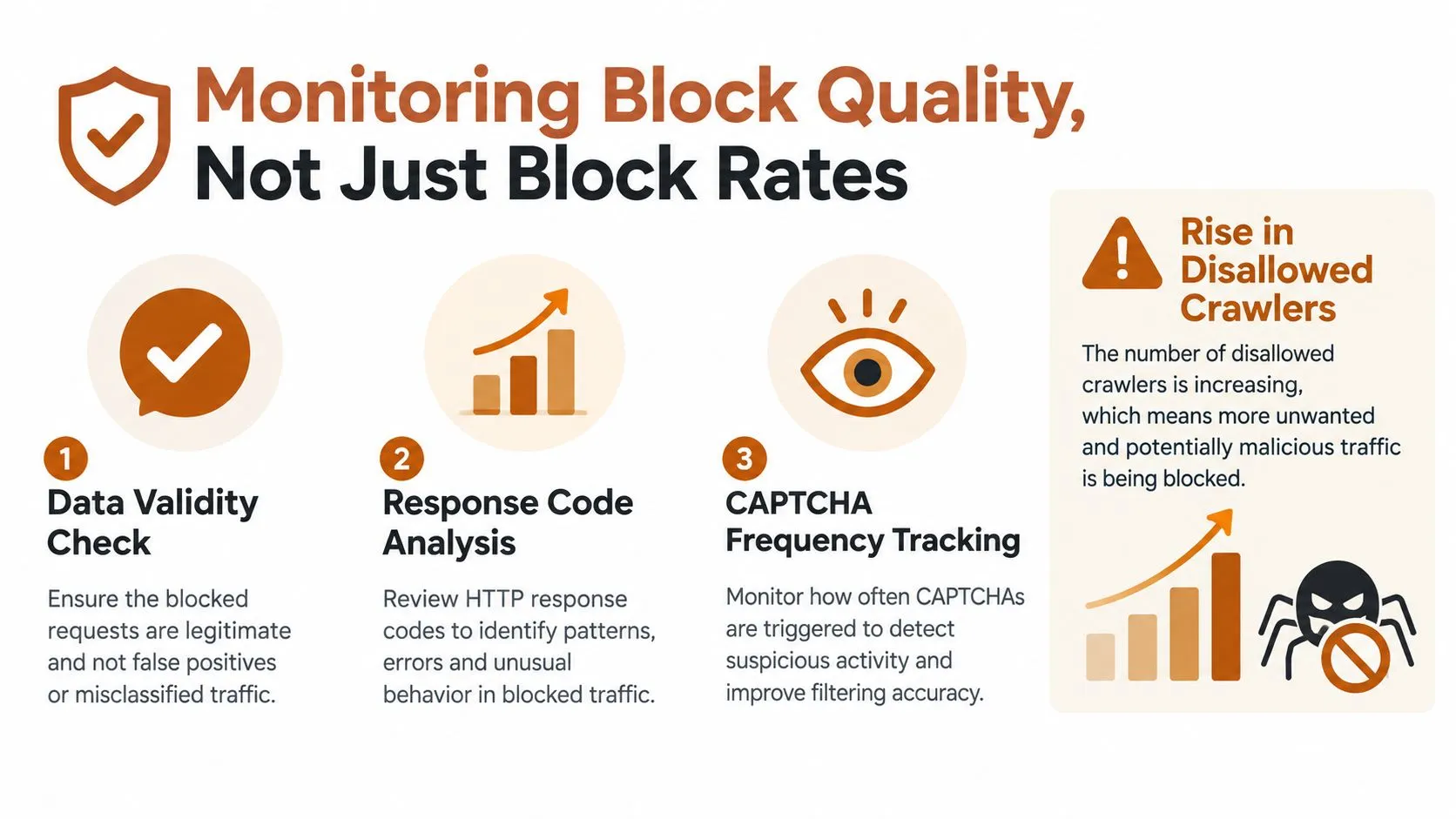
Industry reporting in 2025 described disallowed AI box scrapes rising from 3.3% in Q4 2024 to about 13% by the end of Q1 2025, with more than 26 million disallowed scrapes recorded in March alone, according to FIPP and TollBit. The operational lesson is direct: a polite, auditable pipeline protects data quality better than treating every response as an invitation to increase evasion.
Build quality gates into collection
Compare DOM and schema fingerprints between runs. Check expected record counts, required fields, field distributions, and content signatures. Flag CAPTCHA markers, interstitial templates, empty application shells, and abrupt changes in embedded structured data.
Useful controls include:
- Data validity checks: reject records missing required fields or containing challenge-page text.
- Response analysis: track status classes with content length, DOM structure, and parser yield.
- Challenge monitoring: measure CAPTCHA and interstitial frequency by hostname, path, geography, session, and job.
- Variance testing: compare equivalent requests across approved regions or devices where localized consistency matters.
Separate reporting in 2025 described AI crawler traffic rising from 2.6% of verified bot traffic in January to more than 10.1% in August, while anti-fingerprinting bots were blocked by only about 7% of observed websites. Those figures show uneven defenses, not permission to increase collection pressure. A weak defense can still return plausible, incomplete records.
Prevent silent degradation
Set thresholds that pause a queue when coverage, parser yield, schema validity, or challenge frequency leaves the accepted range. Keep raw responses or representative snapshots for investigation, version extraction logic, and alert on changes before customers discover them.
A hard 403 is visible. A gradual fall in record counts or a changed price field can contaminate downstream decisions without an immediate error. Source governance should include human review for anomalous changes, rollback procedures, and a record of which extraction version produced each delivery. These controls make block quality measurable and keep collection within an auditable operating boundary.
Legal and Ethical Baselines as a Throughput Advantage
Compliance is a routing layer, not paperwork added after engineering. Robots.txt tells the crawler which paths the publisher has identified for exclusion, while terms of service, authentication boundaries, licensing terms, privacy obligations, and regulated-data rules can impose separate constraints.
The production question is practical: what should be crawled, what should be licensed, what should be requested through an API, and what should be declined? Put those decisions into the source configuration so workers don’t improvise under pressure. A publisher that denies automated access shouldn’t be treated as a proxy-selection problem.
Measurement of self-declared bots has also exposed a clear etiquette gap. A study of 130 bots found that AI assistants and AI search crawlers had the lowest robots re-check rates, with fewer than 40% checking robots.txt within 168 hours, as described in the study’s published analysis. Policy-aware crawlers gain an operational advantage because they can prove when directives were checked, which paths were excluded, and why a request was allowed.
Use a production checklist
Before a recurring job runs, confirm:
- Authorization: The client has documented the source, fields, purpose, frequency, and permitted access route.
- Policy control: The crawler fetches and caches robots.txt, applies path-specific rules, and records policy versions.
- Request discipline: Host-level pacing, bounded concurrency, circuit breakers, and backoff control every queue.
- Consistent identity: User-Agent, session, headers, geography, and browser behavior describe one coherent client.
- Supporting infrastructure: Proxies, rendering, and APIs are selected for a defined requirement, not used to conceal excess volume.
- Quality monitoring: DOM, schema, record counts, challenge signatures, parser yield, and regional variance are checked before delivery.
- Escalation: 403 responses, CAPTCHAs, authentication barriers, policy ambiguity, and unexplained quality loss route to human review.
WebscrapingHQ offers managed web data operations, custom extraction pipelines, monitoring, retries, proxy management, and structured delivery formats for recurring workloads. That model is relevant when maintaining source-specific controls and quality checks would otherwise pull engineering teams into continuous scraper operations.
The most reliable way to avoid getting blocked is to behave like a partner the target has no operational reason to refuse. That means requesting less, identifying yourself clearly, honoring restrictions, validating every response, and stopping when the source says no.
If your team needs recurring web data without maintaining every proxy, browser, retry, and quality-control layer internally, review how WebscrapingHQ can scope and operate a monitored extraction pipeline. Share your target sources, required fields, geography, and delivery schedule so the feasibility and compliance path can be assessed before collection begins.
Want this done for you?
Send us the URLs. We'll quote it in 24 hours.
Paste the URL(s) you want scraped. We'll reply within 24 hours with a feasibility check and a ballpark quote.