Jump to section
- Why Ecommerce Scraping Stopped Being a Side Project
- The operational threshold
- What a Managed Ecommerce Scraping Pipeline Actually Does
- From URL collection to rendered page
- From HTML to a usable product record
- The Four Pillars of Data Quality in Scraped Feeds
- Schema defines the contract
- In-House Scrapers vs Managed Data Services
- Common Ecommerce Use Cases and What Good Output Looks Like
- Pricing intelligence
- Assortment and catalog monitoring
- Compliance and brand protection
- Anti-Bot Defenses and Compliance Realities in 2026
- Technical defenses
- Policy and compliance controls
- Operationalizing a Pipeline From Monitoring to Delivery
- Monitor the right signals
- Make retries explainable
- Deliver with an explicit contract
- Choosing a Service That Will Still Work Next Year
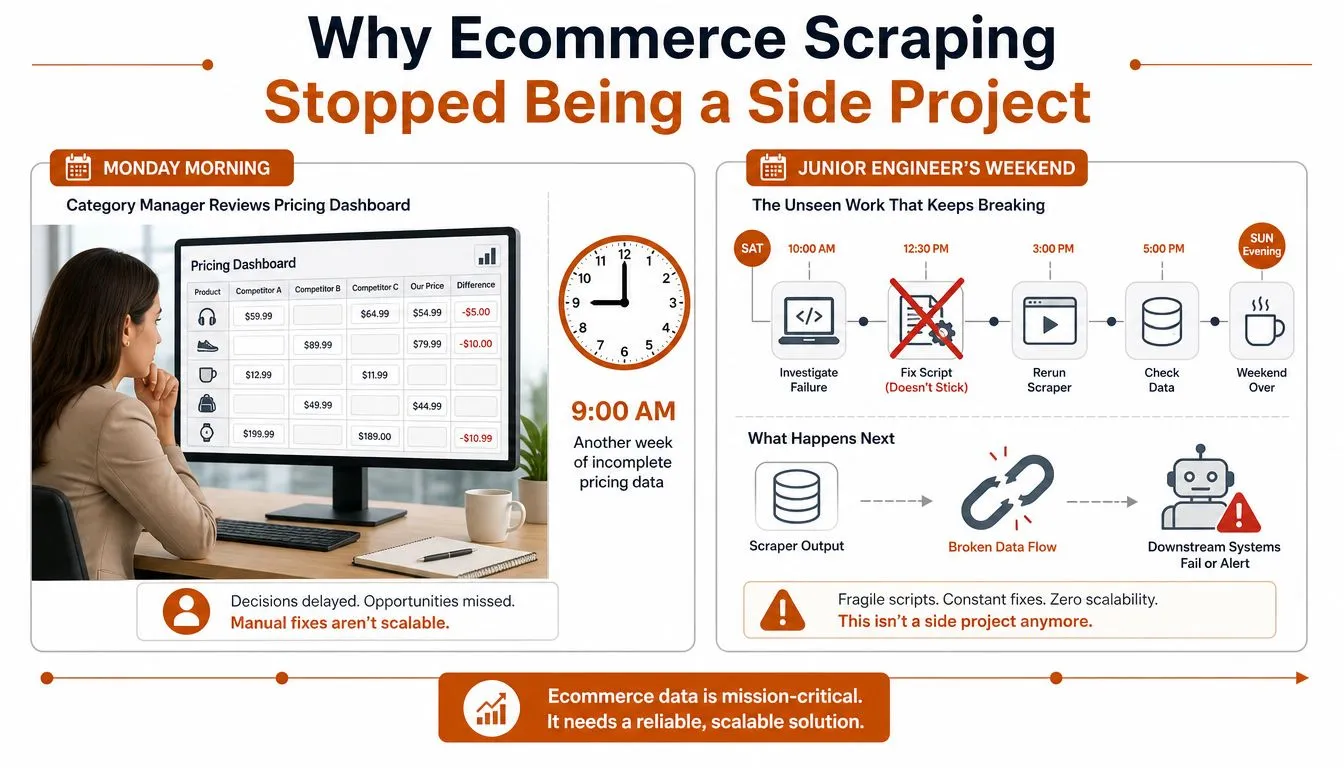
A category manager opens the pricing dashboard on Monday morning and finds half the cells blank. The retailer’s product pages still return successful responses, but the scraper is extracting empty fields because the site changed its layout over the weekend. The engineer who wrote the script is now patching selectors while pricing, assortment, and marketplace teams wait for usable data.
That situation is common because ecommerce scraping rarely fails with an obvious error. A job can return a successful page response while silently dropping prices, variants, seller details, or stock signals. Ecommerce data scraping services address that operational gap by combining extraction with schema management, validation, anti-bot handling, monitoring, and dependable delivery.
Why Ecommerce Scraping Stopped Being a Side Project
A small script can collect product pages successfully during a pilot. The problem begins when another team depends on the output every day. Pricing engines need current competitor prices, assortment teams need stable product attributes, and brand protection teams need recurring marketplace visibility. Once those workflows depend on scraped data, a broken parser becomes an infrastructure incident.
Retail sites change frequently. Product detail pages can receive new components, altered labels, client-side rendering, regional content, or experiments that affect only some visitors. A scraper may continue receiving 200 OK responses while returning null prices or confusing a sale price with the original price. The technical failure stays hidden until a downstream report looks wrong.
The market reflects this shift. Market.us values the global web scraping market at USD 754.17 million in 2024 and projects USD 2,870.33 million by 2034, with a 14.3% CAGR over that period. Retail and ecommerce represented the largest end-user vertical, with a 36.7% share in 2024. Those figures point to a category increasingly treated as recurring data infrastructure rather than occasional developer tooling.
The operational threshold
The threshold is simple: if someone makes a decision from the dataset on a schedule, the collection process needs operational ownership. That means somebody must know:
- Whether sources responded: A reachable page isn’t proof that the required fields were present.
- Whether the schema still matches: A redesign can preserve URLs while changing the structure beneath them.
- Whether records are complete: Missing products and partial listings can distort competitive comparisons.
- Whether delivery happened on time: A correct feed delivered after a pricing decision may have little value.
A weekend script can still be useful for discovery or a narrow experiment. It becomes fragile when the team expects it to support multiple markets, retailers, refresh schedules, and business systems without a named maintenance process. The difference between a script and a service is not merely hosting. It is the presence of monitoring, ownership, recovery procedures, and an agreed definition of usable data.
For a practical comparison of that ownership model, see this guide on choosing web scraping services instead of managing scraping alone. The important question isn’t whether a team can extract a page today. It’s whether the team can explain what happened when tomorrow’s feed is incomplete.
What a Managed Ecommerce Scraping Pipeline Actually Does
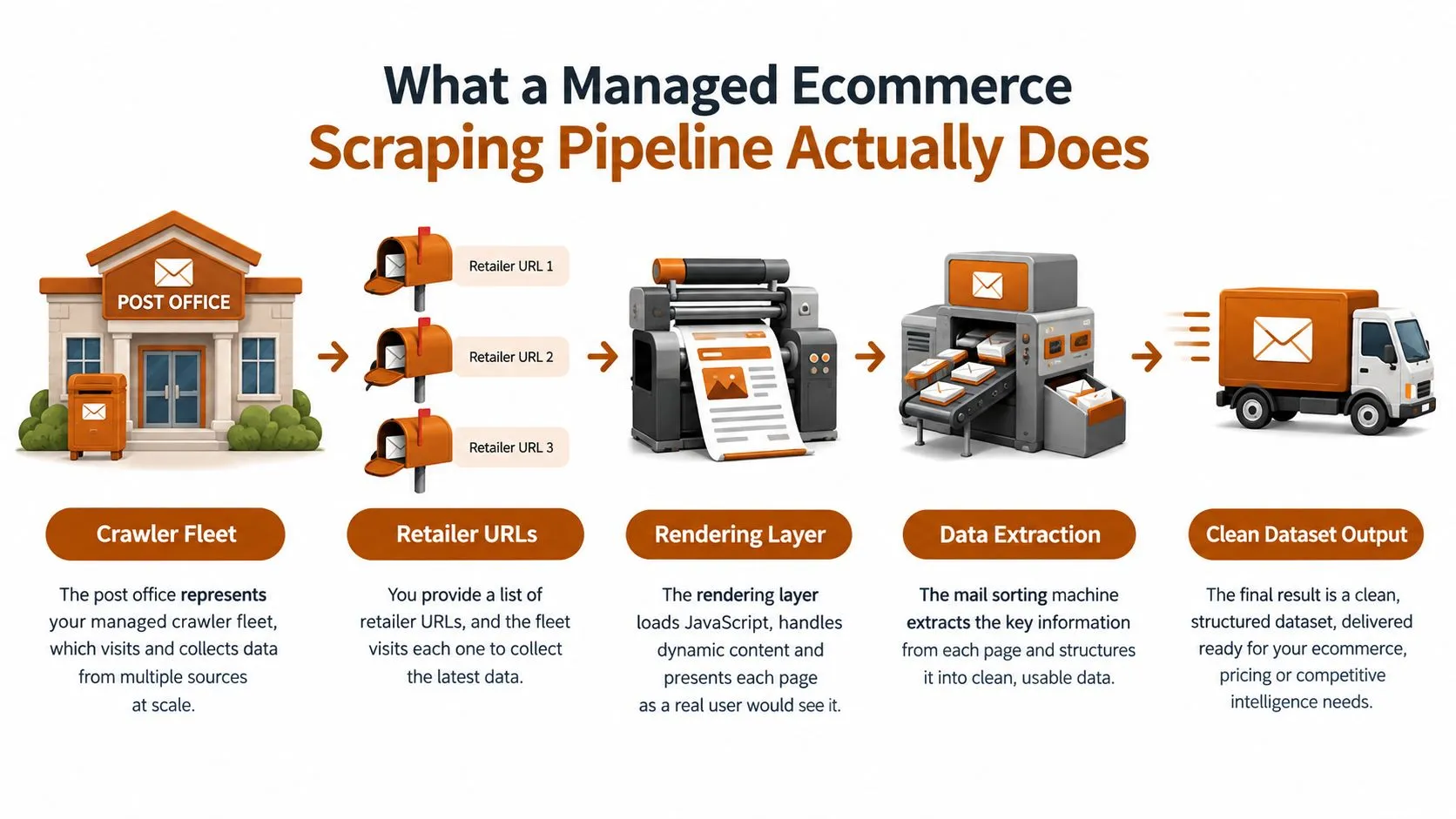
A managed pipeline resembles a postal network more than a single crawler. Retailer URLs are the addresses, crawlers are the delivery routes, parsing is the sorting process, and the final dataset is the mail that reaches the right department in a usable form.
From URL collection to rendered page
The crawler fleet visits product, search, category, and marketplace URLs according to a schedule. A rendering layer handles pages whose meaningful content appears only after JavaScript runs. Without rendering, the response may contain a shell of the page but not the price, availability, variants, or reviews a buyer needs.
Anti-bot handling operates between collection and rendering. Proxy and session management can route requests through appropriate paths, while browser isolation and request controls help separate one source from another. A mature service also records failures rather than treating every blocked request as an ordinary missing product.
The industry benchmark described by AIMultiple’s ecommerce scraper research tested product and search pages specifically because defenses tend to concentrate on those surfaces, not homepages. That distinction matters. A provider that validates only a retailer’s homepage can report healthy access while the exact SKU and listing pages needed for pricing intelligence remain blocked.
From HTML to a usable product record
Extraction converts page content into fields such as:
- Identity: Product title, retailer SKU, marketplace identifier, brand, and variant.
- Commercial data: Current price, original price, promotion state, currency, and seller.
- Availability: Stock status, quantity where publicly exposed, delivery information, and pickup state.
- Evidence: Source URL, collection timestamp, images, ratings, and review counts.
Schema mapping then translates retailer-specific labels into a canonical model. One site may call a field sale_price, another may use currentPrice, and a marketplace may expose several seller offers under a nested structure. The output should give downstream users one consistent representation without forcing every analyst to write a new transformation.
Validation checks the resulting records. A row with no price, an invalid currency, a duplicate identifier, or a broken image URL can be rejected, quarantined, or marked with a quality status. The clean records then move through a delivery layer such as an S3 drop, Snowflake table, REST endpoint, webhook, or scheduled CSV or JSON file.
Teams building marketplace workflows may also find a focused resource on Amazon seller data automation useful when seller-level information must enter an operational data layer. For broader pricing workflows, ecommerce price monitoring shows why recurring collection needs more than a page fetch.
Skipping any stage creates a predictable problem. Without rendering, fields disappear. Without schema mapping, every consumer interprets the data differently. Without validation, bad rows spread. Without delivery controls, a technically correct dataset still arrives too late or in a format nobody can use.
The Four Pillars of Data Quality in Scraped Feeds
Raw extraction tells you what a parser found. Production data operations must also tell you what the record means, whether it changed shape, whether it passed checks, and where it came from. Four controls provide that foundation: schema, versioning, validation, and lineage.
Schema defines the contract
A canonical product schema gives every downstream consumer the same field expectations. It can define how the system represents price, currency, availability, category, seller, variant, and source metadata. The schema should also define controlled vocabularies, such as whether availability uses in_stock, out_of_stock, and unknown, rather than allowing each retailer’s wording to pass through.
Versioning protects consumers from silent changes. If a redesign requires a new field structure, the pipeline should publish a new schema version and communicate the change. A pricing model built against one product representation shouldn’t receive a different representation without a documented migration path.
Validation works at row and field level. Typical rules can require a non-null price where a product is purchasable, a recognized currency code, a numeric stock count when supplied, and a parseable product identifier. Failed rows should be quarantined with an error reason instead of contaminating the main feed. Teams looking to formalize those checks can use this guide to data validation as a reference point.
Lineage records the source URL, collection timestamp, extractor or parser version, run identifier, and relevant transformation history. When a price seems wrong, an analyst can trace the record back to the evidence rather than debating which system changed it.
| Pillar | What it controls | Failure it prevents | Decision it protects |
|---|---|---|---|
| Schema | Field names, types, and allowed values | Inconsistent interpretation across consumers | Pricing and catalog accuracy |
| Versioning | Controlled changes to the data contract | Silent breaking changes after redesigns | Model and dashboard stability |
| Validation | Row-level and field-level acceptance rules | Invalid, incomplete, or duplicate records | Alert fidelity and operational decisions |
| Lineage | Source, timestamp, parser, and run history | Untraceable anomalies | Trust and auditability |
These pillars protect different risks. Schema makes records comparable, versioning makes change visible, validation stops defective rows, and lineage makes investigation possible. A service that advertises structured output but cannot explain those four controls may still be handing the buyer raw extraction with better packaging.
In-House Scrapers vs Managed Data Services
The in-house option often looks inexpensive at the beginning. Open-source libraries can handle an initial target, and a developer can produce a working prototype quickly. The full cost appears later, when the team must maintain selectors, rendering, proxy capacity, storage, schedules, alerts, and fixes for every source that changes.
A managed provider moves that operational burden outside the buyer’s product team. The buyer still needs to define sources, fields, refresh expectations, and acceptable collection practices, but the provider operates the collection layer and maintains the delivery path.
| Criterion | In-House Scrapers | Managed Data Services |
|---|---|---|
| Cost | Lower apparent entry cost, with engineering and infrastructure ownership | Service cost includes operations, maintenance, and delivery work |
| Reliability | Depends on internal monitoring and response capacity | Usually supported by provider monitoring, recovery processes, and agreed service terms |
| Coverage | Often starts with a small set of known sites | Can extend across more domains, markets, and page types |
| Speed | Requires design, implementation, testing, and ongoing fixes | Existing infrastructure can shorten the path to recurring delivery |
| Control | Maximum control over code, timing, and transformations | Shared control within the provider’s supported model |
| Team fit | Suitable for narrow pilots and engineering-led products | Suitable when data must flow without becoming another product to maintain |
The right choice depends on the operating model, not on ideology. In-house collection can work when the scope is narrow, the engineering team wants ownership, and downtime has limited consequences. Managed services become more practical when multiple departments need consistent output and nobody wants to staff a permanent scraper maintenance function.
A useful comparison of automated and manual data extraction costs should include more than request pricing. Count the hours spent diagnosing silent failures, rebuilding historical data, reviewing incomplete feeds, and adapting internal systems after a schema change.
Common Ecommerce Use Cases and What Good Output Looks Like
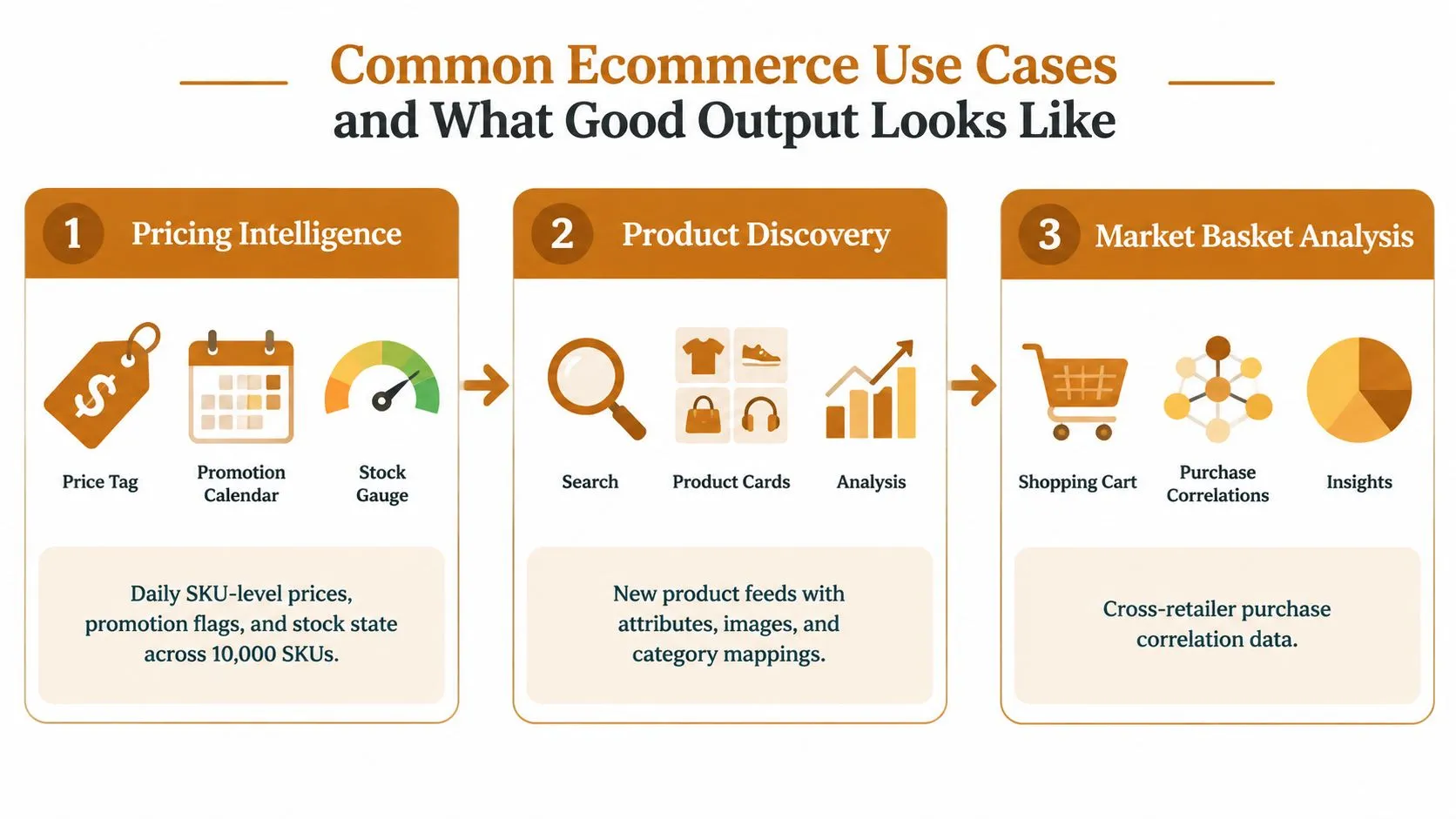
The best way to evaluate a scraping service is to start with the decision, then define the data required to make it. A price feed, an assortment feed, and a brand protection feed may all begin with product pages, but they need different fields, quality checks, and delivery behavior.
Pricing intelligence
A pricing team needs comparable observations, not a collection of screenshots. A useful record can include retailer, product identifier, variant, current price, reference price, promotion flag, currency, availability, source URL, and collection timestamp. Currency normalization and consistent variant mapping prevent analysts from comparing different pack sizes or regional offers as if they were identical.
The quality process should check that expected products were visited, prices are parseable, currencies are recognized, and sudden field loss is flagged. Delivery can feed a pricing engine, warehouse, or dashboard without requiring each consumer to write retailer-specific parsing logic.
For teams developing a broader competitive process, this guide to tracking competitor pricing strategies provides useful context for connecting observations to pricing decisions. The service itself should still document freshness, source coverage, and exception handling.
Assortment and catalog monitoring
Catalog teams care about what exists, what changed, and how completely each item is described. Their schema may include taxonomy path, brand, title, attributes, images, variant relationships, availability, and first-seen or last-seen timestamps. Change detection can identify new products, removed listings, altered descriptions, and meaningful attribute changes.
A strong feed makes missing attributes visible instead of hiding an incomplete product. It can also preserve the source evidence needed to review a newly discovered listing before it enters a master catalog or product discovery workflow.
Compliance and brand protection
Brand teams need marketplace context. A listing record may require seller identity, product identifier, displayed price, review count, rating, offer details, source URL, and collection time. The output should distinguish sellers and offers rather than collapsing every marketplace result into one product row.
Validation should identify duplicate listings, missing seller fields, and inconsistent product matching. Lineage matters especially here because an alert may require a reviewer to verify the exact listing that triggered it. Once approved, the feed can enter an investigation queue, a reporting workflow, or an internal compliance system.
Good output has the same defining properties across all three cases: clear fields, predictable refreshes, visible exceptions, and traceable evidence. Buyers should ask for sample records and failure examples, not only a successful demo.
Anti-Bot Defenses and Compliance Realities in 2026
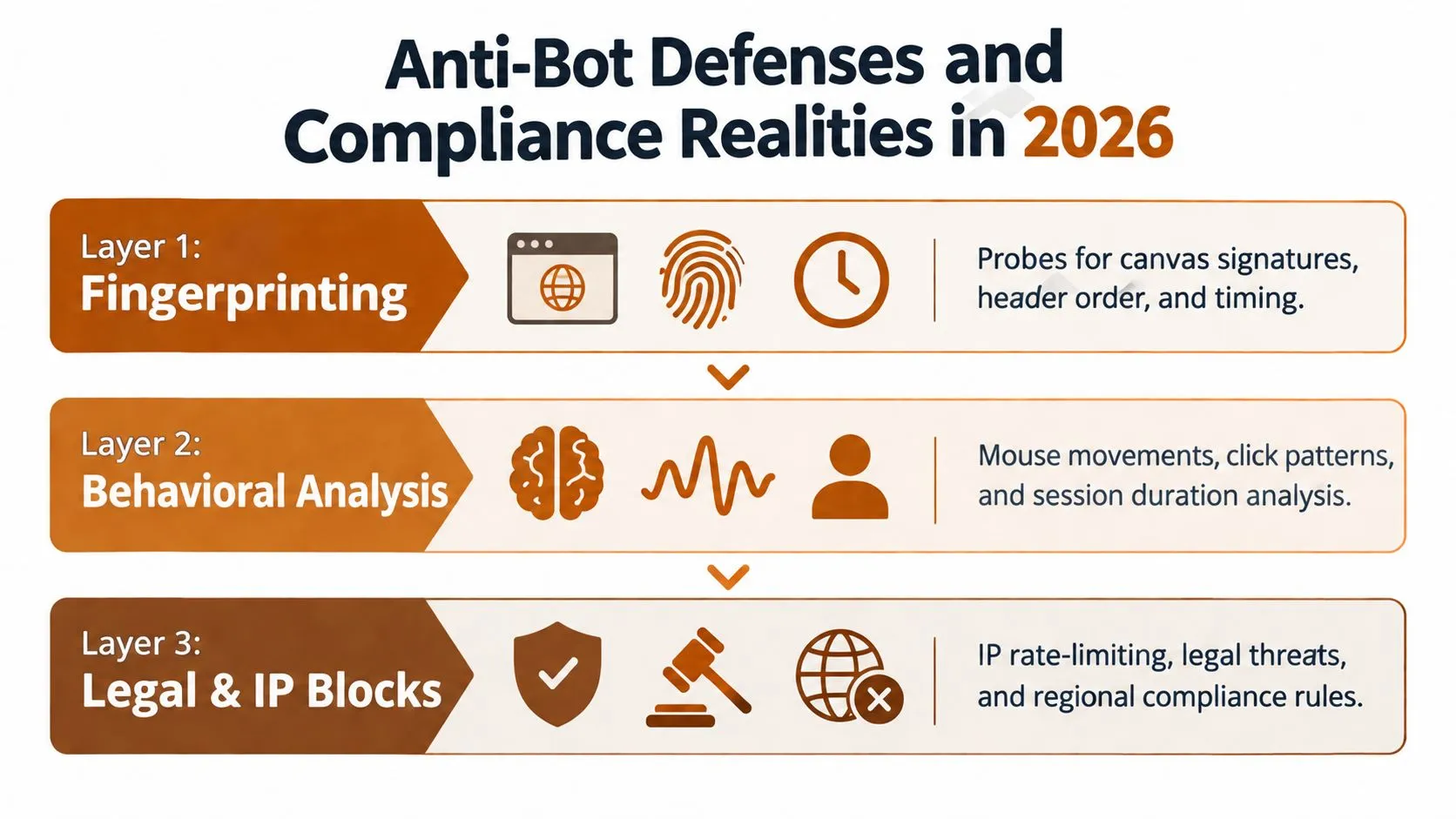
A scraper isn’t operating in a neutral environment. Retailers may use browser fingerprinting, behavioral analysis, rate controls, JavaScript challenges, regional restrictions, or contractual rules that affect what a collection system can access and how it should operate.
Technical defenses
Fingerprinting looks for signals that distinguish automated traffic from ordinary browsing. Those signals can include browser characteristics, header ordering, rendering behavior, and timing patterns. Behavioral systems may examine navigation sequences, clicks, scrolling, and session duration rather than evaluating one request in isolation.
A mature provider responds with controlled browser environments, session management, proxy diversity, request pacing, and ongoing source-specific testing. The objective isn’t to scrape indiscriminately. It is to collect permitted public data with a design that can recognize blocks, stop unsafe behavior, and preserve an audit trail.
Independent benchmark reporting defines ecommerce scraping success as the share of requests that return complete structured data without 403 or 429 errors, CAPTCHAs, or partial blocks. Bright Data’s benchmark summary reports that the strongest tested provider reached a 98.44% average success rate across 11 providers. The metric is useful only when buyers confirm that the test covers the product and search surfaces they need.
Policy and compliance controls
Technical access doesn’t settle the compliance question. Collection plans should define the public sources in scope, review terms of service and robots.txt, minimize personal data, document regional considerations, and establish a process for policy changes. A provider should be able to explain what it won’t collect, how it handles restricted areas, and how it records decisions.
Contemporary guidance on ecommerce scraping compliance is most useful when treated as an operating checklist rather than a legal guarantee. Rules and platform policies can change, so buyers should involve appropriate legal and privacy reviewers for their use case.
Practical rule: The strongest service isn’t the one that pushes through every defense. It’s the one that combines resilient collection, clear limits, data minimization, and auditable decisions.
Operationalizing a Pipeline From Monitoring to Delivery
A working scraper becomes a dependable data product only after the team adds operational controls. Start with source health checks, then measure each run, inspect the fields that matter, and route failures to someone who can act.
Monitor the right signals
A source health check should confirm more than reachability. It should test representative product and search URLs, response completeness, expected content markers, and recent schema behavior. Run-level monitoring can record requested URLs, successful records, blocked responses, retries, duplicates, rejected rows, and delivered rows.
Field-level checks catch silent breakage. Alert when prices disappear, identifiers duplicate, availability becomes unknown across an unusual portion of the feed, or a required attribute falls below the agreed quality threshold. Those rules should be specific to the use case. A missing review count may be tolerable in a price feed, while a missing price is not.
Make retries explainable
Retry logic should distinguish transient failures from hard blocks. A temporary server response may justify a controlled retry, while repeated authorization failures, CAPTCHA responses, or policy restrictions may require the system to stop and escalate. Blind retries waste capacity and can worsen access problems.
Every alert should carry enough context for an operator to investigate:
- Source and surface: Retailer, domain, product or search path, and affected market.
- Failure mode: Timeout, block, parser mismatch, validation failure, or delivery error.
- Run evidence: Last successful run, current row counts, rejected records, and sample errors.
- Ownership: On-call recipient, escalation path, and expected response process.
A notification at night is useful only if it helps the recipient decide what to do next. “Scraper failed” creates another investigation. “Product pages returned records, but the price field is missing in the latest run” gives the operator a starting point.
Deliver with an explicit contract
Delivery should match the consumer. Scheduled CSV, JSON, or Parquet files may suit an analytics team, while a REST endpoint or webhook may fit an application workflow. S3 drops, warehouse tables, and dashboards can coexist if each has documented ownership and access controls.
The delivery contract should define freshness, schema version, file naming, row counts, failure behavior, retention, and authentication. Audit logs and run-level metadata let consumers distinguish “no products found” from “the collection job did not run.” That distinction prevents empty output from being mistaken for a genuine market signal.
Choosing a Service That Will Still Work Next Year
Vendor selection should focus on adaptability rather than the lowest price per record. Ask for the provider’s schema versioning policy, quality reports, source-change process, collection boundaries, proxy and session approach, and escalation model.
Request sample files across different product categories. Inspect field completeness, units, timestamps, variant handling, duplicate behavior, and source lineage. Then read the SLA, changelog, and support terms. Those documents reveal more about operational maturity than a polished demonstration.
| Criterion | What to Look For |
|---|---|
| Schema management | Version identifiers, migration notices, and custom field support |
| Quality controls | Field validation, quarantine behavior, row counts, and exception reports |
| Resilience | Monitoring, retries, source-change detection, and anti-bot response |
| Compliance | Defined public-data scope, policy review, privacy controls, and audit logs |
| Delivery | CSV, JSON, Parquet, API, webhook, warehouse, or S3 options with freshness terms |
| Support | Named escalation path, response expectations, and operational ownership |
| Exit terms | Access to historical data, mappings, documentation, and clean handover rights |
The durable choice is the provider that treats extraction as a managed data operation. WebscrapingHQ, for example, offers custom extraction pipelines with structured CSV and JSON feeds, webhooks, S3 delivery, monitoring, retries, proxy management, and recurring schedules. Evaluate those capabilities against your required sources, fields, compliance scope, and service terms rather than accepting them as a substitute for due diligence.
Buyer’s test: Ask what happens when a target site changes its product page at an inconvenient time. The answer should include detection, ownership, communication, recovery, and evidence.
WebscrapingHQ can design and operate recurring ecommerce data pipelines with structured schemas, quality controls, monitoring, and delivery formats aligned to your downstream systems. Visit WebscrapingHQ to discuss the sources, fields, refresh schedule, and operational requirements your team needs.
Want this done for you?
Send us the URLs. We'll quote it in 24 hours.
Paste the URL(s) you want scraped. We'll reply within 24 hours with a feasibility check and a ballpark quote.