
Jump to section
- Scoping Your eBay Data Extraction Project
- Turn requirements into an operating brief
- Identifying and Targeting eBay Product Data
- Inspect the page as a data model
- Build for change instead of hiding it
- Handling Pagination and Extracting Full Datasets
- Separate discovery from detail extraction
- Pagination is more than a next button
- Navigating Anti-Bot Measures and Proxies
- Match infrastructure to the access pattern
- Rate limits protect the pipeline
- Extracting Complex Data Like Images and Reviews
- Choose rendering or request inspection
- Preserve provenance and quality
- Structuring Data and Legal Considerations
- Make the schema durable
- Treat compliance as an operating requirement
Your team needs a dependable view of eBay listings, but the first test run only captures part of the catalog. Prices appear in inconsistent formats, seller details move between page elements, reviews load after the initial HTML, and a layout change turns yesterday’s working scraper into an empty dataset. That’s the practical difference between collecting web data once and operating a reliable extraction pipeline.
Web data extraction services address the operational layer around collection. A provider can scope the fields, handle browser rendering and proxy requirements, monitor changes, validate records, and deliver structured outputs on a schedule. That model matters as demand shifts toward recurring enterprise pipelines. One 2026 market report valued the web scraping market at US$1.56 billion in 2026 and projected it to reach US$3.49 billion by 2031, implying a 17.39% CAGR, driven by recurring enterprise demand (Mordor Intelligence market estimate).
Scoping Your eBay Data Extraction Project
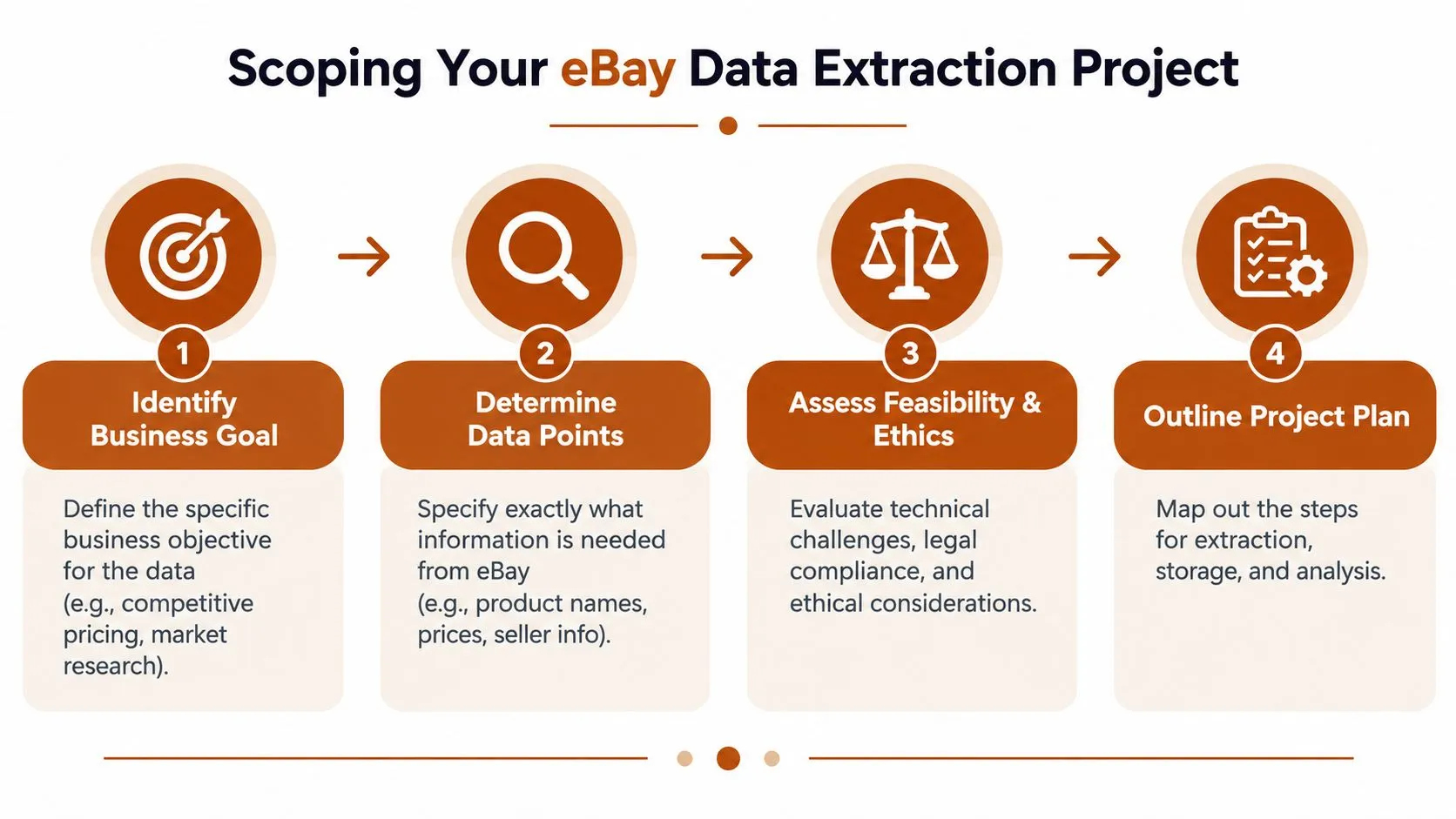
Before opening a developer console, define the business decision the dataset must support. An eBay extraction project might feed competitive price intelligence, identify fast-moving categories, monitor seller positioning, support market research, or supply product signals to an analytics or machine learning workflow. Each use case requires a different schema, collection cadence, and tolerance for missing records.
Start with the output, not the crawler. Write down the fields that must be present in every usable record:
- Product identity: Capture the listing title, item identifier, category, condition, and variant details.
- Commercial terms: Separate item price, shipping cost, currency, discounts, and availability rather than combining them into one text field.
- Seller information: Decide whether seller name, feedback indicators, seller rating, and location are required.
- Market signals: Include review counts, watchers where publicly exposed, listing format, and other attributes only when they serve a defined analysis.
- Evidence and timing: Store the source URL, collection timestamp, locale, and schema version so downstream users can interpret the record.
Refresh frequency determines architecture. A weekly category snapshot may work with a straightforward scheduled crawl. Price monitoring may require more frequent checks, while an AI training pipeline needs repeatable collection, stable field definitions, deduplication, and documented changes. Don’t promise hourly freshness before confirming that the target pages, geography, volume, and compliance requirements support it.
Turn requirements into an operating brief
A useful brief answers five questions:
- What decision will the data change? If nobody can name the decision, the project probably needs narrower scope.
- Which eBay surfaces matter? Search results, category pages, product pages, seller pages, and review interfaces expose different fields.
- What counts as a valid record? Define required fields, acceptable nulls, currency handling, and duplicate rules.
- How often must the data arrive? Match cadence to business value rather than choosing the fastest possible schedule.
- Who owns exceptions? Assign responsibility for failed pages, changed fields, blocked sessions, and questionable records.
A professional feasibility review should also examine permitted access, public availability, regional variation, and whether the collection approach respects eBay’s policies. Teams comparing internal development with outsourcing may benefit from this practical discussion of why managed web scraping services can replace DIY maintenance.
For teams collecting product signals to inform iterative ad creative workflows, the schema should preserve the attributes that creative and merchandising teams use, such as product positioning, visible imagery, price context, and category language. Scope decisions made here prevent a common failure: building a technically impressive crawler that produces data nobody can confidently use.
Identifying and Targeting eBay Product Data
A reliable eBay scraper starts with inspection. Open a representative listing in a browser, launch developer tools, and inspect the elements that contain the title, price, seller information, shipping text, images, and reviews. Don’t assume that the first visible text node is the canonical value. eBay pages can contain repeated labels, hidden templates, accessibility text, and region-specific variations.
Some current eBay layouts expose selectors such as h1.x-item-title__main-title for the product title and div.x-price-primary > span.ux-textspans for the primary price. These selectors can be useful starting points, but production code shouldn’t treat a class name as a permanent contract. Confirm the selector against several listing types and locales before building the parser around it.

Inspect the page as a data model
Map each field to a collection strategy:
- Title: Prefer a specific heading selector, then validate that the extracted text isn’t empty or duplicated elsewhere.
- Price: Capture the numeric value and currency separately when possible. Preserve the displayed string as evidence because sale pricing and regional formatting can complicate normalization.
- Shipping: Treat shipping as its own field. It may appear beside the price, in a delivery panel, or behind a dynamically rendered component.
- Seller details: Look for stable semantic attributes, labels, or structured metadata rather than selecting the nearest text around a seller heading.
- Images: Collect the source URL and retain an image position or role, such as primary, gallery, or thumbnail.
- Reviews: Record whether the value came from initial HTML, rendered DOM, or a secondary request.
Stable attributes, including data-testid, meaningful IDs, semantic labels, and structured metadata, generally make better anchors than long chains of generated classes. A selector like div.x-price-primary > span.ux-textspans may work today, but a parser should also include fallback logic, field-level validation, and alerts when the expected element disappears.
Build for change instead of hiding it
A scraper shouldn’t return blank strings after a layout update unannounced. Add checks that flag missing titles, malformed prices, unexpected currencies, duplicate item identifiers, and sudden shifts in record shape. Store a small sample of raw HTML or rendered evidence according to your governance policy, so an engineer can diagnose a failure without guessing what the page looked like.
The eBay product scraping guide for finding high-converting products is useful for understanding the relationship between page selection and commercial analysis. In production, though, extraction quality depends less on one clever selector than on a maintained field map, test fixtures, change detection, and clear rules for when a record is rejected.
Practical rule: A parser that fails loudly is safer than one that returns plausible-looking blanks.
Handling Pagination and Extracting Full Datasets
A single eBay product page proves very little. The business dataset usually begins with a search or category surface, continues through multiple result pages, and then requires a second pass over individual listings. That two-stage pattern separates discovery from enrichment and makes the workflow easier to retry.
Consider a category monitoring job. The first request loads a search results page, extracts listing URLs and lightweight identifiers, and records the page context. The crawler then follows the next-page control, such as a.pagination__next, until the control is missing, inactive, or points to a page already visited. Every discovered URL goes into a queue rather than being processed immediately inside the pagination loop.

Separate discovery from detail extraction
The discovery stage should collect enough context to explain where each listing came from:
- Canonical URL: Normalize tracking parameters and preserve the page URL used for collection.
- Item identifier: Use a stable listing identifier when available to deduplicate the queue.
- Search context: Store the query, category, filters, locale, and collection timestamp.
- Lightweight fields: Keep visible title, price, and position if those fields support ranking or audit work.
The detail stage visits each unique product URL and extracts the deeper schema. It should run independently from pagination because a single failed product page shouldn’t force the crawler to restart the entire category. Queue states such as pending, successful, retryable, rejected, and permanently failed make the run observable.
Pagination is more than a next button
Result pages can change because listings end, filters alter the available set, or the site presents different layouts by market and device. A well-designed loop needs termination conditions beyond “the button exists.” Stop when the next URL repeats, the page returns no new identifiers, the response is invalid, or the project’s defined scope has been reached.
Infinite scrolling introduces a different control problem because the browser may load more results without changing the URL. Teams handling that pattern should understand the distinction between DOM growth, network requests, and duplicate cards. The Playwright guide to scraping infinite scroll provides relevant implementation context, but the production requirement remains the same: prove that every expected segment was visited and that the final dataset has no unexplained gaps.
Retries should be narrow and deliberate. Retry transient rendering failures, timeouts, and temporary access errors, but don’t repeatedly hammer a page that consistently violates validation rules. Store run metadata, compare record counts with prior runs qualitatively, and route anomalies to review instead of presenting an incomplete export as a complete market view.
Navigating Anti-Bot Measures and Proxies
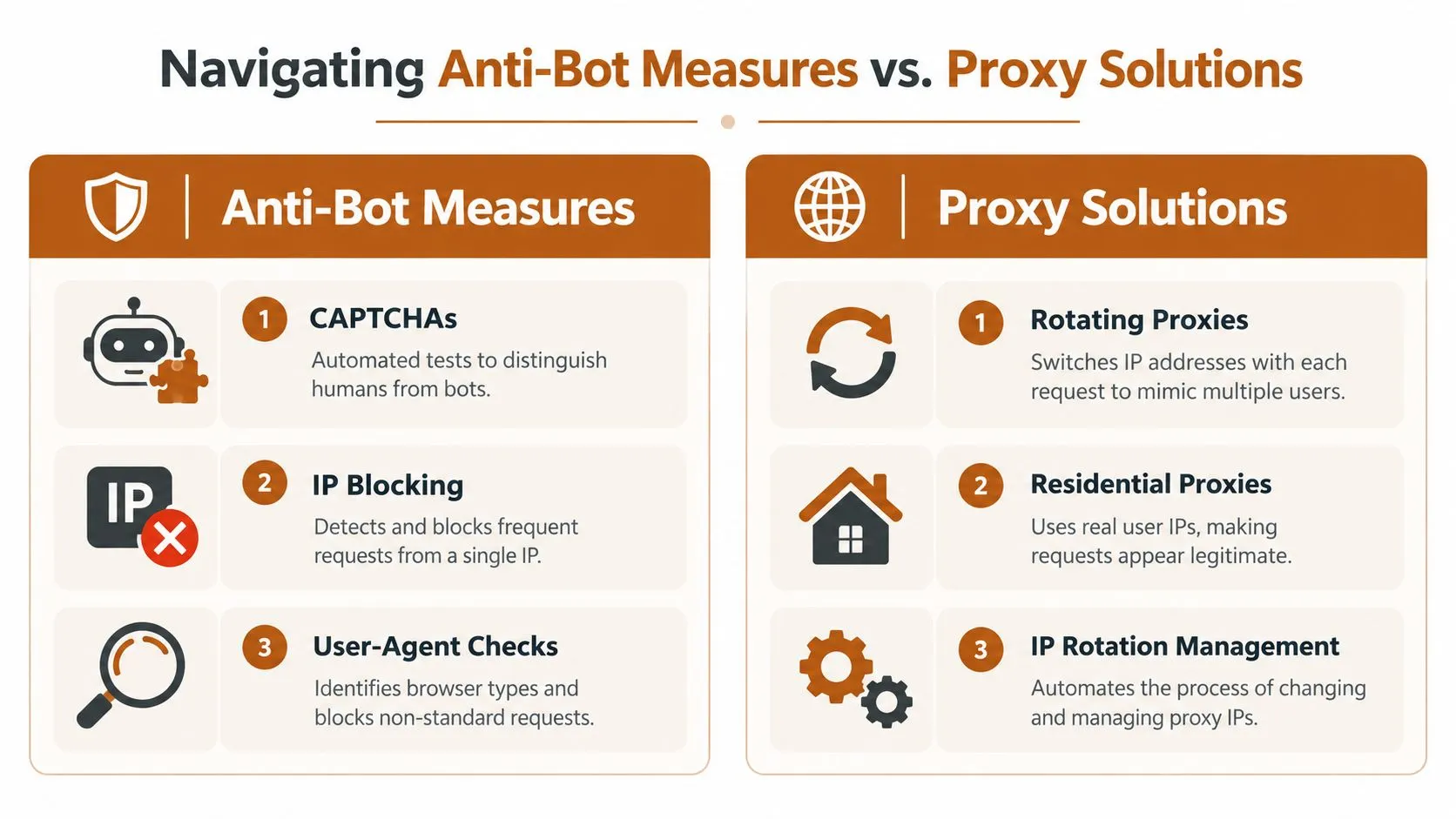
Large-scale collection fails when the request pattern looks unlike ordinary browsing or when the crawler ignores the target’s access controls. Common symptoms include CAPTCHAs, blocked sessions, incomplete HTML, redirected pages, and responses that contain a challenge instead of product data. These failures aren’t solved by adding more threads. More concurrency can make the traffic pattern easier to detect and harder to recover.
Match infrastructure to the access pattern
A proxy changes the network path between the collector and the site, but proxy selection isn’t a universal bypass. Each class has different operational characteristics:
| Proxy type | Practical strength | Main trade-off |
|---|---|---|
| Datacenter | Consistent and often suitable for controlled, lower-risk workloads | Concentrated address ranges may be easier for defenses to classify |
| Residential | Traffic can resemble requests from consumer networks | Quality, consent, geography, and cost require careful provider review |
| Mobile | Useful when a workflow genuinely needs mobile-network characteristics | Availability and operational control can be more difficult |
| Rotating pools | Distributes requests across addresses and locations | Rotation without session logic can create inconsistent browsing behavior |
Use the least complex setup that meets the project’s legitimate requirements. A rotating pool won’t fix poor parsing, excessive concurrency, missing cookies, or a workflow that opens product pages without first establishing the expected navigation context. It can also create data consistency problems if a session changes geography or currency between requests.
Rate limits protect the pipeline
A dependable crawler schedules work. It spaces requests, caps concurrent browser sessions, reuses a session where continuity matters, and applies backoff after errors. User-Agent values should accurately represent the client behavior and remain consistent with the rendering stack. Randomly changing headers without matching browser characteristics can make a request look less credible, not more.
Add explicit controls for:
- Request pacing: Use bounded delays and adaptive backoff rather than unrestrained loops.
- Session continuity: Keep related requests within a coherent session when the page flow requires it.
- Challenge detection: Classify CAPTCHA or block pages before sending their content to the parser.
- Failure budgets: Stop or pause a job when access errors cross a defined threshold.
- Regional consistency: Keep locale, currency, language, and proxy geography aligned with the intended dataset.
A proxy is an operational component, not a substitute for permission, planning, or monitoring.
The build-versus-buy decision becomes clearer at this point. An internal team can assemble proxy routing, browser automation, retries, and alerts, but it also owns every future change and incident. Recent industry coverage describes a shift toward managed infrastructure because it reduces breakage and detection risk, while placing the primary decision around operational ownership, service levels, and maintenance cost (Browserless analysis of web scraping in 2026).
For teams evaluating vendors, compare the quality of their proxy server options for web scraping, but also ask how they detect blocked responses, document consent and compliance, isolate customer sessions, and communicate degraded collection. A proxy vendor may provide connectivity. A managed extraction provider should own the complete data path, including validation and recovery.
Extracting Complex Data Like Images and Reviews
Images and reviews expose the difference between visible content and source content. A basic HTTP client may receive HTML containing a placeholder, a thumbnail, or a component shell while the browser later retrieves the actual image variants and review data. If the parser only reads the first response, the dataset can look complete while missing the information users see.
For images, inspect the markup for source sets, structured metadata, lazy-loading attributes, and gallery identifiers. Where the page supplies multiple resolutions, select the appropriate source deliberately rather than blindly taking the first URL. A high-resolution asset may have a different path or query parameter from the thumbnail, but URL transformations should be verified against observed page behavior rather than assumed.
Choose rendering or request inspection
A headless browser such as Playwright is the straightforward option when the page builds content through JavaScript. Let the page render, wait for the relevant component, and extract from the resulting DOM. This method follows the user-visible path, but it consumes more resources and can introduce timing failures if the workflow relies on arbitrary sleep intervals.
Network inspection can be more efficient when a page requests structured data after load. In browser developer tools, filter requests by Fetch or XHR, reload the page, and identify calls associated with reviews or gallery data. Examine the response schema, required parameters, pagination behavior, and authorization assumptions before deciding whether a direct request is appropriate.
The two methods serve different needs:
- Rendered extraction: Better when content depends on browser state, interaction, or visual layout.
- Request-level extraction: Better when the page exposes a stable, structured response and the access pattern is permitted.
- Hybrid extraction: Useful when product fields come from HTML but reviews or image metadata arrive through separate requests.
Preserve provenance and quality
Don’t flatten reviews into one text field if downstream users need rating, title, body, author display name, date, variant, or helpfulness context. Keep the collection timestamp and source relationship so an analyst can distinguish a current review count from an individual review record. For images, store source URL, resolved URL, dimensions where available, and a stable association with the listing.
The guide to scraping images from websites offers useful background on image URL handling. In an enterprise pipeline, image extraction also needs deduplication, content-type validation, failed-download retries, and rules for retaining or discarding assets.
A common mistake is treating rendered output as automatically correct. Browser automation can faithfully reproduce a page that contains a consent prompt, a login wall, a challenge page, or an empty state. Validate the content before accepting it, and send uncertain records to an exception queue.
Structuring Data and Legal Considerations
Extraction is only one stage of the service. A useful eBay dataset must have a defined schema, consistent types, clear provenance, validation rules, and a delivery method that fits the receiving system. CSV works well for spreadsheet review and simple imports, while JSON suits application workflows and nested records. Direct database, object storage, webhook, or API delivery can reduce manual handling when a downstream platform consumes recurring updates.
Make the schema durable
Use explicit field names and types. Store prices as normalized numeric values with currency, retain the original display text when auditability matters, and represent missing values consistently. Separate product, seller, offer, image, and review entities when their refresh behavior or cardinality differs.
Schema governance should include:
- Versioning: Record when a field is added, renamed, deprecated, or reinterpreted.
- Validation: Reject malformed prices, impossible identifiers, empty required fields, and unexpected data types.
- Deduplication: Define whether identity depends on listing ID, canonical URL, product attributes, or a combination.
- Delivery controls: Use manifests, checksums, run status, and failure reports so consumers know what arrived.
- Retention rules: Decide how long raw pages, images, reviews, and derived records remain available.
Demand is increasingly moving toward AI-era pipelines where the question isn’t merely whether a team can scrape a page, but whether it can deliver governed, schema-stable, refreshable datasets at scale. That shift makes quality controls and reliable delivery cadences central to machine learning workflows (AI-era web scraping market analysis).
Treat compliance as an operating requirement
Review eBay’s Terms of Service, applicable privacy rules, copyright restrictions, and the purpose of the collection before launch. Public visibility doesn’t automatically grant unrestricted commercial rights. Respect robots.txt as an important signal of site preferences, avoid collecting unnecessary personal information, and document the lawful and ethical basis for the fields you retain.
Controls should be specific. Limit collection to public information relevant to the stated purpose, protect access credentials and stored data, honor removal or restriction requests where applicable, and maintain an audit trail for source, time, method, and transformation. The legal risks in web scraping and ways to mitigate them can help teams build a review checklist, but legal counsel should address questions specific to the business, jurisdiction, and intended use.
WebscrapingHQ provides managed web data operations, custom extraction pipelines, monitoring, proxy management, schema controls, and scheduled delivery in formats such as CSV, JSON, webhooks, S3 drops, and reports. That approach is relevant when the requirement is not a one-time eBay export, but a maintained data product with documented quality and governance.
WebscrapingHQ can scope eBay fields and refresh requirements, build custom extraction workflows, and operate the monitoring, retries, proxy handling, and schema validation needed for recurring delivery. Visit WebscrapingHQ to discuss a managed pipeline that turns complex marketplace pages into dependable, governed data for your business.
Want this done for you?
Send us the URLs. We'll quote it in 24 hours.
Paste the URL(s) you want scraped. We'll reply within 24 hours with a feasibility check and a ballpark quote.