
Jump to section
- Table of Contents
- Why Most Price Monitoring Projects Fail in Production
- The first version works, then the site changes
- Alerts matter, but only after data is trustworthy
- Scoping Requirements and Selecting Target Sources
- Pick the sources that actually influence switching
- Separate feasibility from business value
- Scraper Architecture and Parsing Strategies
- Choose the parsing method by page behavior
- Build for pagination, variants, and schema drift
- Anti-Bot Mitigation and Proxy Strategy
- Match the proxy pool to the target site
- Treat blocking as a normal operating condition
- Scheduling Cadence and Delta Detection
- Set cadence by category behavior, not habit
- Detect deltas, not just scrapes
- Data Normalization Schema Design and Quality Assurance
- Normalize the fields that matter downstream
- Version the schema before the business forces a rewrite
- Put QA around the data, not just the code
- Delivery Formats and Operational Best Practices
- Match format to the consumer
- Monitor the monitor and plan for repair
Your pricing team already knows the pain. A competitor drops a flash sale before lunch, the site’s layout changes by dinner, and the report that looked clean yesterday is suddenly full of blanks, duplicates, and stale prices. That gap between “the scraper works” and “the pipeline can be trusted” is where most ecommerce price monitoring efforts break.
At scale, the job is not just collecting price pages. It is building an operational system that can survive layout changes, anti-bot defenses, volatile categories, and downstream consumers that need clean, SLA-backed feeds, not screenshots and hope. With global ecommerce sales projected to reach $7.41 trillion in 2026 and grow 8% from 2025, the number of products and competitors teams need to watch keeps expanding, which makes ecommerce price monitoring an engineering problem as much as a pricing one. The practical shift is simple, but hard to execute: treat the system as offer monitoring, not sticker-price scraping, because shipping, promotions, bundles, and stock can change the competitive position.
Table of Contents
Open Table of Contents
- Why Most Price Monitoring Projects Fail in Production
- Scoping Requirements and Selecting Target Sources
- Scraper Architecture and Parsing Strategies
- Anti-Bot Mitigation and Proxy Strategy
- Scheduling Cadence and Delta Detection
- Data Normalization Schema Design and Quality Assurance
- Delivery Formats and Operational Best Practices
Why Most Price Monitoring Projects Fail in Production
The most common failure pattern is painfully familiar. A pricing analyst finds a competitor’s promo in a dashboard, but the team sees it hours later, after the sale has already moved traffic. The root cause usually isn’t the pricing strategy, it’s the pipeline, which was built like a proof of concept and asked to behave like a production system.
The first version works, then the site changes
A single script can handle one site template and one category. Production ecommerce rarely stays that neat. Product pages get redesigned, variant selectors move, and the same SKU might appear with a different canonical URL or a different price presentation depending on geography, session state, or stock.
That is why engineering teams need to think in terms of scoping, scheduling, normalization, QA, and delivery, not just scraping. A good mental model is to treat every source as a service with its own failure modes and maintenance burden. If you want a practical checklist for the kinds of mistakes that show up early, the common web scraping errors and their solutions page is a useful internal reference point.
Practical rule: if the pipeline can’t explain why a price changed, it shouldn’t push that change downstream.
Alerts matter, but only after data is trustworthy
Teams often bolt on alerts too early and confuse volume with value. A noisy monitor that pages people every time a page layout shifts trains operators to ignore it. Clean alerting starts with reliable extraction, then delta detection, then delivery to the right consumer.
That’s why a guide to DevOps alert tools can be useful for teams building the operational side of monitoring. The right alerting stack does not replace good extraction logic, but it does keep silent failures from lingering long enough to damage pricing decisions. If the feed is supposed to protect margin, then the failure path has to be treated with the same discipline as the happy path.
The core production lesson is simple. Ecommerce price monitoring is not a one-time scraper build. It is an ongoing data operation, and the teams that win are the ones that design for change from day one.
Scoping Requirements and Selecting Target Sources
The cleanest pipeline in the world still wastes money if it watches the wrong products. Start with business impact, not technical convenience. The categories that drive the most revenue, the SKUs most exposed to substitution, and the channels where customers compare offers should define the scope before any crawling logic is written.
Pick the sources that actually influence switching
In practice, automated price monitoring usually tracks 5 to 10 primary competitors per product category, because going past 10 competitors tends to produce diminishing returns, and one industry summary cites research suggesting the top 5 competitors account for 80% of price-driven customer switching (SellersCommerce ecommerce statistics). That does not mean broader coverage is never useful. It means broader coverage should be a deliberate second-phase decision, not the default.
A useful prioritization matrix usually looks like this:
- Revenue relevance: focus first on SKUs and categories that matter most to margin and conversion.
- Competitive overlap: include competitors customers compare against, not just every site in the category.
- Channel type: decide whether you need direct-to-consumer sites, marketplaces, or both.
- Operational friction: weigh page complexity, bot resistance, and layout instability before committing.
Separate feasibility from business value
A source can be strategically important and still be a bad first target. Some sites expose consistent HTML and easy pagination, others hide the useful data behind JavaScript rendering, variant selectors, and endless scroll. Bot sensitivity matters too, because a source that blocks weakly today can become expensive to maintain tomorrow.
A source matrix should score each target on both axes, business impact and engineering complexity. That keeps the team from overcommitting to hard sources that don’t move decisions, and it prevents easy sources from crowding out the ones that really matter.
Scraper Architecture and Parsing Strategies
Good extraction architecture starts with a blunt question: what data is stable on the page? If the answer is “not much,” selector-based scraping can become brittle fast. If the answer is “the page is mostly static and the price lives in predictable markup,” then the simplest approach is usually still the right one.
Choose the parsing method by page behavior
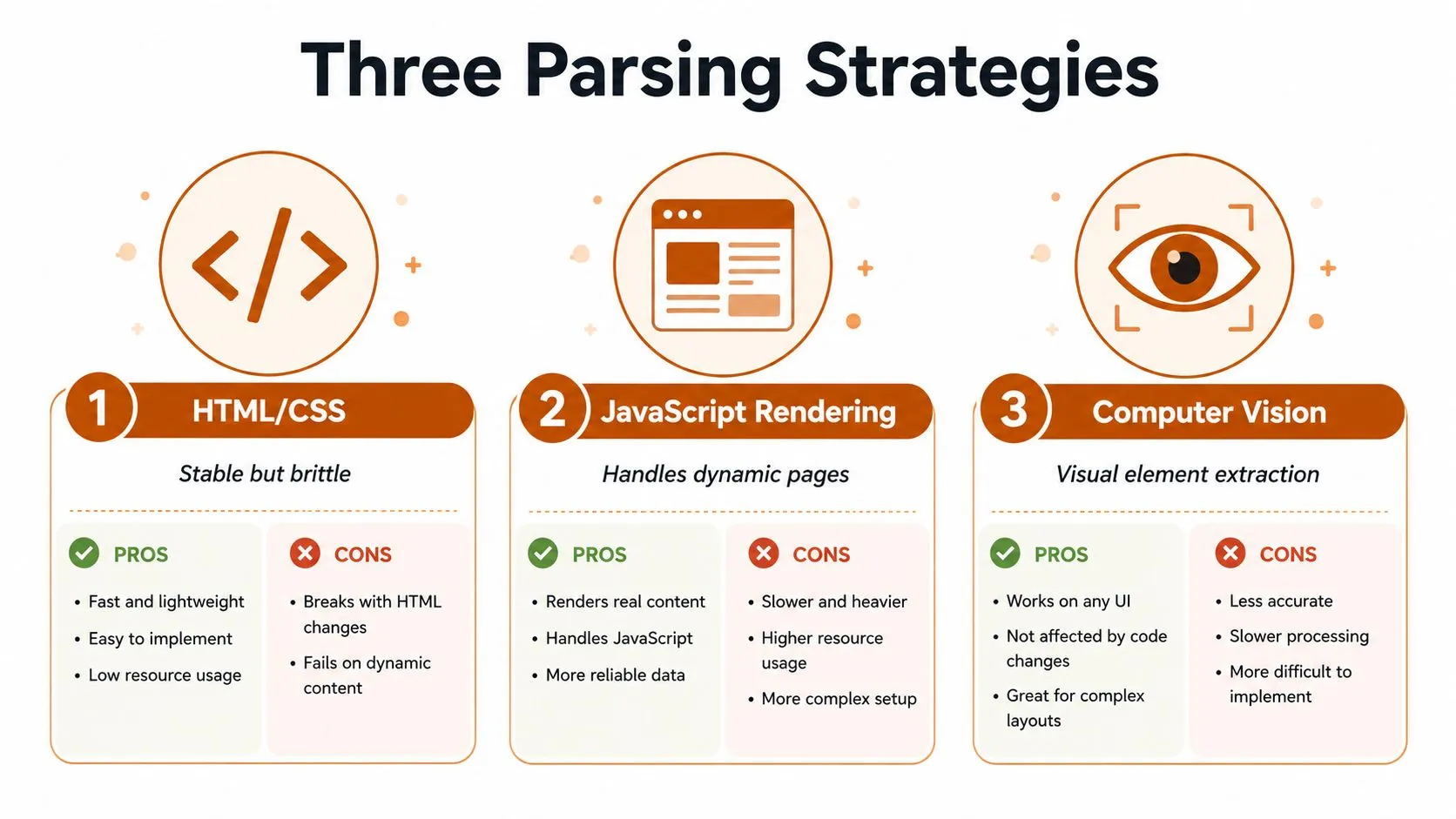
HTML and CSS selector extraction is fast, cheap, and easy to reason about, but it breaks when the site changes structure. Headless browsers help when content is rendered in JavaScript or assembled after network calls, though they cost more and are slower to operate. For pages with heavy visual treatment, computer vision can recover fields that are awkward to parse directly, especially when the useful information sits in rendered elements rather than clean markup.
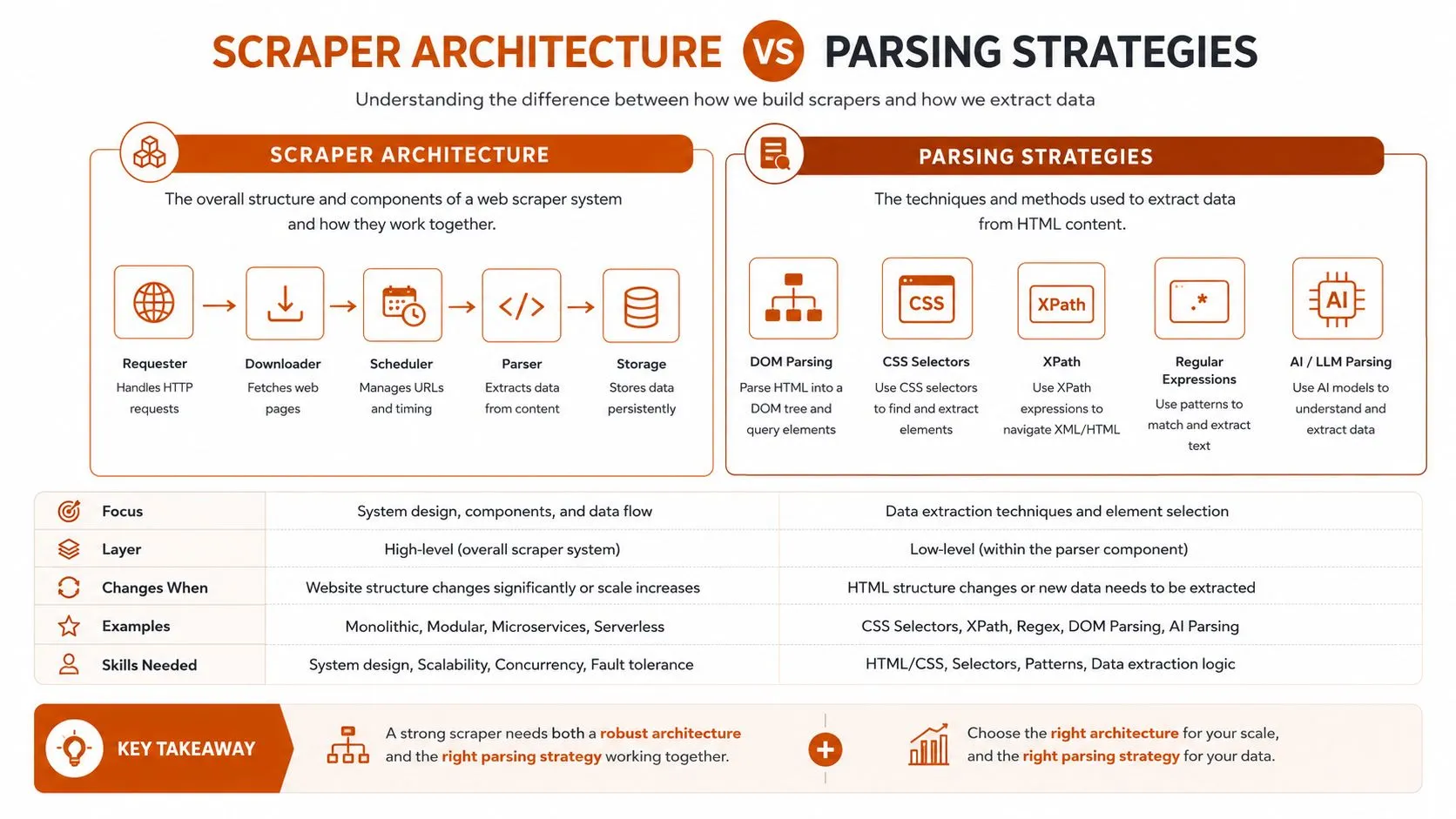
The production decision is rarely one-size-fits-all. A retailer with hundreds of consistent SKUs might run a lightweight HTTP client plus structured selectors for most sources, then route the problematic ones through a browser worker pool. That hybrid model keeps costs sane while preserving coverage where page complexity demands it.
Build for pagination, variants, and schema drift
The hard part is not grabbing one page. It is keeping the same logical product aligned across pagination, variant selections, and changing page layouts. If a page contains bundled offers or variant-specific pricing, the parser has to preserve that context, not flatten it away.
Operational rule: when a source changes, version the schema before you patch the extractor.
For teams that need a scalable crawl backbone, building scalable data pipelines with Scrapy is a useful reference because it frames crawling as a maintainable pipeline rather than a one-off script. In larger environments, that mindset matters more than any individual selector. When the site shifts, the parser, schema, and downstream contracts need to move together.
Anti-Bot Mitigation and Proxy Strategy
Every serious price monitoring pipeline eventually runs into rate limits, fingerprinting, or challenges that were clearly designed to separate people from automation. The mistake is trying to “beat” anti-bot systems with a single tactic. Resilient setups use layers, request pacing, session management, and the right proxy type for the target.
Match the proxy pool to the target site
Residential proxies, datacenter proxies, and mobile proxies solve different problems. Datacenter pools are usually the most efficient for friendly or lightly protected sources. Residential pools are the better fit when the site is more aggressive about blocking automated traffic. Mobile proxies can help in tougher environments, but they should be used where the operational need justifies the extra complexity.
A good implementation also rotates sessions carefully. If every request looks like a new visitor from a new network, the scraper can become more suspicious, not less. Keep cookie state where it matters, throttle bursts, and avoid hammering the same source with identical request patterns.
For teams evaluating proxy architecture, static vs rotating proxies is worth a read because it clarifies the trade-off between consistency and anonymity. That trade-off directly affects maintenance cost. Over-rotating can break sessions and pricing context, while under-rotating can trigger blocks.
Treat blocking as a normal operating condition
The goal is not zero blocks. It is graceful recovery. A mature pipeline detects challenge pages, records the failure mode, retries intelligently, and escalates only when the pattern changes enough to require human intervention.
A proxy budget is recurring infrastructure, not an occasional emergency line item.
Scheduling and delta detection become an optimization problem. If a source is volatile, hitting it too slowly means stale data. If it is stable, hitting it too often just increases bandwidth, proxy spend, and block risk. The best proxy strategy is the one that supports the cadence the business needs.
Scheduling Cadence and Delta Detection
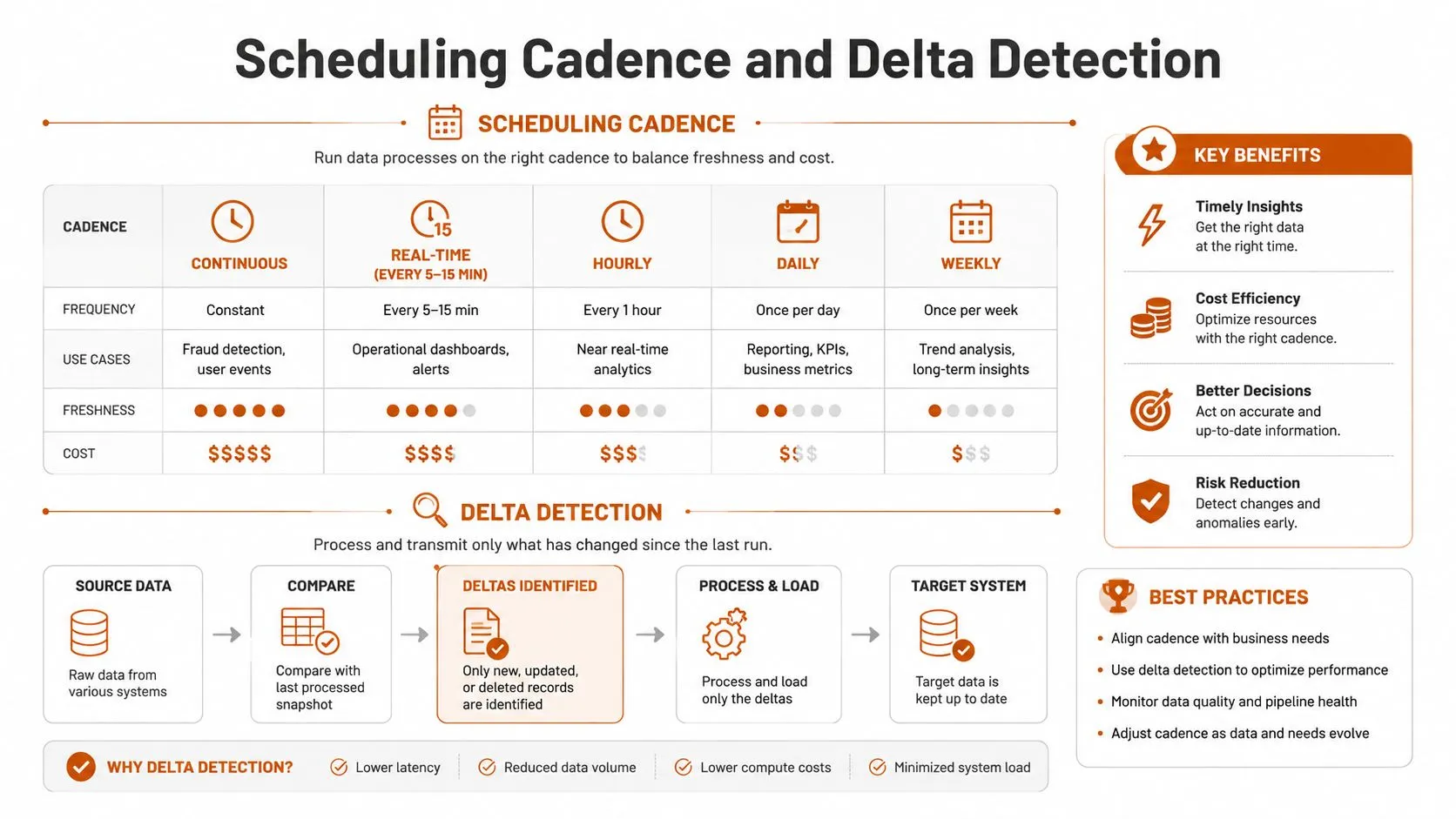
Freshness gets expensive when the cadence is wrong. A monitor that refreshes too slowly misses price moves that affect ranking, margin, or buy-box decisions. A monitor that runs too often burns proxy budget, increases block risk, and creates a stream of duplicate records that nobody wants to triage.
Set cadence by category behavior, not habit
The practical way to set cadence is to group SKUs by velocity and business impact, then assign refresh windows from there. High-turn products with aggressive competition need tighter loops. Slow-moving items do not. That keeps attention on the listings where a stale price can change the outcome.
Category behavior still matters. U.S. Tech Automations describes 4-hour intervals as a useful baseline for capturing most actionable price changes, and many teams use hourly checks for electronics and fashion, every 12 hours for beauty, and every 24 hours for home goods. Those cadences are starting points, not universal rules. Real production schedules usually depend on how volatile a category is, how often competitors reprice, and how quickly the business can react.
The trade-off is straightforward. More freshness improves decision quality, but it also raises infrastructure cost and failure surface area. In practice, the right cadence is the one that matches the business SLA without turning the monitoring stack into a self-inflicted load test.
Detect deltas, not just scrapes
Delta detection compares each new observation to the last known state and keeps only meaningful changes. That sounds simple, but many pipelines still push every scrape downstream and let analysts sort out noise by hand. In production, that creates alert fatigue, hides real price moves inside duplicate snapshots, and makes it harder to trust the feed.
A cleaner pattern is to keep both layers. Store the raw scrape for auditability, then maintain a normalized current state for alerts, repricing logic, and dashboards. When the extractor output changes structure, schema versioning keeps the pipeline from breaking every consumer at once. For teams building near-real-time feeds, how WebSocket-based extraction works is a useful reference for the difference between continuous change delivery and blind polling.
The detection layer also has to understand the offer, not just the field labeled price. Shipping thresholds, promotions, bundle logic, and stock context all affect what the customer sees. A feed that treats sticker price as the full story will miss the conditions that decide who gets the cart. That is why downstream cleaning work matters, including data cleaning and enrichment for product feeds, especially when sources encode the same commercial state in different ways.
Practical rule: monitor the offer the customer sees, not just the number in a price tag field.
Delta logic should also be conservative about change detection. Empty updates, formatting drift, and transient page artifacts should not trigger alerts. The goal is to surface price moves that matter to the business, then deliver them on an SLA that operations can support.
Data Normalization Schema Design and Quality Assurance
Raw scrape output is rarely fit for pricing systems. One site writes currency in a metadata field, another embeds it in text, and a third uses locale-specific formatting that breaks naive parsers. If the normalization layer is weak, the whole monitoring stack becomes unreliable even when the extractor is technically “working.”
Normalize the fields that matter downstream
Schema design should start from the consumers, not the crawler. Pricing engines need stable field names, BI tools need consistent dates and identifiers, and alerting systems need a clean notion of what counts as a change. Currency, units, availability state, and product identity are the core fields that usually need strict normalization.
The edge cases matter as much as the obvious ones. Out of stock, unavailable, and delisted are not the same condition, and they should not be collapsed into one status if pricing decisions depend on them. The same logic applies to bundles and variant-specific listings. If the schema cannot represent those differences, downstream systems will infer them badly.
Version the schema before the business forces a rewrite
Every mature monitor eventually evolves. New channels appear, new attributes get added, and downstream teams ask for more context than the original feed exposed. That is where schema versioning pays off. A versioned model lets you add fields, deprecate old ones, and keep integrations alive while the pipeline changes.
For a practical treatment of transforming scraped records into a cleaner structure, normalizing web scraped data with Python is a solid technical reference. If the raw feed is going to power repricing or compliance workflows, normalization cannot be an afterthought.
Put QA around the data, not just the code
Quality assurance has to catch bad output, not just failed jobs. Automated validation should flag impossible prices, missing currency, duplicate product identities, and sudden spikes or drops that do not make sense in context. Alerting should fire when the data quality degrades, even if the crawler technically returned a 200 response.
Quality rule: a successful request with wrong fields is still a failed delivery.
That is also where a resource like data cleaning and enrichment for product feeds becomes relevant, because feed hygiene and monitoring hygiene are tightly linked. If the pipeline ships messy records, the downstream system will make messy decisions. SLA-backed delivery only means something when the contract includes accuracy, freshness, and completeness, not just uptime.
Delivery Formats and Operational Best Practices
A monitoring system is only valuable if the consuming team can use the output without extra translation. Some teams want clean feeds for automated repricing. Others need instant alerts. Others care about auditability, not latency. The delivery layer should match the actual workflow.
Match format to the consumer
CSV and JSON feeds work well for repricing engines and BI integrations. Webhooks fit alerting and event-driven workflows. S3 drops are a better fit for data lake ingestion and batch processing. PDF reports still matter for compliance and audit review, where a human needs a fixed record more than a live feed.
If multiple teams consume the same source, don’t force them into one format. The same normalized record can be fanned out into different delivery channels with different SLAs. That separation keeps the pipeline stable when one consumer changes its cadence or review process.
Monitor the monitor and plan for repair
Silent failure is the worst failure in ecommerce price monitoring. A scraper can “run” while producing empty rows, stale prices, or partial coverage. Meta-alerting, the monitoring of the monitors, should catch missing jobs, sudden data drops, and repeated fallback responses before those issues reach the pricing team.
For teams that want managed execution rather than maintaining the whole stack in-house, WebscrapingHQ is one option for managed web data operations, including scoping, custom extraction, proxy handling, retries, schema versioning, and SLA-backed delivery. That only matters if the team is spending engineering time on maintenance instead of product work, which is the usual symptom of a system that has outgrown its original build.
A small troubleshooting playbook keeps the pipeline honest:
- Layout change: re-run extraction against the current DOM, then update selectors or move that source to a more resilient parser.
- Blocked requests: slow the cadence, rotate sessions more carefully, and reassess the proxy type.
- Bad normalization: compare raw and cleaned records, then fix the transformation step, not the crawler.
- Missing deltas: inspect the change logic, especially on promotions, bundles, and stock-dependent offers.
- Silent job failure: confirm that alerts fire on empty output, not just hard errors.
The operational edge comes from boring discipline. Stable source selection, resilient parsing, thoughtful cadence, clean normalization, and honest delivery contracts are what keep ecommerce price monitoring useful after the first month.
If your team is stuck between brittle scrapers and expensive manual checks, talk to WebscrapingHQ about a managed ecommerce price monitoring pipeline that fits your sources, cadence, and delivery needs.
Want this done for you?
Send us the URLs. We'll quote it in 24 hours.
Paste the URL(s) you want scraped. We'll reply within 24 hours with a feasibility check and a ballpark quote.