Jump to section
- Table of Contents
- Introduction Navigating the Gray Areas of Web Data
- The Four Pillars of Ethical Data Collection
- Transparency
- Consent
- Purpose Limitation
- Data Security
- Applying Ethical Principles to Web Scraping
- Start With a Field List, Not a Crawl
- Consent and Public Data Are Not the Same Question
- Represent the Source Faithfully
- A Technical Checklist for Compliant Scraping
- Control the collection path
- Detect and limit personal data early
- Secure the storage layer
- Keep the program maintainable
- Building a Governance and Documentation Framework
- Make the project reviewable
- Keep logs that tell the whole story
- Tie governance to operational standards
- How Managed Services Operationalize Ethical Collection
- The operating model is the product
- Managed collection reduces internal drift
- Use partner expertise as control, not convenience
- Conclusion From Compliance Checkbox to Competitive Edge
Your growth team wants the dataset, your SEO lead wants the rankings, and your AI team wants the training corpus. The trouble starts when the source is a public website and nobody can agree on where useful collection ends and questionable collection begins. That’s where ethical data collection stops being an abstract principle and becomes an operating model, especially for web scraping teams that need to ship data without creating legal, reputational, or technical debt.
For a managed scraping operation, the primary question isn’t just whether a page is accessible. It’s whether the collection is defensible, limited to a stated purpose, and built with controls that still make sense when the project expands, the site changes, or the data gets reused downstream. The practical standard now comes from privacy law, research ethics, and security engineering, not from guesswork. If you’re already weighing those issues, this overview of the legal risks in web scraping is a useful companion read.
Table of Contents
Open Table of Contents
- Introduction Navigating the Gray Areas of Web Data
- The Four Pillars of Ethical Data Collection
- Applying Ethical Principles to Web Scraping
- A Technical Checklist for Compliant Scraping
- Building a Governance and Documentation Framework
- How Managed Services Operationalize Ethical Collection
- Conclusion From Compliance Checkbox to Competitive Edge
Introduction Navigating the Gray Areas of Web Data
A public page can look simple from the outside and still hide a hard decision. Your team may need pricing data, job listings, product attributes, or market signals, but the moment you start extracting at scale, the stakes change. You’re no longer just reading a page, you’re building a data process that can create privacy, security, and governance issues if it isn’t designed carefully.
The most useful shift is to stop asking only, “Can we scrape this?” and start asking, “Can we collect only what we need, explain why we collected it, and prove we handled it properly?” That framing lines up with the modern privacy baseline established by the GDPR, which took effect on 25 May 2018 and made principles such as purpose limitation and data minimization enforceable requirements across organizations processing EU residents’ data, regardless of company location (OpenStax on GDPR and ethics in data collection).
For web scraping, that matters because the collection process itself is often the riskiest part of the pipeline. A scraper that grabs full HTML, stores unnecessary identifiers, or keeps raw data forever is creating avoidable exposure before analysis even begins. A defensible program starts by treating collection as a controlled business function, not a clever technical shortcut.
Practical rule: if you can’t explain the business purpose of each field you collect, you probably shouldn’t be collecting it.
That’s the lens used throughout this guide. The goal is to connect ethics to the actual controls a data team can implement, from field selection and storage policies to governance artifacts and managed-service oversight. If you work in growth, compliance, research, or AI, this is the framework that turns uncertain scraping work into a stable operating practice.
The Four Pillars of Ethical Data Collection
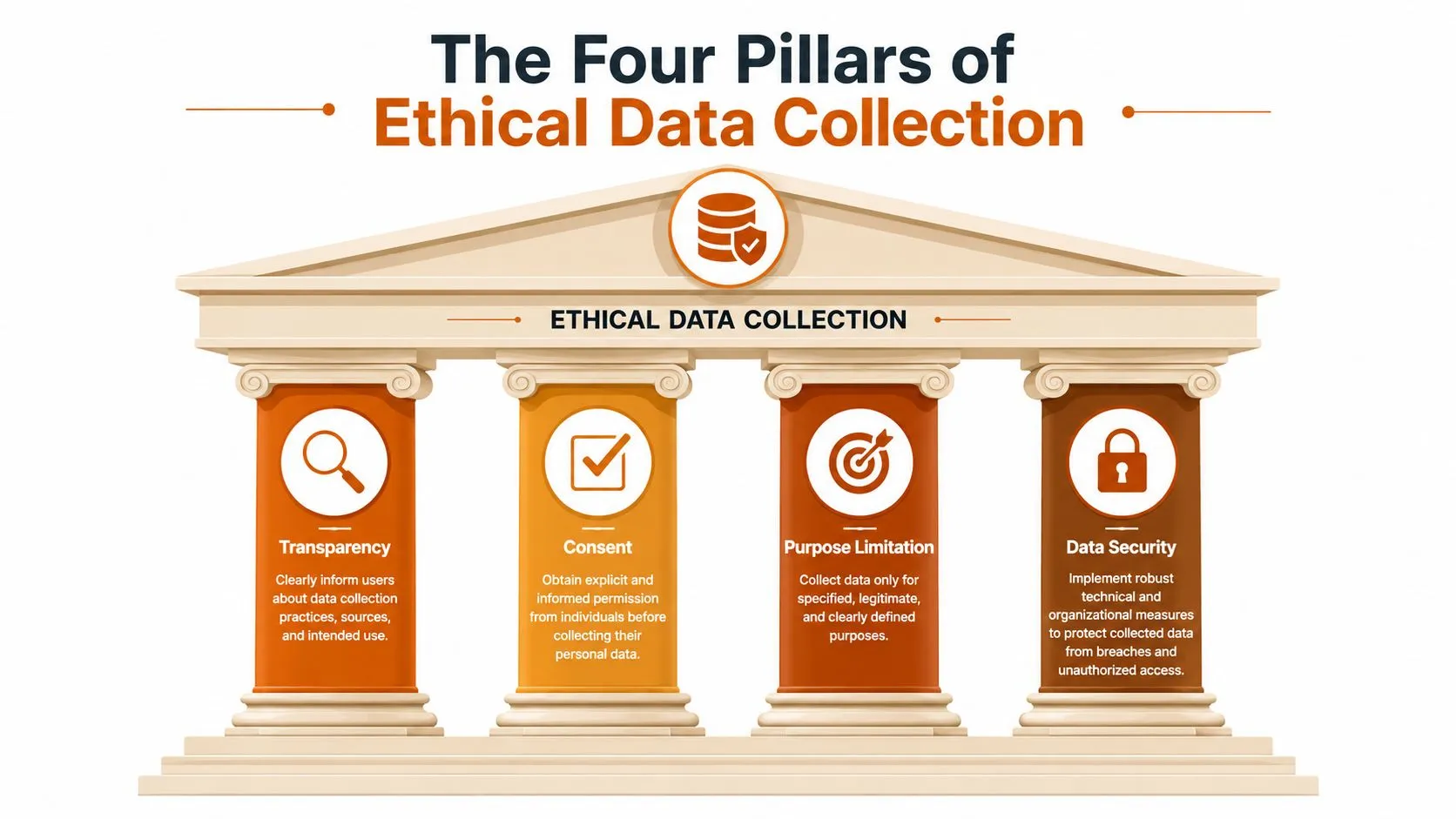
A scraper can look efficient and still be hard to defend. Teams usually run into trouble when they can describe the ethics in a slide deck, but cannot show the controls in the crawl plan, the storage policy, or the review log. The four pillars matter because each one closes a different gap in a scraping program, from what is collected to how long it is kept.
Transparency
Transparency means people inside the organization can trace what data is being collected, why it is being collected, and how it will be used. In a scraping context, that may not always require a consumer-facing notice for every public dataset, but it does require documentation that an auditor, a client, or a regulator can review without guesswork. The failure is not only secrecy, it is an inability to explain the collection decision in operational terms.
For managed scraping teams, that usually means keeping a source register, a field-level purpose note, and a record of the retrieval method. If a target site changes its terms, blocks the crawler, or limits access patterns, the team should be able to show what changed and who approved the response.
Consent
Consent is often misunderstood in web scraping because public availability does not equal blanket permission. The question is whether the person or site operator reasonably expects the collection and use you plan to make of the data, and whether your workflow respects that context. In regulated environments, consent is one expression of respect for the data subject, but it is not the only one. The broader research ethics tradition, including the Belmont Report’s principles of respect for persons, beneficence, and justice, still shapes how teams think about informed participation and fair treatment (Belmont Report background and modern relevance).
Teams working under GDPR pressure should tie that judgment to process, not intuition. A practical guide to GDPR-compliant web scraping helps teams translate consent and lawful-basis questions into review steps, approval gates, and retention decisions before a crawl starts.
Purpose Limitation
Purpose limitation is simple to describe and hard to honor at scale. It is like borrowing a tool for one job, then putting it back instead of using it for every task in the shop. If you collect product availability data to monitor stock status, you should not repurpose the same crawl for behavioral profiling or unrelated enrichment without re-evaluating the ethics and governance.
This pillar is where scope control matters most in scraping operations. The crawl plan should state the business use, the fields needed for that use, and the cases where the data must not be reused. If a client asks for a broader dataset later, that request should trigger a fresh review instead of being handled as a quiet extension of the original run.
Data Security
Data security is the pillar that keeps a collection program from turning into a liability. Good intentions do not protect data in transit, in storage, or in team workflows. Ethical collection requires encryption, access control, and clear handling rules, because the harm often comes after the crawl, when data is copied, shared, or retained longer than necessary.
For a web scraping firm, that means security has to be built into the service model. Raw captures should be isolated from analyst workspaces, credentials should be restricted to the smallest workable set, and retention rules should be enforced automatically where possible. If a dataset is sensitive, the team should assume that weak internal controls are part of the risk, not an edge case.
The GDPR turned these ideas into enforceable obligations and set a benchmark many multinational firms now treat as their internal floor, even when a specific project is outside Europe. That is the standard modern scraping teams have to meet, because the market expectation is no longer just access to data, it is proof that the collection process can be explained, limited, and secured.
Applying Ethical Principles to Web Scraping
A scraper that collects public web data can still be unethical if it ignores scope. Publicly visible doesn’t mean ethically free-for-all, especially when the page contains personal information, sensitive inferences, or data that can be re-linked later. The practical test is whether each field you collect supports the stated purpose and whether the collection method respects the source’s operational limits.
Start With a Field List, Not a Crawl
The cleanest scraping projects begin with a narrow schema. If the business need is price intelligence, you collect price, product name, currency, availability, and source URL. You don’t collect full page HTML just because it’s convenient, and you don’t save every metadata field unless it has a direct purpose in the downstream workflow.
Data minimization thus becomes a design rule, not a policy slogan. Ethical collection is strongest when the system collects only the minimum viable information needed for the stated purpose, because every additional field expands the attack surface and increases re-identification risk (data minimization and re-identification risk).
Consent and Public Data Are Not the Same Question
Teams often ask whether consent is required for public data. The better question is whether the collection respects the context in which the data appears and whether downstream use would surprise or disadvantage the people represented in it. A scraping program that pulls forum posts, seller profiles, or employee information may be technically accessible while still carrying ethical concerns about reuse, profiling, or aggregation.
Practical rule: if a field can identify a person, infer a sensitive trait, or expose a vulnerable group, treat it as a higher-risk collection choice even if the page is public.
The same logic applies to data enrichment. Once a scrape is joined to another dataset, the ethical footprint changes. That’s why teams need explicit collection boundaries before they start, not cleanup after the fact. A helpful reference point for article and news use cases is ethical article scraping guidance, which pushes teams toward purpose-limited, source-aware collection.
Represent the Source Faithfully
Ethical scraping also includes accuracy. If you misread a page, strip context, or parse a field incorrectly, you create bad data and bad decisions. Research ethics has long treated data quality as part of ethical conduct because inaccurate collection can misrepresent people and distort outcomes. In web scraping, that means your parser, your selector logic, and your quality checks are part of the ethics program, not just engineering details.
A Technical Checklist for Compliant Scraping
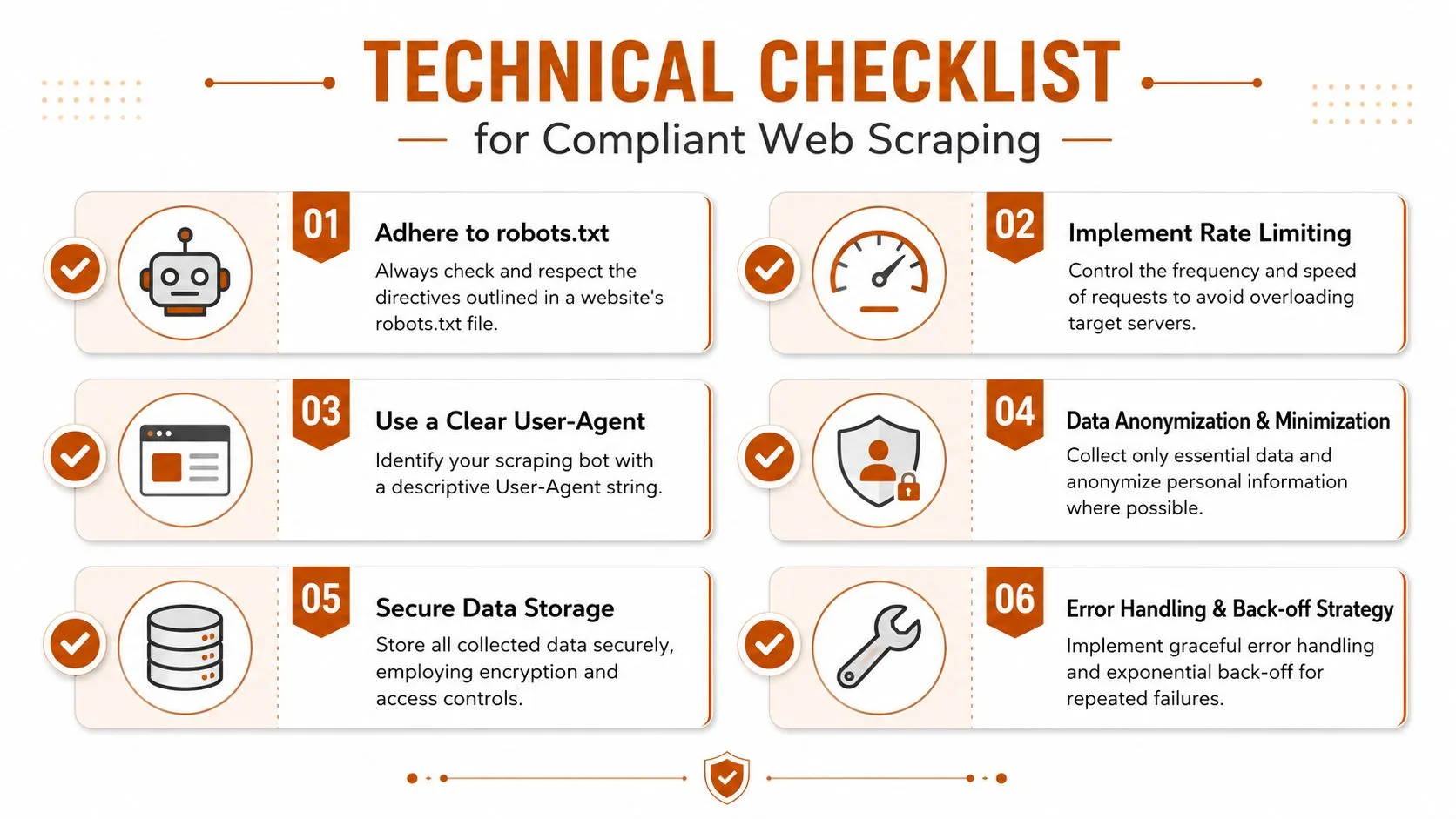
A compliant scraper isn’t defined by one clever control. It’s defined by a stack of boring, repeatable safeguards that make misuse less likely and easier to detect. If you’re building the pipeline, the checklist below is the practical baseline.
Control the collection path
Start with identity and cadence. Use a clear User-Agent string, keep request rates polite, and implement back-off when a site starts returning errors or signs of strain. These aren’t just technical courtesies, they’re evidence that your team is trying to reduce operational harm.
The source terms also matter. Respect robots.txt and site Terms of Service as signals of the publisher’s intent, then review whether the proposed use fits the business purpose. If the source is sensitive, changeable, or likely to contain personal data, the burden on your team goes up fast.
Detect and limit personal data early
Build detection into the pipeline rather than hoping for manual review later. If your extraction can encounter names, emails, phone numbers, addresses, or user profiles, route those fields through a classification and suppression step before they reach general analytics or storage layers. The point isn’t to collect everything and redact later, it’s to avoid over-collection in the first place.
Practical rule: the safest place to drop unnecessary personal data is the parser, not the warehouse.
Secure the storage layer
A technically strong ethical-data program needs security-by-design. That means encryption, access control, accountable oversight, and written data-management policies that the whole team can adhere to (security-by-design guidance). If engineers, analysts, and operators all have different informal habits for moving files around, the collection program will leak through process gaps even if the crawler itself is sound.
Keep the program maintainable
Operational ethics also means graceful failure handling. When a site layout changes, the scraper should fail safely, log the problem, and stop before it starts collecting the wrong fields. That’s one reason many teams use managed monitoring, retry controls, and schema validation instead of treating scraping as a one-time build.
For teams that want a structured implementation approach, this checklist for securing cloud scraping operations is worth reviewing alongside your internal controls. In practice, the strongest setups combine narrow extraction, secure storage, and documented handling rules, not just one of those pieces.
Building a Governance and Documentation Framework
Technical controls don’t prove intent by themselves. A defensible scraping operation needs paper trails, approvals, and repeatable review points so you can show how a project was scoped, approved, monitored, and revised. That matters when legal teams ask why a field was collected, when a client asks how the data was handled, or when a source changes its structure and the project needs to be revalidated.
Make the project reviewable
Before a new collection starts, run a Data Protection Impact Assessment or a similar risk review. The assessment should answer basic questions: what is being collected, why is it needed, who can access it, how long will it be kept, and what could go wrong if the data is misused or exposed? For managed teams, that pre-work is what keeps scraping from becoming an undocumented recurring risk.
A strong governance package usually includes a few core documents:
| Document Type | Purpose | Key Components |
|---|---|---|
| Data Collection Policy | Defines what the team may collect and under what conditions | Scope, approved source types, field restrictions |
| Data Handling Report | Shows how data is processed after collection | Storage, access, retention, deletion rules |
| Project Risk Review | Documents why the crawl is justified | Purpose, risks, mitigations, approvals |
Keep logs that tell the whole story
Logging is more than debugging. You need audit trails that show which version of the parser ran, what sources were touched, what fields were extracted, and when any exception handling kicked in. If the site changes or a compliance question comes up later, those logs are the difference between a credible explanation and a guessing game.
This is also where accountability becomes visible. The Belmont lineage matters here because it connects ethics to responsibility, not just permission. Teams should be able to point to a clear owner for the dataset, a clear reviewer for high-risk cases, and a clear deletion path for data that no longer serves its purpose (Belmont Report background and modern relevance).
Tie governance to operational standards
If your organization already works with customers who ask about security posture, an established control framework can help. A useful external reference is SOC 2 Type 2 compliance details, because it shows how companies document controls, monitor them over time, and prove they’re not just aspirational. That logic translates well to ethical scraping: if you can’t document the control, you can’t rely on it.
Teams building ML datasets should also tighten governance around reuse. machine learning data collection guidance is especially relevant when a project starts as a simple extraction job and later becomes training data, because the downstream expectations change fast.
How Managed Services Operationalize Ethical Collection
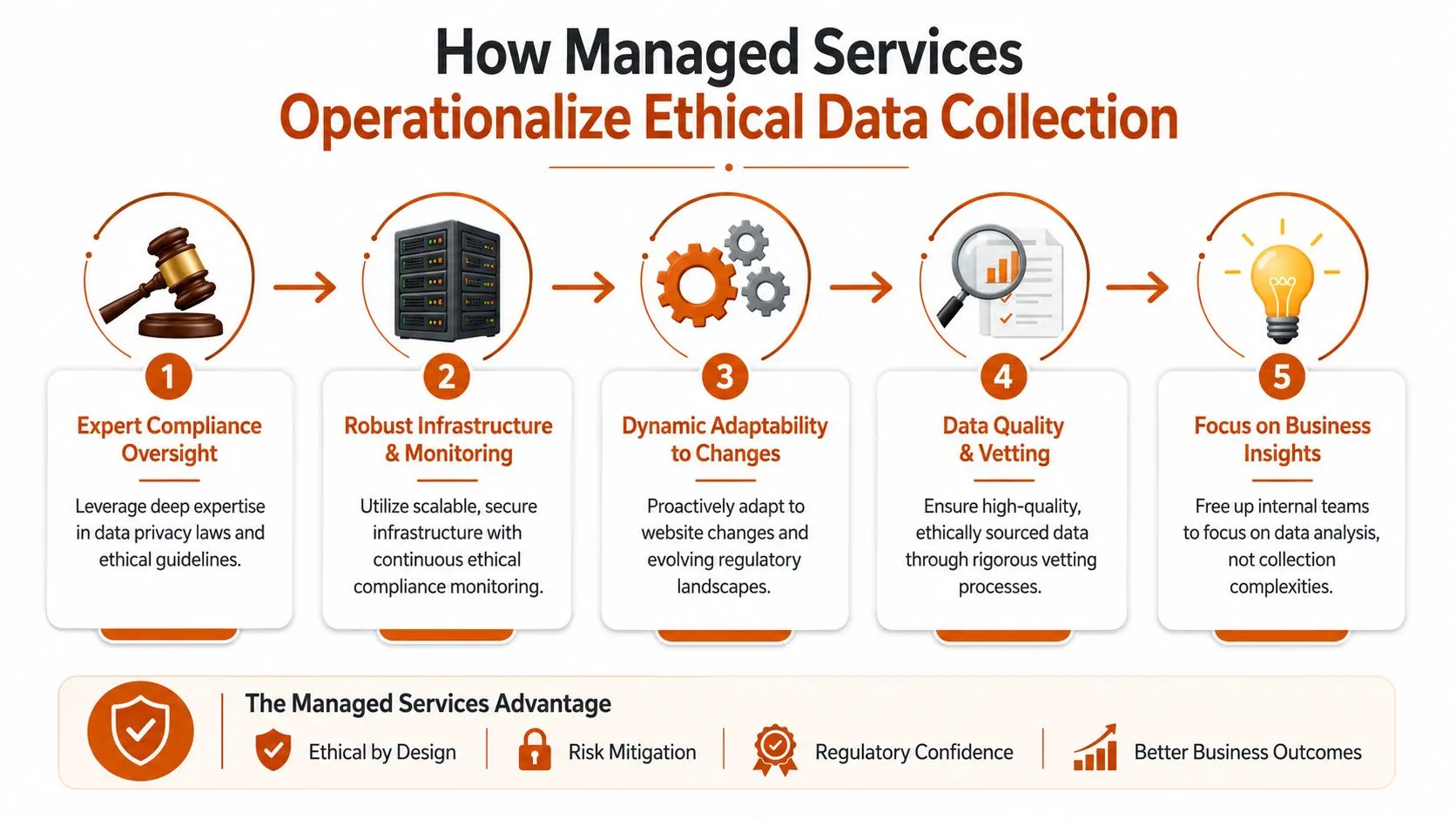
A managed service matters because ethical scraping breaks down most often in the messy middle, where legal review, engineering changes, and source volatility collide. Internal teams usually know the rules, but they don’t always have the time or infrastructure to maintain them across dozens of sites, changing schemas, and recurring delivery schedules. A managed provider turns those controls into an operating system instead of a side project.
The operating model is the product
In practice, a provider such as WebscrapingHQ can absorb scoping, monitoring, retries, proxy handling, and schema maintenance so the client isn’t rebuilding the same safeguards every month. That matters because ethics degrades quickly when the maintenance burden falls back on the customer’s analysts or product managers. Managed operations can also produce structured outputs, including PDF compliance reports, which is useful when internal review workflows still depend on human sign-off.
The more important value is consistency. Ethics isn’t just a launch-time decision, it has to survive site changes, policy changes, and data reuse questions. That’s especially true now that AI systems often combine datasets, which raises new governance problems around downstream reuse and the risk of re-identification or sensitive inference even after direct identifiers are removed (NeurIPS paper on reuse and linked data risks).
Managed collection reduces internal drift
The biggest operational failure I see is drift. A project starts with one field list, one use case, and one retention rule, then slowly expands as new stakeholders ask for “just one more column.” A managed team is more likely to push back, because its job is to keep the crawl aligned to the approved scope and to document when that scope changes.
That’s also where a service model helps with ethical AI pipelines. If the dataset is destined for models, downstream reuse needs to be part of the original approval, not a later assumption. Data collected for one business purpose shouldn’t become a general-purpose inference layer without another review cycle.
Practical rule: if the data might be reused in an AI workflow, govern it as if the use case will expand, because it probably will.
Use partner expertise as control, not convenience
Outsourcing doesn’t remove responsibility. It concentrates execution with a team that already has the tooling and habits to implement the controls properly. For buyers, that means asking for documentation, field-level scope, storage rules, and refresh logic, not just a feed format.
A managed service works when it makes compliance visible, repeatable, and boring. That’s the point. The service handles the scraping complexity while your team keeps ownership of the business decision, the purpose, and the allowed downstream use.
Conclusion From Compliance Checkbox to Competitive Edge
Ethical data collection isn’t a box you check before launch. It’s a system of limits, evidence, and review that has to survive real-world pressure. The teams that do this well don’t just ask whether they can collect data, they define the purpose, minimize the fields, secure the pipeline, and document the choices they made.
For web scraping, that means the ethical posture of a project shows up in the schema, the logs, the storage rules, and the reuse policy. GDPR made that mindset a business obligation, research ethics gave it a moral spine, and modern AI and big-data reuse have made it harder to ignore. If you get those controls right, you lower risk and make the data more trustworthy at the same time.
The competitive edge comes from reliability. Clients, partners, and internal stakeholders can use data faster when they trust how it was collected and handled. That trust is earned through process, not promises.
Want this done for you?
Send us the URLs. We'll quote it in 24 hours.
Paste the URL(s) you want scraped. We'll reply within 24 hours with a feasibility check and a ballpark quote.