Jump to section
- Table of Contents
- 1. Managed Web Scraping Services for Recurring AI-Powered Data Pipelines
- What it catches that warehouse monitors miss
- 2. Monte Carlo
- Extraction-pipeline fit
- 3. Bigeye
- Where it fits and where it stops
- 4. Anomalo
- The important governance trade-off
- 5. Soda
- Rule authoring versus maintenance
- 6. Great Expectations GX Cloud
- Best for controlled schemas
- 7. Datafold
- A targeted control, not a complete observability layer
- 8. Acceldata Data Observability Cloud
- When consolidation is worth the trade-off
- 9. IBM Data Observability by Databand
- Deployment control changes the evaluation
- 10. Validio
- Fit for changing data products
- Top 10 Data Quality Monitoring Tools, Feature Comparison
- Build the Smallest Monitoring Stack That Works
The broadest observability platform isn’t automatically the best data quality monitoring tool. A team that mainly needs explicit schema and completeness checks may gain little from buying a large lineage and incident-management suite. A team collecting changing web data may have the opposite problem, because deterministic tests alone won’t absorb site redesigns, localization differences, image defects, anti-bot failures, or recurring delivery obligations.
Choose the failure mode before the tool. Decide whether the primary risk is a known business-rule violation, an unknown anomaly, a data diff between environments, a broken pipeline run, an unclear downstream blast radius, a contract breach, or extraction maintenance that your engineers shouldn’t own. The comparison below evaluates each option by the failure it catches best, then considers monitoring depth, integration fit, implementation burden, deployment model, scale, pricing visibility, limitations, and operational fit.
Extraction pipelines need a wider quality model than warehouse tables alone. They must validate freshness, volume, schema drift, missing fields, localization, image quality, duplicate records, delivery failures, and site changes. Enterprise buyers can use this framing alongside a checklist for enterprise leaders before treating observability as a platform purchase rather than an operating-model decision.
Table of Contents
Open Table of Contents
- 1. Managed Web Scraping Services for Recurring AI-Powered Data Pipelines
- 2. Monte Carlo
- 3. Bigeye
- 4. Anomalo
- 5. Soda
- 6. Great Expectations GX Cloud
- 7. Datafold
- 8. Acceldata Data Observability Cloud
- 9. IBM Data Observability by Databand
- 10. Validio
- Top 10 Data Quality Monitoring Tools, Feature Comparison
- Build the Smallest Monitoring Stack That Works
1. Managed Web Scraping Services for Recurring AI-Powered Data Pipelines
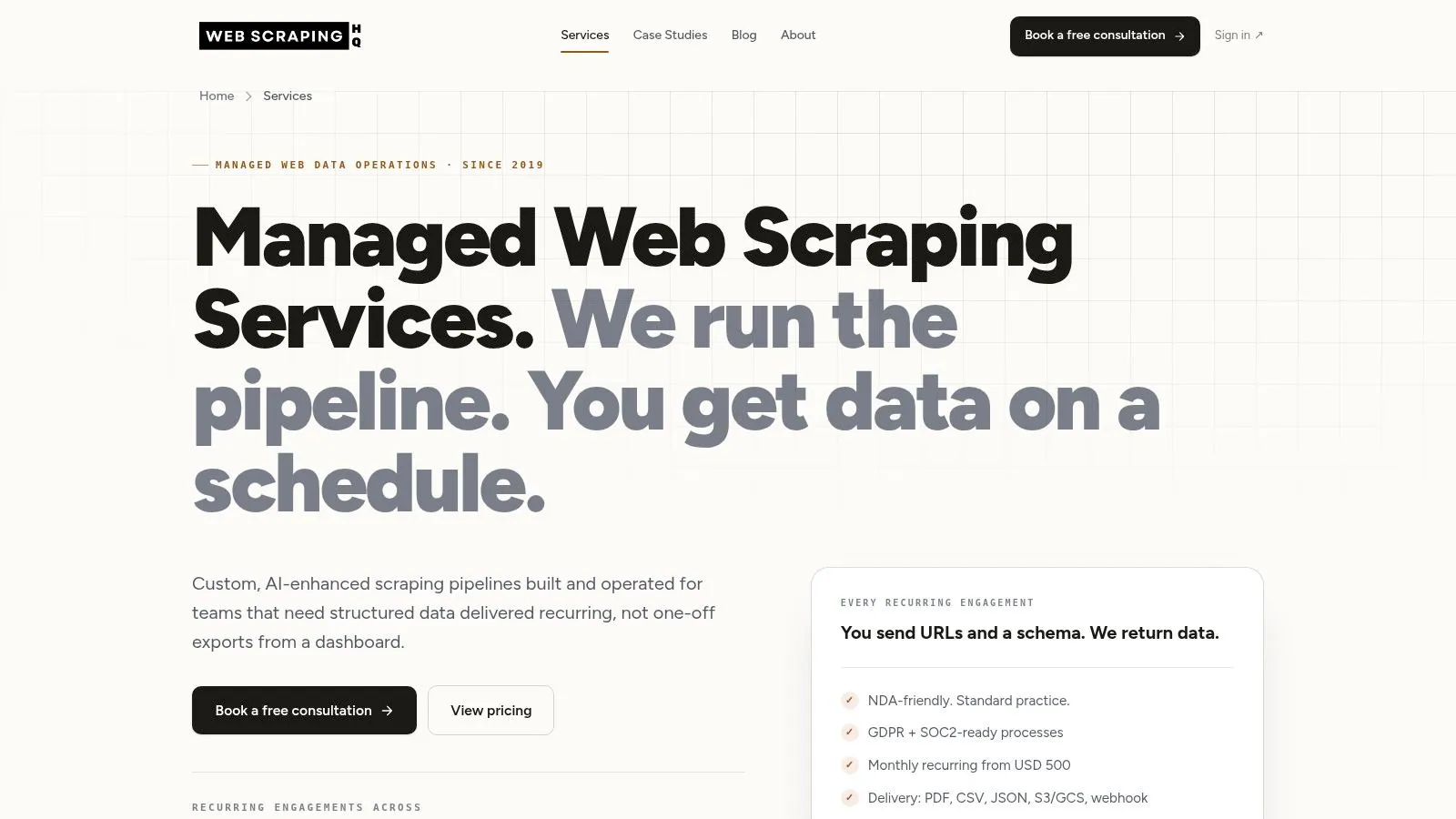
The failure mode WebscrapingHQ is best equipped to catch is operational extraction failure, where the source changes, an anti-bot challenge blocks collection, a parser loses fields, or a scheduled feed arrives incomplete. This is a different problem from monitoring a stable warehouse table. If your organization needs recurring web data, adding an internal validation layer may detect a broken output without restoring the source pipeline.
Managed WebscrapingHQ services combine custom scraper development with ongoing operations. The service scopes target sources, aligns extraction to the required schema, and uses computer vision and large language model parsing for messy pages, structured feeds, images, and compliance-ready PDF reports. Monitoring can cover empty results, field loss, freshness gaps, abnormal distributions, duplicate records, and schema conformance, while retries, proxy management, and anti-bot handling remain part of the managed operating model.
What it catches that warehouse monitors miss
A warehouse monitor can alert you that today’s product feed has fewer rows. It generally can’t maintain the source-specific logic needed to handle a changed page layout, a localized label, an image format problem, or a CAPTCHA response. WebscrapingHQ’s extraction pipelines are designed to absorb those source changes through monitoring, re-tuning, retries, and infrastructure management, then deliver through CSV, JSON, webhooks, S3 drops, dashboards, or PDF reports.
That makes the service especially suitable for competitive intelligence, ad verification, retail monitoring, compliance reporting, model-training data, and multi-geo or multi-language collection. Teams building their own systems can still benefit from the principles in this guide to building scalable data pipelines with Scrapy, but the practical question is whether they want to own every recurring maintenance task.
Practical rule: If the main incident begins at a third-party website, measure the cost of restoring extraction, not just the cost of detecting a bad table.
The trade-off is fit. A fully managed service is aimed at recurring enterprise or growth-stage workloads, so it may be excessive for a small one-off scrape. Web scraping also requires source-specific legal and acceptable-use review. Buyers should define target scope, delivery cadence, data handling, and compliance boundaries before implementation, including the security considerations discussed in this guide to agent risks.
2. Monte Carlo
Monte Carlo is strongest against the silent downstream impact incident, where a freshness, volume, schema, or custom-metric problem spreads through transformations, dashboards, or AI workflows before the responsible team understands the blast radius. Its value isn’t just detecting an unusual table. The platform connects monitoring with lineage, SLA tracking, incident workflows, and integrations across warehouses, data lakes, ETL and ELT systems, BI, and AI environments.
The Monte Carlo platform provides out-of-the-box monitors for freshness, volume, schema, and custom metrics. End-to-end lineage helps teams trace an alert to upstream dependencies and identify affected consumers, while operational integrations support routing incidents into the systems where data teams already work. That broad coverage makes it a reasonable choice for large engineering organizations that need one operational view rather than isolated checks.
Extraction-pipeline fit
Monte Carlo can monitor the warehouse layer after a scraper has delivered data. It can flag a stale destination, an unexpected row-count change, or a schema alteration in the resulting dataset. It won’t, by itself, replace source-specific browser automation, proxy rotation, CAPTCHA handling, visual inspection, or parser maintenance. For web collection, it works best as a downstream control plane, not as the extraction operator.
Implementation is enterprise-oriented. Buyers can access Monte Carlo through AWS Marketplace using credit-based contracts, but the commercial arrangement still requires vendor negotiation, including treatment of overages. Pricing isn’t publicly visible, so procurement should compare the full ownership model, including connectors, monitored assets, incident workflows, and the engineering effort required to remediate source failures.
Teams considering a layered approach can pair observability with explicit checks described in this ultimate guide to data validation. That combination is more defensible when a broad platform catches operational symptoms and deterministic rules enforce business-critical fields.
3. Bigeye
Bigeye is best equipped to catch metric behavior that has drifted from its learned baseline, particularly at table and column level. Instead of requiring every threshold to be authored manually, its monitoring approach applies automated anomaly detection to data metrics and learned expectations. That makes it useful for analytics and machine learning pipelines where normal behavior is meaningful but difficult to express through a fixed rule.
The Bigeye data observability platform supports broad source connectivity, metric monitoring, and lineage visibility. Its deployment model can use an agentless or agent-style approach, and read-only JDBC access provides a clear operational boundary for security review. That read-only model won’t remove every governance question, but it gives security teams a concrete answer to where monitoring connects and what permissions it needs.
Where it fits and where it stops
Bigeye suits engineering teams that want automated detection without giving up a controlled connection pattern. It can identify abnormal null behavior, volume changes, distribution shifts, and other metric-level failures after data enters an analytics environment. It isn’t a substitute for extraction logic that understands localized pages, visual product content, source availability, or an altered HTML structure.
Pricing isn’t posted publicly, so a serious evaluation should ask how monitored assets, data volume, connectors, deployment choices, support, and services affect the quote. Teams that still need explicit assertions can use Bigeye alongside code-based validation rather than expecting learned thresholds to encode every business rule. For the implementation side, this guide to automating data validation with Python libraries illustrates the complementary engineering layer.
4. Anomalo
Anomalo is designed for the unknown anomaly, especially in large and heterogeneous datasets where manually authoring rules for every field would create an ongoing maintenance burden. Its machine-learning approach can identify unusual patterns, missing or late data, and schema drift, while automated root-cause hints help narrow the investigation. The platform also extends monitoring to unstructured data, which matters when quality includes content that doesn’t behave like a clean relational column.
The Anomalo platform integrates quality signals with data catalogs such as Alation, keeping monitoring context closer to the place where users discover and interpret data. Its conversational assistant, AIDA, supports natural-language exploration of quality signals. That can reduce context switching for data consumers, although it doesn’t eliminate the need for owners to define what a valid business outcome means.
The important governance trade-off
Anomalo reduces rule-authoring effort, but teams shouldn’t mistake autonomous discovery for complete quality policy. A model can identify that a product-title pattern, image attribute, or regional distribution looks unusual. It may not know whether the change is an approved campaign, a legitimate market expansion, or a broken parser. Explicit deterministic checks remain valuable for required fields, allowed values, contractual schemas, and compliance outputs.
For extraction pipelines, Anomalo is most useful after collection, where it can observe behavioral changes in structured or unstructured outputs. It won’t manage source access, anti-bot defenses, retries, or scraper re-tuning. Teams evaluating website monitoring should also consider the source-side signals discussed in this guide to monitoring website changes.
Anomalo is enterprise-focused and doesn’t publish pricing. Buyers should test how its anomaly explanations, catalog integration, deployment controls, and data-access model fit their privacy requirements, particularly when sensitive data shouldn’t move into another SaaS layer.
5. Soda
Soda is the strongest choice for the known, enforceable rule failure, particularly when developers want quality checks to live beside transformations and delivery workflows. Its open-source Soda Core provides a test-as-code foundation, while Soda Cloud adds monitoring, alerting, and data-contract capabilities. The split gives teams more control than a purely hosted product, but it also means they must understand which operational needs belong to Core, Agent, or Cloud.
The Soda platform supports checks and monitors, contracts between data producers and consumers, ticketing and messaging integrations, and catalog connections. This is a good fit for teams that want to define expectations in an engineering workflow rather than rely solely on machine-learned baselines. A contract can express what downstream users are entitled to receive, while checks can validate freshness, completeness, schema, or custom SQL logic.
Rule authoring versus maintenance
Soda’s central advantage is also its responsibility. Someone must decide which checks matter, write them correctly, review failures, and update contracts when the source legitimately changes. That model works well for stable internal pipelines and teams with strong ownership. It becomes less attractive when the upstream source is a changing website and every redesign creates a new parser or schema question.
For web-derived data, Soda can validate normalized outputs, required fields, duplicate behavior, and delivery conditions once they reach the warehouse or storage layer. It won’t handle source discovery, browser interaction, proxy management, or CAPTCHA defenses. Teams designing that normalization layer can use this guide to normalizing web-scraped data with Python alongside Soda’s checks.
Pricing is quote-based, and the commercial cloud is separate from the open-source core. Procurement should model the cost of hosting, operating, and maintaining the components, not just compare the visible software line item.
6. Great Expectations GX Cloud
Great Expectations is best equipped to catch explicit expectation failures that need an auditable explanation. A team can express a requirement in a human-friendly expectation, run it against a data asset, preserve validation history, and use the result in compliance, reporting, or release workflows. That explicitness is valuable when a reviewer needs to understand not merely that data changed, but which stated requirement failed.
Great Expectations GX Cloud combines the familiar open-source expectations framework with hosted collaboration, metrics storage, artifact management, and validation history. The approach lowers the learning barrier for engineering teams already comfortable with expectation-based testing. A free tier provides a way to begin, while paid tiers use limits based on Data Assets under test, so asset scoping needs attention during planning.
Best for controlled schemas
GX Cloud works well when teams can define requirements such as required fields, acceptable formats, valid ranges, and schema conditions. It can validate extraction outputs for missing fields, malformed values, duplicate identifiers, or contract changes. It won’t automatically discover every unknown anomaly in a high-change, multi-source environment, and it won’t maintain the source collection process itself.
That makes GX Cloud a strong downstream quality gate for a managed extraction service. WebscrapingHQ can deliver a structured feed, while GX expectations can enforce organization-specific acceptance rules before the feed enters a warehouse or model pipeline. The separation is useful because the extraction operator handles source volatility and the internal team retains control over business definitions.
The limitation is maintenance. Expectations must be defined, reviewed, and updated as schemas evolve. Pricing varies by asset counts, so buyers should identify which datasets require hosted validation history and which can remain in an internal or open-source workflow.
7. Datafold
Datafold is built around the regression and migration failure, where a transformation, database move, or dbt change produces output that differs from the approved baseline. Its distinctive capability is data diffing across environments or over time. That shifts the question from “does this table pass a generic rule?” to “what changed between the version we trust and the version we are about to release?”
Datafold provides Data Diff and cross-database diffing for CI/CD and migrations, along with metric and anomaly monitors, alerting, and integrations. The approach is especially practical when a team is changing SQL transformations, moving between database systems, or trying to catch regressions before production. Clear documentation and quick setup for diff monitors support an evaluation that can begin with a narrow, high-risk workflow.
A targeted control, not a complete observability layer
Datafold is valuable because diffs expose changes that row-level expectations may not anticipate. A field can remain non-null and correctly typed while its values shift materially after a transformation edit. A diff can make that change visible before downstream users treat the new output as authoritative.
For extraction pipelines, Datafold can compare a new parser version with a previous output, or compare staging and production feeds after a schema change. It won’t explain why a website stopped exposing a field, and it won’t operate the proxies, retries, browser sessions, or source monitoring needed to restore collection. Teams should treat it as a release-control layer around extraction and transformation code.
Pricing is custom and isn’t publicly listed. Historical references to pricing tiers may not represent current terms, so buyers should verify the present model directly and ask how comparisons are scoped across databases, assets, environments, and CI/CD usage.
8. Acceldata Data Observability Cloud
Acceldata is best suited to the cross-layer reliability incident, where data quality, pipeline health, infrastructure behavior, and cost or usage context need to appear in one operational view. That breadth matters for organizations trying to reduce tool sprawl. It also creates a larger implementation question, because a consolidated platform has to connect with more of the environment than a narrowly focused validation tool.
The Acceldata Data Observability Cloud combines data quality monitoring with lineage and incident context, pipeline and infrastructure health, and cost and usage insights. Its cloud offering supports modern-stack integrations, while documentation and an active release cadence help teams evaluate how the product is maintained and extended.
When consolidation is worth the trade-off
Acceldata can make sense when the same incident crosses boundaries. A delayed extraction job may create a stale dataset, trigger downstream failures, and alter compute usage. A platform that keeps those signals together can help an operations team distinguish a source problem from an orchestration problem or an infrastructure problem.
It still shouldn’t be treated as a managed web extraction service. The platform can monitor the resulting pipeline and data assets, but source-specific collection work remains someone else’s responsibility. WebscrapingHQ can own the recurring extraction layer, while Acceldata provides broader observability over the destinations and processing systems.
Pricing isn’t public and procurement is typically enterprise-oriented. Buyers should test whether the consolidated view replaces enough existing monitoring to justify the sales and implementation cycle. They should also examine deployment controls and privacy boundaries, because the commercial market includes traditional quality tools, governance products, and observability platforms rather than one universal architecture, as described in this 2026 data quality and observability landscape.
9. IBM Data Observability by Databand
IBM Data Observability by Databand is strongest against the pipeline-run and SLA failure, particularly in organizations that already use IBM Cloud, Control-M, IBM procurement, or self-hosted enterprise infrastructure. It monitors pipeline runs, datasets, and warehouses, then combines alerts, dashboards, quality checks, anomaly detection, SLA tracking, and lineage for incident investigation.
The IBM Data Observability by Databand product supports self-learning anomaly detection and deployment options that include hosted and self-hosted models. Role-based access control and integration with IBM environments can make the platform easier to place inside an established enterprise operating model. That flexibility is important for organizations that can’t treat deployment location as a secondary buying detail.
Deployment control changes the evaluation
A self-hosted option can help teams keep monitoring closer to sensitive systems and satisfy internal access requirements. It can also transfer more responsibility to the customer, including infrastructure operation, upgrades, network design, and support coordination. Hosted deployment reduces that burden but may raise a different set of data-residency and SaaS-approval questions.
For extraction workloads, Databand can observe whether a recurring delivery arrived, whether an orchestration run completed, and whether downstream dataset checks passed. It won’t address a changed page layout or maintain the scraper. Use it when pipeline operations and enterprise integration are the main risks, not when source volatility is the core problem.
IBM pricing pages are opaque and generally quote-based. Public contract schedules may show per-unit SKUs without revealing total cost of ownership, so an evaluation should include deployment, support, integration, infrastructure, and internal administration rather than SKU price alone.
10. Validio
Validio is designed for the context-poor anomaly, where a quality alert is more useful if the investigator can immediately see the affected asset, lineage, catalog context, and possible impact. It combines automated quality checks and anomaly detection with end-to-end lineage and an integrated data catalog. That all-in-one design can shorten the path from discovery to triage for teams that don’t want separate monitoring and metadata workflows.
The Validio platform supports AI-assisted quality checks, anomaly detection, lineage, catalog capabilities, security controls, flexible deployment, and a full-feature trial lasting 14 days. The trial gives evaluation teams a practical way to test connectors, monitor behavior, and assess incident workflows before committing to a larger rollout. Its pricing explanation is organized around data assets and segments, which is more informative for planning than a completely opaque enterprise quote, although final pricing still requires vendor scoping.
Fit for changing data products
Validio can monitor structured outputs from extraction pipelines for freshness, missing fields, abnormal distributions, and schema behavior. The lineage and catalog context help teams understand which reports, models, or downstream products depend on a failing asset. It won’t replace source-side anti-bot handling, browser automation, or parser re-tuning, so it fits best as the monitoring and triage layer after collection.
The main buying risk is scope ambiguity. Teams must define what counts as an asset or segment and avoid underestimating the number of monitored outputs created by multi-source, multi-geo pipelines. A proof of concept should use representative datasets, include expected schema changes, and test how alerts route to owners.
Top 10 Data Quality Monitoring Tools, Feature Comparison
| Product | Core Features | Unique Strengths | Ideal For / Target Audience | Delivery & Outputs | Pricing & Procurement |
|---|---|---|---|---|---|
| Managed Web Scraping Services, Recurring, AI-Powered Data Pipelines (WebscrapingHQ) | Managed web data ops; custom scrapers; computer vision + LLM parsing; monitoring, retries, proxy & anti-bot handling; multi-geo/multi-lang pipelines | Production-grade pipelines since 2019; SLA-backed delivery; image intelligence; schema versioning & quality controls; enterprise case studies | Enterprises & growth teams needing recurring, auditable scraping for compliance, CI, model training, competitive intel | PDF compliance reports, CSV/JSON feeds, webhooks, S3 drops, optional dashboards; flexible cadence | Quote-based (monthly recurring or campaign); optimized for enterprise recurring workloads |
| Monte Carlo | Out-of-the-box monitors (freshness, volume, schema); end-to-end lineage; SLA tracking; incident workflows | Broad end-to-end coverage; proven in regulated industries; strong enterprise evaluation resources | Large enterprises needing full-stack data & AI observability and executive reporting | Alerts, lineage, incident management, executive reports; integrations across modern data stack; AWS Marketplace option | Enterprise pricing (not public); quote-based / contract negotiations |
| Bigeye | Automated anomaly detection on table/column metrics; broad source connectivity; lineage visibility; read-only JDBC option | Clear operational model (read-only JDBC); well-documented for engineering teams | Teams needing metric-based monitoring with easy security review and rapid onboarding | Metric alerts, lineage views, anomaly detection reports; onboarding docs & services | Enterprise custom pricing (not publicly posted) |
| Anomalo | ML-based anomaly detection with root-cause hints; unstructured data monitoring; conversational assistant (AIDA) | Reduces manual rule creation at scale; tight catalog integrations | Large, heterogeneous data environments that prefer ML-first detection over manual rules | Automated alerts, RCA hints, conversational exploration, catalog surface | Enterprise-focused; quote-based pricing |
| Soda | Open-source checks (Soda Core) + Soda Cloud; data contracts; ticketing & catalog integrations; flexible deployment | Strong developer workflow and test-as-code approach; contract-centric governance | Teams that want open-source checks + commercial monitoring and data contracts | Checks, alerts, data contracts, integrations with ticketing/catalogs | Soda Core is free OSS; Soda Cloud is commercial and quote-based |
| Great Expectations (GX Cloud) | Expectation library; hosted validation history & metrics; artifact management; governance features | Familiar OSS model with free tier; explicit, human-friendly tests for compliance | Teams needing auditable, explicit tests and hosted team workflows (compliance/reporting) | Validation artifacts, metrics store, hosted history, team collaboration features | Free tier available; paid tiers by asset count (quote-based at scale) |
| Datafold | Data diff & cross-database diffing; metric & anomaly monitors; CI/CD integration; clear docs | Best-in-class data diffing for migrations, dbt and regression control | Teams performing migrations, schema/dbt changes, or CI/CD regression testing | Data diffs, anomaly alerts, CI/CD hooks, integrations | Custom pricing; sales verification recommended |
| Acceldata (Data Observability Cloud) | Data quality monitoring, lineage, pipeline & infra health, cost & usage insights | Consolidated view across reliability, governance and FinOps; active release cadence | Enterprises seeking a single platform for reliability, governance and cost visibility | Dashboards, lineage, incident context, cost/usage reports | Enterprise-oriented pricing; quote-based sales cycle |
| IBM Data Observability (Databand) | Pipeline/run monitoring, self-learning anomaly detection, SLA tracking, lineage; hosted/self-hosted | IBM enterprise packaging, RBAC, deployment flexibility, IBM procurement channels | Organizations standardized on IBM or requiring enterprise procurement options | Alerts, dashboards, lineage, SLA reports; IBM Cloud/Control‑M integrations | Opaque, quote-based pricing; enterprise contracts |
| Validio | AI-assisted quality checks & anomaly detection; integrated lineage & catalog; trial available | All-in-one discovery → monitoring → triage; clear pricing model explanation by assets/segments | Teams wanting quick evaluation with trial and combined discovery/monitoring/catalog | AI checks, lineage, catalog, alerts; 14-day full-feature trial | 14-day trial; pricing explained by assets but final plans are quote-based |
Build the Smallest Monitoring Stack That Works
The right data quality monitoring tools depend on the failure your team must prevent, not on the length of a vendor feature page. Explicit expectations are the best starting point when rules must be auditable, versioned, and understandable to engineers, reviewers, or compliance teams. Great Expectations, Soda, and similar code-first approaches fit that model, with the trade-off that somebody must author and maintain the rules.
Choose ML-first monitoring when the environment is heterogeneous, changes often, or contains behaviors you can’t reasonably encode in advance. Anomalo and Bigeye focus on learned patterns and anomaly discovery, while Monte Carlo adds broad observability, lineage, SLA tracking, and incident management across complex data and AI estates. Those platforms can reduce manual coverage work, but teams still need explicit controls for contractual fields, regulatory outputs, and approved business changes.
Use data diffs when the risk is a migration, transformation rewrite, or release regression. Datafold answers a narrower question exceptionally well, whether the output changed between trusted and proposed states. It shouldn’t be mistaken for a full source-monitoring or enterprise-lineage strategy. Similarly, Acceldata and IBM Data Observability by Databand are better choices when pipeline reliability, infrastructure context, deployment control, and incident operations matter as much as field-level quality.
The market direction supports this separation of use cases. A 2026 estimate projects software at 57.0% of data quality tools market share, cloud-based deployment at 66.0%, and monitoring and alerting at 22.0% CAGR, according to Coherent Market Insights. Those figures are projections, but they reinforce a practical conclusion: buyers increasingly want continuous, cloud-oriented operations rather than isolated profiling exercises.
Adoption is already substantial among large data and AI organizations. A survey cited by Mordor Intelligence reports that 53% of leaders in Data and Analytics or AI functions have adopted data observability tools, 31% plan implementation in the next 6 to 12 months, and 12% target the following 12 to 18 months. The same market view estimates the data observability market at about USD 3.51 billion in 2026, with public cloud at 69.55% of deployments and services growing at 20.22% CAGR. These are market estimates, not a reason to buy a larger platform than your operating model requires.
Start with a limited set of critical datasets and define the checks that correspond to real failure costs:
- Freshness: Confirm that each scheduled output arrives within its required delivery window.
- Completeness: Check row counts, required fields, null behavior, and empty-result conditions.
- Schema: Detect additions, removals, type changes, and version mismatches before consumers break.
- Validity: Enforce formats, allowed values, ranges, localization rules, and business constraints.
- Delivery: Verify file, webhook, S3, dashboard, or report delivery rather than stopping at successful computation.
- Source health: For extraction, monitor site changes, blocked requests, parser failures, image defects, and anti-bot responses.
Then compare total operational ownership, not license price alone. Include rule authoring, alert tuning, lineage maintenance, connectors, deployment administration, privacy review, incident response, scraper upkeep, proxy and anti-bot handling, and the cost of engineers being pulled away from product work. If third-party web sources create the dominant risk, managed WebscrapingHQ operations may be more practical than adding another internal monitoring tool. If the source is stable and the warehouse is the main risk, a code-first, ML-first, diff-based, or broad observability platform may be sufficient.
The smallest effective stack often has two layers: a source-aware operator for volatile extraction and a focused quality or observability layer for downstream data products. Choose the boundary deliberately, define ownership for every alert, and expand coverage only after the first critical datasets produce actionable signals rather than noise.
WebscrapingHQ designs and operates recurring web data pipelines with custom schemas, computer vision and large language model parsing, monitoring, retries, anti-bot handling, and flexible delivery through feeds, webhooks, S3, dashboards, and compliance reports. Visit WebscrapingHQ to discuss a managed extraction operation that treats source changes and delivery reliability as part of data quality, not as problems your engineering team must absorb.
Want this done for you?
Send us the URLs. We'll quote it in 24 hours.
Paste the URL(s) you want scraped. We'll reply within 24 hours with a feasibility check and a ballpark quote.