Jump to section
- Table of Contents
- Laying the Foundation for Data-Centric AI
- Start with the failure mode
- Define data requirements before collection starts
- Mapping Business Goals to Data Sourcing Strategies
- Translate objectives into data specifications
- Compare sourcing methods like an operator
- Architecting a Scalable Data Collection Pipeline
- Build the pipeline as a sequence of controlled stages
- Scale with feedback, not blind accumulation
- Implementing Data Quality and Annotation Workflows
- Validate at ingestion, not after model training
- Design annotation as a managed workflow
- Navigating Governance Compliance and Ethical Risks
- Governance belongs in the pipeline design
- Find and fix algorithmic data deserts
- Sustaining the Pipeline Monitoring and Delivery
- Monitor pipeline health at three layers
- Deliver datasets like a product
Your team probably has a model prototype that looks fine in a notebook, then breaks the moment production data starts flowing. Fields arrive half empty. Labels mean different things across business units. A source website changes its layout overnight, causing your extraction job to write junk into a training table. The model gets blamed, but the failure started much earlier.
That’s why machine learning data collection has to be treated as an operational system, not a one-time research task. In enterprise environments, the hard part isn’t only finding data. It’s building a pipeline that can keep collecting, validating, documenting, and delivering that data without constant firefighting.
Table of Contents
Open Table of Contents
Laying the Foundation for Data-Centric AI
Start with the failure mode
A model goes live, scores start drifting, and the incident review points at feature engineering. After a few hours, the underlying problem surfaces. One upstream source changed a field type, another stopped sending late-arriving records, and nobody could prove which version of the collection logic produced the training set now in production.
That pattern shows up often in enterprise ML. The model gets blamed first. The pipeline caused the failure.
Reliable machine learning data collection starts with control over collection rules, provenance, retention, and acceptance criteria. If those controls are undefined, every downstream system inherits the ambiguity, including labeling, training, validation, and audit review.
Practical rule: If a feature cannot be traced to its source, capture time, and transformation history, it should not be used in a production training pipeline.
Historical coverage is part of that foundation. Teams usually need enough backfill to capture seasonality, policy changes, and shifts in business operations, not just a stream of fresh events. As noted in AltexSoft’s guidance on machine learning data collection, historical depth and data quality controls both shape whether the dataset is fit for model development. In production, that changes the engineering plan. The job is to build a repeatable historical record with clear lineage, not just collect more rows.
Define data requirements before collection starts
Before any connector is built, the data team needs a written operating contract for the dataset. I look for a few basics first:
- The decision the model will support. Retention scoring, document classification, demand forecasting, anomaly detection, and ranking all require different collection logic and different failure tolerances.
- The structure of a valid record. Required fields, allowed formats, null rules, language coverage, and freshness expectations should be documented before ingestion starts.
- Named ownership for each source. Pipelines fail in predictable ways. Without source owners, schema breaks and delivery gaps sit in a queue until the model team notices degraded output.
- Audit and governance requirements. The dataset should preserve evidence of origin, timing, versioning, and transformation steps so legal, compliance, and internal review teams can inspect how records entered the system.
This work sounds administrative. It is operational risk control.
Teams also need to decide how raw content becomes usable training input. Manuals, policy PDFs, support articles, and markdown-heavy technical documentation rarely arrive in a format that works cleanly for downstream ML systems. Tools that streamline RAG pipeline data can help normalize that content before it enters embedding, retrieval, or supervised training workflows.
A good planning document is boring on purpose. It sets schema expectations, freshness windows, allowed collection boundaries, review checkpoints, retention rules, and failure handling. It also forces the business to separate fields that influence model behavior from signals that are only interesting in a dashboard.
Public web data often belongs in that discussion. Internal systems rarely capture competitor pricing, market messaging shifts, product availability, or public customer sentiment with enough coverage to support enterprise ML use cases. For teams evaluating that route, this guide on why web scraping is essential for companies gives useful context on where external collection fits in a broader data strategy.
Mapping Business Goals to Data Sourcing Strategies
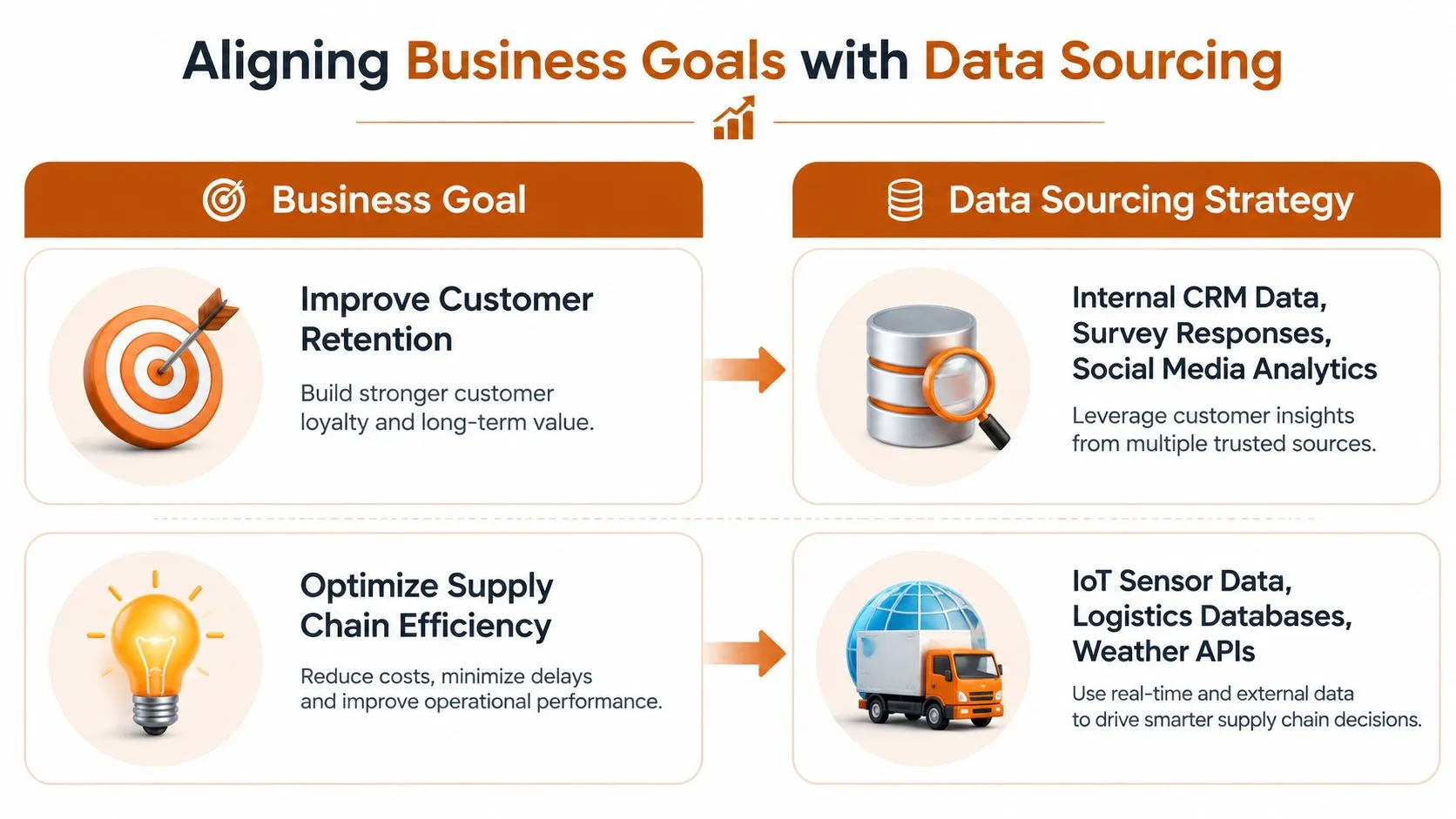
Some ML programs stall because the business asks for a prediction and the data team starts gathering whatever is available. That’s backwards. The job is to convert business objectives into specific data requirements, then choose sourcing methods that fit those requirements.
Translate objectives into data specifications
Start with the operational use case, not the source. A churn model may need customer support interactions, CRM state changes, product usage logs, and complaint signals from public channels. A pricing model may need internal sales history, competitor listings, stock visibility, and category metadata from retail sites.
This is the point where three questions matter:
- What entities are being modeled
- What features describe those entities
- How often do those features change
That exercise usually exposes source mismatches. Internal databases give you control, but often miss external context. APIs are cleaner, but can limit fields, historical access, and update flexibility. Public web data is noisier, yet often captures the actual market behavior the model needs.
Public web collection deserves a place in that mix. Web scraping has emerged as one of the most efficient methods for gathering large-scale public datasets, including data from websites, social media, and articles for sentiment analysis and trend detection, according to this video explanation of web scraping for machine learning. In enterprise work, that matters whenever the missing signal lives outside your walls.
A practical sourcing plan often combines multiple acquisition modes:
- Internal systems for controlled truth: CRM exports, transactional systems, support tickets, warehouse logs, and product telemetry usually anchor entity definitions.
- APIs for stable partner access: They help when a provider offers structured records, authentication, and change management.
- Public web collection for market reality: Competitor prices, product assortments, reviews, job postings, listings, and search results often come from scraping because no complete API exists.
Compare sourcing methods like an operator
The right comparison isn’t “which source is best.” It’s “which source fails in ways we can manage.”
| Method | Data Control | Scalability | Cost Model | Key Challenge |
|---|---|---|---|---|
| Internal first-party data | High | Moderate to high | Infrastructure and engineering time | Gaps in external context |
| Third-party APIs | Medium | Moderate | Usage-based or contract-based | Field restrictions and dependency on vendor limits |
| Public web scraping | Low to medium at source, high after normalization | High | Engineering, monitoring, and infrastructure operations | Site changes, anti-bot controls, and normalization complexity |
The comparison changes further when teams need multilingual or multi-geo coverage. APIs may return a narrow slice of regions or products. Internal data reflects only your customers. Web collection can expand coverage, but it also introduces extraction and governance work.
Collection strategy should diversify risk. If one provider changes terms, one site blocks requests, or one internal system shifts schema, the ML program shouldn’t stop.
For market-facing use cases, teams often use scraping to backfill the blind spots that APIs and internal systems leave behind. That’s particularly true in search, ecommerce, pricing, and localized content workflows. For a practical example of how external web data feeds growth decisions, see how Google data scraping can drive growth for startups and enterprises.
The sourcing plan should end with a matrix, not a wish list. Each source needs an owner, collection method, refresh schedule, compliance note, and fallback plan. If that matrix is missing, the pipeline will eventually become a patchwork of scripts that nobody trusts.
Architecting a Scalable Data Collection Pipeline
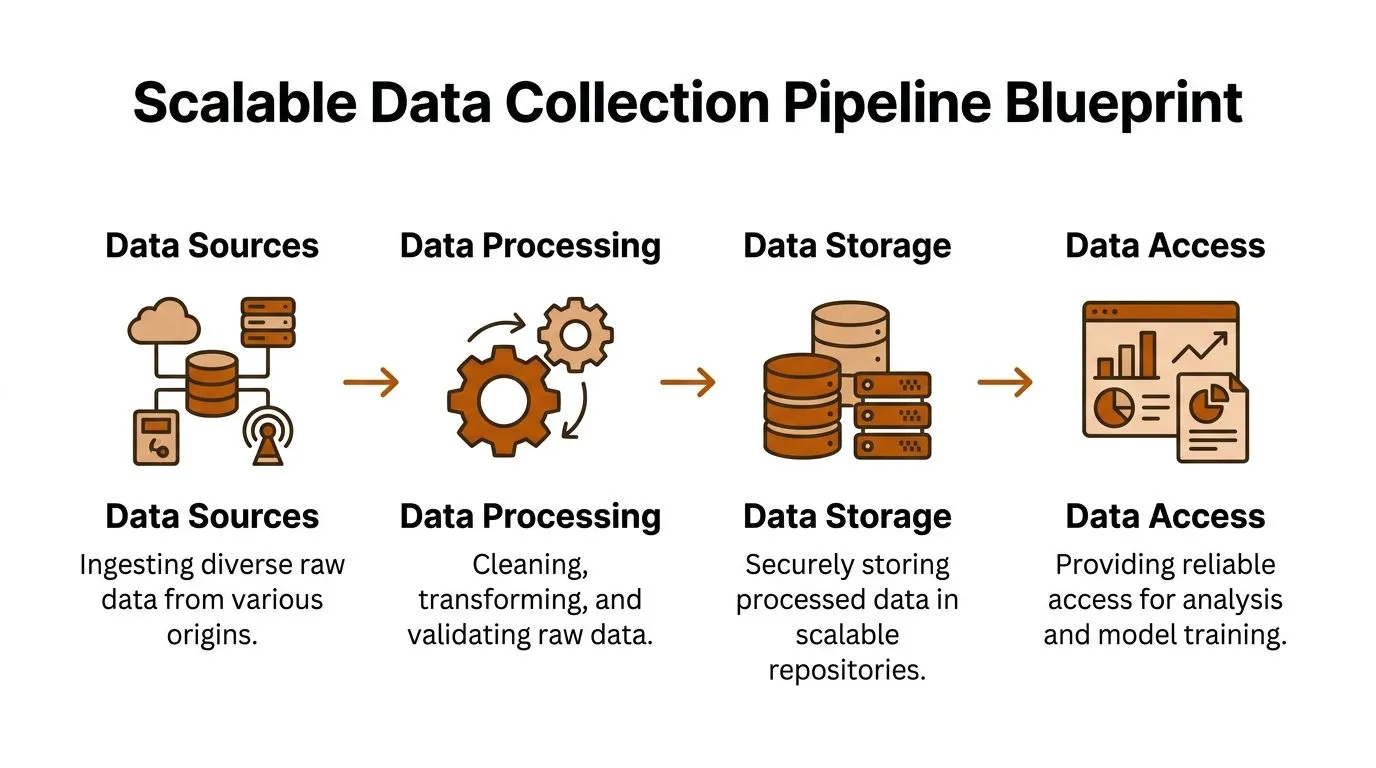
Once sources are approved, substantive engineering begins. Production-grade machine learning data collection is a pipeline discipline. It needs clear stages, fault handling, schema controls, and storage patterns that support both retraining and investigation.
Build the pipeline as a sequence of controlled stages
A reliable pipeline usually has four operational layers: extraction, normalization, enrichment, and delivery. Many teams compress these into a single script, then spend months untangling failures they can’t localize.
For web data in particular, extraction is rarely just an HTTP request. Modern targets often require browser automation for JavaScript-rendered pages, proxy management for geographic variation, and fallback parsers for inconsistent layouts. Some enterprise teams also use visual extraction when critical information appears in images, banners, or rendered components rather than clean HTML.
That’s where adjacent infrastructure matters. If your workflow includes product imagery, scanned artifacts, or screenshot-based evidence, patterns for scalable image processing with S3 are useful because they separate heavy media handling from core record extraction.
A resilient extraction layer should include:
- Retry policies with limits: Not every failure is permanent, but endless retries only hide defects.
- Source-specific adapters: A retail category page, a review feed, and a search result page shouldn’t share one brittle parser.
- Change detection: DOM shifts, renamed fields, and missing blocks need automated checks before bad data propagates.
- Raw capture retention: Save the original response, rendered page, or snapshot so teams can debug parser failures later.
Normalization is where the value gets created. Raw web output has inconsistent units, currencies, text formatting, locale conventions, and identifiers. This stage maps source-specific records into a canonical schema, resolves duplicates, standardizes timestamps, and tags records with lineage metadata.
Scale with feedback, not blind accumulation
Bigger datasets don’t automatically mean better models. A useful guardrail is the 10x data saturation rule, which suggests starting with a training dataset around 10 times the number of model parameters, then scaling in measured increments rather than expanding more than 10x at once without error analysis, as outlined in this technical note on data saturation for ML.
That principle affects pipeline design in a practical way. You need to support staged expansion, replayability, and learning-curve analysis. If engineering only knows how to dump ever-larger data volumes into storage, the ML team can’t tell whether performance changes came from better coverage or more noise.
A good architecture supports that feedback loop:
- Bronze or raw zone: Immutable captures for replay and audit
- Silver or normalized zone: Standardized records with consistent schema
- Gold or training-ready zone: Curated datasets for specific model tasks
If you’re building web collection on Scrapy or similar frameworks, guidance on building scalable data pipelines with Scrapy is useful because it forces separation between crawling, parsing, validation, and export concerns.
One vendor category that fits here is managed pipeline operators. For example, WebscrapingHQ runs custom extraction pipelines with monitoring, retries, anti-bot mitigation, and structured delivery for recurring web data workloads. That kind of service makes sense when internal teams need the data but don’t want scraper maintenance to absorb roadmap capacity.
Implementing Data Quality and Annotation Workflows
Data quality failures usually don’t announce themselves. The pipeline runs, files arrive, dashboards stay green, and the model learns from corrupted or inconsistent labels. By the time someone notices, the problem has already spread into training, evaluation, and downstream decisions.
Validate at ingestion, not after model training
The first control point is the ingestion boundary. Every source should be checked for schema validity, missing critical fields, malformed timestamps, duplicated records, and illegal value patterns before data is accepted into downstream storage.

In practice, teams get the most mileage from simple controls applied consistently:
- Type enforcement: A price field that arrives as free text should fail validation or route to quarantine.
- Range checks: Dates from the future, impossible quantities, and empty identifiers should be flagged immediately.
- Canonical formatting: Normalize casing, units, currency formats, and locale-specific notation before records reach feature engineering.
- Duplicate handling: Decide whether duplicates are valid repeat observations or collection defects. Don’t leave that ambiguity to modelers.
A separate quarantine path matters. If every bad record either gets dropped or accepted without being flagged for review, you lose the ability to improve your collection logic. Teams that take validation seriously maintain a reject table, a reason code, and a review queue. For a broader operational approach, this guide to data validation covers many of the practical controls teams should formalize.
Design annotation as a managed workflow
Annotation is where many promising datasets become unreliable. The common mistake is treating labeling as temporary labor instead of a production process with policy, calibration, and auditability.
One documented pitfall is label inconsistency. Manual or crowdsourced annotation can introduce 15 to 20 percent inter-labeler variance, which degrades supervised model performance, according to this discussion of data collection pitfalls in machine learning. The same source points to two effective mitigations: clear collaborative agreements and maintained data lineage.
That matches what works in practice. Good annotation operations usually include:
- A written labeling guide with edge cases, counterexamples, and escalation rules
- Calibration rounds where multiple labelers review the same sample and discuss disagreements
- Adjudication workflows so one unresolved record doesn’t define policy by default
- Lineage tracking that records source, transformation history, annotator version, and label guideline version
A label is only trustworthy if you can explain the rule that produced it and reproduce the path back to the original source record.
There’s also a trade-off between speed and consistency. Crowdsourcing can move quickly, but domain-specific tasks often require in-house reviewers or expert validators. Programmatic labeling and weak supervision can reduce manual effort, but only if the heuristics are tested against edge cases and reviewed like code.
The right operating model depends on the task. A broad sentiment dataset can tolerate more automation. A compliance classifier, claims processor, or medical text label set usually can’t. The mistake isn’t using one method or another. The mistake is pretending they produce equivalent training data.
Navigating Governance Compliance and Ethical Risks
Governance usually gets delayed until a legal review blocks deployment. By then, the pipeline already exists, the schema is already in use, and the data team is being asked to retrofit controls into a system that was never designed for traceability.
Governance belongs in the pipeline design
Enterprise machine learning data collection needs governance at the record level. Teams should be able to answer four basic questions for any dataset used in training or evaluation:
- Where did this record come from
- What transformations were applied
- Who approved the source and usage
- What restrictions apply to retention, sharing, and downstream use
That isn’t bureaucratic overhead. It’s how you preserve reproducibility, respond to audits, and keep model behavior explainable. If two model versions behave differently, the investigation often starts with data lineage, not code diffs.
The legal dimension is equally practical. Public data collection, partner feeds, and user-generated content all carry different obligations depending on jurisdiction, contract terms, and whether personal information is involved. Teams need written review points before collection starts, not after the first complaint arrives. For teams collecting web data, this breakdown of legal risks in web scraping and how to mitigate them is a useful starting point.

A workable governance checklist usually includes source approval, permitted fields, retention policy, access controls, lineage retention, and incident response for bad or unauthorized data. None of these controls require a giant committee. They require ownership.
Find and fix algorithmic data deserts
Bias is often discussed as skewed outputs. A more operational failure is exclusion through absence. Some populations, regions, or market segments don’t appear in the data with enough consistency for the model to learn from them.
MIT Sloan describes this as algorithmic data deserts, meaning geographic or demographic areas with sparse data where models can fail by producing no predictions for underserved populations, as discussed in MIT Sloan’s article on algorithmic data deserts. That framing matters because many teams only test whether predictions are accurate where data exists. They don’t test where predictions disappear entirely.
Missing coverage is a model failure, even when your aggregate accuracy looks acceptable.
The remediation work is operational, not rhetorical:
- Map coverage gaps: Break datasets down by geography, language, channel, and user segment.
- Inspect null prediction zones: Identify where the pipeline produces too few records to support scoring.
- Adjust sourcing strategy: Add collection methods or partnerships that reach underrepresented groups.
- Review sampling policies: Convenience sampling often creates invisible deserts.
Governance and ethics meet here. A pipeline that’s technically stable but structurally exclusionary is not production-ready. Enterprise teams need to measure not only whether data is valid, but whether coverage is sufficient for the populations their systems are supposed to serve.
Sustaining the Pipeline Monitoring and Delivery
The pipeline isn’t done when records start landing in storage. It’s done when data consumers trust that tomorrow’s delivery will have the same semantics, freshness, and documented quality as today’s. That trust comes from operations.
Monitor pipeline health at three layers
Monitoring job success often stops there. A green orchestration status only tells you the scheduler ran. It doesn’t tell you whether the source changed, the parser degraded, or a critical field dropped to near-zero coverage.
Reliable pipeline monitoring should watch three layers at once:
- Infrastructure health: Runtime failures, queue backlogs, storage write errors, authentication failures, and retry storms.
- Extraction health: Field presence checks, selector breakage, source response anomalies, and unexpected template changes.
- Data quality health: Drift in category distribution, sudden null expansion, duplicate spikes, and record count abnormalities relative to normal collection patterns.
Those layers need different alerting thresholds. Engineering should get immediate alerts for hard failures. Data stewards may need batched alerts for quality degradation. ML consumers should get release notes when schema or business logic changes affect training data.
A practical operating rhythm includes daily automated checks, periodic manual reviews of sampled records, and versioned incident logs. Silent corruption is the most expensive failure mode because it looks like success.
Deliver datasets like a product
Delivery format matters more than teams expect. ML consumers want consistency, not creativity. If one retraining job expects partitioned parquet in object storage and another expects JSON via webhook, the pipeline should formalize those outputs instead of improvising per request.
Strong delivery operations usually include:
- Versioned schemas so feature names and data types don’t change without notice
- Dataset snapshots so experiments can be reproduced against an exact input state
- Defined freshness targets that specify when data should arrive and what delay is acceptable
- Consumer-facing contracts that describe fields, update cadence, known exclusions, and change policy
Here, data as a product becomes more than a slogan. A dataset with owners, documentation, quality checks, version history, and delivery SLAs is something model teams can build around. A folder full of periodic exports is not.
The best long-running pipelines also preserve replayability. When a model drifts or an output is questioned, teams need to reconstruct the exact collection and transformation path that fed training. Without dataset versioning and schema history, root-cause analysis turns into guesswork.
Sustained machine learning data collection depends on discipline more than novelty. Teams need dependable acquisition, explicit validation, annotation controls, governance records, and delivery contracts. When those parts work together, the model team can focus on improving outcomes instead of debugging upstream instability.
If your team needs recurring public web datasets, structured delivery, or managed extraction operations for ML workflows, WebscrapingHQ provides custom web scraping and web data pipeline services built for ongoing enterprise use. They handle source scoping, scraper development, monitoring, anti-bot mitigation, and scheduled delivery in formats such as CSV, JSON, webhooks, S3 drops, and compliance reports, which can reduce the maintenance burden on internal engineering teams.
Want this done for you?
Send us the URLs. We'll quote it in 24 hours.
Paste the URL(s) you want scraped. We'll reply within 24 hours with a feasibility check and a ballpark quote.