Jump to section
- Why Amazon Derived Data Needs Its Own Governance Plan
- What governance protects
- Defining Ownership and Source Taxonomy for Web Derived Data
- Use a taxonomy that reflects risk
- Preserve lineage at record level
- Building Schema Versioning That Survives Amazon Layout Changes
- Separate detection from release
- Measure completeness, not just response success
- Quality Controls and Operational SLAs That Keep Pipelines Reliable
- Set thresholds with definitions attached
- Treat anti-bot events as data-quality failures
- Compliance Retention and Risk Boundaries for Amazon Data
- Make collection decisions field-specific
- Putting Your Governance Plan Into Practice
The dashboard refreshes before the morning pricing meeting, but the Amazon feed is wrong. Several ASINs have blank prices, seller offers appear under the wrong merchant, and a downstream job has treated a blocked page as an out-of-stock product. The scraper technically ran. The data product failed.
That distinction matters. Amazon scraping services aren’t just request-and-response utilities. They support recurring decisions across pricing, catalog intelligence, Buy Box monitoring, retail analytics, and compliance workflows. Once the output feeds another system, the team needs ownership, field definitions, freshness expectations, change controls, and a defensible collection boundary.
Why Amazon Derived Data Needs Its Own Governance Plan
Amazon’s scale makes informal extraction especially fragile. The marketplace was reported to have over 9 million active sellers in 2023, with Chinese cross-border sellers representing 38%, while the seller base continued growing at about 15% annually, according to market context on Amazon scraping infrastructure. The same source described a catalog exceeding 600 million products and reported roughly 2.5 million repricing events per day, conditions that turn a small scraper into an operational data pipeline as soon as coverage expands.
A team may begin by collecting product titles and prices for a category. Soon, merchandising wants variations, finance wants historical observations, sales wants seller offers, and compliance wants evidence of what appeared on a page at collection time. Without governance, each request produces another field, parser, table, or undocumented schedule. Nobody can explain which version is authoritative, whether a missing value means unavailable or blocked, or who must respond when Amazon changes the page.
What governance protects
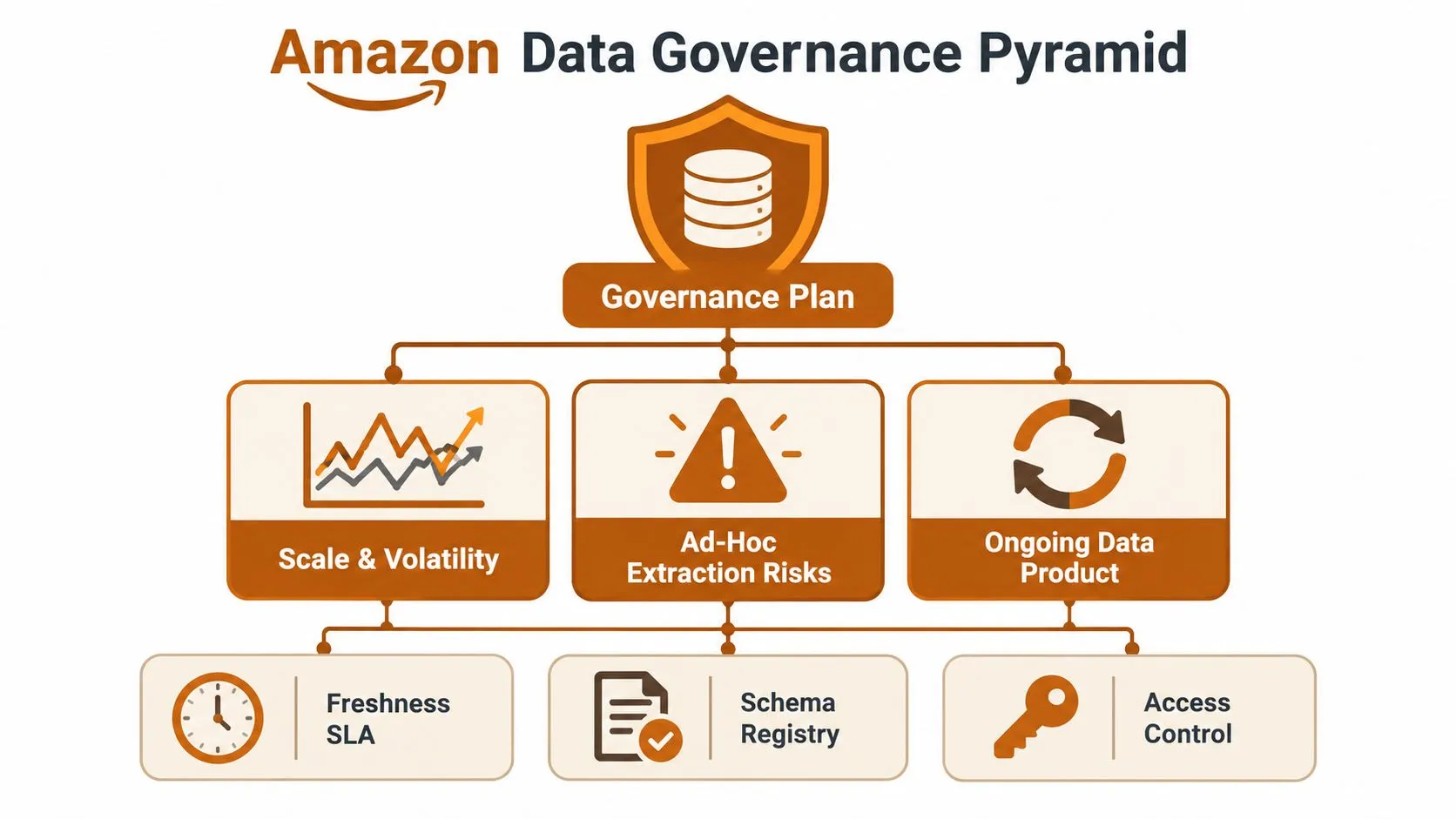
A governance plan protects more than the scraper. It protects the decisions built on the output.
- Operational continuity: Downstream jobs receive explicit status values instead of accepting empty or malformed records.
- Interpretation: A price, seller, review, or availability field carries source, locale, timestamp, and collection status.
- Change management: Layout changes produce a controlled schema or parser release rather than an invisible column change.
- Accountability: A named owner approves source scope, while a steward monitors quality and an engineering team maintains delivery.
- Compliance evidence: The organization can show what it collected, from which surface, under which rule, and for how long it retained the result.
Teams accustomed to master data management will recognize the broader principles in this guide to data governance MDM for business, but Amazon-derived data needs source-specific controls. Product pages, search results, seller surfaces, and review content don’t carry the same operational or compliance risk.
A useful plan starts with a one-page contract. Name the business owner, define the approved sources, list the fields, assign a schema version, state delivery expectations, record acceptable failure behavior, and document retention. Then connect that contract to monitoring and release management.
The benefits of Amazon web scraping for e-commerce websites become dependable only when the collected information behaves like a governed product. Good governance means a consumer can identify the current feed, understand its limitations, trace a record to its source observation, and know what happens when collection falls below the agreed standard.
Defining Ownership and Source Taxonomy for Web Derived Data
Ownership should be assigned before a pipeline is built. “The scraping team owns it” isn’t precise enough because the scraping team may control extraction while merchandising controls the business definition and legal or privacy teams control permitted use.
Start with three roles:
- Data owner: Accountable for business purpose, approved fields, source scope, and acceptance criteria.
- Data steward: Responsible for definitions, lineage, quality review, and issue triage.
- Data consumer: Uses the feed in pricing, analytics, catalog, advertising, or machine learning workflows and confirms whether the output remains fit for purpose.
The owner should maintain a source registry. Each entry needs a stable source name, marketplace and locale, page type, collection purpose, approved fields, access classification, retention rule, responsible steward, and downstream consumers. Record the collection method as well, such as a managed API, browser-based workflow, or an authorized programmatic interface. Teams evaluating account-linked marketplace information may also compare a governed extraction plan with the Amazon SP API with Hopted, particularly when first-party access is appropriate for the use case.
Use a taxonomy that reflects risk
A single label such as “Amazon data” hides important differences. Use source classes that describe both the object and the decision it supports.
| Source class | Typical data object | Governance focus |
|---|---|---|
| ASIN-level product data | Title, brand, images, attributes, availability | Product identity, variation handling, field completeness |
| Search results | Ranking position, displayed products, sponsored placement | Locale, query reproducibility, ranking interpretation |
| Seller profiles and offers | Merchant identity, offer price, condition, fulfillment | Seller matching, offer timestamps, commercial context |
| Pricing history | Observed prices and availability over time | Event time, currency, locale, correction policy |
| Review surfaces | Ratings or review material where collection is permitted | Access boundary, privacy review, retention, text handling |
Preserve lineage at record level
Every normalized observation should retain enough metadata to answer basic audit questions. Store the ASIN or source identifier, canonical source class, marketplace, locale, collection timestamp, schema version, parser or service version, response status, and normalization status. If a field is absent because the page lacks it, use a defined null reason. If the request was challenged, store a failure state rather than mapping the response to “not available.”
This prevents shadow pipelines from becoming unofficial truth. A source registry should also list every scheduled job, destination, owner, and dependency. When a department creates a separate spreadsheet export or vendor feed, register it or retire it. Unlisted copies create conflicting definitions and make deletion or correction requests difficult to execute consistently.
Practical rule: If nobody can name the owner of a field and the reason that field exists, don’t add it to the production schema.
Ownership also determines change response. The steward reviews drift alerts, the owner decides whether a changed field still satisfies the business purpose, and engineering or the managed provider updates extraction logic. That separation keeps technical urgency from expanding collection scope.
Building Schema Versioning That Survives Amazon Layout Changes
Amazon pages don’t behave like a fixed database. Product templates vary by category, marketplace, availability, variation model, and page state. A parser that works for one layout can return plausible but incomplete output on another, which is more dangerous than a visible failure.
A schema registry should define each field by name, type, meaning, source class, null policy, normalization rule, and sensitivity classification. It should also record whether the field is required, conditionally required, or optional. Don’t add columns when a new page element appears. Treat the change as a proposed schema revision.
Separate detection from release
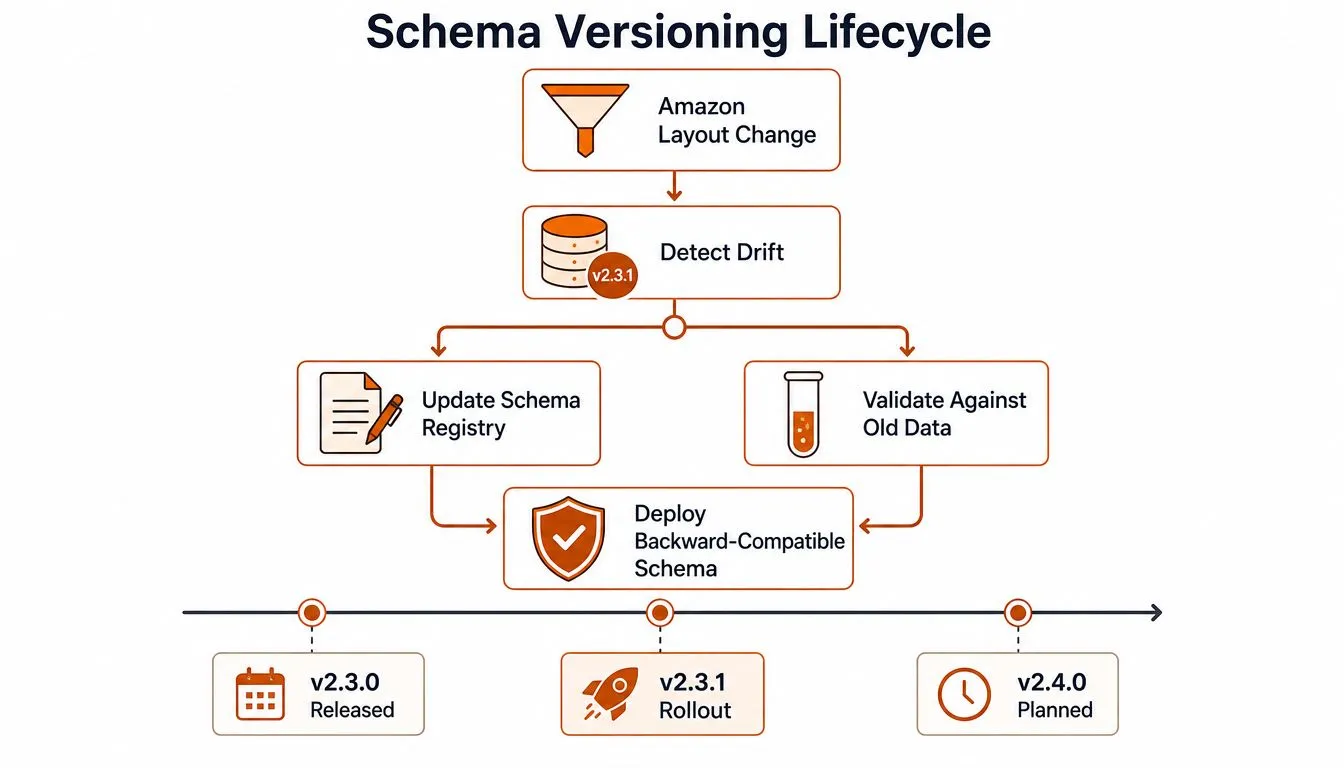
A resilient workflow has distinct stages:
- Detect drift: Compare selectors, labels, field presence, value types, response states, and representative page captures against the current contract.
- Classify the change: Mark it as cosmetic, additive, semantic, or breaking. A renamed label may be cosmetic, while a price field changing from a numeric value to an unparsed string is potentially breaking.
- Update the registry: Record the proposed version, field changes, migration notes, and affected consumers.
- Validate against historical material: Re-run the candidate parser against retained fixtures or approved old observations. Check both extraction success and meaning.
- Deploy deliberately: Release the parser and schema together, with a rollback path and a communication note for consumers.
Version the schema alongside the pipeline release. A record should identify the schema version that produced it, not merely the date it arrived. This lets downstream teams reproduce transformations and prevents a later parser update from changing the interpretation of historical rows.
A practical compatibility policy distinguishes additive and breaking changes. Adding an optional field can preserve the existing contract. Renaming a field, changing units, merging seller and product identities, or altering null semantics requires a migration plan. Keep the prior field during a transition when feasible, populate both versions, and publish a deprecation date in the registry.
Measure completeness, not just response success
An HTTP success response doesn’t prove that the record is useful. A published research pipeline collected 1,181,436 products across five categories and 313 subcategory names, using category seeds, product-page crawling, and field normalization across heterogeneous layouts, as described in the NeurIPS supplemental research pipeline. The relevant lesson is methodological: scale requires consistent schemas across many layouts, not a large request count.
Tool choice also affects output depth. One 2026 benchmark reported structured output ranging from 131 to 686 fields per Amazon product page, documented in coverage of the 2026 anti-bot playbook. Those results don’t establish that more fields are always better. They show why the owner must define the required data product before comparing providers. A broad schema with unstable optional fields may be less useful than a smaller contract with reliable semantics.
For seller monitoring, define identity keys separately from observations. The ASIN identifies the product, while seller, condition, fulfillment, geography, price, and collection time describe an offer observation. The guide to scraping Amazon seller prices is useful background, but production governance still needs explicit keys, deduplication rules, and an empty-offer state.
Quality Controls and Operational SLAs That Keep Pipelines Reliable
Reliability must be measured at the level consumers experience it. A pipeline can report successful requests while delivering stale, partial, mislocalized, or semantically wrong data. Define service levels for freshness, completeness, validity, delivery, and incident response, then measure them against a declared denominator.
Freshness should distinguish collection time from delivery time. A row collected recently but delayed in transport isn’t equivalent to a row collected late. Completeness should count required fields by source class, not every field in a wide schema. Validity checks should confirm currency, numeric formats, ASIN structure, seller identity, and allowed status values without treating every unusual value as an error.
Set thresholds with definitions attached
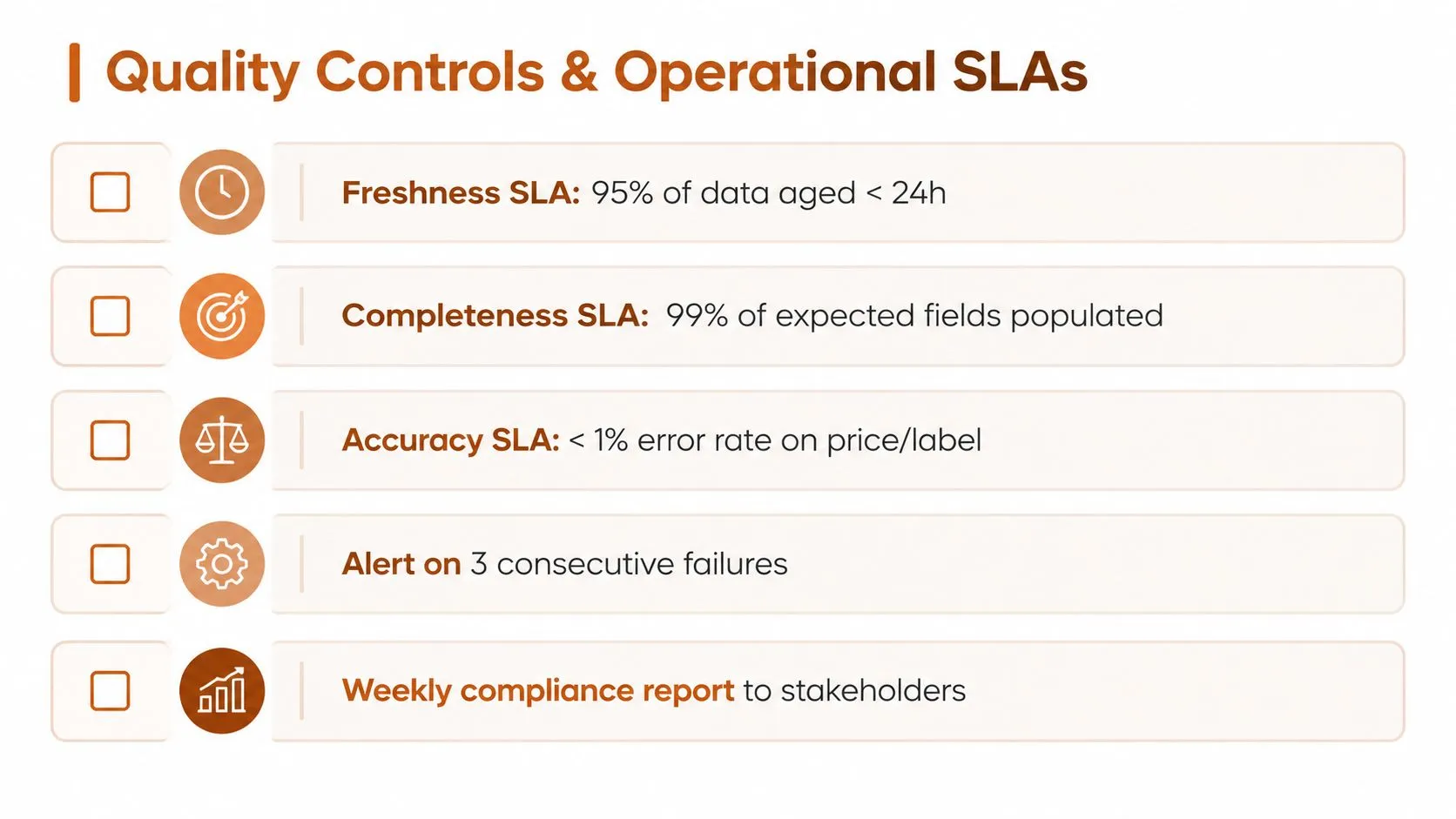
The infographic’s suggested benchmarks include 95% of data aged under 24 hours, 99% of expected fields populated, an error rate below 1% on price or label, alerts after three consecutive failures, and a weekly stakeholder compliance report. These figures are useful as planning examples, not universal guarantees. Adopt them only after measuring baseline performance by marketplace, source class, and collection cadence.
A service-level table makes the contract enforceable:
| Control | Measurement | Response |
|---|---|---|
| Freshness | Age at delivery, split by source class | Alert when the agreed age window is missed |
| Completeness | Required fields populated, with valid null reasons | Quarantine affected partitions and inspect drift |
| Validity | Type, currency, locale, and semantic checks | Reject or flag records before downstream use |
| Availability | Successful usable records, not only HTTP responses | Retry within a bounded budget, then escalate |
| Incident handling | Time to acknowledge, diagnose, and restore | Assign an owner and publish an incident note |
Treat anti-bot events as data-quality failures
Amazon’s defenses evaluate more than HTML. Independent 2026 guidance describes a layered system involving IP reputation, behavioral scoring, session trust, browser or device signals, TLS fingerprinting, and CAPTCHAs, with datacenter proxies reported as immediately vulnerable and residential or mobile IPs described as insufficient without aligned browser fingerprints and timing. The anti-bot guidance for Amazon scraping also associates rapid bursts from one IP with escalation around 8 to 12 requests per minute, while some sessions may remain challenged after a CAPTCHA appears.
Don’t hide these events inside generic retry logic. Classify them as reputation or access-state failures, preserve the response class, and stop retrying aggressively against the same session. Use bounded backoff, session retirement, locale-aware routing, and a retry budget. A retry that repeats the triggering behavior isn’t resilience. It’s an incident amplifier.
The monitoring page should show failure rates by source class, locale, provider route, parser version, and field. Teams responsible for recurring feeds can use monitoring website changes as a complementary change-detection reference, but Amazon operations need content-level checks as well as visual or structural alerts.
Operational insight: A blocked page that looks like an ordinary error can corrupt analytics more quietly than a failed job. Preserve the distinction between unavailable, challenged, missing, and successfully observed.
Compliance Retention and Risk Boundaries for Amazon Data
“Publicly visible” doesn’t mean “risk-free to collect and retain.” Amazon’s Conditions of Use prohibit automated extraction, while courts have generally distinguished publicly accessible information from data obtained by bypassing authentication or collecting personal information. The practical exposure can be civil or contractual even where a particular collection activity doesn’t create the same legal issue as accessing a private account.
That means a compliance program needs a source taxonomy with collection rules, not a blanket statement that scraping is legal. Product and search data may be treated differently from login-walled reviews, authenticated seller surfaces, or information that identifies an individual. Review access has also changed during the recent period covered by the available reporting, including a reported login wall on 2024-11-05, so old assumptions about publicly exposed review paths shouldn’t govern current operations. The legal analysis of Amazon scraping boundaries provides useful context for separating public product and search data from restricted or privacy-sensitive areas.
Make collection decisions field-specific
For every field, document:
- Purpose: The decision or control that requires the field.
- Surface: Product page, search result, seller offer, review surface, or another approved source.
- Access state: Public, authenticated, login-walled, or otherwise restricted.
- Personal-data assessment: Whether the field can identify or describe an individual.
- Retention period: How long raw and normalized forms remain necessary.
- Use restriction: Which teams and downstream systems may access it.
- Deletion path: How the organization removes or suppresses the field from active stores, exports, backups, and derived datasets where required.
Don’t collect the entire page because storage is cheap. Raw captures can help investigate parser changes, but they also increase exposure and retention obligations. Keep the smallest raw artifact needed for quality and audit, then retain normalized fields according to business purpose. Reviews and seller information deserve separate approval because text and profile surfaces can contain personal or sensitive details even when the surrounding page is public.
Cross-border operations add another layer. Organizations operating across markets should streamline cross-border data law by mapping jurisdiction, processing purpose, vendors, transfers, and deletion requirements before launching a multi-geo feed. A compliance review should approve source classes and processing patterns, not merely the vendor contract.
The five steps to GDPR-compliant web scraping can support implementation, but the governing document should remain operational. Record the approved rule, the person who approved it, the date, the affected market, and the trigger for re-review. Reassess when Amazon changes access conditions, when the use case expands, or when a field begins serving a different decision.
Putting Your Governance Plan Into Practice
Start with one category and one marketplace. Define the minimum useful schema, name the owner and steward, register the source, and run the pipeline long enough to measure freshness, completeness, challenge rates, and field stability. Don’t scale a feed because it returns rows. Scale it after the team understands what a valid row means and what happens when collection fails.
A practical rollout sequence looks like this:
- Write the data contract: List required fields, null reasons, identifiers, locale, timestamp, and approved use.
- Register the source: Classify product, search, seller, pricing, or review surfaces and document access boundaries.
- Establish version control: Pair schema versions with parser or provider releases and define breaking-change handling.
- Instrument quality: Measure usable records, required-field completeness, validity, freshness, and delivery exceptions.
- Set response rules: Define retry budgets, quarantine behavior, escalation ownership, and stakeholder reporting.
- Review retention: Separate raw captures, normalized data, derived analytics, and exports under distinct retention rules.
Teams often make three avoidable mistakes. They collect too many fields before proving value, assign “ownership” to a shared inbox, and set SLAs without a baseline or a clear measurement method. Another common error is treating a managed service as a compliance substitute. A provider can manage proxies, retries, parser changes, and scheduled delivery, but the customer still owns purpose, approved scope, retention, and downstream use.
For organizations comparing operating models, WebscrapingHQ is one managed option that provides custom extraction, monitoring, alerting, retries, proxy management, schema versioning, and scheduled delivery across formats such as CSV, JSON, webhooks, and storage drops. In-house teams may prefer direct control for narrow, stable workloads, while managed operations can absorb recurring site changes when maintenance would otherwise distract product engineers.
Use data governance policy examples to turn the plan into a signed operating document. Review the checklist on a fixed schedule, test one failure scenario deliberately, and require approval before expanding fields or source surfaces.
If your team needs Amazon product, seller, pricing, or marketplace data on a recurring schedule, WebscrapingHQ can design and operate a governed extraction pipeline around your schema, quality controls, compliance boundaries, and delivery SLA. Visit WebscrapingHQ to scope a pilot category, define the data contract, and establish an operating model before scaling.
Want this done for you?
Send us the URLs. We'll quote it in 24 hours.
Paste the URL(s) you want scraped. We'll reply within 24 hours with a feasibility check and a ballpark quote.