Jump to section
- Table of Contents
- The Hard Truth About Facebook User Scrapers in 2026
- The surfaces that remain useful
- What Data You Can Actually Access
- A practical surface map
- Build around surfaces, not reverse-engineered endpoints
- The Three Legal Layers Most Guides Confuse
- Platform permission
- Privacy obligations
- Substantive liability
- How Scraping Operations Scale From One User to Millions
- Where the risk changes character
- Building a Production Pipeline That Survives Meta’s Defenses
- Design for controlled access
- Make failure visible
- DIY Tools, Scraping APIs, and Managed Services Compared
- Operational Best Practices for 2026 and Beyond
- Pipeline resilience
- Compliance guardrails
- Data quality and lineage
- Frequently Asked Questions About Facebook User Scraping
- Does the Meta Graph API replace scraping for user profiles?
- Can you scrape Facebook Marketplace listings?
- How can you identify a fake Facebook scraper vendor?
- Are residential proxies still required?
- What should you do when a CAPTCHA appears?
- What does GDPR mean for public Facebook data?
- Do AI scrapers face additional rules?
- What does a Facebook User Scraper cost per 1,000 records in 2026?
In 2026, a Facebook User Scraper that promises unrestricted personal-profile data is usually either ineffective, dependent on login sessions that violate Meta’s terms, or built around data you shouldn’t be collecting. The durable workflows target public Pages, public groups, Marketplace listings, and ads, not private user profiles.
That answer challenges the most popular advice about Facebook scraping. Many tutorials still treat Facebook as a collection of predictable profile pages, where an automated browser can gather names, emails, friends, reactions, and contact details at scale. That model no longer describes a defensible production workflow.
The practical opportunity has moved toward public Facebook intelligence. Public Pages can support brand and competitor monitoring. Public group posts can reveal openly shared market signals where access is available without authentication. Marketplace can support listing research, while the Meta Ad Library can support ad verification and creative monitoring. Personal profiles, private groups, messages, friend-only content, and profile enrichment are a different category entirely.
The distinction matters for teams that need reliable information without turning a data pipeline into a privacy or platform-compliance problem. Someone researching how to protect your e-commerce identity is dealing with the same underlying reality from the opposite direction: public visibility doesn’t mean unlimited reuse.
Table of Contents
Open Table of Contents
- The Hard Truth About Facebook User Scrapers in 2026
- What Data You Can Actually Access
- The Three Legal Layers Most Guides Confuse
- How Scraping Operations Scale From One User to Millions
- Building a Production Pipeline That Survives Meta’s Defenses
- DIY Tools, Scraping APIs, and Managed Services Compared
- Operational Best Practices for 2026 and Beyond
- Frequently Asked Questions About Facebook User Scraping
- Does the Meta Graph API replace scraping for user profiles?
- Can you scrape Facebook Marketplace listings?
- How can you identify a fake Facebook scraper vendor?
- Are residential proxies still required?
- What should you do when a CAPTCHA appears?
- What does GDPR mean for public Facebook data?
- Do AI scrapers face additional rules?
- What does a Facebook User Scraper cost per 1,000 records in 2026?
The Hard Truth About Facebook User Scrapers in 2026
The phrase Facebook User Scraper promises a product that Facebook generally doesn’t offer openly. A vendor may advertise profile discovery, email extraction, friend graphs, or bulk user enrichment, but the implementation often depends on one of three weak foundations: recycled datasets, logged-in sessions subject to Meta’s terms, or automation that stops working when detection systems change.
A tool can return records and still be a poor production choice. If it needs a customer’s personal cookies, its access can disappear with a checkpoint or account lock. If it relies on undocumented mobile requests, a small change in authentication or response structure can invalidate the parser. If it claims to collect private profile fields without consent, the central problem isn’t technical reliability. It’s whether the workflow should exist at all.
Meta has described investing in teams and systems that detect suspicious activity and unauthorized automation, and it has taken legal action against scraping operations in its own account of anti-scraping enforcement. That means production collection faces behavioral analysis, rate controls, account reputation checks, and anomaly detection. Simple URL blocking isn’t the whole defense.
The surfaces that remain useful
A defensible Facebook data operation normally starts with sources that a visitor can view while logged out:
- Public Pages, including page identity, descriptive metadata, visible posts, and other openly displayed information.
- Public group content, where posts are visible to unauthenticated visitors and collection is permitted by the use case.
- Marketplace listings, where public listing details can support catalog or market research.
- The Meta Ad Library, which provides public advertising information for monitoring and verification work.
The word “public” doesn’t settle every legal question, but it changes the technical and governance profile. A pipeline that captures public Page posts for brand monitoring is materially different from one that traverses personal profiles to assemble identity records.
Practical rule: If your requirement begins with “find every Facebook user who…”, rewrite the requirement around a public entity, public post, listing, or advertisement before choosing a scraper.
The boundary is sharper than vendor marketing suggests. Public content can be collected carefully, documented, minimized, and reviewed. Profile-level harvesting is fragile, difficult to justify, and likely to trigger the very defenses that make the product unreliable.
What Data You Can Actually Access
Start by separating logged-out public surfaces from login-gated or consent-gated data. This is more useful than asking whether Facebook as a whole is scrapable.
A public Page may expose its name, category, about text, follower count, and recent visible posts without authentication. Public group posts can sometimes be viewed in the same way, although visibility varies by group settings and page behavior. Marketplace listings may expose fields such as the listing title, price, location, description, and images. The Meta Ad Library makes advertiser identity, creative, and certain ad-related information available for public inspection, with political and social-issue advertising receiving particular transparency treatment.
The opposite category includes personal email addresses, phone numbers, friend graphs, private messages, friend-only posts, and private-group content. A profile may show a name and other limited public information, but that doesn’t create a dependable route to the underlying person’s broader account data.
A practical surface map
| Data Surface | Logged-Out Access | Likely Meta Response |
|---|---|---|
| Public Page metadata and visible posts | Often accessible, subject to page visibility and change | Rate limiting, markup changes, challenge pages |
| Public group posts | Variable, depending on group settings and visibility | Login prompts, restricted rendering, throttling |
| Marketplace listings | Public listings may be viewable | Dynamic rendering, session checks, challenge flows |
| Meta Ad Library records | Public advertising records are available | Interface changes, request controls, schema changes |
| Personal profile contact fields | Generally unavailable without consent or authorized access | Blocked, omitted, or login-gated |
| Friend graphs and private content | Not a defensible logged-out surface | Access denial, authentication requirements |
| Direct messages | Not publicly accessible | Authentication and permission controls |
The Graph API doesn’t restore the old profile-scraping model. Access is constrained by permissions, product rules, and the assets or data scope an application is authorized to use. Older “public profile” assumptions often reduce to a small identity response rather than the broad enrichment fields that earlier scrapers advertised.
Build around surfaces, not reverse-engineered endpoints
A durable pipeline records the exact source surface, access state, capture time, parser version, and intended purpose. That makes it easier to remove fields that aren’t necessary and to improve data governance with classification before the information reaches analytics, sales, or advertising systems.
The engineering principle is straightforward: extract what Facebook intentionally leaves public, not what an undocumented endpoint briefly reveals. That choice reduces breakage and gives legal, security, and data-governance teams something concrete to review.
The Three Legal Layers Most Guides Confuse
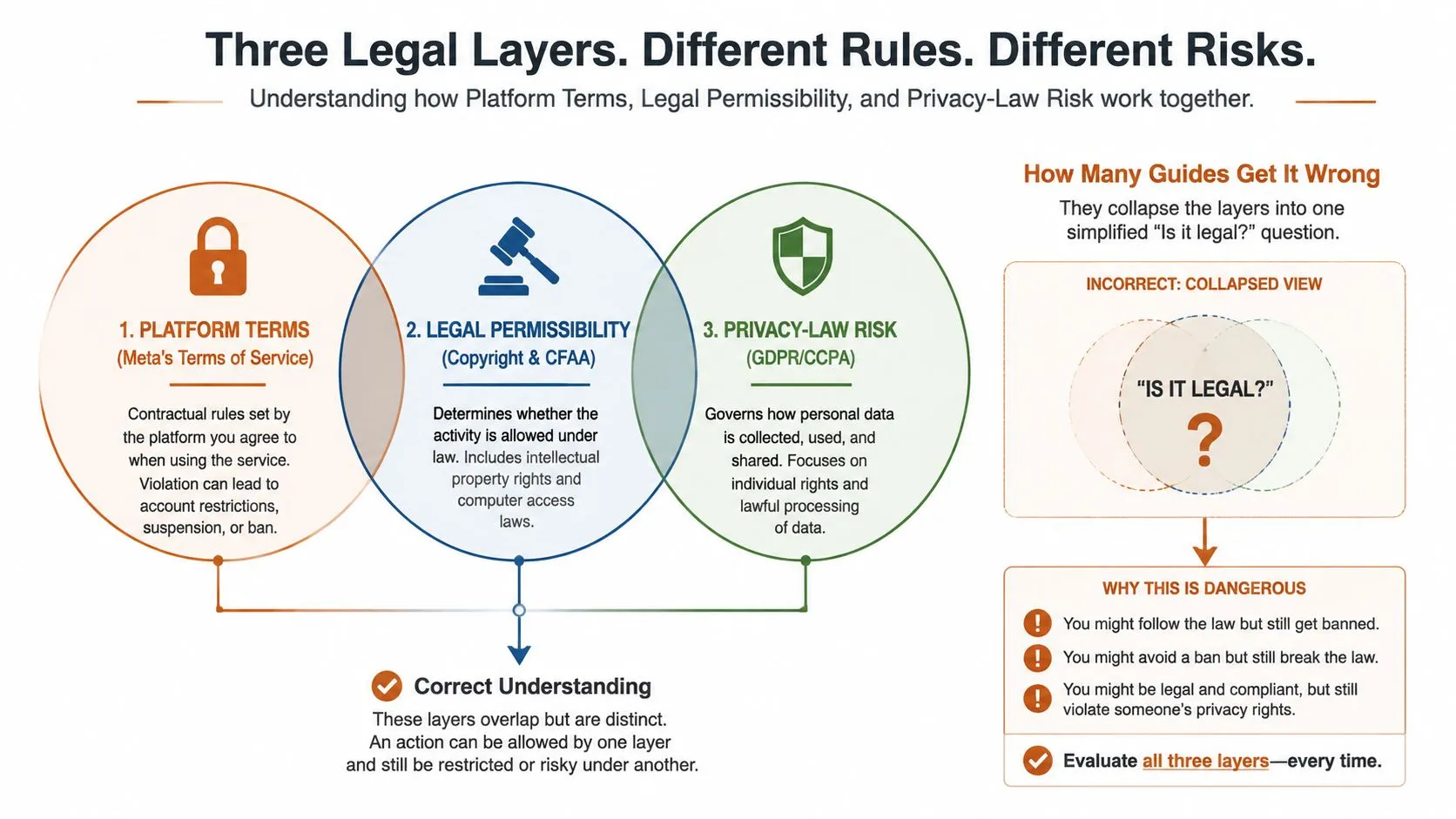
“Is Facebook scraping legal?” is too compressed to guide a real project. A useful review separates three questions: does the law permit the collection, does Meta permit it under its platform terms, and what privacy obligations arise when the resulting data identifies people?
Platform permission
Meta’s Terms restrict automated collection of user content without permission. A public post may be visible in a browser, yet automated extraction can still conflict with the platform contract. That distinction is why a technically successful request doesn’t prove that the workflow is permitted.
The U.S. public-data cases often discussed in scraping disputes can inform the legal-permissibility analysis, but they don’t erase contractual terms or guarantee protection for every implementation. Teams should review the exact target, account setup, access method, and intended use rather than rely on a general statement that public pages are safe.
Privacy obligations
GDPR and CCPA can apply to personal data even when a person posted it publicly. The relevant question isn’t only whether a visitor could see the content. It also includes the purpose of collection, the lawful basis for processing, minimization, retention, transparency, access rights, deletion requests, and onward sharing.
A public Page post can become more sensitive after it is joined with another dataset. For example, a post that is relatively low risk in isolation may become a personal profile when connected to a name, location, employment record, or behavioral history. Reselling or distributing the joined output increases the governance burden.
Substantive liability
Privacy statutes aren’t the only concern. Contract claims, copyright questions, intrusion theories, breach-of-confidence arguments, and computer-access laws can turn on facts such as authentication, bypassing controls, collection method, and downstream use. The right review therefore has to test each layer independently, using a structured risk assessment such as this guide to legal risks in web scraping and mitigation.
Working model: Public visibility may support a legal argument, but it doesn’t provide platform permission or remove privacy-law duties.
A project clears the first layer only when the relevant law supports the collection. It clears the second only when the platform relationship permits the activity or an agreement authorizes it. It clears the third only when the organization can explain why it collects, stores, uses, and shares the data. Clearing one layer never clears the other two.
How Scraping Operations Scale From One User to Millions
The Cambridge Analytica episode shows how quickly a narrow collection route can become a population-scale exposure. The quiz app reportedly reached about 270,000 people who installed it, yet its design could also access friends’ data, with profiles from roughly 200 to 300 friends per participant collected over a few months. Facebook later described the impact as affecting up to 87 million users worldwide, revising an earlier estimate of 50 million in an episode that surfaced publicly in March 2018. These figures are documented in this account of the Cambridge Analytica scandal.
The important lesson isn’t a particular scraping library. It’s the amplification mechanism. A small application, a broad permission model, and access to connected social data can produce an output far larger than the original participant set.
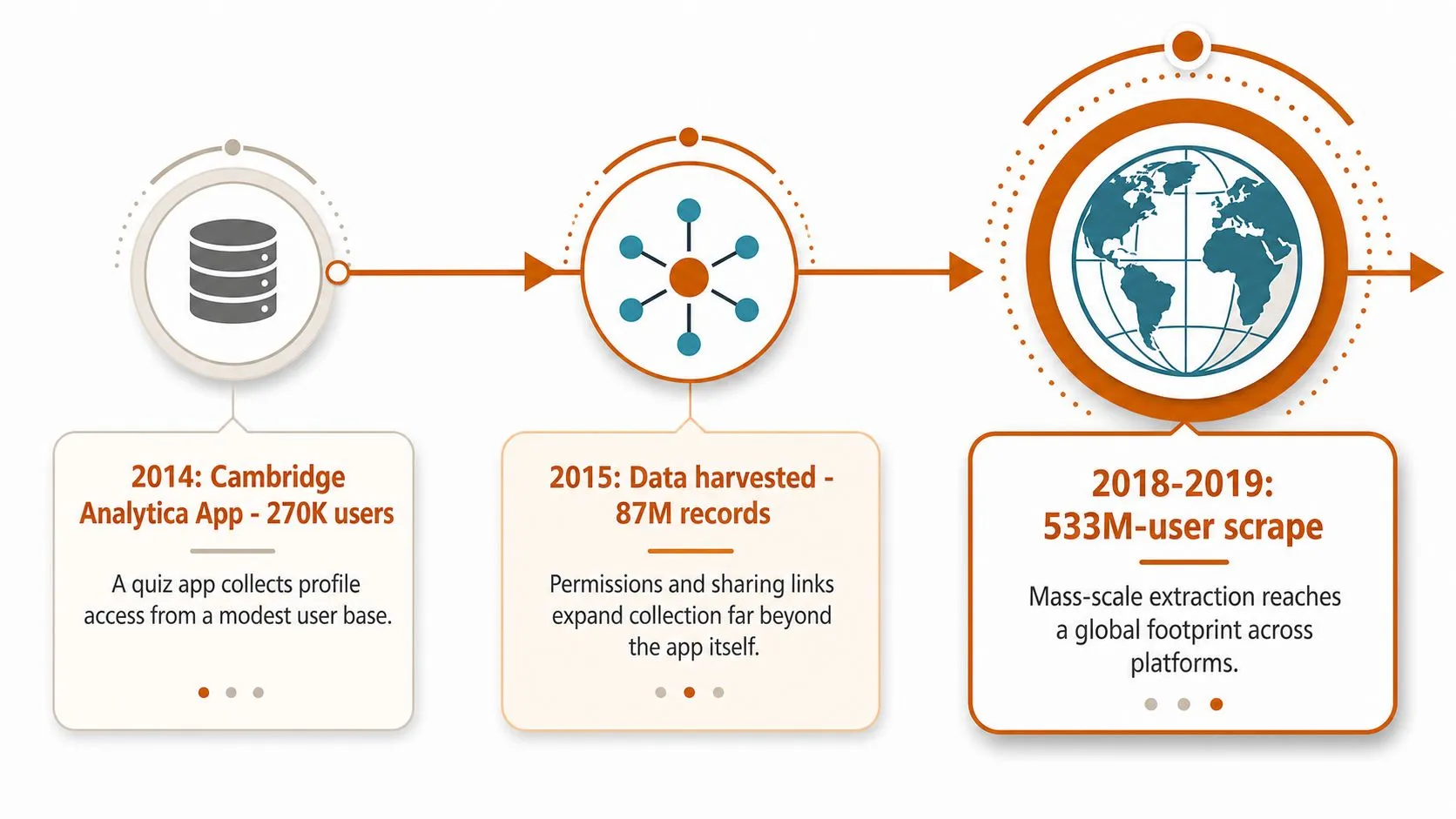
A later event demonstrates the industrial version of the same problem. Meta said a scraping event ran from January 2018 through September 2019 and was disclosed in 2021. Court and press reporting estimated that it affected about 533 million Facebook users across 106 countries. Separate U.S. court filings described another scraper targeting roughly 178 million users during at least part of that period and offering a dataset of about 180 million users. Reuters’ reporting on the litigation and figures places those events in the wider legal context.
Where the risk changes character
A test pull of a few hundred public records can become a much more serious operation when the team adds identity matching, graph traversal, automated account access, contact importing, resale, or sharing with third parties. The technical system may evolve from a parser into a distributed collection network, with many sessions, proxy routes, and queues designed to maintain throughput against platform defenses.
That transition matters because the output is no longer just research material. It begins to resemble a data-broker asset, especially when records are joined, scored, sold, or used to make decisions about identifiable people. Teams building legitimate pipelines should document the intended surface and stop the design before it crosses into profile harvesting.
For general engineering patterns such as retries, queues, validation, and schema versioning, scalable data pipelines with Scrapy offers useful architectural context. Those patterns don’t authorize access to restricted Facebook data. They only help organize collection that has already passed the access and governance review.
Building a Production Pipeline That Survives Meta’s Defenses
A defensible pipeline starts with scope, not evasion. Define the public surface, permitted geography, fields, retention period, and stop conditions before an engineer writes a browser script. If the requirement depends on personal profiles, private content, or unauthorized logged-in access, changing the proxy pool won’t solve the underlying problem.
For public Pages, groups, Marketplace, or ads, separate the system into acquisition, parsing, validation, storage, and monitoring. Use a queue so work can pause cleanly when the site changes. A practical proxy-server selection guide for web scraping can inform infrastructure choices, but proxies shouldn’t be treated as permission or as a way to defeat account controls.
Design for controlled access
Use an access method appropriate to the surface. Official APIs are preferable where the account, application, or research program is eligible. A browser renderer may be necessary for dynamic public listings, but it should operate only on approved pages and data fields.
Rate limiting should be keyed to the actual operational dimensions:
- Per-IP budget: Prevent a single network identity from producing an unnatural burst.
- Per-session budget: Stop one session from becoming the sole collection instrument.
- Per-endpoint budget: Treat Pages, groups, Marketplace, and ad interfaces as separate workloads.
- Queue backoff: Pause and retry cautiously after timeouts, challenge pages, or access denials.
Request headers, navigation paths, and device profiles should be internally consistent. A request that claims to be mobile while behaving like a high-speed automated crawler creates a quality and reliability problem, even when the target is public.
Make failure visible
Store structured events for challenge pages, redirects, authentication prompts, response-shape changes, parser exceptions, and unexpected drops in returned fields. Keep raw responses where the use case and policy permit, then version the parser so a later reprocessing run can be explained.
A kill switch should disable one source, route, session, or parser without taking down every other job. The goal isn’t to make automation indistinguishable from a person. The goal is to keep a legitimate, limited collection process slow enough to audit and easy enough to stop.
DIY Tools, Scraping APIs, and Managed Services Compared
The choice between a custom scraper, a scraping API, and a managed operation isn’t mainly about programming language. It concerns who owns breakage, who reviews the data source, and how much uncertainty the buyer can tolerate.
A DIY stack built with Playwright or Selenium, a proxy provider, custom selectors, and internal monitoring offers the most control. It can be economical for a narrow public Page workflow and lets engineers adapt the schema to a particular business need. The trade-off is ongoing maintenance. Every access change, challenge flow, and markup revision becomes an internal ticket.
Scraping APIs sit between code ownership and outsourcing. Providers such as Bright Data, Apify, and ScraperAPI may offer preconfigured extraction routes for public surfaces. They can shorten implementation time, but buyers should ask how success is measured, which surfaces are covered, how source changes are handled, and whether the contract provides any data-source warranty or indemnity.
Managed services such as Zyte, Grepsr, or PromptCloud absorb more of the operational burden. They typically cost more than an internal parser, but they can own monitoring, retries, schema normalization, delivery, and source-specific maintenance. Contract language still matters. A service agreement doesn’t automatically make a restricted collection lawful.
| Dimension | DIY, Playwright + Proxies | Scraping API, Bright Data or Apify | Managed Service, Zyte or Grepsr |
|---|---|---|---|
| Upfront cost | Engineering time and infrastructure | Lower implementation burden | Scoping and onboarding effort |
| Monthly run rate | Infrastructure plus maintenance | Usage fees and plan costs | Recurring service fees |
| Defense reliability | Depends on internal expertise | Provider-controlled and partly opaque | Provider manages operations and escalation |
| Schema stability | Internal team owns every parser change | Provider controls extractor updates | Service team owns schema and delivery process |
| Legal exposure | Internal team carries source review | Contract terms vary, buyer remains responsible | Review is shared through scope and agreement, not eliminated |
| Best fit | Narrow, controlled public-source projects | Fast validation and standardized outputs | Recurring, compliance-sensitive data operations |
Use this guide to choosing data extraction tools to turn the decision into a requirements exercise. Ask whether you need raw HTML, normalized records, screenshots, provenance, scheduled delivery, or a compliance report. The cheapest request path can become the most expensive option once failed runs and manual review enter the calculation.
Operational Best Practices for 2026 and Beyond
Reliable Facebook data operations look deliberately unremarkable. They run at controlled rates, preserve provenance, validate every field, and stop when access conditions change. A fast extractor that cannot explain where a record came from is a liability, not a production system.
Pipeline resilience
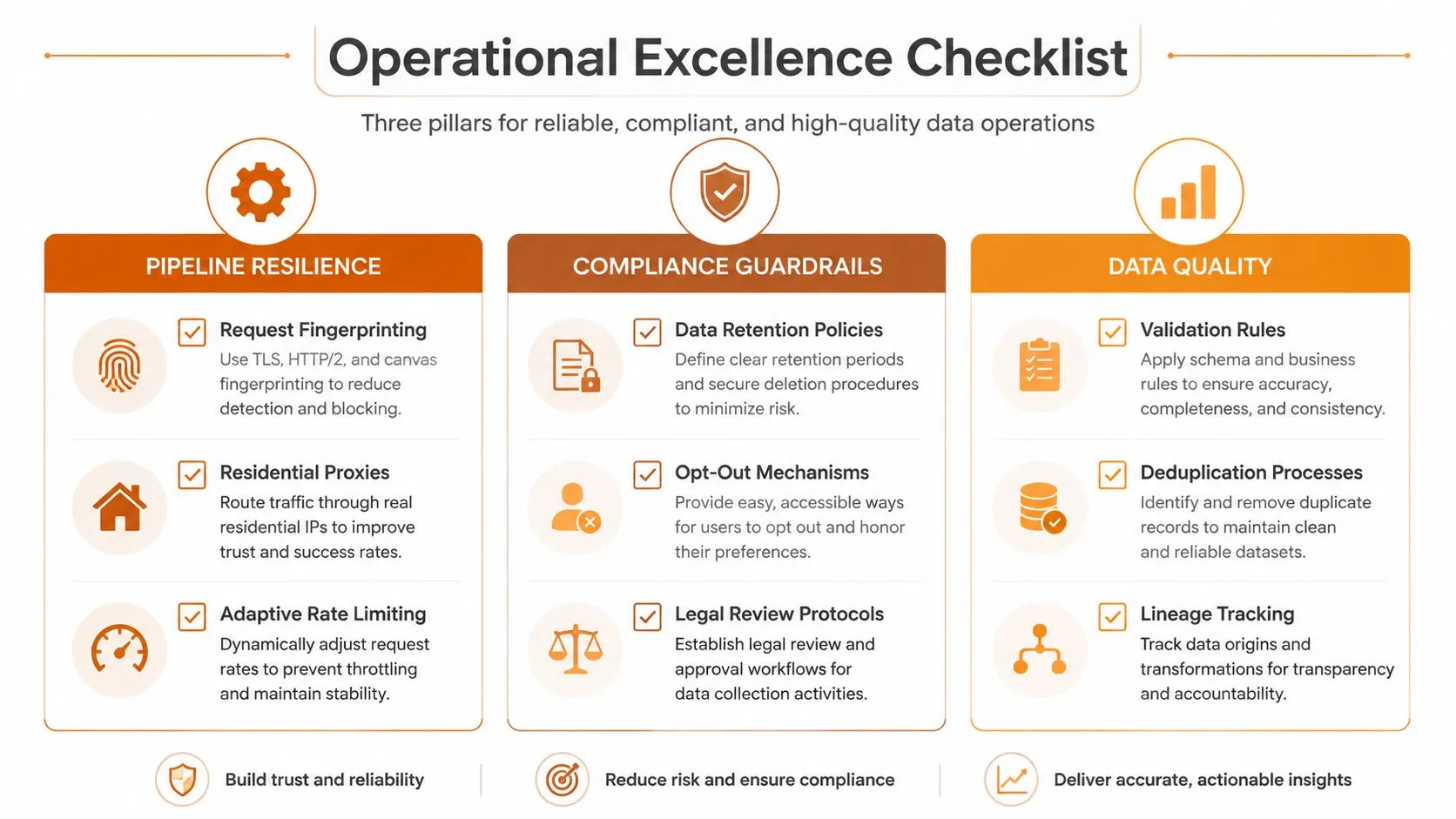
Use request fingerprinting to keep sessions internally coherent across transport and browser signals. Residential or mobile routing may reduce network-level friction, but adaptive backoff and session hygiene matter just as much. Close browser automation leaks, isolate failed sessions, and avoid retry loops that turn a temporary challenge into a sustained burst.
Monitor the pipeline at the source and parser levels. A successful HTTP response can still contain a login wall, an interstitial, or an empty shell. Alert on changes in returned fields, not only on transport failures.
Compliance guardrails
Add a legal review checkpoint whenever the team introduces a new surface, authentication state, geography, or downstream use. Record consent signals for any authorized logged-in workflow, define an opt-out process, limit collection to necessary fields, and document why the business needs each field.
A retention rule should be enforceable in storage, backups, exports, and downstream systems. Public availability doesn’t remove the need for a lawful basis when personal data is processed. Teams handling European data can use these steps for GDPR-compliant web scraping as a starting point, then obtain advice for the specific use case.
Data quality and lineage
Validate schemas at ingestion and reject records with missing identifiers or unexpected types. De-duplicate posts and listings using stable identifiers where available, then use content similarity methods for near-duplicates when the use case requires it.
Tag every record with its source surface, capture timestamp, parser version, access state, and processing history. The accompanying operational checklist summarizes the controls that belong together.
Audit standard: You should be able to explain why each field was collected, how it was obtained, when it was captured, and when it will be deleted.
Frequently Asked Questions About Facebook User Scraping
Does the Meta Graph API replace scraping for user profiles?
No. API access is governed by permissions, product scope, and eligibility, and it doesn’t provide unrestricted profile enrichment. For Pages or assets your organization manages, an approved API route is usually more stable than scraping.
Can you scrape Facebook Marketplace listings?
Public listings may be accessible for approved research or monitoring use cases. Seller history, private seller information, and account-level enrichment aren’t equivalent public surfaces and shouldn’t be assumed to be available.
How can you identify a fake Facebook scraper vendor?
Be cautious with lifetime-access pricing, claims that a tool extracts profile emails at scale, and vendors that won’t document their data sources or access method. Ask for field-level examples, source boundaries, change-management terms, and a clear explanation of how personal data is handled.
Are residential proxies still required?
Network routing alone doesn’t make a workflow compliant, and requirements vary by approved surface. Datacenter traffic is commonly more exposed to platform defenses, so teams often evaluate residential or mobile routes alongside conservative rate controls and session management.
What should you do when a CAPTCHA appears?
Stop increasing concurrency. Back off, recycle the affected session through an authorized process, record the challenge, and review whether the workload is too broad or too fast. CAPTCHA-solving farms create additional legal, security, and account risks.
What does GDPR mean for public Facebook data?
Public posts can still contain personal data. Processing requires a documented lawful basis and appropriate controls for purpose, minimization, transparency, retention, access, and deletion.
Do AI scrapers face additional rules?
The technical challenge is behavioral as well as textual. Meta’s detection systems can assess patterns such as navigation, timing, session behavior, and request consistency, so adding an AI parser doesn’t remove the need for controlled collection and policy review.
What does a Facebook User Scraper cost per 1,000 records in 2026?
The stated market range is $3 to $18 per 1,000 records, depending on the surface and vendor, as reflected in the supplied brief. Treat that figure as a buying reference, not a promise, because record definitions, failed requests, rendering, proxies, storage, and compliance work can change the effective cost.
WebscrapingHQ offers custom scraper development and managed web data operations for defined public-source use cases, including scheduled extraction, monitoring, retries, schema controls, and structured delivery. Visit WebscrapingHQ to discuss a Facebook data workflow built around an approved surface rather than an unrealistic promise of unrestricted user-profile harvesting.
Want this done for you?
Send us the URLs. We'll quote it in 24 hours.
Paste the URL(s) you want scraped. We'll reply within 24 hours with a feasibility check and a ballpark quote.