
Jump to section
- Table of Contents
- Why Most OpenSea Scrapers Fail at Scale
- Defining Your NFT Market Research Data Strategy
- Start with the downstream use case
- Define fields before extraction logic
- Include governance in the strategy, not after launch
- Comparing OpenSea Data Collection Methodologies
- Where DIY scripts break
- Comparison of OpenSea Data Collection Methods
- APIs solve some problems, not the hard ones
- Managed operations fit when failure has a business cost
- Architecting a Resilient OpenSea Data Pipeline
- Use a two-pass crawl design
- Build around anti-bot reality
- Treat metadata as a normalization problem
- Data Governance and Compliance in NFT Analytics
- Data quality needs explicit controls
- Compliance belongs inside engineering decisions
- Turning OpenSea Data Into Actionable Intelligence
Most advice on building an OpenSea scraper is optimized for demos, not operations. A short Python script can fetch a page, parse a few fields, and look convincing in a tutorial. That doesn’t mean it produces a dataset you can trust for valuation models, market intelligence, or training pipelines.
The gap shows up the moment a team needs continuity instead of a one-time export. OpenSea data is shaped by JavaScript-rendered pages, anti-bot controls, and collection-scale edge cases that simple scripts usually ignore. Teams that treat this like a lightweight scraping task often end up debugging missing items, stale metadata, blocked sessions, and inconsistent schemas long after the first prototype looked “done.”
Table of Contents
Open Table of Contents
Why Most OpenSea Scrapers Fail at Scale
OpenSea scraping stops being a scripting task as soon as the data has to stay complete, current, and internally consistent over time. That is an engineering problem with failure modes around session management, pagination limits, anti-bot controls, and metadata drift.
DIY examples usually prove that a request can be made. They do not prove that a collection can be captured end to end, refreshed on schedule, and stored in a form analysts can trust. The same pattern shows up in adjacent ecommerce monitoring work. Teams focused on understanding Google Shopping data run into the same wall once they need stable coverage instead of a one-off sample.
OpenSea makes that wall harder to ignore.
A script that fetches floor price snapshots or a few pages of listings can look successful in testing. Production workloads are less forgiving. OpenSea enforces practical limits that break naive crawlers, including the 10K item ceiling that blocks simple collection-wide extraction paths, anti-bot defenses that degrade long-running sessions, and dynamic metadata that changes after the first crawl. If the output feeds analytics, model training, or recurring reports, the scraper has to be designed as a pipeline from day one.
Site behavior is the first place these systems fail. Sustained collection typically requires valid session state, proxy rotation, User-Agent management, retry discipline, and backoff tuned for rate limits and temporary blocks. Tutorials often mention retries and leave the hard parts implicit. In practice, incomplete pages, expired browser state, and intermittent 403 or 429 responses create silent gaps unless the pipeline records what was missed and schedules recovery.
The second failure point is system design. A scraper that works on a developer laptop can still collapse under concurrency, partial reruns, and browser-state drift across workers. Reliable collection depends on queue control, idempotent jobs, checkpointing, and replayable failure handling. The patterns in distributed web scraping fault tolerance basics map directly to OpenSea workloads because the primary challenge is not extraction alone. It is recovering cleanly without duplicating records or leaving holes in the dataset.
That is where hobby code usually breaks. It can collect some records. It rarely preserves coverage, continuity, and data integrity at the standard enterprise analytics requires.
Defining Your NFT Market Research Data Strategy
The strongest OpenSea scraper starts with a schema, not a script. Teams get into trouble when they collect whatever is visible on the page and only later ask whether the dataset supports a real decision.
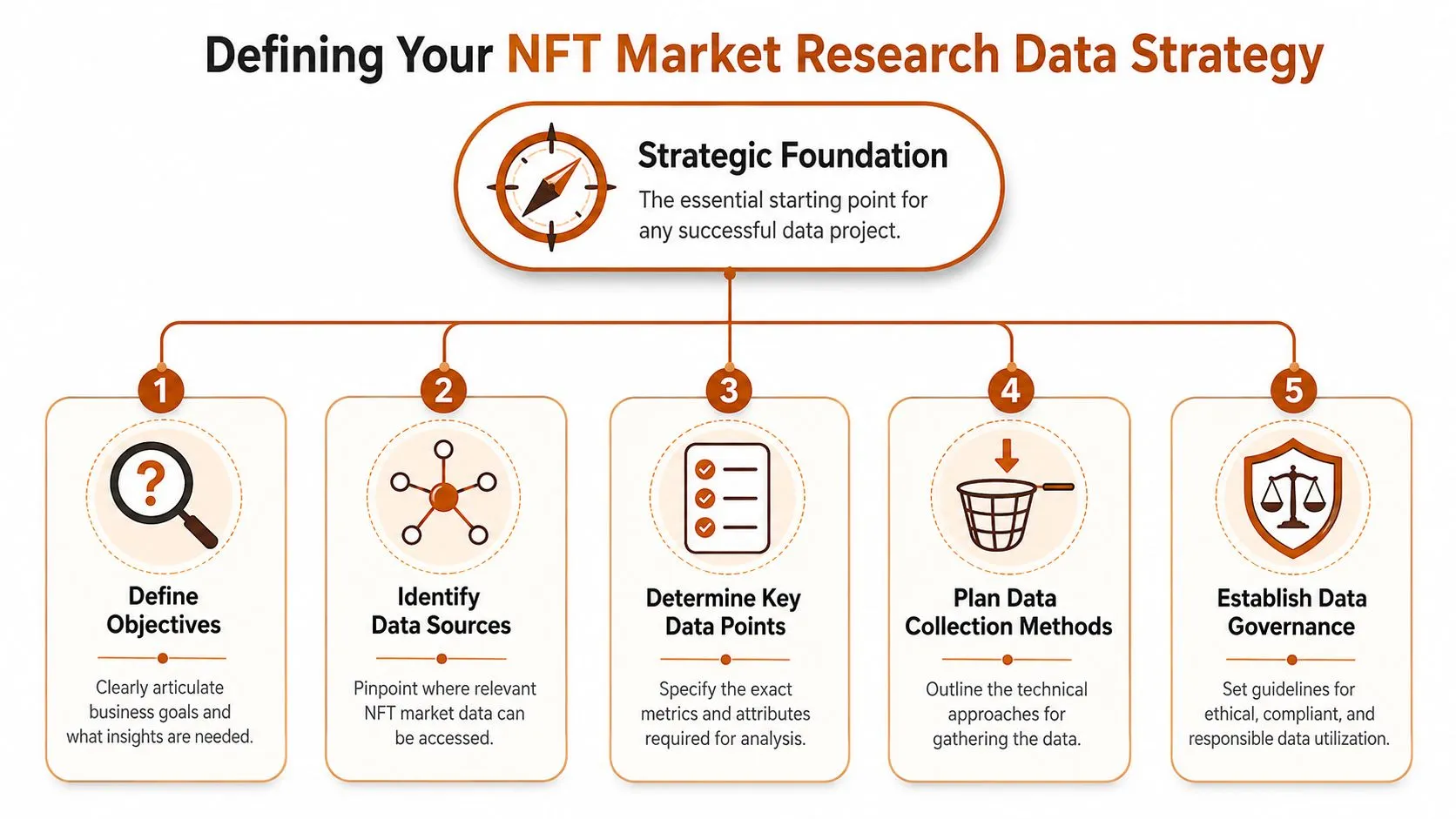
Start with the downstream use case
Different projects need different slices of marketplace data.
- Valuation workflows need item-level traits, listing state, collection context, and normalized metadata that can be joined consistently.
- Competitive monitoring usually cares more about collection changes, listing behavior, trait presentation, and refresh cadence.
- Training datasets for AI systems need the strictest structure. Messy labels, duplicated fields, and inconsistent trait naming will weaken the result before modeling even begins.
That’s why a market research brief should answer three questions early:
- What decision will this dataset support
- Which entities matter most
- How often must the data be refreshed
Define fields before extraction logic
A useful OpenSea data plan separates data into categories rather than page locations.
Consider these field groups:
- Descriptive metadata such as collection name, item identifiers, trait labels, media references, and creator-linked context.
- Market state fields such as visible listings, bid-related signals, and item availability indicators.
- Change-sensitive fields such as refreshed metadata, trait corrections, or delayed updates after collection-side edits.
This planning step prevents over-collection. It also keeps teams from missing fields that only appear after navigation, rendering, or interaction.
Teams that skip schema design usually discover the same problem later. The crawl completed, but the dataset doesn’t answer the business question.
A practical framework for this planning work is to pair source mapping with market research logic. The methods in using web scraping for market research translate well to NFT workflows because they force a connection between raw extraction and actual analysis.
Include governance in the strategy, not after launch
OpenSea data projects often mix structured fields, media-linked content, and user-visible marketplace state. That means storage rules, field definitions, provenance, and access controls should be specified before collection starts. If governance begins after data lands in the warehouse, cleanup becomes the main project.
Comparing OpenSea Data Collection Methodologies
There are three realistic ways to collect OpenSea data at scale. Build it yourself, buy access to a scraping API, or use a managed data operation. All three can work in limited circumstances. They don’t carry the same operational risk.
Where DIY scripts break
The biggest technical trap is collection traversal. The OpenSea collection scraper reference notes a 10K-item browsing limit per collection, which causes systematic data truncation in 60%+ of large collection scrapes. That single constraint invalidates many one-pass scripts because they assume browsing pagination equals full collection access.
For enterprise use, that’s a data integrity issue, not a nuisance. If your crawler stops unreported at the browse limit, every downstream dashboard, ranking model, and anomaly detector is built on partial coverage.
Comparison of OpenSea Data Collection Methods
| Criterion | DIY Scraper | Scraping API | Managed Data Service |
|---|---|---|---|
| Initial setup | Fast for prototypes | Fast if the API already supports the target workflow | Slower upfront because scope and schema are defined carefully |
| Reliability | Fragile when site behavior changes | Better than DIY for simple extraction, uneven for edge cases | Highest when operators monitor failures and retune pipeline logic |
| Scalability | Limited by browser orchestration, proxies, and retries | Moderate, depends on provider design | Strongest for recurring, large-collection workloads |
| Maintenance burden | Falls entirely on internal engineering | Shared, but provider limitations remain | Externalized to the service team |
| Schema control | Full control, but high effort | Often constrained by provider outputs | High control with operational support |
| Best fit | Experiments and internal testing | Narrow recurring tasks | Analytics, ML, compliance, and production feeds |
APIs solve some problems, not the hard ones
A scraping API can reduce boilerplate. It may handle rendering, browser automation, or request orchestration. That’s valuable when the target schema is simple.
But OpenSea has dynamic interfaces, asynchronous metadata behavior, and anti-bot patterns that don’t always map cleanly to a generic abstraction layer. Teams using browser automation stacks such as Playwright often end up needing event-aware extraction patterns, especially for rendered state and asynchronous updates. That’s where techniques like WebSocket data extraction with Playwright become more useful than a standard page-load scrape.
A provider can abstract browser work. It can’t remove the need to understand the site’s data model.
Managed operations fit when failure has a business cost
If missed items, stale records, or blocked runs affect a product, a managed approach usually becomes more economical than it first appears. The deciding factor isn’t developer pride. It’s whether the organization wants to own browser changes, anti-bot adaptation, retry policy, proxy sourcing, quality control, and delivery guarantees.
Architecting a Resilient OpenSea Data Pipeline
A reliable OpenSea scraper isn’t a single job. It’s a coordinated system with collection logic, browser controls, quality checks, and recovery paths.
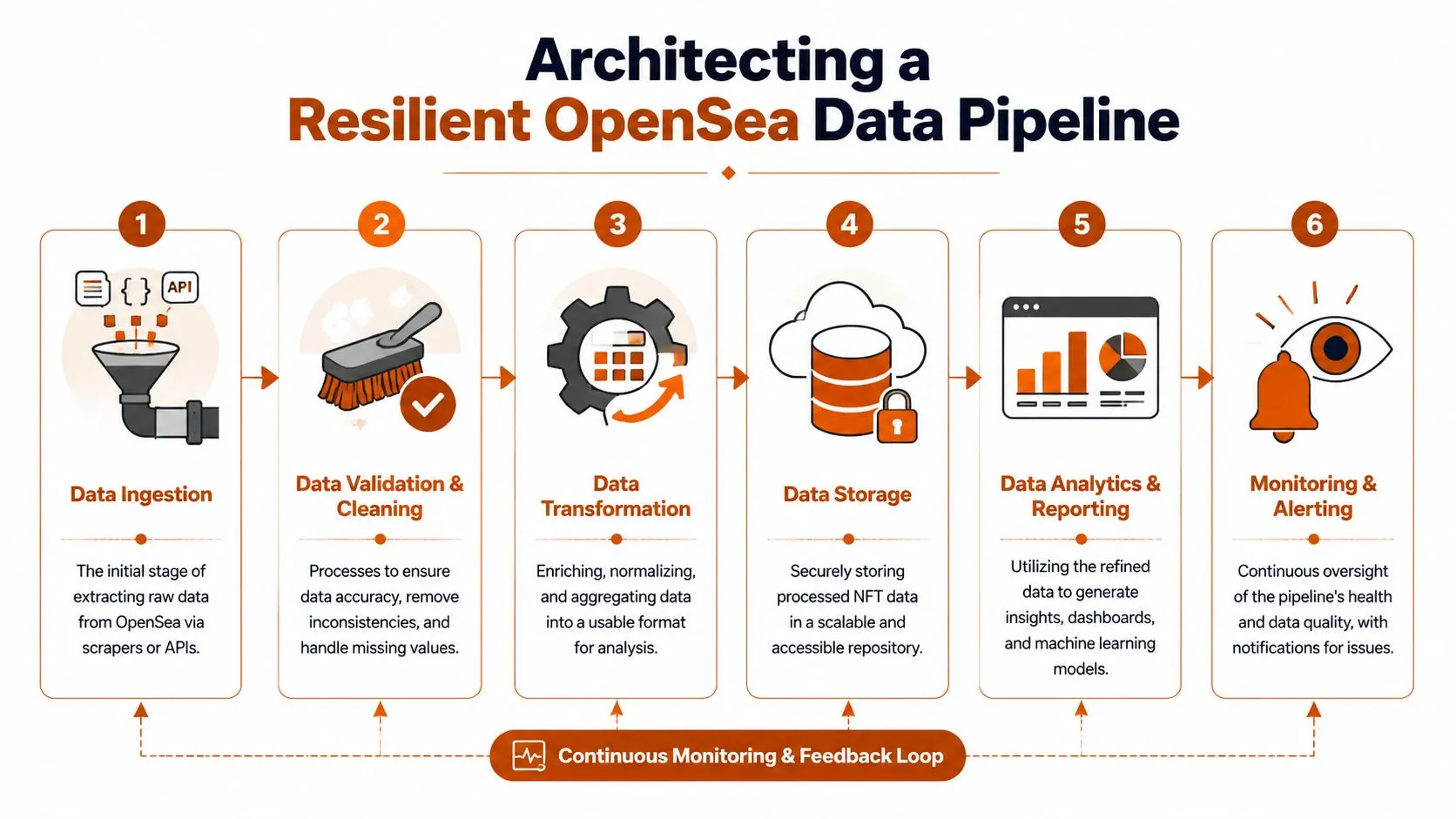
Use a two-pass crawl design
One-pass extraction is the root cause of many incomplete datasets. Production pipelines usually work better with a two-pass architecture.
The first pass collects item links and inventory references at the collection level. The second pass visits each item page to capture detailed fields, rendered metadata, and item-specific state. This design is more expensive than a quick list-page crawl, but it’s the difference between sampling a collection and fully representing it.
Build around anti-bot reality
Datacenter-only routing isn’t enough for sustained access. The ENS support reference notes that OpenSea has increasingly fingerprinted datacenter IPs in the last 12 months, making residential proxies essential and standard datacenter-based scrapers ineffective for sustained access in this context, which directly affects continuity for long-running data collection pipelines, as discussed in the ENS support article.
That changes the architecture in concrete ways:
- Session management must preserve cookies across related requests.
- Proxy allocation should match workflow stage, because detail-page fetches and discovery fetches don’t fail the same way.
- Retry logic should separate transient rendering failures from access-denial patterns.
Treat metadata as a normalization problem
OpenSea metadata isn’t just data retrieval. It’s a cleaning problem. Some fields appear late, refresh asynchronously, or surface with inconsistent labels that break downstream joins.
A resilient pipeline usually includes:
- Validation gates that reject malformed or incomplete item records
- Transformation rules that standardize field names and trait structures
- Fallback parsing using browser rendering, visual inspection, or model-assisted extraction when DOM patterns become inconsistent
For teams building recurring datasets, building scalable data pipelines with Scrapy is a useful reference on orchestration principles, even if the OpenSea-specific implementation also requires browser automation and rendering-aware checks.
Data Governance and Compliance in NFT Analytics
A dataset can be technically complete and still be unusable. Enterprise teams usually learn this when analysts can’t reproduce metrics, legal teams ask where fields came from, or modelers find that the same attribute appears under multiple names.

Data quality needs explicit controls
At minimum, an OpenSea analytics pipeline should define:
- Schema versioning so field changes don’t unexpectedly break downstream consumers
- Deduplication rules for repeated items, relisted states, and retried captures
- Provenance tracking so analysts know whether a value came from a listing page, item page, rendered state, or later normalization
These controls sound administrative until a pricing model starts treating equivalent traits as different categories.
Clean extraction is only half the job. Trustworthy reuse is the harder half.
Compliance belongs inside engineering decisions
OpenSea projects also raise terms-of-service, copyright, and data handling questions. Those aren’t separate from pipeline design. They affect retention, redistribution, field selection, access permissions, and review workflows.
A good mental model is understanding governance as an engineering discipline. The point isn’t bureaucracy. The point is building systems where collection practices, storage decisions, and downstream use are aligned before the dataset spreads across internal teams.
For teams handling personal data or any user-linked signals, privacy review matters too. Practical controls for lawful collection and handling are well summarized in GDPR-compliant web scraping steps.
Without governance, the OpenSea scraper becomes the easy part. The cleanup, reclassification, and approval cycle becomes the primary workload.
Turning OpenSea Data Into Actionable Intelligence
An OpenSea scraper becomes valuable when it stops being a script and starts acting like infrastructure. That means reliable collection, stable schemas, monitored refreshes, and enough resilience to survive rendering changes and access friction.
DIY code still has a place. It’s fine for exploration, feasibility checks, and internal experiments. APIs help when the target workflow is narrow and the schema is simple. Managed operations make more sense when the business depends on continuity, completeness, and repeatable delivery.
The decision should come down to risk ownership. If the cost of missed items, stale metadata, or broken refresh jobs is low, a lighter approach may be enough. If those failures affect models, reporting, or customer-facing products, the OpenSea scraper needs to be treated like a production data system.
That’s the practical dividing line. Not whether a script can scrape OpenSea once, but whether your organization can trust what arrives next week.
If you need a partner to design, run, and maintain production-grade OpenSea and marketplace data pipelines, WebscrapingHQ helps teams turn brittle scraping tasks into managed data operations with structured delivery, monitoring, and ongoing anti-bot adaptation.
Want this done for you?
Send us the URLs. We'll quote it in 24 hours.
Paste the URL(s) you want scraped. We'll reply within 24 hours with a feasibility check and a ballpark quote.