Jump to section
- Table of Contents
- The Untapped Value of Quora Data
- Why this data is commercially useful
- Why value and difficulty rise together
- Why Scraping Quora Is a Deceptively Hard Problem
- Quora is dynamic before it is accessible
- Cloudflare evaluates more than the IP address
- Why basic scripts fail in production
- The Quora Scraper Toolkit for Reliable Extraction
- Start with the right network layer
- Use a real browser stack
- Treat timing and state as first-class concerns
- Structuring and Parsing Quora Data for AI and Analytics
- Raw HTML is not a dataset
- LLM-assisted parsing fixes what selectors miss
- Design a schema that survives site changes
- Enterprise Use Cases for Scraped Quora Data
- Training domain-specific language systems
- Finding product pain points before survey teams do
- Competitive intelligence from public discussion trails
- Editorial and SEO research with better source material
- DIY Scraper vs Managed Service A Strategic Decision
- What the in-house path really includes
- Where managed infrastructure changes the economics
- DIY Scraper vs Managed Service for Quora
Most advice about a Quora scraper is stuck at the hobby stage. It tells you to open Selenium, grab a few CSS selectors, and loop through question pages as if Quora were just another static forum. That advice breaks the moment the scrape matters.
Quora isn’t valuable because it’s easy to scrape. It’s valuable because it captures large-scale, real user questions, explanations, objections, and expertise in a format that maps well to research and model training. Teams using web data for content research already understand this pattern from broader real-time content marketing intelligence, but Quora pushes the challenge further because the data source is both rich and heavily defended.
If you’re collecting a few pages for a side project, a brittle script may limp along for a while. If you need recurring feeds for AI, analytics, or competitive intelligence, you need infrastructure, session handling, parser maintenance, and quality controls. That is the primary consideration.
Table of Contents
Open Table of Contents
The Untapped Value of Quora Data
Quora is one of the few public platforms where people ask questions they care about, then answer with context, disagreement, and lived experience. That makes it unusually useful for teams that need more than keywords. They need intent, nuance, and the language people use when they aren’t writing for a marketing page.
The scale is what turns Quora from an interesting source into a strategic one. Quora hosts over 100 million monthly active users globally as of 2024 and generates approximately 500 million new questions and answers annually according to Crawlbase’s Quora scraper overview. At that volume, you’re not looking at a niche community. You’re looking at a continuously refreshed repository of public Q&A across consumer products, software, health, finance, education, careers, and regional topics.
Why this data is commercially useful
A strong Quora scraper can support several high-value workflows:
- AI training corpora: Question-answer pairs are useful for instruction-style datasets, retrieval pipelines, and domain adaptation.
- Market research: Analysts can trace how people describe frustrations, compare brands, and frame purchase decisions in natural language.
- Topic discovery: Editorial and SEO teams can identify recurring themes, objections, and long-tail questions earlier than they appear in polished publisher content.
- Entity monitoring: Researchers can track discussion around companies, products, technologies, and public figures.
Quora data is valuable because it preserves context. A search trend can tell you what people typed. A Quora thread often tells you why they asked.
Why value and difficulty rise together
High-value public data attracts serious scraping demand. Quora also uses modern rendering patterns, layered anti-bot controls, and changing page structures. That combination changes the engineering brief. You aren’t just downloading pages. You’re operating a collection system that has to remain believable to anti-bot systems and useful to downstream analytics teams.
That is why the common “just use BeautifulSoup” advice misses the point. On Quora, extraction quality starts long before parsing. It starts with access reliability.
Why Scraping Quora Is a Deceptively Hard Problem
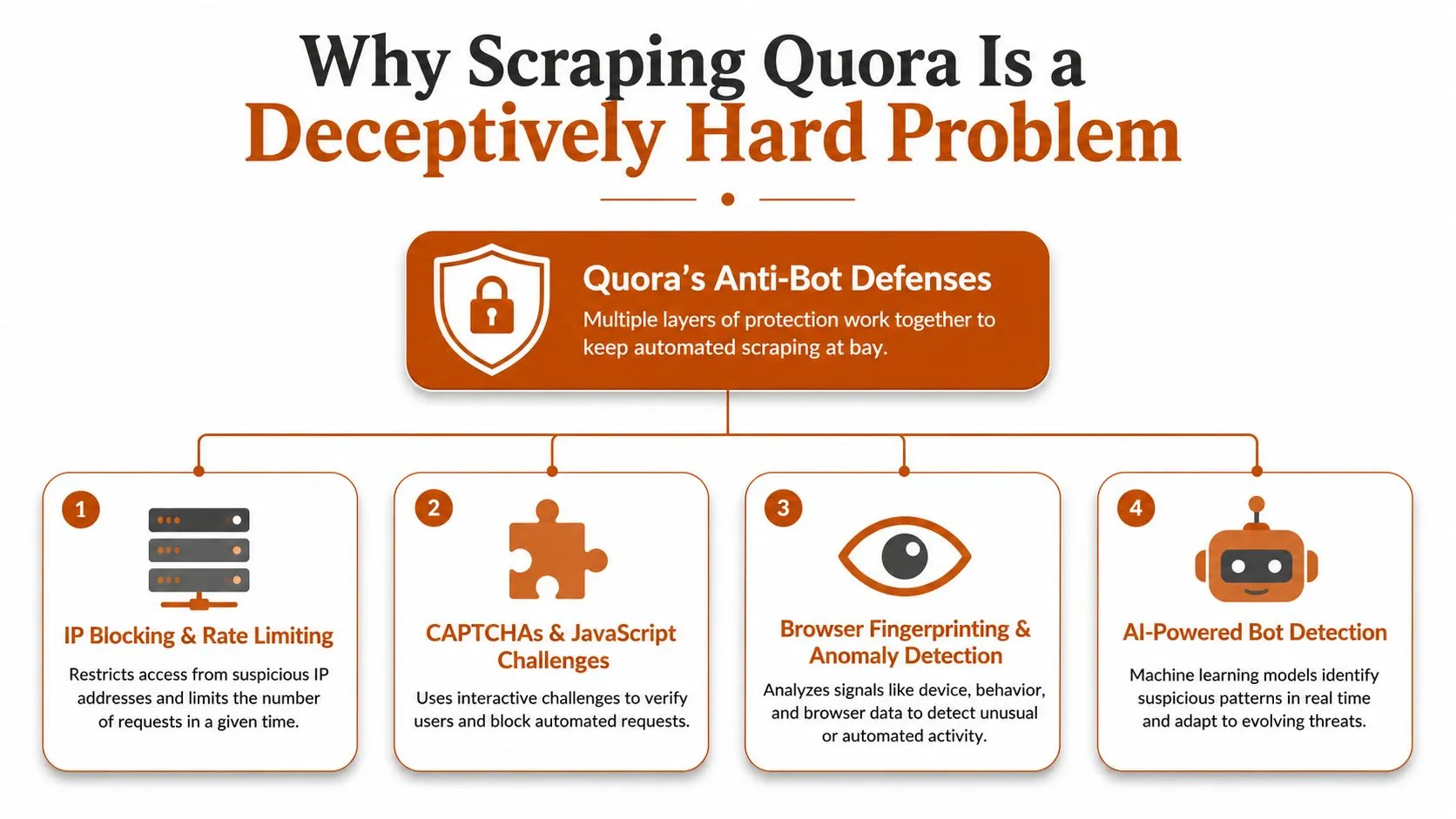
A Quora scraper usually fails for three reasons at once. The page is JavaScript-heavy, the anti-bot layer inspects browser realism, and the request pattern exposes automation long before your parser runs.
Quora is dynamic before it is accessible
Simple HTTP clients don’t see Quora the way users do. Significant page content is rendered dynamically, which means a raw request often won’t produce the complete question page, answer list, or related metadata you expect. That’s why so many tutorials work in a local test and then collapse when moved into a scheduled pipeline.
A lot of developers reach for Selenium or Playwright and assume that solves the problem. It solves only the rendering layer. It doesn’t solve how Quora and Cloudflare classify the browser session.
If you’re tuning browser automation, this Playwright anti-bot guide is a useful technical companion because it explains the kinds of signals detection systems inspect beyond basic DOM access.
Cloudflare evaluates more than the IP address
Quora’s anti-bot infrastructure, powered by Cloudflare, is rated “Medium difficulty” (3/5) for scraping, instantly flagging datacenter IPs and requiring residential proxies with matching browser fingerprints and sticky sessions to avoid being blocked, based on Scraperly’s Quora analysis. That “medium” rating misleads people. It doesn’t mean easy. It means beatable only if your scraper behaves like a coherent browsing session.
Cloudflare doesn’t just count requests. It inspects signals such as TLS fingerprints, header consistency, and behavioral patterns. A mismatch between the browser’s declared locale and the exit geography can trigger scrutiny. So can static IP use, abrupt timing, and browser fingerprints that don’t resemble a normal user session.
For teams evaluating network setup, this practical write-up on how to boost data collection with proxies is worth reading because it frames proxy choice as an operational issue, not a commodity purchase.
Why basic scripts fail in production
The usual failure pattern looks like this:
- Datacenter IPs get challenged quickly: They may work briefly, then start returning rate limits or access denials.
- Headers don’t match the browsing context: The browser says one thing, the network fingerprint says another.
- Sessions aren’t preserved: Cookies and local storage are discarded between requests, so the scraper never accumulates a believable state.
- Timing is too clean: Fixed pauses and linear navigation paths create a machine signature.
Practical rule: If your Quora scraper can be described as “open page, wait 2 seconds, extract, repeat,” it’s built for a demo, not for production.
The deeper issue is architectural. A production scraper isn’t a script. It’s a managed browser fleet, proxy policy, retry system, session store, parsing layer, and monitoring loop. Once you accept that, Quora becomes less mysterious. It becomes an operations problem.
The Quora Scraper Toolkit for Reliable Extraction
A reliable Quora scraper rests on three pillars. Network realism, browser realism, and behavioral realism. Leave out any one of them and the other two won’t save you.
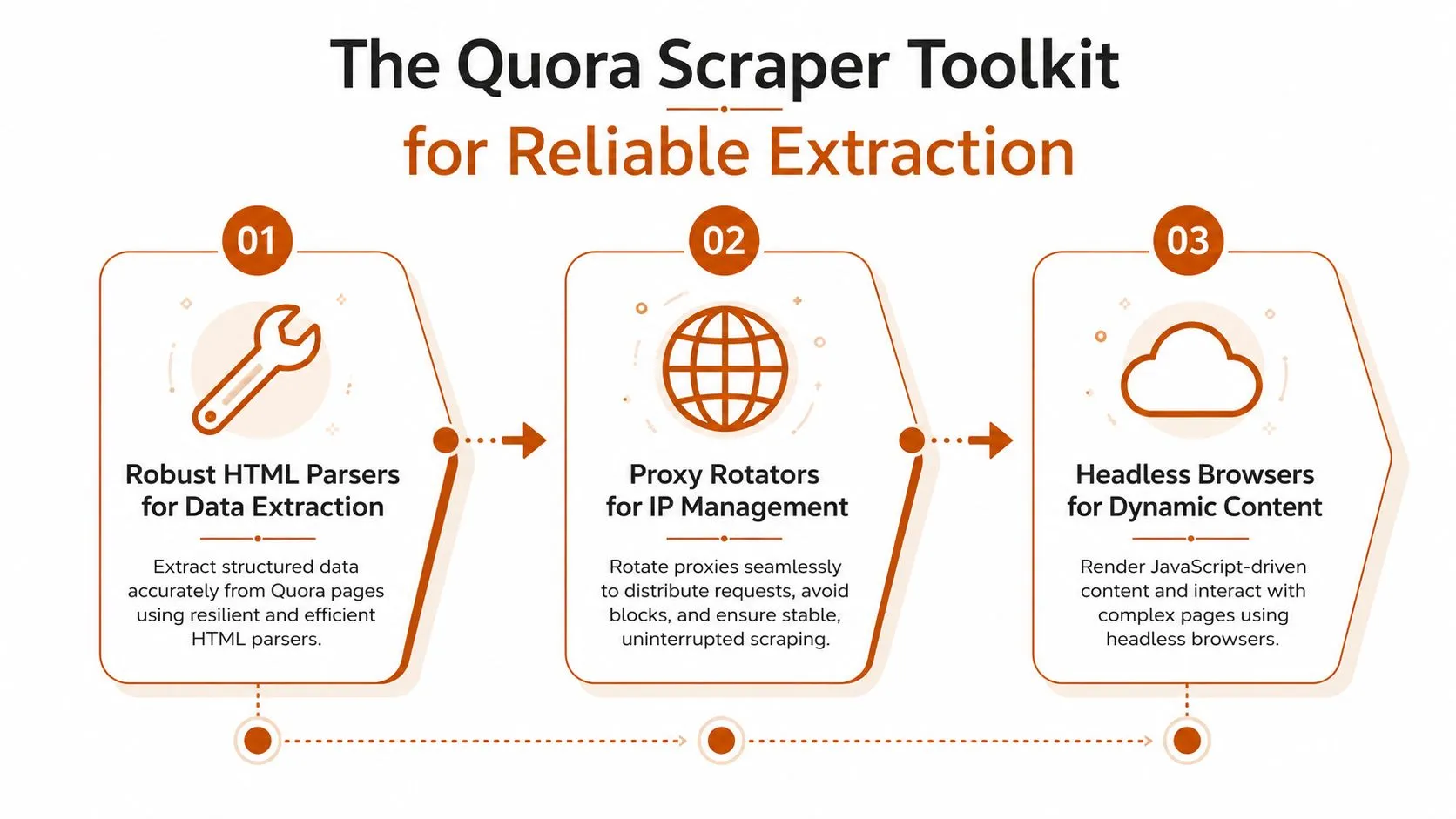
Production-grade Quora scrapers achieve more than 95% success rates by combining residential proxies with low concurrency, fortified browsers with stealth patches, and Gaussian-distributed request delays of 2 to 8 seconds according to this anti-bot engineering write-up. That combination matters because Quora’s defenses evaluate the whole session, not one isolated request.
Start with the right network layer
Residential and mobile proxies are the baseline for Quora at scale. Datacenter proxies might work for isolated experiments, but they don’t hold up once you increase volume or repeat the job on a schedule.
What matters isn’t only the proxy type. It’s how you use it.
- Low concurrency per IP: Flooding one exit point creates a clean bot pattern.
- Sticky sessions: Keep the same IP long enough for cookies and local storage to make sense.
- Geo alignment: Browser language, timezone behavior, and exit geography should look coherent together.
A proxy pool with poor quality control creates hidden failure modes. You’ll see partial loads, challenge loops, and intermittent parser breakage that looks like a data issue but is really an access issue.
Use a real browser stack
Quora requires a browser automation layer that can render JavaScript and survive fingerprint scrutiny. In practice, that means tools like Playwright or Puppeteer, usually hardened with stealth patches that adjust properties exposed through WebGL, canvas, and the navigator object.
A plain headless browser often leaks enough signals to get classified. A fortified browser aims to reduce those mismatches. It won’t make automation invisible, but it narrows the gap between your session and a real user session.
For developers who need the browser-side mechanics, this JavaScript scraping guide with Playwright gives a solid implementation baseline before you add Quora-specific anti-bot tuning.
Treat timing and state as first-class concerns
Many homemade scrapers fail here because timing logic gets treated as an afterthought. It isn’t. Behavioral systems inspect request rhythm, navigation cadence, and session continuity.
The anti-bot data above points to Gaussian-distributed delays in the 2 to 8 second range as a working pattern. The point isn’t the math for its own sake. The point is variation. Human browsing has noise. Bot loops often don’t.
State persistence matters just as much:
- Carry cookies forward across page transitions.
- Retain local storage per sticky session.
- Rotate IPs deliberately, not randomly on every request.
- Retry with context, preserving the session where possible.
The best Quora scraper logic doesn’t move fast. It moves consistently, quietly, and with memory.
Engineers often want one silver bullet. There isn’t one. Proxies without browser hardening still fail. A stealth browser without state persistence still fails. Good timing on a bad proxy pool still fails. Reliability comes from the stack acting as one system.
Structuring and Parsing Quora Data for AI and Analytics
Access is only half the job. A Quora scraper that fetches pages but produces inconsistent fields is expensive noise.
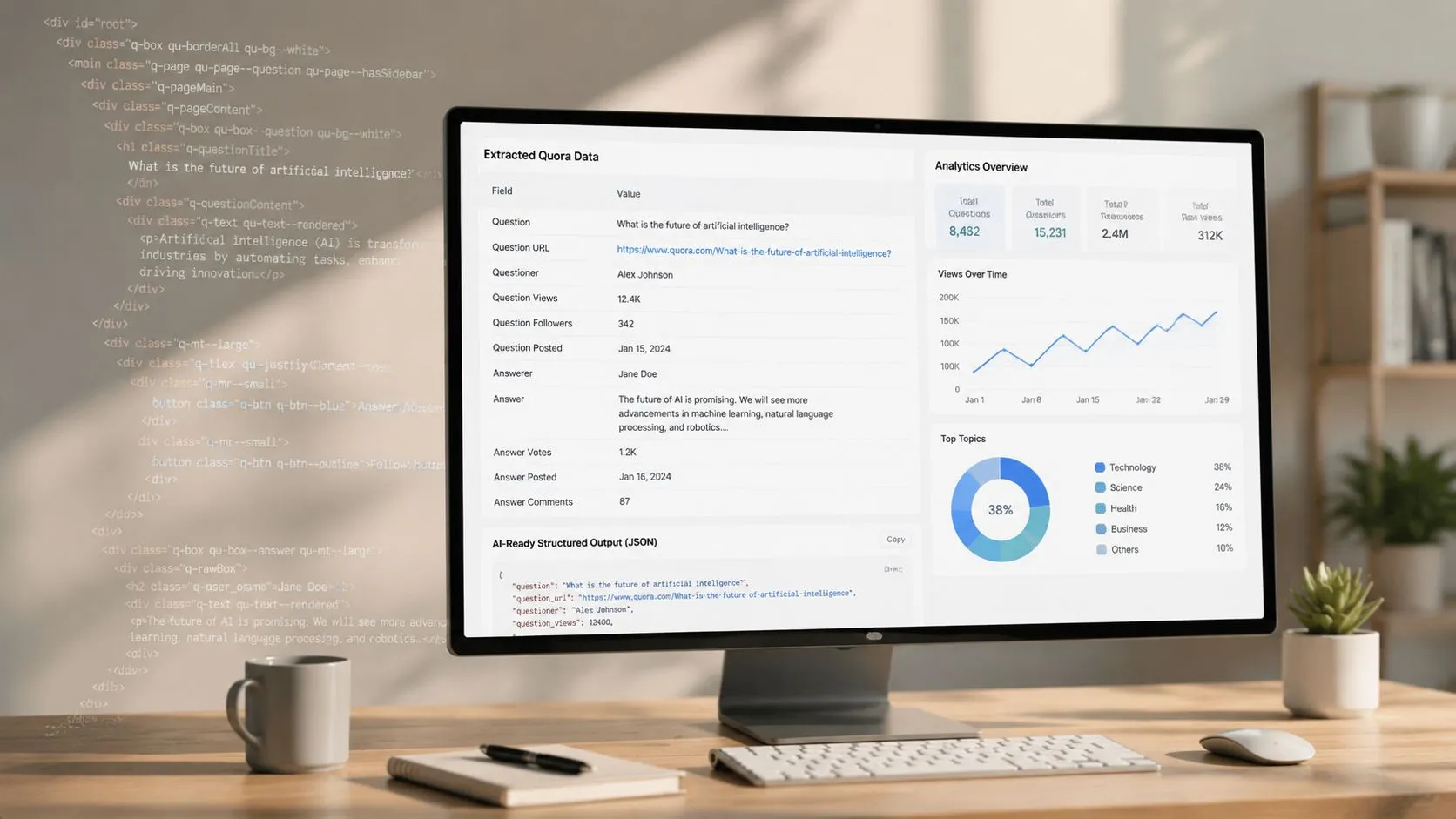
Most tutorials stop at extracting question text and answer text. That isn’t enough for serious AI and analytics workflows. Teams usually need richer fields such as author identity cues, upvote counts, answer structure, related questions, and engagement metadata. The challenge is that Quora’s front end evolves, and selectors that worked last month may degrade without notification.
Raw HTML is not a dataset
Industry analysis shows that 42% of scraped Quora datasets contain malformed or incomplete fields after 30 days due to unparsed schema shifts, as discussed in ScraperAPI’s Quora scraping analysis. That number matches what experienced data teams already know. Parser breakage often doesn’t announce itself. It leaks quality slowly.
A reliable extraction pipeline needs a schema, validation rules, and review steps. At minimum, define:
- Required fields: For example, question title, canonical URL, answer body.
- Optional engagement fields: Upvotes, comments, related content, author descriptors.
- Normalization rules: Whitespace cleanup, entity resolution, deduplication, and null handling.
- Quality checks: Missing-field thresholds, field-type checks, and sample-based visual review.
When the source is HTML-rich, teams also benefit from simple cleanup stages before deeper parsing. This HTML to plain text reference is useful for thinking through content normalization before records enter downstream NLP workflows.
LLM-assisted parsing fixes what selectors miss
Selector-based parsing is fast when the page is stable. It becomes fragile when the DOM shifts or labels move. That’s where LLM-driven re-parsing becomes practical. The browser captures rendered content and structural cues. A parsing layer then maps visible content into a target schema, even when exact selectors have changed.
This doesn’t mean replacing deterministic parsers everywhere. It means using the right parser for the failure mode.
| Parsing approach | Best use | Weakness |
|---|---|---|
| CSS/XPath selectors | Stable repeated elements | Breaks when DOM shifts |
| Heuristic HTML cleanup | Body text normalization | Loses deeper field relationships |
| LLM-assisted parsing | Schema recovery and flexible field extraction | Needs validation and guardrails |
For data preparation work after extraction, this guide on cleaning web-scraped data with Python and pandas is a practical next step because Quora records usually need both structural normalization and content cleanup.
A parser should answer one question clearly: if Quora changes the page tomorrow, how will we know which fields drifted and how will we recover them?
Design a schema that survives site changes
The strongest Quora scraper pipelines separate capture schema from delivery schema. Capture schema stores everything you may need later, including raw HTML snapshots, rendered text blocks, and extraction confidence markers. Delivery schema provides the clean fields consumed by analytics, search, or model training systems.
That split gives you room to reprocess old captures when field definitions change. It also prevents one parser bug from forcing a full rescrape.
A practical Quora record often includes these groups:
- Question fields: Title, URL, topic context, related questions.
- Answer fields: Body content, answer position, answer URL, timestamps as displayed.
- Author fields: Name, profile link, visible credentials or bio fragments.
- Engagement fields: Counts and interaction signals when publicly visible.
- Lineage fields: Crawl timestamp, parser version, source page identifier.
Without schema discipline, scraped Quora data becomes difficult to trust. With it, the same source becomes reusable across search, research, and machine learning teams.
Enterprise Use Cases for Scraped Quora Data
The business case for a Quora scraper becomes obvious when you look at who uses the output. Not hobby developers. Teams with recurring data needs and deadlines.
Recent data from 2024 to 2025 indicates that 68% of large-scale web scraping attempts on sites like Quora fail within 48 hours without managed anti-bot infrastructure, according to the industry analysis cited in this GitHub research summary. That matters because the most valuable use cases aren’t one-off exports. They’re recurring pipelines.
Training domain-specific language systems
AI teams often need public question-answer data that reflects how users ask for help in the wild. Quora is well suited to that because threads contain direct questions, alternative answers, disagreement, elaboration, and follow-on context.
A useful pipeline here doesn’t just dump text. It segments by topic, filters for quality, preserves thread relationships, and normalizes metadata so model builders can decide what to include in training or retrieval systems.
Finding product pain points before survey teams do
Consumer brands and product teams use Quora differently. They mine it for phrasing. What frustrates people. What confuses them. Which alternatives they compare. Which objections keep repeating.
That work is hard to do from search volume alone because search tools flatten intent into keyword counts. Quora discussions keep the surrounding language intact, which helps analysts cluster pain points and spot recurring decision criteria.
Public Q&A data is often more useful than polished reviews when you need the language of uncertainty, not the language of conclusion.
Competitive intelligence from public discussion trails
Market intelligence teams track how people discuss companies, software tools, categories, and emerging technologies. Quora is useful here because people often compare options directly and explain why they prefer one over another.
Typical signals include:
- Brand comparison threads: Users weigh one product against another in their own language.
- Feature perception: Repeated mentions of ease of use, reliability, pricing concerns, or missing capabilities.
- Regional variation: Different geographies can emphasize different concerns and vocabulary.
- Narrative shifts: The way people talk about a technology can change before analyst reports catch up.
Editorial and SEO research with better source material
Content teams can also use Quora data to build stronger briefs. Not by copying answers, but by understanding the exact questions, misconceptions, and subtopics people care about. This is especially useful when a topic has fragmented intent and generic keyword tools collapse distinct user needs into one cluster.
The key trade-off is operational. These use cases need continuity. If the feed breaks every few days, the downstream model, dashboard, or research workflow breaks with it. That’s why Quora extraction for enterprise use is less about scraping once and more about sustaining collection without repeated interruptions.
DIY Scraper vs Managed Service A Strategic Decision
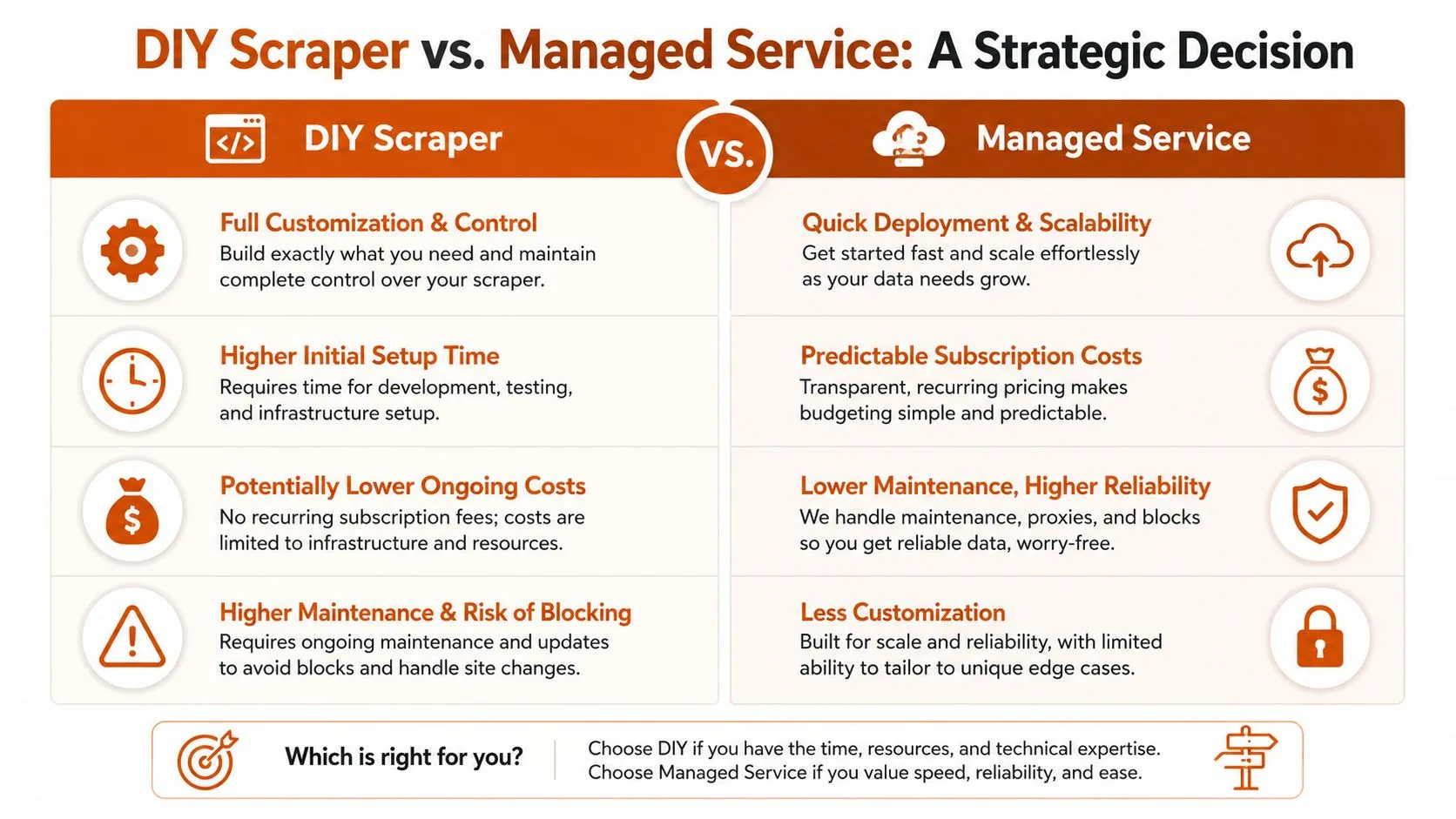
Most organizations don’t choose between “scrape Quora” and “don’t scrape Quora.” They choose between building a Quora scraper stack internally or outsourcing the messy parts to a managed provider. That’s a build-vs-buy decision disguised as a technical tutorial.
What the in-house path really includes
A DIY scraper gives you control. That’s the main advantage, and in some environments it’s the right call. You can tune the crawler, own the schema, and integrate directly with internal systems.
But the full scope is broader than teams typically estimate:
- Anti-bot maintenance: Proxy sourcing, browser hardening, challenge handling, and session tuning.
- Operations work: Monitoring, retries, failure alerting, and page-change response.
- Parsing upkeep: Schema drift detection, parser fixes, and backfills.
- Data QA: Validation, deduplication, and delivery formatting for internal consumers.
For some teams, that’s acceptable. For many, it means data engineers spend too much time protecting the pipeline and too little time using the output.
Where managed infrastructure changes the economics
Managed scraping services shift the burden from tool assembly to delivery. That matters when Quora data is tied to product launches, AI training schedules, competitive reporting, or executive dashboards.
The practical benefits are straightforward:
- Faster operational maturity: You start with browser infrastructure, proxy strategy, and monitoring already in place.
- Lower maintenance load: Site changes, CAPTCHA pressure, and anti-bot retuning don’t land on your product team.
- Cleaner outputs: Mature providers usually think in schemas and delivery contracts, not just raw HTML.
- More predictable reliability: Business users care whether the feed arrives on time, not how elegant the crawler code looks.
If you’re evaluating that route, this explanation of why teams choose managed web scraping services is useful because it frames the decision around operational ownership, not just tooling preference.
DIY Scraper vs Managed Service for Quora
| Factor | DIY In-House Scraper | Managed Scraping Service |
|---|---|---|
| Control | Full control over crawler logic, schema, and integrations | Less direct control over internal implementation details |
| Setup time | Longer ramp-up because browser, proxy, and monitoring layers must be assembled | Faster deployment because infrastructure already exists |
| Anti-bot handling | Team must maintain proxy policy, fingerprinting, and session logic | Provider absorbs anti-bot changes and challenge handling |
| Maintenance burden | Ongoing parser fixes and scraper retuning stay internal | Lower internal maintenance burden |
| Reliability for business users | Depends on internal staffing and operational discipline | Typically better suited to recurring delivery needs |
| Custom schema output | Highly flexible if the team has bandwidth | Usually available, but depends on vendor scope |
| Engineering focus | Pulls engineers into crawler operations | Frees internal teams to work on downstream use cases |
Build in-house when Quora extraction is a core technical competency you want to own. Use a managed service when the data matters more than the crawler.
The wrong comparison is “Can our developers scrape one Quora page?” Of course they can. The right comparison is “Who will keep this pipeline reliable, structured, and useful quarter after quarter?” That’s where the strategic decision gets made.
If your team needs Quora data delivered as a reliable feed instead of a fragile script, WebscrapingHQ builds and runs managed web data pipelines with anti-bot mitigation, schema-aware extraction, and recurring delivery in formats your analysts and ML systems can use.
Want this done for you?
Send us the URLs. We'll quote it in 24 hours.
Paste the URL(s) you want scraped. We'll reply within 24 hours with a feasibility check and a ballpark quote.