Jump to section
- Table of Contents
- Why Instagram Scraping Is Harder Than You Think
- A first run is not a service
- Reliability has an operating cost
- How Platform Defenses Evolved Since 2018
- From API dependence to browser operations
- Architecture of a Modern Instagram User Scraper
- Build the control plane first
- Make parsing tolerant and outputs explicit
- Comparing Access Paths for Instagram Data
- Legal Boundaries and Compliance Considerations
- Define the boundary before implementation
- Rollout Checklist for Production Pipelines
- Establish the contract and the controls
- Prove quality before scaling
- Real-World Applications Across Industries
The popular advice is wrong: an Instagram User Scraper isn’t a solved scripting exercise. Installing a library, opening a profile, and extracting a few fields proves only that a proof of concept can work under one set of conditions. A production pipeline must keep working while login walls, request limits, fingerprints, page structures, and platform policies change.
Instagram’s scale explains why collectors continue targeting it. One industry summary of Instagram statistics reports 3 billion monthly active users in Q3 2025, while its historical review describes growth from 1 billion monthly active users in June 2018 to 2 billion around 2021 and 2.99 billion in 2025. That audience creates substantial opportunities for profile, caption, hashtag, follower-count, and engagement research, but it also makes the platform a high-priority target for defensive systems.
The practical question in 2026 isn’t whether you can collect a profile once. It’s whether you can deliver consistent, permitted, validated data over months without turning your engineering team into a permanent anti-bot maintenance group.
Table of Contents
Open Table of Contents
- Why Instagram Scraping Is Harder Than You Think
- How Platform Defenses Evolved Since 2018
- Architecture of a Modern Instagram User Scraper
- Comparing Access Paths for Instagram Data
- Legal Boundaries and Compliance Considerations
- Rollout Checklist for Production Pipelines
- Real-World Applications Across Industries
Why Instagram Scraping Is Harder Than You Think
Most tutorials frame an Instagram scraper as a short chain: send a request, parse a response, save JSON. That model works for experimentation, not for an operation exposed to a platform that actively restricts automated collection. A successful first run says very little about whether the same workflow will survive a changed markup pattern, a login wall, a rejected session, or a temporary block.
Instagram’s large audience makes the platform valuable, and that value makes careless automation easy to identify. A collector may want usernames, bios, captions, hashtags, public follower counts, or engagement signals, yet every field can arrive through a different page state or response shape. Public visibility also doesn’t guarantee stable machine access.

A first run is not a service
A DIY script usually fails in predictable ways:
- Selectors become stale: A parser tied to one HTML arrangement breaks when the interface changes.
- Sessions lose validity: Login-dependent workflows can fail without a useful application-level error.
- Traffic patterns become visible: Repeated timing, identical headers, and concentrated requests create recognizable behavior.
- Partial results look healthy: A job can finish while omitting profiles, comments, or fields.
- Retries amplify the incident: A poorly designed retry loop turns a temporary response failure into a broader block.
The broader overview of web scraping challenges applies directly here, but Instagram adds a particularly difficult combination of dynamic rendering, access controls, and changing internal endpoints. The engineering work is less about writing the extractor and more about controlling failure modes.
Practical rule: Treat every successful scrape as an observation from a changing system, not as proof that the system is stable.
Reliability has an operating cost
Long-term collection requires proxy management, request scheduling, session hygiene, parser versioning, quality checks, alerting, and recovery procedures. Residential and datacenter routes behave differently, and a route that works for one workflow may perform poorly for another. Proxy churn isn’t a switch you turn on once. It’s an operating decision with cost, observability, and compliance implications.
A managed extraction operation can outperform a small internal script because it assigns this recurring work to infrastructure designed for monitoring and re-tuning. That doesn’t remove the need for legal review or clear scope. It does change who absorbs the maintenance burden.
How Platform Defenses Evolved Since 2018
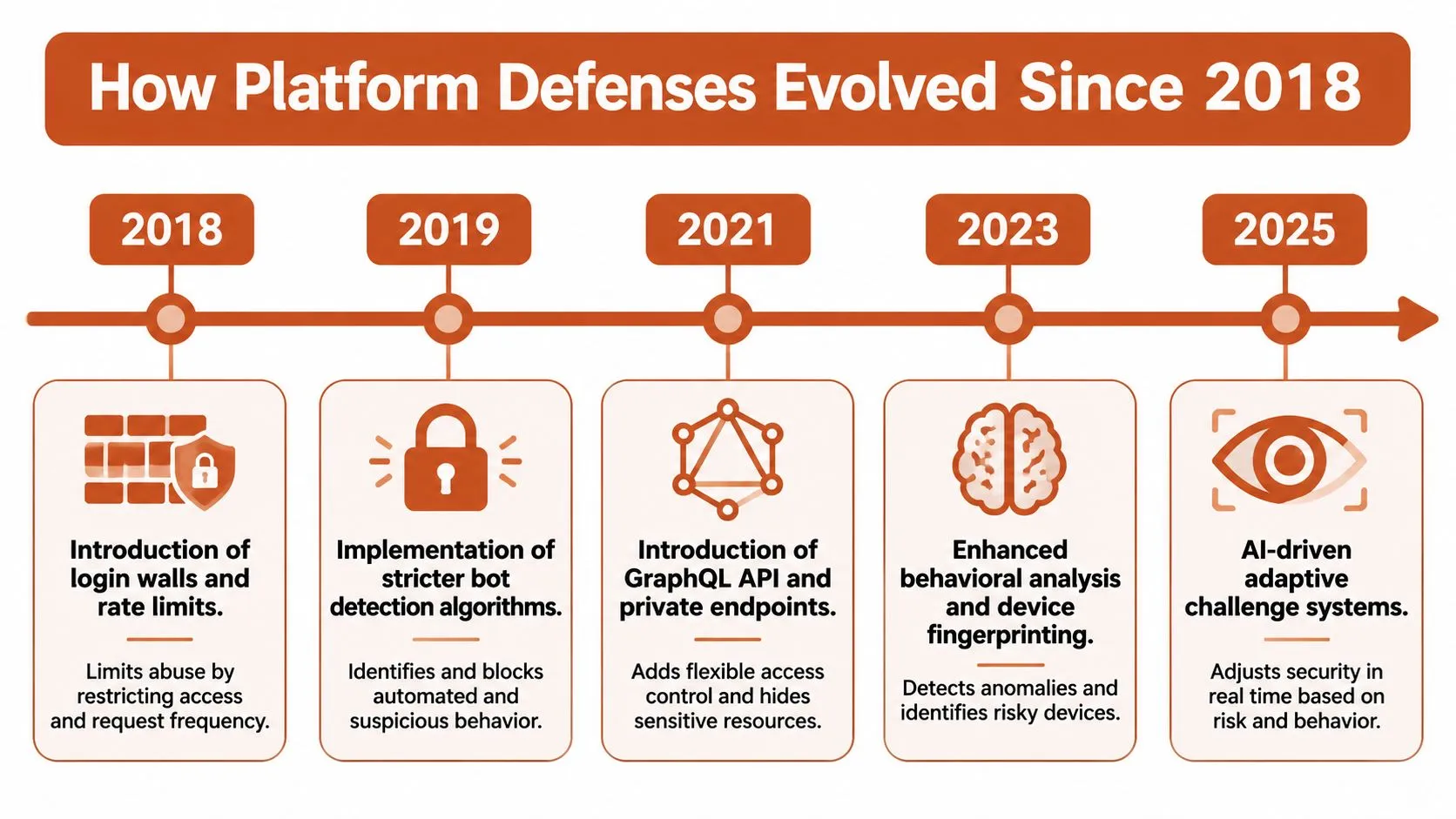
Instagram’s current difficulty follows a clear policy history. On April 4, 2018, Facebook announced that APIs for follower lists, relationships, and commenting on public content would stop functioning immediately. The same announcement kept the planned deprecation of the public-content reading API on December 11, 2018, and the basic profile information API deprecation scheduled for 2020, as documented in TechCrunch’s coverage of the API shutdown.
That change followed the wider privacy and platform-access restrictions associated with the Cambridge Analytica scandal. It mattered technically because teams that had depended on predictable, programmatic access had to reconsider their collection architecture. Browser rendering, public-page parsing, session handling, and anti-bot-aware scheduling became more important than a simple API wrapper.
From API dependence to browser operations
The official route narrowed further over time. Recent coverage identifies the December 2024 shutdown of Instagram’s Basic Display API, removing a previously used path for personal-account integrations. The remaining Graph API route is intended for Business and Creator accounts, requires Meta app review, and carries a limit of around 200 calls per hour per user token, according to the 2026 review of Instagram scraping access.
That distinction is central. A team can’t solve every research requirement by switching to the official API, because official access is limited by account type, permissions, ownership, review, and endpoint scope. A competitor-monitoring workflow and an owned-account publishing workflow may both concern Instagram, but they don’t have the same viable access path.
The technical defenses also affect implementation choices. Recent reporting describes mandatory login walls, obfuscated GraphQL, TLS fingerprinting against Python clients, and a residential IP threshold of roughly 200 requests per hour before 429 responses and longer blocks may occur, as discussed in ScrapFly’s Instagram scraping analysis. These conditions make request orchestration and client fingerprints operational concerns, not optional refinements.
For teams working with browser automation, the guide to anti-bot measures in Playwright provides useful background. The important lesson is that defenses changed the economics of scraping. A script may be cheap to write, but maintaining a dependable access layer requires continuous engineering attention.
Architecture of a Modern Instagram User Scraper
A production Instagram User Scraper should be designed as a service with independent components, not as one process that fetches, parses, and exports everything synchronously. Separation lets the team change scheduling without rewriting parsing, replace a proxy provider without changing storage, and quarantine malformed responses before they reach downstream systems.
The orchestrator should assign work, enforce scope, and record the state of every extraction. A useful job record includes the target identifier, collection mode, schema version, attempt status, response category, parser version, and timestamp. That metadata turns a mysterious data gap into an incident that engineers can investigate.
Build the control plane first
The request queue and scheduler should apply deliberate pacing, concurrency limits, and backoff. Don’t let workers retry indefinitely. Classify responses into temporary failures, authentication failures, parsing failures, and policy or access failures, then route each class to a different action.
The proxy and rotation manager should track route health rather than rotate blindly. It needs to know which routes are failing, which sessions are associated with them, and whether a failure follows the route, the session, the client profile, or the target page. Proxy diversity can reduce concentration, but it doesn’t make unauthorized automation acceptable or guarantee access.
A TLS and fingerprint layer matters when the target distinguishes clients by transport characteristics. The goal should be consistent browser-like behavior within an approved workflow, not an uncontrolled attempt to defeat platform safeguards. Logged-out public-page parsing should remain separate from authenticated workflows, because combining them makes permissions, session failures, and audit records harder to reason about.
Make parsing tolerant and outputs explicit
The parser should prefer stable semantic data where available and retain raw evidence for debugging. It should tolerate missing fields, reordered properties, changed nesting, and optional media structures. Hard-coded assumptions such as “every profile has this exact field” create silent corruption when the platform changes.
Define the output contract before collecting data. A profile record might distinguish:
- Identity fields: username, profile URL, and platform identifier when available.
- Descriptive fields: bio text, public links, category labels, and account state.
- Activity fields: public media references, captions, hashtags, and timestamps where permitted.
- Measurement fields: follower or engagement values, with collection time and provenance.
- Quality fields: validation status, parser version, and missing-field reasons.
Storage should support idempotency, so rerunning a failed job doesn’t create duplicate records. For broader pipeline design, scalable data pipelines with Scrapy offers relevant patterns for queues, item processing, retries, and structured delivery.
Teams operating across regions also need to think carefully about route selection and access requirements. For example, documentation on how to access Russian sites with proxy can help engineers understand regional proxy considerations, although a proxy choice must still satisfy the project’s legal, contractual, and data-governance requirements.
Comparing Access Paths for Instagram Data
The cheapest access path in a prototype can become the most expensive one in production. The Graph API provides a defined permission model for eligible accounts. Public web extraction reaches a wider research surface but carries heavier operational and compliance exposure. Managed extraction shifts recurring browser, proxy, parser, and monitoring work to a specialist provider.
The Graph API fits organizations that own or are authorized to operate the relevant Business or Creator account. It requires Meta app review and supports around 200 calls per hour per user token, according to the Instagram scraping access review. Its advantages are governance and documented access. Its limitation is scope. It will not satisfy every request for public competitor profiles, follower lists, or personal-account data.
Public web scraping can collect information displayed through permitted public access, but visibility alone does not resolve contractual or legal questions. Instagram’s rules prohibit automated collection without express permission, so a public page is not a complete compliance answer. The engineering cost is also recurring. Login walls, browser changes, proxy churn, session failures, and anti-bot responses require continuous testing and replacement.
Managed extraction suits teams that need recurring feeds without owning every part of that maintenance cycle. A provider still needs a lawful scope and a clear data contract. The operational benefit is practical: it absorbs parser updates, route changes, failed sessions, and alerting work while delivering normalized outputs. Vendor oversight remains part of the job.
| Access Path | Rate Limits | Data Scope | Maintenance Burden | Compliance Risk |
|---|---|---|---|---|
| Graph API | Permission and account context determine limits | Authorized Business and Creator workflows | Moderate, centered on tokens, review, and API changes | Lower technical ambiguity, but permission scope still matters |
| Public web scraping | Variable and defensive, with blocking risk | Permitted public-page data, subject to access conditions | High, including parsing, sessions, routing, proxy rotation, and monitoring | Material, because terms and jurisdictional law may diverge |
| Managed extraction service | Provider-managed and contract-dependent | Agreed public or authorized scope | Lower internal burden, with vendor oversight required | Depends on scope, contract, jurisdiction, and provider controls |
A separate media workflow may be appropriate when the requirement concerns Reels rather than user records. Teams evaluating video processing for Instagram Reels should keep media transformation separate from profile extraction, using distinct schemas, retention rules, and processing controls.
Choose the path by starting with ownership and permitted scope. Then weigh freshness, volume, required fields, delivery format, and the engineering capacity available for maintenance. A scraper that succeeds in a demo may fail under proxy churn and platform changes. For long-running workloads, managed extraction often costs less operational effort than maintaining a DIY system, provided its scope and controls meet the project’s requirements.
Legal Boundaries and Compliance Considerations
Technical feasibility doesn’t establish permission. Instagram’s platform rules explicitly prohibit collecting data through automated means without express permission, and Meta has described static analysis across Facebook, Instagram, and Reality Labs codebases to identify scraping vectors early, as summarized in this library guide to Instagram scraping policy.
That creates two separate questions. Can the system technically reach the data? And is the organization authorized to collect, use, store, and distribute it? A public profile may be visible to a browser while automated collection still conflicts with platform terms. Conversely, a contractual or documented permission path may support collection that would otherwise be inappropriate.
Define the boundary before implementation
Keep private accounts, direct messages, Stories, and account insights outside a public-profile extraction scope unless a specific authorized integration permits the relevant data. Don’t design around bypassing login barriers, evading access controls, or obtaining information that users haven’t made available through the permitted path.
A defensible workflow documents:
- Purpose: Why the organization needs each field.
- Scope: Which profiles, content types, regions, and account categories are included.
- Permission: Which official or contractual access basis applies.
- Retention: How long raw and derived data remain available.
- Security: Who can access the output and operational logs.
- Deletion: How the team responds to removal requests or changed authorization.
Privacy obligations can extend beyond Instagram’s own terms. Teams handling European or Israeli data should review the implications of EU GDPR and Israeli privacy law with qualified counsel, especially when profiles are linked to identifiable individuals, used for profiling, or transferred across jurisdictions.
Compliance is an architecture requirement. If the team can’t explain why a field is collected and which access right supports it, the parser shouldn’t collect that field.
The legal risks in web scraping and mitigation options provide a useful checklist for internal review. Also document provider responsibilities when buying managed data. A vendor can operate the infrastructure, but the customer still needs to validate its purpose, jurisdiction, downstream use, and contractual controls.
Rollout Checklist for Production Pipelines
A production rollout should begin with a feasibility decision, not a coding sprint. Confirm that the requested data is within an authorized scope, that the intended access path supports it, and that the organization can accept the operational cost of recurring collection.
Establish the contract and the controls
-
Feasibility assessment: Record the target account types, public or authorized access mode, collection purpose, jurisdictions, and prohibited fields. Reject requirements that depend on private access or bypassing controls.
-
Schema definition: Name every required field, its type, its provenance, and its behavior when unavailable. Include a schema version so downstream consumers can distinguish an intentional change from a parser failure.
-
Authentication setup: If an approved workflow requires authentication, isolate credentials and sessions from public-page jobs. Test expiration, revocation, renewal, and failure handling without embedding secrets in application logs.
-
Rate-limit planning: Set queue pacing and concurrency limits conservatively. Build backoff into the scheduler, and make the system pause rather than escalate when response patterns indicate blocking or access pressure.
The cloud scraping security checklist is useful when reviewing secrets, storage, worker isolation, and operational access.
Prove quality before scaling
-
Error handling protocol: Define retryable and non-retryable failures. A malformed response should go to a parser review queue, while an authorization failure should stop the workflow and notify an owner.
-
Data validation: Check required identifiers, URL normalization, duplicate rates, timestamp formats, and unexpected null patterns. Compare output against a controlled sample, but don’t treat a complete row count as proof of correctness.
-
Monitoring and logging: Track success, failure categories, latency, field completeness, route health, parser versions, and delivery status. Alerts should identify a specific action, such as pausing a source or rolling back a parser.
-
Deployment and scaling: Start with a bounded workload and expand only after quality and failure recovery are proven. Keep scaling rules tied to queue depth and route health, not merely to the desire for faster completion.
A DIY build is justified when the team needs unusual logic, has long-term ownership, and can staff maintenance. A managed operation makes more sense when recurring delivery, multi-region coverage, or strict downstream schedules matter more than owning every implementation detail.
Real-World Applications Across Industries
An AI startup may need public profile descriptions, captions, hashtags, and language signals for a training-data pipeline. Its priority is usually normalization. The ingestion layer needs consistent field names, clear provenance, language-aware handling, and a way to quarantine low-quality or incomplete records before they reach an NLP workflow.
A retail intelligence platform has a different cadence. It may monitor public brand profiles, product references, creator accounts, and campaign activity on a recurring schedule. The key requirement isn’t a one-time export. It’s a stable historical feed with deduplication, collection timestamps, change detection, and delivery into an analytics warehouse.
An ad verification bureau may need structured evidence rather than a raw profile dump. Its workflow could capture permitted public content, preserve the relevant record metadata, classify exceptions, and produce reports for human review. In that environment, auditability and repeatable output matter as much as extraction coverage.
These examples share the same operational pattern: the data product defines the scraper, not the other way around. A training pipeline needs normalized text. Retail monitoring needs change-aware snapshots. Compliance reporting needs evidence and traceability. Each requirement affects the request strategy, schema, validation rules, retention policy, and delivery format.
WebscrapingHQ provides managed web data operations and custom extraction pipelines that can be scoped around source requirements, schemas, monitoring, retries, proxy management, and recurring delivery. If your Instagram User Scraper needs to operate as a maintained data service rather than a fragile script, visit WebscrapingHQ to discuss the target fields, permitted access path, delivery cadence, and operational requirements.
Want this done for you?
Send us the URLs. We'll quote it in 24 hours.
Paste the URL(s) you want scraped. We'll reply within 24 hours with a feasibility check and a ballpark quote.