Jump to section
- Why Scraping Twitter Usernames Is an Identity Problem
- Scoping the Job and Choosing Your Input Seeds
- Selectors, Pagination, and When to Use a Browser
- Rate Limits, Batching, and Backoff
- Proxies, Fingerprints, and Anti-Bot Trade-offs
- Parsing Profiles with LLMs and Computer Vision
- Schema Design and Delivery Formats
- Monitoring what silently breaks
- Day-one operating checklist
You’ve been asked for a clean list of X usernames, perhaps from search results, a follower page, or a set of profile URLs. The first crawl works, the CSV looks usable, and then the data starts to rot. Handles change, profiles disappear, selectors stop matching, and duplicate accounts enter the dataset under different names. If you scrape Twitter usernames for monitoring, research, or competitive intelligence, the job isn’t exporting handles. It’s maintaining a reliable map between mutable usernames and persistent account identities.
Why Scraping Twitter Usernames Is an Identity Problem
A username changes. A Snowflake ID does not. If a pipeline treats both as equivalent, its records will drift as accounts update their profiles or disappear from ordinary discovery.
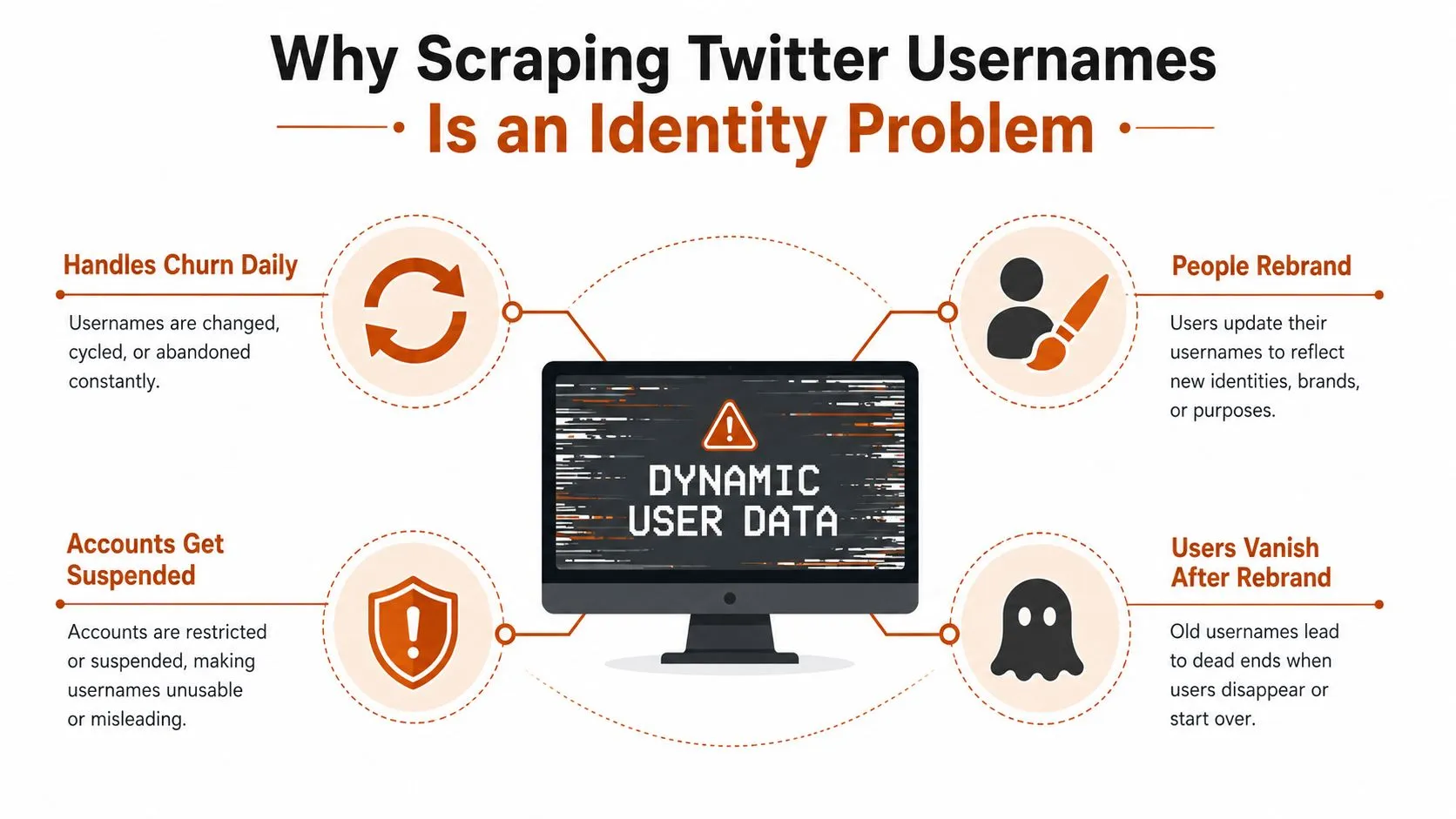
X users can change handles, edit display names, become suspended, or vanish from the paths your collector normally searches. A username list is therefore an observation, not a durable account register. The pipeline must preserve the relationship between each observed handle and the account behind it.
The durable identity layer is the 64-bit Snowflake user ID. X moved to durable Snowflake IDs on January 22, 2013, and those IDs persist when an account changes its screen name, as documented in the X developer discussion about user ID durability and username changes. Older IDs were sequential integers. Historical handles may need indirect reconstruction from archived replies or mentions instead of live API retrieval.
Build the data model around that distinction:
- Canonical key: Store the numeric user ID as the primary account identity.
- Mutable attribute: Store the current username separately with its capture time.
- History table: Record every observed handle and the period associated with that ID.
- Display metadata: Keep display name, bio, verification status, and counts as independently changing fields.
- Resolution state: Record whether a handle resolved, redirected, returned an error, or became unavailable.
Suppose an account starts as @alpha_data, changes to @alpha_research, then updates its display name. A handle-only database can split those observations into multiple accounts or overwrite useful evidence. An ID-first model retains one identity, multiple historical aliases, and a dated trail of profile observations.
Practical rule: Use the username for discovery and the Snowflake ID for joining, deduplication, and longitudinal monitoring.
Operational policy matters too. Collect only information you’re permitted to use, respect access controls, and set retention rules before the crawl starts. WebscrapingHQ’s ethical data collection guidance can help translate those requirements into operating rules.
Scoping the Job and Choosing Your Input Seeds
Before choosing a CSS selector, define what you’re trying to discover. A competitor profile, a follower graph, a hashtag participant set, search-result authors, and accounts mentioned by a known profile are different collection problems. Each produces different pagination behavior, duplication patterns, and confidence levels.
Start with a seed inventory:
- Profile URLs: Good for controlled lists and recurring monitoring.
- Search results: Useful for discovering authors around a topic, but results can be incomplete or difficult to reproduce.
- Follower or following pages: Appropriate for network analysis, with cursor-based traversal and substantial duplication.
- Mentions and replies: Valuable for conversation mapping, but they require thread and author resolution.
- Numeric IDs: Best for rechecking known identities when handles have changed.
A seed should carry provenance. Save the original URL, query, crawl timestamp, extraction path, and resolution status alongside the discovered account. If you’re unfamiliar with converting profile references into stable numeric identifiers, SuperX’s guide to finding X IDs provides useful background.
| Seed type | Pagination style | Typical yield per page | Risk tier |
|---|---|---|---|
| Profile URL list | Direct profile resolution | Varies by input list | Low |
| Search results | Query-specific cursors | Varies by query and interface state | Medium |
| Followers or following | Cursor-based graph traversal | Varies by account and endpoint | High |
| Mentions and replies | Thread and result cursors | Varies by conversation activity | Medium |
| Known numeric IDs | Direct lookup or profile resolution | One identity per lookup | Low |
Don’t estimate the job by counting usernames alone. Estimate the number of profile resolutions, cursor pages, retries, and enrichment calls. A list that looks small can become operationally expensive if every handle needs historical resolution, profile metadata, and a second pass after transient failures.
For competitive intelligence, keep discovery separate from enrichment. The competitive intelligence gathering workflow offers a useful framing: first identify the entities that matter, then collect the fields needed for the decision. That separation makes it easier to reduce scope when access conditions change.
Selectors, Pagination, and When to Use a Browser
X’s interface is a dynamic single-page application. Profile and timeline elements may appear only after hydration, while virtualized lists can remove nodes that have scrolled out of view. A scraper that reads only initial HTML will miss accounts rendered later.
Use narrow, purposeful selectors. Prefer stable attributes such as data-testid where available, and avoid generated class names that can change during frontend deployments. A selector should identify the semantic container for a user record, then extract its profile URL or embedded ID. The guide to mastering CSS selectors for web scraping covers techniques for keeping selectors useful after ordinary layout changes.

Pagination uses cursors rather than offsets. The next request depends on a cursor returned by the previous response, and followers, bookmarks, search, and other views may expose different cursor fields. Log the operation, cursor, request status, and extracted-record count for every page.
A resilient loop should:
- Stop when the next cursor is absent or repeats.
- Deduplicate by numeric user ID, not only by handle.
- Preserve the raw response or a relevant diagnostic fragment.
- Retry transient failures without reprocessing completed cursors.
- Record empty pages as events rather than successful completions.
- Check that the record count is plausible before advancing.
A real browser fits low-volume verification and pages whose data appears only after client-side rendering. Browser sessions consume more resources and expose more automation surface. Authenticated web clients or carefully managed endpoint flows can be more efficient in production where permitted. Keep the browser path available for validation, not as the default for every collection job.
Authentication needs its own runbook. Isolate sessions, expire credentials safely, and never treat a login wall as permission to bypass access controls. The examples of X API authentication flows help operations leads understand the moving parts without confusing authentication with unrestricted access. Stable numeric IDs, raw response retention, and selector tests also make identity tracking easier when the interface changes.
Rate Limits, Batching, and Backoff
Rate-limit planning determines whether a username pipeline stays predictable during a large crawl. X documents API limits in 15-minute windows, and the authenticated user-lookup endpoint is listed at 900 requests per 15 minutes, or a theoretical 60 lookups per minute if the full window is consumed, in the X API rate-limit documentation.
Treat the published ceiling as an upper boundary. Reserve capacity for retries, metadata enrichment, authentication overhead, and uneven response times. Read x-rate-limit-remaining, x-rate-limit-reset, and x-rate-limit-limit on every applicable response. Slow workers before the remaining budget reaches zero, then resume after the reset time. A controlled pause is easier to operate than a predictable burst of failures.
| Endpoint | Window | Per-App Cap | Recommended Worker Pace | Retry Behavior |
|---|---|---|---|---|
| Authenticated user lookup | 15 minutes | 900 requests | Pace below the published ceiling, with reserve capacity | Honor reset information, then retry with jitter |
| Profile enrichment flow | Endpoint-dependent | Check returned headers | Batch conservatively and monitor each route separately | Retry transient failures, quarantine persistent failures |
| Graph traversal | Endpoint-dependent | Check returned headers | Separate graph workers from profile workers | Back off per endpoint, not globally |
| Search or discovery flow | Endpoint-dependent | Check returned headers | Use query-level pacing and cursor checkpoints | Preserve cursor state before retrying |
Batch handles into cohorts, while preventing one expensive cohort from starving the queue. Grouping by expected profile complexity or enrichment requirements makes worker behavior easier to predict. Use exponential backoff with full jitter, a dead-letter queue for accounts that repeatedly fail, and a circuit breaker that pauses workers when failures cluster near a reset boundary.
Throttling, not parsing, is usually the practical failure mode in username pipelines. Parser defects can be corrected after a deployment. A worker pool that ignores headers can waste the operating window and leave the identity dataset only partly refreshed. Keep retry state, cohort status, and rate-limit headers in operational logs so a stalled run can resume without replaying completed work.
Proxies, Fingerprints, and Anti-Bot Trade-offs
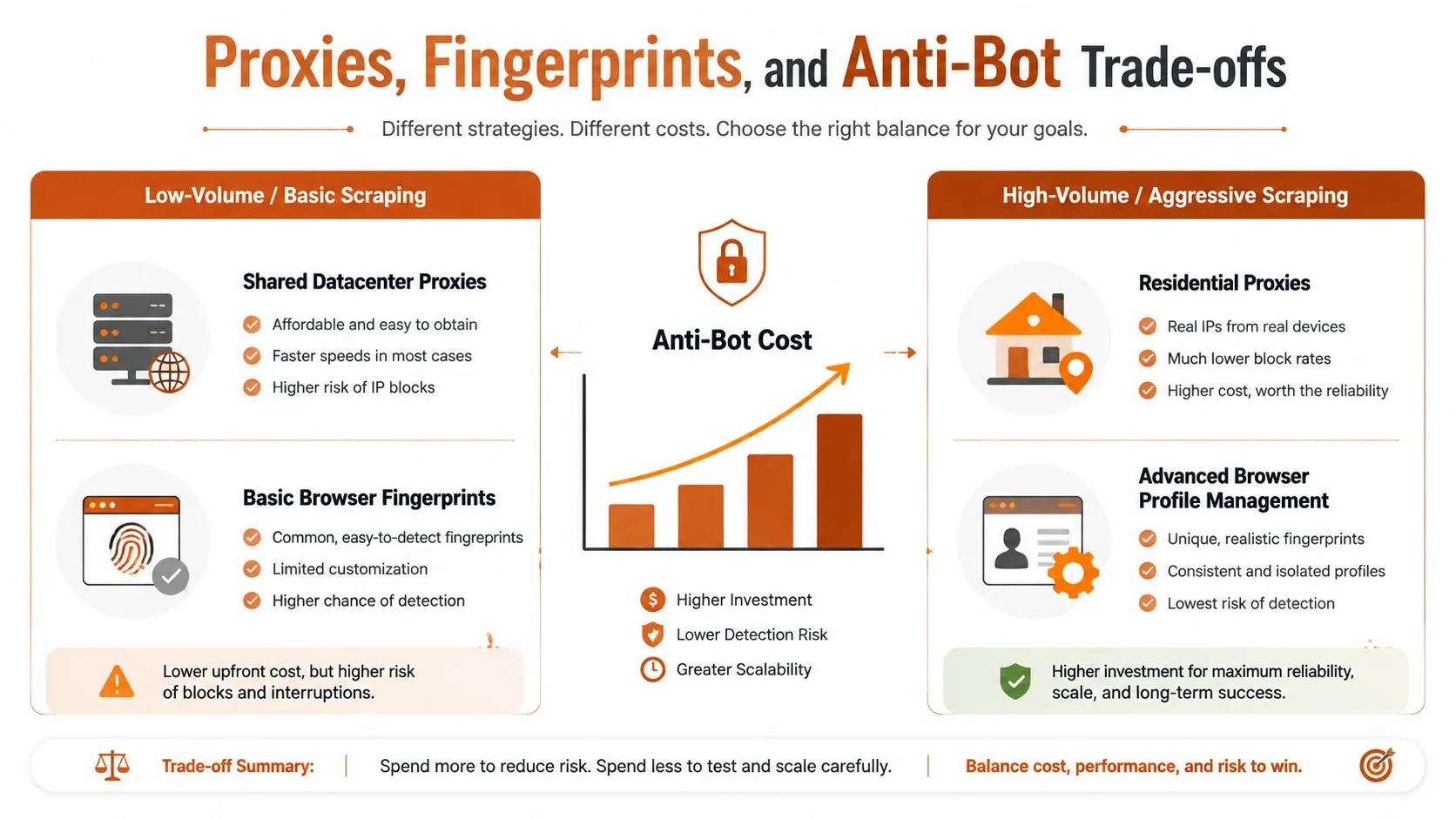
Proxy selection should match the access path. A datacenter pool may handle public profile requests with conservative pacing. Residential or mobile routes may be required for harder public pages, but they bring higher cost, less predictable latency, and more session-management work.
| Route | Useful for | Main advantage | Main drawback |
|---|---|---|---|
| Datacenter proxy | Controlled public profile checks | Simple routing and predictable operations | More likely to be classified as automated |
| ISP proxy | Longer-lived sessions | Better continuity than constantly changing addresses | Smaller pools and higher operational cost |
| Residential proxy | Challenging public pages | Traffic resembles household access patterns | Cost, consent, and quality vary by provider |
| Mobile proxy | Hardest access conditions | Can provide a distinct network profile | Expensive, slower, and difficult to scale responsibly |
Session continuity, TLS characteristics, browser properties, and request timing often matter more than raw IP rotation alone. A headless Chromium session can expose automation signals through browser properties and rendering behavior. Aggressive rotation can also look suspicious when the account, cookie state, and network identity do not align. Preserve a consistent session for each cursor-based workflow, and change routes only when measured failures justify it.
Use a routing ladder:
- Start with the least invasive route that reliably returns the permitted public data.
- Escalate only after measured failures, such as repeated interstitials or empty responses.
- Keep sessions sticky for cursor-based pages where continuity affects results.
- Separate diagnosis from escalation, since selector failures can look like blocks.
- Treat CAPTCHA handling as a compliance decision, since automated bypasses create legal and operational risk.
The economics depend on volume, target difficulty, and how much data each request returns. Avoid a blanket spend-per-thousand rule until the failure distribution is known. Compare fixed and rotating approaches in this static versus rotating proxy guide.
Parsing Profiles with LLMs and Computer Vision
A profile parser has to handle more than the normal account page. Suspended accounts, missing bios, localized labels, verification icons, and partially rendered widgets can all produce valid HTML with incomplete meaning. A regex that works on a clean profile can map the wrong text when the interface changes.
Use a two-stage parser:
- Deterministic extraction: Parse profile URLs, IDs, handles, timestamps, counts, and known attributes from the DOM or structured response.
- Model-assisted fallback: Send difficult cases to an LLM or vision-language model with the raw HTML, an annotated screenshot, and explicit field instructions.
The first stage should handle the common layout quickly. The fallback should handle ambiguity, not every record. If a standard parser can’t resolve a handle, distinguish between a missing field, a blocked page, a suspended account, and a selector miss before invoking a model.
Give the model a strict output contract:
{
  "handle": null,
  "display_name": null,
  "bio": null,
  "join_date": null,
  "follower_count": null,
  "following_count": null,
  "verified": null,
  "confidence": null
}
Use null when evidence is absent. Don’t ask the model to infer hidden fields, repair an unavailable account, or convert uncertain text into a confident value. Log the model confidence, input artifact, parser version, and fallback reason. Low-confidence results should return to a heuristic or review queue rather than shipping directly to a downstream identity table.
The data parsing guide provides useful context for separating extraction, normalization, validation, and delivery. That separation matters here because an LLM can identify a field while still producing a value that fails your identity rules.
Schema Design and Delivery Formats
The schema is where a username scraper either becomes a monitoring system or remains a disposable export. Anchor each record to the Snowflake user ID, then store the current handle and every historical observation as attributes with timestamps. A handle should never be the primary key because a retired name can later appear on a different account, while the original ID remains the stable join key.
A practical profile observation includes:
- Identity:
user_id,username_raw,username_normalized, andsource_url. - Profile text:
display_name,bio, and any permitted public profile fields. - Counts: follower count, following count, and tweet count, each with its capture timestamp.
- Status: verification state, resolution status, suspension or unavailable indicators.
- Lineage: seed source, extraction method, request ID, parser version, and
schema_version. - Timing:
captured_at, first-seen timestamp, and last-successful-resolution timestamp.
Validate handles before writing them to the canonical table. A conventional handle pattern is ^[A-Za-z0-9_]{1,15}$, but validation should not replace identity resolution. Store both the raw form and a normalized lowercase form so you can detect casing differences, malformed values, and conflicts between what the page displayed and what the URL contained.
| Field | Type | Delivery Format Fit |
|---|---|---|
user_id | String or integer-safe identifier | JSON, NDJSON, Parquet, database |
username_raw | String | CSV, JSON, audit exports |
username_normalized | String | Warehouse joins, deduplication |
display_name | String | CSV, JSON, review workflows |
bio | String or nullable string | JSON, Parquet, downstream text analysis |
follower_count | Nullable integer | CSV, Parquet, dashboards |
following_count | Nullable integer | CSV, Parquet, dashboards |
tweet_count | Nullable integer | CSV, Parquet, trend analysis |
verified | Nullable boolean | JSON, warehouse tables, webhooks |
captured_at | Timestamp | Every delivery type |
source_url | String | Audits and traceability |
schema_version | String | All production deliveries |
Choose the delivery format according to the consumer. CSV works for spreadsheet audits and one-off review. Newline-delimited JSON suits streaming ingestion because each record stands alone. Parquet is appropriate for analytical retention and columnar queries. Signed webhook POSTs fit near-real-time monitoring, provided the receiver validates the signature and handles replay protection.
A Python REST client should also separate transport from parsing. The reliable Python REST API guide is useful background for structuring request handling, response validation, and error paths without mixing them into business logic.
Monitoring what silently breaks
A scraper can return HTTP success while producing an empty or degraded dataset. Health checks must therefore measure extraction quality, not only request status.
Track:
- Selector-hit rate
- Empty-profile rate
- Proxy block rate
- CAPTCHA frequency
- Records per minute
- Duplicate-ID rate
- Schema-validation failures
- Cursor termination reasons
- Percentage of records missing a user ID
Run a small calibration crawl against known seed handles every day. Compare the resulting fields with expected structural conditions, not only exact text, since profile content naturally changes. Alert when operational metrics move materially away from their recent baseline, then inspect screenshots, raw HTML, request status, and selector logs before changing the parser.
Keep deployment rollback simple. Version selectors, parsers, schemas, and routing rules independently. Store the last known-good configuration, pause delivery when validation fails, and replay quarantined records after the correction. Don’t overwrite failed observations with blanks, because an empty value can mean a changed profile, a blocked request, a suspended account, or a broken selector.
Day-one operating checklist
- Define seeds: Record the discovery source, scope, and expected crawl shape.
- Lock identity rules: Make
user_idcanonical and handle history append-only. - Set validation: Reject malformed records before they reach downstream systems.
- Add checkpoints: Persist cursors and completed identities so retries are idempotent.
- Stand up alerts: Monitor extraction quality, not just HTTP status.
- Write rollback steps: Document how to pause, revert, and replay.
- Confirm delivery security: Test webhook signing, access permissions, and retention.
- Run calibration: Verify known profiles before the first production batch.
WebscrapingHQ provides managed web data operations, custom extraction, monitoring, proxy management, and structured delivery options for teams that need recurring data rather than a one-time username file. If your X identity pipeline needs durable IDs, schema validation, and operational support through interface changes, visit WebscrapingHQ to discuss the required source, fields, cadence, and delivery format.
Want this done for you?
Send us the URLs. We'll quote it in 24 hours.
Paste the URL(s) you want scraped. We'll reply within 24 hours with a feasibility check and a ballpark quote.