Jump to section
- A Realistic Look at How Raw Data Becomes Useful
- The stages between input and output
- Defining Data Parsing Beyond the Buzzword
- Four terms that need separate meanings
- Core Parsing Techniques Compared
- A comparative view
- Validation and Schema Mapping After the Parse
- A schema-first sequence
- Parsing Inside Web Scraping and ML Pipelines
- One early error can change the downstream meaning
- AI and LLMs Are Changing Parsing, Not Replacing It
- Best Practices for Reliable Parsing Pipelines
- Five checks for production readiness
You’ve just received three inputs for the same project: product pages saved as messy HTML, scanned invoices sitting in a PDF folder, and a JSON API response full of nested arrays. The business team wants one tidy spreadsheet, but the computer has only received bytes in several unrelated formats. Data parsing is the work that turns those inputs into structures software can inspect and use.
The difficult part is that parsing isn’t synonymous with extraction, cleaning, or validation. A parser may build a document tree, identify fields, preserve table relationships, or interpret recovered OCR text, but downstream systems still need canonical field names, reliable types, duplicate handling, and rules for rejecting bad records. Treating parsing as a single “convert this to JSON” operation is how plausible-looking errors reach dashboards and machine-learning datasets.
A Realistic Look at How Raw Data Becomes Useful
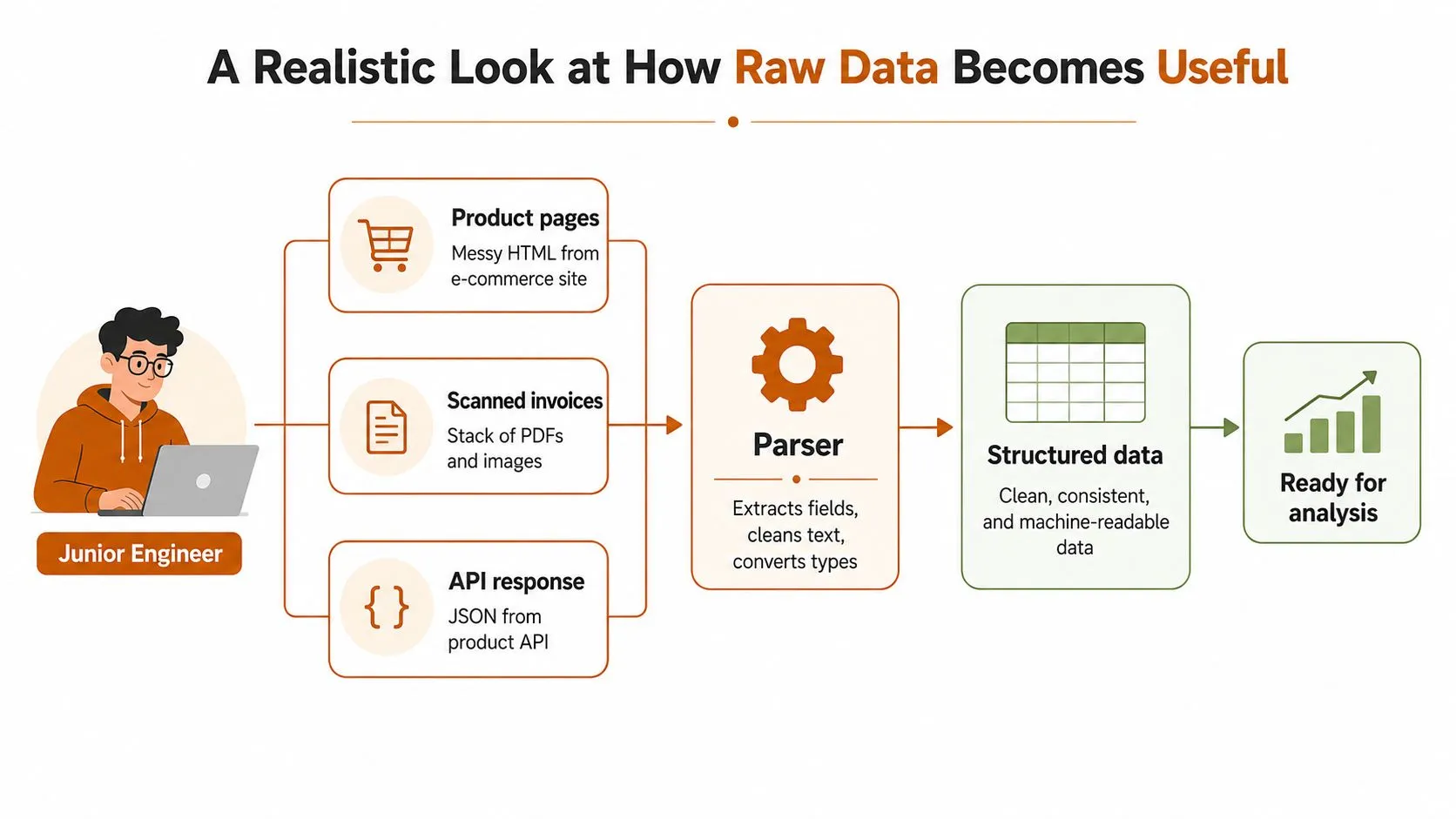
Suppose you’re building a product catalog. Your first source returns HTML with navigation menus, promotional banners, repeated product cards, and text hidden inside nested elements. The second source contains scanned invoices, where a human can see a supplier, date, total, and line items but the file has no usable text layer. The third source returns JSON, yet the useful values are buried inside arrays for variants, offers, and stock locations.
The first stage is ingestion. You collect the response or file, preserve the original content, record where it came from, and attach enough metadata to reproduce the operation. At this point, you haven’t created business data. You’ve created a trustworthy copy of an input.
Next, the system identifies the input’s shape. A web page has hierarchy and attributes. A scanned invoice has pixels and visual regions. An API response already expresses relationships through objects and arrays. The parser’s job is to recover those relationships in a form that later code can query without repeatedly interpreting raw content.
The stages between input and output
After structure recovery, the pipeline selects the fields it needs, converts values into usable types, and maps different labels to a shared schema. A product price might arrive as text, while an invoice total may come from OCR with a currency symbol or a recognition error. Those values need separate handling even when the final column is called price.
A useful practical distinction appears in this guide to cleaning web-scraped data with Python and pandas. Parsing creates an interpretable structure. Cleaning makes that structure consistent, while validation decides whether it’s acceptable.
Finally, the pipeline stores accepted records and quarantines failures. A missing SKU shouldn’t become an empty cell if the warehouse requires a SKU. It should produce an observable error, preserve the source record, and follow a retry, fallback, or human-review path. That’s why parsing is the bridge between “we received something” and “we can safely use something.”
Defining Data Parsing Beyond the Buzzword
Data parsing is the conversion of serialized input into a structured representation that software can query, transform, and validate. Serialized input may be HTML, JSON, XML, plain text, a document file, or text recovered from an image. The output might be a DOM tree, an object graph, a list of tokens, or records aligned to a target schema.
Consider a product card embedded in a web page:
<div class="product">
  <h2>Trail Backpack</h2>
  <span class="vendor"> Alpine Gear </span>
  <span class="price">$89.00</span>
</div>
Parsing the HTML creates a tree of elements and text nodes. The parser understands that the h2 and span elements sit inside the product container. It doesn’t necessarily decide which values belong in your warehouse, nor does it guarantee that $89.00 is a valid numeric price.
Four terms that need separate meanings
Extraction selects the information you want from the parsed structure. Finding the h2 node and reading Trail Backpack is extraction. Selecting the vendor span and the price span is extraction too.
Cleaning changes values into a consistent representation. Trimming the vendor value produces Alpine Gear. Lowercasing it might produce alpine gear, depending on the matching rules your application uses. Removing currency symbols and separators can prepare the price for type conversion, but cleaning alone doesn’t prove the result is a valid price.
Validation checks the result against rules. A positive floating-point value may be required for price. A SKU may be mandatory. Availability may need to belong to an approved set such as in_stock, out_of_stock, or unknown. Validation should produce a clear failure when the input violates those rules.
You can use the same distinction with media workflows. A creator who needs searchable text from a video may first use a service such as YoutubeToText for content creators. The transcript is collected or generated content, parsing gives it a usable textual structure, extraction selects relevant passages, and cleaning or validation prepares it for a downstream application.
Practical rule: If you can’t say whether a step is recovering structure, selecting content, normalizing values, or enforcing rules, your pipeline probably has too many responsibilities hidden in one function.
The terms overlap in commercial tools because production products often package the entire flow together. The distinction still matters for debugging. If a field is absent, ask whether the parser failed to build the structure, extraction selected the wrong node, cleaning discarded the value, or validation rejected it.
Core Parsing Techniques Compared
Different inputs call for different parsers. Choosing a technique because it’s fashionable, rather than because it matches the source structure, creates avoidable failure modes.
A comparative view
| Technique | Best for | Typical failure mode | Example tool |
|---|---|---|---|
| HTML and DOM parsing | Nested pages, attributes, links, and rendered markup | Selectors break after layout changes or target the wrong repeated element | BeautifulSoup, cheerio |
| JSON and XML parsing | API responses, feeds, and explicitly structured objects | Missing schema awareness causes incorrect assumptions about optional or repeated nodes | Python json, lxml |
| Regular expressions | Narrow, stable patterns in logs or small text fragments | Greedy or unanchored patterns capture too much or match the wrong occurrence | Python re |
| NLP-based parsing | Prose, reviews, contracts, entities, and key-value language | Ambiguous wording and domain vocabulary produce uncertain interpretations | spaCy, transformer models |
| OCR and vision parsing | Scanned PDFs, screenshots, and image-only documents | Poor scans, tables, reading order, and visual context create recognition errors | Tesseract, document vision models |
For HTML, a DOM parser is the natural choice because the input already expresses nesting. A product page can be traversed with a CSS selector, such as selecting a product card and then its title, price, and availability nodes. XPath can also work well where relationships are more important than class names. The comparison of CSS selectors and XPath is useful when a page’s structure makes one approach easier to maintain than the other.
JSON parsing is more deterministic. If an API returns offers as an array, your code can iterate over that array rather than searching for bracket patterns in raw text. XML offers similar structural benefits, but namespaces, attributes, optional nodes, and schema versions still demand care. A syntactically valid document can remain semantically misunderstood.
Regex has a smaller but valuable role. It can capture a timestamp or a narrowly defined log token, such as the status after status=. It becomes risky when used to interpret arbitrary HTML or prose, because nested structures and repeated delimiters quickly exceed what a simple pattern can represent.
NLP parsing handles meaning rather than only visible syntax. A review may contain an entity, sentiment cue, or feature-value phrase that has no fixed HTML location. NLP systems can help identify it, but their output should pass through the same schema and confidence checks as every other parser.
OCR comes first for an image-only invoice. It recovers text and coordinates, but it may confuse characters, merge columns, or lose reading order. Vision-aware parsing can use layout and spatial relationships, yet tables and diagrams remain cases where end-to-end fidelity requires specialized capabilities. Recent benchmark work reports that no single method was consistently strong across tables, charts, faithfulness, semantic formatting, and visual grounding, which supports a multi-capability design rather than a universal parser (document parsing benchmark).
Validation and Schema Mapping After the Parse
A parser can return a perfectly valid object that your warehouse still can’t trust. Validation and schema mapping give that object a contract.
Assume a product API returns:
{
  "sku": "TB-17",
  "MSRP": "$89.00",
  "availability": null
}
Your canonical record might require sku, list_price, and availability. The pipeline should rename MSRP to list_price, remove the currency symbol, convert the price to a numeric type, and decide how a null availability value is represented. It might use unknown, route the record for review, or apply a documented fallback. The correct choice depends on the business rule, but it shouldn’t happen accidentally inside a string-cleaning expression.
A schema-first sequence
Start with the destination schema, not with whichever fields happen to appear in the first response. Define required fields, accepted types, allowed values, null behavior, and mappings for synonyms such as MSRP, recommended_price, and list_price.
Then validate the parsed payload in a deliberate order:
- Presence: Confirm that required fields exist, even if a field is allowed to contain null.
- Type: Coerce safe representations, such as a currency string to a numeric value, and reject ambiguous values.
- Meaning: Check business rules, such as a price being positive and availability using an approved vocabulary.
- Mapping: Rename source-specific labels into canonical names and preserve the source field for traceability where needed.
- Output: Emit a row only after it meets the contract.
| Validation Check | Example | Action on Failure |
|---|---|---|
| Required field | sku must be present | Retry, use a fallback selector, or quarantine |
| Numeric type | list_price must parse as a number | Reject the record and retain the raw value |
| Allowed value | availability must use a known status | Map a documented synonym or send to review |
| Non-null rule | A warehouse key cannot be null | Block insertion and raise an alert |
| Cross-field rule | A sale price must not exceed the list price | Quarantine for investigation |
JSON Schema can express structural requirements for JSON payloads. Pydantic is useful when Python code needs typed models, coercion, and readable validation errors. Great Expectations can apply expectations to batches and help teams monitor whether accepted records continue to meet operational standards. For a broader framework around KPIs for operational data quality, connect field-level checks to measures such as completeness, validity, and freshness without hiding the underlying record failures.
Silent passes are more dangerous than visible failures. A missing price that becomes zero can distort a dashboard while appearing technically complete. Use retries for transient source problems, fallbacks for known layout variants, and quarantine queues for records that need inspection. The ultimate guide to data validation provides additional context for making these checks explicit rather than leaving them scattered across parsing code.
Parsing Inside Web Scraping and ML Pipelines
Parsing sits between the fetcher and the systems that create value from the result. A typical flow looks like this:
- A requester sends an HTTP request.
- The source returns HTML.
- A DOM parser or narrow pattern extracts candidate fields.
- A schema layer validates and normalizes them.
- Storage records the accepted data and the original provenance.
- Feature engineering prepares values for analytics or modeling.
- A dashboard, classifier, recommendation system, or training job consumes the result.
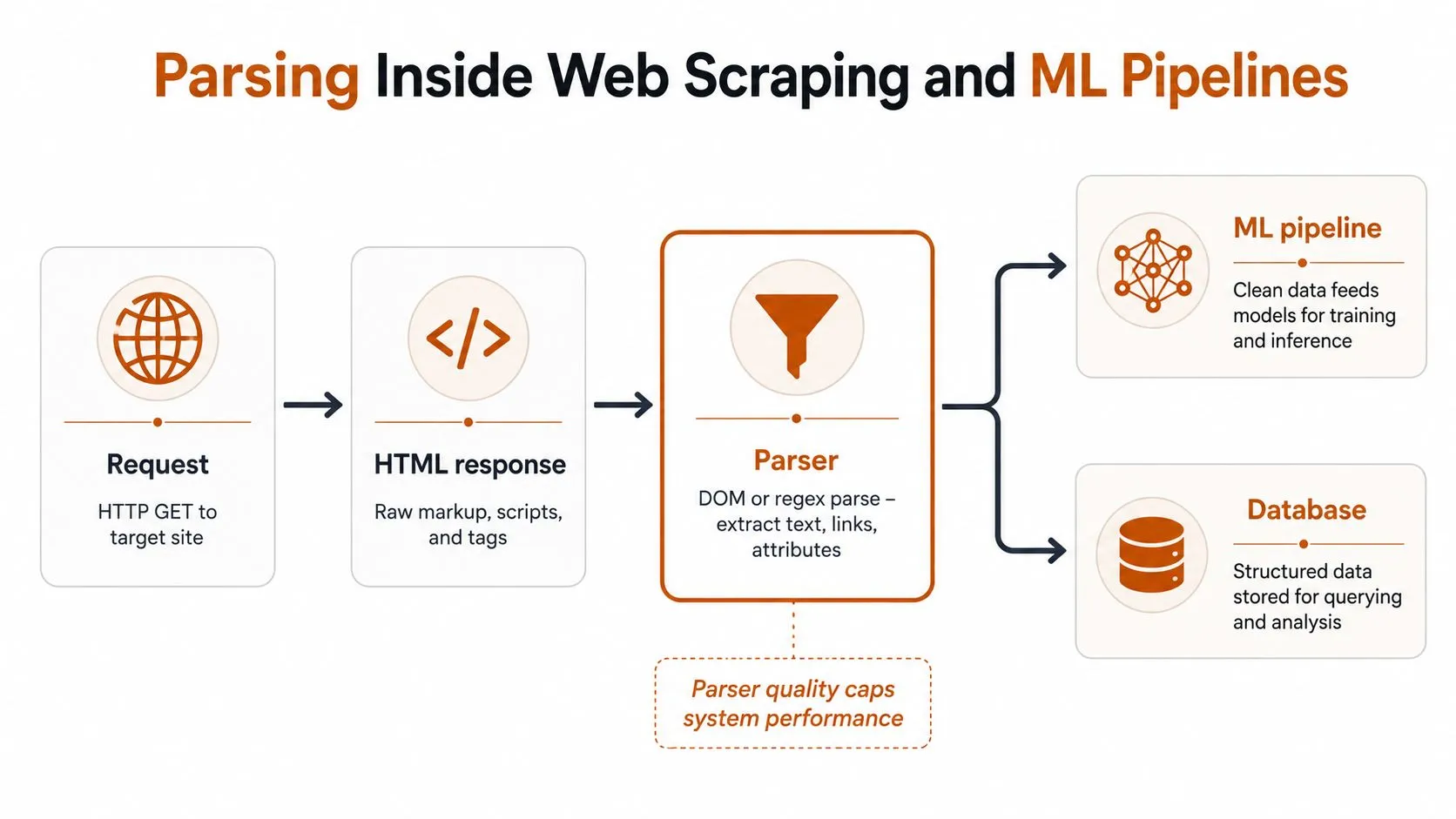
One early error can change the downstream meaning
Take a retail catalog scrape. The product card contains a title, brand, current price, original price, and stock state. A selector that matches the promotional banner instead of the product price may return a plausible currency value. The record can pass a superficial “not empty” check while assigning the wrong price to the item.
An encoding problem creates a different kind of defect. A product name with a damaged character may fail a deduplication key, split one product into multiple records, or create inconsistent labels in a training set. If the price parser misses a decimal separator, aggregation results become misleading. If the availability field falls back to a default without an error, inventory analysis can count unavailable products as active listings.
The model doesn’t know which values came from a parser. It learns from the dataset it receives. A classification model trained on malformed categories learns those malformed categories. A dashboard groups whatever strings the pipeline emitted, including spelling variants and fallback values.
The parser sets a quality ceiling for every chart, feature, and prediction downstream.
Parser quality also affects the cost of operations. A narrowly targeted DOM parser is fast and deterministic for stable markup, but it needs maintenance when the source changes. A broader language or vision model may recover structure from messy content, but it introduces uncertainty, latency, and a need for stronger validation. The right choice depends on the field, source, and failure consequence, not on whether the tool is traditional or AI-based.
For a fuller view of how collected data supports modeling workflows, see machine learning data collection. The important design decision is to preserve raw inputs and parser metadata alongside normalized records. That makes it possible to compare outputs after a selector change, explain a suspicious metric, and regenerate a dataset without refetching everything.
AI and LLMs Are Changing Parsing, Not Replacing It
The claim that LLMs will make traditional parsers obsolete confuses flexible interpretation with dependable structure handling. A CSS selector can retrieve a job title from a stable card quickly and repeatably. An LLM may understand a long job description and identify skills expressed in varied language, but its output still needs a schema, type rules, and checks against the source.
A production job-board pipeline might route fields like this:
- Stable identity fields: DOM parsing retrieves the title, company, location, and posting URL.
- Scanned attachments: OCR recovers text from an image or PDF before structural processing begins.
- Variable descriptions: An LLM identifies skills, seniority signals, and responsibilities from prose.
- Shared output layer: Validation checks required fields, allowed values, and evidence or confidence metadata.
That architecture treats an LLM as one parser in a routing system, not as a replacement for every parser. Rules are cheaper to operate when the source is stable and the expected pattern is narrow. OCR is necessary when the content exists as pixels. Language models are useful where wording and layout vary enough to make a large collection of brittle rules costly to maintain.
The trade-off is control. A deterministic parser usually fails in a visible, repeatable way when a selector no longer matches. An LLM can produce a well-formed answer that misinterprets an ambiguous passage. Production systems therefore need constrained prompts or extraction schemas, source snippets or coordinates for review, validation, and monitoring for changes in field coverage.
The same principle applies to specialized collection projects, including a Leboncoin scraper. Whether a pipeline uses selectors, rendered content, computer vision, or an LLM, the output should enter one canonical schema and one error-handling process. Hybrid parsing wins because each technique handles the input it understands best.
Best Practices for Reliable Parsing Pipelines
Reliable parsing starts with a few operational checks. Apply them to an existing scraper, document workflow, or API ingestion job before adding another model or library.
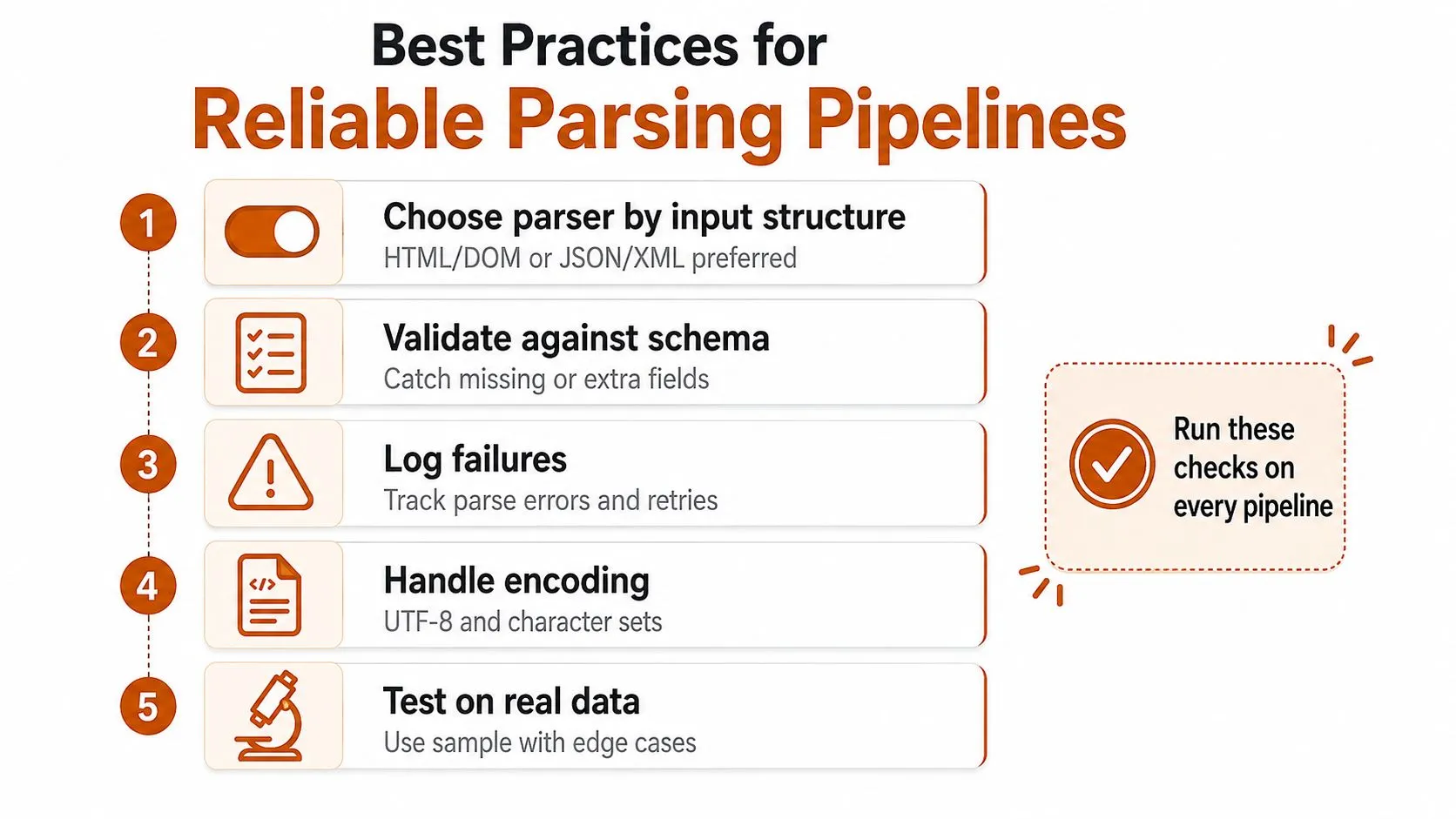
Five checks for production readiness
-
Choose by input structure. Use HTML or DOM parsing for hierarchical markup and JSON or XML parsers for machine-readable objects. Reserve regex for small, clearly bounded patterns. Don’t use regex as a substitute for understanding nested HTML.
-
Validate against a versioned schema. Define required fields, types, null behavior, and permitted values with JSON Schema, Pydantic, or an equivalent contract. Keep schema changes reviewable so a new source field doesn’t alter the meaning of an existing column.
-
Log and quarantine failures. Store the source identifier, parser version, error category, and raw record when a parse fails. Retry temporary fetch or service problems, but route malformed or ambiguous records to a review queue instead of dropping them or filling defaults.
-
Handle encoding and layout. Test UTF-8 and other source character sets, escaped entities, line breaks, merged table cells, and image-only documents. OCR output needs separate checks for reading order, numeric characters, and column boundaries.
-
Test with real edge cases. Build fixtures from actual pages and documents, including missing fields, repeated elements, unusual titles, empty arrays, changed classes, and poor scans. A parser that works only on a clean sample isn’t ready for scheduled collection.
Version selectors and parser dependencies so you can explain when an output changed. Monitor parse success, field coverage, rejected-record counts, and representative sample differences over time. A sudden drop in a field may indicate a layout change even when requests still return successful responses.
Run one audit today. Pick a recent batch, trace every output field back to its source location, confirm that each required field has a fallback path, and verify that every parse error reaches a review or retry mechanism. If you can’t answer those questions, the pipeline is producing data, but it isn’t yet producing dependable data.
WebscrapingHQ designs and operates custom web data pipelines that combine DOM rules, visual inspection, LLM-assisted extraction, schema versioning, monitoring, retries, and structured delivery. Visit WebscrapingHQ to discuss a recurring feed, document-heavy workflow, or training-data pipeline that needs reliable parsing and validation rather than raw scraped output.
Want this done for you?
Send us the URLs. We'll quote it in 24 hours.
Paste the URL(s) you want scraped. We'll reply within 24 hours with a feasibility check and a ballpark quote.