Jump to section
- Table of Contents
- Why a Single OLX Scraper Strategy Fails
- Reconnaissance before implementation
- Understanding OLX Scale and Data Volume
- Estimate the job before selecting the stack
- Technical Realities of Scraping OLX Pages
- What defensive systems can observe
- Country-by-Country Protection Variability
- A working comparison framework
- Pagination and identity are local problems
- Designing a Production-Grade Extraction Pipeline
- Give every market its own operating profile
- Optimize carefully, not aggressively
- Enterprise Use Cases for OLX Classifieds Data
- Data products built from listings
- Governance belongs in the design
- Evaluating Managed Services Versus In-House Scraping
- Choose according to the workload
Most advice about an OLX scraper starts with the wrong premise: that OLX is one website with one predictable defense system. It isn’t. OLX is a collection of country-specific marketplaces, and the request path that works on one domain can fail on another because rendering requirements, page structure, IP sensitivity, and pagination behavior differ materially by market.
A reliable pipeline therefore starts with reconnaissance, not code copied from a tutorial. Test the target country, observe its live network behavior, identify the public listing paths that remain accessible, and only then choose between direct HTTP, browser rendering, API interception, and different proxy pools. The engineering problem isn’t collecting HTML. It’s maintaining a country-aware data product without violating published crawl restrictions or creating traffic patterns that trigger defensive systems.
Table of Contents
Open Table of Contents
- Why a Single OLX Scraper Strategy Fails
- Understanding OLX Scale and Data Volume
- Technical Realities of Scraping OLX Pages
- Country-by-Country Protection Variability
- Designing a Production-Grade Extraction Pipeline
- Enterprise Use Cases for OLX Classifieds Data
- Evaluating Managed Services Versus In-House Scraping
Why a Single OLX Scraper Strategy Fails
The first step is testing the target country with a controlled probe, not copying a tutorial script. A quick run can fetch a search page, parse several cards, follow a listing URL, and produce clean-looking output. That result is only evidence that one route worked under one market’s conditions, not a platform-wide specification.
OLX operates as a group of regional marketplaces rather than one uniform technical target. A parser built around one country’s selectors may meet different markup, localization, URL conventions, embedded data, or client-side rendering elsewhere. The same search workflow can also expose different network requests and pagination mechanics across domains.
Protection varies by market as well. Some domains may return useful internal JSON with relatively low IP sensitivity. Others can present Cloudflare or JavaScript challenges and reject datacenter traffic after limited request volumes, as documented in recent cross-country OLX scraping coverage. That difference determines proxy segmentation, rendering choices, and queue design before parsing begins.
Reconnaissance before implementation
Treat each market as its own source adapter. For a new country, record:
- Rendering behavior: Check whether listing fields arrive in the initial response or only after JavaScript executes.
- Network access: Inspect requests from search and listing pages, limiting collection to permitted public paths.
- Pagination shape: Test numbered pages, cursors, infinite scrolling, and URL parameters separately.
- IP response: Observe whether repeated requests return normal content, throttling, challenges, or empty results.
- Schema differences: Compare field names, localized categories, seller labels, location formats, and missing-value patterns.
This profile should drive crawler behavior at runtime. It prevents a common failure mode: engineers refine selectors while the selected request method never reaches the listing data.
Practical rule: A country adapter should own URL construction, rendering mode, proxy policy, pagination logic, and parser assumptions.
Fault tolerance becomes a separate design concern once markets fail differently. Isolate country queues, retry transient errors without replaying entire jobs, and preserve checkpoints when a domain changes behavior. The principles in this guide to distributed scraping fault tolerance apply directly, particularly bounded retries and failure isolation. A country-specific pipeline takes more setup than one universal script, but it limits blast radius and makes changes testable.
Understanding OLX Scale and Data Volume
Infrastructure planning changes when the source is treated as a large recurring inventory system rather than a handful of pages. OLX Group’s FY2025 investor deep dive describes operations across nine brands in nine markets, with nearly 64 million active listings daily, 29 million monthly app users, and about 27 million secondhand items traded during FY25 on OLX platforms (Prosus OLX Group investor deep dive).
Those figures don’t tell you how many pages your project should request. They do tell you that naïve full-catalog crawling is usually the wrong starting point. A narrow category, location, or keyword scope still needs explicit boundaries, incremental collection, deduplication, and storage policies.
OLX’s scale also has historical context. Fortune reported that OLX, founded in 2006 in Buenos Aires, had reached 200 million monthly active users, 11 billion page views, 25 million listings, and 8.5 million transactions per month by October 2014, with operations in 40 countries and about 1,200 employees at that time (Fortune’s OLX profile). The older figures aren’t a blueprint for current capacity, but they show why the platform has long required marketplace-scale thinking.
Estimate the job before selecting the stack
Start with the dataset definition, not a concurrency target. Decide whether you need current search results, complete listing pages, seller-level relationships, historical snapshots, images, or only selected fields. Each choice affects browser usage, bandwidth, parsing complexity, retention, and quality checks.
A practical collection model separates:
- Discovery: Find listing URLs from permitted search pages and category paths.
- Enrichment: Fetch listing pages only when the project needs fields unavailable in discovery results.
- Normalization: Convert localized prices, dates, categories, and locations into a consistent schema.
- Lifecycle tracking: Mark records as new, changed, unavailable, or awaiting verification.
Mobile usage deserves particular attention. The FY2025 figures show substantial app activity, but a web scraper doesn’t automatically receive the same representation as a mobile client. Don’t assume an app endpoint is public, stable, or permitted because the browser page uses a related service. Build around observable public behavior and document the source of every field.
Technical Realities of Scraping OLX Pages
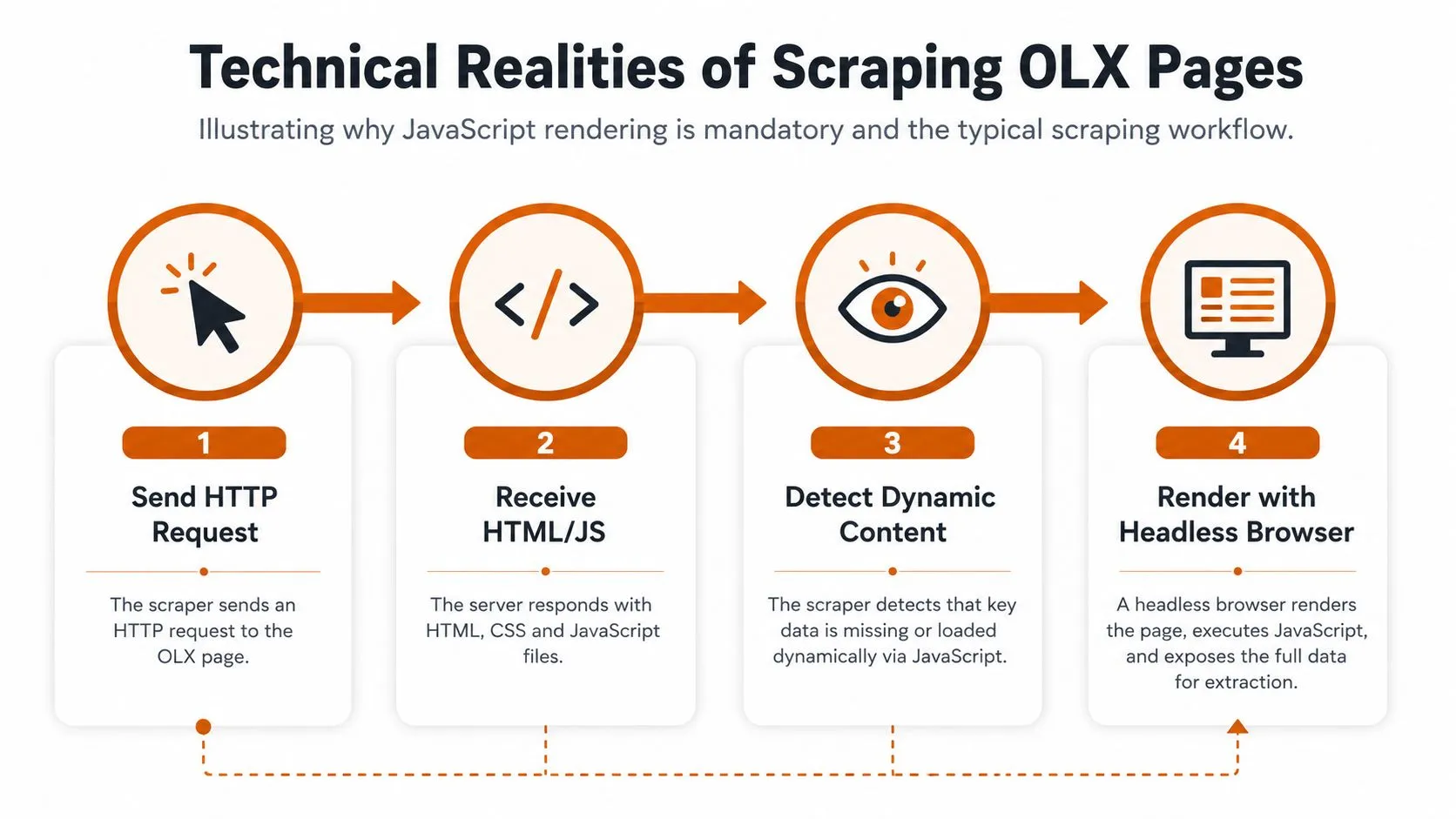
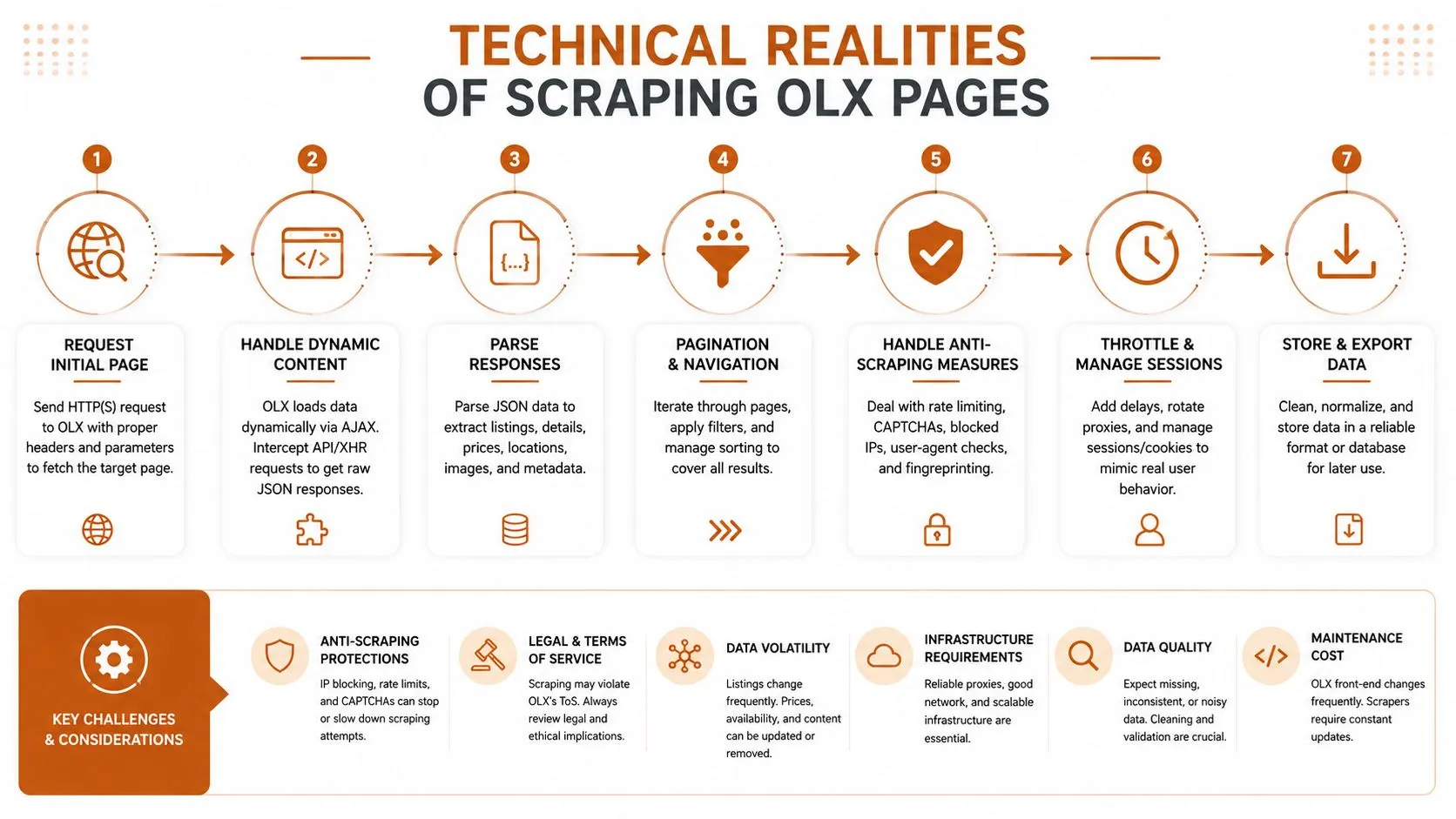
The first request to an OLX page often answers an important question: is the data present in the response, or does the browser need to execute JavaScript before the listing becomes usable? Some pages can be parsed with ordinary HTTP when the relevant content is server-rendered. Others return a shell, scripts, or partial metadata and require a real browser session.
The distinction affects cost and reliability. Direct HTTP is fast and easy to scale, but it has little value if the response lacks the fields you need. Headless browser rendering provides a closer approximation of a user session, yet it consumes more resources and introduces browser lifecycle failures. API interception can reduce parsing work when the page publicly requests structured data, but it should be treated as a market-specific optimization, not a universal shortcut.
What defensive systems can observe
OLX pages can be JavaScript-rendered and protected by bot detection, rate limits, and geo-sensitive gating. Low-friction requests frequently fail where a persistent session with realistic browser characteristics, regional routing, consistent headers, and controlled pacing succeeds, according to technical guidance on scraping OLX.
The relevant signals aren’t limited to one header. Defensive systems can evaluate whether a session behaves consistently, whether requests arrive too quickly, whether the client follows expected navigation, and whether its network and browser characteristics align. A scraper that rotates every signal independently can look less like a user, not more.
Use a staged decision process:
- Probe with HTTP: Check status, response completeness, redirects, and embedded listing data.
- Compare browser output: Render a small sample and identify fields that appear only after scripts run.
- Capture permitted public requests: If structured responses support the visible page, map them carefully and avoid account, posting, or private flows.
- Classify failures: Separate a parser miss from a challenge, timeout, rate limit, geo mismatch, or empty search result.
- Stop on policy boundaries: Don’t retry disallowed endpoints or increase concurrency to force access.
OLX robots files show source-specific restrictions on paths including API, AJAX, posting, and account-related routes in some country domains. The safest operational boundary is to target public search and listing pages, review each relevant domain’s published rules, and avoid aggressive concurrency. For browser implementation details, this Puppeteer guide to extracting data from JavaScript pages is a useful technical reference.
Country-by-Country Protection Variability
An OLX scraper is not a single solution. The target market determines how requests are served, which fields appear, and how quickly defensive controls respond. One country domain may return usable public data through HTTP, while another may challenge a datacenter session before the parser can confirm whether the page changed.
Observed markets range from sites with accessible internal JSON patterns and low IP sensitivity to domains using Cloudflare or JavaScript challenges. A pipeline that works in one country can fail in another because proxy reputation, rendering requirements, URL structure, and pagination behavior differ. Route traffic through market-specific proxy pools, keep sessions stable, and select HTTP or browser access per country rather than globally.
A working comparison framework
| Market Profile | Protection Level | Rendering Need | Proxy Strategy | Recommended Approach |
|---|---|---|---|---|
| Structured public responses | Lower observed sensitivity | Test HTTP first | Regional pool with stable sessions | Parse permitted public responses, then validate against rendered pages |
| JavaScript-heavy pages | Moderate application dependence | Browser rendering often needed | Regional sessions with controlled pacing | Use a browser for discovery or enrichment, and cache results |
| Challenge-prone market | Elevated defensive behavior | Browser may be required | Prefer an appropriate regional pool, avoid blind rotation | Reduce concurrency, isolate failures, and stop on repeated challenges |
| Unmapped market | Unknown | Unknown | Begin with a small controlled probe | Build a profile before selecting a production architecture |
Use the table for planning, not as a permanent classification. A site can change its behavior after a frontend release, routing change, or protection update. Re-test affected markets and keep each adapter configurable. Record response type, challenge frequency, pagination behavior, field availability, and duplicate patterns during reconnaissance.
Pagination and identity are local problems
Pagination rarely means incrementing a page number. Depending on the market, search results may use query parameters, cursors, continuation tokens, or client-side requests. Map the next-page mechanism from permitted public navigation, then persist the last successful cursor or URL. A restart should resume from that point rather than repeatedly scanning the first result set.
Deduplication also requires local rules. Prefer a stable listing identifier when the page exposes one publicly. If no identifier exists, combine the normalized URL, title, location, and selected listing attributes. Retain the raw source fields so a later parser change can be audited against the original record.
The same separation between source behavior and downstream normalization applies beyond classifieds. Teams comparing regional marketplace extraction can review this IndiaMART data extractor for a related example. The implementation should still follow each OLX domain’s public rules, access patterns, and operational limits.
Designing a Production-Grade Extraction Pipeline
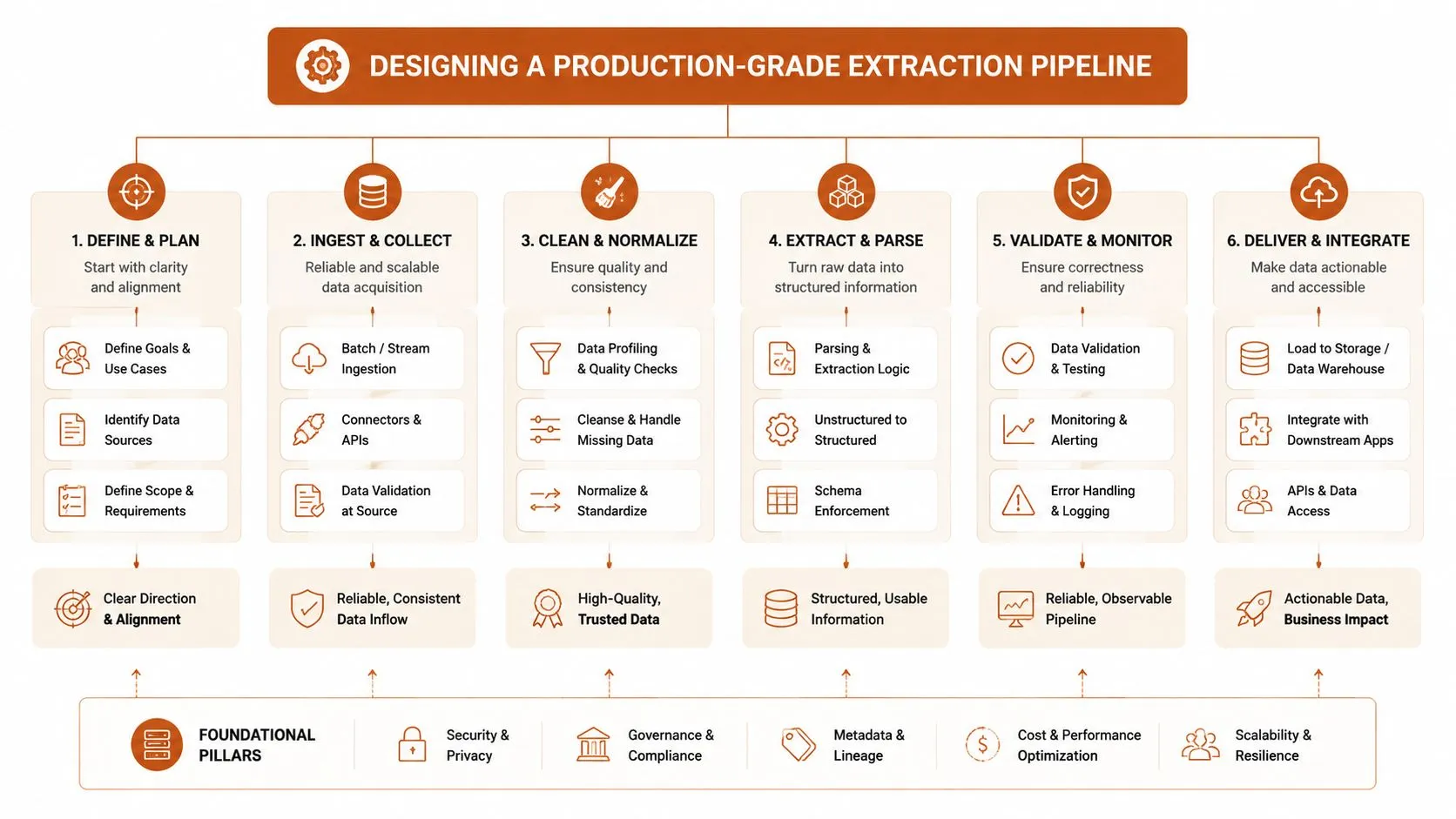
A production OLX pipeline should be modular enough to replace a renderer, proxy pool, or parser without rewriting discovery and storage. The cleanest design separates source access from business logic, because country-specific differences belong at the edge of the system.
Give every market its own operating profile
Store configuration per country domain, including permitted seed paths, rendering mode, locale, proxy class, pacing policy, pagination adapter, parser version, and retry rules. The scheduler should route jobs to the correct profile instead of applying a global concurrency setting.
A sensible pipeline has these stages:
- Discovery queue: Accept approved search or category URLs and emit listing candidates.
- Fetch workers: Select HTTP or browser access according to the market profile, preserving session consistency.
- Parser layer: Extract fields into a versioned schema and retain raw evidence for debugging.
- Quality gate: Check required fields, URL validity, suspiciously empty responses, and sudden selector loss.
- Deduplication store: Match stable identifiers first, then apply carefully documented fallback keys.
- Delivery layer: Publish normalized records to the destination chosen by the consumer.
Optimize carefully, not aggressively
Use session reuse where it produces consistent browser behavior, but discard a session after repeated challenge responses or corrupted state. Pace requests with bounded jitter and backoff rather than a fixed burst. Keep queues per market so a defensive response in one country doesn’t stall unrelated work elsewhere.
Headless browsers make sense when JavaScript execution or interaction is unavoidable. HTTP workers are preferable for pages that reliably contain the required public fields. API interception can be efficient when the relevant response is openly requested by the public page and remains stable, but a production system should retain a browser fallback and monitor the response contract.
For teams handling property-oriented workflows alongside classifieds data, a Proptech API toolkit can provide useful context for designing structured real estate integrations, although it doesn’t remove the need to profile each OLX market.
Monitoring should expose more than request success. Track field completeness, page depth, duplicate rates, challenge responses, render time, parser version, and delivery lag. A sudden increase in empty titles is a data-quality incident even when every HTTP request returns a successful status. This Scrapy guide to scalable data pipelines offers relevant architectural patterns for queueing, retries, and item processing.
Enterprise Use Cases for OLX Classifieds Data
The business value of OLX extraction comes from the structured signal created after collection, not from a pile of unprocessed pages. A retailer may compare asking prices across selected categories. A market research team may observe availability and seller activity by location. An AI team may need normalized descriptions, categories, and product attributes for a training or evaluation workflow.
OLX’s breadth makes the data useful across real estate, vehicles, electronics, household goods, jobs, and local services. The correct scope depends on the decision the dataset must support. A pricing dashboard needs consistent prices, currency handling, condition labels, and timestamps. A market-sizing model needs stable geography and category definitions. A lead workflow needs strict rules around whether seller information is necessary and how it can be used.
Data products built from listings
Common outputs include:
- Price intelligence feeds: Normalize asking prices and compare comparable items without treating asking price as a completed-sale price.
- Availability monitors: Track whether relevant inventory remains visible in selected searches or categories.
- Market maps: Group listings by location, category, condition, and other public attributes.
- Change histories: Preserve snapshots so analysts can distinguish newly discovered inventory from edited or relisted ads.
- Research datasets: Convert descriptions and structured fields into language- or market-specific analytical inputs.
The raw page should never become the only record. Keep provenance, collection time, parser version, and transformation history so analysts can explain where each value came from. That discipline matters when a listing disappears, a category changes, or a localized field is interpreted incorrectly.
Governance belongs in the design
Classifieds pages may contain personal information, including seller names, locations, images, or contact-related details. Collect only fields required for the stated use case, restrict access, define retention rules, and avoid turning public visibility into unlimited reuse. Review OLX terms, applicable privacy obligations, and internal legal guidance before deployment.
Enterprise teams should also separate analytical identifiers from direct seller information whenever possible. Hashing or tokenizing an internal record key doesn’t make personal data anonymous, but it can reduce accidental exposure in downstream dashboards. The safest pipeline is technically useful and deliberately narrow.
Evaluating Managed Services Versus In-House Scraping
Build versus buy isn’t a simple comparison between an API fee and a developer’s first script. An in-house OLX scraper carries continuing work: market reconnaissance, proxy procurement, browser maintenance, parser updates, pagination repair, duplicate handling, monitoring, and incident response. Those tasks remain even after the initial extraction code looks finished.
A managed service can absorb much of that operational burden, but it introduces its own questions. Ask how the provider handles country coverage, schema changes, retries, regional routing, delivery failures, raw-response access, and privacy controls. A polished dashboard isn’t evidence of dependable data delivery.
Choose according to the workload
| Decision factor | In-house pipeline | Managed service |
|---|---|---|
| Market-specific behavior | Maximum control over adapters | Confirm country-level coverage and configuration |
| Custom schema | Deep customization | Depends on extraction and delivery options |
| Operational ownership | Your team handles failures and changes | Provider handles agreed operational scope |
| Debugging | Full access to requests and code | Depends on logs, raw data, and support |
| Delivery expectations | You define and maintain them | Review SLA, freshness, and incident terms |
| Compliance process | Designed internally | Verify processing, retention, and governance controls |
In-house development is sensible when the data model is highly specialized, the target markets are limited and well understood, or the extraction logic is part of the product itself. A managed option is often more practical when the team needs recurring multi-geo delivery and would rather focus on analysis than browser and proxy operations. This comparison of web scraping services and self-managed systems provides a useful checklist for that assessment.
Before committing, run a controlled feasibility test in every target market. Define the fields, permitted pages, refresh expectation, quality thresholds, failure handling, and delivery format. Then compare the resulting operational effort, not just the initial extraction demo.
WebscrapingHQ builds and operates custom web data pipelines for multi-market sources such as OLX, with market-specific extraction, monitoring, retries, proxy management, and structured delivery. If you need a reliable classifieds feed rather than another fragile script, visit WebscrapingHQ to discuss your target countries, fields, and update requirements.
Want this done for you?
Send us the URLs. We'll quote it in 24 hours.
Paste the URL(s) you want scraped. We'll reply within 24 hours with a feasibility check and a ballpark quote.