
Jump to section
- Table of Contents
- Why an UberEats Scraper Needs a Real Pipeline
- Core Concept of a Real-Time Data Pipeline
- The moving parts that matter
- Streaming vs Micro-Batch for Uber Eats Data
- Five Core Components of a Scraping Pipeline
- Ingestion and messaging
- Processing and storage
- Delivery and workflow composition
- Anti-Bot Resilience in 2026
- What actually helps
- Build or buy
- Reference Architecture for an UberEats Scraper
- How the flow should run
- Schema evolution and a day one rollout
- Operational Checklist and When to Outsource
- What helps
You can get a prototype Uber Eats scraper running in an afternoon, then spend the next week wondering why it only works for one city, misses half the menus, and starts failing the moment you schedule it. The problem usually isn’t the parser. It’s that Uber Eats behaves like a location-aware product surface, not a static page, so the extraction job turns into an orchestration problem almost immediately.
The teams that last stop thinking in terms of “scrape this URL” and start thinking in terms of address resolution, store hydration, retries, and freshness. They also stop treating anti-bot friction as an edge case. A serious pipeline has to survive geo-gating, markup drift, and the reality that public menu data changes faster than a one-off export can stay useful.
Table of Contents
Open Table of Contents
Why an UberEats Scraper Needs a Real Pipeline
A team I reviewed had a clean-looking first pass. They pointed a script at a few restaurant pages, parsed the HTML, and pushed the output into a spreadsheet. It worked on day one. By day three, the store pages had shifted enough that menu sections no longer lined up, and by day seven the scraper had started returning almost nothing for new locations because Uber Eats does not even show restaurants until a delivery address is set. That makes the surface location-gated before it is useful for crawling.
That is the point where the problem stops being “can I fetch a page” and becomes “can I keep a moving target clean.” Uber Eats scraping at scale has already been demonstrated across 1.5 million restaurants in 3,300 U.S. cities, and that scale only works when collection is organized around city pages, category pages, and repeatable navigation patterns, not one-off page visits Extreme Uber Eats Scraping project. A serious pipeline has to assume the surface is broad, segmented, and constantly changing.
Practical rule: if your Uber Eats job cannot re-run cleanly tomorrow, it is not a scraper yet. It is a draft.
The right mental model is closer to a data product than a crawler. A city scheduler resolves a location, an enumerator finds store URLs, a hydration step pulls the canonical restaurant record, and a delivery step writes versioned output for downstream use. If you are already thinking in that shape, the rest of the architecture starts to make sense, and a generic crawler framework like Scrapy pipeline design at scale becomes a useful building block instead of the whole answer.
The biggest shift is discipline around freshness. Menus, prices, hours, and availability are only useful if they are recent enough to trust, which means the system needs scheduled re-pulls rather than a single export. That is the fix for a brittle ubereats scraper, not another round of selector tweaks.
Proxy rotation, browser fingerprinting, retries, and address handling also belong in the same design discussion, because they decide whether the job survives anti-bot pressure or falls apart after a few clean runs. Teams that want to offload that burden often start with a managed layer such as Zinc API, especially when the alternative is maintaining session state, solve rates, and fallback logic across multiple markets.
Core Concept of a Real-Time Data Pipeline
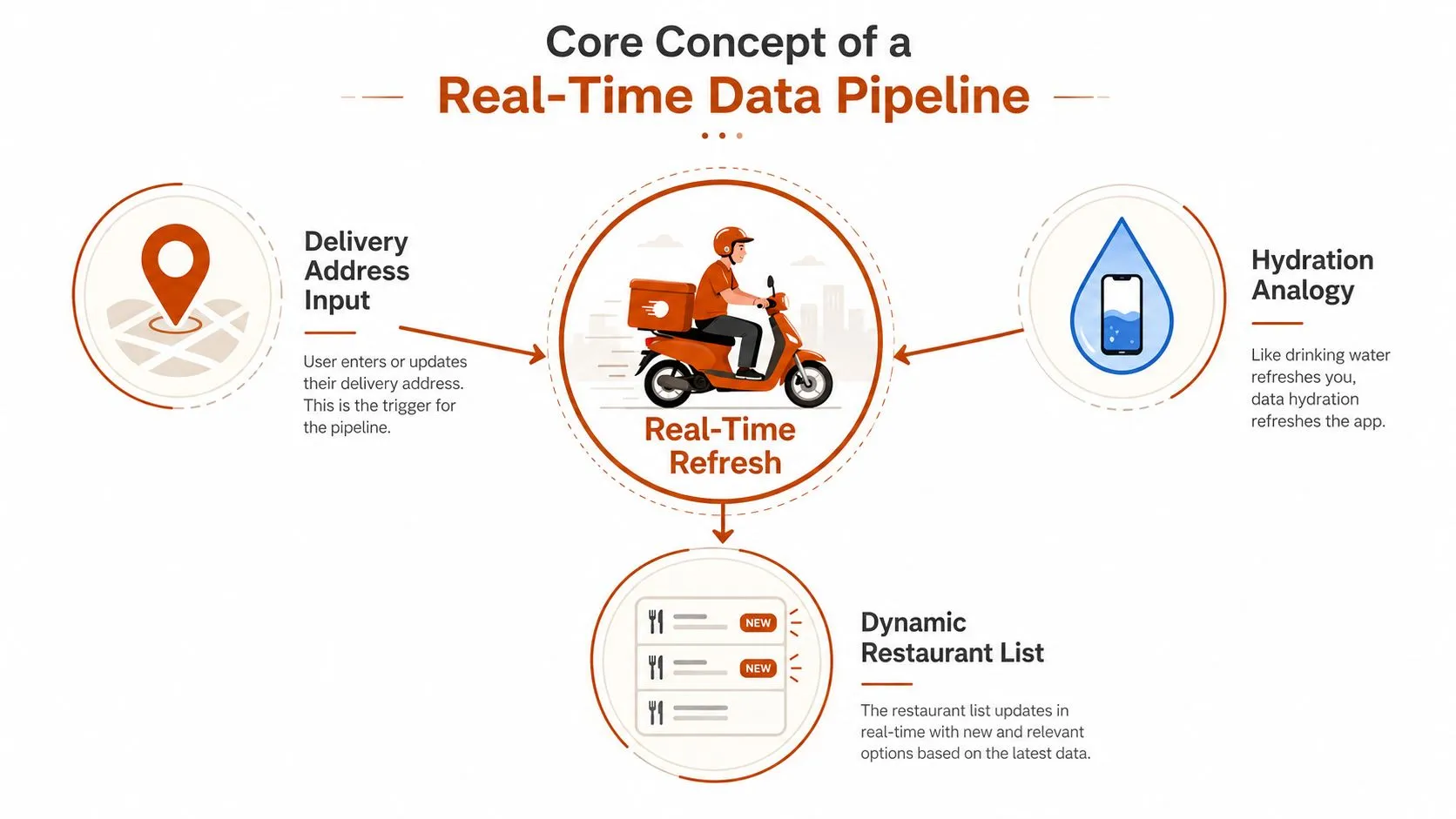
A real-time pipeline for Uber Eats is easiest to understand as a hydration loop. The system sets the address, the market surface refreshes, and the pipeline pulls the newly visible restaurants and menu state. That mirrors how the product works operationally, because the platform exposes restaurants only after location is established, so every run has to begin with location resolution before it can meaningfully enumerate stores ScrapingBee guide.
The moving parts that matter
The pipeline usually has four responsibilities. First, it resolves a city or address into a usable market context. Second, it enumerates store URLs from the relevant location or category surface. Third, it hydrates each store into a normalized record with metadata and menu structure. Fourth, it persists those records in a way that lets later runs compare versions cleanly. That last part matters because the same restaurant should update in place, not multiply into duplicate rows every time the job retries.
Idempotency is the control that keeps retries from polluting the dataset. If the store URL is the stable key, then a failed pull can run again without creating a second restaurant record. The same idea applies to menu items and review samples. A retry should be safe, because anti-bot pressure and transient network failures are normal in production. The WebSocket-style thinking for real-time extraction is helpful here, even if the transport isn’t WebSocket, because the design goal is the same, keep a live state feed coherent under churn.
A pipeline that can’t absorb retries without duplication will eventually lie to you about freshness.
Backpressure is the other control that matters. When a site starts slowing responses or returning block pages, the system should reduce pressure instead of flooding harder. In practical terms, that means queue depth, retry delay, and proxy behavior need to be treated as live operational signals, not static settings copied from a tutorial. The difference is subtle on paper and decisive in production.
Streaming vs Micro-Batch for Uber Eats Data
The choice between streaming and micro-batch isn’t abstract when the target is Uber Eats. It comes down to whether you’re trying to watch a handful of restaurants for rapid menu or price changes, or whether you’re building broad market coverage across cities and cuisine segments. For a large geographic footprint, micro-batch is usually the sane default, because it matches the way the surface is discovered and re-crawled.
| Criterion | Streaming | Micro-Batch |
|---|---|---|
| Freshness target | Best for watched stores that need fast refreshes | Better for periodic market-wide refreshes |
| Operational complexity | Higher, because each update path needs tight orchestration | Lower, because jobs can be scheduled and replayed |
| Anti-bot exposure | Can spike quickly if the same stores are hit too often | Easier to spread across time and markets |
| Idempotency pressure | Strong, since repeated updates arrive constantly | Still needed, but easier to manage |
| Cost control | Harder to predict under active monitoring | Easier to shape by city, category, or cadence |
| Best fit | Price monitoring on a small watchlist | Nationwide restaurant and menu coverage |
A good reference point for the broader trade-off is the general discussion of batch processing vs stream processing trade-offs. The Uber Eats-specific twist is that the site itself is location-scoped, and store pages drift over time, so a micro-batch job often maps better to how the data appears and changes.
Streaming only really earns its keep when the watched set is small and the freshness requirement is strict. If you’re tracking a few branded locations or a handful of competitors, a near-continuous refresh loop can work. But if you try to stream every restaurant in a metro, you’ll amplify anti-bot risk, inflate queue pressure, and spend most of your time recovering from partial failures instead of collecting usable records.
Micro-batch fits the reality of this surface better. It lets you run city by city, reuse the same scheduling rules, and rehydrate stores on a cadence that respects both coverage and block risk. That’s usually the better engineering trade-off for an ubereats scraper that has to survive production, not just a demo.
Five Core Components of a Scraping Pipeline
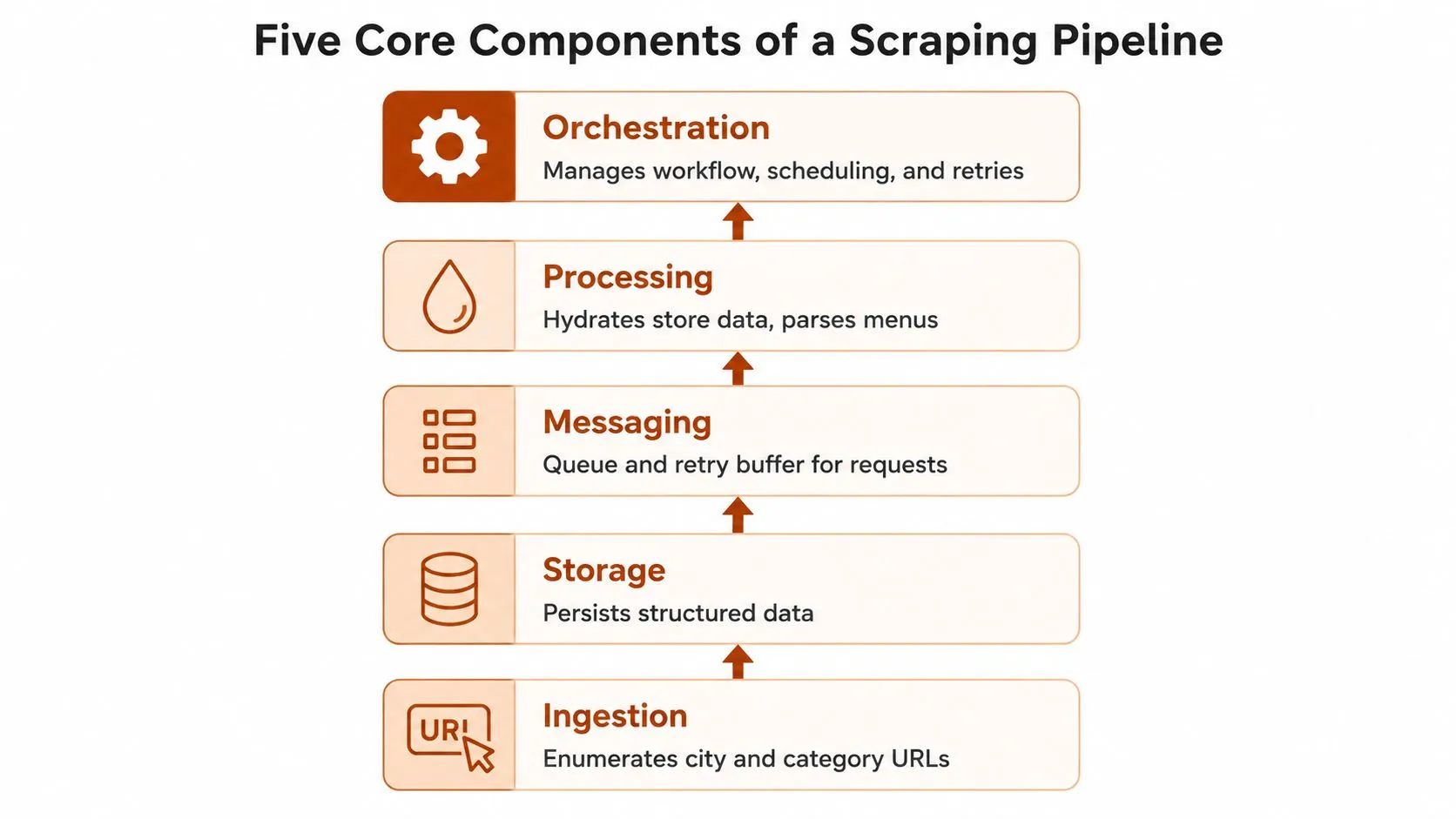
A production pipeline for Uber Eats is easier to reason about when you split it into five layers. The layers are not just technical abstractions. They correspond to distinct responsibilities in the data flow, and each one fails differently when it’s underbuilt.
Ingestion and messaging
Ingestion is the front door. It enumerates city pages, category pages, or direct store URLs, depending on whether you’re discovering the market or re-pulling known stores. That’s where the multi-million-record pattern matters, because scale comes from structured enumeration, not random browsing Extreme Uber Eats Scraping project.
Messaging sits behind ingestion and absorbs work spikes. In practice, that means a queue or retry buffer that can hold store URLs when a proxy pool slows down or a city suddenly yields a larger store set than expected. If you skip this layer, every slowdown bleeds directly into your crawler and you end up with brittle execution timing.
Processing and storage
Processing is where the store is hydrated. The worker fetches the restaurant page, parses the embedded state, and normalizes the record into a stable schema. That’s also where menu hierarchy matters, because preserving sections and subsections makes downstream pricing analysis much cleaner than flattening everything too early. The Google Maps contact export workflow is a useful analogy for this kind of structured extraction, since the value is in the normalized shape, not the raw page.
Storage should keep versions, not just current snapshots. A restaurant record without dedup keys becomes a pile of near-duplicates the first time the page changes. For validation discipline, the data validation guide is worth revisiting, especially if you’re comparing old and new menu states across runs.
Operational insight: if the storage layer can’t answer “what changed since last run,” the rest of the pipeline is doing work without producing decisions.
Delivery and workflow composition
Delivery is the last layer. It writes to CSV, JSON, S3, a webhook, or a warehouse table, depending on who consumes the data next. The important thing is not the file format, it’s the contract. A downstream team should know exactly when records arrive, how they’re versioned, and whether they represent a fresh pull or an incremental update.
The whole workflow composes cleanly when each stage has one job. Ingestion finds the stores, messaging protects the system, processing hydrates the data, storage preserves history, and delivery hands off a trustworthy feed. That’s the difference between a script and a pipeline.
Anti-Bot Resilience in 2026
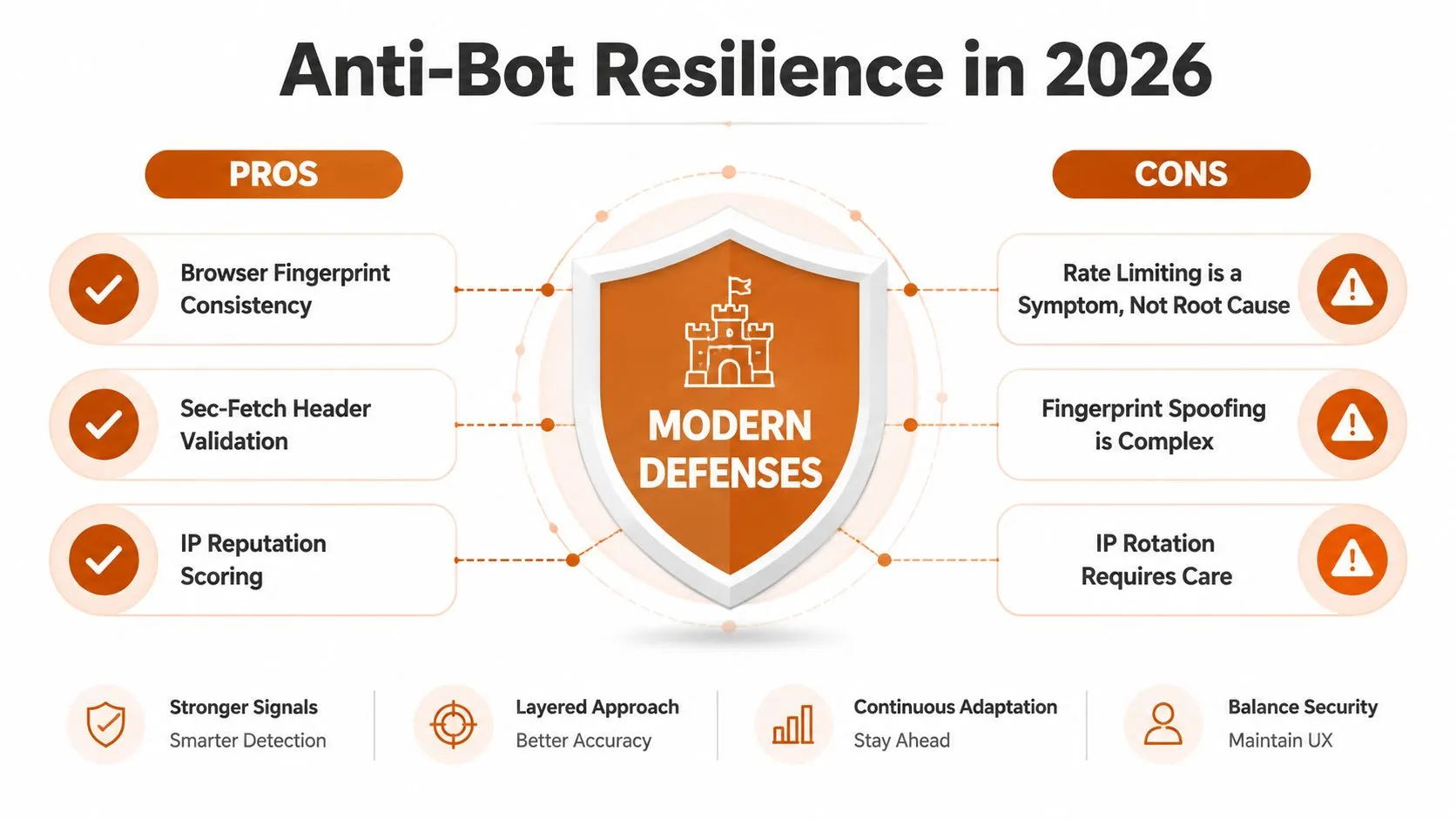
The first failure mode I see is teams treating every blocked request as a rate-limit problem. In production, Uber Eats blocking reacts to browser fingerprints, request headers, IP reputation, and behavioral signals, not just request volume. The Scraperly guidance spells that out, and if your stack only rotates user agents, it is already too thin.
What actually helps
A resilient setup keeps browser fingerprints coherent, preserves Sec-Fetch-* headers, and uses residential proxies when sustained collection matters. It also backs off on 429 responses instead of pushing harder, because retries that arrive too fast usually create more block pressure. One-off scripts rarely manage those controls well because they were never built as systems.
Micro-batch fits this surface better. In practice, it gives you room to stagger traffic, absorb short-lived failures, and keep the queue from turning a temporary block into a traffic spike. That matters more than raw speed when location-aware gating changes the response pattern from one metro to the next.
Sticky sessions by city are another practical move. If one proxy identity is already working for a metro, forcing the job to bounce between unrelated egress points often creates more friction than it solves. I have had better results treating proxy configuration as a tunable variable, not a fixed line in a config file.
Build or buy
The browser-fingerprint side is where DIY gets expensive. The Playwright anti-bot measures guide is a solid reference if you want to understand how much nuance sits behind a headless flow that looks simple on paper. The primary question is whether your team should keep spending cycles on rotation logic, header fidelity, and retry tuning every time the target shifts.
Managed extraction becomes more attractive when the maintenance burden starts to dominate the data value. If you only need a few stores for an internal pilot, DIY can be justified. If you need ongoing market coverage, changing menus, and repeatable delivery, the anti-bot layer stops being a side task and becomes the product itself.
Reference Architecture for an UberEats Scraper
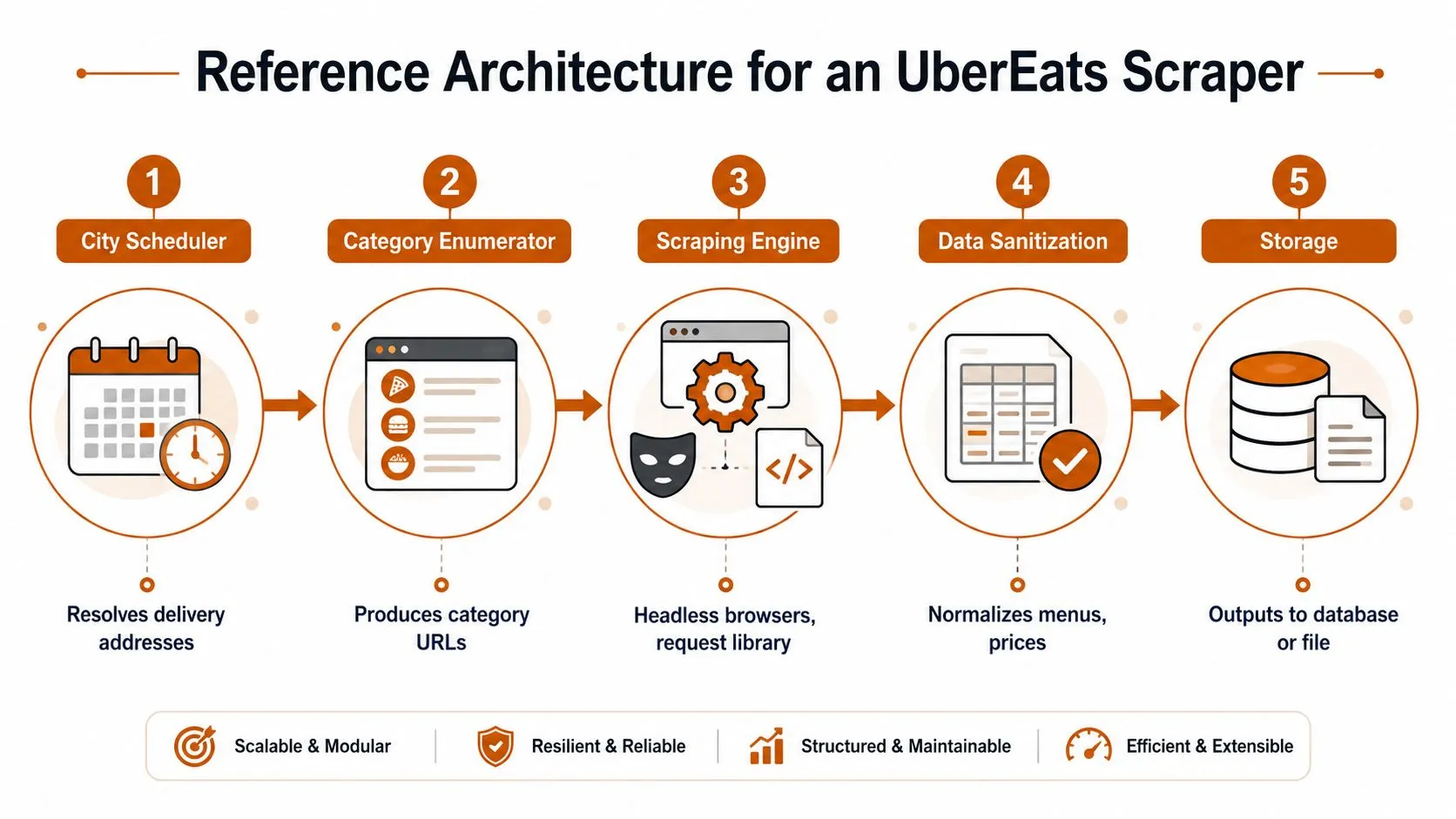
A workable architecture starts at the city level and only moves to stores after the market context is known. The scheduler resolves a delivery address, the enumerator produces unique store URLs, the hydration worker fetches each store page, and the delivery layer writes versioned records for downstream consumers. That two-stage path is important because the platform is designed around store-level entities, not a single global catalog.
How the flow should run
The scheduler should partition work by metro so proxy locality stays stable and the queue doesn’t mix unrelated regions. The enumerator can walk category URLs to avoid duplicate store discovery, then hand off canonical store URLs to the hydration stage. That design matches the way the public surface is organized and keeps discovery separate from detail extraction.
The hydration worker should be conservative with concurrency. Higher concurrency can improve throughput, but it also increases the chance of tripping blocks or forcing retries to pile up. A safer approach is to tune concurrency per city and keep max retries high enough to survive transient failures without turning them into traffic spikes.
Schema evolution and a day one rollout
Schema evolution matters because Uber Eats pages don’t stand still. Promo banners, menu tags, and embedded-state fields can appear without warning, so the storage layer needs versioned schemas and tolerant parsing. If a new field shows up, the system should keep the old shape intact and add the new field without breaking the feed.
A day-one rollout for a new city is straightforward. The scheduler resolves the location, the enumerator collects the market’s store URLs, the worker hydrates each store, and the delivery layer emits a structured batch. On the first pass, you’re not chasing perfection, you’re establishing a stable baseline that can be refreshed on schedule.
Keep the discovery pass separate from the store pass. That one design choice prevents a lot of duplicate work later.
That architecture is the difference between coverage and fragility. It gives you a place to absorb retries, a place to version records, and a place to adjust anti-bot posture without rewriting the whole job.
Operational Checklist and When to Outsource
A useful operating checklist starts with the signals that fail first in production. Track success rate, not just request volume. Track freshness, not just row counts. Keep retries on exponential backoff, maintain schema versions per source, and use proxy fallback tiers so one bad pool does not stall the whole market refresh.
Monitoring should focus on the patterns that predict failure before it reaches downstream users. If menu records are still arriving but freshness is slipping, the job is drifting. If retries keep climbing while the same cities fail, proxy locality or fingerprinting is usually the problem. If the schema starts shifting in the same run, parse resilience needs to change before the next scheduled refresh.
A real monitoring example is easy to spot in production. If a city that normally clears at a stable success rate drops below that level for several runs, and the retry queue keeps growing at the same time, the issue is no longer a one-off timeout. That pattern usually points to browser fingerprinting pressure, a bad proxy pool, or a location-aware gate that needs a different path through the pipeline.
When the maintenance burden starts consuming the team, managed extraction is often cheaper than continuing to patch a DIY stack. The managed-vs-self-operated argument is strongest when browser fingerprints, proxy rotation, and site changes are eating the hours that should go into analysis.
What helps
If you are reviewing an Uber Eats pipeline this week, keep the decision grounded in those signals. If the system cannot keep data fresh, stable, and deduplicated without repeated manual intervention, simplify the stack instead of adding more moving parts. That usually means fewer custom retry branches, clearer ownership of schema changes, and a cleaner split between discovery, hydration, and delivery.
For teams that already know the pipeline is drifting, the question is not whether the scraper can be made to limp along. The question is whether the engineering cost still makes sense compared with a managed build-and-run setup that absorbs scheduling, retries, proxy management, and schema drift without pulling the team back into maintenance every time the target changes.
Want this done for you?
Send us the URLs. We'll quote it in 24 hours.
Paste the URL(s) you want scraped. We'll reply within 24 hours with a feasibility check and a ballpark quote.