
Jump to section
- Table of Contents
- Why Leboncoin Is Harder to Scrape Than Most Guides Admit
- Scale changes the failure model
- What a Leboncoin Scraper Is in 2026
- The commodity layer and the difficult layer
- Define the ambition before choosing the design
- The Anti-Bot Stack and the Countermeasures That Matter
- Identity and network reputation
- Transport and browser fingerprints
- JavaScript challenges and adaptive behavior
- Pipeline Architecture from Crawl to Delivery
- Navigation needs state
- Schema control prevents quiet corruption
- Compliance, ToS Exposure, and Engineering Choices
- Compliance becomes system behavior
- KPIs That Tell You Whether the Scraper Is Healthy
- Separate customer evidence from SRE evidence
- Vendor Selection Checklist With Real Use Cases
- Use case one, dealer compliance reporting
- Use case two, French-language training data
- Use case three, competitor intelligence
A Leboncoin scraper is less likely to fail because its CSS selector is wrong than because its operating model is wrong. Leboncoin’s real-estate section attracts roughly 14 million monthly visitors, while the marketplace carries about 28 million online ads overall and has been estimated to receive around 885,000 new ads each day in Adevinta’s segment analysis, as documented in coverage of the Leboncoin scraping litigation. At that scale, a collector isn’t reading pages. It’s maintaining a time-sensitive system against constant listing churn, regional variation, pagination changes, and active bot detection.
That distinction matters for market intelligence, pricing research, compliance monitoring, and training-data operations. A prototype can retrieve a few records, but a dependable feed needs session continuity, failure recovery, schema controls, freshness measurement, and a compliance posture that survives internal review. The central engineering question is therefore not “can a script extract Leboncoin?” It’s “can the pipeline deliver accurate, auditable data when the site and its defenses keep changing?”
Table of Contents
Open Table of Contents
- Why Leboncoin Is Harder to Scrape Than Most Guides Admit
- What a Leboncoin Scraper Is in 2026
- The Anti-Bot Stack and the Countermeasures That Matter
- Pipeline Architecture from Crawl to Delivery
- Compliance, ToS Exposure, and Engineering Choices
- KPIs That Tell You Whether the Scraper Is Healthy
- Vendor Selection Checklist With Real Use Cases
Why Leboncoin Is Harder to Scrape Than Most Guides Admit
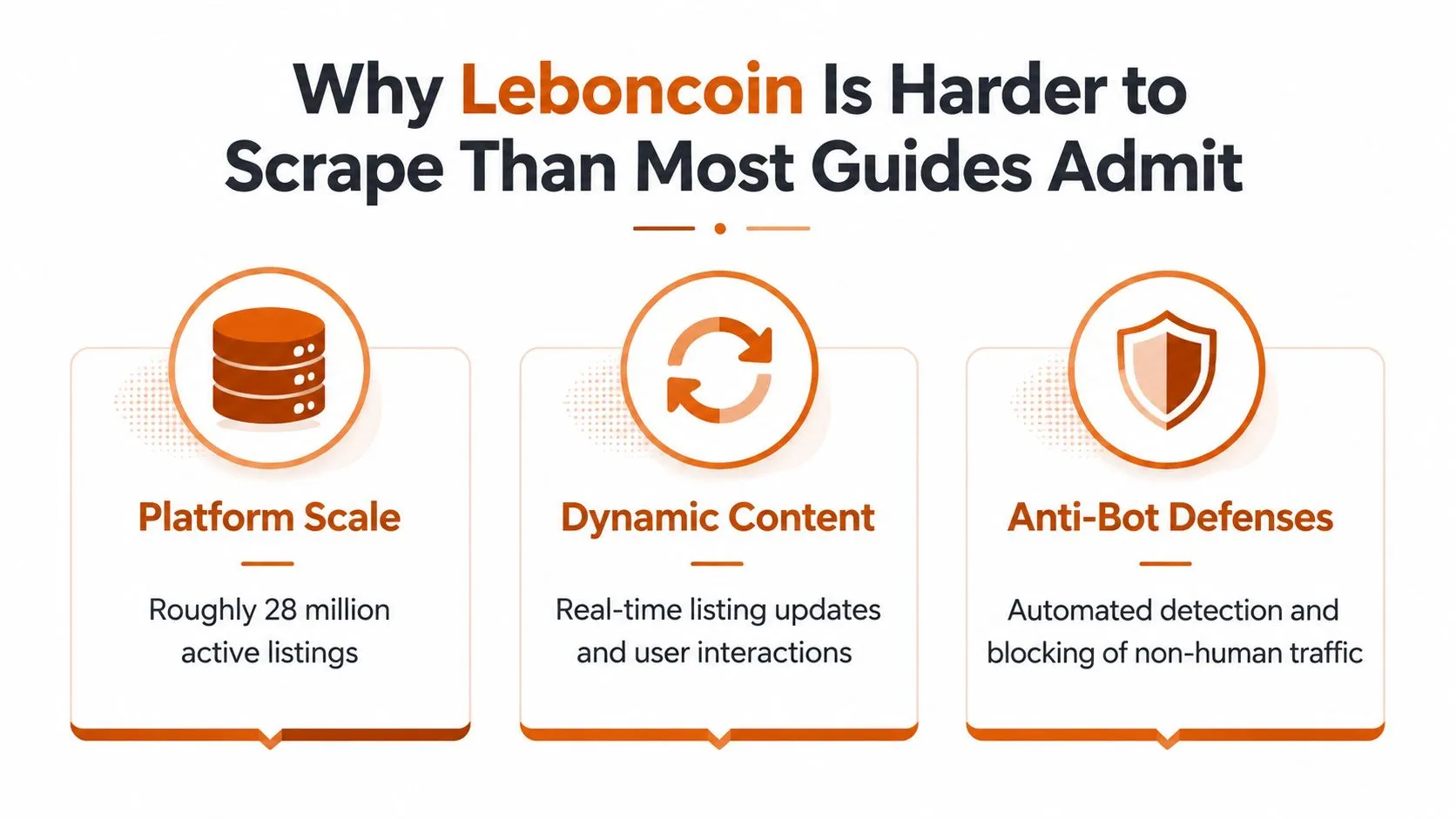
Leboncoin’s scale creates a problem that basic tutorials usually hide. A marketplace with about 28 million ads overall and roughly 885,000 new ads posted daily, figures reported in Adevinta’s historical Leboncoin analysis, doesn’t present a stable inventory. Listings appear, disappear, change price, move position, and acquire new content while a crawl is still running.
The real-estate category alone has roughly 14 million monthly visitors, according to the same source. That audience concentration makes property searches especially valuable for analysts, but it also means a scraper must handle many combinations of location, property type, price, surface area, and seller status. A single global pagination strategy will miss relevant regional behavior and create uneven coverage.
Scale changes the failure model
At low volume, a failed request looks like an inconvenience. At marketplace scale, it becomes a data-quality event. If a worker loses a session halfway through a category, the resulting dataset may look complete while excluding a region, a page range, or a group of newly published ads.
A production design needs to treat every crawl as an incomplete observation until it passes coverage checks. That means recording the requested category and geography, the pages visited, the listing identifiers discovered, and the reasons individual pages were skipped. Without that audit trail, downstream users can’t distinguish “no matching ads” from “the collector was blocked.”
Traffic is also heavily France-oriented. One independent dataset reported about 33 million monthly visits in July 2025, with France contributing roughly 32 million visits, or 96.8%, while another dataset reported 89.61% of visitors from France and 93.06 million visits in June 2026, as shown in Ahrefs’ Leboncoin traffic data. These figures point to an operational conclusion: French routing and French-localized query design aren’t optional refinements for many use cases.
Engineering principle: A scraper’s output is only as reliable as its coverage evidence. Store what the worker attempted, what it received, and what it couldn’t verify.
The defense environment compounds the problem. Leboncoin is protected by DataDome, and its scraping protection overview describes restrictions involving automated access, browser signals, JavaScript challenges, IP reputation, and localized routing. A request-based script might parse a page perfectly during its first successful run, then fail when the platform evaluates its behavior across requests.
That’s why reliability engineering belongs at the center of a Leboncoin scraper. The parser is important, but it isn’t the first constraint. The system must first obtain representative pages consistently, then prove that the extracted records reflect the intended slice of the marketplace.
What a Leboncoin Scraper Is in 2026
A modern Leboncoin scraper is a managed data service, not a loop that requests URLs. It combines four connected responsibilities:
- Crawl orchestration schedules categories, search parameters, geography, and refresh jobs.
- Browser execution maintains coherent sessions, runs JavaScript, and captures pages when direct HTTP retrieval is insufficient.
- Data interpretation converts changing layouts and free text into a controlled schema.
- Delivery and observability sends validated records to consuming systems and reports failures.
The distinction matters because a one-off script generally assumes stable markup, complete responses, and a successful HTTP status as proof of successful extraction. A hardened marketplace can violate all three assumptions. The collector must establish that it reached the intended pages before the parser can produce trustworthy records.
The commodity layer and the difficult layer
Schedulers, queues, object storage, relational databases, and CSV serialization are established building blocks. They still require careful retry and idempotency logic, but those components rarely decide whether a Leboncoin project remains reliable.
The difficult layer lies between session acquisition and schema correctness. A worker needs continuity across related navigation, while the parser must distinguish a changed page from a valid page containing empty values. A technically correct selector can therefore produce bad data if the upstream response is incomplete or misleading.
A production design stores raw HTML, screenshots when visual context matters, extracted fields, parser confidence, and schema versions. That evidence allows teams to reprocess historical captures after parser improvements, rather than recrawling the source for every correction. It also makes coverage gaps visible to operators.
For teams assessing extraction systems, the NotFair docs overview provides context on separating collection, processing, and delivery. That separation keeps anti-bot incidents, parser changes, and downstream formatting requirements from becoming one failure-prone executable script.
Define the ambition before choosing the design
A research analyst requesting one snapshot has different requirements from an intelligence team producing recurring, geographically balanced updates. The first may accept manual review and incomplete retries. The second needs durable queues, alerting, deduplication, and a documented freshness target.
The operating distinction is clear:
- One-off scrape: optimize for fast exploration and human validation.
- Reliable feed: optimize for continuity, coverage evidence, recovery, and controlled change.
LLM-assisted parsing can support the second model when it is constrained by schemas, confidence checks, and review queues. It should interpret ambiguous titles or descriptions, not replace deterministic validation.
Calling both activities “scraping” hides the engineering trade-off. Once other systems depend on the output, the collector becomes a service. Its quality depends on recoverability and evidence of coverage as much as on selector accuracy.
The Anti-Bot Stack and the Countermeasures That Matter
Leboncoin’s protection should be treated as a layered decision system, not a single CAPTCHA that a script either passes or fails. The platform’s use of DataDome, together with signals described in technical coverage of Leboncoin’s marketplace defenses, means that the worker’s identity, transport behavior, session history, and browser execution can all affect access.
A useful way to reason about the stack is to map each signal to an engineering control.
Identity and network reputation
IP reputation is the first obvious layer. Reusing a small set of datacenter addresses, sending bursts from one origin, or mixing incompatible geographies can make an otherwise valid request suspicious.
The appropriate response isn’t indiscriminate rotation. Rotation without session logic can create a new failure pattern because the same logical user appears to jump between unrelated networks. A production collector should select French residential routing where the use case requires France-localized access, track proxy health, and preserve a coherent session for related navigation.
Transport and browser fingerprints
TLS and HTTP/2 behavior provide signals before the application has parsed the page. Browser fingerprinting adds more context through headers, JavaScript-exposed properties, viewport behavior, cookies, and interaction patterns. A lightweight HTTP client can reproduce a URL while still looking unlike a normal browser.
This is why teams should evaluate browser infrastructure by fingerprint consistency, not by the number of available proxies. A worker needs compatible transport and browser characteristics, stable cookies, controlled concurrency, and recovery when the browser process crashes. The Playwright anti-bot measures guide provides further implementation context for teams assessing browser-based collection.
JavaScript challenges and adaptive behavior
JavaScript challenges test whether the client can execute the site’s expected browser logic. They may also appear selectively, based on prior behavior rather than URL alone. The countermeasure is a real browser session with challenge detection, bounded retries, and escalation to a review queue when the session cannot be validated.
Practical rule: Treat a challenge page as a failed acquisition, not as an empty listing page.
The same principle applies to CAPTCHA events. A pipeline that keeps retrying blindly can increase its risk while producing no additional data. Workers should record challenge frequency, stop escalating sessions that show repeated failure, and let the scheduler defer or reroute work according to policy.
LLM-assisted parsing can help after acquisition, especially when descriptions and seller notes contain useful information that doesn’t fit rigid selectors. It shouldn’t be used to compensate for missing pages or to infer fields that the source didn’t expose. For teams exploring language-model tooling around extraction and content processing, browse Copyai in the AI hub is a relevant resource, but the same validation discipline still applies.
The operational conclusion is direct: proxy rotation is only one control. Stable collection requires coordinated routing, realistic browser fingerprints, session continuity, JavaScript execution, challenge telemetry, and a parser that can detect uncertainty instead of concealing it.
Pipeline Architecture from Crawl to Delivery
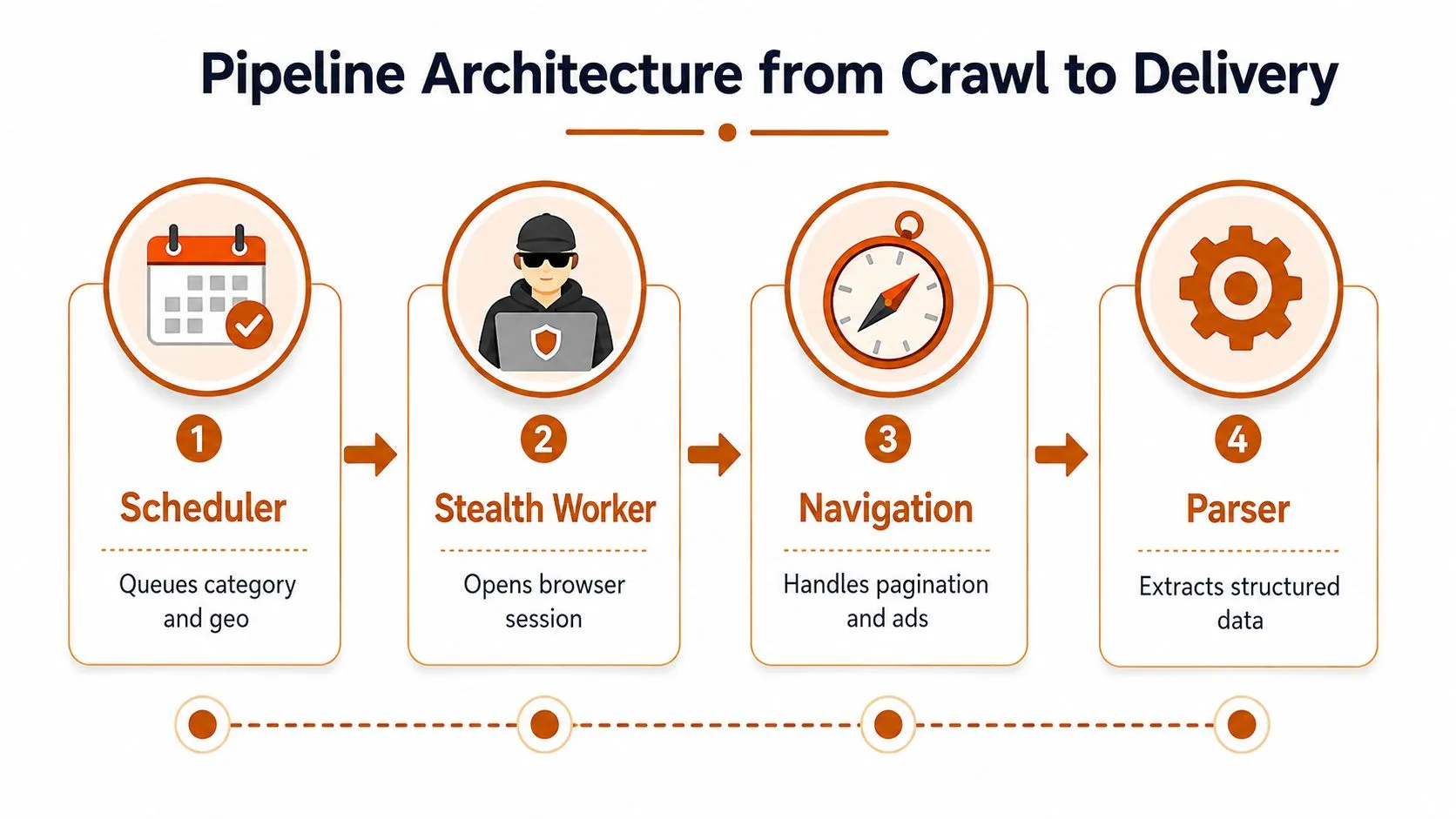
A durable pipeline begins before the browser opens. The scheduler converts business requirements into crawl units, each with a category, search definition, French geographic scope, pagination policy, priority, and refresh objective. It places those units on a durable queue so a worker crash doesn’t erase the job’s state.
The worker then acquires a browser session and records the session metadata needed for diagnosis. It should capture the response context, rendered HTML, relevant network events where permitted, and screenshots for pages whose visual structure affects interpretation. The objective isn’t to save everything indiscriminately. It’s to retain enough evidence to reproduce a parsing decision and investigate a failed acquisition.
Navigation needs state
Pagination is not just a loop over page numbers. The worker should confirm that each page belongs to the intended query, detect repeated result sets, identify redirects, and stop when the site returns a challenge or an unexpected layout. Detail-page navigation needs similar safeguards because a listing can disappear between discovery and enrichment.
A practical flow looks like this:
- The scheduler queues work: It partitions searches by category and geography, then assigns priority and retry policy.
- The stealth worker opens a session: It uses a browser context with coherent cookies, locale, viewport, and network routing.
- The navigation layer verifies pages: It checks page identity, follows pagination, records listing identifiers, and captures detail pages selectively.
- The parser creates records: It combines CSS and structured extraction with visual checks and LLM-assisted interpretation for free-text fields.
- The quality layer validates output: It checks required fields, types, duplicates, confidence, and schema version.
- The delivery layer publishes results: It emits the format required by the consuming workflow.
The LLM belongs in the interpretation stage, not in the control plane. It can normalize a description, classify seller notes, or extract category-specific attributes from irregular text. Deterministic rules should still handle identifiers, prices, URLs, dates, and other fields where exactness matters. Every model-derived value should carry provenance and confidence so downstream users know which records deserve review.
Schema control prevents quiet corruption
Leboncoin spans categories with different attributes. A vehicle record, property listing, and consumer product don’t share the same complete field set. The schema should therefore distinguish common fields from category extensions and use explicit nulls for unavailable values rather than changing field meaning.
Version the schema whenever a field is renamed, retyped, or reinterpreted. Run contract tests against stored captures, compare field completeness by category, and quarantine records when the page shape changes materially. Deduplication should use stable listing identifiers when available, supplemented by canonicalized URLs and conservative content signatures.
A clean CSV can still be wrong. Delivery success means the file arrived, not that the records are complete, current, or semantically correct.
Mature delivery supports more than a download. Depending on the consumer, the pipeline can publish CSV or JSON feeds, webhooks, object-storage drops, dashboards, or PDF reports with highlighted exceptions. The OLX scraper architecture discussion offers a useful comparison point because the same separation between acquisition, parsing, validation, and delivery applies across classifieds platforms.
Compliance, ToS Exposure, and Engineering Choices
Leboncoin’s robots.txt explicitly restricts search robots and other automated methods unless permission is granted, and the platform is protected by DataDome, as described in the documented Leboncoin scraping controls. Those facts don’t answer every legal question, but they do establish that an operator shouldn’t treat public visibility as blanket permission for automated collection.
The platform’s data has also become relevant in French litigation over repeated scraping. Reporting on Leboncoin’s legal dispute shows why the issue is more than a theoretical terms-of-service concern. A commercial operation should involve legal review of the intended source, fields, purpose, access method, retention period, and distribution model before production collection begins.
Compliance becomes system behavior
A compliance posture must translate into controls that engineers can test:
- Minimize collection: Gather only the fields required for the stated use case, particularly when listings contain personal or contact information.
- Limit retention: Define deletion and reprocessing rules rather than storing raw captures indefinitely by default.
- Control access: Restrict raw data and sensitive fields to approved roles and log downstream exports.
- Throttle responsibly: Use scheduling and rate controls that reflect the approved operating posture.
- Preserve evidence: Keep crawl decisions, parser versions, schema versions, and exception records for auditability.
A team collecting public market signals for internal analysis may adopt a different posture from a business redistributing listing data or building a commercial lead database. The engineering design should reflect that distinction. This guide to website terms of service and scraping provides a practical framework for identifying the clauses and operational assumptions that require review.
The strongest design is not the one that extracts the most fields. It’s the one that can explain why each field was collected, how access was obtained, who can use it, and when it will be removed.
KPIs That Tell You Whether the Scraper Is Healthy
“Runs successfully” isn’t an operational metric. A worker can return pages while missing an entire region, parsing prices as text, or treating challenge pages as valid empty results. A healthy Leboncoin scraper measures acquisition, interpretation, freshness, and change separately.
The following table uses qualitative operating targets rather than invented universal numbers. Each team should set its own numeric thresholds from a validated baseline, category, geography, and approved crawl frequency.
| KPI | Healthy threshold | Degradation signal |
|---|---|---|
| Success rate by category | Stable against the team’s established baseline, with coverage differences explained | One category or region falls below its baseline while others remain stable |
| Median time to refresh | Within the freshness objective agreed with downstream users | Refresh latency expands or becomes uneven across geographies |
| CAPTCHA challenge rate | Low and stable for the approved operating pattern | Sudden increase by session, route, browser profile, or category |
| Schema drift incidents | Changes are detected, versioned, and reviewed before broad publication | Required fields become null, retyped, or misclassified without an alert |
| False-positive rate on parsed fields | Validation samples remain within the accepted quality budget | Model or selector output looks populated but fails human or rule checks |
| End-to-end freshness SLA | Published records meet the agreed delivery window and include coverage evidence | Files arrive on time but contain stale, partial, or unverified data |
Separate customer evidence from SRE evidence
Customers usually need freshness, field completeness, coverage by category, and the number of records held for review. Operators need deeper signals, including browser crashes, retry causes, proxy health, challenge distribution, queue age, parser confidence, and differences between discovered and enriched listing sets.
Monitoring should also track the shape of the data. A sudden increase in identical descriptions, missing locations, or repeated identifiers may indicate a page loop or fallback response rather than a genuine market pattern. Guidance on monitoring website changes is relevant here because structural monitoring and extraction monitoring should share alerts.
Operational test: If the dashboard reports only request counts and HTTP status codes, it isn’t measuring data health.
Use canary searches and stored page fixtures to detect drift before a full crawl publishes corrupted records. Review samples from each important category, and make alert severity depend on business impact. A missing optional attribute may be tolerable. A broken price field can invalidate the entire downstream analysis.
Vendor Selection Checklist With Real Use Cases
The build-versus-buy decision should start with the failure modes, not with a feature checklist copied from an API landing page. A generic endpoint may return HTML while leaving your team responsible for browser fingerprints, French routing, schema changes, retries, and quality review. A managed operation should show how it handles each responsibility and how it proves delivery quality.
Look for these capabilities:
- Managed anti-bot operations: The provider should explain how it handles DataDome-style controls, browser sessions, routing, challenge events, and recovery.
- Schema ownership: Confirm that category-specific fields, version changes, null handling, and historical compatibility are documented.
- LLM and visual parsing: Ask where models are used, how confidence is represented, and which deterministic checks prevent fabricated or misread values.
- SLA-backed delivery: Require definitions for freshness, coverage, failed jobs, late deliveries, and escalation.
- Flexible outputs: Check whether the service supports the formats your systems consume, such as CSV, JSON, webhooks, object-storage drops, or reviewed PDF reports.
- Auditability: Request crawl evidence, parser versions, validation summaries, and exception workflows.
Use case one, dealer compliance reporting
An ad verification bureau producing 1,680 monthly dealer compliance reports, a documented WebscrapingHQ workload, needs more than listing extraction. It needs visual evidence, consistent report layouts, exception highlighting, and a review process that can defend why an ad passed or failed. Computer vision and LLM parsing may matter as much as browser collection because the final artifact is a compliance report, not a raw table.
Use case two, French-language training data
An AI startup building French-language training corpora should prioritize localized collection, language-preserving normalization, deduplication, provenance, and governance. The team should ask how personal information is minimized, how source captures are retained, and whether model-assisted fields can be traced back to the original content.
Use case three, competitor intelligence
A retail intelligence team tracking auto and real-estate categories needs stable identifiers, category-aware schemas, price normalization, location fidelity, and refresh measurements. It should favor a provider that can show coverage by geography and distinguish a genuine listing change from a collection gap.
The common thread is ownership of the operational burden. The case for managed web scraping services is strongest when the data supports a business process and the team doesn’t want browser maintenance, anti-bot incidents, and parser drift to become a permanent product responsibility.
WebscrapingHQ designs and operates managed Leboncoin data pipelines with anti-bot handling, French geo-routing, computer vision, LLM-assisted parsing, schema controls, monitoring, and scheduled delivery in formats such as CSV, JSON, webhooks, S3 drops, and PDF reports. If you need a reliable feed rather than a fragile script, visit WebscrapingHQ to discuss your categories, geography, fields, freshness requirements, and compliance constraints.
Want this done for you?
Send us the URLs. We'll quote it in 24 hours.
Paste the URL(s) you want scraped. We'll reply within 24 hours with a feasibility check and a ballpark quote.