Jump to section
- What Cloud Based Web Scraping Actually Means
- The practical distinction
- Why Enterprises Are Moving Data Collection to the Cloud
- What stakeholders should take from the data
- Anatomy of a Cloud Scraping Pipeline
- Six stations with different responsibilities
- Rendering should be deliberate
- Scaling Without Overwhelming Target Sites
- Treat pacing as feedback control
- Multi-region does not mean independent politeness
- Governance, Provenance, and Staying Defensible
- Build an evidence record for every run
- A Worked Example Using Amazon Review Data
- Quality gates protect the analysis
- Costs, Carbon, and Choosing Your Operating Posture
- Planning Your Cloud Scraping Program
A scraper can work perfectly on a laptop for weeks. Then a target site changes its layout, adds client-side rendering, slows requests, or blocks the machine’s address. The team loses its feed, analysts work from outdated exports, and engineers shift from building useful products to repairing collection scripts.
Cloud based web scraping addresses that operational problem by moving collection into a remotely managed system that can distribute work, adjust capacity, monitor failures, and deliver structured results on a schedule. It isn’t just “running Python on someone else’s server.” A genuine cloud design combines scalable infrastructure with scheduling, observability, recovery, governance, and controlled delivery.
What Cloud Based Web Scraping Actually Means
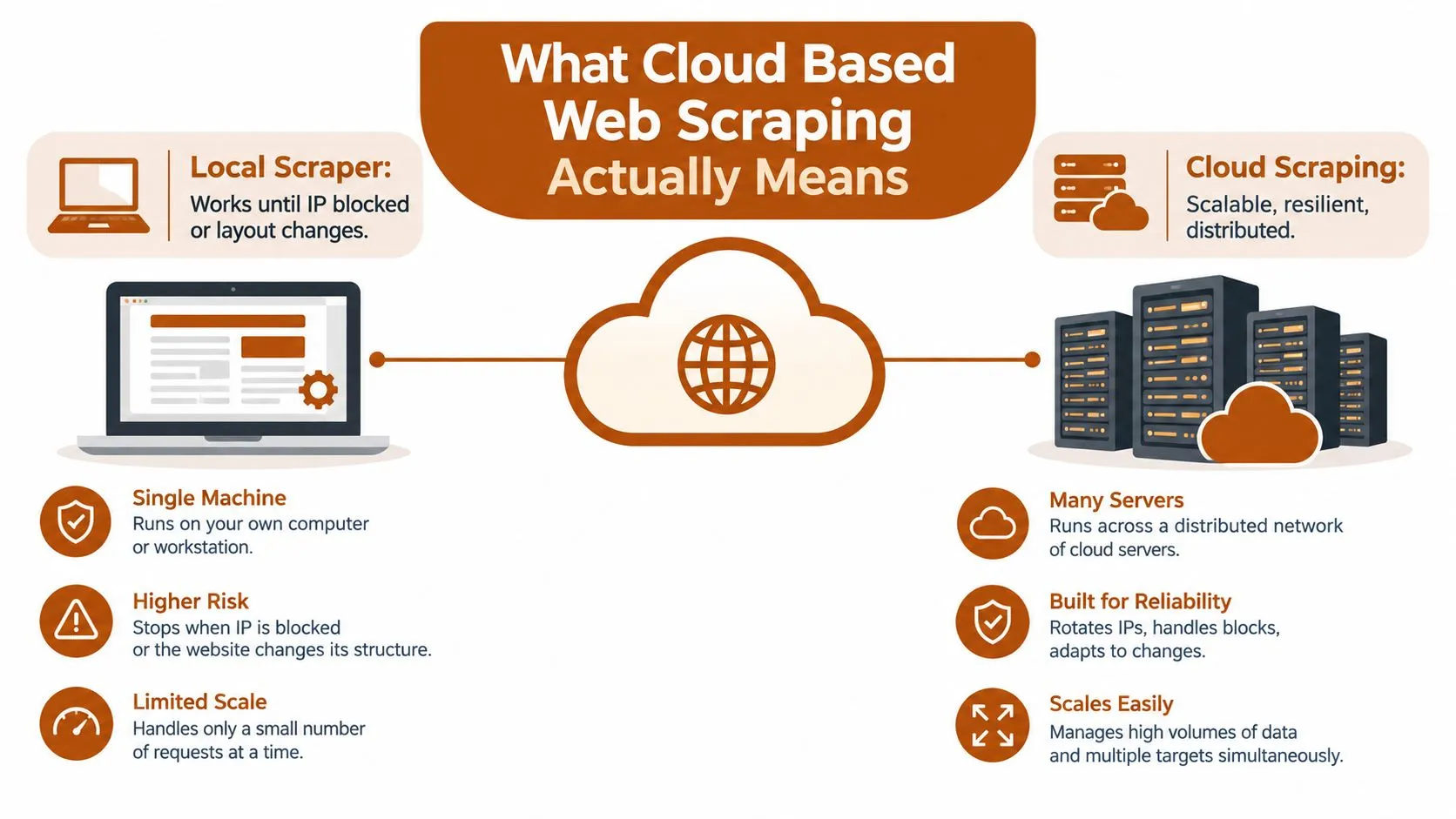
A local scraper is like cooking in one kitchen. You have a fixed oven, a limited number of work surfaces, and one person responsible for every step. If tonight’s orders increase, or the oven fails, the entire operation slows down.
Cloud scraping is closer to booking a professional kitchen whose capacity can change with demand. You can start workers when a crawl begins, distribute requests across available resources, store intermediate results centrally, and release capacity after the job finishes. The important feature isn’t the building where the computers sit. It’s the programmable access to shared, scalable, and measured computing resources.
The NIST definition of cloud computing provides a useful test. It identifies five essential characteristics:
- On-demand self-service: A collection job can request computing resources without a team manually installing a new server for every run.
- Broad network access: Workers, operators, and downstream systems can access the service through appropriate network connections.
- Resource pooling: Shared infrastructure can support parallel work across multiple domains or projects.
- Rapid elasticity: Capacity can expand during a large crawl and contract when the workload ends.
- Measured service: Resource consumption can be tracked by project, customer, schedule, or workload.
These characteristics separate cloud based web scraping from a script that merely runs on a rented virtual machine. A fixed virtual machine may be remote, but it can still have one manually maintained environment, one capacity ceiling, and weak visibility into resource consumption.
The practical distinction
A cloud scraper should treat infrastructure as an operating layer, not as the product itself. The product is the reliable data flow, including the rules that decide what to fetch, how quickly to fetch it, how to identify failures, and how to prove what was collected.
NIST also describes software, platform, and infrastructure service models, along with cloud deployment models. That vocabulary helps stakeholders ask whether a provider is offering a finished data service, a platform for building crawlers, or raw infrastructure that still requires internal engineering. Teams comparing those choices can also review why web scraping services can be preferable to managing collection internally.
Practical rule: Remote hosting is only one part of cloud scraping. Elasticity, shared control, measurement, and operational recovery create the real value.
Why Enterprises Are Moving Data Collection to the Cloud
Cloud based scraping fits a broader change in how organizations operate software. Teams increasingly expect computing resources to be available when needed, accessible across locations, and connected to monitoring and delivery systems. Data collection follows the same pattern because recurring extraction requires more than a script and a storage folder.
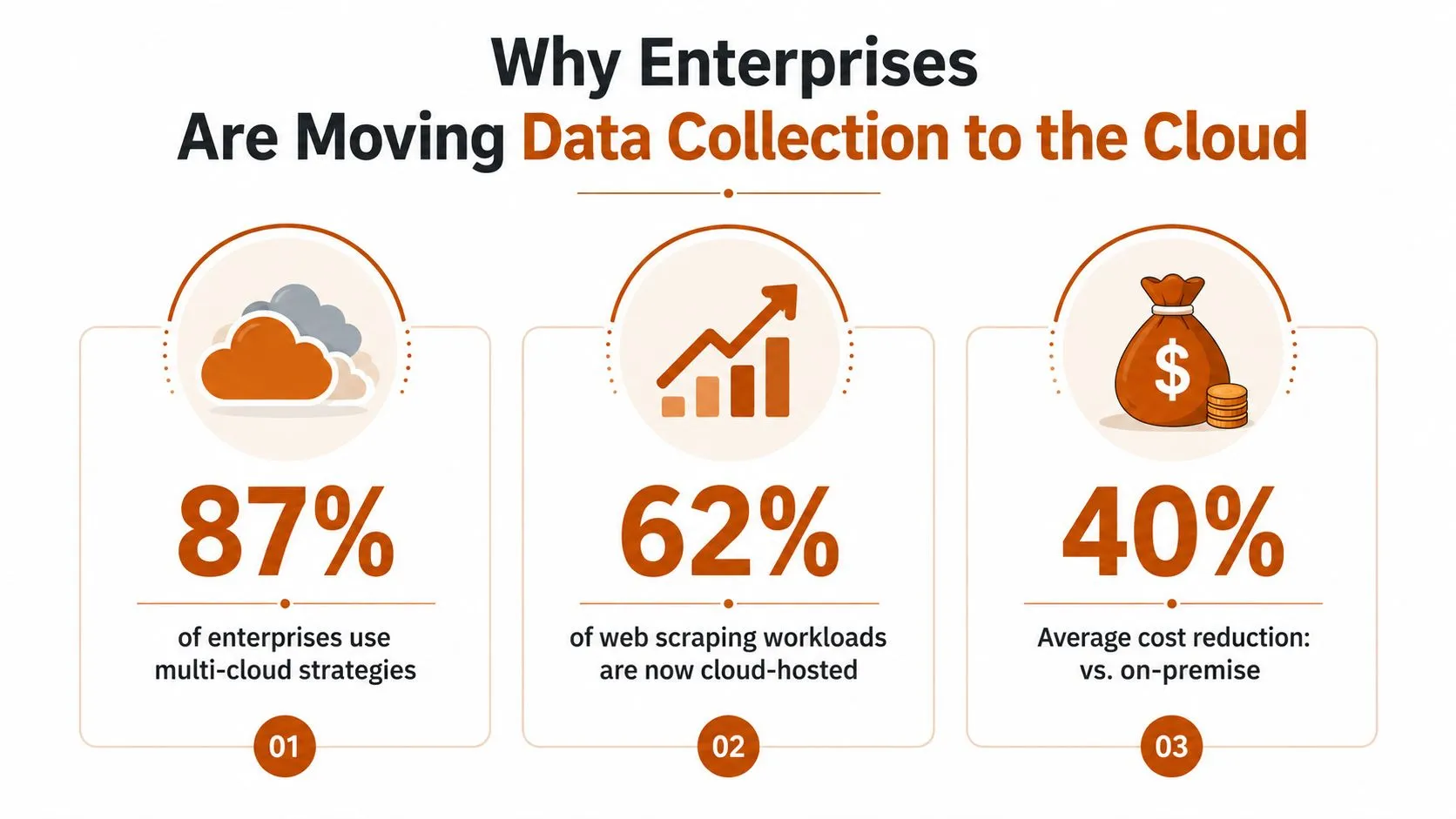
Eurostat reported that 52.74% of EU enterprises with at least 10 employees used paid cloud-computing services in 2025, an increase of 7.42 percentage points from 2023. Adoption reached 84.67% among large enterprises, according to the Eurostat 2025 cloud computing survey. Those figures don’t measure scraping specifically, but they show that the infrastructure model behind hosted collection is already familiar to business technology teams.
The same survey found that 28.2% of EU enterprises used paid cloud services for computing power to run their own software, while 26.1% used cloud platforms for application development, testing, or deployment. These capabilities map naturally to extraction workloads. A production system may need custom parsers, browser automation, image processing, validation jobs, and scheduled delivery, all without requiring the company to own every underlying machine.
What stakeholders should take from the data
Large organizations have an easier time justifying internal cloud teams, security reviews, monitoring systems, and platform engineering. Smaller or growing teams may need the same collection outcomes without building the entire operating stack themselves. That difference creates a role for managed data operations, especially when the business needs recurring feeds rather than a one-time export.
Cloud adoption also changes the business conversation. Instead of asking whether the company should buy and maintain hardware for a possible future crawl, stakeholders can evaluate a service according to freshness, completeness, governance, delivery format, and operational ownership. The infrastructure becomes a means to support a defined data requirement.
Cloud scraping should be viewed as part of the wider enterprise transition to on-demand computing, not as an isolated trick for sending more requests.
There are trade-offs. Cloud infrastructure introduces variable resource consumption, provider dependency, data-transfer considerations, and a need for stronger access controls. A cloud deployment also makes poor design easier to multiply. If a scheduling error sends excessive traffic to one host, elastic capacity can amplify the problem rather than solve it.
Anatomy of a Cloud Scraping Pipeline
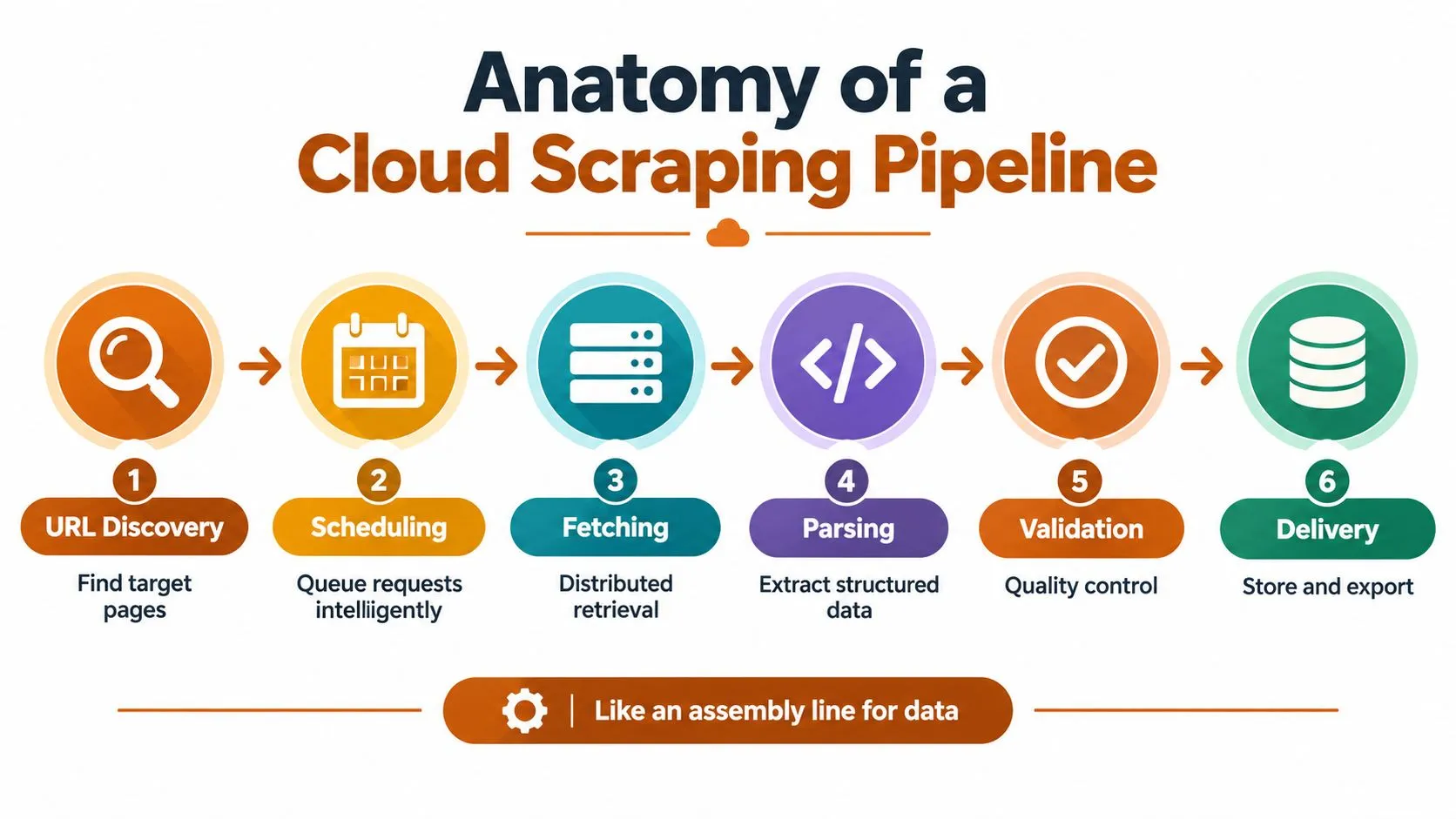
A reliable scraper resembles an assembly line. Each station performs a defined task, records its output, and passes work to the next station. If one station fails, the system should retry that stage instead of throwing away everything produced earlier.
A practical pipeline separates URL discovery, scheduling, fetching, parsing, validation, and delivery. This separation creates independent recovery points and makes changes easier to test.
Six stations with different responsibilities
-
URL discovery identifies the pages or endpoints that belong in the job. Sources may include a supplied list, sitemap references, category navigation, or previously observed links. The system should record where each URL came from so operators can distinguish a valid discovery rule from an accidental expansion.
-
Scheduling decides when each URL should be attempted. It can group work by hostname, freshness requirement, geography, or priority. Scheduling is also where the system applies domain-level request policies rather than allowing every worker to make independent decisions.
-
Fetching retrieves the response and records the result. The fetch artifact should be immutable, or represented by a stable content hash, in object storage. Keeping the original response means a parser can be improved later without requesting the page again.
-
Parsing converts HTML, structured responses, or rendered page content into the intended schema. Parsers should carry a schema version so the team knows which extraction logic produced a record.
-
Validation applies quality gates before data reaches a customer or downstream model. Required-field checks, type validation, duplicate detection, and anomaly thresholds can reject or quarantine questionable records.
-
Delivery sends approved data to its destination. That might be a CSV or JSON export, webhook, report, or database feed. Delivery should be idempotent, so a temporary outage can trigger a resend without creating duplicate records.
A durable database can hold crawl state, status transitions, schema versions, and retry information. An acknowledged queue can publish work between stages and confirm that a message was processed. This is the difference between a recoverable pipeline and a long browser process that fails after hours with no usable intermediate output.
The architecture also supports targeted diagnosis. Track fetch success, parse success, validation rejection, freshness lag, and end-to-end delivery latency separately. An origin outage, a changed selector, and a broken destination are different incidents. They need different responses.
Rendering should be deliberate
Dynamic pages create a common design mistake. Teams often launch a full browser for every URL because it appears to handle everything. Browser rendering is usually more expensive and operationally heavier than requesting and parsing a static response.
Use ordinary HTTP extraction when the required fields are present in the response. Invoke browser rendering only when JavaScript is demonstrably necessary or when required fields remain absent after the static path. For example, a review page may expose the first records in its HTML but require rendering for a pagination control. The pipeline can send only those difficult pages to the browser stage.
This staged approach is closely related to batch data processing patterns, where durable intermediate outputs allow later work to continue without repeating completed operations.
Scaling Without Overwhelming Target Sites
Adding workers doesn’t automatically produce more usable data. If every worker targets the same hostname, horizontal scaling can multiply traffic to one site until a temporary slowdown becomes a sustained block.
Google describes a crawler fleet that operates across thousands of machines and datacenters, while automatically adjusting crawl rates when a target slows down or returns errors. The Google crawler and fetcher overview illustrates the important principle: distributed execution still requires centralized control over how a target is approached.
Treat pacing as feedback control
A managed scraper should maintain request-rate and concurrency state per host, ideally in a shared store. Each worker then consults the same policy rather than acting as an independent crawler.
The controller should reduce issuance after signals such as:
- Increased response latency
- HTTP 429 responses
- HTTP 5xx errors
- Repeated connection failures
- A rising retry rate
After the target recovers, the controller can increase activity gradually. Retries should use exponential backoff with jitter, which prevents a group of workers from retrying at exactly the same moment. If the target supplies Retry-After, the scheduler should honor it.
The drone display is a useful analogy, but the operator’s job isn’t to send more drones into the air. It’s to maintain a shared flight plan, detect congestion, and keep one group from interfering with another. A queue that assigns work by hostname makes that policy enforceable.
Multi-region does not mean independent politeness
Geographic distribution can improve network proximity and support localized content. It can also create a serious control gap. If workers in several regions each apply a local request limit, their combined traffic may exceed the target’s tolerated load.
The safe split is straightforward:
- Distribute compute when network proximity, localization, or resilience requires it.
- Share one politeness policy for each target domain across all regions.
- Centralize measurements for latency, status-code mix, retries, and successful records per unit of compute.
- Assign hostname-aware queues so the scheduler can coordinate pressure on each origin.
Teams evaluating proxy infrastructure should treat it as one component of this policy, not as permission to increase volume without limits. A guide to proxy servers for web scraping can help explain network options, but proxy selection doesn’t replace pacing, monitoring, or consent review.
Engineering principle: Politeness is a distributed-systems control. It must survive worker restarts, regional expansion, and traffic spikes.
Governance, Provenance, and Staying Defensible
A cloud scraper can be technically reliable and still create an evidence problem. A successful request tells you that a page was retrieved. It doesn’t, by itself, show which policy applied, what permission signal was available, who authorized the target, or what data classification the result received.
Robots.txt is useful context, but it is voluntary and non-enforceable. Research analyzing approximately 3.9 million requests across 36 websites found that bots were less likely to comply with stricter robots.txt directives, while AI-search crawlers frequently failed to check robots.txt at all, as documented in this crawler behavior research. A separate analysis found that 55.6% of the top one million websites had robots.txt at the domain root in September 2025, which means a published file was absent for a large minority of sites. Both findings support the same operational conclusion: robots.txt should be one signal in a wider governance process, not the complete control.
Build an evidence record for every run
A governance layer should preserve the reasoning around collection, not just the extracted rows. At minimum, ask whether the system records:
- Policy snapshots: Save the relevant access-policy state with a timestamp, rather than relying on a current file during a later audit.
- Consent signals: Record permissions, contractual approvals, or internal decisions that authorize collection.
- Crawler identity: Identify the responsible service or crawler so an operator can trace activity to an owner.
- Retrieval evidence: Preserve source URLs, retrieval time, response metadata, and immutable fetch artifacts where appropriate.
- Data classification: Mark personal, sensitive, restricted, or public fields according to the organization’s policy.
- Human review: Route ambiguous targets, unclear permissions, or new data categories to an accountable reviewer.
This is also where isolation matters. A platform handling several customers should separate tenants, credentials, queues, storage, logs, and access policies. Teams designing agent-connected systems can use tenant isolation in MCP as a useful governance reference because it frames isolation as an operational control rather than a checkbox.
A practical data governance policy example should answer who can approve a target, how evidence is retained, and what happens when a site changes its policy. The same rules should apply to scheduled jobs, one-off investigations, and reprocessing of stored artifacts.
More crawl volume without provenance scales unverifiable exposure, not defensible data collection.
A Worked Example Using Amazon Review Data
Consider a team collecting Amazon user reviews for product research. The business doesn’t need a pile of HTML. It needs normalized records that analysts can compare across products, regions, and collection dates.
A review record might include the rating, title, body text, verified purchase status, publication date, helpful vote count, and product identifier. Each field supports a different analysis, and each can fail in a different way.
| Data Field | Analysis Use | Common Quality Issue |
|---|---|---|
| Rating | Measure satisfaction and compare products | Missing values or inconsistent representations |
| Review title | Group recurring themes quickly | Layout changes can merge title and body text |
| Body text | Run sentiment, topic, and feature analysis | Truncated content or incomplete expansion |
| Verified purchase status | Segment confidence signals | Labels may vary by regional page structure |
| Date | Track changes in customer response | Locale-specific formatting or missing dates |
| Helpful vote count | Prioritize reviews with stronger reader engagement | Dynamic values and absent fields |
| Product identifier | Join reviews to catalog and product attributes | Parent and child product identifiers can be confused |
The pipeline begins with URL discovery for the relevant product pages or review views. Scheduling then assigns requests by hostname and region, while the shared policy prevents regional workers from treating the same domain as several unrelated targets.
Fetching should use the cheapest reliable path first. If the review fields are present in the response, an HTTP extractor can store the page artifact. If pagination, expansion, or review content requires JavaScript, the scheduler can send that page to a browser-rendering fallback instead of rendering every page by default.
Quality gates protect the analysis
Before delivery, validation can require a product identifier, review body or title, date when available, and a recognizable rating format. It can also compare record fingerprints to identify duplicates. Duplicate detection matters because the same review may appear in several navigation contexts or be returned again after a retry.
Region-specific structures add another problem. One page may expose a purchase label directly, while another uses a different presentation or omits it. The parser should normalize those variations into a stable schema and preserve the raw value when analysts may need to inspect the original interpretation.
A failed parser shouldn’t force a complete refetch. Stored HTML can be reprocessed with a new selector or schema version. Likewise, if the downstream sentiment feed is temporarily unavailable, validated records can wait in the delivery stage and be resent without being collected again.
The resulting dataset can support sentiment analysis, product issue detection, competitor comparison, and trend monitoring. It can also support an audit trail, provided each record retains source and retrieval evidence. Teams exploring the commercial use of this type of dataset can review how an Amazon review scraper supports product business analysis, while still treating quality and governance as design requirements rather than optional add-ons.
Costs, Carbon, and Choosing Your Operating Posture
Request volume is only one part of the cost model. Browser time, storage, bandwidth, proxy usage, data transfer, maintenance, and downstream processing all influence the operating posture. Environmental impact adds another dimension, particularly for recurring workloads that repeatedly download similar pages or assets.
Research on cloud infrastructure identifies wide-area network transfer as an overlooked emissions source and describes shifting network-intensive workloads across time and regions according to local carbon intensity. A separate 2025 study estimates that data centers could consume more than 500 TWh and emit roughly 225 million metric tons of CO2, using a global-average intensity of 450 gCO2 per kWh, as reported in this analysis of data-center energy and emissions.
Running every crawl in the nearest region at maximum speed isn’t always the best choice. Lower latency can encourage more frequent transfers and duplicate downloads, while a slightly slower schedule may satisfy the business requirement with less network impact.
A practical framework includes:
- Freshness tiers: Match crawl frequency to business value. Not every page needs the same schedule.
- Page fingerprints: Compare hashes or other fingerprints before downloading unchanged assets repeatedly.
- Selective media retrieval: Avoid high-resolution images unless visual analysis requires them.
- Carbon-aware timing: Schedule non-urgent work during periods or in regions with lower carbon intensity.
- Transparent service levels: Compare latency, completeness, cost, and environmental impact instead of optimizing one metric in isolation.
Managed providers could expose carbon-aware delivery as an operating option alongside freshness and completeness. That gives stakeholders a measurable choice rather than a vague sustainability promise.
Planning Your Cloud Scraping Program
Start with the data contract. Define fields, acceptable quality, freshness tiers, delivery destinations, and retention requirements before choosing infrastructure.
Then decide whether the team should build the pipeline or use managed operations. In either case, require policy snapshots, provenance, tenant separation, schema versioning, and human review for ambiguous targets. Set observability targets for fetch success, parse success, validation rejection, freshness lag, and delivery latency.
A managed provider such as WebscrapingHQ can take responsibility for monitoring, retries, re-tuning, proxy management, browser execution, and scheduled delivery, allowing internal teams to focus on analysis and product decisions. Start with one well-governed target domain, prove the complete path from discovery to delivery, and expand only after the controls work. That approach is safer than launching a large crawl that fails quietly across many sources.
WebscrapingHQ provides managed web data operations and custom extraction pipelines with scheduled delivery, monitoring, retries, re-tuning, and structured outputs for recurring data needs. If your team needs cloud based web scraping with a defined schema and auditable operating process, visit WebscrapingHQ to discuss the target sources and delivery requirements.
Want this done for you?
Send us the URLs. We'll quote it in 24 hours.
Paste the URL(s) you want scraped. We'll reply within 24 hours with a feasibility check and a ballpark quote.