
Jump to section
- Why Media Breaks the Average Twitter Pipeline
- The failure happens at the attachment layer
- How X Structures Tweet Media and Why It Matters
- Classify before downloading
- Proxy Types Matched to Twitter Media Workloads
- Residential proxies for selective collection
- ISP proxies for sustained archives
- Rotation Strategies and Geo-Targeting That Actually Work
- Assign sessions by transfer risk
- Geo should support the source, not decorate the dashboard
- Health Checks and Integration With Scraper Code
- Probe for the failure that matters most
- Add a circuit breaker
- Anti-Bot Mitigation as a Layered System
- Start with the cheapest effective layer
- Escalate instead of retrying blindly
- Cost and Operations Trade-Offs at Scale
- Best Practices and When to Outsource the Pipeline
- Know when internal ownership stops paying
Your pipeline probably doesn’t fail on tweet text. It fails after the tweet has already been found. Handles, timestamps, and post text arrive consistently, while image URLs return incomplete responses, GIFs produce unusable assets, or video downloads collapse under retries. The parser gets blamed, but the problem is usually infrastructure.
A Twitter media scraper has to handle an attachment model, endpoint-specific throttling, larger payloads, expiring URLs, and anti-bot controls that don’t appear in a text-only workflow. X defines media as images, GIFs, or video attached to a Tweet, retrieved through Tweet expansions such as attachments.media_keys and additional media.fields, rather than through a standalone media object endpoint. That structure makes media extraction inseparable from Tweet parsing. (X media data model)
Why Media Breaks the Average Twitter Pipeline
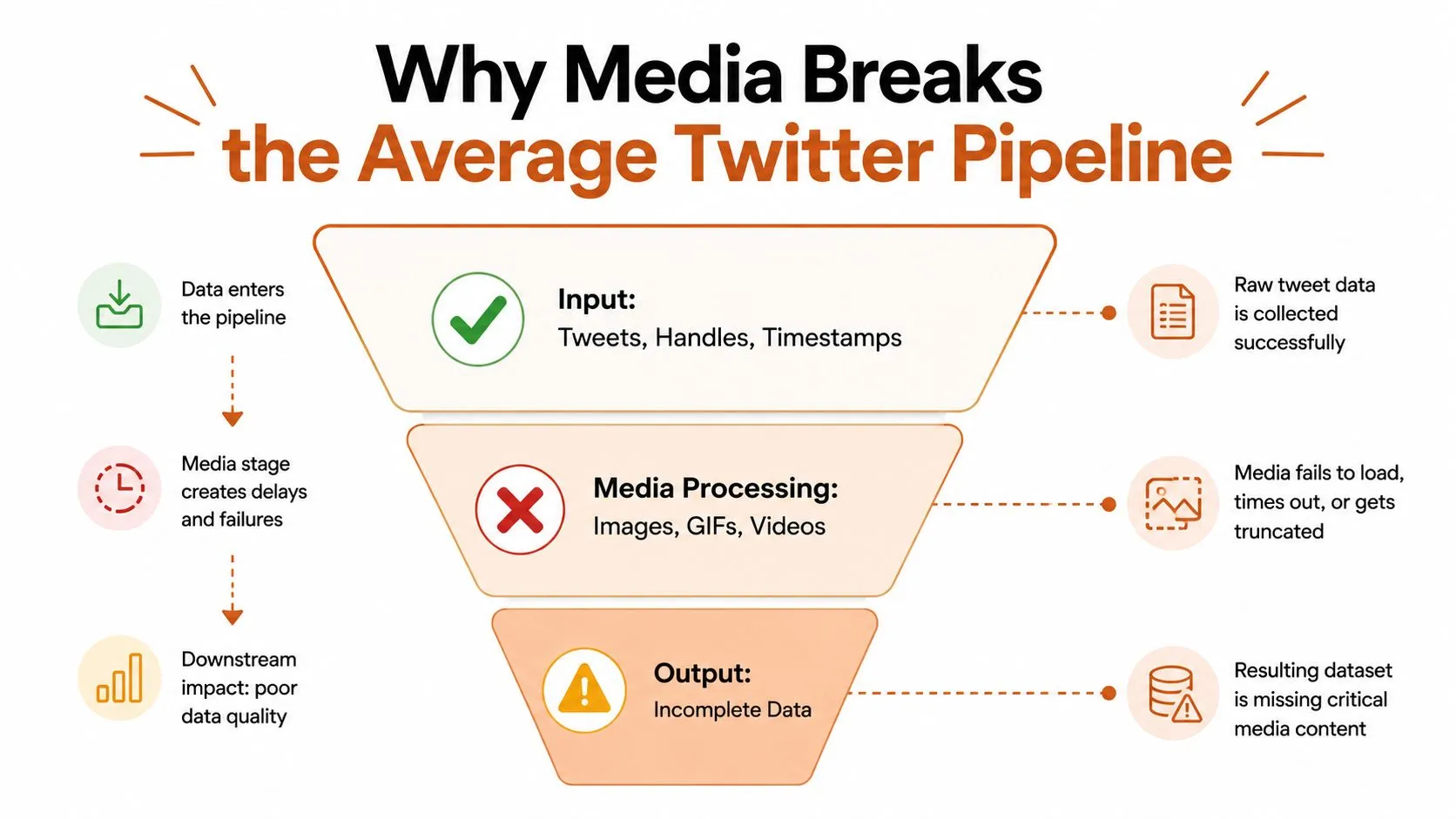
A typical failure starts innocently. The crawler reads a timeline, stores each Tweet, and records the media reference. The database looks healthy until someone opens the export and finds that image files are missing, animated GIFs are truncated, and video records contain metadata without playable content.
The mistake is treating media retrieval as a final download step. X exposes Tweet data and attached assets through related request paths, including syndication and pbs.twimg.com media delivery. Those paths have different response behavior, larger payloads, and their own throttling pressure. A worker that processes text smoothly can still spend most of its time retrying media requests.
The failure happens at the attachment layer
Text extraction is comparatively cheap. Media extraction adds several stateful operations:
- Metadata resolution: The scraper must request or parse the Tweet expansion that contains media identifiers and fields.
- Asset classification: Images, GIFs, and video need different download and validation paths.
- Byte validation: A successful HTTP response doesn’t prove that the complete asset was received.
- Deduplication: Reposts, quote posts, retries, and multiple Tweet references can point to the same underlying media.
- Storage handling: Large files need streaming, resumable work, and content hashing rather than a simple in-memory response.
X’s official media documentation defines upload ceilings of 5 MB for images, 15 MB for GIFs, and 512 MB for video uploads using the amplify_video category. Those are upload limits, not a promise that every delivered rendition has the same size, but they show why a text-oriented request budget doesn’t translate directly to a media budget. (X media introduction)
Practical rule: Treat media discovery, media download, and media validation as separate pipeline stages. A Tweet record can be valid even when its attachment has failed.
The proxy decision follows from that separation. Metadata calls can tolerate short sessions and modest bandwidth. Video retrieval needs stable connections, careful retry behavior, and enough egress capacity to avoid turning every segment into a new risk event. A reliable Twitter media scraper therefore starts by matching infrastructure to the asset being collected, not by adding random proxy rotation after the first ban.
How X Structures Tweet Media and Why It Matters
A scraper can retrieve the Tweet successfully and still fail on the attachment. X uses a Tweet-first, attachment-second media model. The Tweet response exposes references, commonly through attachments.media_keys, while the scraper requests the fields needed to resolve and interpret them. (X Tweet and media model)
That relationship should shape the storage schema and request plan. Keep the Tweet identifier, media key, media type, source URL, available variants, and processing status together. Saving only a rendered image URL removes the identifier needed to reconcile duplicate references and retry a failed download safely.
Classify before downloading
Use a separate processing path for each media class:
- Images can usually follow a direct download path, then be normalized and checked against the expected content length when that header is available.
- Animated GIFs should use video-like transfer and playback validation, even though the interface presents them as GIFs.
- Videos may require manifest handling, segment retrieval, poster-frame association, and a final integrity check before completion.
X documents images, GIFs, and video as attachment types. Its upload guidance lists ceilings of 5 MB for images, 15 MB for GIFs, and 512 MB for video uploads using the amplify_video category. Those figures describe uploads, not a guarantee that every delivered rendition has the same size. They still show why a text-oriented request budget cannot be applied directly to media. (X media introduction)
A successful Tweet lookup therefore does not confirm that the next asset request will have the same access conditions. Metadata retrieval and media delivery should have separate retries, status tracking, and failure handling.
| Media type | CDN host | Size ceiling | Token expiry |
|---|---|---|---|
| Image | pbs.twimg.com | X documents an image upload ceiling of 5 MB | Treat media URLs as time-sensitive and refresh from Tweet metadata when a saved URL fails |
| Animated GIF | pbs.twimg.com, commonly delivered as an MP4 loop | X documents a GIF upload ceiling of 15 MB | Refresh the attachment reference rather than retrying an old failed URL indefinitely |
| Video | video.twimg.com, with delivery variants | X documents video uploads up to 512 MB for the amplify_video category | Keep manifest and segment retrieval within the active URL validity period |
The table is an operational guide, not a promise that every public URL exposes identical metadata. Preserve the original reference, request time, response headers, and final content hash. That record separates an expired reference from a blocked proxy, a truncated response, or a parser regression. It also gives the media worker enough context to decide whether to refresh metadata, retry the transfer, or quarantine the asset.
Proxy Types Matched to Twitter Media Workloads
Proxy choice should follow the workload’s bandwidth profile and tolerance for stable sessions. A proxy that works for discovering public Tweets may be a poor choice for retrieving video segments, while an expensive stealth pool can be wasteful for low-risk metadata collection.
| Proxy type | Stealth vs X media | Bandwidth cost | Best fit workload |
|---|---|---|---|
| Residential | Stronger alignment with ordinary consumer traffic | Expensive for sustained large transfers | Occasional image, GIF, or video collection |
| ISP | Stable egress with better sustained throughput | Usually more efficient for ongoing transfers | Mid-volume archives and predictable workers |
| Datacenter | Fast and inexpensive, but easier to classify | Efficient for raw transfer | Controlled experiments or browser-backed workflows |
| Mobile or rotating pool | Strong stealth characteristics, with added latency | Costly and less predictable for media | Hostile targets where other classes repeatedly fail |
Residential proxies for selective collection
Residential exits are the sensible starting point for a low-volume Twitter media scraper. They resemble ordinary consumer network paths and can be useful when the scraper must access public pages and visible attachments without maintaining a large, persistent archive. The trade-off is bandwidth. Large media transfers can make a residential pool expensive long before request volume becomes the main concern.
ISP proxies for sustained archives
ISP proxies offer a better balance when the pipeline needs stable egress over longer sessions. They’re often a practical fit for image-heavy collections and controlled video retrieval, provided the same address can remain associated with a worker long enough to finish its transfer. Their value comes from consistency, not magical immunity to blocking.
Datacenter proxies are the wrong default for direct media collection. They can be fast, but X can classify the network and request pattern quickly. I’d use them only within a complete browser stack with conservative concurrency and strong observability, never as a cheap substitute for proxy hygiene.
Mobile and 4G pools belong in the escalation path. They can help when residential and ISP exits repeatedly trigger defenses, but latency and frequent network changes make HLS-style video retrieval fragile. Before adopting them, test complete asset delivery rather than measuring only the initial response.
For a deeper treatment of persistent versus rotating egress, see this guide to static versus rotating proxies. Teams that also manage authentication-heavy workflows may benefit from understanding replace Clerk with Passflow as a separate identity and access concern, rather than mixing login state into the media downloader.
Rotation Strategies and Geo-Targeting That Actually Work
Rotation isn’t a switch labeled “on.” It’s a routing policy attached to the request type.
Metadata discovery can use shorter sessions because the responses are small and the work is easy to retry. Media downloads need the opposite treatment. If a video transfer changes egress halfway through a manifest or segment sequence, the worker may produce gaps, repeated failures, or a file that passes superficial checks but won’t play.
Assign sessions by transfer risk
Use a request-aware policy:
| Request type | Session length | Rotation | Notes |
|---|---|---|---|
| Tweet metadata | Short-lived | Rotate more freely | Cache identifiers and avoid repeated expansion calls |
| Image retrieval | Short to moderate | Rotate after failure clusters | Validate bytes before releasing the worker |
| GIF retrieval | Moderate | Keep the session through the transfer | Treat the asset as a video-like download |
| Video manifest and segments | Sticky | Hold the same egress during the job | Retry carefully and preserve segment state |
| Recovery after throttling | Cooldown-based | Move to a healthy pool | Don’t hammer the same endpoint with a new URL |
X’s API model is endpoint-specific, and the official documentation describes separate per-user and per-app scopes along with rate-limit headers such as x-rate-limit-remaining and x-rate-limit-reset. (X API rate-limit behavior) Read those headers and pace each endpoint independently. A global request counter hides the failure mode that matters.
Geo should support the source, not decorate the dashboard
Geo-targeting matters less for ordinary public Tweet collection than it does for region-sensitive services, but it still has a role. Pin a session to a coherent geography when the account, page experience, or media variant appears region-dependent. Don’t rotate countries casually while keeping the same browser identity. That combination creates an inconsistent session that can look less like a normal visitor than a fixed region would.
A scraper should fingerprint the request class, not only the URL. Lightweight Tweet discovery can use a rotating pool, while high-cost video work receives a sticky session and its own concurrency budget. The same principle applies to adjacent platforms, including workflows that require a specialized Douyin scraper. Reusing one generic rotation policy across every target usually creates avoidable failures.
Health Checks and Integration With Scraper Code
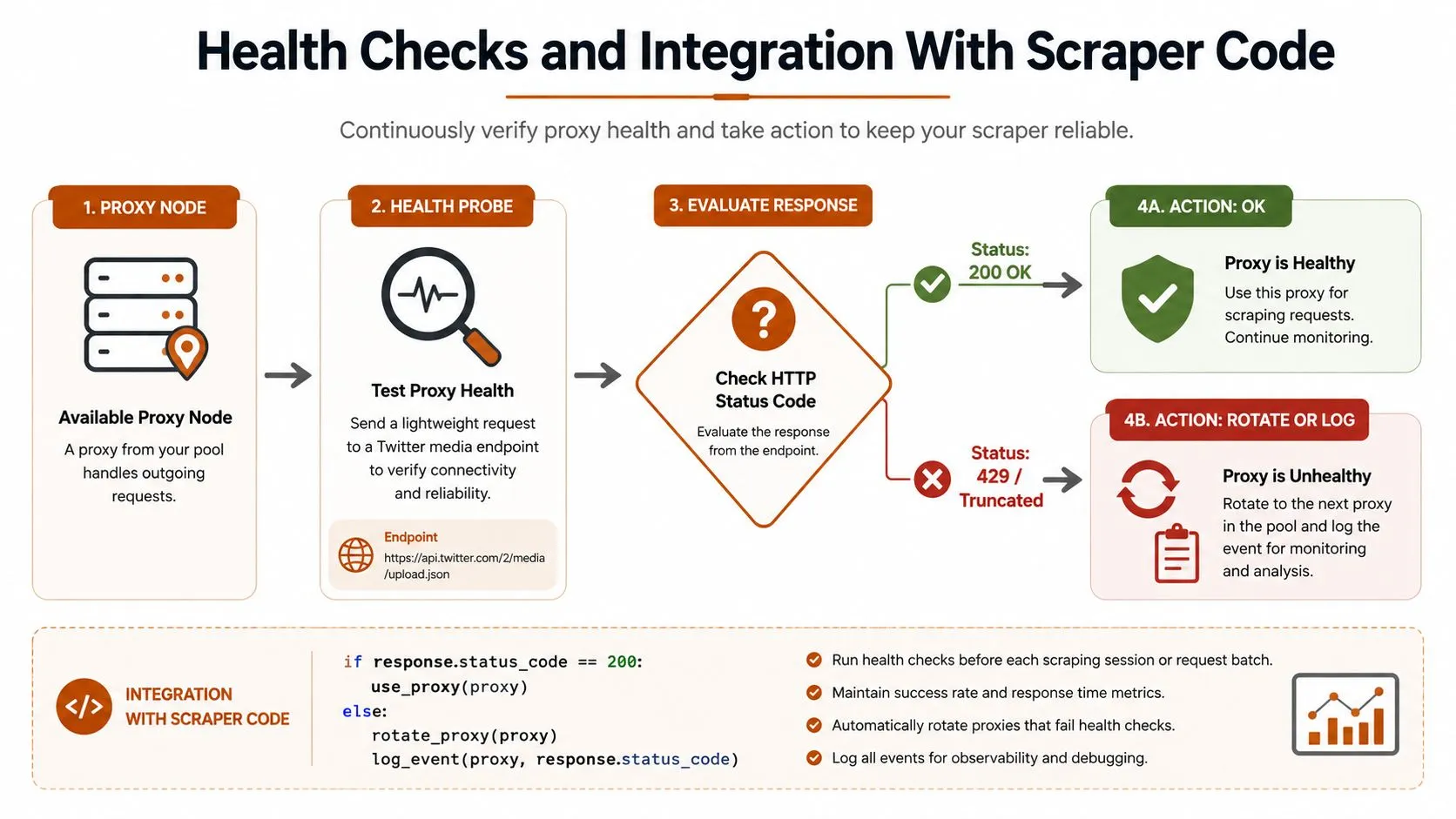
A proxy can pass a page request in the morning and fail a video transfer later the same day. It may return 429, reset the connection, or report 200 after delivering only part of the media object. If the pipeline stores only the final exception, engineers cannot separate parser errors from CDN responses, proxy failures, or storage problems.
Probe for the failure that matters most
A useful health checker measures the outcome the worker needs, not just whether a socket opened:
- Status behavior: Record successful responses, throttling responses, authorization failures, and connection resets separately.
- Latency: Track connection time and time to first byte. Slow exits can keep segment jobs active and push concurrency beyond its intended level.
- Content completeness: Compare received bytes with response metadata where available, then verify that the file decodes.
- Endpoint coverage: Probe the same X resource class the worker will request. A proxy can pass a page test and still fail during media delivery.
- Identity continuity: Attach every request to a proxy ID, session ID, media type, and retry number.
Add a circuit breaker
Retire an exit after a short run of consecutive failures, place it in cooldown, and restore it only after a fresh probe succeeds. Keep the threshold configurable, but make the behavior part of the worker rather than an operator habit. One unhealthy proxy should not consume the retry budget for an entire image, GIF, or video queue.
Log the rotation decision itself. “Proxy changed” does not identify the cause. Store the failed endpoint, the reason for rotation, whether the response was truncated, and whether the replacement completed the job. These fields expose a degrading pool before it affects the dataset.
Operational insight: A
200response is a transport result, not a data-quality result.
Separate discovery from downloading, and make retries idempotent. Persist a media key and content hash so workers can claim unfinished assets without creating duplicate files. Queue boundaries also make it easier to give video jobs different retry and timeout rules from lightweight image collection.
For broader queue and worker patterns, see this guide to building scalable data pipelines with Scrapy. Teams assessing public-page retrieval against paid access can also compare social media APIs before committing to browser and CDN collection.
Anti-Bot Mitigation as a Layered System
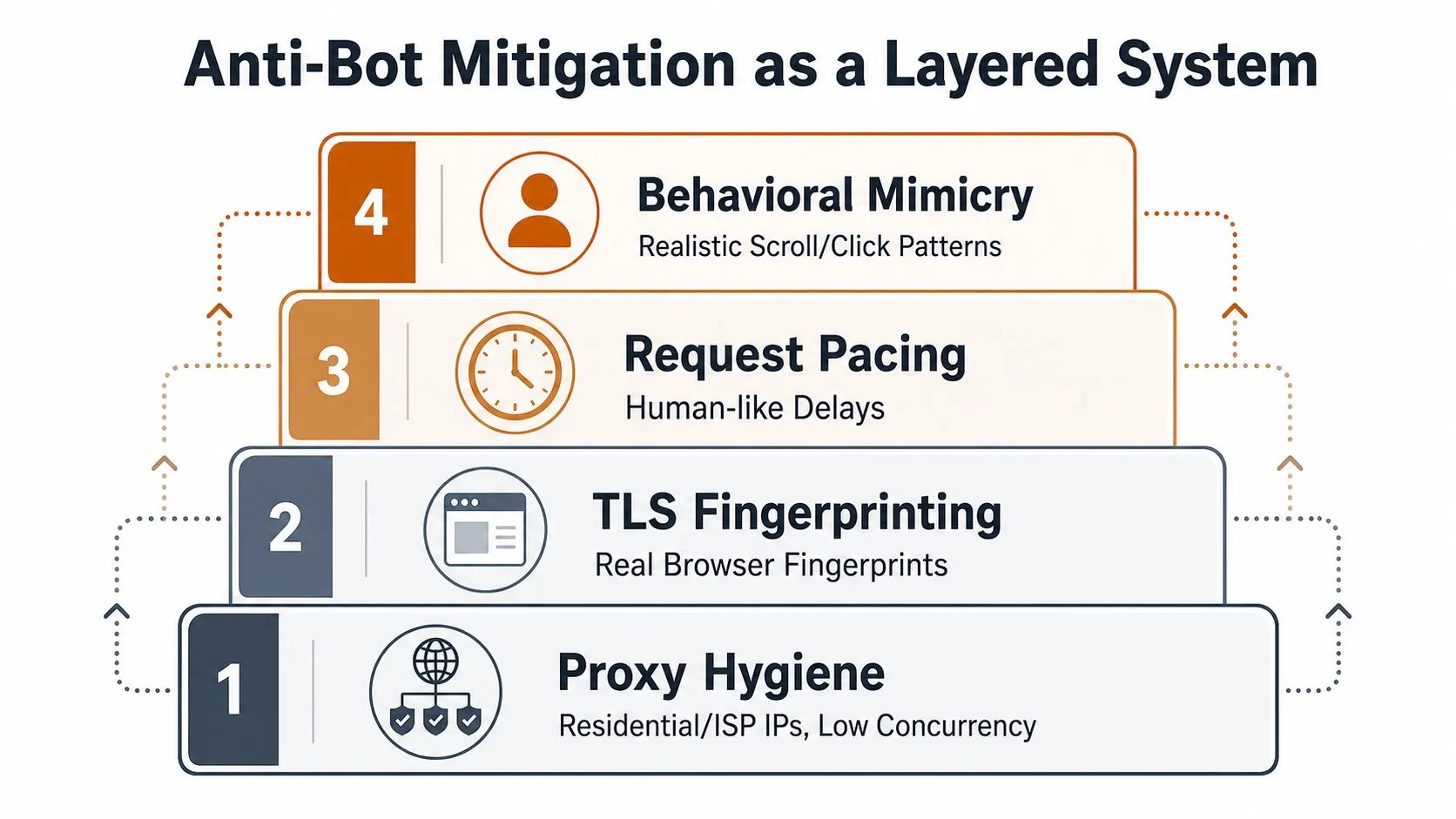
No single anti-bot measure carries a production Twitter media scraper. Proxy rotation without browser consistency creates suspicious sessions. Browser realism without pacing still produces an abusive request pattern. Captcha handling without pool health turns every challenge into a retry storm.
Start with the cheapest effective layer
Proxy hygiene is the foundation. Use clean residential or ISP exits for ordinary public collection, keep concurrency conservative per node, and remove exits that show repeated throttling or incomplete transfers. Datacenter capacity can have a place, but only when the rest of the request environment is controlled.
Request shape comes next. Keep Accept-Language, user-agent, referer, and client-language behavior internally consistent. A request that claims to come from a browser should carry a coherent browser-like set of headers, rather than a rotating collection assembled independently by different libraries.
Behavioral pacing matters most when using a browser. Go to real public Tweet or profile pages, allow the page to load, and avoid issuing a burst of unrelated media requests immediately after every page load. Account warm-up and realistic interaction can reduce abrupt transitions, but they add execution time, so reserve them for workflows that need browser access rather than API retrieval.
Escalate instead of retrying blindly
A 429 response should feed the rate-limit controller, not trigger immediate repetition. A JavaScript challenge should move the task to a browser-capable fallback or an approved challenge-solving workflow. Repeating the same request through the same pool only converts a recoverable event into a wider ban.
Fingerprint consistency deserves its own review. Playwright and real Chrome sessions can provide more credible browser behavior than a minimal HTTP client, but headful execution costs more and still doesn’t make restricted content accessible. The Playwright anti-bot guide is useful when the failure is browser detection rather than media parsing.
The right sequence is diagnostic: identify whether the failure comes from IP reputation, request shape, behavior, rate limits, or access restrictions. Spend on the least expensive layer that addresses that cause. Don’t buy mobile proxies to solve a malformed header set, and don’t add CAPTCHA solving to compensate for a worker that ignores reset headers.
Cost and Operations Trade-Offs at Scale
The main cost isn’t the first successful download. It’s the system required to keep downloads complete after URLs expire, exits degrade, and X changes access conditions.
The official access path has become increasingly metered. Historical access descriptions included 500,000 Tweets per month on essential access, 2 million on access, and up to 10 million for Academic Research Track users, while later reporting described paid tiers including a $200 monthly basic tier with 10,000 Tweets, a $5,000 Pro tier, and enterprise pricing beginning around $42,000 per year. These figures come from the documented access history and later reporting summarized in the X API data dictionary reference. Treat them as access milestones, not as a universal price quote for every current media requirement.
| Approach | Volume tier | Estimated cost / 1M requests | Hidden overhead |
|---|---|---|---|
| Official X API | Low-volume, contracted access | Depends on the applicable plan and read allowance | Endpoint limits, media coverage, schema constraints |
| Self-managed residential | Selective public media | Depends on transferred bytes and pool terms | Pool health, retries, storage, deduplication, monitoring |
| Self-managed ISP | Sustained archive work | Depends on provider and bandwidth model | Stable-session management, failure isolation, engineering time |
| Managed extraction | Recurring operational workload | Vendor-specific | Scope, schema design, delivery, and coverage constraints |
The phrase “per million requests” is a weak cost unit for media. One metadata request and one video segment request aren’t economically equivalent. Measure cost per complete asset, including failed transfers, duplicate downloads, storage, validation, and reprocessing.
An API is often easier to defend for a modest research workflow when its permitted coverage matches the requirement. Self-managed collection can make more sense for image-heavy public archives where the team can operate proxy pools and storage responsibly. Managed services become attractive when engineers spend more time tuning access than consuming the data. A useful framework for comparing those trade-offs is this analysis of automated versus manual data extraction costs.
Best Practices and When to Outsource the Pipeline
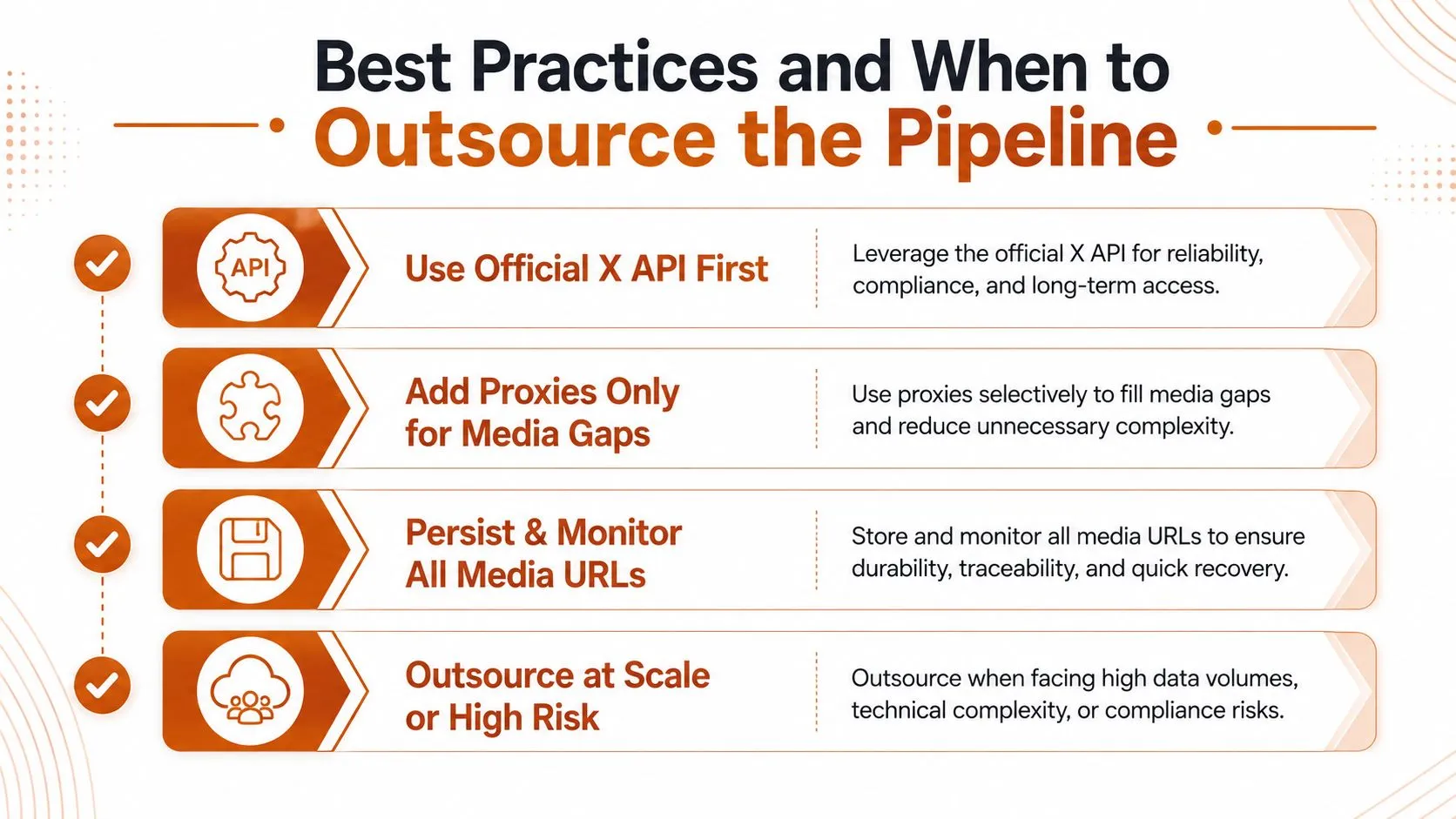
A durable Twitter media scraper is less about a clever selector than about ownership boundaries. The team needs to know which system discovers Tweets, which system resolves attachments, which worker downloads bytes, and which process decides whether an asset is complete.
Use this operating checklist:
- Start with the official X API: Test the permitted access path against the actual media coverage you need before introducing browser automation or proxies.
- Persist every original reference: Store Tweet IDs, media keys, original media URLs, request timestamps, response metadata, and content hashes.
- Separate media pools: Don’t let a video-host failure poison image collection. Give expensive or fragile transfers their own workers and egress policy.
- Make retries replayable: Record every rotation, cooldown, retry, and validation result so an operator can reproduce the decision.
- Monitor quality, not only throughput: Alert on missing attachments, decode failures, repeated
429responses, and sudden changes in asset-type distribution. - Treat challenge rates as a signal: A rising CAPTCHA or browser-challenge rate usually indicates pool or behavior degradation, not a parsing problem.
Know when internal ownership stops paying
A team should outsource when the pipeline requires continuous proxy tuning, fingerprint maintenance, challenge handling, schema repair, and delivery support that don’t advance the core product. The decision isn’t about whether the team can write the scraper. It’s about whether it wants to operate a changing data service.
WebscrapingHQ provides managed web data operations, custom extraction pipelines, monitoring, retries, proxy management, anti-bot mitigation, and delivery through formats such as CSV, JSON, webhooks, and S3 drops. For X media work, ask for a feasibility assessment that defines public coverage, asset types, refresh cadence, validation rules, and the handoff format before committing to a build.
Decision test: If you can’t explain how the system detects a truncated video, retires a degraded proxy, and replays a failed media job, you don’t yet have an operational pipeline.
Start by sampling the exact public profiles or Tweet sets you need. Measure complete image, GIF, and video delivery separately, then compare that result with the engineering time required to maintain it. That evidence will tell you whether to extend the API path, build a controlled proxy-backed collector, or hand the operation to a managed provider.
Visit WebscrapingHQ to scope a production Twitter media scraper with media validation, proxy management, monitoring, and scheduled delivery. Share the media types, public sources, refresh cadence, and preferred output format, and ask for a feasibility and cost estimate before your team invests in another fragile collector.
Want this done for you?
Send us the URLs. We'll quote it in 24 hours.
Paste the URL(s) you want scraped. We'll reply within 24 hours with a feasibility check and a ballpark quote.