Jump to section
- Why Recruitment Data Extraction Matters Now
- From page capture to market signal
- The Extraction Workflow From HTML to Structured Data
- 1. Retrieve and preserve the response
- 2. Parse the document selectively
- 3. Map fields into a stable schema
- Common HTML Parsers for Job Data Extraction
- Choosing the Right Extraction Approach
- Custom development
- Managed services
- The Hidden Challenge of Deduplication and Normalization
- Normalization steps that hold up in production
- Duplicate resolution needs evidence
- Building Reliable Production Pipelines
- Make failure visible
- Design for change
- Validate before delivery
- Turning Data Into Recruitment Intelligence
- Build feedback into the operating model
A recruitment team can collect thousands of job pages and still lack a usable view of the labor market. One vacancy appears on an employer’s career site, a general job board, and an industry aggregator. The title changes, the salary field disappears, and an old version remains searchable after the role has been filled. Analysts then count records instead of vacancies and build dashboards on noise.
That’s the central problem with job recruitment data scraping services. Extraction is only the first stage. The commercial value comes from turning inconsistent HTML into structured, deduplicated records with clear provenance, predictable refreshes, and fields that recruitment, workforce planning, and market intelligence teams can trust.
Why Recruitment Data Extraction Matters Now
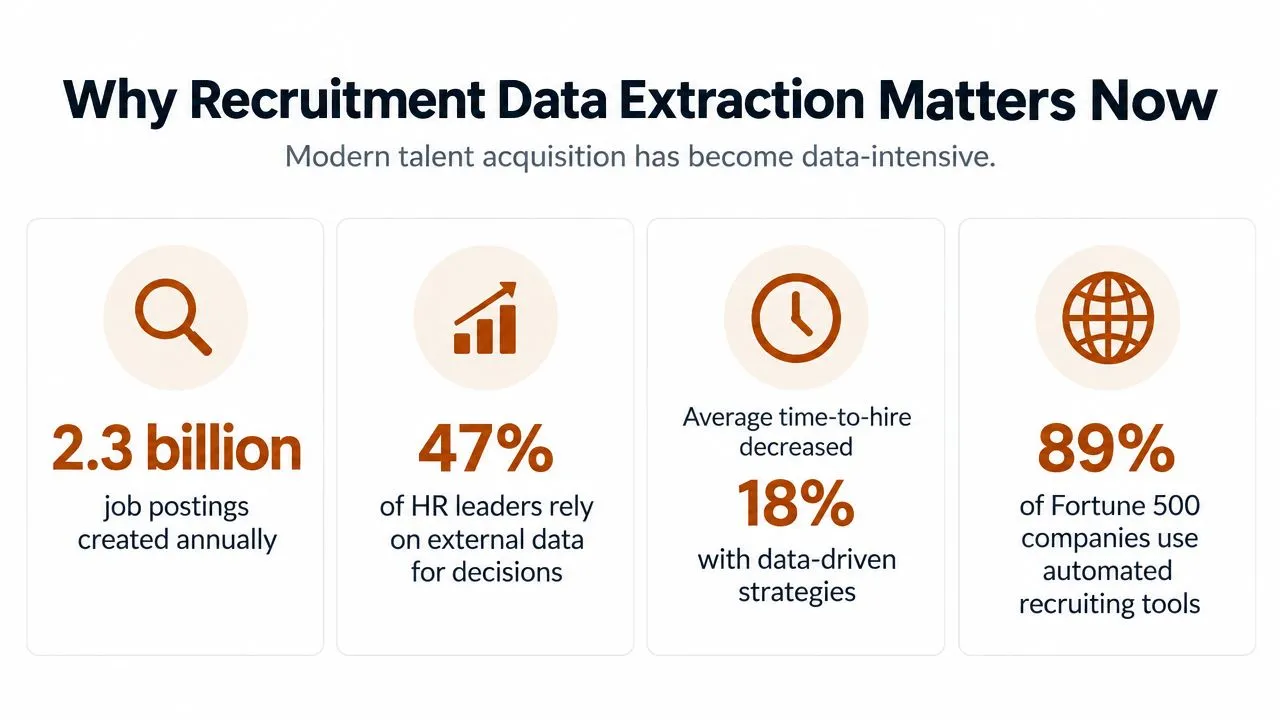
A recruiter can review a vacancy on an employer site, find the same role on several boards, and still fail to identify how many openings exist. Titles change, salary fields disappear, and filled roles remain searchable. The resulting dataset may count advertisements rather than vacancies, which distorts skill demand, employer activity, and hiring trends.
Browse AI’s recruiting data overview reports coverage of more than 3 billion current and historical job postings from over 33 million websites across 15 countries, supporting both real-time and historical labor-market analysis through its recruiting data overview. That scale gives recruitment teams material for salary benchmarking, skills analysis, and monitoring employer behavior, provided the records are structured consistently.
The harder problem appears after collection. Each source uses its own HTML, field names, pagination, location formats, and publication dates. One team member may copy a role from a company site while another captures the same vacancy from a job board. Manual checks can correct individual records, but they do not create a continuously refreshed or auditable flow.
From page capture to market signal
In the U.S. market, Browse AI describes a daily jobs dataset that aggregates live postings from more than 45,000 sources. The source count matters less than the downstream work: matching equivalent postings, standardizing titles and locations, preserving publication history, and separating active roles from stale copies.
That requirement changes the engineering brief. A production service needs request handling, extraction, classification, duplicate detection, historical storage, quality checks, and delivery into the buyer’s workflow. A recruitment marketplace may prioritize freshness, while a salary intelligence product needs stable compensation fields and historical retention. An AI training pipeline may require different validation and provenance rules.
Specialized sources can add context that broad boards miss. A resource such as remote machine learning jobs 2026 helps analysts examine how a defined role category is named and grouped before they set collection and normalization rules.
Practical rule: Define the decision before choosing sources. Compensation benchmarking, competitor hiring analysis, and candidate matching require different fields, refresh schedules, and retention policies.
The useful output is a consistent dataset, not a folder of HTML files. Recruitment teams need records that show which roles remain active, where demand is emerging, how employers describe skills, and how much confidence to place in each normalized record.
The Extraction Workflow From HTML to Structured Data
A dependable workflow starts with the response, not the parser. First identify the source behavior. A simple HTTP client such as Python’s requests works well when the server returns the job content directly. A JavaScript-rendered page may require a browser automation tool such as Playwright, but adding a browser to every request increases infrastructure cost and failure surface.
1. Retrieve and preserve the response
Store the source URL, retrieval timestamp, response status, content type, and raw response before transforming anything. This gives engineers an audit trail when a selector changes or a stakeholder questions a field. Respect published access rules, terms, privacy obligations, and reasonable request rates. A scraper that overloads a source isn’t a production system.
2. Parse the document selectively
Beautiful Soup is practical for irregular pages and quick prototypes. lxml is a strong choice when XPath, speed, and predictable tree operations matter. selectolax offers fast CSS-selector parsing for high-throughput workloads. None of these libraries solves source interpretation by itself. The extractor still needs rules for distinguishing the title, employer, location, description, compensation, requirements, and application controls.
A basic cleaning pass should decode entities, remove script and style nodes, preserve heading hierarchy where possible, and isolate the main content block. Blindly calling get_text() on the entire document often pulls in navigation, recommendations, cookie notices, and unrelated jobs.
3. Map fields into a stable schema
A normalized record might include:
source_urlandsource_namesource_job_id, when availabletitle_rawandtitle_normalizedcompany_rawandcompany_normalizedlocation_raw, geography, and work arrangementdescription_rawand cleaned description- skills and seniority
- salary text, currency, and normalized range when published
- publication and expiry signals
captured_at, parser version, and record status
Keep raw values alongside normalized values. A parser may standardize “New York City” and “NYC” into one geography, but reviewers still need the original text when validating the transformation. For extraction design patterns, the job posting data extraction techniques guide provides useful context.
Common HTML Parsers for Job Data Extraction
| Library | Best For | Performance | Learning Curve |
|---|---|---|---|
| Beautiful Soup | Prototypes and irregular markup | Moderate | Low |
| lxml | XPath-heavy, structured extraction | High | Moderate |
| selectolax | Fast CSS-selector parsing | High | Moderate |
| Playwright | JavaScript-rendered pages | Lower than direct HTTP parsing | Moderate |
Structured extraction can then feed keyword extraction, topic modeling, clustering, and association-rule mining. Research on recruitment text processing describes unsupervised methods as practical at scale, while supervised extraction can improve accuracy at the cost of maintaining a substantial manual vocabulary in this proceedings paper.
The final delivery contract matters as much as the parser. A recruitment platform may need JSON through an API, an analyst may need CSV, and an operations team may require a database table with change history. Documentation about how eRecruit works is a useful example of why downstream workflow context should shape the extraction schema.
Choosing the Right Extraction Approach
There isn’t one correct architecture for every recruitment dataset. The right choice depends on source behavior, update requirements, schema complexity, legal review, and the engineering team that will maintain the system after launch.
A lightweight HTTP scraper is usually the sensible starting point for a page whose content arrives in the initial response. It’s faster to operate, easier to test, and less expensive than rendering a full browser session. Browser automation becomes appropriate when critical fields appear only after JavaScript execution, interaction, or client-side API calls. It shouldn’t be the default just because a page looks modern.
Custom development
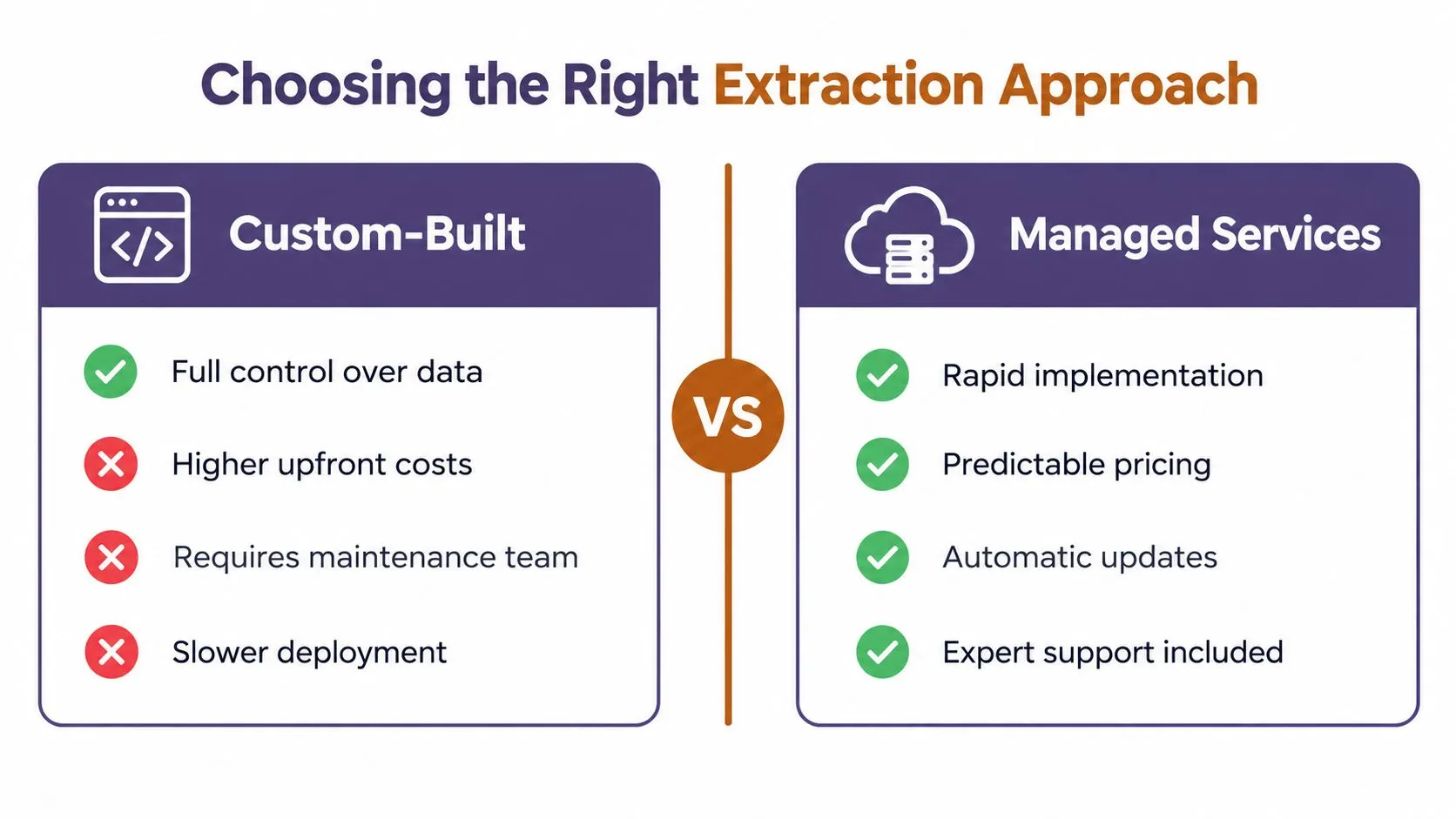
Custom scrapers provide control over selectors, schemas, storage, retries, and source-specific logic. They make sense when the target set is narrow, the output model is unusual, or the extraction becomes part of a core product. The cost is ongoing ownership. Engineers must detect layout changes, investigate blocked requests, maintain tests, review parser drift, and keep compliance controls current.
Open-source projects can accelerate experimentation. A curated list of open source job scrapers helps teams compare starting points, but a repository is not the same as an operated data service. Teams still need observability, deployment, source coverage, and a plan for failures.
Managed services
Managed providers take responsibility for source monitoring, infrastructure, proxy management, retries, parser updates, and delivery. That can reduce the internal maintenance burden, especially when the dataset spans many boards or geographies. The trade-off is less direct control over implementation and a need to verify the provider’s schema, provenance, retention, and service-level commitments.
| Situation | More suitable approach |
|---|---|
| One stable source and a narrow schema | Custom HTTP scraper |
| JavaScript-heavy source with changing layouts | Managed browser-capable pipeline |
| Core product with distinctive business logic | Custom system, possibly with managed infrastructure |
| Many sources and recurring delivery | Managed extraction service |
| Short feasibility test | Small prototype before committing |
Anti-bot measures deserve careful treatment. Rate limiting, session handling, conservative concurrency, and source-specific request policies are more durable than aggressive evasion. Major boards can differ sharply in accessibility and response behavior, so a design that works for one source may fail on another. The benchmark of 12,500 requests across LinkedIn, Indeed, Glassdoor, Craigslist, and ZipRecruiter found provider success rates ranging from 58% to 90% overall, with 500 URLs per platform, a 2-second delay between requests, and success requiring all three validation checks in this scraping benchmark. The lesson is operational: test each target independently, and define success as a valid record, not an HTTP response.
For a broader evaluation of implementation choices, compare the criteria in how to choose data extraction tools. The cheapest scraper is rarely the cheapest option once maintenance and data correction are included.
The Hidden Challenge of Deduplication and Normalization
Raw collection is only the first engineering hurdle. A recruitment dataset becomes useful when it can distinguish one genuine vacancy from copies distributed across an employer site, general job board, specialist board, and aggregator. Those records often differ in title, description, location, identifier, and salary format while describing the same hiring need.
One recruitment-data provider observed about 3.9 raw postings per genuine vacancy, so uncorrected counts can overstate hiring by roughly fourfold. Its analysis also found greater inflation in sectors such as logistics and retail, with salary shown on roughly 61% of postings in its analysis of recruiting scraping data. A separate labor-market dataset reports more than 500,000 new job listings added daily and 482M+ total job postings. At that scale, deduplication and refresh logic must run continuously rather than as a one-time cleanup.
Normalization steps that hold up in production
Retain every original field, then create normalized counterparts with deterministic rules and controlled vocabularies. This preserves the source record while giving matching and analysis jobs consistent values.
- Titles: Lowercase comparison values, remove irrelevant punctuation, standardize seniority terms, and preserve role-family distinctions. “Backend Engineer” should not become “Software Engineer” unless the taxonomy supports that mapping.
- Locations: Separate city, region, country, remote status, and free-text location. “Remote, United Kingdom” is not equivalent to a role restricted to a particular city.
- Compensation: Keep the original salary string, then parse currency, period, minimum, maximum, and estimate status. A missing salary must remain missing, not become zero.
- Skills: Extract phrases from requirements and responsibilities, then map synonyms only where the relationship is defensible. “Postgres” and “PostgreSQL” may match, while two broad technology terms may not.
For implementation detail, see how to normalize web-scraped data with Python.
Duplicate resolution needs evidence
A reliable matcher combines signals instead of treating title equality as proof. Compare employer identity, normalized title, geography, description similarity, salary range, source identifiers, and publication timing. Generate a candidate fingerprint from stable fields, then route ambiguous pairs to a slower similarity model or a human review queue.
Keep the losing record’s provenance. Store every source URL, capture time, source identifier, parser version, and merge decision. Analysts can then determine whether a vacancy appeared first on an employer site, whether an aggregator retained a stale copy, and why two records were merged.
Data engineering rule: Deduplication should produce a canonical vacancy plus a source history, not a silent deletion.
Separate identity resolution from enrichment. First determine which records represent the same vacancy. Then combine the most reliable fields, retaining conflicts for review instead of overwriting them invisibly. This separation prevents a plausible value from masking a source disagreement and makes later corrections auditable.
Building Reliable Production Pipelines
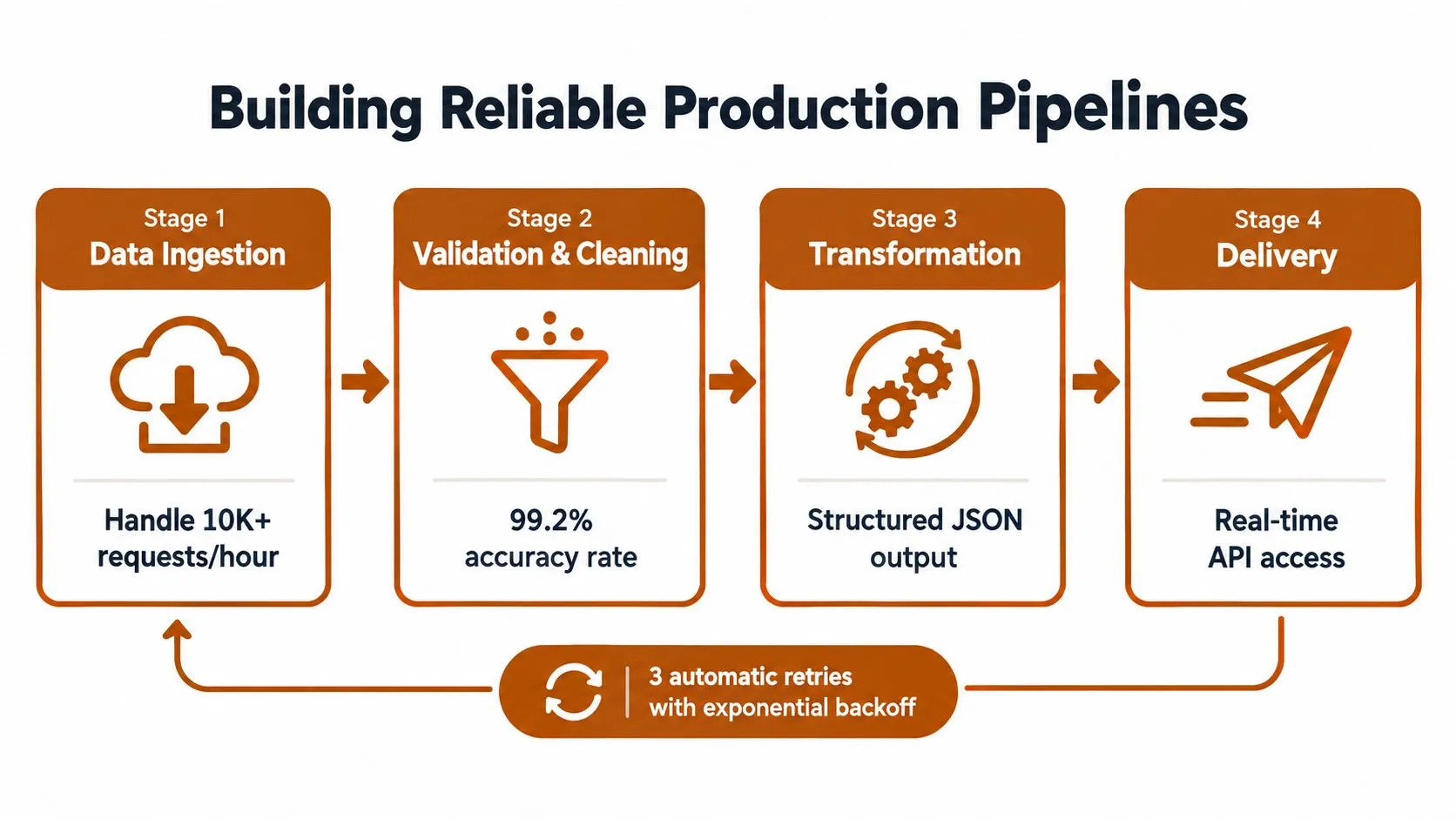
A prototype proves that a page can be parsed. Production proves that the pipeline can keep delivering when a request fails, a selector changes, a source adds a consent layer, or a posting disappears.
Make failure visible
Use bounded retries with exponential backoff for transient network errors. Don’t retry every response indiscriminately. A persistent access denial, malformed document, or validation failure needs a different path from a temporary timeout.
Record metrics at source and field level:
- request success and failure classes
- response latency and content-size changes
- records discovered, parsed, rejected, and merged
- missing-field rates
- duplicate-candidate rates
- parser version and deployment history
Alert on changes from the source’s normal pattern, not just on total job counts. A successful request that returns an empty template can be more dangerous than a failed request because it may publish an incomplete dataset.
Design for change
Use selector fallbacks where possible, but don’t hide structural changes behind increasingly loose rules. A parser should fail clearly when confidence drops. Capture representative HTML samples for regression tests, inspect visual changes when needed, and route uncertain records to a review queue. Computer vision and language-model parsing can help interpret layout variation, but they need field-level validation and human escalation for consequential decisions.
Storage should preserve both the current view and historical observations. The current view supports recruiter workflows. Historical snapshots support trend analysis, change detection, and audit questions. Retention should be explicit. Keep only what the use case requires, and include deletion controls in the data model.
The guide to building scalable data pipelines with Scrapy is relevant when a team needs queue management, item pipelines, and controlled concurrency. Scrapy can handle the crawl framework, but it doesn’t remove the need for source governance, schema tests, and downstream reconciliation.
Validate before delivery
Apply rules before records reach an ATS or dashboard. Reject impossible date sequences, flag salary ranges with inconsistent currencies, check that a title exists, and measure whether descriptions contain actual role content rather than navigation text. Delivery contracts should include schema versions, error handling, replay procedures, and a clear definition of a complete batch.
The most resilient pipelines isolate source adapters from shared normalization and delivery layers. When one board changes its markup, engineers should update one adapter without rewriting the canonical schema or downstream integrations.
Turning Data Into Recruitment Intelligence
A normalized vacancy record becomes useful when it answers a defined operating question. Recruitment leaders may need to compare compensation language, workforce planners may track skill demand, and talent teams may monitor where competitors are opening roles. Each question requires a different aggregation, but all depend on the same foundation: consistent identity, clear timestamps, and known data quality.
Start with a small decision surface. For example, a team might monitor a role family across selected employers and regions, then compare active vacancy counts, common requirements, published compensation, and changes in wording. A dashboard should show source coverage and confidence alongside the headline result. Otherwise, users may interpret a drop in postings as lower demand when the actual cause is a broken parser or a missing source.
Build feedback into the operating model
Recruiters should be able to mark a record as irrelevant, duplicated, filled, misclassified, or incorrectly located. Those labels can improve rules and provide a practical quality signal. Analysts should also sample canonical records against their source pages, especially after a parser release or taxonomy change.
The underserved buyer question is not “Can you scrape job boards?” It’s “Can you deliver a reliable view of distinct vacancies across boards, aggregators, and employer sites?” Guidance on scraping job boards for talent intelligence emphasizes starting with a specific decision, then adding deduplication, provenance logs, and retention controls instead of collecting everything. That approach prevents the data platform from becoming an expensive archive of unverified pages.
Integration should follow the team’s actual workflow. Send curated records to an ATS or CRM only when the field mapping and update semantics are clear. Use APIs, webhooks, database views, or scheduled files according to the consumer’s needs. Keep raw evidence separate from recruiter-facing fields so the operational interface stays simple without sacrificing auditability.
For practical hiring applications, how scraping job postings can improve your hiring strategy offers a useful starting point for connecting extracted signals to recruitment decisions. From there, define quality thresholds, assign ownership for exceptions, and review whether the data changes an action. If it doesn’t, reduce the collection scope.
The strongest implementation roadmap is deliberately narrow: select one decision, validate a few representative sources, agree on a schema, test duplicate resolution, establish provenance and retention rules, then expand coverage only after the first workflow is trusted. Job recruitment data scraping services deliver value when they operate as maintained data infrastructure, not when they only return more pages.
WebscrapingHQ provides managed web data operations and custom extraction pipelines that can collect recruitment data, normalize records, monitor source changes, and deliver structured CSV or JSON outputs on a defined schedule. If your team needs a reliable vacancy dataset rather than raw page captures, visit WebscrapingHQ to discuss the sources, schema, refresh cadence, and quality controls your workflow requires.
Want this done for you?
Send us the URLs. We'll quote it in 24 hours.
Paste the URL(s) you want scraped. We'll reply within 24 hours with a feasibility check and a ballpark quote.