Jump to section
- Table of Contents
- Why an IndiaMART Data Extractor Is a Pipeline, Not a Script
- The first run is the cheap part
- The five stages that keep it alive
- The Five Stages of an IndiaMART Extraction Pipeline
- Ingestion, transformation, orchestration
- Monitoring and governance
- What IndiaMART Pages Actually Expose
- Supplier identity is not just a company name
- Price fields carry meaning, not just amounts
- Scale Changes the Math
- Volume changes how sampling works
- Concurrency and idempotency stop being optional
- The Operational Reality of Anti-Bot, Login Walls, and Selector Drift
- What breaks first
- Maintenance becomes the cost center
- Normalization Is Where the Value Is Created
- The four validation gates that save the downstream layer
- Tooling should match the mess
- What the Data Powers in Practice
- Different teams use the same feed differently
- Delivery should match the consumer
- Enterprise Readiness Checklist for an IndiaMART Extractor
- The checklist that separates a demo from a system
- What to ask before launch
A sourcing team usually notices the problem too late. The spreadsheet looked clean when it was first downloaded, the supplier names lined up, and the buyer felt like they had a working shortlist. A few weeks later, half the phone numbers are blank, some GST fields never populated, and the prices that looked comparable aren’t comparable at all because one row hid a MOQ tier while another buried the unit price in a different layout.
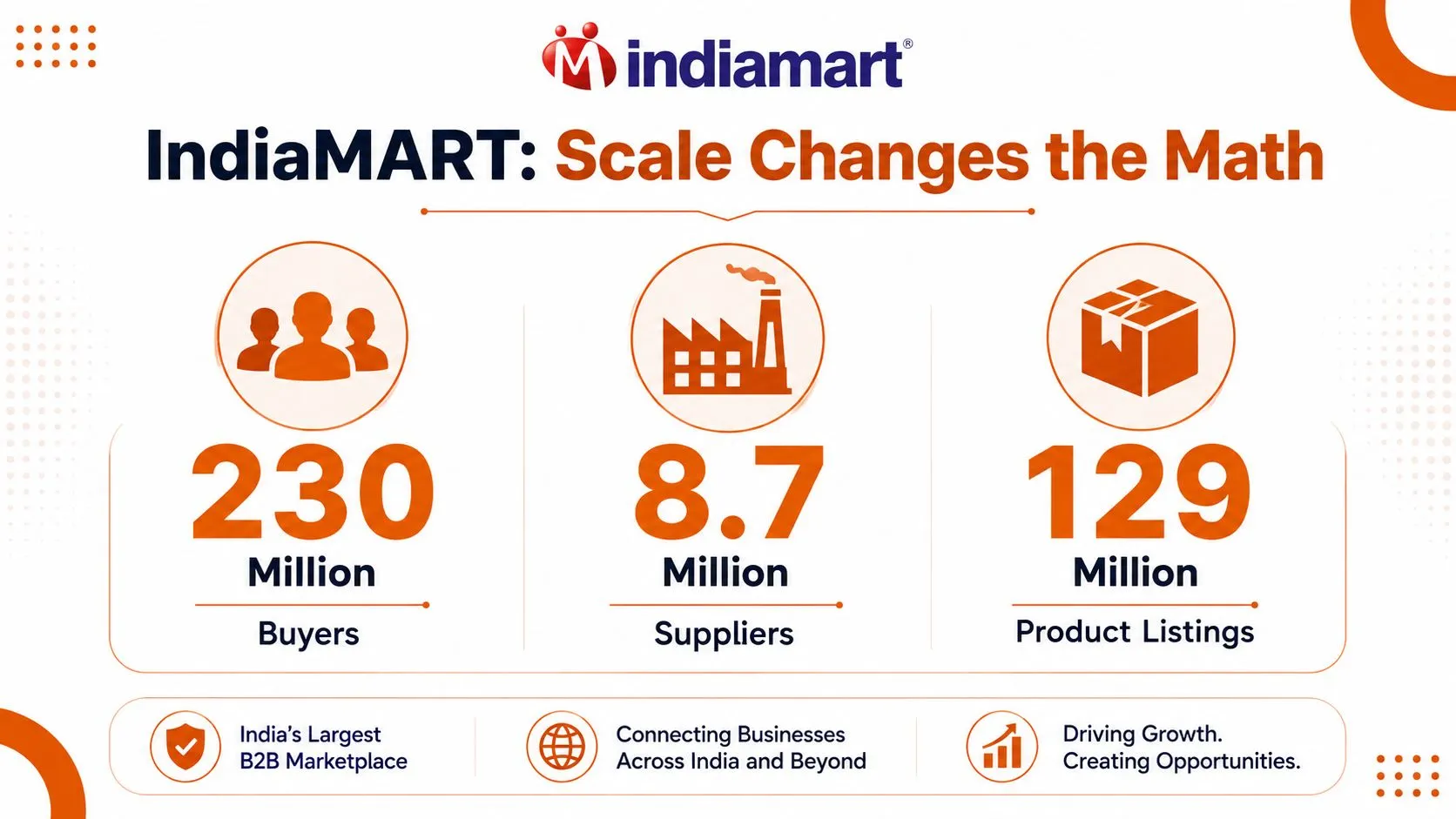
That’s the shape of an IndiaMART data extractor in production. It’s not a one-time pull of listings, it’s a living pipeline that keeps supplier identity, verification state, and pricing logic intact while the marketplace shifts underneath it. IndiaMART’s own scale makes that difference obvious, with 230 million buyers, 8.7 million suppliers, and 129 million products & services in its official investor profile as of March 31, 2026, which means even a narrow category can sit inside a very large record universe (IndiaMART investor profile).
Teams that treat this work as a pipeline end up with something durable. Teams that treat it like a script usually end up with a dusty CSV, stale prices, and a lot of manual cleanup. If you want a good adjacent example of how extraction projects turn into operational systems, the same mindset shows up in Instagram scraping for business growth, where the value comes from repeatable collection rather than a single export. For a framework on the broader trade-off between crawling and API-driven data access, the comparison in web scraping vs API is useful because it makes the maintenance cost explicit.
Table of Contents
Open Table of Contents
- Why an IndiaMART Data Extractor Is a Pipeline, Not a Script
- The Five Stages of an IndiaMART Extraction Pipeline
- What IndiaMART Pages Actually Expose
- Scale Changes the Math
- The Operational Reality of Anti-Bot, Login Walls, and Selector Drift
- Normalization Is Where the Value Is Created
- What the Data Powers in Practice
- Enterprise Readiness Checklist for an IndiaMART Extractor
Why an IndiaMART Data Extractor Is a Pipeline, Not a Script
The failure mode is easy to recognize. A procurement analyst downloads a supplier list, sends it around internally, and people start using it as if it were current. Two months later, the sourcing team is chasing dead rows, inconsistent verification flags, and price fields that can’t be compared because they were never normalized in the first place.
The first run is the cheap part
A script solves one moment in time. A pipeline handles the next ten moments too. That means you’re not just deciding how to fetch pages, you’re deciding who owns retries, how schema changes get noticed, and how stale rows get retired without corrupting downstream analysis.
Practical rule: if a supplier table will feed sourcing, compliance, or CRM, it needs an owner, a refresh policy, and a validation layer. Without those three, the spreadsheet will age faster than anyone expects.
A good IndiaMART data extractor therefore starts with scope, not selectors. Are you pulling supplier profile pages, category pages, or product pages. Are you keeping verification status and source URLs with each row. Are you preparing the data for lead generation, market mapping, or a spend analysis model. Those answers determine whether the system is useful six weeks later, not just on day one.
The pipeline mindset also changes budgeting. You budget for change handling, not only extraction. That means maintenance time, QA time, and field reconciliation time belong in the plan from the beginning, because marketplace listings don’t stay fixed while your internal dashboard does.
The five stages that keep it alive
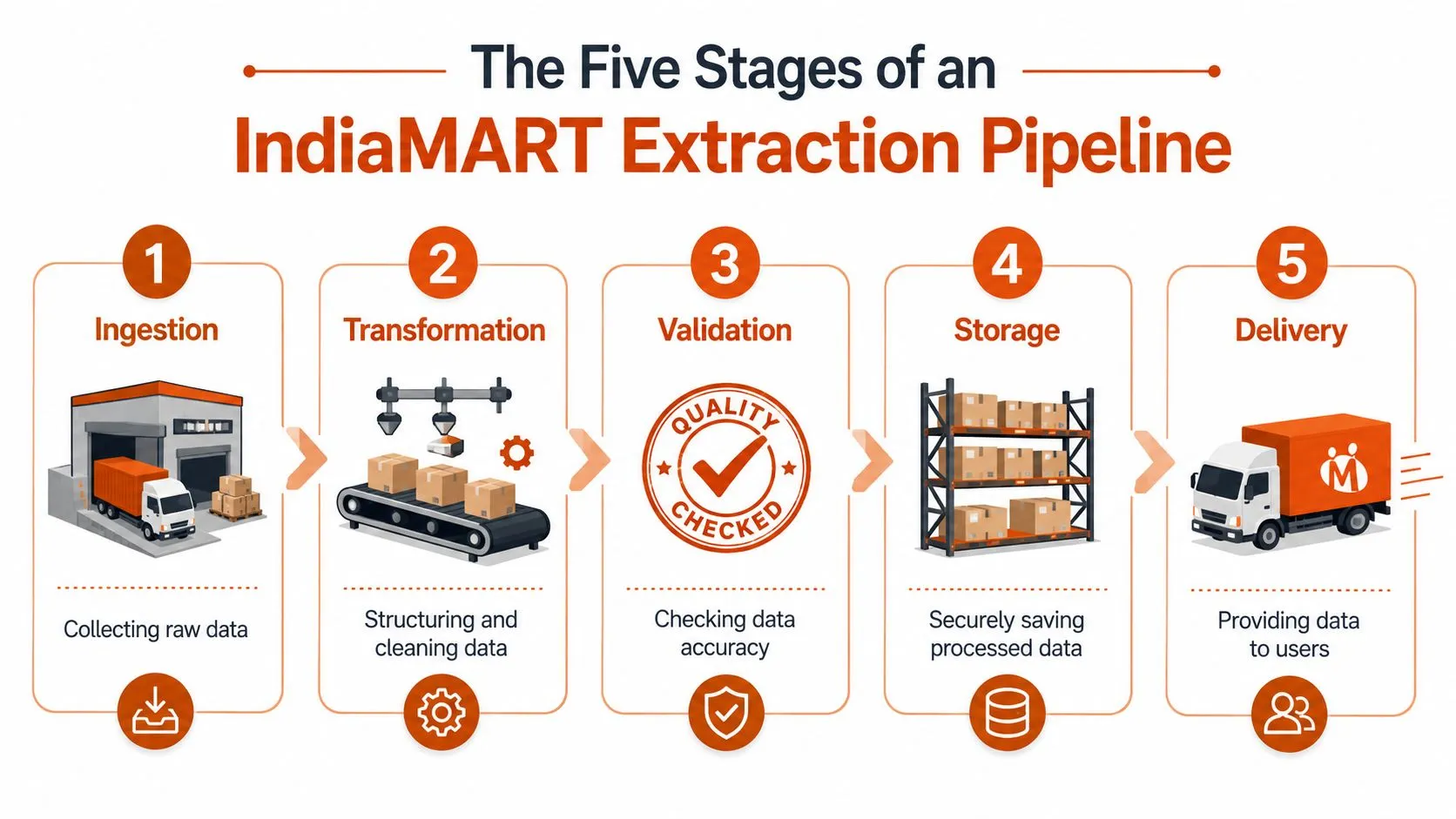
The rest of the pipeline comes down to five stages, ingestion, transformation, orchestration, monitoring, and governance. Each one protects a different part of the data path. Skip any of them, and you still get rows, but you lose trust.
The Five Stages of an IndiaMART Extraction Pipeline
Ingestion, transformation, orchestration
Think of ingestion as the loading dock. It decides what enters the system, whether that’s listing pages, supplier profiles, or category feeds. For IndiaMART, that choice matters because each path exposes different detail depth and different missing-field behavior, so the crawler can’t assume every page type is equivalent.
Transformation is the sorting room. Raw page fragments turn into a consistent schema, which is where MOQ-tiered pricing stops being an awkward text block and becomes a machine-readable structure. If you leave pricing as a raw string, your downstream buyer sees a number. If you canonicalize it, your downstream buyer sees a usable commercial signal.
Orchestration is the shift manager. It handles queueing, retries, rate control, and run sequencing so the pipeline doesn’t collapse when one page type slows down. That layer is where most production pain shows up, because selector failure is rarely isolated to one URL for long.
Monitoring and governance
Monitoring is the security camera. It should catch blank GST fields, sudden drops in supplier coverage, and unusual parse failures before the business notices. Governance is the audit binder, the part that preserves schema versions, lineage, and delivery contracts so the output can be trusted later, not just today.
The technical point is simple. IndiaMART isn’t a raw HTML problem, it’s a structured data problem wrapped in a fragile delivery channel. That’s why an extraction system should be designed as a pipeline from the first commit, not rewritten into one after the first broken selector.
If you want a practical reference for building extraction systems with process discipline, the patterns in building scalable data pipelines with Scrapy map well to this kind of work because they treat extraction, retry logic, and persistence as separate concerns.
What IndiaMART Pages Actually Expose
IndiaMART listings are more useful when you think of them as a joined entity graph instead of a pile of text. A supplier record can carry a supplier ID, GST verification status, mobile verification, premium-listing flags, a category slug, a source URL, and a UTC scrape timestamp. Product-level records can add an ISO currency code and nested specification pairs such as Width and Composition from the same listing.
Supplier identity is not just a company name
That combination matters because procurement teams don’t buy from titles, they buy from entities. If a supplier appears under multiple pages, the extractor has to preserve identity keys so the records can be reconciled later. If the pipeline drops the supplier ID and keeps only the display name, duplicate detection becomes guesswork.
A lot of tools fall short. They fetch visible text, but they don’t preserve the structure needed for joining supplier pages back to product pages. The problem is similar to what teams hit in guided Sales Navigator scraping, where the visible profile and the downstream record are not the same thing and the hidden identifiers matter more than the page copy.
Price fields carry meaning, not just amounts
IndiaMART pricing also arrives in different layouts. You can see MOQ, unit-price ranges, and volume breakpoints presented in table formats that don’t line up cleanly across listings. That’s not a cosmetic problem, it’s a schema problem.
A row that looks complete can still be analytically useless if the supplier’s verification state, pricing tier, and product attributes can’t survive normalization together.
The right extraction target is therefore not a flat CSV row. It’s a structured record where supplier identity, verification state, and product attributes travel together through every downstream step. That’s the only way a buyer can compare vendors without mixing apples, oranges, and tiered cartons.
If you need the same mindset for general web data shape management, the normalization patterns in how to normalize web scraped data with Python are relevant because they formalize the difference between capture and usable structure.
Scale Changes the Math
IndiaMART’s size changes the operating model. Its official investor profile places the marketplace at 230 million buyers, 8.7 million suppliers, and 129 million products & services as of March 31, 2026. That scale means a narrow category still sits inside a huge supplier universe, so crawl budget and storage layout stop being theory and become daily engineering decisions.
Volume changes how sampling works
A small notebook crawl and a production extractor are different products. The notebook answers a question once. The production system has to answer the same question again and again, across changing pages, without drifting away from what the marketplace exposes.
That matters because IndiaMART keeps expanding in ways that affect extraction design. A separate IndiaMART scraping reference from Real Data API shows supplier listings growing from 350,000 in 2020 to 720,000 in 2025, product listings rising from 1.2 million to 2.8 million, average product-price increase moving from 4.2% to 5.5%, and average listings per supplier rising from 3.4 to 3.8. That kind of movement is why the pipeline needs repeatable partitions and stable schema keys, not ad hoc exports.
Concurrency and idempotency stop being optional
At scale, retries matter because duplicate rows become a reconciliation job, not a small nuisance. Partitioning matters because analysts need fresh slices without rereading the full history every time. Idempotency matters because the same supplier should not show up as two different entities just because it was discovered through two entry points.
The practical consequence is blunt. If the extractor only survives one crawl pattern, it is fragile. If it can keep coverage steady while the marketplace expands, it can support sourcing, pricing, and compliance without pushing analysts back into manual cleanup.
The Operational Reality of Anti-Bot, Login Walls, and Selector Drift
The first successful run proves very little. IndiaMART extraction breaks in production for ordinary reasons, login walls on some views, CAPTCHA escalation, rate limits that show up without warning, and page-structure changes that break selectors.
What breaks first
The first failure is usually not a total outage. A field starts returning blanks, or a pricing block stops mapping cleanly because the DOM shifted. That kind of break is harder to catch than a hard crash because the job still “succeeds,” while the dataset becomes misleading.
Mitigations help, but they are not magic. Residential and mobile proxy rotation reduce obvious access friction. Headless browser fingerprint management lowers bot suspicion. Playwright-style workflows are useful when simple HTTP fetching no longer reflects what the marketplace serves, and a retry queue with jitter helps the pipeline avoid looking like a robot hammering the same pages in lockstep. For teams evaluating automation, the anti-bot trade-offs in the ultimate guide to anti-bot measures in Playwright are relevant because they frame browser automation as an operational discipline, not a one-off bypass trick.
Maintenance becomes the cost center
The access layer needs alerts, not just retries. If a selector drifts on Tuesday, you want to know within hours, not after the reporting team has already loaded a broken file into its dashboard. Field-completeness checks matter as much as uptime checks, because missing supplier names or price bands can poison downstream joins even when the crawl log looks healthy.
Maintenance becomes the primary cost center once the extractor is in production.
A production extractor should be judged on weekly survivability. If it cannot absorb selector drift, rate limiting, and layout variation without constant manual rescue, then it is not ready for enterprise use. The real test is whether the pipeline detects breakage, recovers, and preserves field completeness before analysts feel the damage.
Normalization Is Where the Value Is Created
Normalization is the part most vendor pages skip, and it’s the part that matters most once the data hits analytics. IndiaMART pricing often arrives as a mix of MOQ, unit-price ranges, and volume breakpoints, so the extractor has to canonicalize multiple layouts into one machine-readable structure before comparisons become trustworthy. If that doesn’t happen, landed-price estimates and supplier rankings get distorted even when the raw scrape was technically successful (Dataflirt scraper reference).
The four validation gates that save the downstream layer
A sensible pre-launch run should pass four checks. GST formatting needs to be validated so bad identifiers don’t leak into compliance work. MOQ logic needs to be checked so tiered pricing doesn’t collapse into a single misleading figure. Certification null rate needs to be measured so missing fields are visible rather than ignored. Supplier-count reconciliation needs to confirm that the same seller isn’t counted twice through inconsistent page paths.
| Validation Gate | What It Checks | Pass Criterion |
|---|---|---|
| GST format | Identifier shape and consistency | GST values match the expected public pattern when present |
| MOQ logic | Tiered pricing and quantity boundaries | MOQ tiers map into a stable three-level structure |
| Certification null rate | Missing or absent certification fields | Nulls are measured and acceptable for the source profile |
| Supplier-count reconciliation | Duplicate supplier identity across pages | Counts align after deduplication and key matching |
Tooling should match the mess
The implementation stack earns its keep. Playwright-style browsers help with dynamic pages. Proxy rotation helps when access varies. LLM-based parsing can help when price or specification text is semi-structured and inconsistent. Schema versioning keeps consumers from breaking when fields evolve. Deduplication rules stop supplier records from fragmenting. Delivery formats, whether CSV, JSON, or API feeds, should follow the consumer’s workflow, not the scraper’s convenience.
If you need a practical starting point for the cleanup layer, how to normalize web scraped data with Python is a solid reference because it treats normalization as a data engineering step, not a formatting trick.
What the Data Powers in Practice
Once the extractor is stable, the output stops being a scrape and starts acting like a decision layer. That matters because IndiaMART data is only useful downstream if the pipeline keeps supplier identity, product history, and pricing context intact. The reference numbers from the IndiaMART scraping example, supplier listings moving from 350,000 in 2020 to 720,000 in 2025, product listings rising from 1.2 million to 2.8 million, average product-price increase moving from 4.2% to 5.5%, and average listings per supplier increasing from 3.4 to 3.8, are the kind of inputs that support trend analysis instead of one-off sourcing snapshots.
Different teams use the same feed differently
A sourcing team uses that history to watch category expansion and seller concentration. A market-intelligence team compares price drift across suppliers and time windows. A compliance team can route structured pages into computer vision and LLM parsing workflows to review dealer-facing material at scale. An AI team can feed localized consumer and supplier signals into training pipelines when they need market-specific context.
For teams that already work with image-heavy review flows, Vision use cases is a useful reference point, because extracted data becomes more valuable when it is paired with visual evidence and structured metadata, not just text rows.
Delivery should match the consumer
The output format should fit the operational consumer. CSV works for ad hoc review. JSON works for systems that expect nested supplier and product structures. Webhooks and S3 drops fit automated ingestion. PDF compliance reports fit audit workflows where a human reviewer still signs off.
If the pipeline is feeding pricing intelligence, it should also preserve the context needed for comparisons. A practical benchmark design pattern is described in ecommerce price monitoring, and the lesson is straightforward, consistency in capture matters more than a single lucky scrape. The downstream team will not trust the analysis if it cannot trust the schema.
Enterprise Readiness Checklist for an IndiaMART Extractor
The checklist that separates a demo from a system
An enterprise-ready IndiaMART data extractor should cover the schema your buyers use. That means GST, MOQ tiers, verification flags, nested specs, source URLs, and stable supplier identity keys. If any of those are missing, downstream users will recreate them manually and the automation win disappears.
Governance comes next. Schema versioning, lineage tracking, and PII handling need to exist before the first production run, especially because India’s Digital Personal Data Protection Act was enacted in 2023 and commercial data handling expectations keep tightening. The point isn’t to scare the team off extraction, it’s to make sure the pipeline’s recordkeeping is serious enough for business use (data quality and normalization context).
What to ask before launch
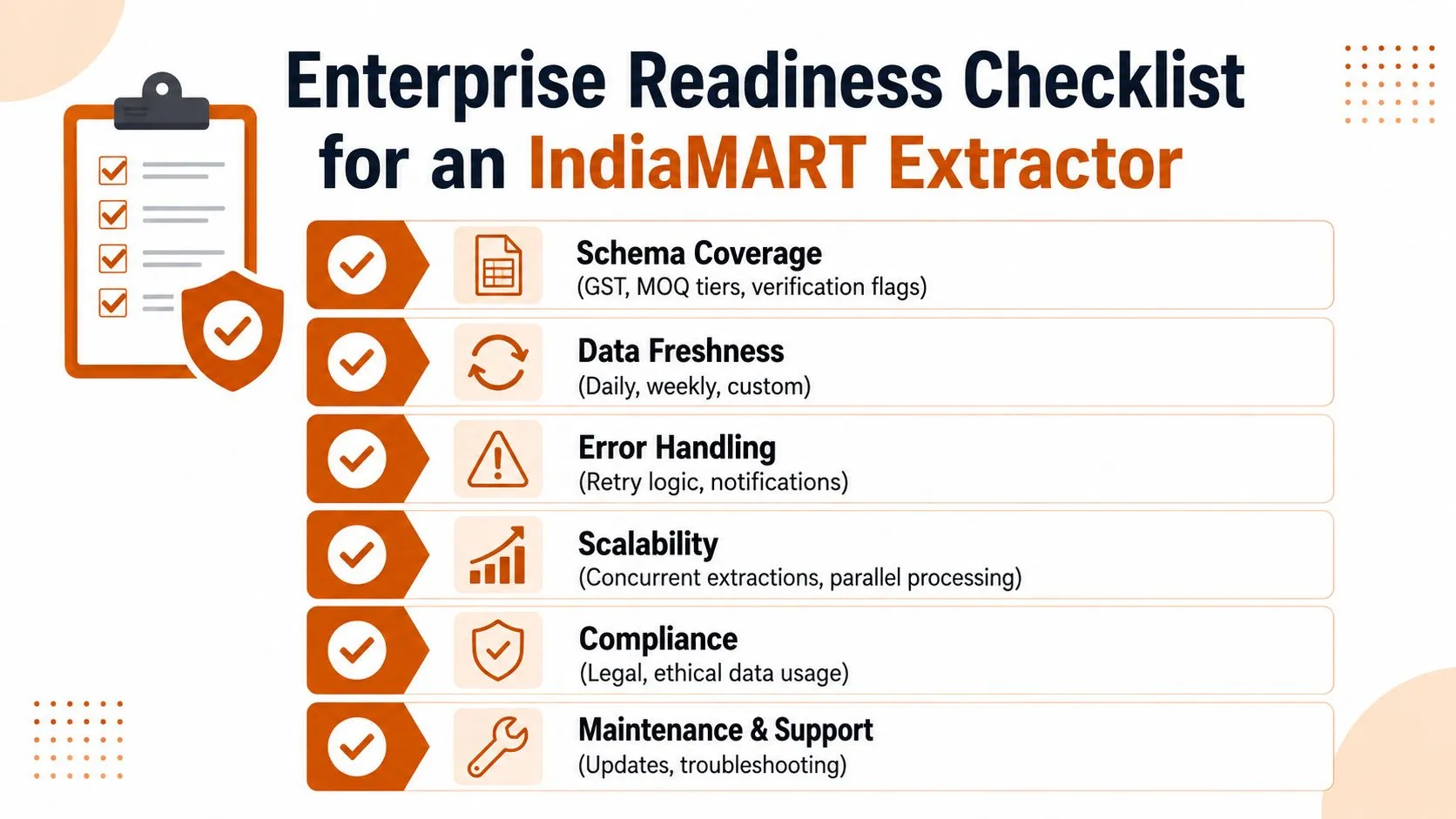
- Schema Coverage: Does the dataset preserve GST, MOQ tiers, verification flags, and nested specs without flattening them.
- Data Freshness: Are refresh schedules daily, weekly, or custom, and is that cadence visible to users.
- Error Handling: Do retries, notifications, and fallbacks trigger automatically when fields go missing or selectors drift.
- Scalability: Can the system support concurrent extractions and parallel processing without mixing entities.
- Compliance: Is public-data use documented clearly, with handling rules for anything sensitive or ambiguous.
- Maintenance and Support: Is there a clear path for updates, troubleshooting, and selector re-tuning when the page changes.
Buying rule: ask for field completeness and supplier coverage, not just row counts. A big export with missing verification fields is a weak dataset.
The KPIs should be just as concrete. Require field completeness, supplier coverage rate, freshness in hours, and price-canonicalization accuracy as part of the delivery contract. If a vendor can’t describe how those are measured, the output probably isn’t ready for production.
If you need an IndiaMART pipeline that keeps working after selectors shift, prices reformat, and verification fields go missing, WebscrapingHQ builds and runs that kind of system. Visit WebscrapingHQ to talk through the schema you need, the refresh cadence you want, and the operational burden you’d rather not own in-house.
Want this done for you?
Send us the URLs. We'll quote it in 24 hours.
Paste the URL(s) you want scraped. We'll reply within 24 hours with a feasibility check and a ballpark quote.