Jump to section
- The Hidden Truth About YouTube Tags
- A tag-only record is too thin
- What production users actually need
- Three Extraction Paths You Need to Know
- Public HTML and meta keywords
- Embedded JSON
- The official API
- Why JSON Parsing Outlasts CSS Selectors
- Source-level parsing changes the maintenance problem
- Build for partial success
- API Access Versus Scraping Approaches
- Use the API when the documented surface fits
- Scraping requires a separate policy review
- Building a Production Extraction Pipeline
- Separate retrieval from parsing
- Monitor fields, not only jobs
- From Metadata Extraction to Business Value
- Match the payload to the decision
- The Case for Multimodal Metadata Extraction
YouTube tags are limited to 500 characters and play a minimal role in discovery compared with the title, thumbnail, and description. A production YouTube meta tag scraper therefore needs to collect broader metadata alongside tags if the output is meant for meaningful downstream use.
The popular advice is backwards. Treating tags as the center of a YouTube SEO workflow produces a narrow dataset and an inflated view of what those tags can tell you. A resilient pipeline treats them as one contextual field among several, then combines them with structured page data, transcripts, channel information, and an access method that matches the use case.
That distinction matters in practice. A small script can read a hidden keyword field from a watch page. A production system must also cope with changing page structures, incomplete fields, dynamic rendering, policy restrictions, retries, storage, and data validation. The extraction problem is less about finding a comma-separated list and more about preserving useful meaning when the platform changes.
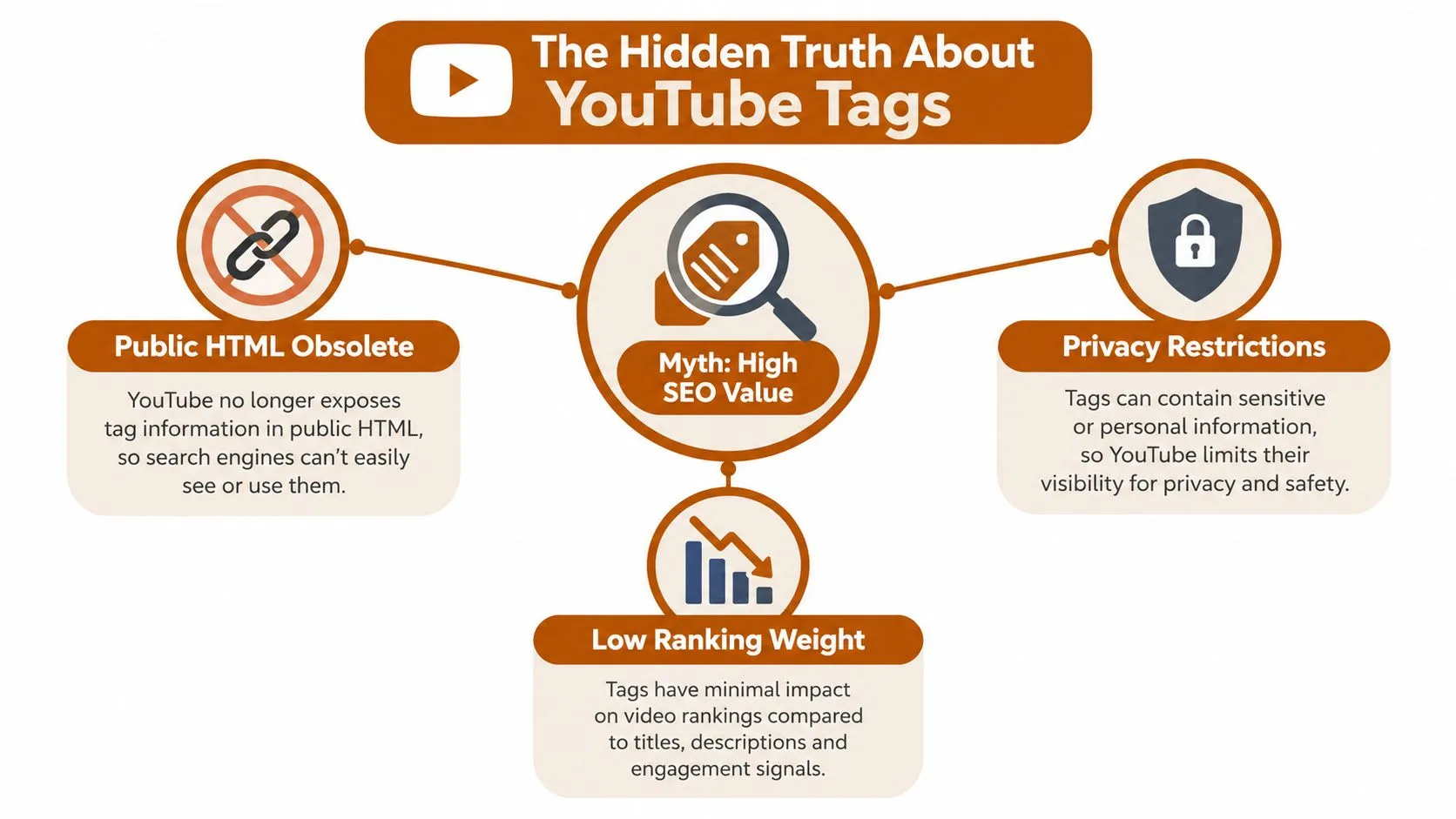
The Hidden Truth About YouTube Tags
Many SEO workflows begin with the assumption that tags reveal the keywords driving a video. That assumption makes a tag-only scraper look more valuable than it is. Recent guidance describes YouTube’s tags field as constrained to 500 characters, while also describing tags as having a minimal discovery role compared with the title, thumbnail, and description (2026 guidance on YouTube metadata).
A tag extractor can still answer useful questions. It may show how a publisher categorizes a video, reveal spelling variants, support content classification, or provide additional context for a research record. It can’t, by itself, explain the video’s subject, audience intent, presentation, or competitive position.
A tag-only record is too thin
Consider a video that contains several topical tags but has a broad title and a detailed description. If your pipeline stores only the tags, it loses the language viewers encounter, the publishing context, and the explanatory text that gives each tag meaning. The resulting record can be technically valid while remaining weak for editorial research or search analysis.
YouTube’s own developer documentation presents metadata as a structured, first-class part of its platform surface. The YouTube Data API supports video uploads, playlist management, and metadata updates, while the videos resource supports insert and update operations. Its documented fields include title, description, published time, language, and artist (YouTube developer documentation).
That model suggests a better design: make tags a nullable, versioned field inside a wider video object. Store the raw value, the parsed list, the retrieval timestamp, and the source path. If the field disappears or changes format, your system should mark that field unavailable rather than pretending that an empty list means the creator used no tags.
What production users actually need
Growth teams may compare titles and descriptions across a topic. Researchers may need channel and publication context. Content teams may use transcripts to identify recurring questions, while machine learning teams may need normalized text and media references. A useful YouTube metadata record serves all of those workflows without making tags carry the entire analytical burden.
For adjacent research, a YouTube channel podcast setup guide can help clarify how channel content is organized for podcast-style publishing. For keyword discovery, pair metadata collection with a dedicated YouTube autocomplete keyword scraper, because suggested queries and creator-supplied tags represent different signals.
Practical rule: Capture tags because they’re available and sometimes useful. Don’t design the system as if they’re the primary explanation of YouTube discovery.
Three Extraction Paths You Need to Know
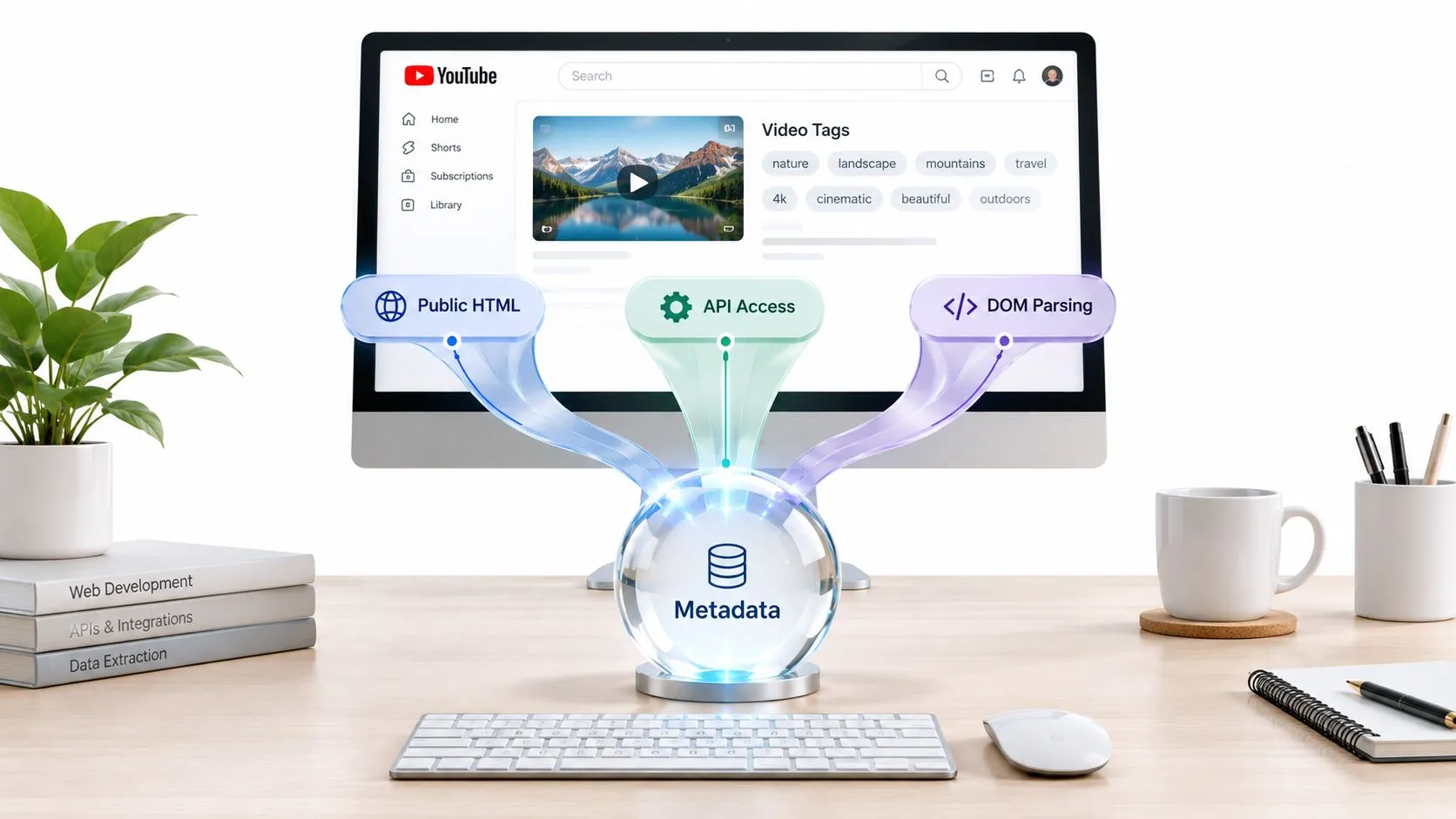
A YouTube metadata pipeline has three practical access paths, and they solve different problems. Public HTML is fast to inspect, embedded JSON usually carries more context, and the official API provides documented semantics. Tags are a useful field, but their value is declining, so production extraction should preserve surrounding metadata rather than build the system around tags alone.
Public HTML and meta keywords
The simplest route requests the watch page, parses its document head, and reads the meta element with the name keywords. Public watch-page HTML may expose video tags as a comma-separated content value, allowing extraction without a login (YouTube tag extraction pattern).
A practical implementation should:
- Retrieve the source document: Request the page and retain the original response for troubleshooting.
- Parse the head: Check
meta[name="keywords"], rather than relying only on visible player elements. - Normalize carefully: Split values without changing capitalization, punctuation, or repeated terms.
- Record absence explicitly: Separate a missing field from an empty field and from a failed request.
This path suits targeted collection because it is lightweight and easy to test. It can fail when the response is incomplete, consent handling changes, or different clients receive different content. A DOM-only browser routine is especially fragile if it waits for visible elements, as explained in this guide to extracting data from JavaScript pages with Puppeteer. Preserve and inspect the original source before treating a missing tag value as meaningful.
Embedded JSON
The watch page can also include structured payloads such as ytInitialPlayerResponse. Parsing that JSON can expose title, description, channel information, counts, and other fields without depending on the player interface’s layout. Open Graph metadata may appear elsewhere in the HTML, so the extractor should inspect several known locations instead of assuming one permanent block (YouTube scraping approaches).
JSON extraction needs defensive handling. Script content may be escaped, nested fields may change, and a response may contain only part of the expected record. The trade-off is a broader payload that supports validation and enrichment, including metadata that remains useful when tags are absent or no longer informative.
The official API
The YouTube Data API offers the clearest programmatic representation of supported video metadata. Its documented resources and field semantics make schema design and validation more predictable than reverse-engineering a page.
The API still imposes practical constraints. Access conditions, quotas, authentication, field availability, and developer-policy requirements all affect the design. Choose it when the use case fits the documented surface and permissions. A page scraper and an API client are different integration paths, not interchangeable implementations.
| Path | Strength | Main trade-off |
|---|---|---|
| Public HTML | Simple access to source-level fields | Page responses and policy conditions can vary |
| Embedded JSON | Rich structured payload with less dependence on visual layout | Requires defensive parsing and schema checks |
| Official API | Documented resources and field semantics | Requires policy review and API-specific integration |
A production design can use one path as the primary source and another for validation or recovery. Do not merge conflicting values without explicit handling. Store the source, retrieval context, and parsing status for every field, so downstream users can distinguish a current value from an unavailable or stale one.
Why JSON Parsing Outlasts CSS Selectors
CSS selectors describe presentation. Embedded JSON describes data. That difference explains why a selector can break after a visual redesign while a source parser continues to find the same conceptual field.
A selector-based scraper might look for a title inside a player container, a channel name under a particular class, or a count beside an icon. These choices are convenient during a prototype, but they couple extraction to the current DOM. A layout adjustment can preserve the title for viewers while moving it to a different node, changing a class name, or rendering it through a different component.
Source-level parsing changes the maintenance problem
JSON-backed extraction starts with a different question: where does YouTube place the structured payload in the response? Once the parser locates ytInitialPlayerResponse, it can traverse fields by meaning rather than by screen position. The same response may also contain Open Graph metadata and other machine-readable values, so the extractor should inspect multiple known locations and apply precedence rules.
This doesn’t make JSON parsing maintenance-free. YouTube can alter script serialization, omit fields, rename nested structures, or return different payloads for different page states. The advantage is that a schema-aware parser can detect those changes directly, while a CSS scraper often keeps returning plausible-looking but incomplete records.
Build for partial success
A parser should validate each field independently. If title extraction succeeds but duration parsing fails, preserve the title and attach a field-level error. Don’t discard the entire video, and don’t fill the missing value with a guessed default.
Useful controls include:
- Schema validation: Check types, required identifiers, and acceptable empty states before writing a record.
- Raw response retention: Keep the source needed to reproduce a parsing failure and develop a new rule.
- Parser versioning: Store which extraction logic produced each field so historical records remain interpretable.
- Change detection: Alert when a normally populated field becomes absent across a meaningful sample.
- Fallback precedence: Define whether API data, embedded JSON, Open Graph values, or meta tags win when values disagree.
Engineering judgment: A parser that returns fewer records with explicit errors is safer than one that returns complete-looking records filled with stale or misplaced values.
The distinction between selector strategies is useful beyond YouTube. This comparison of CSS selectors and XPath helps frame the broader trade-off, but neither selector method solves the core problem of coupling extraction to a changing visual tree. For YouTube, source retrieval and structured-payload parsing should come before browser automation whenever the required fields are already present in the response.
API Access Versus Scraping Approaches
The first question isn’t which scraper library to install. It’s whether the proposed access path is allowed for the intended use.
YouTube’s developer policies state that API clients must not scrape YouTube or obtain scraped YouTube data, except under narrow conditions such as public search engines that follow robots.txt or cases involving prior written permission (YouTube Developer Policies). That restriction changes the architecture decision for any product that uses an API client alongside independently collected page data.
Use the API when the documented surface fits
The official API is appropriate when the required fields are available through its documented resources and the project can meet its authentication, usage, and policy obligations. It gives engineers a clearer contract than reverse-engineering a watch page, which helps with schema reviews, access control, and operational ownership.
The API may not provide every field or every workflow a research team wants. It also introduces its own failure modes, including invalid requests, permission issues, quota behavior, and transient service errors. Teams building around it should define retryable versus non-retryable failures and log the request context without exposing credentials.
A practical guide to YouTube API error handling is useful when designing those boundaries. Error handling isn’t an afterthought. It determines whether a scheduled job fails loudly, repeats an invalid request, or produces a misleading partial export.
Scraping requires a separate policy review
A public page isn’t automatically an unrestricted data source for every commercial purpose. Review the site’s terms, the relevant developer policies, applicable permissions, the data you intend to retain, and how users will access the output. A scraper that works technically can still be the wrong production choice if the collection method conflicts with the governing conditions.
| Decision question | API path | Page extraction path |
|---|---|---|
| Is the field documented? | Strong fit | May expose additional page fields |
| Is the access contract clear? | Generally clearer | Requires broader review |
| Can the page layout change? | Not dependent on DOM layout | Yes, especially for visual selectors |
| Is permission needed? | Follow API requirements | Check policy, terms, and permission boundaries |
For a deeper comparison of architectural trade-offs, use this analysis of web scraping versus APIs. The goal isn’t to label one route universally superior. Choose the narrowest compliant path that supplies the fields your workflow needs, and keep the access decision documented alongside the schema.
Building a Production Extraction Pipeline
A reliable YouTube pipeline starts with a contract, not a request loop. Define the input, output schema, allowed access path, retention rules, and behavior for missing fields before collecting at scale.
The input should be a normalized video identifier or URL. Resolve it once, validate it, and use a stable internal key for deduplication. Store the original URL separately because it helps operators investigate redirects, changed handles, or malformed submissions.
Separate retrieval from parsing
A request handler should fetch the permitted source and return a structured response object containing status, headers needed for diagnosis, body, timing, and retrieval metadata. The parser should consume that object independently. This separation lets you replay saved responses against new parsing logic without repeatedly requesting the platform.
Transient failures need bounded retries with exponential backoff and jitter. Permanent failures, such as an invalid identifier or a policy rejection, shouldn’t enter an endless retry cycle. Add a dead-letter queue or review state so operators can inspect problematic inputs without blocking the rest of the batch.
Enrichment comes after the core record is valid. Combine tags with title, description, publish time, language, channel fields, thumbnails, transcripts, and other permitted metadata. Keep each enrichment source separate in storage, then expose a normalized view to analysts.
Monitor fields, not only jobs
A green job status doesn’t prove that extraction quality is intact. Monitor field population, parser exceptions, response types, duplicate rates, and changes in representative raw payloads. A sudden loss of descriptions or tags can signal a structural change even when requests continue returning successful responses.
Use a compact operational checklist:
- Replay samples: Re-run known pages after parser changes and compare field-level output.
- Version schemas: Add fields deliberately and preserve compatibility for existing consumers.
- Cache responsibly: Avoid unnecessary retrieval and make cache expiry part of the data contract.
- Alert on drift: Notify engineers when expected structures or field distributions change.
- Protect provenance: Record whether each value came from API data, embedded JSON, or HTML metadata.
For teams designing a broader crawler architecture, this guide to building scalable data pipelines with Scrapy offers relevant patterns for queues, retries, and structured exports. The same operational discipline applies here, but YouTube-specific parsing and access rules still need their own tests.
From Metadata Extraction to Business Value
Raw tags become useful only when they answer a business question. A competitive intelligence team may compare how channels describe similar subjects, but the comparison becomes stronger when it includes titles, descriptions, publication context, and channel identity. Tags can support clustering and variant discovery without being mistaken for a complete ranking explanation.
Content strategists can use transcripts and descriptions to identify recurring themes, unanswered questions, and changes in editorial focus. A normalized record makes those analyses repeatable. Instead of manually reviewing isolated pages, the team can query a consistent dataset and inspect the source fields behind each conclusion.
Match the payload to the decision
A useful mapping looks like this:
- SEO research: Titles, descriptions, tags, publication context, and search-oriented query data.
- Editorial planning: Transcripts, subtitles where available, descriptions, chapters or time-linked structure where permitted, and thumbnails.
- Market monitoring: Channel identity, video topics, publish timing, engagement fields, and historical snapshots.
- Machine learning preparation: Clean text, provenance, language labels, media references, and explicit quality flags.
The technical team should resist collecting everything without a downstream purpose. Extra fields create storage, review, privacy, and governance obligations. At the same time, collecting tags alone can force analysts to rebuild context later, often from less reliable sources.
The useful unit isn’t the tag. It’s the validated, time-stamped video record that explains where the tag sits within the wider content.
That record can feed dashboards, alerts, research notebooks, warehouse tables, or model-preparation workflows. It can also support manual review because analysts can see both the normalized value and the raw source context. The best schema is therefore not the largest one. It’s the smallest schema that preserves the evidence needed for the decisions your team makes.
The Case for Multimodal Metadata Extraction
Standalone tag extraction is increasingly difficult to defend as a complete YouTube data strategy. Recent tooling is moving toward multimodal extraction with separate sources for search, downloads, transcripts, and metadata, while scraper guidance describes combined collection of subtitles, transcripts, thumbnails, channel metadata, and tags (Oxylabs changelog). The direction is clear: teams want context, not just hidden keywords.
A transcript can reveal language that never appears in the tags. A thumbnail can support visual classification. Channel metadata can identify the publisher and connect individual videos into a larger publishing pattern. Descriptions and titles provide the visible framing that tags often fail to capture.
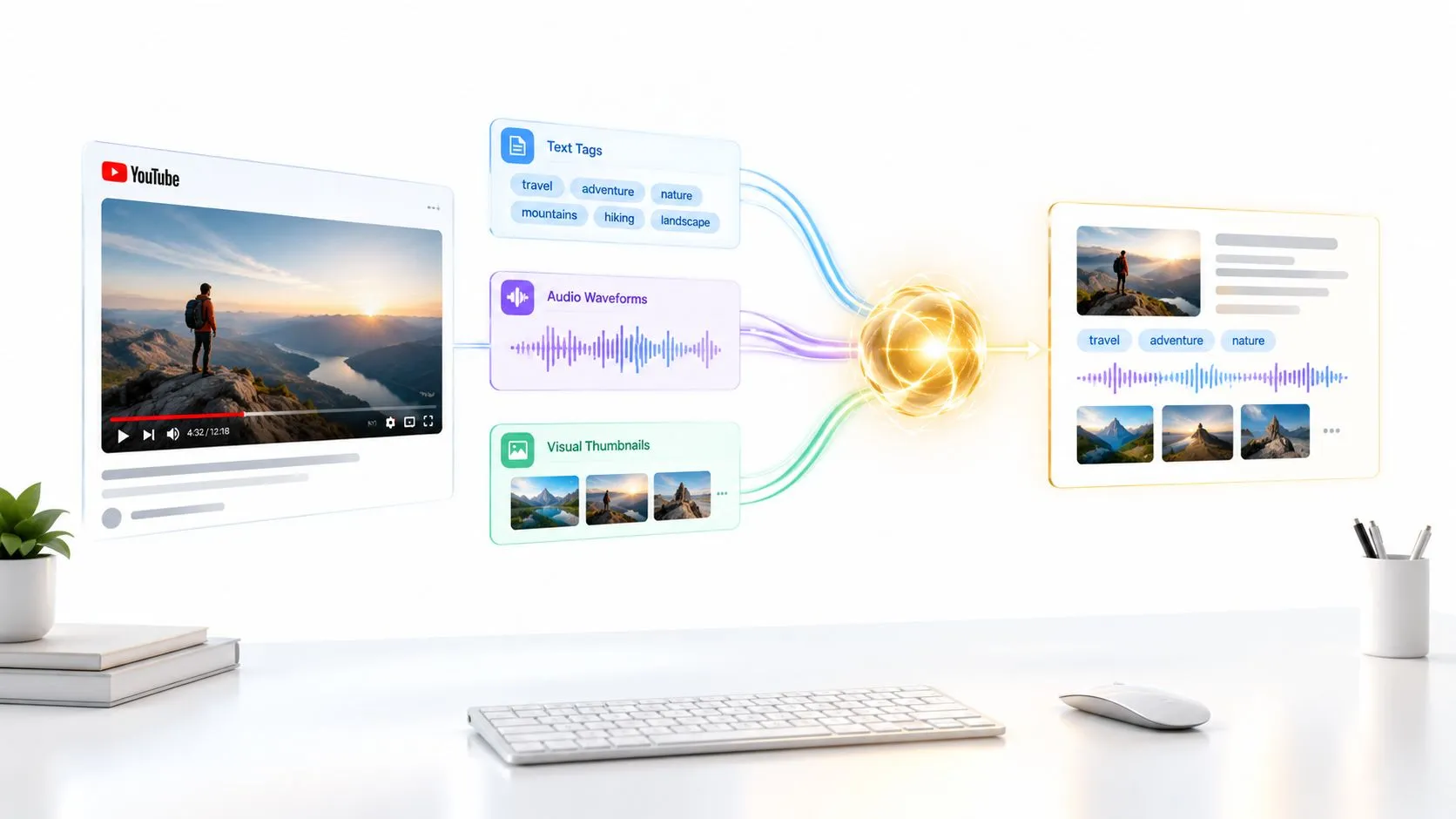
The practical shift is architectural. Keep tags in the payload, but give them the same status as other optional signals. Normalize text, preserve language and provenance, validate each source independently, and let downstream users select the fields appropriate to their analysis.
A YouTube meta tag scraper still has a place. It can provide compact contextual data and help enrich a broader record. It shouldn’t be sold internally as a complete SEO intelligence system, and it shouldn’t be built with selectors alone when structured page data is available.
WebscrapingHQ provides managed YouTube extraction and custom web data operations that can deliver structured video fields, including metadata and related public data, in formats such as JSON or CSV. Visit WebscrapingHQ to discuss a compliant pipeline that combines resilient parsing, monitoring, enrichment, and scheduled delivery for your workflow.
Want this done for you?
Send us the URLs. We'll quote it in 24 hours.
Paste the URL(s) you want scraped. We'll reply within 24 hours with a feasibility check and a ballpark quote.