
Jump to section
- Why Teams Outsource Web Scraping Before They Hit a Wall
- The moment a tool becomes an operation
- How Proxy and Site Blocking Actually Works
- Signals that change the outcome
- Read the failure instead of guessing
- Legitimate Strategies to Maintain Reliable Access
- Build the access layer around the target
- Make retries less aggressive
- Treat CAPTCHAs as an SLA variable
- Ethical and Legal Considerations You Cannot Ignore
- Separate collection from reuse
- Ask for evidence before signing
- Choosing Between In House Builds and Managed Operations
- Use the use case to make the decision
- Putting It All Together and Staying Compliant at Scale
You’ve got a scraper that worked last month. Now it returns empty fields, authentication loops, or a clean-looking dataset with missing pages. Engineering keeps patching selectors while proxy costs rise and analysts lose confidence in the output. The problem isn’t extraction capacity. It’s the operational work required to keep access, schemas, data quality, and compliance aligned as target sites change.
To outsource web scraping successfully, treat the purchase as an ongoing data operation. A capable provider should scope sources, test feasibility, manage access, detect silent failures, re-tune pipelines, validate records, and deliver data in a format your systems can use. The sections below focus on what keeps production extraction stable, where outsourcing earns its cost, and which governance questions need answers before a pipeline goes live.
Why Teams Outsource Web Scraping Before They Hit a Wall
A retail team often starts with a short Python script. It reads product pages, extracts prices, and writes a file for an analyst. That approach works while the HTML is simple and the request pattern stays within the site’s tolerance. Then the retailer adds JavaScript rendering, changes product-card markup, introduces regional pricing, or tightens its bot controls. The script still runs, but the output deteriorates.
That silent deterioration is more dangerous than an obvious outage. A failed request creates an alert. A successful response with an empty price, duplicated product, or stale availability field can travel into reports without attracting attention. Real estate teams face the same pattern when listing layouts shift, while SEO teams encounter it when search results vary by location, device, session, and challenge state.
A useful comparison of managed web scraping services and self-managed pipelines starts with the operational burden rather than the first script. Internal teams must maintain selectors, browser behavior, proxy pools, retries, storage, schema changes, alerting, and downstream delivery. They also need someone to investigate why a target that returned valid records yesterday now produces a plausible but incomplete feed.
The moment a tool becomes an operation
Lightweight tools still have a place. A one-off research task on a stable public page may not justify a managed service. A browser extension or a small BeautifulSoup parser can be appropriate when the scope is narrow, the output is disposable, and nobody depends on scheduled freshness.
The decision changes when data supports recurring decisions. Daily competitor pricing, multi-region SERP monitoring, property inventory, job-market analysis, and compliance reporting all create operational expectations. Someone has to define freshness, acceptable completeness, schema behavior, escalation paths, and what happens after a target redesign.
Practical rule: If your team needs to explain why yesterday’s data is trustworthy, scraping has already become an operations problem.
Outsourcing makes the most sense when web data supports the business but isn’t the product’s central engineering advantage, when sources are numerous or difficult, or when internal developers keep abandoning roadmap work to repair collectors. It can also help growth-stage teams avoid hiring for a specialized maintenance function before demand justifies a permanent internal group.
The market’s scale reflects that shift. One estimate places the web scraping industry at USD 1.34 billion in 2025, projects USD 1.56 billion in 2026, and forecasts USD 3.49 billion by 2031, with a 17.39% CAGR across 2026 to 2031. Those figures are projections and estimates from Research and Markets’ web scraping market analysis, not a guarantee of vendor performance. They do show why managed extraction now operates as a commercial service with recurring monitoring, maintenance, and delivery requirements.
How Proxy and Site Blocking Actually Works
A block rarely comes from one signal. Target sites combine network reputation, request frequency, browser characteristics, session behavior, geographic consistency, and account history to decide whether a request looks trustworthy. That decision may produce a visible 403, a CAPTCHA, a redirect loop, a partial page, or a normal HTTP response containing no useful content.
The first diagnostic mistake is treating every failure as an IP problem. An IP with a good reputation can still trigger a challenge if the browser fingerprint doesn’t match the headers, if cookies disappear between requests, or if the session jumps between regions. Conversely, rotating identities too aggressively can make a session look less human and increase suspicion.
Signals that change the outcome
IP reputation matters because shared datacenter addresses may carry a history of automated traffic. Dedicated datacenter addresses can provide cleaner identity separation, while residential and ISP/static residential options may align more closely with consumer access patterns. None is universally reliable. The target’s controls determine the trade-off.
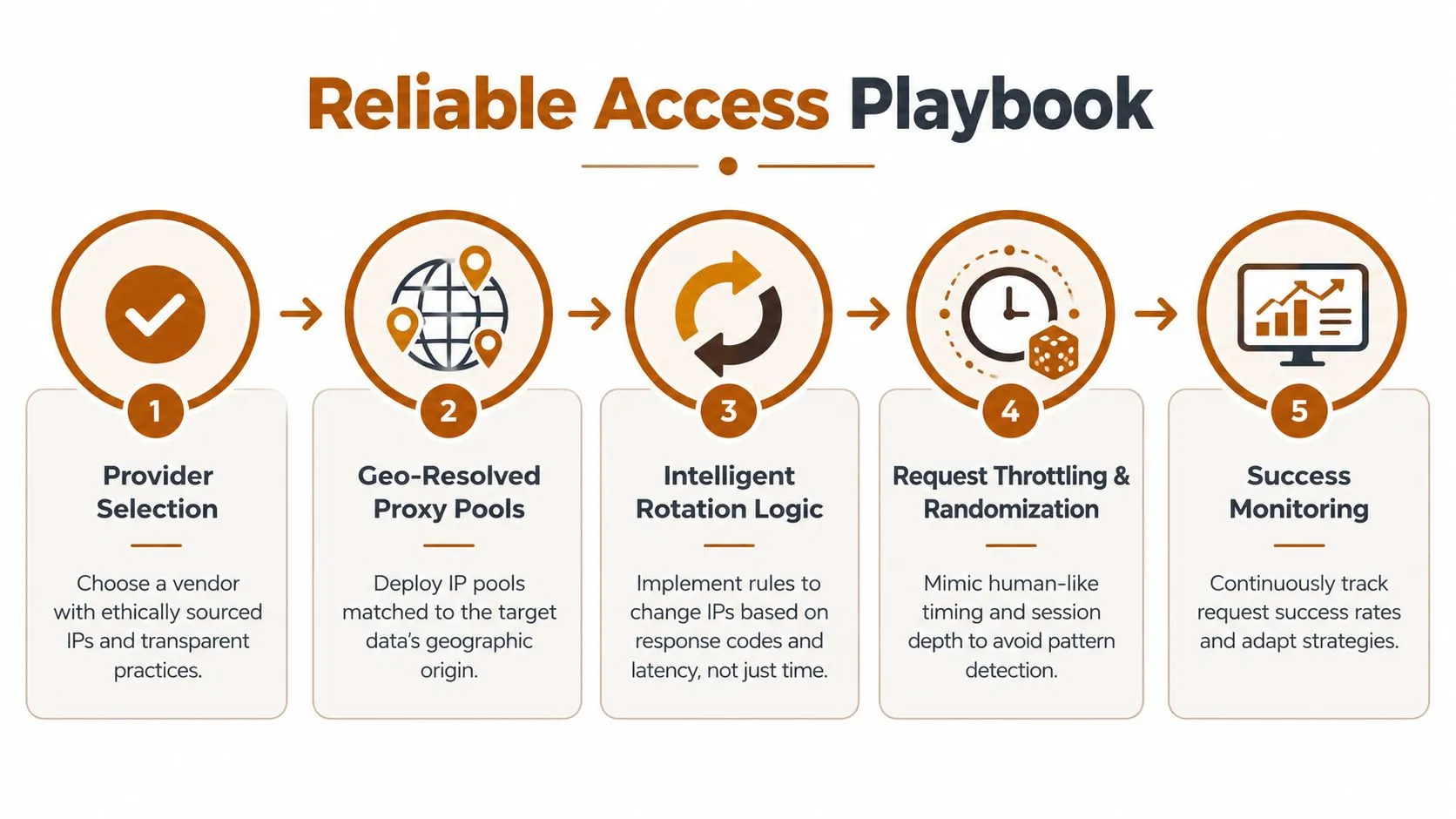
Rate and sequence behavior matters as much as raw speed. Repeated requests at identical intervals, shallow sessions that jump directly to deep URLs, and aggressive retries after errors create recognizable patterns. A provider should model request pacing, session depth, and backoff rather than increase concurrency.
Fingerprint fidelity includes user-agent consistency, browser capabilities, headers, TLS behavior, viewport characteristics, JavaScript execution, and cookie handling. A scraper that claims to be a browser but behaves like a minimal HTTP client can fail before the page logic runs.
Geography creates another failure mode. A request from one country, a language header from another, and a session cookie associated with a third region can produce a redirect, a restricted page, or a challenge. Geo-resolved pools should reflect the source market and the data requirement, not just offer a large collection of addresses.
Read the failure instead of guessing
A 403 can indicate reputation, permissions, or a policy response. A CAPTCHA loop often signals a trust-score problem that retries won’t solve. An empty response may reflect a JavaScript-rendered page, a changed selector, an API response that wasn’t captured, or a deliberate content suppression mechanism.
Benchmark results reinforce why target-specific testing matters. In a 2026 extraction benchmark, simple HTML produced an extraction success rate of 0.93 with BeautifulSoup, 0.82 with Scrapy, and 1.00 with both Claude and Simular.ai. On complex HTML, the scores were 0.80 for BeautifulSoup, 0.20 for Scrapy, 0.57 for Claude, and 1.00 for Simular.ai. The results appear in the 2026 scraping benchmark, and they shouldn’t be read as a universal ranking. They demonstrate that parser performance changes sharply with page complexity.
Authentication creates a separate operational class. The same benchmark reported Simular.ai scores of 0.63 on simple authentication and 0.70 on complex authentication, while CAPTCHA pages fell to 0.10. Claude scored 0.20, 0.12, and 0.05 for those respective cases. Login flows therefore need explicit fallback and escalation logic, not an assumption that a browser automation library will handle every challenge.
For buyers, the useful question is not “Which proxy is best?” It’s “Which signals are failing on this target, and how will the provider prove that the fix improved valid data rather than merely reducing visible errors?” A practical guide to static and rotating proxies can help teams understand the identity trade-off before they compare vendors.
Legitimate Strategies to Maintain Reliable Access
Reliable access is an operating discipline, not a collection of evasion tricks. A provider should follow applicable site policies, limit request volume, and collect only what the stated use case requires. Proxy rotation, browser automation, and challenge handling are controls within that design. They do not grant permission to bypass restrictions.
Build the access layer around the target
Begin with a source profile. Document the required geography, page types, authentication state, update cadence, response formats, and known policy constraints. That profile determines whether a shared datacenter pool can support a stable public page or whether a high-friction target needs managed identities and consistent sessions.
Proxy selection should follow observed target behavior. Independent 2026 anti-blocking data found that, against generic e-commerce, shared datacenter proxies succeeded at 74%, dedicated datacenter at 88%, residential rotating at 97%, and ISP/static residential at 99%. Against Cloudflare Enterprise, the same tiers fell to 4%, 9%, 52%, and 61%. The contrast matters. A tier that performs well on one target may perform poorly on another. The benchmark also reports that common solver services typically took 10 to 30 seconds per reCAPTCHA v2 solve and cost around $2.99 per 1K solves, while newer AI solvers were faster but less consistent. Both data sets appear in Scrapewise’s 2026 proxy benchmark.
Set rotation rules from response codes, latency, and session state. Changing identity after every request can break cookies and look suspicious. Retaining one identity through a coherent session, then retiring it after a meaningful failure pattern, is usually more stable than rotating on a timer alone.
Make retries less aggressive
A failed request should not trigger an immediate burst of repeats. Use exponential backoff with bounded jitter, and distinguish transient network errors from policy responses. A parser failure needs a different route from a challenge page. Replaying the same request with the same identity often makes the problem worse.
Headers and browser state must remain consistent. Align language, timezone, location, cookies, and user-agent behavior with the selected region. Preserve session cookies when authentication or multi-page navigation requires continuity. Discard state once it is clearly invalid.
Production pipelines also need a stop condition. If challenges rise across a segment, pause that segment, record the event, and send it for investigation. Endless retries consume proxy capacity and may intensify blocking.
Treat CAPTCHAs as an SLA variable
Challenge handling affects delivery latency, cost, and data freshness. A vendor that excludes challenge time from delivery estimates understates operational risk. The contract should state whether a workflow stops for customer authorization or human review instead of attempting automated solving.
For authenticated data, define credential ownership, storage controls, permitted actions, and the provider’s response when access conditions change. Teams can consult anti-bot measures in Playwright, but browser configuration cannot correct poor source selection, inconsistent sessions, or weak validation.
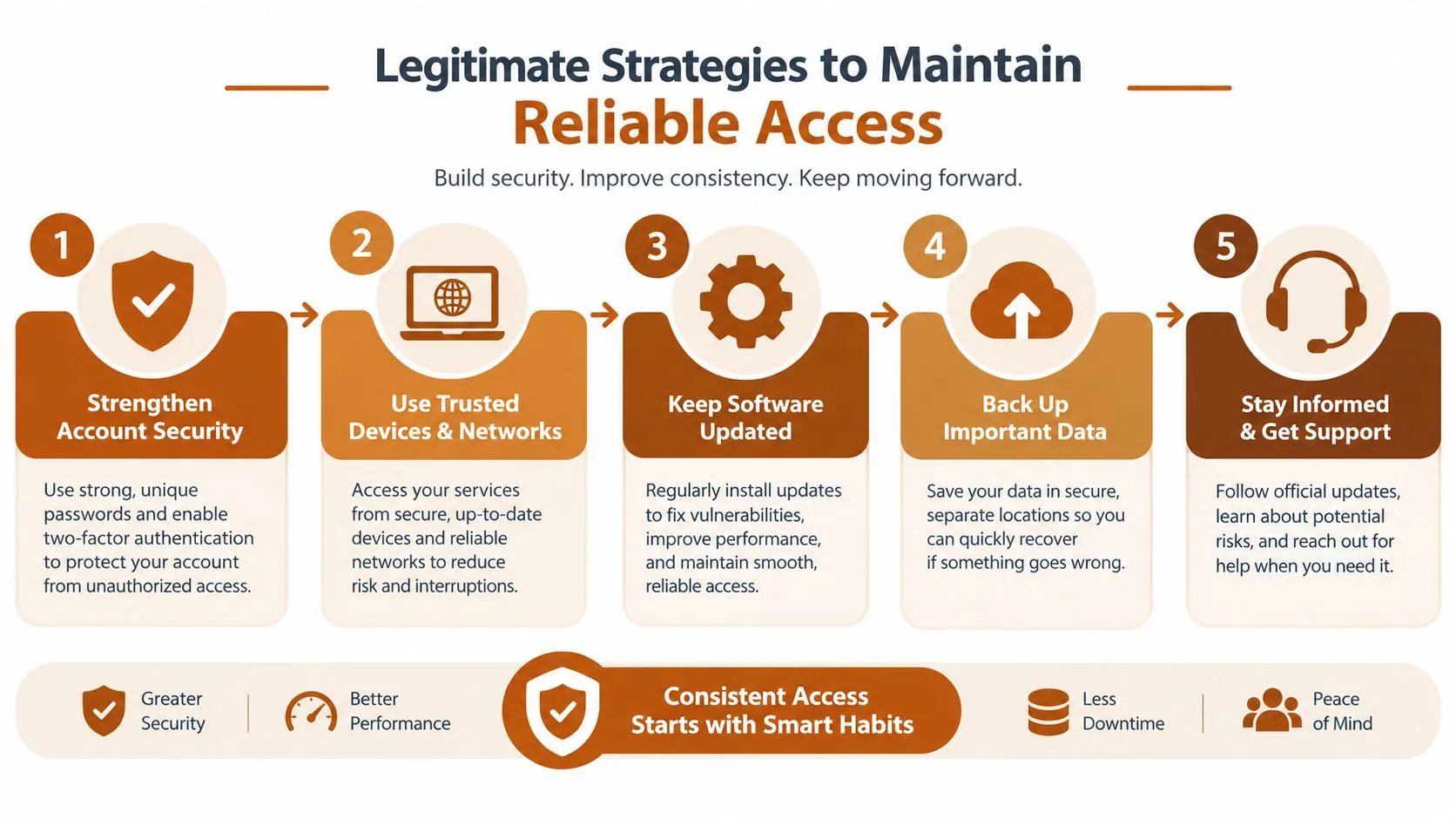
Outsourcing should therefore buy continuous re-tuning and control, not only request volume. Monitor valid-field completeness, duplicate behavior, record counts, schema conformity, response classifications, and source freshness. A request that returns successfully is not a successful extraction until the record passes validation. The provider should show how changes improved valid data quality, not merely reduced visible errors.
Ethical and Legal Considerations You Cannot Ignore
Public visibility does not grant unrestricted reuse. Legal exposure depends on the data type, access method, jurisdiction, contractual terms, and downstream purpose. A public page may still contain personal data, copyrighted material, restricted commercial information, or terms that create a separate dispute.
Privacy rules such as GDPR may apply when a pipeline collects personal data. A vendor clause alone will not address that risk. Define the collection purpose, minimize fields, set retention and access controls, and determine whether the provider acts as a processor or another participant in the data flow.
Separate collection from reuse
An organization faces separate questions at each stage:
- Collection: Was the access method permitted, and did the process respect applicable restrictions?
- Data type: Does the dataset contain personal, sensitive, proprietary, or regulated information?
- Transformation: Could normalization or enrichment create a new privacy or intellectual-property issue?
- Reuse: Can the business use the output for analytics, advertising, model training, or publication?
- Response: Can the organization identify records, answer takedown requests, and stop processing when required?
AI adds another decision point. Material collected for monitoring may later be reused to train or evaluate a model, and those purposes require separate review. The overview of the web scraping legal framework explains why enterprises need jurisdiction-aware governance rather than assuming public pages are automatically free to collect and reuse.

Ask for evidence before signing
A vendor should document proxy sources, credential handling, storage locations, and collection-event logging. Request audit trails that connect the source, timestamp, request context, transformation, and delivery. Confirm how the provider handles a takedown request, a policy change, or a target that becomes legally sensitive.
Put these requirements in the contract. A review of legal risks in web scraping can support internal discussion, but it does not replace advice for the relevant jurisdictions and data categories.
Ethical design also limits unnecessary collection. Do not request every available field when the business needs only a product price, property status, or aggregate market signal. Restrict access frequency, exclude sensitive fields, define retention, and document deletion procedures. These controls reduce legal exposure and give operations teams a clear record for quality review, incident response, and ongoing governance.
Choosing Between In House Builds and Managed Operations
The build-versus-buy choice depends on who will own the failure at 3 a.m., after a target changes markup or begins returning challenge pages. In-house development gives the team direct control and can make sense when extraction is a core product capability, the sources are highly specialized, or internal engineers already operate the necessary browser, data, and observability stack.
Managed operations shift recurring work to a provider. That includes monitoring, alerting, retries, proxy management, selector changes, schema versioning, validation, and delivery. The trade-off is less direct control over implementation and a need for clear contracts, data ownership terms, escalation procedures, and exit conditions.
The web’s technical history helps explain why this distinction matters. Tim Berners-Lee created the World Wide Web in 1989. Crawler concepts emerged by 1993, including the World Wide Web Wanderer at MIT, and JumpStation became the first crawler-based web search engine that year. BeautifulSoup arrived in 2004, followed by Scrapy in 2008, according to this brief history of web scraping. Modern managed services grew from that progression, because recurring extraction became harder to treat as a one-off script.
| Criteria | In House Build | Managed Operation |
|---|---|---|
| Monitoring and alerting | Your team designs and operates them | Provider operates them under agreed service expectations |
| Anti-bot and proxy management | Internal responsibility | Included in the managed scope when specified |
| Site-change response | Engineers investigate and patch | Provider re-tunes collectors and reports material changes |
| Schema versioning | You own migrations and compatibility | Provider can maintain versions and coordinate delivery changes |
| Delivery formats | You build CSV, JSON, webhooks, or S3 workflows | Provider delivers agreed formats and schedules |
| Control and customization | Maximum control over code and infrastructure | Custom behavior depends on the contract and platform |
| Internal workload | Ongoing specialist maintenance | Relationship oversight and quality review remain internal |
| Best fit | Core data capability or highly sensitive workflows | Recurring, complex, multi-source collection that supports the business |
Use the use case to make the decision
A one-off market snapshot can remain internal or use a lightweight tool. Daily price monitoring needs resilience and validation. Multi-geo compliance reporting needs regional behavior, documented governance, fixed delivery, and exception handling. A search intelligence product may justify internal ownership if the collection layer itself is the competitive advantage.
Teams that do build internally can still use external talent for defined gaps. For example, organizations exploring how to hire elite engineers through outsourcing may use a dedicated engineer or hybrid team while retaining architecture and governance ownership.
Before requesting quotes, document target domains, fields, geography, authentication, update cadence, acceptable missingness, output format, retention, and escalation rules. Ask vendors to estimate feasibility and operational scope from that brief, not from a page-count headline.
For buyers comparing regional providers, web scraping companies in the USA can be a starting point, but location alone doesn’t establish technical or legal fit. Evaluate the operating model, evidence from a representative proof of concept, and the provider’s willingness to expose quality metrics.
Putting It All Together and Staying Compliant at Scale
A reliable outsourced pipeline passes five checks before it earns production volume. First, the provider should disclose proxy sourcing, data handling, authentication practices, and the limits of its access strategy. Second, legal reviewers should approve the target data, collection method, jurisdictions, retention, and intended reuse.
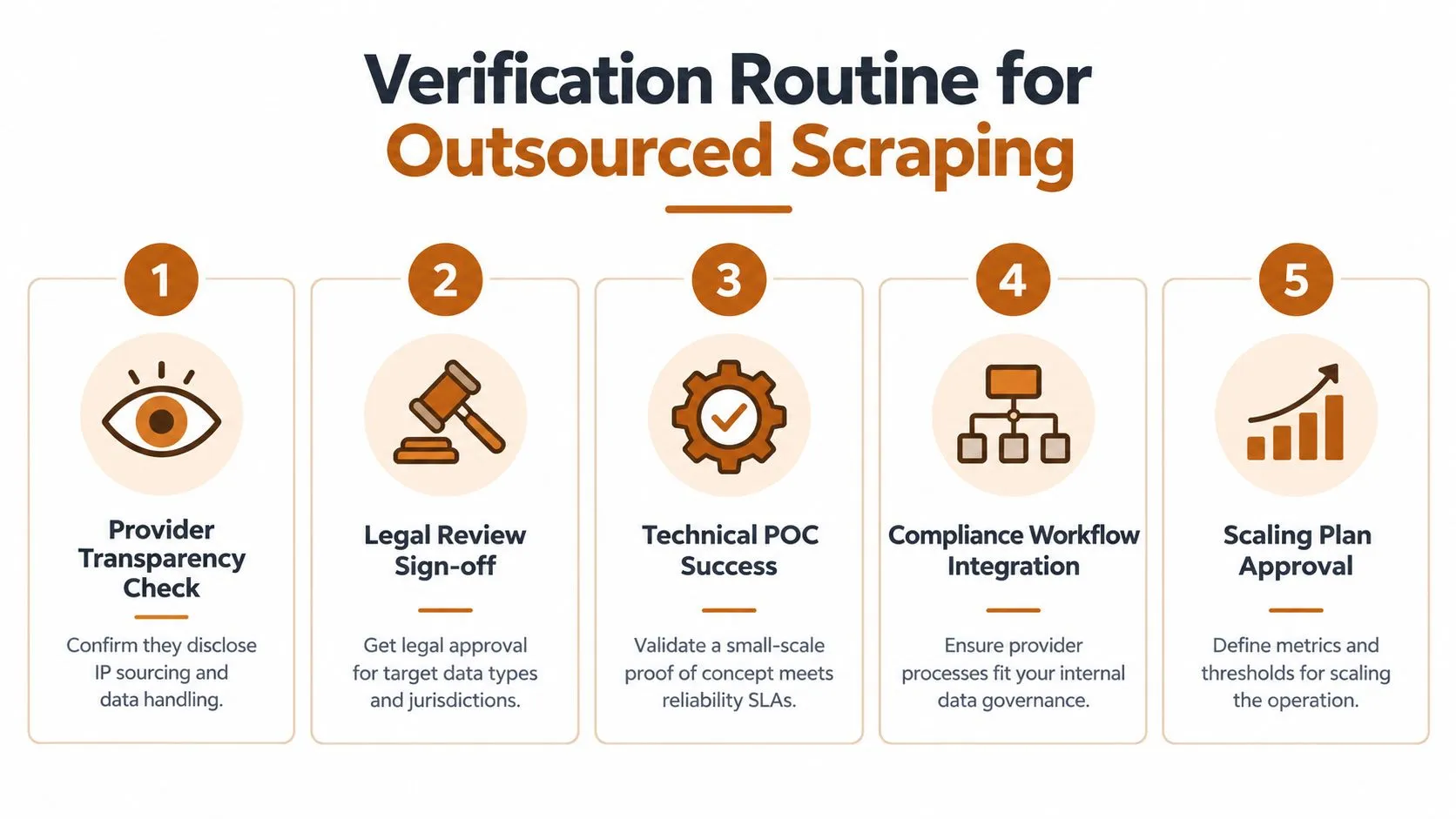
Third, run a technical proof of concept against representative pages, not only the easiest URLs. Check authentication, complex HTML, regional variation, pagination, images, missing fields, duplicate behavior, and delivery timing. Define success using valid records and schema completeness, not request counts.
Fourth, connect the provider’s workflow to internal governance. Assign ownership for quality review, access approvals, incident response, takedowns, and schema changes. Require versioned schemas so a new field or changed interpretation doesn’t rewrite historical data.
Fifth, approve a scaling plan with thresholds. Monitor response classifications, valid-field rates, duplicate rates, freshness, challenge frequency, and source consistency. Adaptive defenses can create invisible trust barriers, while AI-generated or polluted pages can introduce bad inputs even when collection succeeds. Browserless’ discussion of the 2026 state of web scraping describes this broader reliability problem, including fingerprinting, geo-blocks, CAPTCHA, and data pollution.
Operational standard: A pipeline is healthy only when access, extraction, validation, delivery, and governance all produce evidence.
Start with a limited target set and a clearly defined delivery schedule. Review the first outputs against source pages, test failure alerts, and inspect what happens when a schema changes. If direct collection creates unacceptable legal or operational risk, consider a managed report, dashboard, or scheduled data delivery model that limits what your team receives and retains.
WebscrapingHQ provides managed web data operations, custom extraction pipelines, monitoring, alerts, retries, re-tuning, multi-geo delivery, and outputs such as CSV, JSON, webhooks, S3 drops, and compliance reports. If you’re ready to test a recurring use case, define your sources, fields, geography, cadence, and governance requirements, then visit WebscrapingHQ to discuss a scoped proof of concept.
Want this done for you?
Send us the URLs. We'll quote it in 24 hours.
Paste the URL(s) you want scraped. We'll reply within 24 hours with a feasibility check and a ballpark quote.