
Jump to section
- Understanding Computer Vision Web Scraping
- Where visual interpretation earns its place
- Building Visual Extraction Pipelines
- Capture the page state
- Convert pixels into text and regions
- Normalize and validate the output
- Real-World Applications and Use Cases
- Retail and ecommerce extraction
- Compliance reporting
- Visual QA and advertising verification
- Navigating Extraction Challenges and Limitations
- Measure the failure that damages the business
- Treat latency as a design constraint
- Integrating Vision Models with LLM Parsing
- Ground the language model before asking it to reason
- Use the LLM as a semantic layer, not a visual substitute
- Make uncertainty visible
- Best Practices for Production Deployments
- Route by expected value
- Operate the browser and model as production infrastructure
- Evaluating the Future of Visual Data Extraction
The popular advice is simple: replace brittle CSS selectors with computer vision and your scraper becomes resilient. That’s only half true. Computer vision web scraping can tolerate visual and template changes that disrupt DOM rules, but it also introduces inference cost, latency, image-quality risk, and new governance obligations. In production, the strongest architecture usually doesn’t send every page through a vision model. It uses fast extraction first, then applies vision where the rendered page, document structure, or compliance requirement justifies the extra work.
That distinction matters for enterprise teams. A visual model can identify a price beside a product image, recover a table from a PDF, or verify how an advertisement rendered. It can also return a plausible answer while misreading a row boundary or associating text with the wrong visual block. Reliable systems treat vision as a measured component in a broader data operation, not as a universal replacement for HTML parsing.
Understanding Computer Vision Web Scraping
Traditional scraping targets a page’s implementation. Engineers select DOM nodes with CSS selectors, XPath expressions, class names, or other HTML structures, then transform the returned text into records. That method remains efficient when the markup is stable and the required fields have clear semantic boundaries.
The weakness appears when the page changes without changing its apparent meaning. A frontend team can rename classes, rearrange containers, introduce client-side rendering, or place important information inside a canvas or image. The page still looks familiar to a person, while the scraper loses its selectors. Computer vision reverses the extraction target. Instead of asking which HTML node contains the value, it analyzes the rendered pixels, spatial relationships, and visual layout.
A 2021 conference paper, “Computer Vision-based Web Scraping for Internet Forums”, proposed a forum-scraping approach based on a website’s visual representation rather than HTML structure or templates. Review literature published in 2023 also described computer vision as one of the AI techniques used for web page parsing, alongside natural language processing and machine learning. The significance isn’t that pixels have made selectors obsolete. It’s that visual interpretation became a recognized extraction strategy for pages where source structure doesn’t reliably express the information a human sees.
Where visual interpretation earns its place
Visual extraction is particularly useful for JavaScript-heavy interfaces, image-led retail pages, scanned documents, changing templates, and pages where reading order depends on geometry. A DOM parser may recover all visible strings but still lose the relationship between a label, its value, and the surrounding product or table row. A vision pipeline can attach text to coordinates and reason over blocks, although that reasoning must be validated.
Teams working with images should also distinguish page inspection from asset collection. Extracting product photos, logos, or image metadata requires its own handling for URLs, lazy loading, variants, dimensions, and deduplication. A practical overview of scraping images from a website is useful when the visual asset itself, rather than only the page layout, belongs in the output.
Practical rule: Use vision when the rendered experience carries meaning that the DOM fails to represent cleanly. Don’t pay for visual inference merely because a selector needs maintenance.
The historical shift is therefore architectural, not magical. HTML parsing remains the low-cost path for regular text and stable fields. Computer vision adds a second interpretation layer for exceptions, visual verification, and mixed-format content. That division gives engineers a way to preserve speed while improving resilience where it has measurable operational value.
Building Visual Extraction Pipelines
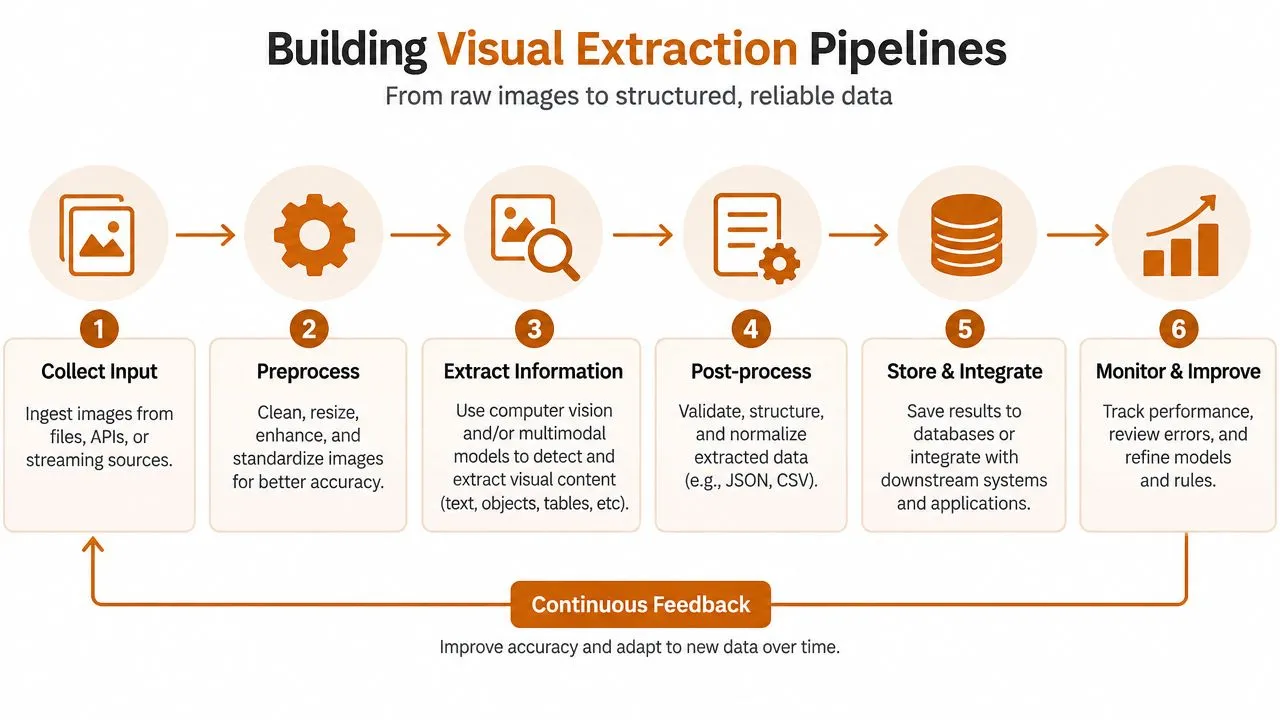
A production pipeline begins before the model sees an image. The browser must render the correct state, the capture must preserve enough detail, and each extracted element must retain its position so later stages can reconstruct meaning.
Capture the page state
Use a headless browser when content depends on JavaScript, scrolling, viewport size, login state, or interaction. Capture the rendered viewport or a full-page image after the required content has loaded. A screenshot taken too early can produce a technically valid image with missing prices, collapsed sections, or placeholders instead of the data your pipeline needs.
Preserve the capture alongside metadata such as the target URL, timestamp, viewport configuration, locale, and extraction run identifier. Those artifacts support debugging and audit review. If a downstream record looks wrong, engineers need to inspect what the model saw, not only the final JSON.
Convert pixels into text and regions
OCR produces text, but raw text alone isn’t enough. The useful output includes bounding boxes, confidence signals, line grouping, and reading order. Coordinate mapping lets the system determine whether a price sits under the correct product, whether a label belongs to the adjacent value, and whether a line belongs inside a table cell.
Object detection or region detection identifies meaningful visual components, such as buttons, product cards, tables, forms, banners, and document sections. Layout analysis then groups those regions into semantic blocks. A page can contain the same words in a different order, so spatial structure carries information that a plain OCR transcript loses.
A document-oriented evaluation illustrates why this matters. The Intelligent Document Processing leaderboard evaluates 16 datasets and 9,229 documents across OCR, key information extraction, visual question answering, table extraction, classification, and long-document tasks. The lesson for web scraping is direct: receipts, invoices, dealer reports, and compliance PDFs behave more like documents than ordinary text pages.
Normalize and validate the output
After detection and layout analysis, transform the visual blocks into a schema. Keep source coordinates or region identifiers with each field, then apply validation rules for required fields, data types, duplicate records, and relationships between values.
A useful pipeline can be represented as:
- Render: Load the page or document in the intended browser and state.
- Capture: Store a sufficiently detailed viewport or full-page image.
- Recognize: Run OCR and detect visual regions.
- Arrange: Reconstruct lines, blocks, tables, and reading order.
- Extract: Map verified regions to a structured schema.
- Validate: Check field relationships, confidence thresholds, and business rules.
Teams adding this capability don’t need to rebuild an entire scraper. A visual feature extraction layer can sit after existing rendering and before schema validation, allowing DOM output to remain the primary path while screenshots support selected fields or failure cases. The computer vision feature extraction guide provides useful context for treating visual features as structured signals rather than as an undifferentiated image.
Real-World Applications and Use Cases
The strongest business cases appear where the page’s visual state affects the decision. A blog feed with clean headings rarely needs a vision model. A retail page with badges, variant cards, promotional overlays, and images carrying key attributes is a different engineering problem.
Retail and ecommerce extraction
Product information can be distributed across title blocks, image labels, swatches, price panels, availability indicators, and promotional components. A DOM parser may collect each string but fail to associate the correct variation with the correct image or price. Visual analysis helps identify cards and relationships, especially when layouts change across sellers or locales.
That doesn’t mean every catalog page should be processed visually. A sensible design extracts stable fields through HTML, then sends pages to visual analysis when validation detects missing attributes, unexpected card geometry, or a mismatch between text and image regions. Vision is most valuable for the difficult subset, where manual review or repeated selector repair is already expensive.
Compliance reporting
Dealer and partner portals often expose records through visually structured pages or downloadable PDFs. The output may need more than a list of strings. It may require preserving reading order, identifying exceptions, associating evidence with a dealer, and producing a report that a reviewer can understand.
Enterprise visual extraction workloads include 1,680 dealer compliance reports per month for a U.S. verification bureau, using automated computer vision and LLM extraction to generate monthly PDF reports. That example demonstrates a practical role for visual models: they support an operational artifact with a defined cadence and review purpose, rather than just populating a database column.
A compliance workflow typically combines:
- Rendered evidence: Store the relevant page or document image for review.
- Layout interpretation: Identify tables, headings, logos, dates, and exception blocks.
- Schema extraction: Convert findings into consistent fields.
- Exception handling: Route ambiguous or failed records for review.
- Report generation: Produce the required PDF or structured delivery.
Visual QA and advertising verification
A successful HTTP response doesn’t prove that a page displayed the intended creative, placement, disclaimer, or brand treatment. Visual QA captures the rendered state and checks it against rules or reference images. This is useful for ad verification, brand compliance, and monitoring pages where screenshots provide stronger evidence than HTML alone.
The visual inspection automation guide is relevant to this pattern because the system evaluates what users see, not merely what the source code contains. Bounding boxes and structured flags can make review faster, provided the pipeline stores the original capture and clearly distinguishes a model finding from a confirmed business decision.
The best use case is not “scrape everything with vision.” It’s “use visual evidence where the business decision depends on rendered reality.”
These applications share a common trait. The value comes from recovering relationships, verifying presentation, or producing auditable evidence. Simple text collection usually doesn’t justify the additional latency and inference expense.
Navigating Extraction Challenges and Limitations
Computer vision does not remove extraction fragility. It shifts the failure modes. Selectors break after markup changes, while visual pipelines degrade with low-resolution screenshots, irregular tables, small fonts, missing page state, or occluded content. A pipeline can still return plausible text after misreading row boundaries or associating a value with the wrong card, so superficial text checks will miss the defect. These are among the common web scraping challenges that become more expensive when visual inference is added.
A benchmark from Snowflake’s enterprise-scale document AI analysis reported that the strongest system achieved 39.58% exact table matches and 70.83% shape matches on a multi-engine enterprise table benchmark. Other major engines ranged from 4.00% to 32.00% exact matches and 26.00% to 68.00% shape matches. The result is a practical warning: character accuracy cannot stand in for structural accuracy. A parser may recognize every important word while placing it in the wrong row or column.
Measure the failure that damages the business
Separate text recognition from structural recovery in your evaluation. For tables, measure exact cell reconstruction, row and column recovery, header association, and handling of missing cells. For product pages, verify that the extracted price belongs to the correct product and variation. For compliance reports, confirm that every exception retains its source region and document context.
The same Snowflake benchmark reported scores of 0.8685 and 0.9045 for the leading system on nonstandard and distorted document subsets. Those results connect reliability to capture conditions and layout variation. Store failure samples by source, document type, viewport, language, and page state. A single aggregate visual-accuracy score will conceal which inputs require routing or human review.
| Characteristic | DOM Parsing | Computer Vision Extraction |
|---|---|---|
| Primary input | HTML, DOM, network responses | Rendered screenshots or document images |
| Typical speed profile | Fast for stable, text-oriented pages | Slower because rendering, capture, and inference are involved |
| Template changes | Often require selector maintenance | Can tolerate visual changes when meaning and layout remain recognizable |
| Spatial relationships | Must be reconstructed from markup | Available directly through coordinates and regions |
| Tables and mixed layouts | Strong when semantic HTML is reliable | Useful when structure is visual, but row and column recovery require testing |
| Operating cost | Usually lower for high-volume extraction | Higher due to browser, image processing, and model inference |
| Best production role | Default path for regular fields | Verification, fallback, visual QA, and complex documents |
Treat latency as a design constraint
Vision-based extraction is slower and more expensive than HTML-only parsing, which makes page-by-page visual processing a poor default for high-volume, low-margin feeds. The cost includes browser startup or session management, screenshots, image storage, retries, GPU or hosted-model usage, and the monitoring needed for confidence scores and exceptions.
The trade-off supports routing rather than blanket replacement. Use DOM extraction for fields it handles reliably, validate the result, and invoke visual analysis when the expected business value justifies the added latency and inference cost. A hybrid pipeline preserves throughput while directing visual verification and fallback processing toward pages most likely to fail or matter most.
Integrating Vision Models with LLM Parsing
Vision models and LLMs solve different parts of extraction. A vision component is good at locating regions, preserving spatial relationships, and identifying the structure of a rendered page. An LLM is good at interpreting varied labels, normalizing values, and mapping context into a business schema. Combining them works best when each model receives a bounded responsibility.
Ground the language model before asking it to reason
An LLM should not receive an unstructured screenshot and an open-ended instruction when the output feeds a database or compliance report. First create grounded visual units:
- Region coordinates: Where the text, table, image, or control appears.
- OCR content: What the region contains.
- Block relationships: Which label, value, image, or row belongs together.
- Document context: Page, section, card, or form identity.
- Evidence references: Links back to the captured region or source artifact.
The LLM can then normalize those units into a strict schema. For example, a visual model may identify a product card and locate three price-like strings. The LLM can select the field that matches the schema’s definition of current price, preserve currency text, and reject a crossed-out comparison price if the surrounding block labels it as a previous value.
This pattern reduces hallucination risk because the language model isn’t being asked to invent structure from an unconstrained image. It reasons over visually verified, coordinate-mapped evidence. Validation still matters. A model can misunderstand a label or normalize a value incorrectly even when the region is correct.
Use the LLM as a semantic layer, not a visual substitute
A useful orchestration flow is:
- Render the target and capture the relevant state.
- Run OCR and layout detection.
- Build a compact representation of semantic blocks.
- Ask the LLM to map those blocks to a versioned schema.
- Validate types, relationships, and required fields.
- Store both the normalized record and its evidence.
The data parsing guide is useful background for separating extraction from transformation. That separation becomes more important when visual blocks, OCR text, and LLM-normalized fields must be traced independently.
Make uncertainty visible
Don’t hide ambiguity behind a clean JSON response. Include field-level confidence, source coordinates, model version, and a reason for fallback or review. If the LLM chooses between multiple candidate regions, preserve those candidates or the decision rationale in an internal trace.
A valid JSON document can still contain invalid business data. Validate relationships, not just syntax.
The hybrid design also helps control cost. Run lightweight parsing and deterministic checks first. Invoke the LLM only after the visual layer has reduced the page to relevant blocks, and reserve human review for records that fail business rules or fall below an agreed confidence threshold. This produces a more auditable system than asking one multimodal model to perform rendering, recognition, interpretation, and validation in a single opaque call.
Best Practices for Production Deployments
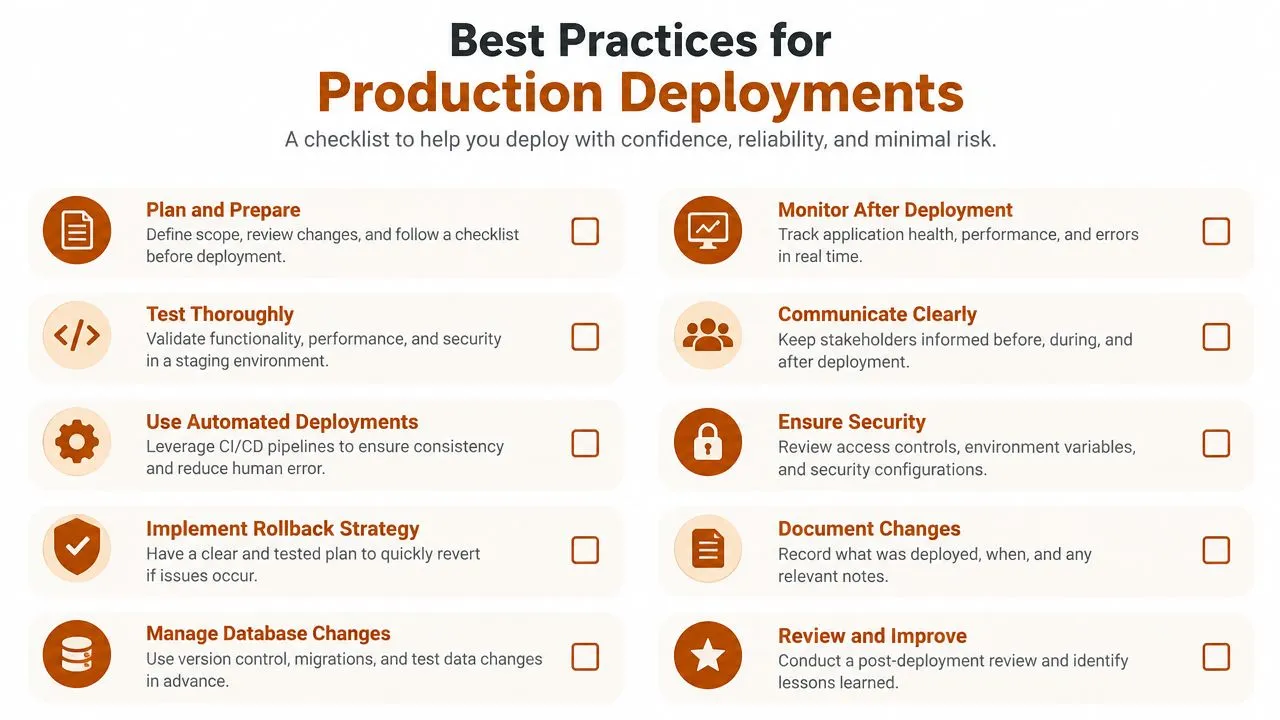
Production reliability depends less on choosing a fashionable model than on routing, observability, and evidence. Computer vision should enter the pipeline through explicit decision points, with clear rules for when the system trusts DOM output, requests a screenshot, retries a capture, or sends a record to review.
Route by expected value
Start with HTML and network-level extraction for predictable fields. Trigger visual fallback when selectors return incomplete records, validation detects an impossible relationship, the page uses a known image-first pattern, or the target is a document where layout is part of the requirement.
Useful routing signals include:
- Missing-field checks: Send records to vision when required values disappear.
- Structural checks: Compare expected cards, rows, or sections with observed output.
- Visual exceptions: Inspect pages containing banners, overlays, canvases, or scanned content.
- Business priority: Apply deeper review to compliance, advertising, or high-value records.
- Change detection: Capture a new visual baseline when the source template changes.
This tiered approach limits expensive inference without treating vision as an afterthought. It also gives the team a measurable question: how many visual fallbacks produce accepted records, and how many just confirm that the DOM path was correct?
Operate the browser and model as production infrastructure
Browser sessions need controlled viewport settings, locale handling, retry policies, and state management. Proxy management may be necessary for geography and access stability, while image-based CAPTCHAs require careful handling within the target site’s terms, consent requirements, and applicable law. Don’t design around defeating access controls as if they were ordinary parsing errors.
Compute planning matters as well. Visual workloads can require image processing and accelerated inference, while hosted models add usage charges and network latency. Store screenshots selectively when retention rules allow, compress them without destroying small text, and avoid sending irrelevant page regions to a model.
A practical control plane should include:
- Schema versioning: Record which field definitions and model versions produced each output.
- Golden samples: Maintain representative pages and documents for regression tests.
- Field-level metrics: Track missing fields, structural matches, invalid relationships, and review rates.
- Evidence retention: Preserve source captures or region references for disputed records.
- Alerting: Notify operators when fallback volume, latency, or failure patterns change.
- Cost attribution: Associate visual inference with source, workflow, and business outcome.
WebscrapingHQ is one option for teams that want managed web data operations, custom extraction, visual inspection, LLM-based parsing, monitoring, retries, proxy management, and scheduled outputs such as PDF reports or CSV and JSON feeds. The right choice depends on whether the organization wants to operate these components internally or delegate recurring pipeline maintenance.
The final safeguard is human review designed as part of the workflow, not as an emergency repair queue. Reviewers should see the extracted value, the supporting region, the validation failure, and the model trace needed to approve or correct the record. That feedback can improve routing rules and test coverage without turning every page into a manual task.
Evaluating the Future of Visual Data Extraction
Visual extraction is moving into a more complicated operating environment. As teams use scraped material for vision-language systems and compliance workflows, consent, provenance, and data-owner permissions become engineering requirements. A 2025 research listing on consent mechanisms in web-scraped vision-language AI datasets signals that governance is no longer separate from extraction design. It affects what teams collect, how they retain it, and whether they can explain the source of a training or reporting artifact.
Anti-bot defenses create a similar tension. Image-based challenges and fingerprinting are increasingly being addressed with AI vision techniques, but improved capability raises the compliance burden rather than eliminating it. A scraper that can interpret a visual blocker still needs a lawful, auditable basis for accessing the content.
Teams should adopt a tiered methodology:
- DOM first for stable, text-oriented fields.
- Vision fallback for layout failures, complex documents, and spatial relationships.
- LLM normalization after visual grounding, with strict schemas and validation.
- Human review for material ambiguity and compliance-sensitive exceptions.
- Governance controls for consent, provenance, retention, and access decisions.
For broader discussion of AI-enabled interfaces and conversational systems, the AI chat platform blog from Thareja Technologies Inc. offers relevant context. The strategic conclusion is practical: visual models will become more useful, but production teams that measure cost, latency, structural fidelity, and governance will outperform teams that apply vision indiscriminately.
WebscrapingHQ can scope and operate hybrid extraction pipelines that combine DOM parsing, computer vision, LLM-based normalization, monitoring, and scheduled delivery. Visit WebscrapingHQ to discuss a visual fallback or verification workflow for your pages, documents, compliance reports, or ecommerce data feeds.
Want this done for you?
Send us the URLs. We'll quote it in 24 hours.
Paste the URL(s) you want scraped. We'll reply within 24 hours with a feasibility check and a ballpark quote.