Jump to section
- Table of Contents
- When the In-House Scraper Stops Working
- Decide whether the real problem is extraction or maintenance
- Match the buyer profile before you compare vendors
- What U.S. Web Scraping Companies Actually Sell
- Managed pipelines versus tools versus hybrids
- Read the vendor pitch in plain English
- Cost, Scale, and What You Actually Pay For
- Price follows friction, not just row count
- Budget for the operating model, not the crawl alone
- Parsing Strategies and the Tech Behind the Service
- Choose the parser that fits the markup
- Ask how the vendor handles extraction layers
- Anti-Bot Defenses and Malformed HTML in Practice
- Treat blocking as an operating condition
- Don’t ignore bad HTML just because the page loads
- Computer Vision and LLM Extraction for Hard Targets
- Buy outcomes when the page is hostile
- Vet the AI layer hard
- Choosing the Right Company for Your Use Case
- Match profile to operating model
- Use a short due-diligence checklist
You probably have the same problem most enterprise teams run into. A scraper worked, the dashboard looked clean for a while, then a site changed its markup, a CAPTCHA started appearing, or the weekly job quietly died over the weekend. The question stops being whether you should scrape at all, and becomes whether you want your own engineers spending their time patching brittle scripts or whether you want a vendor to absorb that maintenance burden.
That is why the market for web scraping companies in USA matters now. It is not a narrow buyer’s market for hobbyists. It is a real data infrastructure category, with the U.S. web scraping market at USD 286.51 million in 2024 and projected to reach about USD 930.39 million by 2034 at 12.5% CAGR according to one market estimate, while a broader 2026 industry summary says the global web scraping industry has crossed $1 billion and is growing at 14%+ annually (Market.us market estimate).
The right vendor depends on who you are. Compliance teams need managed delivery, auditability, and low operational risk. AI and ML teams need scalable training data pipelines, clean schemas, and reliable refreshes. Growth and research teams usually need speed, flexibility, and enough resilience to keep price, SERP, and competitor feeds alive without dragging engineering into every adjustment.
Table of Contents
Open Table of Contents
- When the In-House Scraper Stops Working
- What U.S. Web Scraping Companies Actually Sell
- Cost, Scale, and What You Actually Pay For
- Parsing Strategies and the Tech Behind the Service
- Anti-Bot Defenses and Malformed HTML in Practice
- Computer Vision and LLM Extraction for Hard Targets
- Choosing the Right Company for Your Use Case
When the In-House Scraper Stops Working
The common failure pattern is brutally familiar. A product, jobs, or listings scraper works for weeks, maybe months, then the target site tweaks its structure and your overnight run comes back with empty fields, broken selectors, or partial records. By Monday morning, someone is manually checking logs instead of using the data.
Decide whether the real problem is extraction or maintenance
That is the first decision point. If the target is stable and the output is simple, an internal scraper can be enough. If the site changes often, blocks aggressively, or needs cleaning and delivery on a schedule, the main cost is not building the first version, it is keeping it alive.
Practical rule: if your team spends more time fixing scrapers than using the data, you already have a managed-services problem.
The vendor selection matters because the market has moved beyond one-off scraping scripts. A 2026 enterprise comparison says small projects can start around $500 per month, while large-scale operations can exceed $100,000 annually (enterprise vendor comparison). That spread reflects a simple truth, the service model now determines who owns breakage, retries, and delivery.
Match the buyer profile before you compare vendors
Most buyers fall into three groups. Enterprise data and compliance teams care about scheduled reporting, schema consistency, and defensible delivery. AI and ML teams care about volume, coverage, and whether the output is already normalized enough for training or enrichment. Growth and research teams care about speed to insight, competitive tracking, and less time wasted on maintenance.
If you are still running a script internally, use the maintenance question as the filter. The fix is not another patch unless the site is low-risk and low-change. If you need recurring feeds, compliance artifacts, or reliable collection from hostile targets, you should be evaluating operating models, not just tools. For a practical maintenance perspective, the internal guide on how to maintain web scrapers for long-term use is worth reading before you commit to another rebuild.
What U.S. Web Scraping Companies Actually Sell
The biggest mistake buyers make is assuming every vendor sells the same thing. They do not. Some sell a managed data pipeline, some sell a self-service scraping platform, and some sit in the middle with hybrid tooling plus services. If you blur those together, you will compare apples to a staffed extraction program and wonder why the quotes are so different.
Managed pipelines versus tools versus hybrids
A managed pipeline means the vendor handles extraction, monitoring, cleaning, validation, and delivery. That is what buyers want when data continuity matters more than internal tinkering. Providers such as ScrapeHero and Zyte Data position themselves this way, handling the moving parts that usually break first, including maintenance and delivery.
A self-service platform gives you the building blocks and expects your team to operate them. Apify is the clearest example in the U.S. market discussion, because it emphasizes reusable scraper builds and cloud execution rather than pure done-for-you delivery. That model works if you have engineering capacity and want control.
A hybrid product sits between the two. It may start with APIs, reusable components, or managed setup, then let your team own more of the workflow over time. That can be efficient, but only if your team wants to manage change.
Read the vendor pitch in plain English
Vendor language is often misleading. If a company says managed service, ask whether it really means human operators maintain the extractor and schema over time. If it says data as a product, ask whether you get recurring feeds or just access to a platform. If it says custom extraction, ask who owns updates when the site changes.
Useful shortcut: if the vendor cannot describe how they handle schema drift, retries, and delivery without drifting into marketing language, they are probably selling software, not an outcome.
For buyers, the taxonomy is simple. Choose a managed pipeline when you need reliability and low internal lift. Choose a platform when you have strong in-house engineering and want control. Choose a hybrid only when you know exactly which tasks stay with you and which ones the vendor owns.
Cost, Scale, and What You Actually Pay For
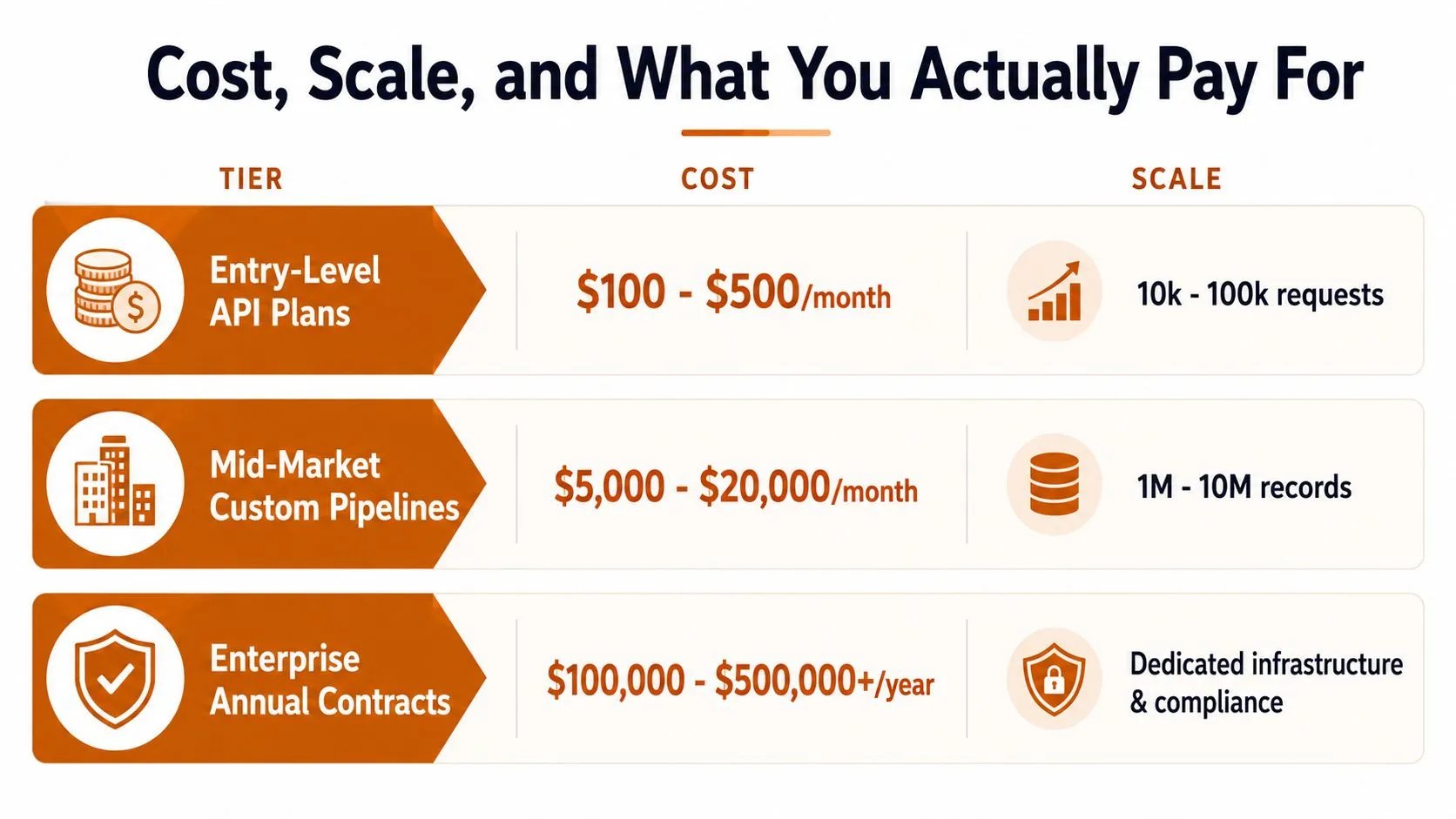
Web scraping pricing looks opaque because it is opaque. The quote often hides the key cost drivers, and the cheap offer usually excludes the hardest work. Buyers should stop asking, “What does it cost?” and start asking, “What am I paying to have removed from my team?”
Price follows friction, not just row count
The low end of the market can look deceptively accessible. Independent market roundups report entry-level API scraping plans around $24 per month for basic use, while enterprise projects can reach $100,000+ annually (ScrapingBee comparison). The reason for that spread is not just scale, it is friction.
What pushes cost upward is usually a combination of volume, anti-bot intensity, custom schema mapping, compliance reporting, and SLA-backed delivery. If a quote looks cheap, check whether it includes monitoring, selector fixes, retries, and downstream formatting. Those are the line items that disappear from sales decks and reappear on your internal backlog.
Budget for the operating model, not the crawl alone
A managed provider may cost more than a raw API, but the comparison is often unfair. The key question is whether your team wants to absorb break-fix work, proxy management, and re-tuning every time a site changes. If not, a higher vendor price can still be the lower total cost.
For teams comparing manual extraction against automation, the cost logic is similar. The internal guide on automated versus manual data extraction cost comparison is a useful way to pressure-test whether labor is being hidden in the project plan.
A quote that excludes maintenance is not a full quote. It is a teaser.
The market size data matters here because it signals maturity, not experimentation. In a category this large and growing, vendors compete on who can keep data flowing, not just who can launch the first crawl. That is why the cheapest option is often the one most likely to cost you more later.
Parsing Strategies and the Tech Behind the Service
Under every scraping service sits a parsing decision. A good vendor will choose the parser based on the target, not based on habit. If they cannot explain that choice clearly, they probably do not have a strong extraction architecture.
Choose the parser that fits the markup
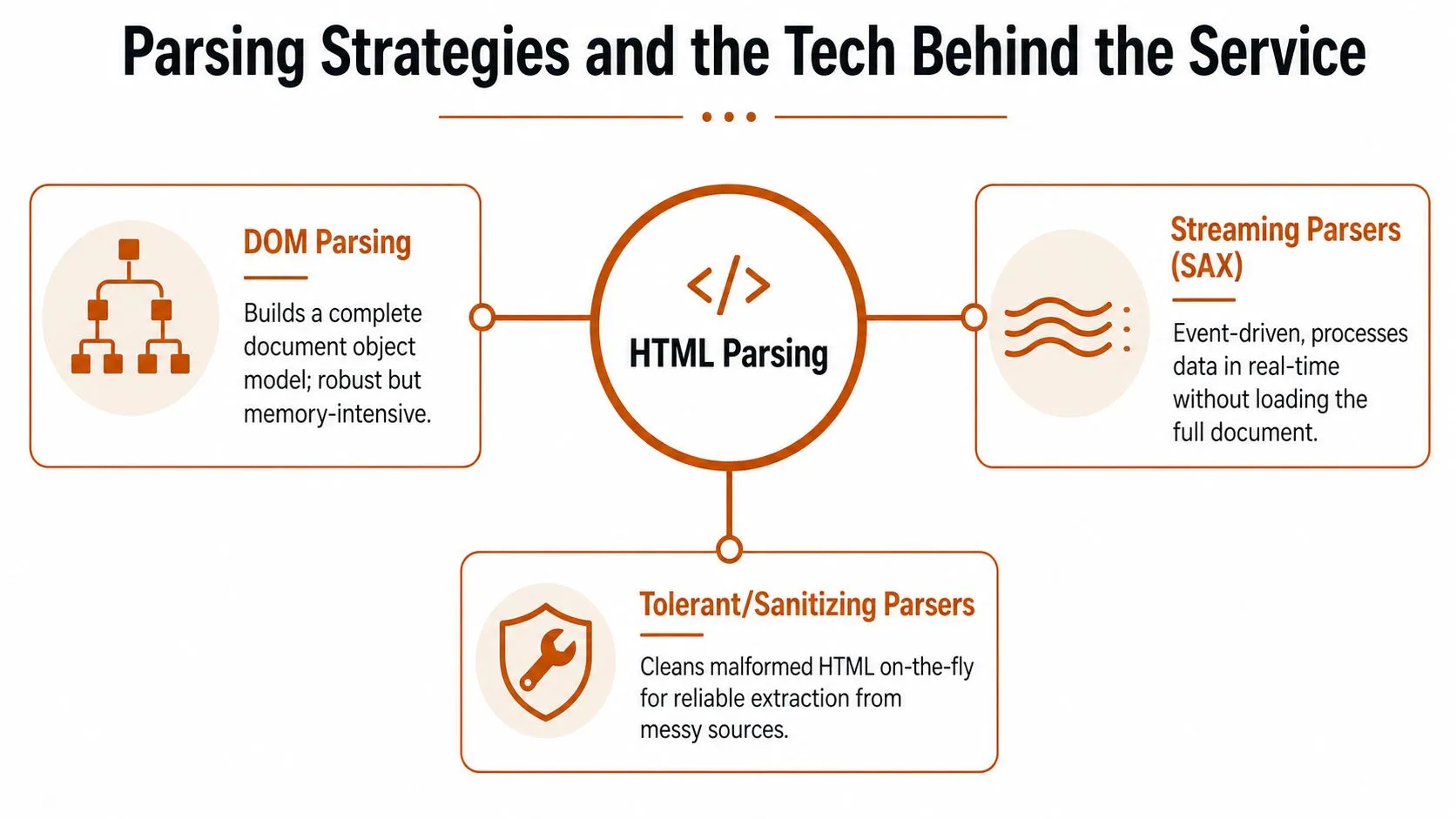
DOM parsing is the right default for stable HTML. It builds a full document object model, which is useful when the page structure is consistent and the data sits where you expect it. It is also memory-heavy, so it is not the right answer for every large or messy page.
Streaming parsers, like SAX-style approaches, process content as events rather than loading everything at once. That makes them useful when scale or throughput matters more than page-by-page inspection. They are less forgiving when the markup is inconsistent, so they work best with disciplined sources.
Tolerant or sanitizing parsers are the workhorses of real-world scraping. Libraries such as Beautiful Soup or lxml are often used to clean malformed HTML and recover from bad structure. That matters because public web pages are often messy, and messy markup is normal rather than exceptional.
Ask how the vendor handles extraction layers
The better vendors mix parsers. They may use a tolerant parser for broad cleanup, then a stricter selector strategy for stable fields, then an LLM fallback for odd cases. That is the right architecture when the site has dynamic content, inconsistent HTML, or text that needs more contextual interpretation.
Operator’s test: ask for the fallback path, not just the happy path. If the first extractor fails, what happens next?
If you work with a scraping team that uses Scrapy, the internal guide on building scalable data pipelines with Scrapy is a practical reference for understanding how the plumbing fits together. For a vendor conversation, the important point is simple. You are not buying parsing in isolation. You are buying a chain of decisions that determines whether extraction stays reliable when the source changes.
Anti-Bot Defenses and Malformed HTML in Practice
Scrapers often face critical failures in production. Sites slow you down, block you, challenge you, or feed you broken markup that looks fine to a human but confuses the extractor. Good vendors are not the ones who promise invincibility. Good vendors are the ones who have a clear mitigation path.
Treat blocking as an operating condition
Start with the basic defenses. Rate limiting means you need pacing and concurrency control. Fingerprinting means you need browser behavior that does not look obviously synthetic. CAPTCHAs mean you need either solving workflows, better request strategy, or a browser-based approach that reduces challenge frequency.
TLS and headless-browser checks are another layer. Some sites care less about the page request than about the client profile behind it. That is why proxy rotation alone is not enough. You also need browser fingerprint management, retry logic, and enough observability to know when a target changes behavior.
The internal guide on anti-bot measures in Playwright is useful because it reflects how production teams think about these problems. The core question is not whether a vendor can “bypass” blocks. It is whether they can keep a scheduled feed running without turning every source change into an outage.
Don’t ignore bad HTML just because the page loads
Malformed HTML is a separate failure mode. A page can render visually while still breaking naive selectors. That is why tolerant parsing libraries matter, and why schema validation should happen after extraction rather than before.
Use a vendor that can tell you how they detect drift, how they alert on missing fields, and how they re-run failed jobs. If they cannot describe the retry policy in plain English, they probably do not have one. If they can only talk about proxies, they are underselling the significant operational work.
Computer Vision and LLM Extraction for Hard Targets
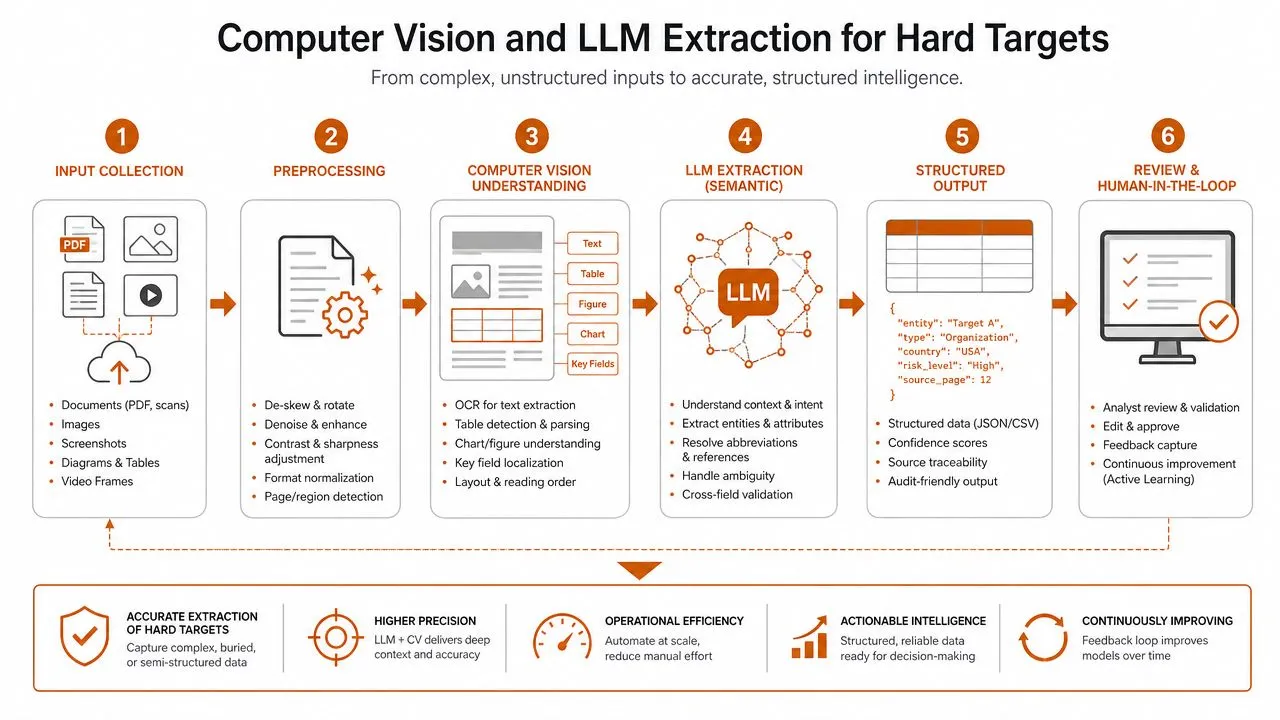
Some sources are too messy for conventional scraping to be the primary answer. Think product galleries with image-heavy layouts, dealer compliance portals, and pages where the useful signal is partly visual and partly textual. In those cases, computer vision plus LLM-assisted extraction is not a gimmick. It is the right tool for the job.
Buy outcomes when the page is hostile
The value of computer vision is simple. It can read what a browser renders, not just what an HTML tree exposes. That helps with image capture, deduplication, visual schema inference, and layout-heavy pages where the important data is embedded in the presentation layer.
LLM extraction has a different role. It can normalize unstructured text, infer labels, and help map ugly source material into a usable schema. The browser and parser still matter, but the model provides a fallback when the target refuses to behave like a neat table.
A useful resource on the modeling side is Llama 3.2 vision capabilities, which shows why multimodal approaches are increasingly relevant for difficult extraction tasks. It is especially useful when a source mixes images, text, and layout cues that classical parsing alone misses.
Vet the AI layer hard
Do not buy “AI extraction” as a buzzword. Ask what happens when the page changes, what confidence checks exist, and how the vendor handles errors in the generated schema. Ask whether the AI is doing field identification, OCR-like reading, summarization, or all three. Those are different capabilities and should be priced differently.
The internal guide on machine learning data collection is a good fit for buyers building training pipelines, because the requirements are stricter than casual enrichment. If you need repeatable data, the model layer must be paired with governance, validation, and human review where needed.
For many enterprise buyers, the practical rule is clear. Classical parsing should handle the easy bulk. Vision and LLMs should handle the hard edge cases. Vendors that invert that order usually inflate cost without improving reliability.
Choosing the Right Company for Your Use Case
The right choice depends less on brand and more on buyer profile. If you start with your operating need, the vendor list gets much shorter. That is a feature, not a limitation, because the wrong model is where most projects burn budget.
Match profile to operating model
Enterprise and compliance teams should favor a fully managed pipeline with documented delivery, governance, and schema control. They need a vendor that can handle scheduled outputs, keep artifacts consistent, and take responsibility when a source changes. In this category, managed service matters more than tooling access.
AI and ML teams should look for a managed or hybrid provider that can deliver normalized feeds, high-volume coverage, and custom extraction logic. They should care less about dashboard polish and more about the shape of the data, update cadence, and whether the vendor can support multi-source pipelines without turning every source into a one-off project. WebscrapingHQ fits this kind of managed extraction model, because it designs, builds, and runs pipelines with computer vision and large language models when the source needs it.
Growth and research teams can often start with a hybrid or platform-led model if they have some engineering support. Their priority is usually speed and flexibility, so they should accept a little more self-service if it keeps iteration fast. The trap is choosing a platform that looks affordable but then shifts all maintenance onto the team.
Use a short due-diligence checklist
Before the first call ends, ask five things.
- Reference Customers: Do they support sites and volumes similar to yours, not just adjacent industries?
- Schema Versioning: How do they track field changes, additions, and breaking updates?
- Alerting and Retry Behavior: What happens when a source fails at 2 a.m.?
- Data Governance: Who owns the output, the transformations, and the delivery history?
- Exit Terms: How easily can you leave without rebuilding the whole workflow?
If the vendor cannot answer those five questions cleanly, the contract will not save you later.
The market is mature enough that you do not need to settle for vague promises. You need an operating model that fits the job, and a vendor willing to own the messy parts. Pick based on maintenance burden first, price second, and feature lists last.
If you need managed web data operations, custom extraction, or recurring delivery for hard targets, talk to WebscrapingHQ and compare your use case against a pipeline that includes monitoring, retries, schema control, and AI-assisted extraction where it adds value. If your current stack keeps breaking every time a site changes, that is the signal to replace the operating model, not add another patch.
Want this done for you?
Send us the URLs. We'll quote it in 24 hours.
Paste the URL(s) you want scraped. We'll reply within 24 hours with a feasibility check and a ballpark quote.