
Jump to section
- Why a Twitter User Scraper Project Starts with a Feasibility Study
- What a Web Scraping Feasibility Study Actually Covers
- Map the target surface
- Audit the schema
- Model volume and request behavior
- Review compliance and price the decision
- The Scope Variables That Drive Your Estimate
- Proxies Anti-Bot Defenses and the Hidden Infrastructure Layer
- Engineering Effort and SLA Pricing Models Compared
- Example Cost Estimates for a Twitter User Scraper
- Where Most Twitter User Scraper Budgets Quietly Break
- The annual budget follows the refresh policy
- Scoping Checklist Before You Sign a Statement of Work
You have a list of X usernames, a deadline, and a procurement request for a “Twitter User Scraper.” The first vendor quote looks attractive because it prices the visible output, not the infrastructure and maintenance required to keep that output arriving. That distinction matters more than the scraper framework. A profile export can be technically possible and still be commercially unsuitable once access limits, refresh cadence, proxy consumption, compliance review, and operational support enter the scope.
The right question isn’t whether a scraper can collect public user data. It’s whether the pipeline can deliver the required fields, volume, freshness, and retention policy at a cost your team can defend for the full engagement.
Why a Twitter User Scraper Project Starts with a Feasibility Study
A Twitter User Scraper project should begin as a budgeted engineering engagement, not a weekend experiment. The February 2023 API change made that shift unavoidable. Twitter announced that free API access would end, then introduced a free plan limited to 1,500 post requests per month, a $100-per-month Basic plan with 10,000 read requests and 50,000 post requests per month, and an Enterprise plan reportedly priced at $42,000 per month. Legacy access levels were also scheduled for discontinuation, making broad automated collection more expensive and less accessible. These figures are documented in TechCrunch’s coverage of the new Twitter API tiers.
Before a vendor writes code, ask five questions:
- Which users and fields are in scope? A handle-only list is a different product from enriched profiles, timelines, follower relationships, and engagement history.
- How complex is the target surface? Client-rendered pages, lazy-loaded widgets, login walls, and internal requests increase both browser and maintenance requirements.
- How often must data be refreshed? A one-time research pull has a different cost profile from a scheduled intelligence feed.
- What proxy and anti-bot controls are required? Access conditions can change, and infrastructure may become a recurring operating cost.
- How many engineering hours are reserved? Parsing, validation, retries, schema changes, monitoring, and incident response all belong in the estimate.
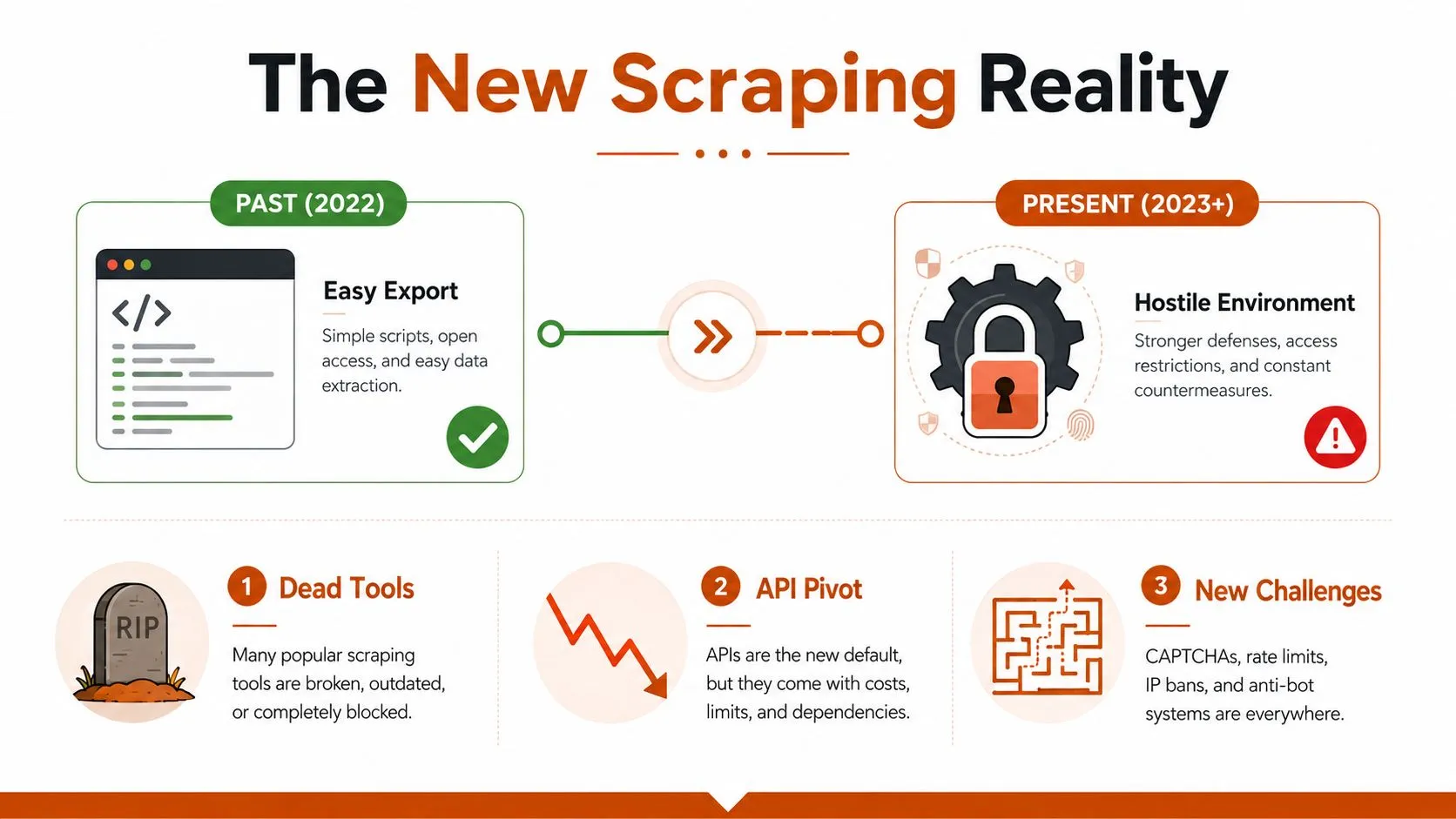
A feasibility study prevents a common buying error: comparing two quotes that appear to promise identical deliverables but assume different access methods, retention windows, refresh guarantees, and failure handling. A team deciding between web scraping and API access should compare the complete operating model, not just the initial implementation fee.
The practical output should be a written scope with assumptions, reachable fields, expected failure modes, delivery format, and a cost range. If a vendor can’t explain what happens when an account is suspended, a username is invalid, or the page structure changes, the quote isn’t complete.
What a Web Scraping Feasibility Study Actually Covers
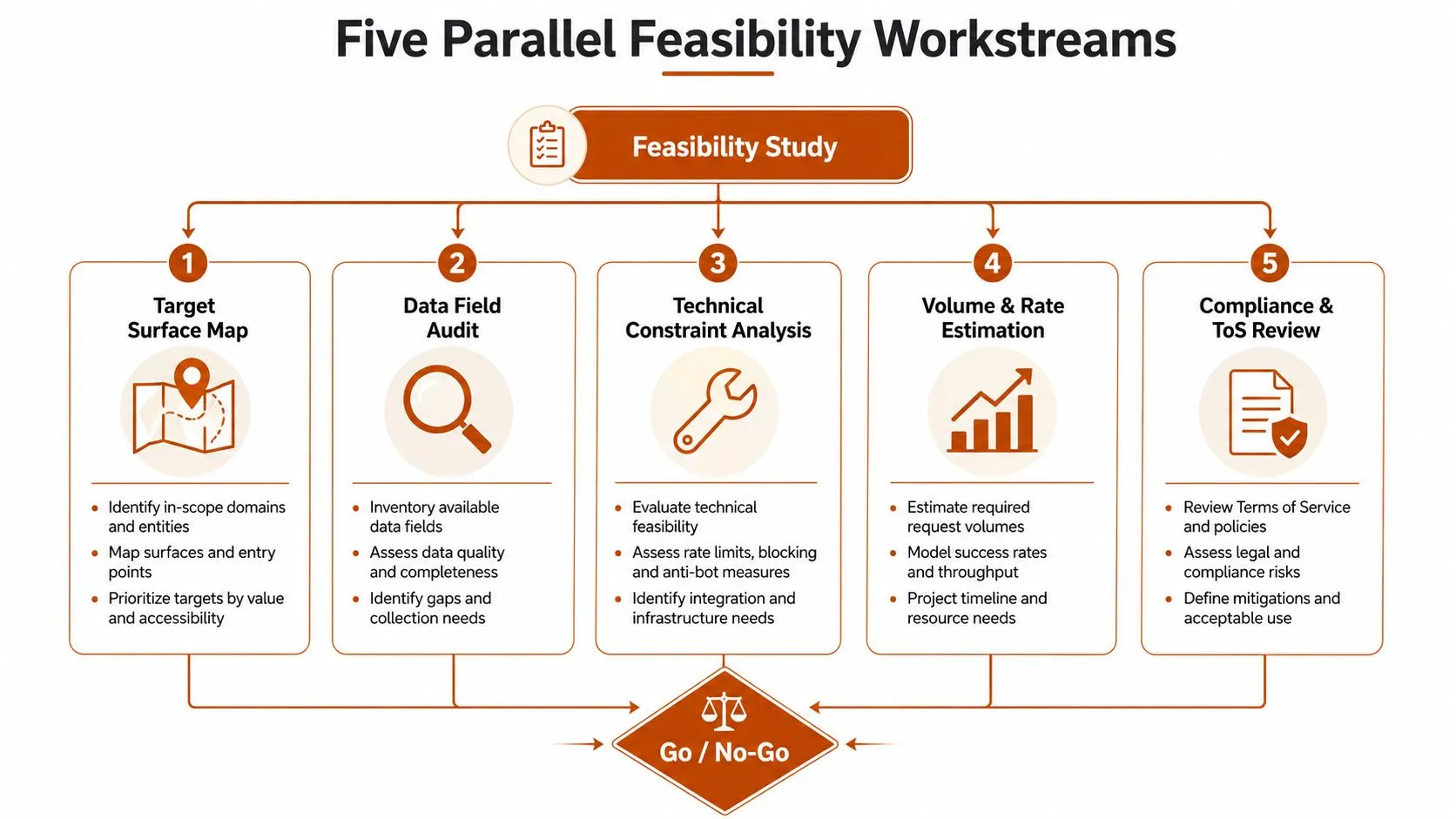
A proper feasibility study runs several workstreams before production development begins. It should produce a go or no-go recommendation, not a sales presentation.
Map the target surface
Start with the exact data surface. Separate public profile fields, visible posts, timeline history, follower relationships, likes, search results, and account-level metadata. Public profiles and visible tweets may be reachable, but protected accounts, DMs, follower lists, and complete search results aren’t automatically available. ScrapFly’s discussion of Twitter scraping constraints also notes that X’s terms prohibit automated scraping, so technical reachability doesn’t establish permission.
The map should identify where each field comes from, whether it requires browser rendering, and what happens when the field is absent. It should also distinguish a reliable field from one that appears only after login or interaction.
Audit the schema
X’s user lookup endpoints support batches of up to 100 identifiers per request. The default user object is minimal unless the request adds user.fields for attributes such as created_at, description, location, public_metrics, profile_image_url, and verified, as documented in the X API data dictionary.
That detail changes the design. If the team requests only usernames first and enriches records later, it may create unnecessary round trips and a more complicated retry path. The feasibility deliverable should define the canonical schema before extraction begins.
Model volume and request behavior
Translate “millions of profiles” into batches, request windows, validation rules, storage, and retry behavior. X documents an app-only limit of 900 requests per 15-minute window for user lookup-style endpoints. At the maximum batch size, community guidance describes roughly 90,000 user records per 15 minutes, but invalid usernames appear in an errors array and reduce effective yield. The relevant X developer community discussion supports planning for deduplication and identifier validation rather than budgeting against theoretical throughput.
Review compliance and price the decision
Legal review should address the intended use, account data, storage, onward sharing, retention, and X’s current terms. A useful web scraping legal risk checklist can support that review, but it shouldn’t replace counsel for a regulated or high-risk use case.
The final study should include a fixed scope, assumptions, exclusions, test criteria, and a no-go trigger. If those items aren’t written down, procurement is buying uncertainty.
The Scope Variables That Drive Your Estimate
The quote moves most when the buyer leaves scope language vague. “Scrape users” could mean collecting usernames and IDs, or it could mean rendering profile pages, capturing media, retrieving timelines, validating suspended accounts, and delivering refreshed records on a schedule.
| Scope Variable | Low Scenario | High Scenario | Per-Profile Cost |
|---|---|---|---|
| Profile field depth | Username, ID, bio, location, public counts | Profile media, verification, joined date, pinned post, expanded metadata | About $0.002 to $0.015 per profile |
| Page complexity | Direct structured lookup | Client-rendered page with lazy-loaded elements | 2 to 4 sequential requests per fetch |
| User volume | 50,000 profiles | 5 million profiles | Weekend-scale batch versus 60 to 90 days of pipeline operation |
| Update cadence | One-time pull | Monthly refresh | One-time pulls can run 40% to 60% cheaper |
| Geography and language | One locale and routing policy | Multiple locales and languages | Extra routing and QA rules |
The field-depth variable is usually the easiest place to reduce spend without damaging the project. Decide whether the team needs avatars, banners, pinned posts, and full follower lists. A market-sizing project may need a compact profile record. A creator intelligence product may need media, recent activity, public metrics, and change tracking.
Page complexity affects both latency and failure probability. A profile overview that looks like one page to a person can require several sequential requests for a scraper because the browser loads components progressively. That means a per-profile estimate based on one HTTP request is usually too optimistic.
Volume changes the operating model, not only the multiplication. 50,000 profiles can support a controlled pilot, while 5 million profiles requires queue management, validation, storage, monitoring, and long-running recovery. Update cadence then determines whether the team pays repeatedly for unchanged records, and geography adds routing and language-specific quality checks.
Use the table as a starting point, not a final quote. The vendor should replace each low or high scenario with a tested assumption and identify which variable triggers a change order.
Proxies Anti-Bot Defenses and the Hidden Infrastructure Layer
Infrastructure is where a cheap scraper quote often becomes an expensive operating contract. The visible deliverable may be a CSV or JSON feed, but the pipeline underneath can require proxy bandwidth, browser execution, session management, challenge handling, retries, and monitoring.
| Infrastructure Line Item | Typical Unit Cost | Estimated Monthly Spend |
|---|---|---|
| Residential proxy bandwidth | $3 to $15 per GB | Depends on rendered page weight, retries, and volume |
| Mobile IP pools | Vendor-specific | Usually a premium over standard residential routing |
| Anti-bot challenge handling | Vendor-specific | Increases with protected pages and failed sessions |
| CAPTCHA or SMS verification | Vendor-specific | Applies when authenticated account workflows are used |
| Monitoring and retuning | Engineering rate or managed fee | Depends on breakage frequency and SLA |
Residential proxy bandwidth is the most visible recurring variable. A lightweight lookup may consume little data, while a browser-rendered profile with images, scripts, retries, and failed challenges can consume much more. Mobile IP pools may help with difficult routes, but they shouldn’t be added by default. Use them only when testing shows that a lower-cost proxy tier cannot meet the required success and freshness criteria.
Anti-bot defenses also require operational judgment. Recent coverage describes changes involving guest token formats, TLS fingerprinting, rotating GraphQL document IDs, cookie validation, and IP reputation filtering. The implication is straightforward: proxy selection and rotation cadence need monitoring. A configuration that works during a pilot may require retuning later.
Budgeting rule: Treat proxy, browser, and challenge costs as production operating expenses. Don’t hide them inside an initial development estimate.
CAPTCHA and SMS services deserve special scrutiny. If a workflow requires account authentication, the SOW should identify who owns the account risk, how credentials are protected, what happens after suspension, and whether verification costs are passed through or marked up. For a public-data workflow, authenticated automation may introduce more risk than value.
Use a transparent infrastructure schedule and ask vendors to separate pass-through costs from service margin. The proxy server comparison guide can help procurement understand the categories, but the final choice should come from target-specific testing rather than a generic proxy ranking.
Engineering Effort and SLA Pricing Models Compared
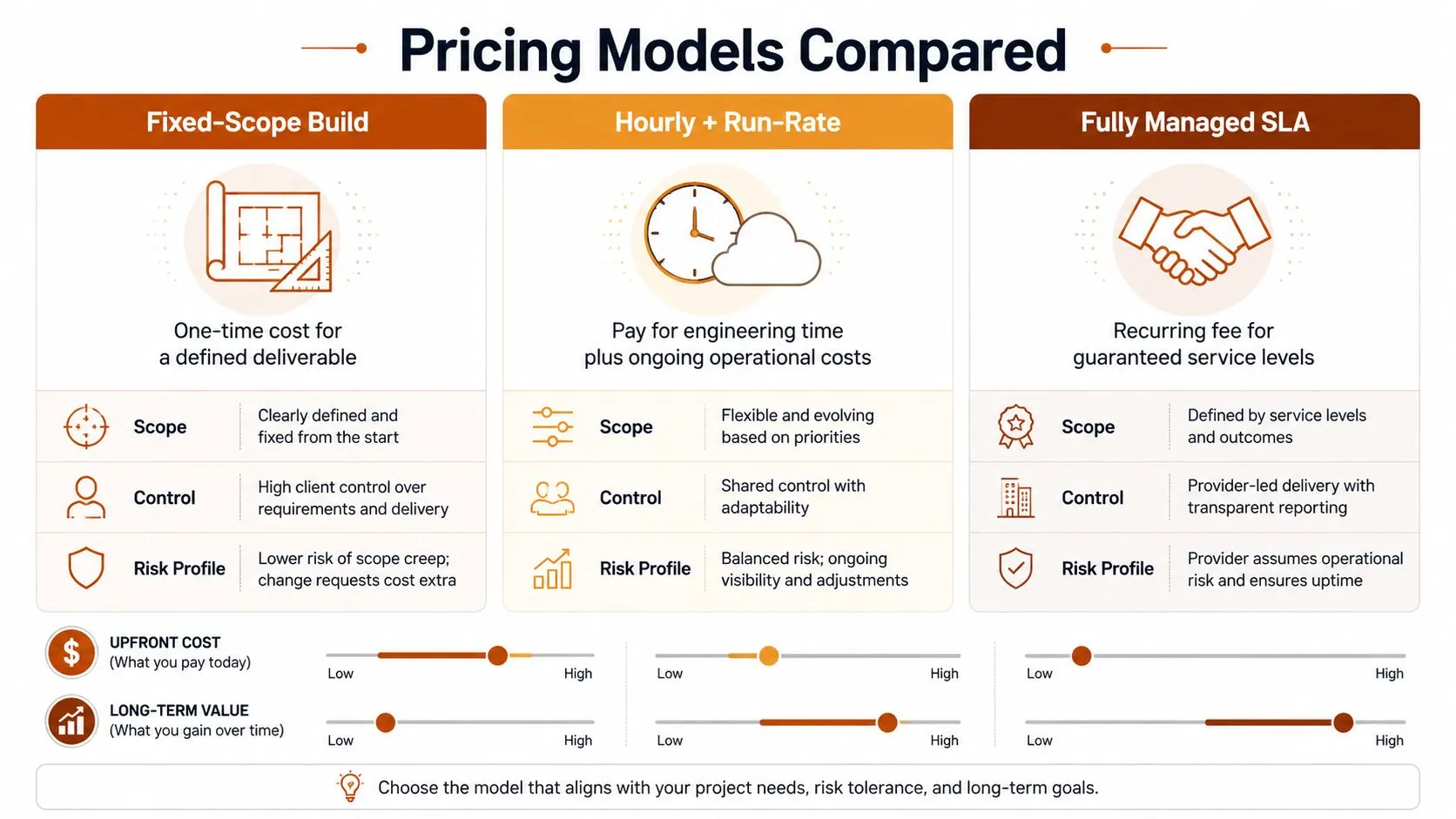
There are three sensible commercial models for a Twitter User Scraper. The right one depends on whether the buyer needs a controlled experiment, a reusable system, or dependable recurring delivery.
| Pricing Model | Best Fit | Typical Commercial Shape | Main Risk |
|---|---|---|---|
| Fixed-scope build | Pilot or single deliverable | Starts near $12,000 for one defined project | Retuning and new fields may be excluded |
| Hourly plus run-rate | Internal technical ownership | Senior engineers at $85 to $175 per hour, plus infrastructure | Buyer carries schedule and failure risk |
| Fully managed SLA | Recurring intelligence feed | $7,000 to $18,000 per month for a full-time-equivalent managed engagement | Higher recurring fee, but clearer operational ownership |
A fixed-scope build works when the target, schema, volume, output, and delivery window are stable. The contract must state whether post-launch fixes, endpoint changes, proxy escalation, and schema revisions are included. A low initial price often means those obligations are billed separately.
Hourly engineering plus run-rate gives the buyer more control. It also transfers responsibility for prioritization, incident response, proxy decisions, and uptime back to the buyer. This model is appropriate when the organization already has data engineering ownership and can absorb interruptions.
A fully managed SLA aligns the vendor with ongoing delivery. The SOW should define freshness, completeness, retry behavior, incident notification, maintenance windows, and what counts as a successful refresh. SLA credits rarely make up for a missed intelligence window, so the buyer should negotiate operational remedies, not just a percentage credit.
The correct model also depends on the time horizon. A campaign or one-time research project generally suits fixed scope. A recurring feed needs either an internal team with explicit ownership or a managed service with a meaningful maintenance commitment. Guidance on maintaining web scrapers for long-term use is useful when evaluating what “ongoing support” should include.
Walk away from a quote that promises enterprise-scale freshness with no proxy budget, no retry policy, and no named retuning responsibility. That isn’t a low-risk offer. It’s an incomplete one.
Example Cost Estimates for a Twitter User Scraper
Worked estimates make trade-offs visible, but they aren’t universal price lists. The numbers below are planning anchors for two different operating models, and each should be validated through a target-specific feasibility test.
| Cost Bucket | Scenario A: One-Time 500K Profiles | Scenario B: Continuous 2M Profiles, Weekly Refresh |
|---|---|---|
| Feasibility and schema design | Included in project setup | Included in setup |
| Engineering build | Part of roughly $4,500 to $9,000 total | Part of roughly $9,000 to $14,000 one-time setup |
| Proxy and browser infrastructure | Minimal recurring spend, subject to test results | Part of roughly $11,000 to $22,000 monthly operating cost |
| Validation, retries, and QA | Required during the collection window | Repeated on every refresh cycle |
| Retention and delivery | 60 to 90 days of retention planning | Ongoing storage, deduplication, and delivery |
| Operational support | Limited after handoff | Retuning and SLA support included in monthly run-rate |
Scenario A suits market research where the buyer needs a defined public-profile snapshot. The main cost is building and testing the extraction path, then retaining enough data to validate delivery and resolve failed records. It shouldn’t be priced like a permanent monitoring system.
Scenario B is a different product. A weekly refresh of 2 million profiles requires scheduling, queue recovery, changed-field detection, duplicate control, account-status handling, delivery monitoring, and recurring infrastructure. The setup estimate and monthly estimate must be shown separately, or procurement will compare an initial build against an ongoing service as if they were equivalent.
Sensitivity matters more than the midpoint. Doubling target volume or reducing acceptable refresh latency can shift total costs by 35% to 80%, depending on which constraint forces additional concurrency, proxy capacity, browser execution, or engineering coverage. That relationship is why automated versus manual data extraction costs should be evaluated across the entire delivery period, not by comparing only the first export.
Don’t approve either scenario until the vendor states what “profile” means, what fields are guaranteed, how failures are reported, and whether protected or unavailable records count against the delivery target.
Where Most Twitter User Scraper Budgets Quietly Break
The initial scrape is rarely the expensive part of a serious data operation. Retention creates the long-term bill.
A one-time collection still needs storage for JSON, deduplication for repeated posts, handling for deleted or suspended accounts, and a reliable mapping between handles and user IDs. If the buyer doesn’t define those requirements, the team will pay for emergency work later.
The annual budget follows the refresh policy
| Cost Category | % of Annual Budget | Typical Trigger |
|---|---|---|
| Initial engineering and schema | Project-specific | New target, fields, parser, and delivery contract |
| Recurring extraction | Project-specific | Scheduled profile and timeline refreshes |
| Proxy and browser infrastructure | Project-specific | Volume, rendering, retries, and route difficulty |
| Monitoring and retuning | Project-specific | Front-end, token, cookie, or anti-bot changes |
| Storage and data quality | Project-specific | Retention, deduplication, validation, and replay |
| Compliance operations | Project-specific | Policy changes, use-case review, and deletion requests |
The percentages are intentionally left as project-specific because no verified allocation applies across all Twitter User Scraper engagements. A vendor that fills this table with universal percentages is presenting false precision. Ask for the allocation based on your own volume, cadence, retention, and SLA.
Follower graphs drift. Rate limits can surge. A public profile policy can change and trigger a new legal review. Each event creates work that the line item labeled “scraping” often doesn’t cover.
The practical fix is to price retention and change management explicitly. Define how often handles are revalidated, how deleted records are treated, how historical snapshots are preserved, and who approves a schema change. A one-time export may be affordable, but an unmanaged refresh obligation can make the lifetime cost unpredictable.
Scoping Checklist Before You Sign a Statement of Work
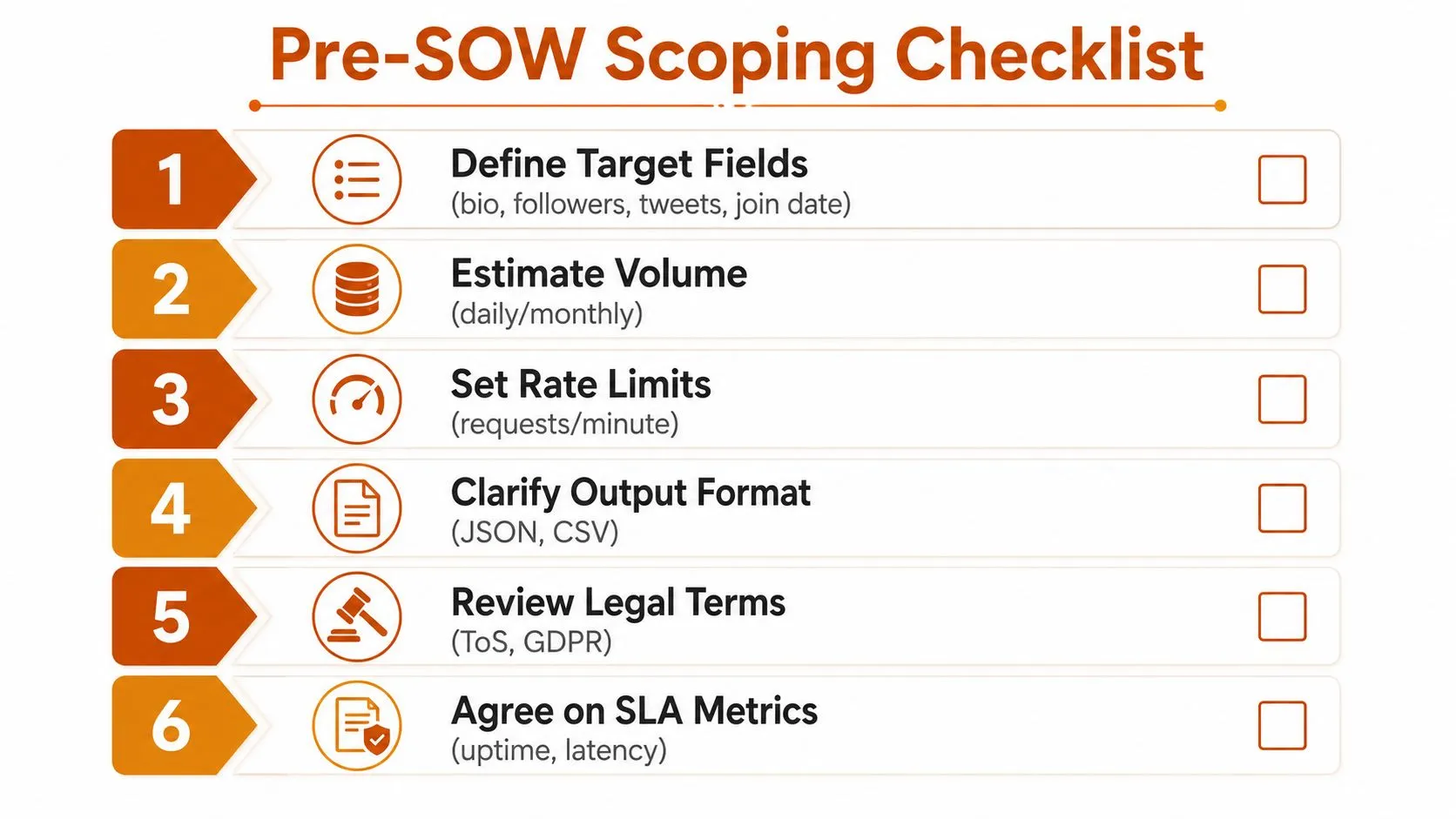
Give procurement and the vendor the same worksheet. If either side fills in an item with “standard,” ask for the actual assumption.
-
Define target fields. Specify whether each user needs a username, ID, bio, avatar, banner, location, joined date, public metrics, pinned post, recent posts, follower data, or timeline history. Mark every field as required, optional, or best effort.
-
Estimate volume. State the starting list size, expected additions, invalid-identifier policy, and whether the pipeline must support a one-time batch or recurring growth.
-
Set rate limits and freshness. Write the required refresh interval, acceptable latency, retry window, and treatment of partial delivery. Don’t accept “near real time” without a measurable definition.
-
Clarify output and retention. Choose JSON, CSV, database delivery, webhook, or object storage. Define schema versioning, snapshot retention, deduplication, deletion handling, and reprocessing rights.
-
Review legal terms. Put the permitted use, account responsibility, data retention, access controls, deletion process, X terms review, and privacy obligations in writing. Technical accessibility isn’t a substitute for authorization.
-
Agree on SLA metrics. Specify uptime, completeness, freshness, incident response, maintenance windows, reporting, and remedies. State who pays for proxy escalation, CAPTCHA or SMS verification, and engineering retunes.
The checklist also exposes bad economics early. A vendor can’t estimate a weekly refresh without knowing the field set, and it can’t promise stable delivery without defining what happens when records are unavailable. Ask for a pilot acceptance test using representative usernames before committing to the full volume.
For teams that don’t want to own monitoring, retries, proxy management, and schema maintenance, WebscrapingHQ offers managed web data operations, custom extraction pipelines, scheduled CSV or JSON feeds, webhooks, S3 delivery, and compliance-oriented reporting. Visit WebscrapingHQ with this checklist prepared, and request a feasibility assessment that separates setup, infrastructure, maintenance, and SLA costs.
Want this done for you?
Send us the URLs. We'll quote it in 24 hours.
Paste the URL(s) you want scraped. We'll reply within 24 hours with a feasibility check and a ballpark quote.