Jump to section
- Introduction to Python Web Scraping Services and What They Deliver
- What a managed service actually owns
- Choosing Your HTML Parsing Stack in Python
- Start with the document, not the library
- Prefer structural selectors
- Handle encoding and malformed markup deliberately
- Extracting Structured Fields and Handling Errors Gracefully
- Map one record at a time
- Let one bad field fail locally
- Protect the contract downstream
- Parsing Dynamic Content and JavaScript Rendered Pages
- Escalate only when the evidence requires it
- Make browser extraction deterministic
- Practical Tips for Reliable and Compliant Scraping Operations
- Monitor the data, not just the process
- Treat governance as an engineering requirement
- Decide what to operate internally
- Conclusion and Next Steps for Your Scraping Project
- Use a clear build or buy test
A parser that worked perfectly on Friday can start returning empty titles on Monday. A retailer changes a class name, moves price data into a script block, or adds a consent layer, and the scheduled job still reports success because the HTTP request completed. The file looks valid, but the fields are blank, shifted, or stale.
That failure exposes the difference between a Python web scraping script and a production data operation. A short BeautifulSoup example can prove that a target page is readable. A dependable service must also define the source scope, map HTML into a stable schema, handle dynamic rendering, detect layout changes, manage retries, and deliver records where another system can use them.
Introduction to Python Web Scraping Services and What They Deliver
A one-off scraper usually starts with a sensible experiment. You send a request, inspect the response, find a product card, and extract its title with a selector. That approach is useful for feasibility work, and a practical web scraper Python passo-passo can help a developer understand the basic sequence from request to parsed output.
The trouble begins when the script becomes operational. A business may need product availability, job listings, property attributes, search results, or compliance evidence on a recurring schedule. Each target can expose different HTML conventions, pagination rules, localization behavior, JavaScript dependencies, and access controls. The parser is only one component in that chain.
What a managed service actually owns
A serious service starts by turning a vague request into a data contract. That means identifying the target URLs, the fields that matter, the expected frequency, the geographic or language variants, and the delivery format. The output might be normalized JSON, a CSV feed, an S3 drop, a webhook, or a report that highlights exceptions.
The engineering work then continues after the first successful extraction:
- Source assessment: Determine whether the required fields appear in raw HTML, embedded JSON, an accessible endpoint, or rendered browser content.
- Schema mapping: Define how titles, prices, availability, metadata, links, and timestamps become consistent fields.
- Failure handling: Record missing nodes, changed layouts, blocked responses, timeouts, and invalid values without discarding the entire run.
- Operational delivery: Schedule jobs, retry transient failures, monitor field quality, and route usable data to downstream systems.
- Maintenance: Re-test selectors and adjust extraction logic when the target changes.
This is why the decision is rarely “BeautifulSoup or no BeautifulSoup.” The question is whether your team wants to maintain the entire path from source inspection to reliable delivery. The case for choosing web scraping services instead of managing it on your own comes down to that ownership boundary.
Practical rule: If an empty result can affect a business decision, treat extraction as a monitored pipeline rather than a script that happens to run.
A DIY parser is appropriate when the source is stable, the scope is narrow, and an engineer can respond quickly to changes. A managed operation makes more sense when several sources, recurring updates, multiple regions, or strict output requirements turn maintenance into a permanent engineering task.
Choosing Your HTML Parsing Stack in Python
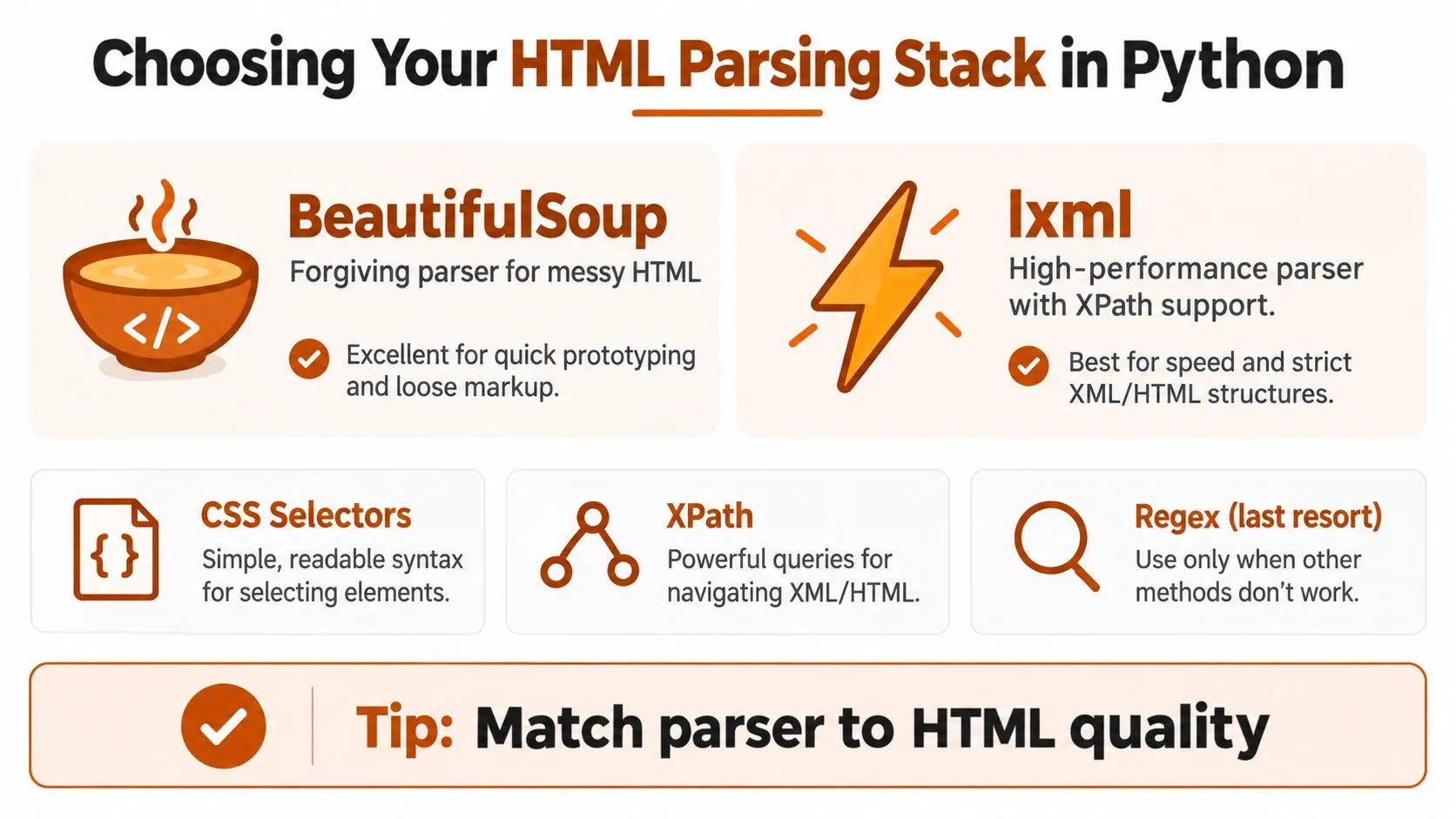
Parser selection should follow the shape and quality of the HTML, not personal preference. BeautifulSoup is forgiving and easy to inspect, while lxml offers fast tree processing and precise XPath queries. CSS selectors work well across both approaches, but selector quality determines whether a parser survives a redesign.
Start with the document, not the library
Fetch and save representative responses before writing extraction logic. Inspect the raw response, not only the browser’s rendered inspector, because the browser may display nodes created after JavaScript runs. Check the document encoding, whether the relevant content is present, and whether the markup contains repeated containers for each record.
BeautifulSoup is a strong first choice for irregular or forgiving HTML. It lets you move through a parse tree with readable methods and CSS selectors, and it remains useful when tags are imperfectly nested. That makes it effective for prototypes and targets where developer-friendly inspection matters more than maximum parsing throughput.
lxml is a better fit when documents are large, structures are consistent, or XPath expresses the relationship more clearly than a CSS query. An XPath can select a price relative to a product container, locate a link by an attribute, or move through nested nodes with precision. The trade-off is that poorly formed markup can require more care than it would with BeautifulSoup.
Prefer structural selectors
A selector tied to a generated class name can fail after a harmless front-end rebuild. A selector based on a stable semantic attribute, a repeated item container, or a relationship between a label and its value usually lasts longer.
| Selector choice | Useful for | Main risk |
|---|---|---|
| Stable attributes | Product identifiers, links, semantic markers | The attribute may still be redesigned |
| Container plus child relationship | Keeping fields tied to the same record | Incorrect nesting can misalign values |
| CSS selectors | Readable, concise extraction rules | Deep chains become brittle |
| XPath | Precise relationships and conditional selection | Complex expressions can be hard to maintain |
| Regular expressions | Text cleanup or narrowly defined patterns | Regex is fragile as a primary HTML parser |
Avoid selecting “the third div inside the second wrapper” unless the page gives you no better option. A parser should express what the data means, not merely where it happened to appear during one inspection session. The basics of HTML web scraping provide useful grounding for examining that structure before choosing selectors.
Handle encoding and malformed markup deliberately
Encoding errors can turn a correct selector into corrupted data. Preserve the response content, confirm the declared encoding when necessary, and normalize text only after extraction. Strip repeated whitespace, decode entities, and retain the original response for debugging when the target contains unexpected characters.
Keep parser code separate from transport code. requests or httpx should obtain the response, while BeautifulSoup or lxml should turn that response into nodes. That separation makes it easier to replace a static request with browser-rendered HTML later without rewriting the schema mapping.
The parser choice is less important than the boundary around it. Store selectors in identifiable functions, test them against saved fixtures, and make failures visible. A fast parser with opaque selectors still creates a slow maintenance problem.
Extracting Structured Fields and Handling Errors Gracefully
Reliable extraction begins with a schema, not a loop over matching nodes. Before writing selectors, define the record that downstream users need. An ecommerce record might contain title, price, currency, availability, product_url, source_url, and collected_at. A job record might need a title, employer, location, description, and application link.
Map one record at a time
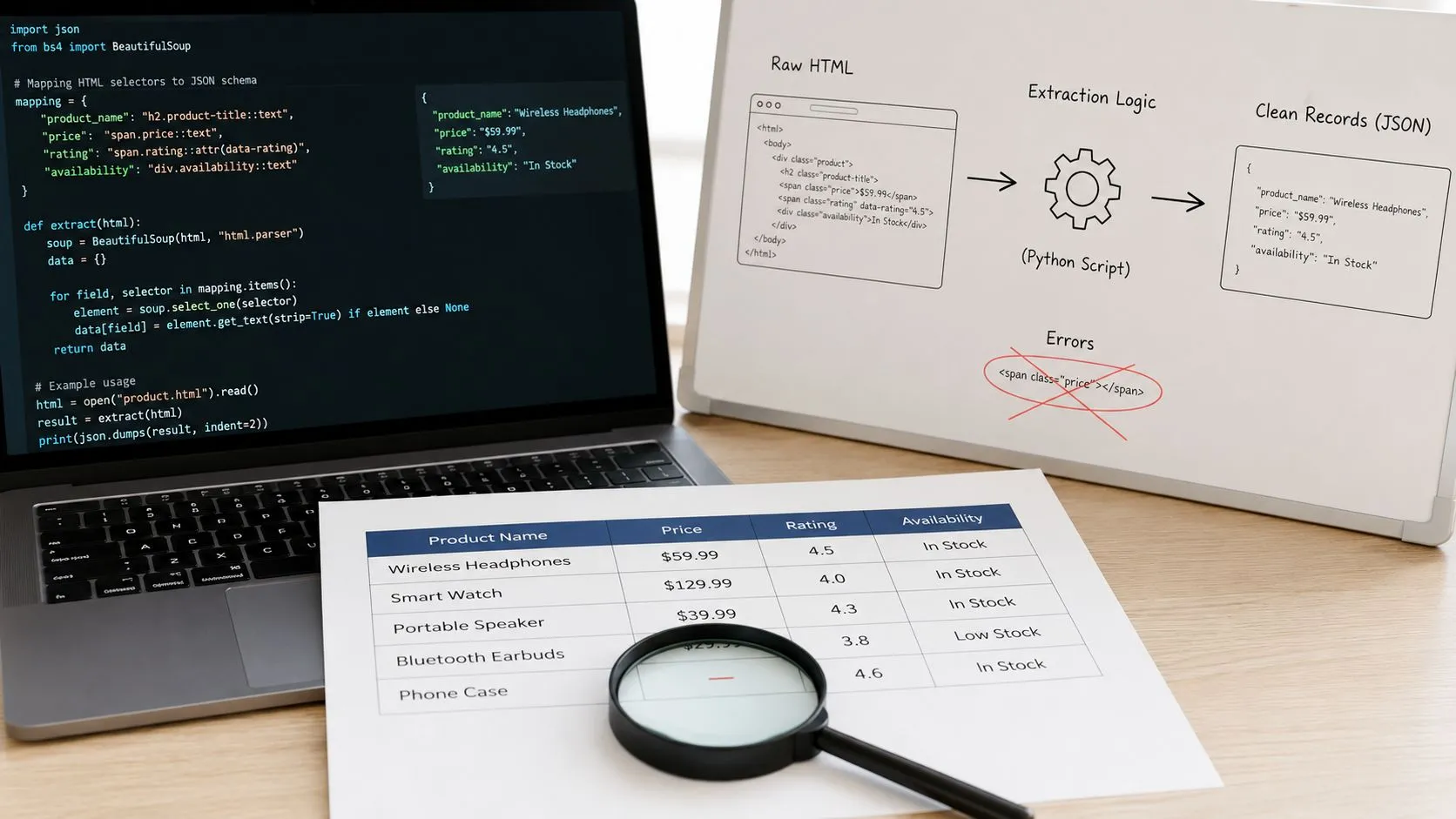
Find the repeated container first. Extract every field inside that container so the title, price, and availability remain attached to the same item. Pulling all titles into one list and all prices into another can misalign records when one field is missing.
A useful field mapping has four parts:
- Locate the node: Use a stable CSS selector or XPath relative to the record container.
- Extract the value: Read text, an attribute, a URL, or embedded data.
- Normalize the value: Collapse whitespace, standardize date formats, and separate currency from the numeric representation.
- Validate the result: Check required fields, expected types, and sensible relationships between values.
Normalization belongs in a distinct layer. Keep the raw text when an audit trail matters, then create a cleaned field for analysis. A price parser should distinguish a missing value from a value that failed conversion. A date parser should preserve the original string when the source format changes.
Let one bad field fail locally
A missing description shouldn’t erase an otherwise valid product. Wrap field-level extraction in small functions that return a controlled null value and log the reason. Reserve record-level rejection for conditions that make the record unusable, such as a missing identifier or canonical URL.
Useful error categories include:
- Transport failure: The request timed out, returned an error response, or produced an unexpected content type.
- Selector failure: The expected node is absent or appears in a different location.
- Normalization failure: The text exists but cannot be converted into the required type.
- Validation failure: The record violates a schema rule, such as a missing identifier.
- Delivery failure: The data parsed correctly but could not be written to the destination.
Log the URL, source, field, parser version, response status, and a safe excerpt of the relevant HTML. Avoid logging sensitive values unnecessarily. A useful log lets an engineer reproduce the failure without searching through an entire run.
A parser should degrade by field, not collapse by page.
Fallback selectors have a place, but they shouldn’t conceal a redesign indefinitely. If the primary selector fails and a fallback succeeds, mark that event so the team can review it. Silent fallbacks turn a visible change into hidden technical debt.
Protect the contract downstream
Schema versioning becomes necessary when a source adds, renames, or changes a field. Keep the existing field stable when possible, introduce a new version for breaking changes, and document the transformation. Downstream consumers should know whether an empty value means “not present on the page,” “not collected,” or “parser error.”
Before export, run checks for required columns, duplicate identifiers, unexpected null rates, and invalid formats. The common web scraping errors and their solutions are useful as a diagnostic reference, but production code still needs project-specific validation rules.
A clean CSV or JSON file isn’t proof of correctness. A parser can produce a syntactically valid file filled with stale or misplaced values. Quality checks must examine the fields that matter, not only whether the job completed.
Parsing Dynamic Content and JavaScript Rendered Pages
Static HTML and rendered browser content are different extraction problems. A request made with requests or httpx may return a useful document, an application shell with no records, or data embedded in a script block. Starting a browser for every page is expensive and unnecessary when the source already exposes the required fields.
Escalate only when the evidence requires it
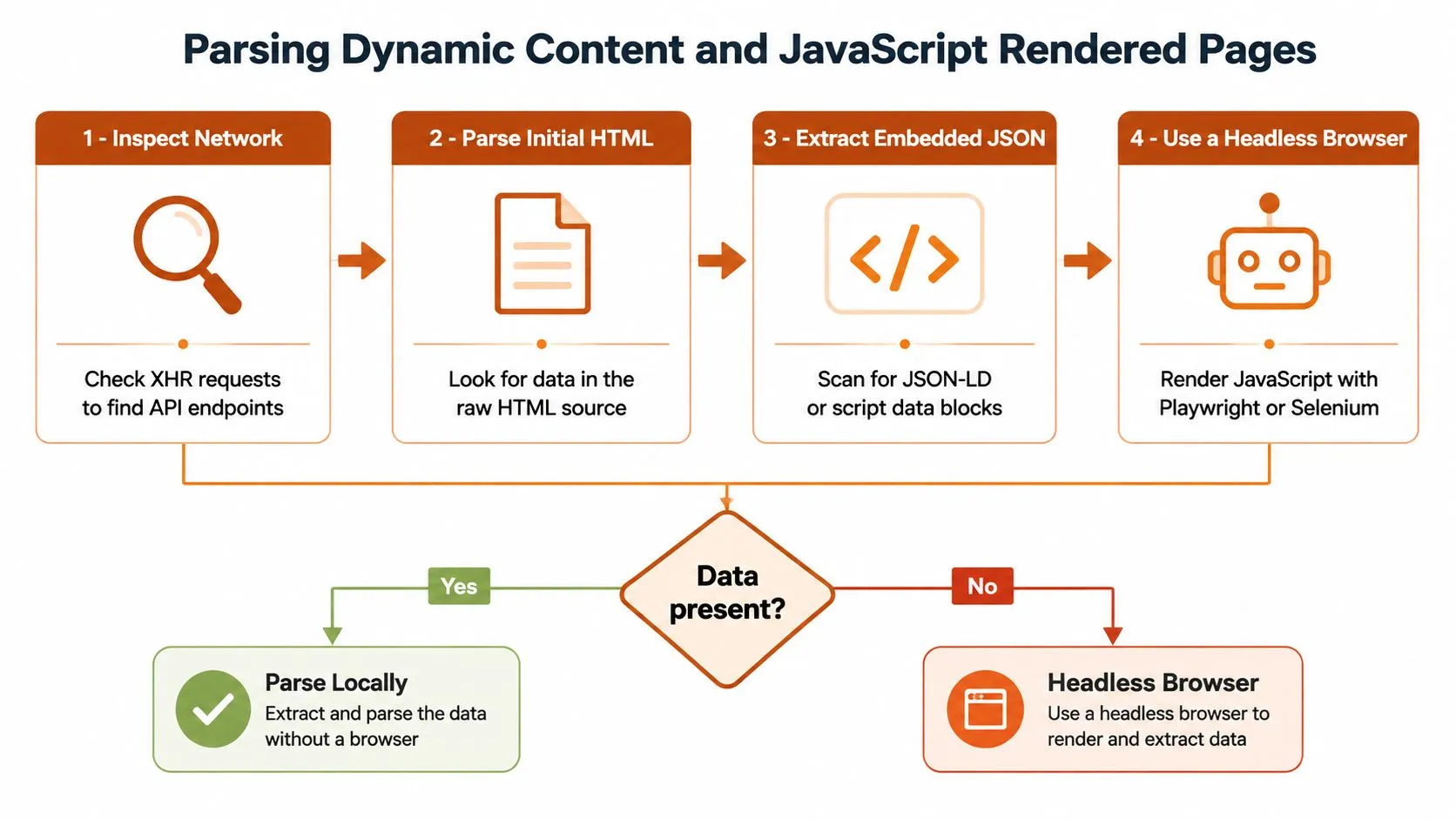
Use a clear diagnostic sequence:
- Inspect network activity: Look for XHR or fetch requests that return structured records. An accessible data endpoint may be more stable and lighter than rendering the full page.
- Parse the initial response: Search the raw HTML for visible fields, links, pagination information, and stable containers.
- Check embedded data: Examine JSON-LD and relevant script blocks for product, article, or application data.
- Render selectively: Use Playwright, Selenium, or another browser automation tool when JavaScript, interaction, scrolling, or client-side state is required.
The browser should be an escalation layer, not the default hammer. Rendered sessions consume more resources, require careful waiting logic, and introduce browser lifecycle failures. Static requests are easier to retry, inspect, cache, and run at higher concurrency.
Make browser extraction deterministic
Avoid arbitrary sleeps as the primary synchronization method. Wait for a meaningful condition, such as a specific record container, a network response, or a loading marker disappearing. Capture the final HTML after the condition is met, then pass it through the same parsing and schema validation layer used for static responses.
Infinite scroll requires its own stopping rule. Continue only while new records appear, a page limit remains, or the source signals that no further results exist. Without a stopping condition, a browser worker can spend its entire session chasing a feed that never declares completion.
Browser automation doesn’t eliminate anti-bot controls. A controlled 2025 benchmark across 82 sites found that a single static residential IP reached about 45.1% success with a basic request setup, about 50% after adding a custom User-Agent, and 51.2% with a full browser agent, while Playwright reached 29.3% in that test. These figures come from the ScrapeOps blocking case study, and they show why changing headers or selecting a browser library isn’t a complete access strategy.
CAPTCHAs, JavaScript challenges, and no-response blocks were the common failure modes in that benchmark. Header spoofing alone won’t address browser fingerprints, IP reputation, request frequency, or behavioral signals. A practical escalation should therefore combine transport choices, browser handling, rate control, proxy decisions, and an explicit path for unresolved challenges.
The guide to extracting data from JavaScript pages with Puppeteer offers a useful comparison point for browser-based workflows. The tool matters, but the diagnostic sequence matters more. Render only what cannot be obtained reliably through a lighter method.
Practical Tips for Reliable and Compliant Scraping Operations
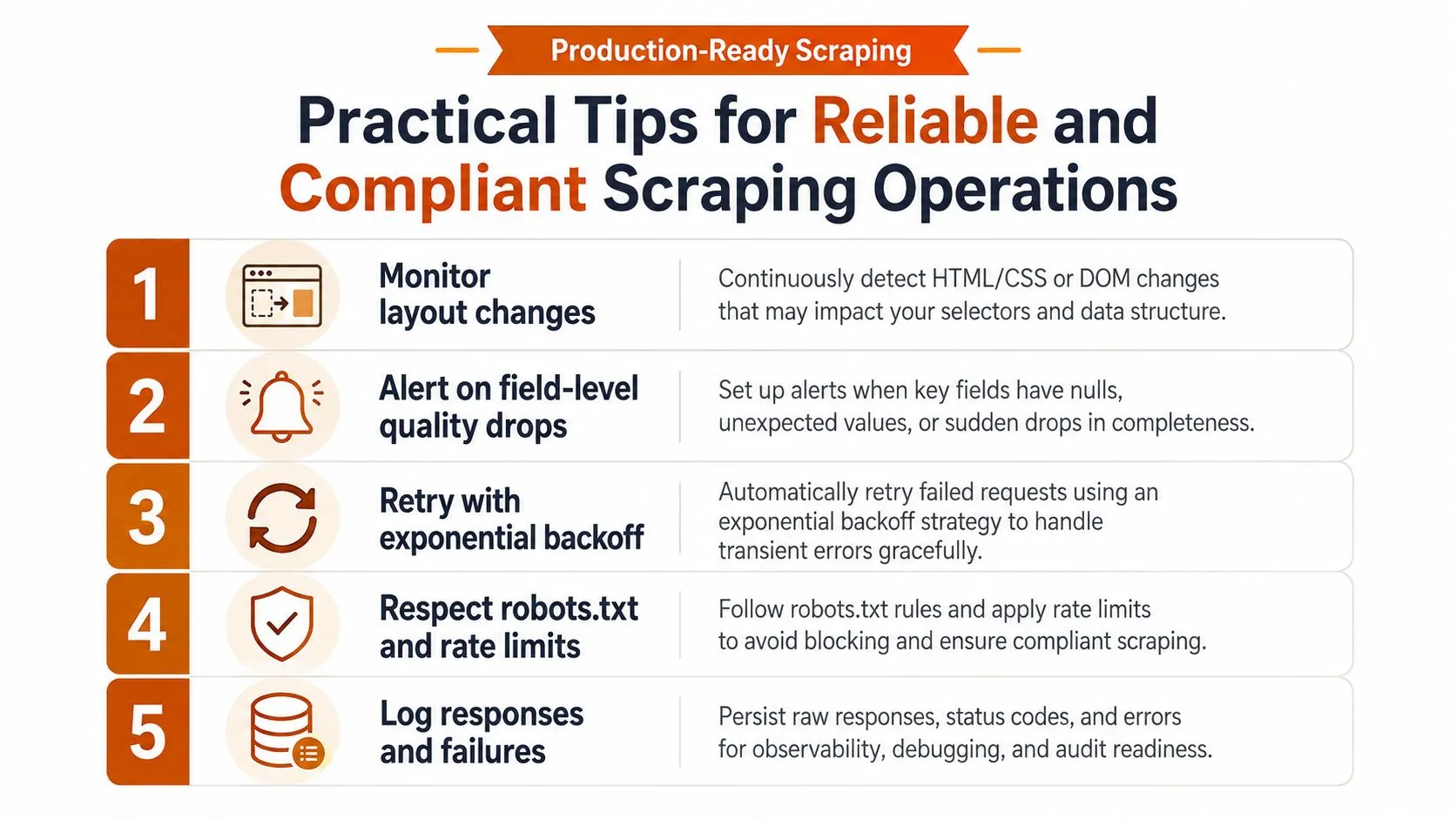
A production scraper needs feedback loops. It should collect responses, validate record quality, classify failures, and adjust its handling when the source or access conditions change. A job that exits successfully can still be broken if a required field has vanished or the response is a challenge page.
Monitor the data, not just the process
Set checks at the field level. Track required-field presence, URL validity, unexpected duplicates, and sudden responses containing an application shell or challenge page. Store representative response samples, so engineers can compare a healthy run with a failed one and identify whether the break occurred in access, parsing, or schema mapping.
Retries must separate transient failures from persistent defects. A timeout may justify a controlled retry with backoff. A repeated selector miss should raise an alert and preserve the original response, classification, and parser version instead of creating an endless retry loop. Record enough context to reproduce the failure.
Rate control protects reliability and the target’s infrastructure. Follow published access guidance, robots.txt where applicable, terms of service, and reasonable request pacing. Proxy rotation can support distributed access requirements, but it does not provide authorization or replace careful traffic management.
Treat governance as an engineering requirement
Public availability does not settle whether data may be collected, retained, or reused. Compliance work should cover data minimization, documented lawful basis, transparency, and auditable decision logs, particularly when processing personal or quasi-personal data across jurisdictions. The discussion of the GDPR risks in large-scale web scraping reinforces the distinction between technical access and processing rights. Teams can also use a step-by-step approach to GDPR-compliant web scraping when documenting collection and review controls.
Before launch, document:
- Purpose: Explain why each field is needed and remove fields that do not support that purpose.
- Source rules: Review terms, access instructions, authentication requirements, and applicable restrictions.
- Retention: Define how long raw responses and normalized records remain available.
- Access controls: Limit access to sensitive extracts, logs, and delivery destinations.
- Review evidence: Preserve decisions about scope, lawful basis, changes, and exceptions.
A broader practical guide to third party data helps place scraped information within a wider governance process rather than treating extraction as an isolated coding task.
Decide what to operate internally
Internal teams generally keep ownership of schema definitions, acceptance tests, and downstream business logic. They may not need to run browser fleets, choose proxies, handle challenges, and repair selectors after every source change. WebscrapingHQ is one managed option. It scopes sources, builds custom extraction pipelines, monitors changes, and delivers structured outputs through CSV, JSON, webhooks, S3 drops, or reports.
Choose the handoff by failure cost and operating burden. A small prototype can remain in a repository with fixture tests and a scheduled worker. A recurring multi-source operation needs named ownership, alerts, escalation procedures, delivery checks, and documented compliance controls. Those requirements determine whether maintaining the pipeline internally remains practical.
Conclusion and Next Steps for Your Scraping Project
The durable approach to Python web scraping starts with a production pipeline, not a clever selector. Inspect the source, choose BeautifulSoup or lxml according to the document, map records into an explicit schema, normalize values, validate results, and separate static extraction from browser escalation. Then add monitoring, retries, delivery checks, and governance before anyone depends on the output.
DIY is a sensible choice when the target is limited, the schema is simple, changes are infrequent, and your team can respond to failures. A managed service becomes more practical when the project spans many sources, regions, languages, schedules, or downstream consumers. It also makes sense when engineers are spending more time repairing access and selectors than building the product that uses the data.
Use a clear build or buy test
Ask four questions before committing:
- How often will the source change? Frequent redesigns create recurring maintenance work.
- What happens when data is wrong? A missed field may be inconvenient, or it may trigger a bad commercial or compliance decision.
- How much rendering and access handling is required? Static pages are simpler than JavaScript-heavy sources with layered defenses.
- Who owns delivery and incident response? A parser isn’t complete until the right data reaches the right system.
Start with a source audit and a schema workshop. Save representative HTML, identify required and optional fields, test whether data appears in raw responses or embedded structures, and define validation rules before scaling collection. Keep the first parser small, but design its interfaces as if another worker will eventually replace it.
AI-assisted extraction can help interpret changing layouts and unstructured content, but it doesn’t remove the need for schemas, review rules, provenance, or quality monitoring. The lasting advantage comes from combining flexible parsing with disciplined operations, not from replacing every selector with a model.
WebscrapingHQ can scope target sources, build Python-compatible extraction pipelines, monitor parser and access failures, and deliver normalized data through feeds, webhooks, S3, or scheduled reports. Visit WebscrapingHQ to discuss your fields, sources, delivery schedule, and whether a managed operation fits your project.
Want this done for you?
Send us the URLs. We'll quote it in 24 hours.
Paste the URL(s) you want scraped. We'll reply within 24 hours with a feasibility check and a ballpark quote.