Jump to section
- Enterprise Hotel Data Extraction in Practice
- Why the script becomes a service
- Technical Hurdles and Anti-Bot Resilience
- Why collection quality moves
- What resilient architecture checks
- Normalizing Data for Accurate Rate Parity
- Align the commercial meaning
- Synchronize time and context
- Managed Operations Versus In-House Engineering
- Comparing Control, Maintenance, and Cost
- Where hidden costs appear
- Navigating Legal and Compliance Boundaries
- Build governance into the pipeline
- Drafting SLAs and Vendor Selection Criteria
- Define measurable service behavior
- Ask procurement questions that engineers can verify
- Transforming Raw Feeds into Strategic Intelligence
A revenue team opens its morning dashboard and sees a familiar problem. The direct website shows one rate, an OTA shows another, and a third channel displays a total that appears lower until taxes, cancellation terms, occupancy, and stay dates are compared. The team can’t tell whether it has a genuine parity breach or three valid offers presented under different conditions.
That confusion is rarely caused by a lack of raw data. It comes from treating a hotel data scraper as a page-download utility instead of a continuously operated data system. Reliable hospitality intelligence depends on collection quality, anti-bot resilience, temporal alignment, parameter normalization, validation, governance, and delivery into the systems that make pricing decisions.
Web scraping has been positioned as a hospitality research method since 2021, when Han and Anderson described it as a way to automatically download, parse, and organize web data for practical hotel research (methodological reference). The enterprise question has moved on from whether hotel pages can be collected. It’s whether the resulting feed is comparable, explainable, and dependable enough to support an SLA-backed revenue workflow.
Enterprise Hotel Data Extraction in Practice
A revenue manager opens a parity report and sees three different offers for the same stay. One channel shows a lower nightly rate, another includes different cancellation terms, and the direct site returns a total that only appears comparable after taxes, occupancy, currency, and dates are aligned. The decision depends on a rate record that preserves its search conditions, not a number copied from a page.
A basic script can request HTML, locate a price selector, and save the result. That approach breaks when rates render through JavaScript, markup changes, results depend on a session, or the platform returns a market-specific offer. It also creates false comparisons when the same property uses different names or identifiers across channels, or when one source reports a nightly amount while another reports the full stay.
An enterprise hotel data scraper therefore needs a service boundary and an operating model:
- Collection workers retrieve pages or rendered results under defined market, device, and timing contexts.
- Session controls preserve conditions that affect inventory, currency, and rate visibility.
- Parsers extract room, price, policy, availability, and property fields.
- Normalization services map inconsistent representations into a shared analytical schema, including stay dates, occupancy, currency, taxes, cancellation terms, and rate-plan identity.
- Validation rules flag missing fields, duplicates, unexpected changes, stale timestamps, and suspicious values.
- Delivery jobs publish structured outputs to a warehouse, object store, dashboard, or pricing system.
- Operational controls record run status, parser versions, retry history, and evidence for each comparison.
The European Union has documented hotel data collection through web scraping from Booking.com and reported that around 15,000 unique accommodation establishments per month were collected from Hotels.com and Booking.com. The same documentation recorded 239 new accommodation establishments with 10 or more bed places in 2022 identified through scraping (EU methodology reference). The significance is operational: scraping can support repeatable registers and tourism statistics when collection, definitions, and validation are managed as infrastructure.
Why the script becomes a service
Hotel platforms behave like changing applications rather than static documents. Results may depend on destination, dates, guest count, currency, geography, device, cookies, and session state. A pipeline that stores only the visible price produces a tidy-looking dataset that cannot support a defensible parity decision.
Time adds another failure mode. A direct rate captured in the morning and an OTA rate captured later may reflect a legitimate inventory or price change, not a channel discrepancy. Reliable parity workflows record collection timestamps, align observations within an agreed window, and preserve the parameters used for each search. Without that temporal normalization, even accurate extraction can produce misleading alerts.
The EU and UNECE case study on hotel room prices demonstrates the operational risk. Collection rates in 2019 ranged from 89.4% in January to 94.0% in March, with 92.0% in June and 92.0% in September. During the disruption in 2020, collection fell to 0.6% in April and 19.8% in May, then recovered unevenly, reaching 83.0% in July 2021, 81.6% in September, and 81.3% in October (EU and UNECE case study).
Practical rule: Treat every collected rate as a measurement with a timestamp, source, search context, parser version, and validation status.
The hidden cost is maintaining trust after platforms change, traffic conditions shift, and commercial teams depend on the feed. That work includes ownership, monitoring, incident response, quality thresholds, and an SLA that defines when a record is usable.
Technical Hurdles and Anti-Bot Resilience
A scheduled hotel-rate job can report success while returning a consent page, an empty inventory response, or a cached shell with no offer data. Modern booking platforms place meaningful results behind JavaScript rendering, session-bound rate tables, and geography or currency rules. A plain HTTP request may reach the domain yet fail to reproduce the browsing context required for a comparable rate.
Production collection usually combines browser automation, session persistence, and market-aligned proxy routing. Browser automation handles client-side rendering and interaction flows. Session persistence keeps dates, occupancy, currency, and other inputs stable across requests. Proxy alignment helps the request represent the geography whose prices the revenue team is measuring, although it adds cost, pool-quality variation, and governance work.
The Playwright anti-bot measures guide helps when designing browser-based collection. Rendering alone does not address traffic-pattern analysis or reputation problems. A production worker also needs controlled concurrency, retry limits, response classification, and evidence that the returned page contains a genuine offer rather than a silent block.
Why collection quality moves
Travel platforms inspect request behavior through traffic patterns, IP reputation checks, CAPTCHA challenges, and responses that appear valid but contain no usable inventory. Guidance on anti-bot and hotel price scraping discusses the trade-offs between datacenter and residential routing, browser and TLS fingerprint handling, and rate-controlled session rotation.
Residential routing can improve geographic realism, but it increases spend and introduces questions about provider governance and pool quality. Browser fingerprint handling can keep sessions more consistent, while browser workers consume more compute than direct requests. Aggressive retries may recover a transient failure, but they can also reinforce the traffic pattern that triggered the block.
Set an operational coverage threshold before the crawler reaches production. If any property is missing from two consecutive snapshots, flag it for manual review. If a channel, market, or date cohort falls below its agreed threshold, open an incident even when every worker exits successfully. This shifts monitoring from transport health to business-data availability. Keep the threshold and escalation path in the SLA rather than leaving them to individual engineers.
What resilient architecture checks
A dependable hotel data scraper should record:
- Response classification: Separate valid rate results from consent pages, CAPTCHA screens, empty inventories, and fallback content.
- Session continuity: Preserve the dates, occupancy, currency, and other inputs associated with each result.
- Geographic consistency: Route and validate searches according to the market being measured.
- Change detection: Alert when selectors, field names, response shapes, or page flows change.
- Coverage monitoring: Track missing properties, channels, dates, and fields rather than only worker completion.
- Controlled recovery: Retry with limits and escalation paths, not unlimited loops.
Before scaling the crawler, teams can run a Screaming Frog site crawl on owned hotel properties to identify URL patterns, redirects, metadata inconsistencies, and page structures that affect direct-site extraction. That audit does not replace dynamic rate collection. It reduces avoidable discovery and mapping errors, leaving the pipeline to focus on session stability, valid observations, and incident response.
Normalizing Data for Accurate Rate Parity
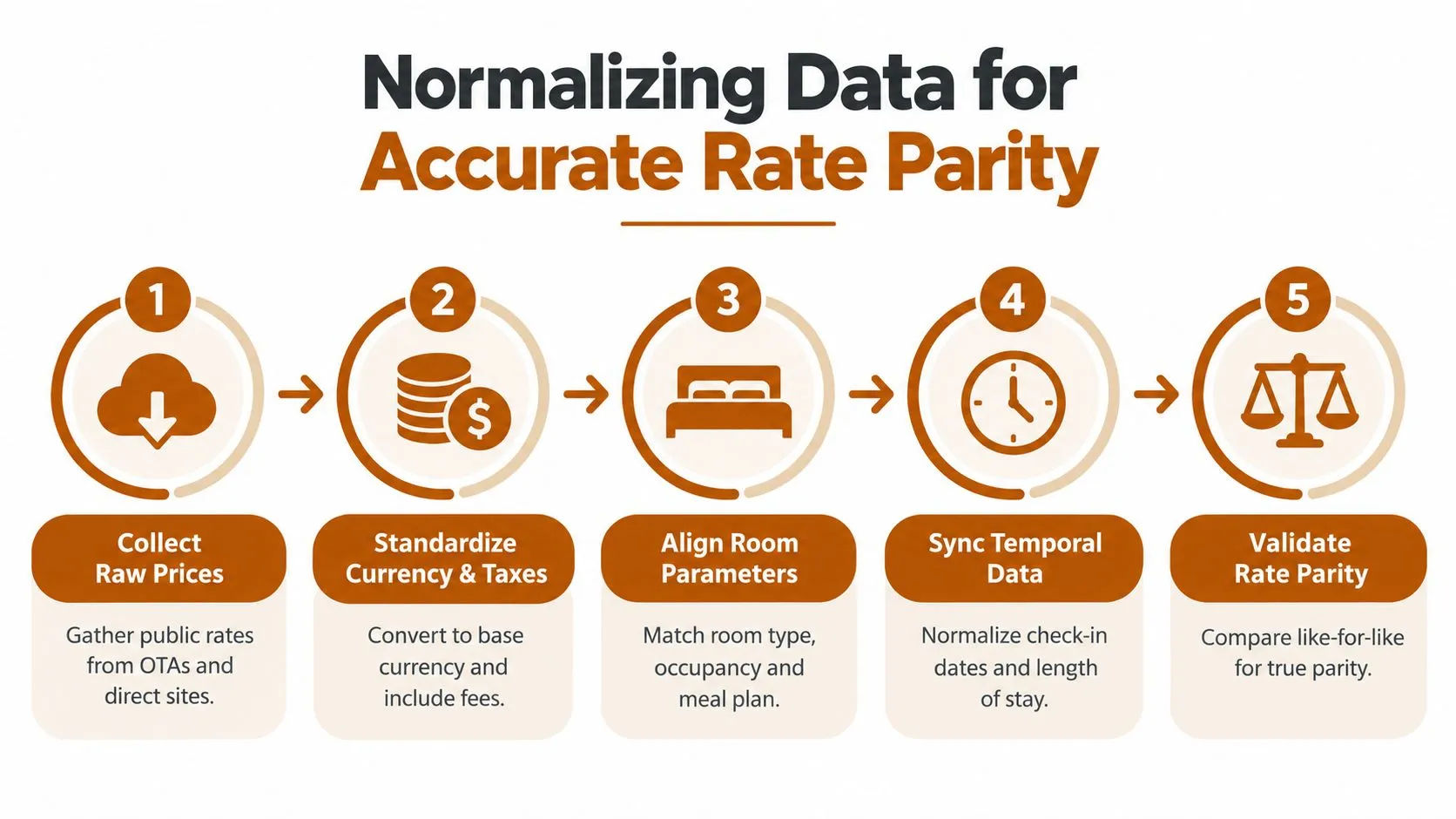
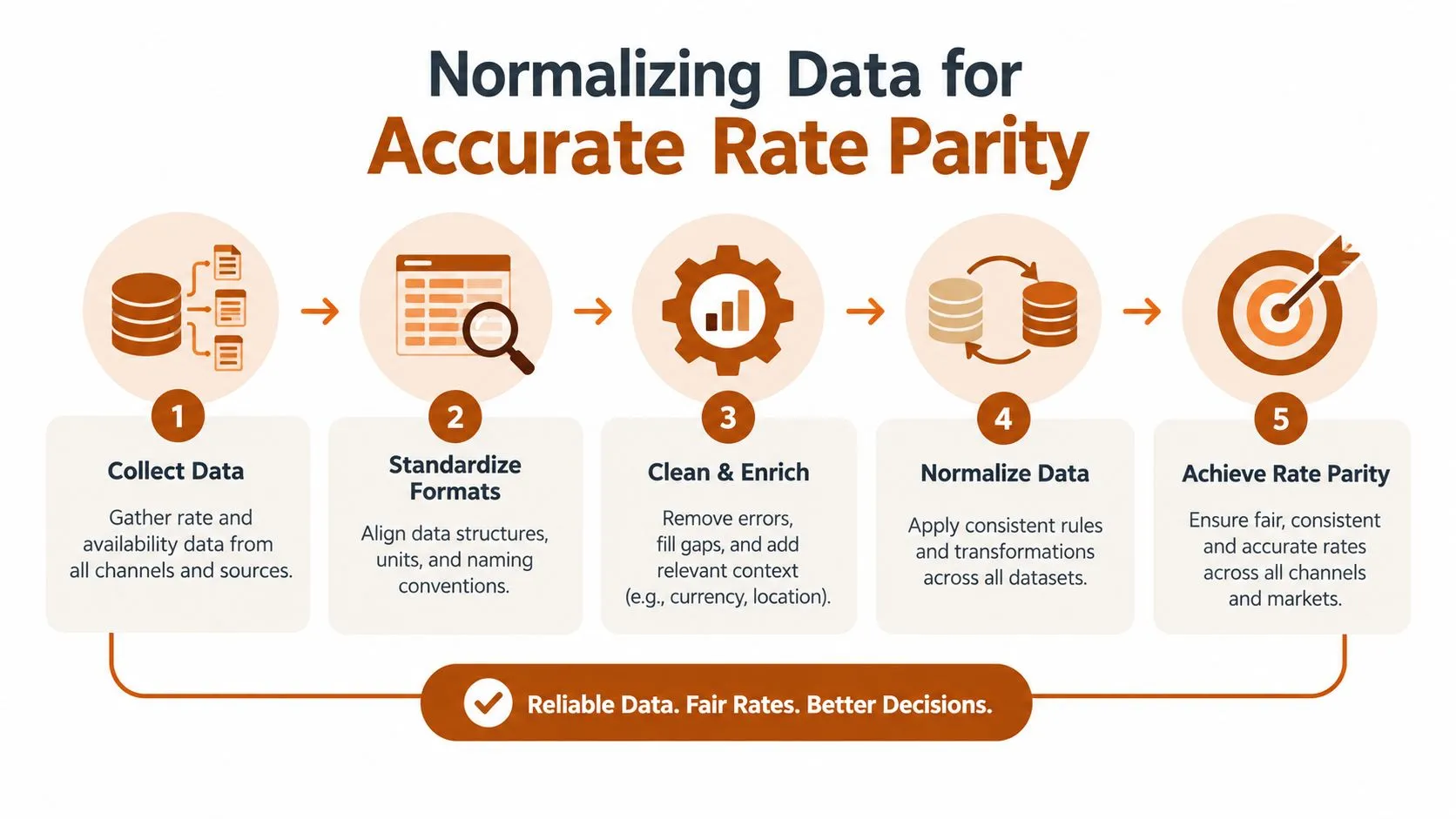
A rate parity alert can fail before any price comparison occurs. One channel may return a member rate for two guests in one currency, while another shows a public rate for a different stay context. A parity engine must reject that comparison, even when the room names look alike.
Create a search context key for every observation. Store the property and source-channel identities, check-in and check-out dates or length of stay, guest count, room occupancy, currency, geography, device context, and collection timestamp. Include cancellation terms, payment timing, meal plan, room type, bed configuration, and offer class, such as public, member-only, mobile-specific, or package-based. Without this record, later analysts cannot distinguish a pricing change from a query mismatch.
Align the commercial meaning
A nightly amount and a full-stay total need a common representation. Keep the original values for audit, then record the normalized amount, whether taxes and mandatory fees are included, and any tax treatment exposed by the source. Cancellation and payment conditions belong in separate fields. Combining them into one “rate” value removes the conditions that determine whether the offer is commercially equivalent.
Room matching needs more than string similarity. “Deluxe room” can carry different occupancy, bedding, meals, or cancellation terms across channels. Match normalized room names with occupancy, bed type, meal plan, cancellation policy, and visible amenities. If the evidence is incomplete, mark the records as unmatched. A cautious unmatched result is more useful than a false parity signal.
Property identity needs the same discipline. Maintain a canonical hotel identifier alongside each source-specific identifier. Resolve aliases, addresses, coordinates, and brand information through controlled entity resolution, and deduplicate before competitive comparisons reach a dashboard. Otherwise, one hotel can appear as several competitors and distort the resulting signal.
Synchronize time and context
Temporal normalization determines whether a parity comparison can support an operational decision. Query every channel with the same stay dates, length of stay, guest composition, and relevant booking conditions. Preserve the collection timestamp as well. A direct-site result from the morning is not an exact counterpart to an OTA result collected in a materially different search window, even when both records describe the same room.
The European Commission’s technical hotel data pipeline case study describes complications including JavaScript-rendered results, session-bound rates, and geographic or currency rules. It also addresses reconciling per-night and total-stay pricing, taxes, and duplicated listings before analytics compare hotels reliably.
Set alerts for persistent, context-matched deviations, rather than every transient fluctuation. Store raw observations, normalized records, match confidence, comparison status, and the ruleset version used for transformation. The guide to normalizing web-scraped data with Python can help engineers implement repeatable transformations, while revenue and distribution owners define the commercial equivalence rules.
A parity alert is only as credible as the context attached to both sides of the comparison.
Managed Operations Versus In-House Engineering
For a hotel rate-parity pipeline, the operating model determines how quickly missing snapshots, parser failures, and stale records reach the team that depends on them. Building internally provides direct control over code, infrastructure, schemas, deployment, temporal normalization, and parameter handling. It also assigns the organization responsibility for proxy pools, browser workers, CAPTCHA handling, source changes, data-quality investigation, reprocessing, and delivery recovery.
A managed operation transfers day-to-day collection and maintenance to a specialist. The buyer still owns scope, governance, acceptance criteria, and the rules that define comparable rates. This model can fit when hotel data influences pricing or market intelligence, while scraper maintenance competes with core product work.
Comparing Control, Maintenance, and Cost
The right model depends on whether scraper maintenance competes with product delivery and whether the team can support context-matched data under an agreed SLA.
| Feature | In-House Engineering | Managed Data Operations |
|---|---|---|
| Initial control | Full control over code, infrastructure, and deployment choices | Control through requirements, schemas, acceptance tests, and change requests |
| Anti-bot response | Internal team manages routing, browser behavior, session handling, and recovery | Provider operates collection infrastructure and adapts workflows |
| Site changes | Engineers diagnose and patch parsers | Operational team monitors changes and re-tunes extractors |
| Data quality | Internal analysts and engineers create validation rules | Provider implements agreed validation, exception handling, and reporting |
| Delivery | Team builds storage, schedules, retries, and integrations | Structured CSV, JSON, S3, webhook, or other agreed delivery can be operated externally |
| Resource impact | Ongoing maintenance competes with product and platform work | Internal staff focuses on requirements, consumption, and governance |
| Best fit | A core capability requiring deep internal control and available ownership | A recurring data need requiring reliability without maintaining the full stack |
In-house engineering works well when the company already runs browser infrastructure, has strong data-platform ownership, and can assign source-specific maintenance. It becomes fragile when a prototype is treated as production, no owner monitors collection gaps, or the original developer moves to another priority. Rate parity also requires consistent stay dates, guest parameters, currencies, and booking conditions. Someone must maintain those rules as sources change.
Managed operations reduce that maintenance load, but they do not remove the need for technical oversight. A provider may return the wrong schema, omit a market, or conceal collection gaps behind a polished dashboard. Test the service with representative properties, dates, geographies, and policy combinations before signing a recurring agreement. Define freshness, coverage, normalization, exception handling, and escalation requirements in measurable terms.
For a deeper build-versus-buy evaluation, why choose web scraping services instead of managing it on your own examines maintenance responsibility and operational trade-offs.
Where hidden costs appear
An internal budget often omits incident investigation, reprocessing missed snapshots, browser-version maintenance, proxy review, schema changes, and explanations for unexpected parity movements. Outsourcing does not eliminate these tasks. It places them within a service relationship where delivery expectations, response procedures, and accountability can be specified.
The decision should follow the business consequence of failure. If a missing or stale feed can influence a pricing action, require coverage checks, freshness monitoring, retained raw observations, and an escalation process, regardless of who operates the workers. A managed provider can support those controls, while an internal team must fund and operate them directly.
Navigating Legal and Compliance Boundaries
A hotel rate can be visible in a browser and still sit behind contractual, privacy, or technical restrictions. Before adding a source to a hotel data scraper, define what is collected, how often, for what business purpose, and under which controls. Public access alone does not settle those questions.
Start with a documented boundary. Public room rates, availability, property descriptions, and visible ratings may support rate-parity analysis. Login-protected pages, guest profiles, payment details, and back-office panels should remain excluded. Reviews, contact details, and other user-generated content need separate privacy assessment because they can introduce personal data into the pipeline.
Build governance into the pipeline
Record the business purpose before selecting sources. A parity-monitoring system has a narrower scope than an unrestricted archive of pages and user interactions. Define retention periods for raw responses and normalized records, limit access by role, and keep an audit trail linking each observation to its source, collection time, parser version, and processing status.
Governance must also account for temporal and parameter normalization. A rate snapshot without its check-in dates, length of stay, occupancy, currency, market, device context, and policy parameters cannot reliably support a parity decision. Retain those inputs with the output, and document which fields are transformed, discarded, or treated as unknown. This makes later review possible when two offers appear different because their search contexts changed.
Technical restraint is part of compliance. Apply rate controls, bounded retries, source exclusions, and escalation procedures. Anti-bot controls are not only an engineering obstacle. They can indicate that a platform has established boundaries requiring review, rather than automatic circumvention. If collection behavior cannot remain within an approved limit, pause the source and document the decision.
The guide to legal risks in web scraping and mitigation offers a practical checklist for separating public-data collection from privacy, contractual, and operational exposure. Obtain legal review before expanding into new regions, source categories, or materially higher collection frequency.
Governance standard: If the team cannot explain why a field is needed, how long it will be retained, and who can access it, keep that field out of production by default.
Assign ongoing ownership. Platform terms change, fields evolve, and a previously harmless output can become sensitive when combined with internal records. Maintain source inventories, deletion procedures, incident handling, periodic legal review, and a written decision log for exceptions.
Drafting SLAs and Vendor Selection Criteria
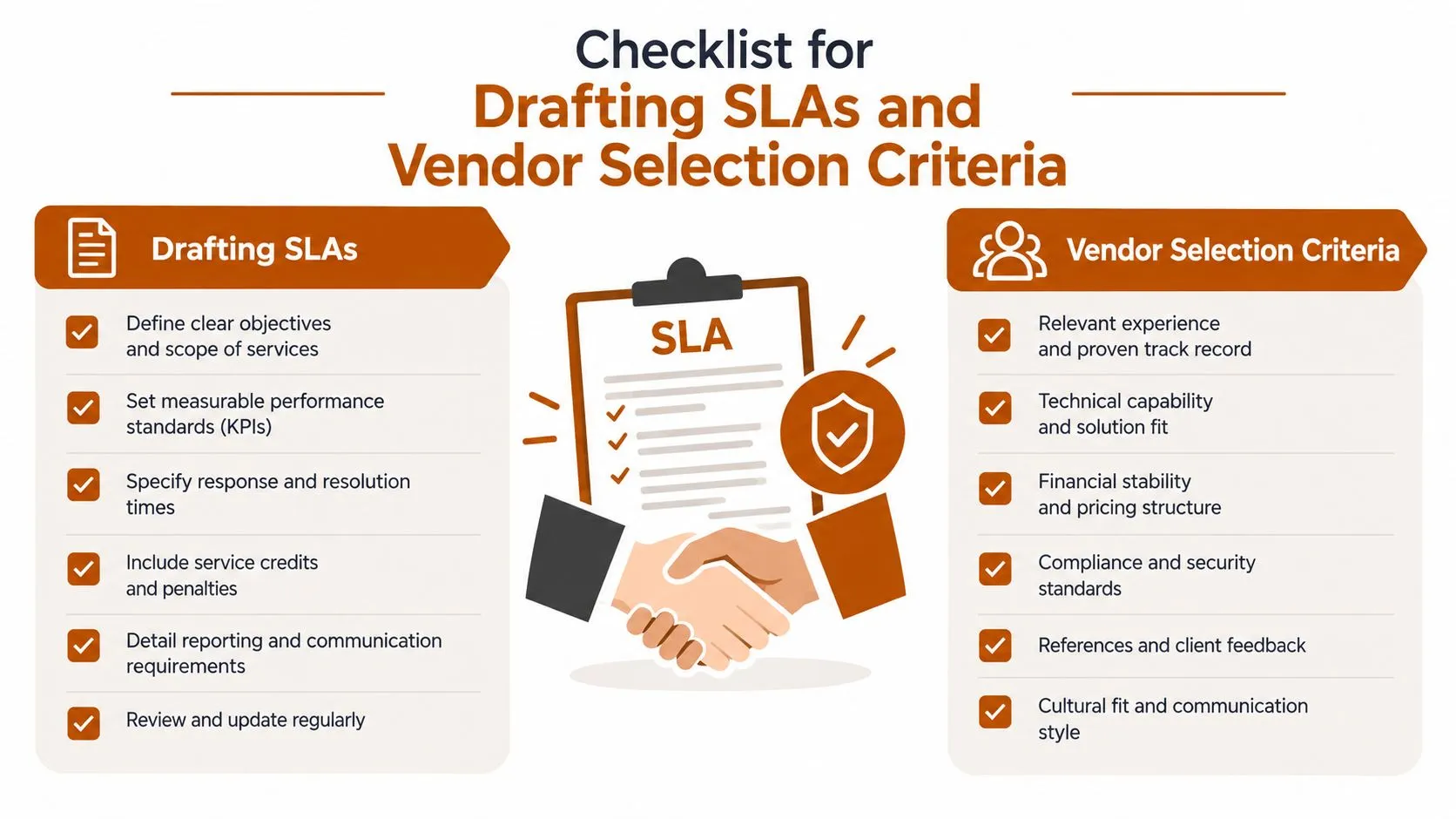
An SLA should define the data service the business will receive, not the infrastructure a vendor plans to operate. “Daily delivery” has little meaning unless it specifies properties, channels, search contexts, fields, formats, and exception states.
Start with an output contract. Define the canonical property identifier, source identifiers, rate and fee fields, currency, tax treatment, room and policy attributes, availability status, collection timestamp, search parameters, parser version, and validation flags. Require schema versioning so added fields or changed interpretations do not break downstream models.
Define measurable service behavior
A practical SLA should cover:
- Coverage: Markets, properties, channels, date windows, room types, and guest contexts included.
- Freshness: The time from completed collection to availability for consumers.
- Completeness: Mandatory fields and the way missing values are reported.
- Validity: How the provider separates a real offer from a block page, empty result, or malformed response.
- Delivery: Agreed formats, such as CSV, JSON, S3 objects, or webhooks.
- Change handling: Detection and communication of parser failures, schema changes, and source redesigns.
- Incident response: Alert recipients, incident evidence, and reprocessing procedures.
- Governance: Retention, access controls, source restrictions, and audit records.
For rate parity, the SLA also needs temporal and parameter rules. Specify which check-in and check-out dates, occupancy inputs, currencies, markets, devices, and booking conditions define a comparable observation. Require those inputs to travel with each result. Otherwise, a vendor can meet a freshness target while returning records that cannot be compared reliably.
A vendor trial should use difficult cases rather than clean sample pages. Test localized currencies, cancellation policies, occupancy patterns, direct sites, OTA results, and duplicate property mappings. Review successful records alongside failure artifacts, partial results, and evidence of blocked or invalid responses.
Ask procurement questions that engineers can verify
Ask how partial coverage is reported, whether raw evidence is retained, how schema versions are published, and what happens when a source changes without notice. Require a clear distinction between a completed job and a completed dataset. A worker can terminate successfully while quality checks still fail.
Broader procurement guidance, including material on selecting vendors for ecommerce, helps structure evaluation around fit, operational accountability, and integration requirements. Hotel scraping needs added tests for stay context, rate policy, temporal alignment, and parity matching.
The strongest SLA makes failure visible. A missing property, invalid currency, stale snapshot, unmatched room, and changed search context should each have distinct statuses. Those states determine whether the business retries collection, excludes the comparison, or escalates the vendor. Ad hoc repairs belong outside the production contract.
Transforming Raw Feeds into Strategic Intelligence
A hotel data scraper becomes strategic infrastructure only when its output is trusted, interpretable, and aligned to business decisions. Normalized records can support revenue management, market research, competitive dashboards, anomaly detection, and forecasting. Unvalidated spreadsheet rows cannot safely support those workflows.
Build lineage from each source observation to the final business signal. Retain collection context, parser version, normalization decisions, match confidence, and exceptions affecting a comparison. The data parsing guide covers the transformation layer, but parsing alone does not establish operational quality.
Rate-parity systems also need temporal and parameter discipline. Store the stay dates, occupancy, currency, device or channel context, collection timestamp, and applicable policy with every observation. A price comparison is only meaningful when those inputs align. Otherwise, analysts may treat a valid response as a false discrepancy, while stale or mismatched records enter dashboards and models.
Advanced extraction can interpret visual listing elements, irregular descriptions, policy language, and structured classifications through computer vision or language models. Deterministic checks, human review for sensitive decisions, and a stable downstream schema still govern release.
Treat external hotel data as a managed utility with defined freshness, coverage, quality, compliance, and delivery expectations. WebscrapingHQ provides managed operations and custom pipelines for recurring hospitality intelligence, including structured feeds, monitoring, anti-bot mitigation, schema controls, and scheduled delivery. Teams can discuss required sources, parameters, and SLAs through WebscrapingHQ.
Want this done for you?
Send us the URLs. We'll quote it in 24 hours.
Paste the URL(s) you want scraped. We'll reply within 24 hours with a feasibility check and a ballpark quote.