
Jump to section
- Table of Contents
- Beyond the Python Script Why Amazon Scraping Fails
- The target is moving
- Why “just parse the HTML” is outdated
- Comparing Amazon Data Extraction Methods
- A practical comparison
- Where AJAX changes the playbook
- Anatomy of a Resilient Price Scraping Pipeline
- Request handling and access control
- Extraction, structure, and delivery
- Ensuring Data Quality and Governance
- Validation has to happen before storage
- Governance turns output into a feed
- Enterprise Use Cases for Seller Price Data
- Competitive intelligence that actually moves decisions
- Repricing and compliance monitoring
- Operational scope in the real world
- Navigating Legal and Ethical Considerations
- Responsible collection is a risk framework
- Why compliance-aware operations matter
Most advice on how to scrape Amazon seller prices starts with the wrong problem. The issue isn’t writing a quick script that can read a page once, it’s keeping a price feed alive when Amazon changes the page state, shifts offer data into dynamic requests, and blocks repetitive traffic. A one-off extractor can work for a demo. It usually falls apart when the same ASIN needs to be checked again, and again, across multiple sellers and geographies.
Enterprise teams treat Amazon price scraping as an operational system, not a coding task. That means resilient request handling, parsing that survives layout drift, quality checks that catch bad price states, and delivery that downstream pricing systems can trust. It also means accepting that the easiest code path is rarely the safest production path.
Table of Contents
Open Table of Contents
Beyond the Python Script Why Amazon Scraping Fails

A basic scraper usually breaks for reasons that have little to do with Python skill. Amazon seller data shifts often, the offer surface changes, and the page you inspect in a browser is not always the same structure your script receives. Recent guidance on Amazon scraping emphasizes resilient monitoring, retries, and schema versioning, not simple extraction alone, and it points toward managed APIs and AI-assisted parsing because the underlying price elements change frequently Amazon scraping reliability guide.
The target is moving
Amazon seller prices are not a single static field. The same product can show different offers, fulfillment states, and promotional overlays depending on when and how the page is loaded, which makes a script that reads one selector fragile. A more dependable workflow starts by asking whether the captured value is the Buy Box, an offer listing, or a page-state artifact.
Timing creates another failure mode. For fast-moving categories, monitoring often has to run on a tight schedule, and teams that track a broad universe of ASINs with multiple competing sellers per item quickly turn a few price checks into a recurring feed. That is the point where monitoring intervals and seller volume shape the design of the pipeline, not the other way around.
Practical rule: if the business needs recurring price intelligence, design for continuous operation first, then decide how to extract the fields.
The maintenance burden is why generic scraping posts miss the mark. If your process cannot recover from selector drift, localized pricing, or a temporary block, the first successful run does not mean much. For a broader map of common failure modes, the overview at Web Scraping Challenges is useful background.
Rate limits create a similar break point. Once request volume rises, the pipeline needs backoff, rotation, and retry logic that can handle API Rate Limit Exceeded events without turning a short throttle into a full outage.
Why “just parse the HTML” is outdated
Modern Amazon pages often load seller data through AJAX requests when a shopper clicks into the offers view, so the collection target is not always static HTML anymore Amazon AJAX offer loading. That matters because request-level capture is usually more stable than browser-text parsing alone. It changes the engineering problem from finding a selector to identifying the data source, then normalizing it.
A simple script can still help with prototyping. It is not enough for an enterprise feed where price freshness, seller identity, and offer context all have to stay trustworthy. The teams that succeed build for drift, not just for first-page success.
Comparing Amazon Data Extraction Methods
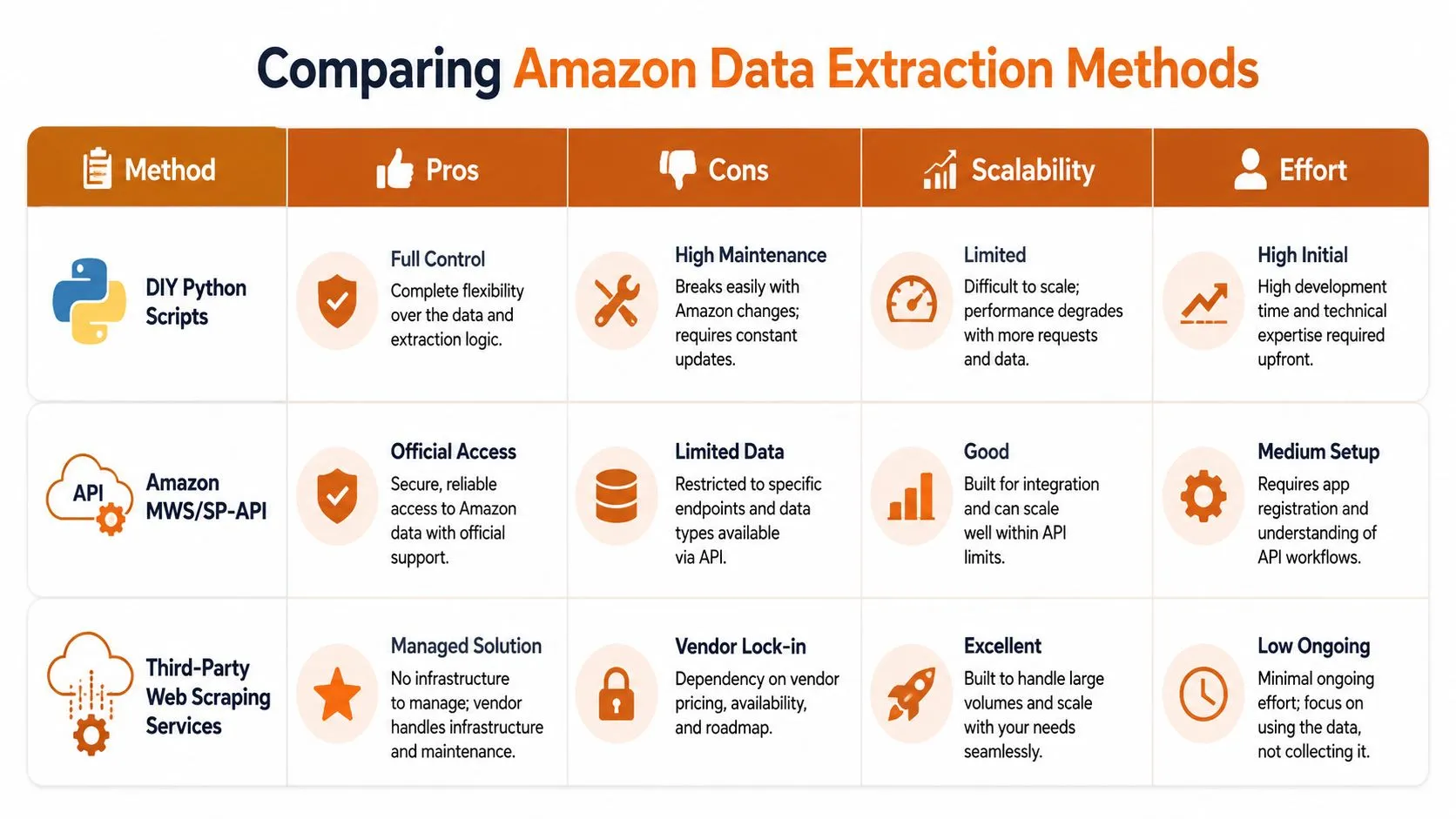
Three extraction paths matter in practice. DIY scripts give you direct control, Amazon’s official interfaces give structured access with clear boundaries, and managed extraction services give you operational consistency. The right choice depends less on coding preference than on how much failure your pricing process can absorb without breaking downstream reporting.
A practical comparison
| Method | Initial Cost | Scalability | Reliability | Maintenance Overhead |
|---|---|---|---|---|
| DIY Python Scripts | Low | Limited | Variable | High |
| Amazon MWS/SP-API | Medium | Good for supported data | High for official data | Medium |
| Third-Party Web Scraping Services | Medium to High | Excellent | High when managed well | Low ongoing |
DIY scripts are the fastest way to prove that the data is available. They also show how quickly Amazon can change selectors, move seller data into request payloads, or block requests that look automated. If you only need a small proof of concept, they are acceptable. If the feed has to stay available, the script turns into a maintenance burden.
Amazon’s official seller tooling fits use cases that stay inside the supported surface. For teams assessing what can be done through Amazon’s seller APIs, mastering Amazon Seller Central API is a useful reference point. The constraint is scope. Official interfaces do not expose full seller-price visibility across every offer state, which matters if you need broad market coverage rather than a narrow internal view.
Managed services are the better fit when the business needs repeatable extraction across many ASINs and many sellers. They absorb retries, structure changes, and anti-bot controls without pushing all of that work onto the engineering team. If you want a broader way to compare collection models, best web scraping methods in 2026 gives a useful framework for separating tool choice from operating model.
Where AJAX changes the playbook
Amazon often loads seller-offer data through AJAX when a shopper opens the offers view. That means the collection target may sit in network requests rather than in fully rendered page text. The practical result is simple. Request capture is usually more stable than browser-text parsing alone, because the source data is easier to identify and normalize.
That changes the engineering problem. A scraper has to understand request flow, parameters, and response structure, not just the DOM. In practice, that is a better fit for structured requests and controlled access patterns than for brittle page scraping, especially when the page layout shifts but the underlying response format stays consistent.
Anatomy of a Resilient Price Scraping Pipeline
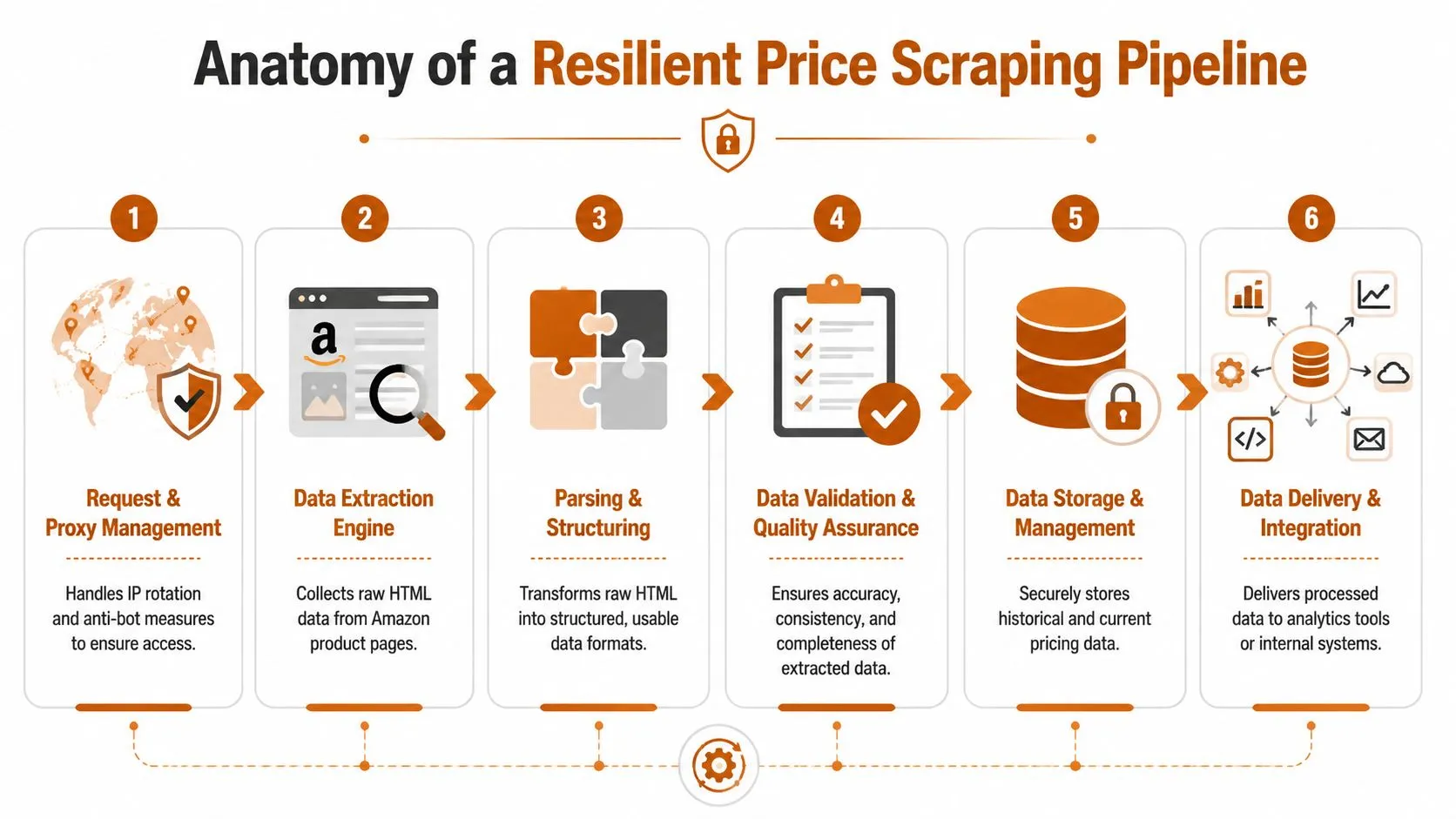
A production pipeline for Amazon seller prices starts before extraction and ends after delivery. The gap in most demos is everything between request and report, especially the controls that keep the feed stable when Amazon pushes back. At scale, production systems rely on residential proxy rotation, sticky sessions, randomized delays, exponential backoff, and active monitoring for 429/503 errors and CAPTCHAs anti-bot controls for Amazon monitoring.
Request handling and access control
The first job is consistent access. That means proxy rotation, stable session handling when a flow needs it, and headers that do not look machine-generated in a way that triggers blocks. Randomized delays matter because bursty access patterns are one of the easiest signals for anti-bot systems to detect.
Request management is also where failover starts. A resilient pipeline should treat blocked responses as expected events, not edge cases, and retry with backoff rather than hammering the same path. Operational maturity starts here, long before parsing logic becomes the problem.
Extraction, structure, and delivery
Once a request lands, the scraper has to pull the right seller offer fields, normalize them, and send them downstream in a format that other systems can use. Some teams still ship raw HTML, but that is rarely enough for pricing, analytics, or governance. A cleaner pattern is to structure the output into CSV or JSON, then push it into internal systems, dashboards, or pricing engines.
The same principle shows up in LLM-optimized Amazon data output, because downstream automation needs structured records, not just readable pages. The point holds either way. The data still has to be correct before it can be useful.
Operational insight: if you cannot observe success rate, proxy health, and structural-change alerts, you do not have a pipeline, you have a script with network access.
A managed data operator such as WebscrapingHQ can fit into this layer when the goal is ongoing delivery rather than one-time extraction. The point is not the tool name. The point is that extraction, retries, and delivery belong in one controlled system, not scattered across ad hoc scripts. Teams that build that control layer on top of a scalable task model, such as the approach described in building scalable data pipelines with Scrapy, usually spend less time repairing broken collection jobs and more time using the data.
Ensuring Data Quality and Governance

Raw Amazon data is rarely ready to use as-is. The Buy Box can differ from the full offers view, promotions can distort a plain price read, and local page states can change what the shopper sees. For that reason, the most reliable practice is to reconcile the user-facing Buy Box price against the Offers listing and normalize promotions and coupons before treating the price as truth Buy Box reconciliation and price normalization.
Validation has to happen before storage
The validation layer often determines whether data processing succeeds or leads to subsequent difficulties. A price value that looks clean may still be wrong if it came from the wrong state of the page. The safer pattern is to compare the visible offer with the full offer set, then apply rules for promotions, coupons, and missing seller metadata.
That’s why quality control belongs in the pipeline, not just in the analyst notebook. If a price feed gets stored without reconciliation, downstream systems can reprioritize inventory, advertising, or repricing logic on a false signal. Once that happens, the error spreads.
Governance turns output into a feed
Governance is the part many demos ignore. Schema versioning, validation rules, and change tracking are not bureaucracy, they’re how a feed survives selector drift and page changes. If a seller field disappears, changes name, or starts returning a different structure, the pipeline should flag it before the business assumes the data is still good.
The validation guide at ultimate guide to data validation is a useful reference for building that layer in a disciplined way. The core idea is simple, even if the implementation isn’t. You don’t just store what you scraped. You store what passed your rules.
A raw scrape can be collected in minutes. A reliable dataset is built by review, normalization, and a schema that doesn’t drift silently.
This is the point where enterprise teams start to see the difference between a dump and a dataset. A dump is what the scraper found. A dataset is what survived the checks.
Enterprise Use Cases for Seller Price Data
A stable Amazon seller-price feed supports more than competitive research. It becomes input for repricing, assortment decisions, channel checks, and market monitoring. The difference is speed and continuity, so high-velocity categories need recurring observation rather than sporadic checks.
Competitive intelligence that actually moves decisions
The clearest use case is seller comparison. Teams use price data to see which sellers are active on a given ASIN, how the Buy Box shifts, and whether offer patterns are changing in ways that should affect pricing or promotion. Because a single product can carry multiple seller offers, the feed has to reflect the full offer set, not a single page snapshot.
That matters when a brand needs to understand market pressure without waiting for manual review. Price intelligence only has value when it reaches the team while the market is still moving.
Repricing and compliance monitoring
Automated repricing systems depend on current, trustworthy inputs. If the price is stale or misread, the pricing logic can react to a false signal. MAP compliance monitoring has the same dependency, since the output needs to arrive soon enough to show violations while they still matter.
A more advanced use case is predictive analysis. Repeated seller-price observations can show how offer conditions change around promotions, stock moves, or seller turnover. The value is not in a single row. It is in the pattern that emerges after repeated collection.
Operational scope in the real world
The benchmark for monitoring makes the operating burden clear. High-velocity categories like electronics are often watched every 15 to 30 minutes, and typical monitoring sets run from 50 to 500 ASINs with 5 to 15 sellers per ASIN, which creates a large recurring tracking surface. That is why a recurring pipeline matters more than a clever parser, and why high-frequency Amazon monitoring best practice needs to be treated as an operations problem, not a scripting exercise.
Rule of thumb: if the price informs a live decision, it needs a live feed.
Teams that want to handle the legal side with less guesswork should also review the legal risks in web scraping and how to mitigate them.
Navigating Legal and Ethical Considerations
Amazon’s public pages are not the same thing as permission to scrape them without restraint. The company’s conditions of use are restrictive, and the practical risk for enterprises is not just access blocks. It’s operational disruption, brand exposure, and the cost of running brittle collection against a platform that actively defends itself.
Responsible collection is a risk framework
A good citizen approach starts with restraint. Respect robots.txt as a guideline, limit request rates so you’re not stressing the site, and make your user-agent string identifiable rather than deceptive. Those steps don’t make scraping risk-free, but they do reduce unnecessary friction and show intent.
The safer mindset is to collect only what the business needs and to avoid private, login-protected, or personal data. Public product and offer pages are one thing. Anything behind authentication is a different category entirely.
Why compliance-aware operations matter
The legal risks in scraping are easier to discuss when they’re tied to operating behavior. Aggressive request patterns, unclear identity, and sloppy handling of platform terms create avoidable exposure. The overview at 5 legal risks in web scraping and how to mitigate them is a helpful reference for teams that want to structure this more carefully.
For enterprises, the practical answer is rarely “scrape anything, anytime.” It’s “collect the minimum data needed, handle it responsibly, and use a pipeline that can absorb platform changes without turning compliance into a firefight.” That’s also where managed services become attractive, because they centralize monitoring, retries, and adaptation instead of leaving every risk to an internal engineering team.
If you need Amazon seller prices for competitive intelligence, repricing, or compliance work, start by defining the ASIN universe, the refresh cadence, and the downstream schema. Then let WebscrapingHQ design a managed pipeline that can keep the feed stable while Amazon keeps changing the surface.
Want this done for you?
Send us the URLs. We'll quote it in 24 hours.
Paste the URL(s) you want scraped. We'll reply within 24 hours with a feasibility check and a ballpark quote.