Jump to section
- The Hidden Complexity of Modern Contact Extraction
- Why raw HTML isn’t enough
- Adaptation over selector accumulation
- How AI and Computer Vision Power Modern Scrapers
- LLM parsing needs boundaries
- Navigating Compliance and Access Protocols
- Operational controls
- Measuring Data Quality Beyond HTTP Success Rates
- A validation sequence that reflects real risk
- Enterprise Use Cases for Managed Extraction Pipelines
- Contact workflows need narrower schemas
- Evaluating In-House Builds Versus Managed Operations
- Compare the operating model
- Designing Resilient Schemas for Long-Term Reliability
- Make uncertainty a first-class value
The popular advice is to start with an HTTP client, add a CSS selector for email addresses, and scale the request queue. That approach can collect samples, but it doesn’t produce a dependable contact data scraper. Production contact extraction is a record-level data quality and compliance system, not a page-count exercise.
A useful pipeline must answer harder questions. Where did each record come from? When was it collected? Is the address associated with an organization or an individual? Has the role changed? Can the field be used for the intended workflow? Can the team remove or correct it later? AI parsing helps with messy pages, but it only becomes valuable when paired with validation, provenance, policy controls, and ongoing monitoring.
The Hidden Complexity of Modern Contact Extraction
A basic scraper assumes that a page has a stable document structure. Real websites rarely cooperate. Contact details may appear in server-rendered HTML, client-side JavaScript, embedded JSON, downloadable documents, location widgets, images, or content loaded only after interaction. A selector that worked during development can fail after a redesign, while still returning successful HTTP responses.
Anti-bot controls create another distinction between retrieving a page and extracting a trustworthy record. A request may receive a challenge page, a partial response, or a consent screen that looks valid to a parser. Rate limits, authentication requirements, geographic variations, and language-specific templates can all change what the scraper sees. The result is often a pipeline that reports technical success while producing empty, duplicated, or misclassified contacts.
The broader engineering problem is described well in this overview of common web scraping challenges. Contact extraction adds another layer because the target isn’t merely content. The target is a structured claim about a person, team, organization, or communication channel.
Why raw HTML isn’t enough
A reliable system begins by preserving the raw evidence, then creates a canonical record separately. The evidence might include the source page, rendered content, document text, image references, extraction timestamp, and parser version. The canonical record should contain normalized fields, confidence values, validation outcomes, and a link back to that evidence.
That separation matters when a parser changes. If an LLM starts interpreting a “sales” label differently after a prompt revision, engineers can re-run extraction against retained evidence rather than re-crawling every source. It also makes review possible. A human can inspect the exact page or image that led to a disputed email address.
Production rule: Treat every extracted contact as a claim that needs evidence, not as a string that needs cleaning.
A contact data scraper should also distinguish discovery from activation. Discovery identifies candidate records. Activation sends them to a CRM, advertising workflow, enrichment process, or outreach system. Those stages should not be fused, because a record can be technically extractable yet unsuitable for a particular use.
Adaptation over selector accumulation
Traditional scripts respond to change by adding more selectors. That works for a narrow, stable source, but it becomes difficult to govern across many domains. A more resilient design combines DOM parsing, semantic extraction, document processing, and visual inspection. The system can recognize that “Contact our regional office” and “Reach the commercial team” represent related concepts even when their markup differs.
Teams evaluating an external service should distinguish enrichment from extraction. For example, Fetchin’s real-time data API is relevant when a workflow needs current data enrichment alongside source collection. The decision should depend on the required fields, permitted sources, refresh policy, and evidence requirements, not on the apparent simplicity of an API response.
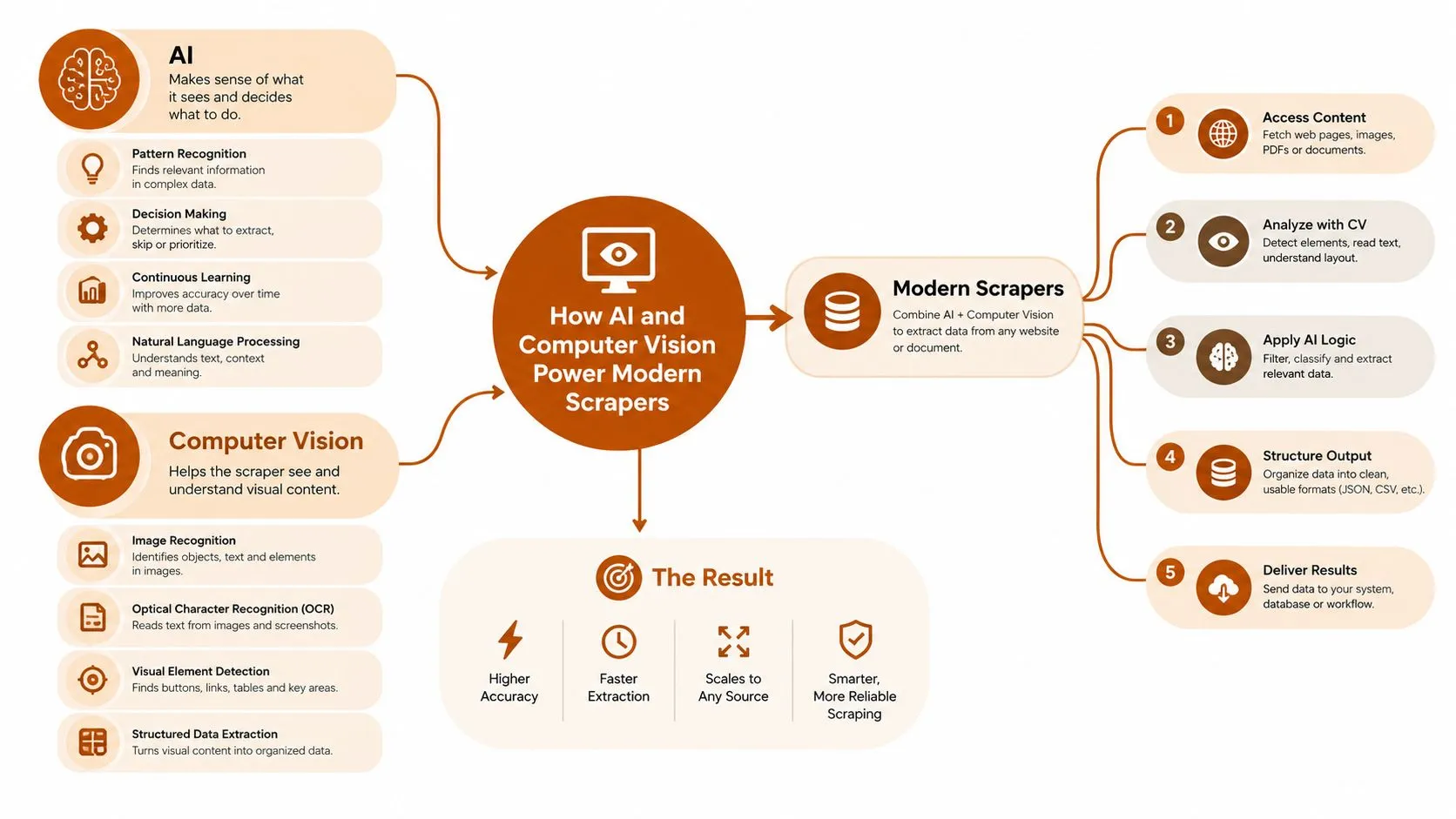
How AI and Computer Vision Power Modern Scrapers
AI augmentation works best as a layered extraction process, not as a single prompt sent to a full webpage. The pipeline first identifies relevant content, removes navigation noise, detects page type, and preserves source context. It then applies specialized extraction logic to text, structured elements, documents, and images.
An LLM can interpret relationships that CSS selectors can’t. It can distinguish a customer-service address from a press contact, map regional labels to a common schema, and infer that a person’s name belongs to a particular role when the page layout is irregular. The output should still be constrained by a defined schema, field-level instructions, allowed value formats, and confidence thresholds.
LLM parsing needs boundaries
An LLM shouldn’t be allowed to invent missing fields or resolve ambiguity without flagging it. A reliable extraction contract should require the model to return a null value when evidence is absent, preserve the original text, identify the source fragment, and assign a confidence category. It should also separate observed facts from inferred classifications.
For example, “info@example.org” can be captured as an email address, but its role should remain general unless the page explicitly associates it with sales, support, media, or another function. A named employee’s address needs different handling from a generic company mailbox. This distinction affects both data quality and downstream policy.
A practical architecture often uses deterministic checks before and after AI parsing:
- Content routing: Detect whether the source is HTML, PDF, an image, a directory listing, or a rendered application.
- Semantic extraction: Ask the LLM to populate a fixed schema from bounded evidence.
- Normalization: Standardize names, organization labels, phone formats, country context, and role categories.
- Conflict handling: Preserve competing values instead of forcing an unsupported choice.
- Review routing: Send low-confidence or sensitive records to quarantine.
Computer vision handles information that text parsers can’t reliably access. Phone numbers and email addresses may be embedded in a scanned brochure, dealership sign, map image, screenshot, or visually complex table. Optical character recognition can recover text, while layout analysis associates that text with the correct organization or location.
The visual layer still needs safeguards. OCR can confuse characters, merge adjacent columns, or assign a phone number to the wrong listing. High-resolution capture, region detection, deduplication, and cross-checking against nearby text reduce those errors. The practical trade-off is cost and latency versus coverage. Use visual extraction where the field depends on presentation, not as a default replacement for accessible text.
For a deeper technical comparison, computer vision in web scraping provides useful context. The resilient pattern is hybrid: deterministic rules for predictable signals, AI for semantic interpretation, vision for visual evidence, and human review for unresolved cases.
Navigating Compliance and Access Protocols
A contact data scraper needs an access policy before it needs a crawler. The modern web’s access-policy foundation is the Robots Exclusion Protocol, commonly implemented through a robots.txt file. Created in 1994 as a voluntary mechanism, it lets website operators communicate which crawler paths shouldn’t be accessed. It wasn’t originally a security system or a legally binding authorization framework.
After nearly three decades of informal use, the Internet Engineering Task Force published RFC 9309 in September 2022, formalizing the protocol as an Internet standard. The history is important because robots.txt supplies machine-readable guidance, but it doesn’t resolve privacy, copyright, contract, or personal-data obligations. Disallow rules communicate intended crawler behavior. They don’t encrypt pages or prevent technically capable requests. The historical context is documented in this overview of robots.txt and the Robots Exclusion Protocol.
Operational controls
A defensible pipeline applies several controls together:
- Scope the source list. Record the domains, paths, content types, geographic variants, and intended purpose before collection begins.
- Capture access guidance. Store robots.txt snapshots and the time each policy was observed. Respect disallowed paths where applicable, and don’t treat a successful request as permission.
- Control request behavior. Use conservative rates, honor authentication boundaries, and avoid bypassing access controls or challenges.
- Minimize fields. Collect only what the defined workflow requires. Don’t gather direct mobile numbers or named contacts merely because a parser can find them.
- Gate activation. Keep discovery outputs separate from marketing, sales, or model-training exports until legal review and suppression checks are complete.
- Maintain provenance. Store the source URL, collection timestamp, geographic scope, extraction purpose, and applicable lawful basis with each record.
Names, direct email addresses, mobile numbers, and other fields that identify or can reasonably be linked to an individual should be treated as personal-data processing, not simple document retrieval. European data-protection guidance characterizes extraction, cleaning, structuring, and storage as processing. Public availability doesn’t remove that obligation.
A public page answers where a field was visible. It doesn’t answer whether collecting, retaining, enriching, or activating that field is permitted.
Regional policy gates are safer than one global rule. The same business contact may contain a generic company address in one case and a named employee’s direct address or mobile number in another. The schema should therefore carry policy status, purpose, retention metadata, and review state. Deletion and rectification workflows should work at record level, with the original evidence retained only as long as the documented policy permits.
Security and resilience controls belong in the same operating conversation. Teams that need background on related European cyber requirements can browse the EU cyber resilience guide, while implementation teams can use this practical guide to GDPR-compliant web scraping. Neither resource replaces a case-specific legal assessment.
Measuring Data Quality Beyond HTTP Success Rates
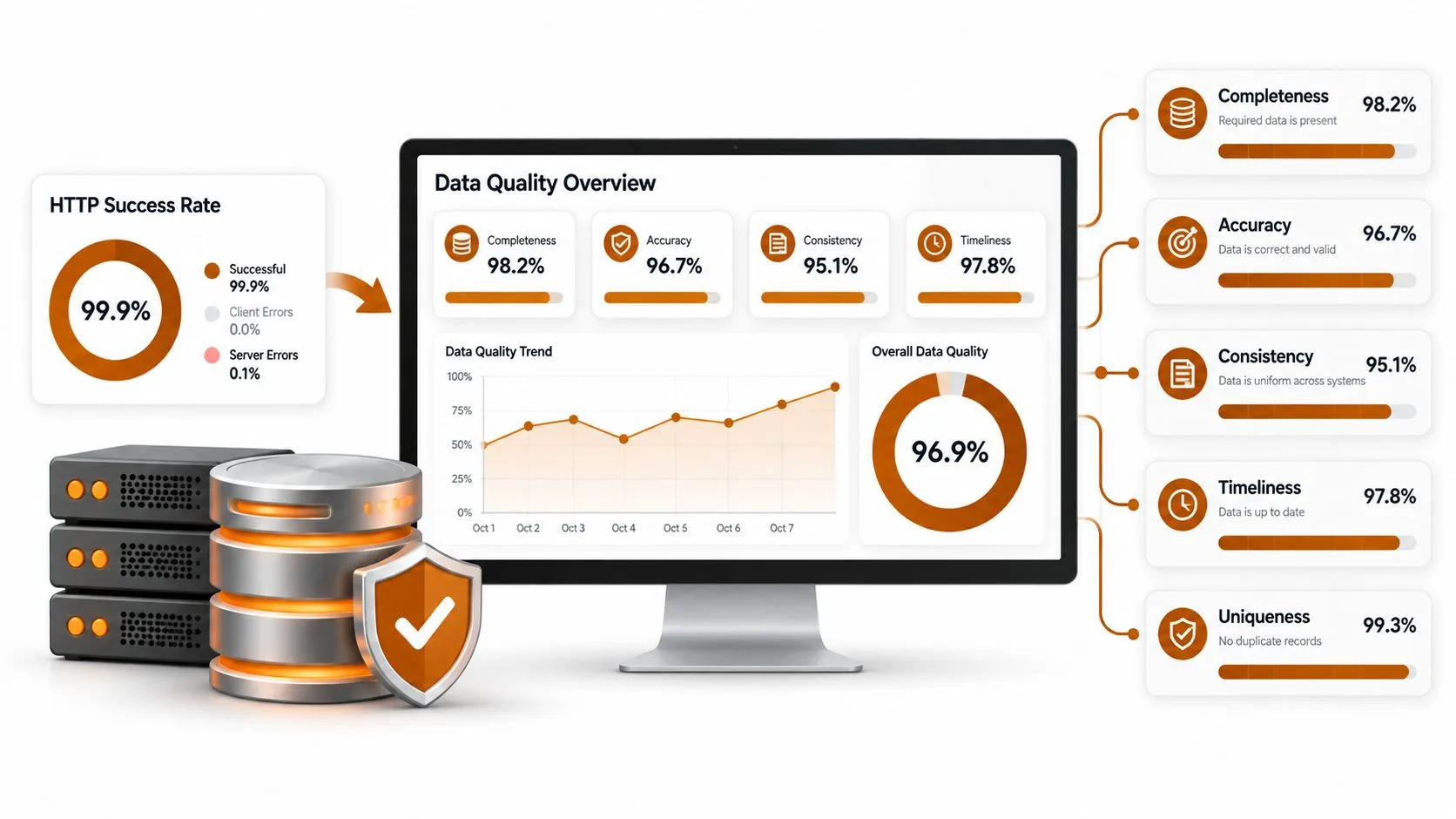
An HTTP success response proves that a server returned something. It doesn’t prove that the response contained the intended page, that the page contained a contact, or that the contact belongs in a downstream system. A contact data scraper should report record-level quality, with metrics broken down by source and country rather than hiding all outcomes behind page totals.
A 2025 enterprise data-quality survey reported that 84% of organizations struggle with inaccurate or duplicate data, while 32% cited outdated contact information, 25% cited changing regulations, and 23% cited incomplete customer profiles. The same source reports an industry estimate that 22% of contact data becomes outdated every six months and that as much as 70% becomes outdated, incomplete, or inaccurate within a year. These figures are from Melissa’s 2025 data-quality survey summary.
A validation sequence that reflects real risk
Start with syntax and normalization. Then check whether the domain has usable mail infrastructure, classify role accounts, detect disposable domains, resolve duplicates, and, where legally permitted, perform careful deliverability testing. These checks improve triage, but none of them proves that a person will receive a message or that contacting that person is allowed.
Validation services also produce false positives and false negatives. Catch-all, accept-all, temporary, and deliberately opaque mail systems can defeat confident classification. A record marked “valid” should therefore carry the checks performed, their timestamp, and any unresolved uncertainty.
A useful production scorecard includes:
- Precision and recall: Compare extracted results with a labeled sample.
- Duplicate rate: Measure repeated records after normalization and entity resolution.
- Missing-field rate: Track absent values by source, page type, and field.
- Freshness: Store last-seen timestamps and measure changes over time.
- Bounce rate: Use only where the workflow and legal basis permit the test.
- Exception volume: Count records quarantined for conflicting, risky, stale, or incomplete evidence.
Quarantine is more reliable than silent publication. Catch-all addresses, contradictory organization names, stale role pages, and uncertain OCR outputs should remain outside the CRM until a rule or reviewer resolves them. Refresh cadence should follow source volatility. A frequently changing directory needs closer checks than a stable corporate switchboard.
This is also why data-quality monitoring tools should monitor fields and source behavior, not only crawler uptime. Teams may also evaluate CapyScout for CRM data monitoring when they need checks closer to the destination system. The key design choice is to store raw evidence separately from canonical records, with schema versions that preserve comparability when extraction logic changes.
Enterprise Use Cases for Managed Extraction Pipelines
The strongest enterprise use cases begin with a fixed business artifact, not a vague request for more contacts. An ad-verification team may need site snapshots, visual confirmation, extracted advertiser details, exception notes, and a recurring report layout. A generic endpoint that returns HTML won’t satisfy that requirement. The pipeline must produce evidence that reviewers can inspect and a report that fits the team’s control process.
A managed workflow can combine browser rendering, computer vision, and LLM parsing. Visual inspection identifies whether the approved creative appears in the expected context. Semantic extraction maps dealer or advertiser information into a defined schema. Exceptions are highlighted rather than buried in a large export, allowing the compliance team to focus on records that need human attention.
AI startups have a different requirement. They may need multi-language and multi-geo collection, normalized fields, field-level provenance, and filters that prevent sensitive attributes from entering a training dataset. The important output isn’t a large undifferentiated crawl. It’s a documented collection aligned with source scope, purpose, schema consistency, retention rules, and review thresholds.
Retail intelligence platforms often need scheduled snapshots rather than one-time discovery. A daily or recurring pipeline can capture product, availability, or competitive signals across localized pages, then compare the new evidence with prior records. Change detection becomes more useful than raw extraction because the business cares about what changed, when it changed, and whether the change came from a source redesign or a genuine market event.
Contact workflows need narrower schemas
A company-data pipeline may collect public organizational endpoints, while a prospecting workflow may request a named role, direct address, or office phone. Those are not interchangeable requirements. The schema should state why each field exists, whether it identifies an individual, how recent it must be, and what action is permitted after validation.
European data-protection guidance treats extraction, cleaning, structuring, and storage as processing when fields identify or can reasonably be linked to people. Provenance should therefore remain attached to each record, including source URL, collection timestamp, geographic scope, extraction purpose, and applicable lawful basis, as described in the EDPB guidance on web scraping.
The schema is part of the compliance control. If the pipeline can’t express purpose, provenance, retention, and review status, it can’t support reliable governance.
Managed extraction is valuable when the output has to match an operational process. That may mean a PDF report with exceptions, a normalized feed for an NLP system, or scheduled files that downstream teams can consume without manual restructuring. The system should be judged by fitness for that workflow, not by the number of pages it can fetch.
Evaluating In-House Builds Versus Managed Operations
An in-house build can be the right choice when the source set is narrow, the layout is stable, the team owns the application, and the data has a short operational lifespan. Engineers also gain direct control over code, infrastructure, observability, and deployment. The risk appears when a prototype becomes a permanent data product without a corresponding maintenance budget.
A production operation must handle source changes, retries, rendering, geographic variants, rate controls, anti-bot behavior, parser regression, validation, schema evolution, and support for downstream formats. Those responsibilities compete with core product work. Managed operations shift that recurring burden to a specialist team, but they introduce vendor governance, contract review, service dependencies, and the need to define acceptance criteria clearly.
Compare the operating model
| Operational Factor | In-House Engineering Team | Managed Data Operations |
|---|---|---|
| Source changes | Engineers detect and repair broken selectors or parsers | Provider monitors sources and re-tunes extraction workflows |
| Infrastructure | Team manages rendering, queues, retries, and access controls | Provider operates the extraction environment and recurring delivery |
| AI and vision | Team builds prompts, OCR flows, evaluation sets, and fallback logic | Provider supplies configured extraction components for the target schema |
| Quality controls | Team designs validation, quarantine, deduplication, and reporting | Provider can deliver source-specific quality checks and exception outputs |
| Governance | Organization owns evidence retention, deletion, and schema versioning | Responsibilities must be assigned contractually and documented |
| Output formats | Team builds integrations for internal systems | Provider may support feeds, files, webhooks, or storage delivery |
| Cost profile | More direct control, with continuing engineering capacity required | Recurring service cost, with less customer-side maintenance |
| Best fit | Stable, strategic sources closely tied to the product | Changing, multi-source, multi-geo, or artifact-heavy workloads |
The comparison should focus on total operational ownership, not the initial script. A low-cost prototype can become expensive when every redesign requires emergency engineering work or when bad records enter a CRM without evidence.
Teams considering the trade-off can review why companies choose web scraping services instead of self-management. WebscrapingHQ is one managed option, providing custom extraction pipelines that use computer vision and LLM-based parsing, recurring operations, schema-focused delivery, and formats such as CSV, JSON, webhooks, and cloud-storage drops.
Before signing, require a source inventory, field-level specification, validation rules, escalation process, retention terms, change notifications, and a clear definition of an accepted record. Managed doesn’t mean responsibility disappears. It means the operating boundary moves, so the contract and audit trail need to reflect that boundary.
Designing Resilient Schemas for Long-Term Reliability
The initial scraper is rarely the durable asset. The durable asset is the system that preserves evidence, measures quality, manages change, and keeps downstream consumers compatible as sources evolve. A resilient schema can accept new fields without breaking existing integrations, while still making version changes visible to analysts and reviewers.
Start with stable identifiers and explicit field semantics. A contact record may include organization, person name, role, email, phone, source URL, collection timestamp, geographic scope, purpose, lawful-basis reference, confidence, validation state, last-seen timestamp, and retention status. Not every workflow needs every field, but the schema should make omissions deliberate rather than accidental.
Make uncertainty a first-class value
Avoid a binary model in which every field is either present or absent. A phone number can be present but poorly associated with an organization. An email can pass syntax checks but belong to a role account. A name can be visible on a page while the relationship between that name and the mailbox remains unclear.
Use field-level states such as observed, normalized, inferred, conflicting, quarantined, removed, or awaiting review. Preserve the original value alongside the normalized value, and store the evidence reference that supports both. Schema versioning then lets engineers compare releases without confusing a parser change with a source change.
Record-level quality should follow a defined sequence. The EDPB’s discussion of anonymisation and web scraping supports treating extraction quality as more than page count or HTTP success. Validate syntax and normalization first, then apply domain checks such as DNS or MX resolution, role-account classification, disposable-domain detection, duplicate resolution, and legally permitted deliverability testing.
Deletion and rectification must be operational features, not policy statements. A request should locate every canonical record, derived export, suppression entry, and retained evidence object governed by the applicable retention policy. If an organization can’t trace where a record came from, it can’t confidently correct it. If it can’t locate derivatives, it can’t demonstrate that correction propagated.
More frequent scraping won’t solve weak governance. A pipeline can repeatedly collect a fresh but incorrect role, preserve a duplicate under a new URL, or reintroduce a suppressed contact if it lacks source-change detection and deletion controls. Fitness depends on the workflow. Prospecting may prioritize role recency and bounce risk, while an audit workflow may prioritize visual evidence and reproducibility.
The practical standard is therefore simple: measure the reliability of each record for its intended use. Define service levels by field, confidence thresholds, freshness expectations, review rules, and permitted actions. Then select an in-house or managed operating model that can maintain those controls after the first successful extraction.
WebscrapingHQ provides managed web data operations and custom contact extraction, including structured outputs, ongoing monitoring, AI-assisted parsing, and pipelines designed around source-specific schemas and quality controls. If your team needs dependable contact records with provenance, validation, and scheduled delivery rather than another brittle script, visit WebscrapingHQ to discuss the workflow and sources you need to operate.
Want this done for you?
Send us the URLs. We'll quote it in 24 hours.
Paste the URL(s) you want scraped. We'll reply within 24 hours with a feasibility check and a ballpark quote.