Jump to section
- 1. WebscrapingHQ
- Where the managed model earns its cost
- 2. ScrapeHero
- A practical middle ground
- 3. Zyte
- Flexible ownership, different implementation burdens
- 4. Bright Data
- Scale is useful only when governance keeps pace
- 5. Import.io
- A useful escalation path
- 6. Grepsr
- Reliability as a procurement requirement
- 7. Diffbot
- Platform control versus managed responsibility
- 8. DataOx
- Where project discipline matters
- 9. Datamam
- A fit for data products, not just extracts
- 10. Crawlbase
- Good infrastructure, limited outsourcing
- Top 10 US Website Scraping Services Comparison
- Choose the Operating Model Before the Vendor
- Use this selection sequence
The biggest feature list doesn’t identify the best website scraping service in the United States. It often identifies the provider with the broadest infrastructure, not the one that fits your operating model. A team choosing between white-glove managed extraction, API infrastructure, visual self-service, and AI-assisted parsing is deciding who will own the difficult work after the first successful crawl.
That distinction matters. Source complexity, maintenance ownership, delivery format, geographic coverage, governance, implementation effort, and suitability for recurring analytics or machine learning pipelines affect the result more than a long product catalogue. A visual tool may be efficient for a stable page, while a managed service may be more appropriate when login barriers, dynamic rendering, site changes, or recurring quality checks dominate the workload.
Legal review also remains the customer’s responsibility. The U.S. has no single statute governing every scraping scenario, and exposure can depend on the access method, data type, contractual restrictions, privacy obligations, and downstream use. Octoparse’s discussion of U.S. web scraping legality reflects that practical boundary. This comparison evaluates the supplied provider information, not universal legal or performance claims. For background on implementation choices, see this scraping tools and API guide.
1. WebscrapingHQ
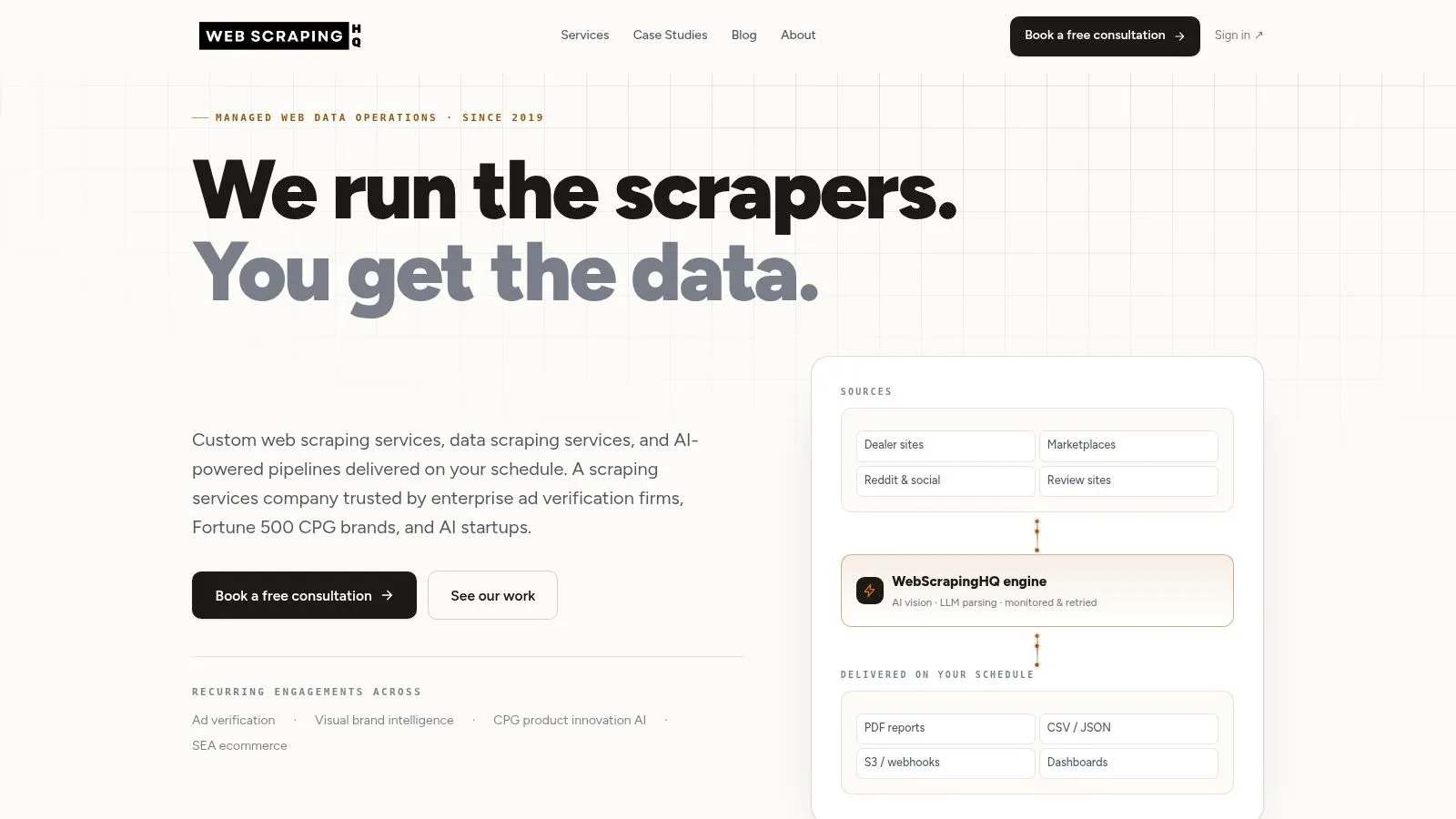
WebscrapingHQ fits buyers assigning operational responsibility to the provider rather than adopting scraping infrastructure for internal operation. Established in 2019, it designs, builds, and runs custom production pipelines. Its documented workflow combines computer vision and large language model parsing with monitoring, retries, proxy management, anti-bot mitigation, and ongoing re-tuning. The resulting model places selector failures, job recovery, and schema drift with the service provider instead of the customer.
Delivery is structured for downstream systems. Depending on the engagement, WebscrapingHQ provides CSV or JSON feeds, PDF compliance reports, S3 drops, webhooks, or dashboards on fixed schedules. Schema versioning and quality controls give analytics and ML teams a defined way to distinguish source changes from dataset changes. Customers still specify required fields and acceptable freshness, while the provider handles recurring collection work.
Where the managed model earns its cost
The service targets visually complex and geographically distributed sources. Capabilities include high-resolution image inspection, deduplication, format conversion, multi-language and multi-geo normalization across 20+ geographies, and extraction from unstructured text or visual artifacts. This operating model suits ad verification, ecommerce intelligence, compliance reporting, retail monitoring, and training-data workflows better than a simple page-to-CSV task.
Documented use cases include Fortune 500 retail and automotive programs, ad verification bureaus, and AI and CPG startups. One supplied example describes 1,680 AI-audited dealer compliance PDFs delivered monthly. That workload shows why report generation and exception handling can require as much operational attention as crawling.
Operating judgment: Choose WebscrapingHQ when maintaining a reliable recurring data operation is the main burden. A self-serve tool is more appropriate for quick control over a limited, stable source.
Recurring services start from approximately USD 500 per month, with scope and pricing quoted after feasibility work. That commitment may exceed the needs of a small one-off extraction, but it can suit teams requiring scheduled delivery without assigning engineers to scraper maintenance. Direct details are available from the provider’s site.
2. ScrapeHero
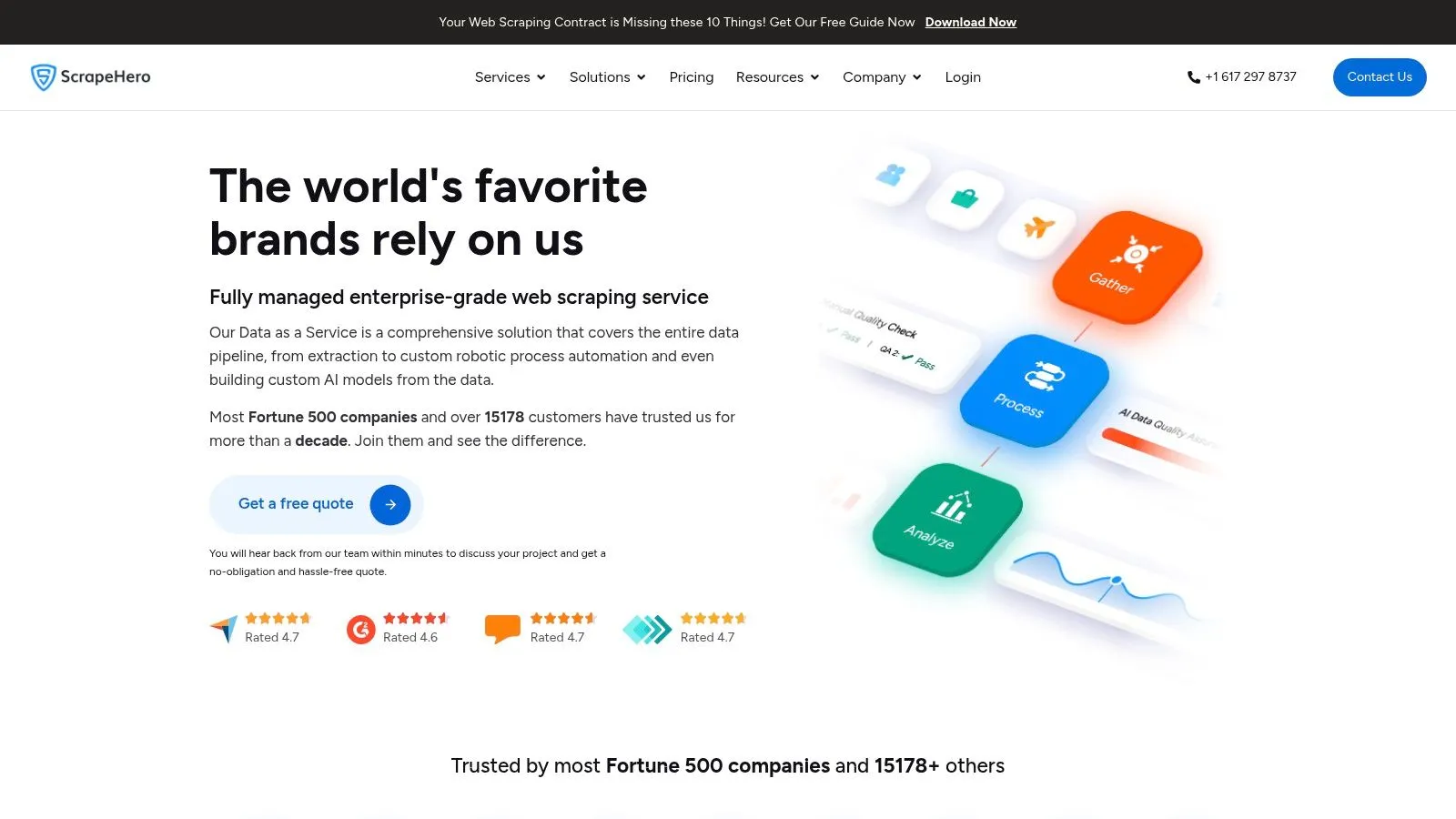
ScrapeHero is a managed extraction choice for buyers who want a provider to handle scoping, development, production runs, monitoring, change management, and delivery. Its strongest distinction is operational continuity. The customer describes the sources and required fields, while ScrapeHero builds and maintains the collection workflow rather than leaving the buyer to operate crawlers after deployment.
The service supports large, dynamic, and login-gated sites, with distributed crawling and anti-bot mitigation included in the operating model. Delivery can use multiple formats and schedules, which makes it suitable for recurring competitive intelligence, ecommerce datasets, market research, and other feeds where stale or incomplete records undermine the analysis.
A practical middle ground
ScrapeHero also offers a marketplace of ready-made crawlers and ScrapeHero Cloud APIs. That gives buyers an alternative to a fully custom program. A ready-made crawler can reduce implementation effort for a known source, while a custom pipeline remains available when the source structure or schema is more specialized.
The trade-off is that managed work introduces a scoping stage. That can be slower than launching a self-service workflow, especially for a one-off pull. Per-site minimums may also make the model difficult to justify when the dataset is small or the source is unlikely to change.
For a recurring program, ask how the provider handles source changes, failed records, delivery incidents, and schema modifications. Those questions reveal more about total operating responsibility than the presence of an API. Review the provider’s current offering at ScrapeHero.
3. Zyte
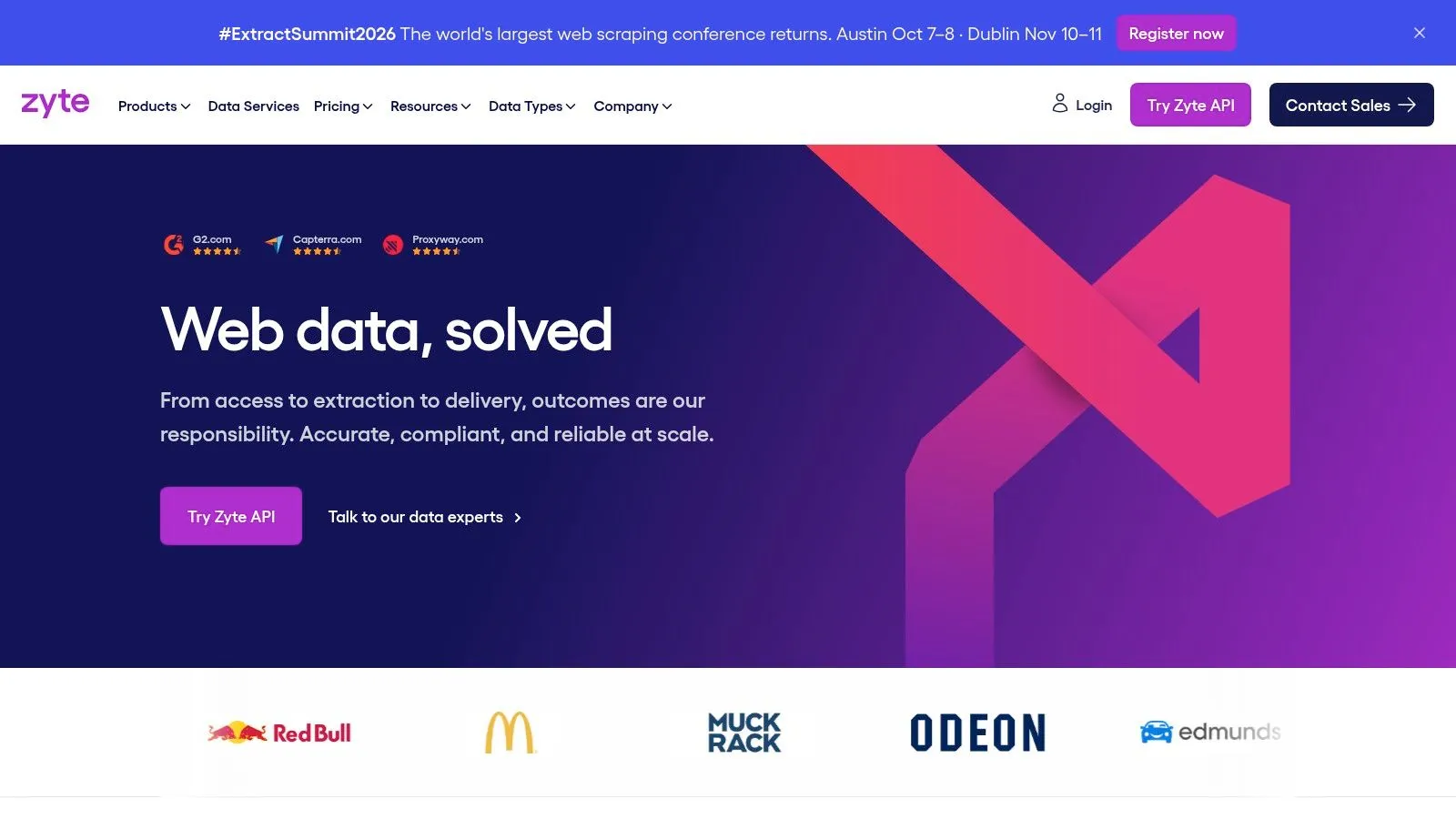
Zyte is useful when a team wants to preserve a choice between managed data delivery and developer-controlled infrastructure. Its portfolio includes Zyte Data for managed extraction, Zyte API for API-first collection and automatic extraction, and Scrapy Cloud for teams that want hosted tooling around developer workflows. The operating decision is therefore not just whether to buy scraping. It’s whether the buyer wants to own the pipeline, share ownership, or outsource the result.
Flexible ownership, different implementation burdens
Zyte Data delivers data to an agreed specification, while Zyte API and Scrapy Cloud give engineering teams more control over integrations and execution. That flexibility can reduce vendor lock-in at the workflow level, but it also means the customer must select and manage the appropriate layer. An API-led implementation can fit a product that needs extraction inside an application. A managed engagement is more suitable when the internal team wants to receive datasets rather than operate collection infrastructure.
Zyte’s scraping and anti-blocking expertise is a strength for difficult sources, particularly where request handling and operational reliability require specialist knowledge. Enterprise plans include support and SLA options, but managed engagements may require a scoping cycle before production work begins.
API pricing also requires usage monitoring. A technically simple integration can become operationally difficult if request volume, extraction behavior, retries, and output requirements aren’t tracked against the commercial model.
For teams comparing web scraping companies in the USA, Zyte stands out as a hybrid operating choice. It suits engineering-led organizations that may need both a managed outcome and a platform they can integrate directly. Visit Zyte for current product and enterprise details.
4. Bright Data
Bright Data combines a fully managed data acquisition service with a broad proxy and API stack. That makes it a strong operating choice for large, multi-geography programs where collection, quality checks, monitoring, delivery, and governance documentation need to be coordinated across sources.
The managed service is oriented toward a data-concierge workflow. The buyer defines business objectives and data requirements, then the provider handles collection, validation, enrichment, and delivery through datasets, reports, dashboards, or other agreed outputs. Its proxy and IP infrastructure can also be relevant when the customer needs to combine managed acquisition with direct access to collection components.
Scale is useful only when governance keeps pace
Bright Data’s supplied capabilities include customized datasets, monitoring, quality checks, and compliance materials such as third-party audits and SOC reports. These features matter to procurement, security, and data governance teams that need more than a working crawler. They can also add complexity. Enterprise products, multiple infrastructure layers, and sales-led scoping may be more than a small team needs for a narrow source.
A buyer should distinguish between documented compliance posture and legal permission for a particular use case. Governance documents can support internal review, but they don’t replace the customer’s assessment of source terms, personal data, access controls, and downstream use.
A related comparison of proxy servers for web scraping can help teams understand why proxy infrastructure and managed collection are separate purchasing decisions. Bright Data is best considered when geography, scale, and governance requirements justify an enterprise operating model. See Bright Data.
5. Import.io
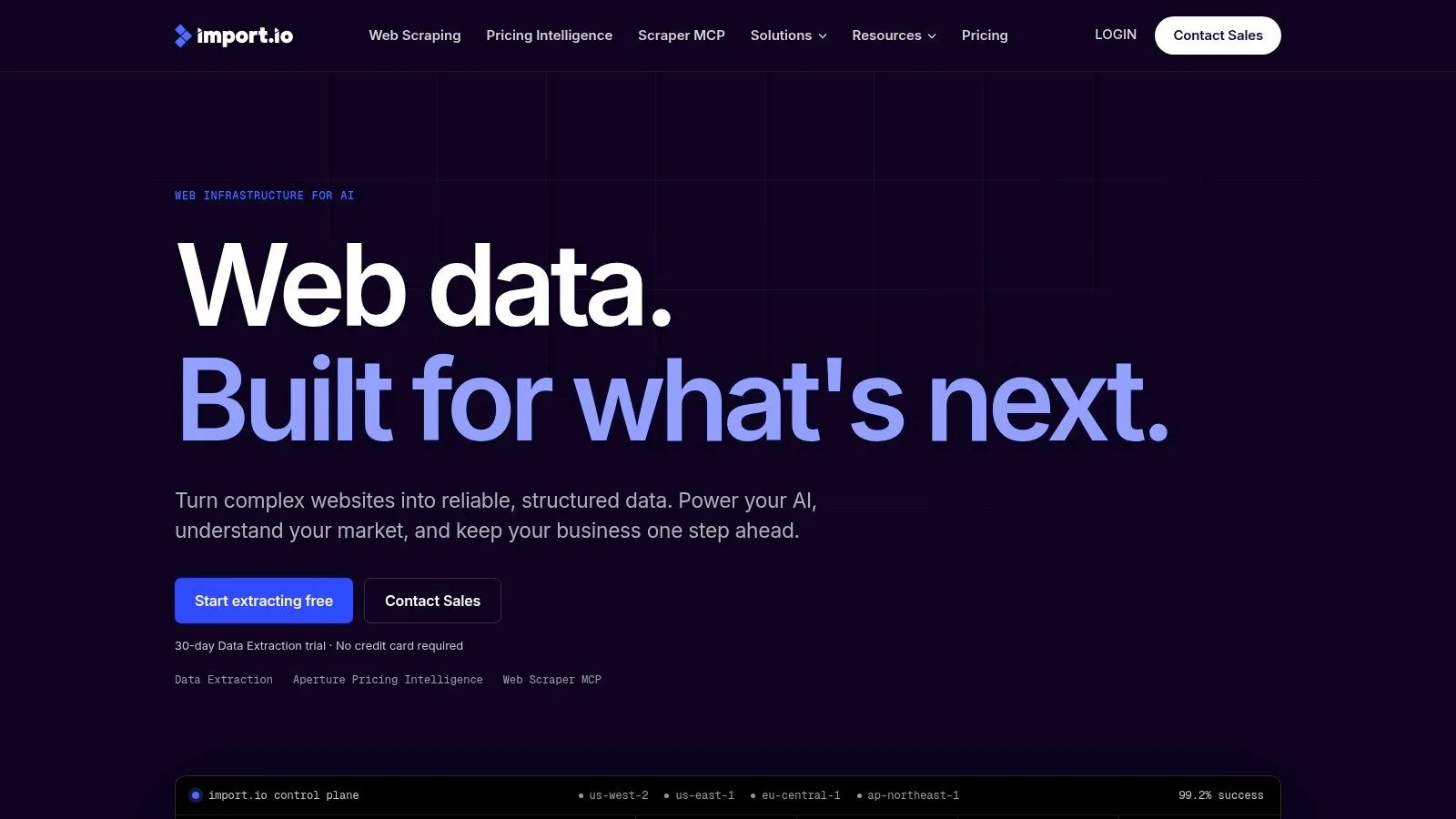
Import.io gives buyers three ways to operate: a no-code visual extractor, programmatic APIs and SDKs, and an operated service tier for complex or high-volume collection. That range makes it attractive to organizations that want to start with visual extraction but retain a path toward managed delivery when the source becomes too difficult or too important to maintain internally.
The visual approach can lower initial implementation effort, especially when users need to define fields by interacting with a page rather than writing a crawler. It doesn’t remove the need for schema design, validation, and change handling. A self-serve workflow still requires someone to understand the target structure and investigate what happens when JavaScript, authentication, pagination, or page layouts change.
A useful escalation path
Import.io focuses on dynamic and protected sites, with scheduling and cadence options ranging from quick checks to regular feeds. The operated tier is the more relevant choice for teams that need the provider to assume responsibility for high-volume execution, maintenance, and service commitments.
That structure supports a staged procurement approach. A team can validate the desired fields with a visual workflow, then decide whether the resulting maintenance burden warrants an operated engagement. Conversely, a team with a known recurring requirement may avoid the intermediate self-serve phase and scope the managed service directly.
The API and SDK options suit engineering teams that need data embedded in applications or internal platforms. AI and agent integrations broaden the possible downstream uses, but they don’t eliminate governance questions around what data enters those systems. For a broader distinction between web scraping and APIs, consider whether the source already exposes an authorized interface before choosing extraction. Explore Import.io.
6. Grepsr
Grepsr is built around recurring delivery rather than isolated extraction. Its managed pipelines include proactive change monitoring, quality assurance, scheduled delivery, and support for dynamic, JavaScript-heavy, and login-gated sites. The fit is strongest when a buyer values continuity and communication but doesn’t want to run crawler operations internally.
Reliability as a procurement requirement
Grepsr can deliver structured data through storage, webhooks, feeds, and other channels. That matters because the destination often determines implementation effort. A dataset delivered into an existing storage or ingestion process is operationally different from a file that someone must download and clean manually.
The service emphasizes compliance and recurring scheduled work, but buyers should request concrete governance documentation for their own use case. A provider’s compliance positioning doesn’t establish that every target, field, access method, or downstream use is acceptable. The customer should confirm how personal data, login-gated content, retention, permissions, and incident escalation are handled.
Grepsr may be excessive for a small one-off pull. Custom managed work also means that turnaround and cost depend on source complexity and volume. For enterprise programs, however, the central benefit is not a particular extraction interface. It’s the transfer of maintenance, monitoring, and quality responsibilities to an operating partner.
Use Grepsr when scheduled delivery and source-change response matter more than immediate self-service access.
7. Diffbot
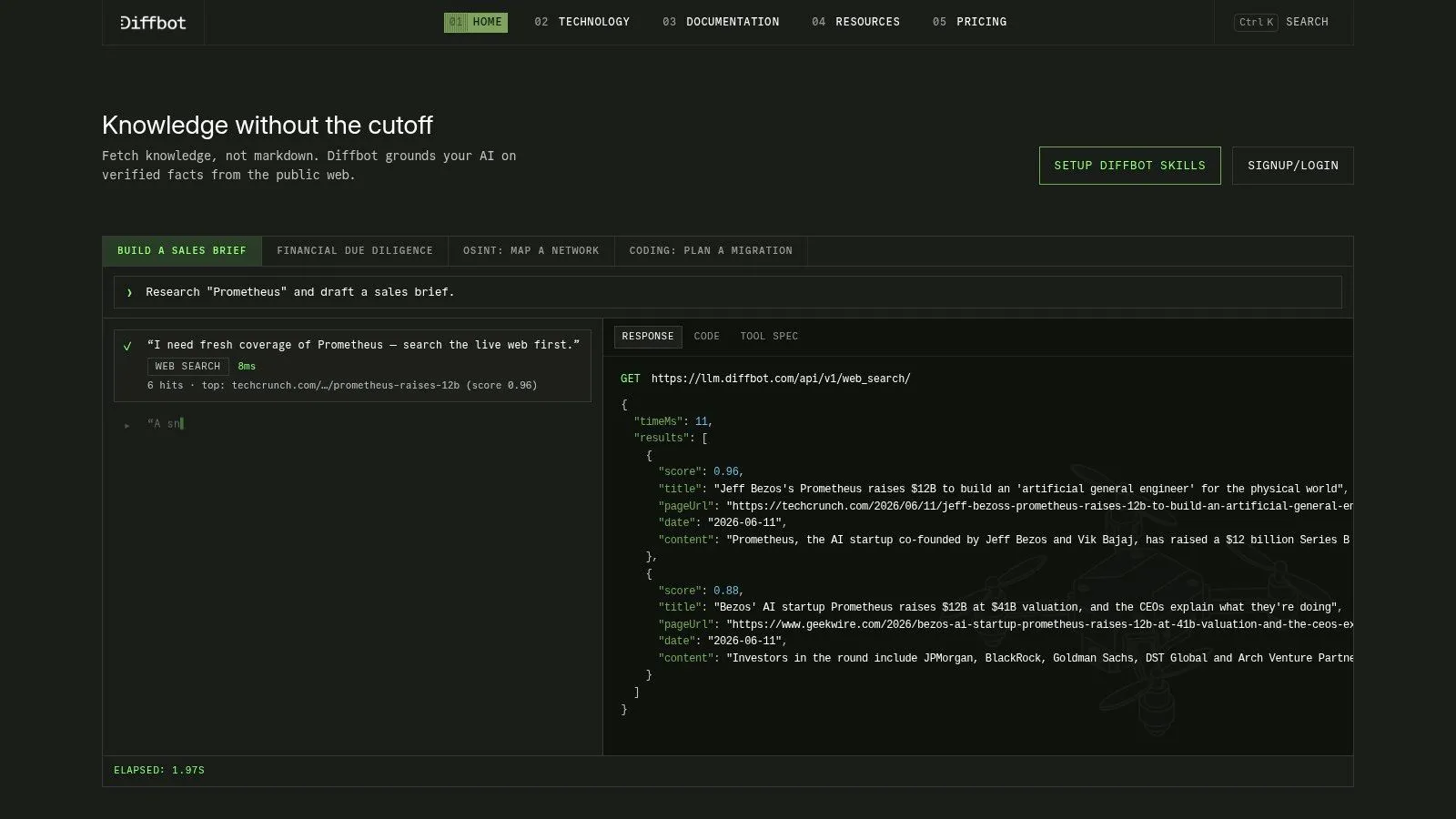
Diffbot takes a different route from rule-heavy custom scraping. Its Analyze and Extract APIs use AI and computer vision to identify page types and produce structured outputs for common categories such as products, articles, and discussions. Managed crawl jobs and Knowledge Graph access extend the model from individual pages toward broad discovery and entity-level enrichment.
That approach can reduce manual rule creation where automatic page-type detection works well. It’s especially relevant to teams building search, content intelligence, market monitoring, entity resolution, or ML enrichment workflows. The output isn’t merely a raw page capture. It is intended to be a structured representation that downstream systems can consume.
Platform control versus managed responsibility
Diffbot is primarily a platform and API choice. Teams get programmatic control and can run large crawls, but a fully managed delivery program may require additional solutioning. That distinction affects internal staffing. The customer may still need to design ingestion, monitor credits, validate fields, and decide how changes in automated parsing affect models or reports.
Credit-based pricing also requires planning for broad or repeated crawls. A pilot should test not only extraction quality, but how page types are classified, how missing fields appear, and how the Knowledge Graph aligns entities with the customer’s identifiers.
For teams that need context-rich structured data rather than a narrowly focused feed, Diffbot can be more efficient than maintaining manual selectors. For teams requiring exact proprietary schemas or report layouts, a custom managed service may offer tighter control. Read more about data parsing, then assess Diffbot against the fields your pipeline requires.
8. DataOx
DataOx positions itself as a service partner that delivers datasets to specification rather than merely exposing a scraping tool. It supports real-time and scheduled extraction, alerting, manual quality assurance where required, and long-term maintenance. Its stated coverage includes ecommerce, jobs, real estate, finance, mobile-app data, JavaScript-rendered sources, and protected targets.
The workflow begins with documented scoping and a proposal, followed by implementation, quality review, and delivery through formats such as CSV, JSON, XML, sheets, or APIs. That proposal-led model is useful when requirements need to be translated into a formal schema, cadence, and service commitment before engineering begins.
Where project discipline matters
DataOx’s operating model suits buyers who want a defined implementation process and SLA-backed delivery. It may also help teams whose datasets need human review for exceptions that automated validation won’t reliably resolve. The cost is a higher starting commitment than a typical DIY tool, and project kickoff requires lead time.
The relevant question is whether the source and output justify that structure. A stable source with a small field set may not need a managed program. A mobile application, protected website, or feed that must remain consistent over time creates a different maintenance problem, particularly when downstream dashboards or models depend on stable fields.
Before signing, ask for a sample that includes ordinary records, missing values, changed layouts, and known edge cases. A clean first sample alone can’t demonstrate that the operating process will remain reliable. Review current service details at DataOx.
9. Datamam
Datamam is a custom web scraping and data engineering shop for buyers who need extraction plus downstream transformation. Its services include scrapers built for complex or authenticated targets, cleaning, normalization, governance, integration, real-time APIs, dashboarding, and embedded database options.
That breadth changes the buying question. Instead of asking only whether Datamam can retrieve a page, the buyer can evaluate whether the provider can turn source material into a usable internal data product. Dashboarding and embedded databases can serve stakeholder access, while normalization and integration can reduce the handoffs between scraping and analytics teams.
A fit for data products, not just extracts
Datamam’s compliance-first positioning may appeal to sensitive or regulated use cases, but the customer should still request specific controls and responsibilities in writing. A compliance posture is not a blanket authorization to collect or use data. The contract should address source permissions, personal data handling, retention, security, output ownership, and incident response.
Engagements are scoped and quoted, so public price comparison is limited. That can be acceptable when the work is specialized, but it makes a structured discovery process important. Buyers should define the schema, update frequency, real-time expectations, integrations, and consumer-facing views before comparing proposals.
The boutique positioning may be a constraint for organizations requiring many concurrent global scopes, though fit depends on the program rather than the label. Datamam is most relevant when data engineering and presentation are part of the deliverable. See Datamam for the current scope of its services.
10. Crawlbase
Crawlbase is more infrastructure-oriented than white-glove managed providers. Its Enterprise Crawler accepts large URL queues and can return results through webhooks or storage, while its Crawling API handles rendering, CAPTCHA and bot challenges, proxy use, and geographic routing for inline application requests.
That creates two distinct operating paths. A team can push a queue to a managed crawler and receive results asynchronously, or it can call the API inside its own product and control how responses enter the application. Documentation and SDK coverage support developer integration, while the provider assumes much of the rendering and anti-blocking burden.
Good infrastructure, limited outsourcing
Crawlbase also offers a Web MCP server for supplying AI agents with live web context. That feature is relevant to teams building agentic applications, but it doesn’t turn the product into a fully outsourced data operations department. Internal teams may still own field definitions, business validation, storage, monitoring of downstream jobs, and decisions about acceptable use.
This model suits buyers who want operationally difficult collection handled by a provider while retaining engineering control over queues, integrations, and application behavior. It may be less suitable for a buyer that wants custom schemas, report production, manual exception review, and proactive business-level quality management handled end to end.
A sensible evaluation should separate technical success from business completeness. Test rendering, geo-routing, retries, webhook behavior, and failure visibility, then verify whether the returned data meets the intended schema. This guide to choosing data extraction tools provides a useful framing for that assessment. Visit Crawlbase for current infrastructure and enterprise options.
Top 10 US Website Scraping Services Comparison
| Provider | Core offering | Quality & reliability | Best for / target use cases | Pricing & engagement |
|---|---|---|---|---|
| WebscrapingHQ | End-to-end managed scraping; computer-vision + LLM extraction; multi-geo pipelines; CSV/JSON, PDF, S3, webhooks, dashboards | SLA-backed deliveries, schema versioning, monitoring, retries & re-tuning; Fortune 500 case studies | Enterprise ad verification, retail/CPG, AI training pipelines, recurring high-volume feeds | Managed service; recurring from ~USD 500/mo; scoped quotes; 24h feasibility reply |
| ScrapeHero | Fully managed scoping, build, run; marketplace crawlers & Cloud APIs | Strong ops focus, anti-bot mitigation, change handling | Teams wanting done-for-you programs and ready-made crawlers | Clear minimums; per-site minimums; managed timelines |
| Zyte | Managed data delivery + Zyte API & Scrapy Cloud tooling | 24/7 support, SLA options, deep anti-block expertise | Teams needing flexibility between managed outcomes and API-first integrations | Tiered API pricing; managed work requires scoping |
| Bright Data | Managed Data Collector plus extensive proxy/IP catalog and QA | Enterprise compliance docs (SOC/audits), monitoring, governance | Very large, multi-geo scraping programs needing proxy scale | Enterprise-oriented; sales-led pricing and complexity |
| Import.io | No-code visual extractor, APIs/SDKs and managed/operated tier | Operated delivery for protected sites; enterprise support & scheduling | Users who want self-serve visual tools or escalate to operated delivery | Self-serve and managed tiers; sales engagement for SLAs |
| Grepsr | Fully managed pipelines with proactive maintenance and QA | Proactive change monitoring, SLA-backed recurring delivery | Recurring enterprise data needs where reliability is priority | Scoped engagements; may be overkill for one-offs |
| Diffbot | AI/vision Analyze & Extract APIs, managed crawls, Knowledge Graph | Automated ML/NLP parsing, minimal rules for common page types | Programmatic large-scale crawls and entity/knowledge enrichment | Credit/API pricing; plan for overage; managed delivery needs solutioning |
| DataOx | Custom managed scraping, real-time or scheduled, manual QA | Documented scoping, SLAs and long-term maintenance | Partners needing datasets-to-spec across ecommerce, jobs, real estate, finance | Scoped proposals; starts above typical DIY pricing |
| Datamam | Custom scraping + data engineering, normalization, dashboards | Compliance-first governance, cleaning and integration | Extraction plus downstream data engineering and stakeholder dashboards | Scoped engagements; boutique sizing, limited public pricing |
| Crawlbase | Enterprise crawler managed service + crawling API, rendering & CAPTCHA handling | Built-in anti-blocking, geo-routing, SDKs for integration | Teams wanting infra-style managed crawling with webhook/storage outputs | Infrastructure-as-a-service; enterprise quotes via sales |
Choose the Operating Model Before the Vendor
Start with the sources and permissions, not the vendor shortlist. List every target domain, application, page type, login boundary, geographic requirement, and intended use. The U.S. market has no single scraping statute that resolves every case. Practical exposure can depend on the access method, data type, contractual terms, privacy obligations, and what your organization does with the output, as discussed in this overview of web scraping law. Internal legal and compliance review should therefore define the acceptable scope before technical implementation begins.
Next, specify the dataset. Name the fields, formats, acceptable missing values, freshness, historical requirements, and destination systems. A price feed, a compliance PDF, a search-results dataset, and an ML training corpus create different quality and governance requirements. If stakeholders can’t agree on the schema, no provider can reliably estimate the operating burden.
Then estimate volume, geography, and source complexity. North America was estimated to represent 34.08% of global web scraping market share in 2025, while the overall market was projected to grow from USD 1.56 billion in 2026 to USD 3.49 billion by 2031, at a 17.39% CAGR, according to Mordor Intelligence’s web scraping market report. Those figures describe market conditions, not a procurement recommendation. They do indicate that U.S. buyers are choosing within a mature but expanding market where scraping can be treated as an intelligence function rather than a one-off automation task.
Use this selection sequence
- Define permission boundaries: Document public versus authenticated access, terms, personal data, retention, and downstream use.
- Specify the schema: Include field definitions, normalization rules, null handling, identifiers, and versioning expectations.
- Set freshness requirements: Distinguish real-time, scheduled, campaign-based, and historical delivery.
- Assign maintenance ownership: Decide whether the provider or internal engineers handle source changes, retries, proxy issues, and failed records.
- Require sample outputs: Test ordinary pages, edge cases, missing fields, changed layouts, and representative geographies.
- Confirm delivery mechanics: Verify CSV, JSON, PDF, S3, webhooks, APIs, dashboards, authentication, and alerting.
- Review escalation terms: Ask what qualifies as an incident, how quality is measured, and how schema changes are approved.
Managed services are usually the stronger fit when recurring or protected sources create the main burden. WebscrapingHQ, ScrapeHero, Grepsr, DataOx, and Datamam are oriented toward transferring more operational responsibility to the provider, although their delivery and data-engineering emphases differ. Zyte, Import.io, Bright Data, Diffbot, and Crawlbase give engineering teams more platform or infrastructure control, with different degrees of managed support.
The final choice should be based on total responsibility, not headline capability. Compare schema stability, retries, monitoring, change handling, quality assurance, governance materials, implementation effort, delivery integration, support escalation, and the work your team must still perform after launch. A scoped pilot should precede a larger commitment. It should run against representative sources and produce the exact output consumed by analytics, reporting, or ML systems. That test exposes hidden maintenance and integration costs before they become part of a recurring program.
WebscrapingHQ provides managed web data operations, custom extraction, computer vision and LLM-assisted parsing, schema-versioned outputs, and scheduled delivery through CSV, JSON, PDF, S3, webhooks, or dashboards. If your U.S. data program involves recurring feeds, difficult source changes, multi-geo collection, or compliance-oriented reporting, visit WebscrapingHQ to discuss the sources, schema, and operating responsibility your team needs.
Want this done for you?
Send us the URLs. We'll quote it in 24 hours.
Paste the URL(s) you want scraped. We'll reply within 24 hours with a feasibility check and a ballpark quote.