
Jump to section
- Understanding GDPR Web Scraping Risks
- Public pages contain mixed data
- Why enforcement changes the engineering decision
- Mapping Product Data for Compliance
- Start with a field-level inventory
- Document purpose and lawful basis early
- Build exclusions before the crawler runs
- Technical Implementation and Anti-Bot Measures
- Compare technical choices by purpose
- Separate access controls from data controls
- Ensuring Transparency and Accountability
- Create an evidence trail at collection time
- Validate before publishing downstream
- Set retention and rights workflows
- Building a Sustainable Scraping Strategy
Your Amazon scraper can be technically flawless and still create a GDPR problem. The pipeline extracts ASINs, titles, prices, ratings, and availability exactly as designed, then one seller name or reviewer profile enters the dataset through a shared page template. From that point, the system isn’t handling only product intelligence. It may be processing personal data.
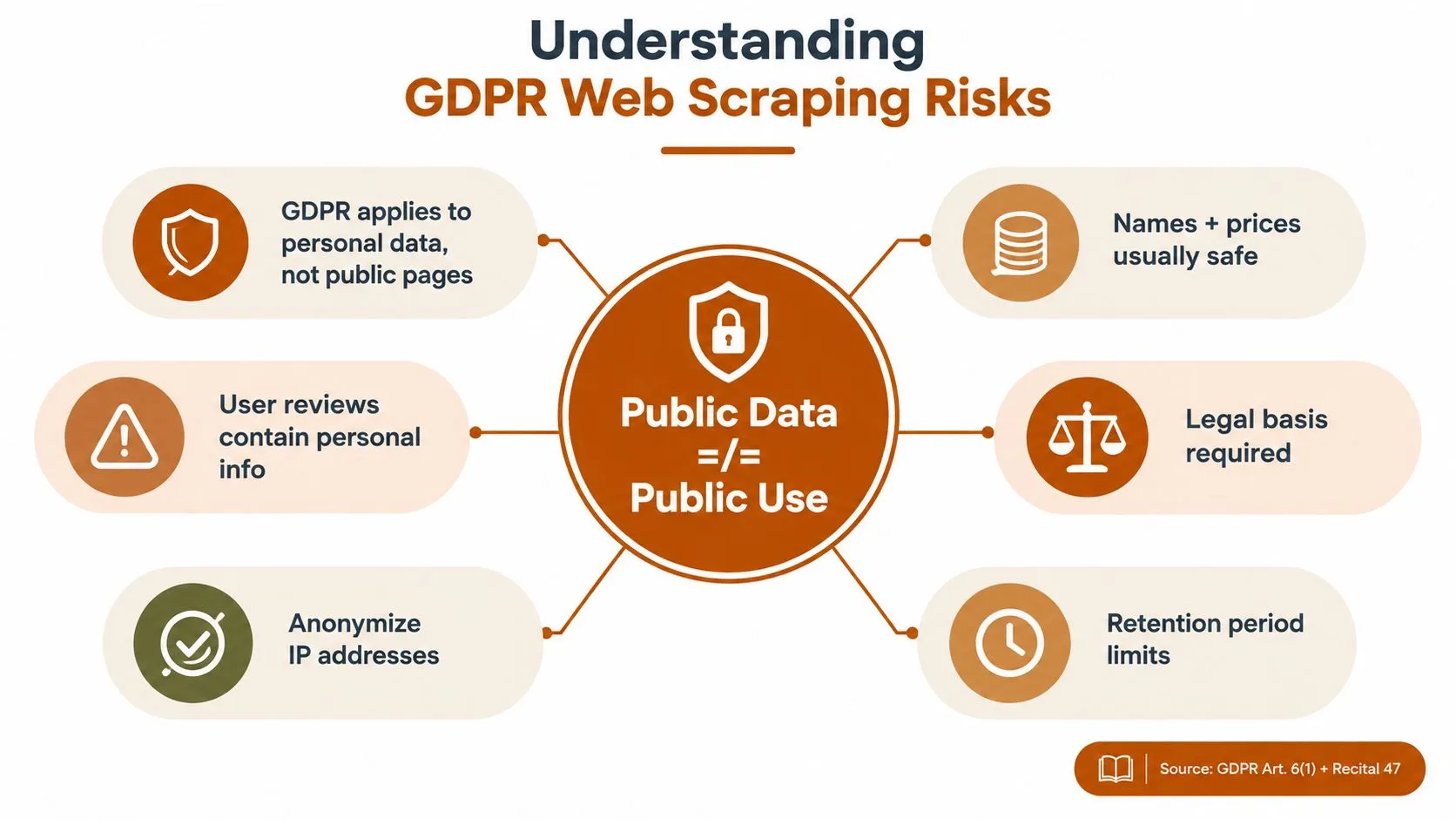
That distinction matters because public visibility is an access condition, not a legal exemption. GDPR obligations depend primarily on what the pipeline captures and how the business uses it. A compliant operation therefore starts with schema design, not browser automation, proxy rotation, or parser performance.
Understanding GDPR Web Scraping Risks
A product-data workflow can fail because of one field. Product titles, ASINs, prices, currencies, dimensions, and stock status generally describe commercial goods rather than identifiable people. A seller display name, public contact detail, reviewer name, profile link, or free-text review can change the classification immediately, especially when those values are stored, organized, enriched, or reused downstream.
The GDPR became applicable on 25 May 2018, establishing a significant legal framework for automated collection involving personal data. The European Data Protection Board’s guidance on web scraping and generative AI emphasizes that processing can include collection, storage, organization, and retrieval. A scraper doesn’t escape those obligations because the source page is available without a login.
Public pages contain mixed data
Amazon product pages illustrate the problem well. The same document can contain structured commercial attributes and human-generated content. A parser that treats the page as one undifferentiated record makes it difficult to prove which fields were necessary and which should have been excluded.
| Field type | Typical examples | Initial GDPR treatment |
|---|---|---|
| Product identifiers | ASIN, SKU, manufacturer part number | Usually non-personal, subject to verification |
| Commercial attributes | Title, price, currency, dimensions, availability | Usually product data |
| Business relationship data | Seller name, storefront URL, seller contact details | Review for personal-data status |
| User-generated content | Review text, reviewer name, profile URL | Treat as potentially personal data |
| Technical traces | IP address, account identifier, cookie value | Personal data requiring strict controls |
| Enrichment fields | Social profile, inferred location, employment detail | High-risk, generally exclude unless justified |
The distinction isn’t based only on what a field is called. A storefront name may identify a company, but it may also identify an individual trader. A review may contain no visible name while still revealing a person through its text, location, occupation, or unusual circumstances.
Practical rule: Design the output around product intelligence. Don’t collect a personal field merely because the parser can see it.
A useful introduction to broader regulatory duties is Kons Law’s compliance guide, particularly for teams that need to connect data operations with documented governance. For scraping-specific risks, review this web scraping risk analysis before approving a production crawler.
Why enforcement changes the engineering decision
The CMS GDPR Enforcement Tracker recorded 2,560 cases overall by 1 March 2025, including 2,245 fines with complete information, with recorded fines totaling approximately €5.65 billion. The tracker reports an average fine of approximately €2.36 million for the 2018 to 2024 period. These figures cover GDPR enforcement across sectors and processing activities, not web scraping alone, so they shouldn’t be presented as a direct scraping penalty forecast. They do show why teams need defensible decisions around legal basis, transparency, accuracy, minimization, and retention. (CMS GDPR Enforcement Tracker, executive summary)
The most useful mental model is simple: ASIN extraction can be low-risk while page extraction is not. Compliance depends on field-level behavior, downstream use, retention, recipients, and the ability to explain why each captured value belongs in the dataset.
Mapping Product Data for Compliance
Before writing selectors, define the smallest dataset that answers the business question. If the objective is competitive price monitoring, the schema might need ASIN, product title, price, currency, availability, product URL, collection timestamp, and parser version. It probably doesn’t need a seller biography, reviewer profile, or review text.
Start with a field-level inventory
Create a schema register before collection begins. Each row should identify the field, its purpose, source location, data classification, retention rule, and decision.
A practical register might look like this:
| Field | Business purpose | Classification | Default decision |
|---|---|---|---|
| ASIN | Join product records across snapshots | Product identifier | Retain |
| Product title | Identify the item | Product attribute | Retain |
| Price and currency | Compare commercial offers | Commercial attribute | Retain |
| Availability | Monitor purchasing status | Commercial attribute | Retain |
| Product URL | Trace provenance | Source reference | Retain with access controls |
| Seller name | Attribute offer ownership | Potentially personal | Exclude unless justified |
| Reviewer name | Analyze user sentiment | Personal data risk | Exclude |
| Review text | Qualitative analysis | Potentially personal | Exclude or isolate after assessment |
| IP address | Technical diagnostics | Personal data | Avoid in business output |
| Account or cookie value | Session operation | Personal data risk | Never store in the dataset |
Classification must account for combinations. An ASIN alone generally identifies a product, but an ASIN joined with a named sole trader, private email address, or inferred location can contribute to identifying a person. The pipeline owner should assess the assembled record, not only each field in isolation.
Document purpose and lawful basis early
Write a purpose statement that is narrow enough to test. “Collect everything useful from Amazon” isn’t operationally defensible. “Create recurring product-price snapshots for internal retail comparison” gives the team a basis for deciding what belongs in scope.
Where legitimate interests under Article 6(1)(f) are considered, document the three-part assessment:
- Specific interest: State the lawful business objective, such as monitoring product availability for a retail intelligence service.
- Necessity: Explain why the selected data is needed and why an equally effective, less intrusive source isn’t available.
- Balancing: Assess context, scale, reasonable expectations, sensitivity, likely consequences, and safeguards.
The dual-compliance guide for tech companies can help teams place technical processing inside a wider compliance program. For implementation principles, use data governance by design as an engineering reference, then adapt the controls to the actual Amazon fields and business purpose.
Build exclusions before the crawler runs
An exclusion list is stronger than a promise to clean the data later. Configure the collection layer to skip review modules, seller biographies, profile links, contact details, account identifiers, and free-text areas unless the approved purpose specifically requires them.
Use layered controls:
- DOM exclusions: Don’t select containers known to hold reviewer or seller information.
- Field allowlists: Store only approved schema fields rather than scraping a broad page object.
- Pattern filters: Detect emails, phone numbers, account identifiers, and other direct identifiers.
- Content suppression: Drop free-text fields that can contain unexpected personal details.
- Post-parse review: Sample records and inspect fields that passed automated rules.
Article 9 creates additional requirements when special-category personal data is processed. A review or description may reveal health information, political opinions, religious beliefs, or other sensitive details even when the original extraction goal was commercial. The safest Amazon pipeline doesn’t attempt to classify every sensitive phrase after capture. It prevents unnecessary text capture in the first place.
Technical Implementation and Anti-Bot Measures
A GDPR-aware scraper needs two separate control planes. The first keeps requests reliable and respectful of the source. The second limits personal-data processing and creates evidence that the limits worked. Proxy rotation, browser settings, and retry logic solve availability problems. They don’t establish a lawful basis or justify collecting a reviewer profile.
Compare technical choices by purpose
| Engineering choice | Operational value | Privacy and compliance concern | Safer implementation |
|---|---|---|---|
| Residential or datacenter proxies | Supports geographic coverage and resilience | Can obscure accountability or expand processing scope | Record provider, purpose, jurisdiction, and access rules |
| Rotating proxies | Reduces repeated requests from one address | Rotation can become indiscriminate collection at scale | Use bounded source lists and conservative request policies |
| Headless browser | Renders dynamic product content | Captures more page elements than the target schema needs | Block unnecessary modules and parse an allowlist |
| CAPTCHA solving | Restores access after a challenge | May undermine source expectations or access controls | Prefer approved access paths and stop when restrictions indicate objection |
| Aggressive retries | Improves completion rates | Creates excess traffic and repeated collection | Apply backoff, retry caps, and source-specific limits |
| Full-page HTML storage | Helps debug parser changes | Retains incidental personal data | Store minimized snapshots or redact before retention |
A proxy is an infrastructure component, not a compliance control. If the system uses a provider to route requests, document the provider’s role, the geographic scope, the data it can observe, and the safeguards in the contract. Don’t retain proxy logs longer than the operational purpose requires.
Headless Playwright or Selenium can render content that a simple HTTP client misses, but rendering also exposes the crawler to recommendation modules, seller blocks, reviews, and embedded tracking elements. Select the product container directly, then discard the raw document as early as the debugging and provenance requirements allow.
The Playwright anti-bot measures guide is useful for understanding detection and reliability techniques. Apply those techniques with restraint. A system that evades every signal, ignores access restrictions, and maximizes extraction yield may be technically impressive while producing a poor legitimate-interest record.
Separate access controls from data controls
Robots.txt, terms of service, CAPTCHAs, login walls, and other technical signals can inform expectations and access decisions. They don’t replace GDPR analysis, and public visibility doesn’t supply a lawful basis by itself. Conversely, respecting a technical exclusion doesn’t make it acceptable to store personal information that the scraper did collect elsewhere.
Use a decision gate before each source:
- Is the source within the approved domain and geographic scope?
- Does the request target a documented product path?
- Are technical restrictions signaling that collection should stop?
- Does the response contain only approved fields?
- Will raw HTML or logs retain incidental personal data?
- Can the system delete or isolate an offending record?
Implement the gate in code rather than leaving it to operator judgment. Return a structured skip reason when a page fails the gate, such as excluded_personal_data, source_restriction, or schema_mismatch. Those decisions become valuable evidence during audits and parser reviews.
Engineering principle: Anti-bot resilience should reduce unnecessary requests, not justify collecting everything the browser can render.
A production pipeline can combine request throttling, bounded concurrency, parser versioning, and source-specific backoff with field-level minimization. If a site changes its layout, the correct response is a controlled parser failure and review, not a fallback that stores the entire page indefinitely.
Ensuring Transparency and Accountability
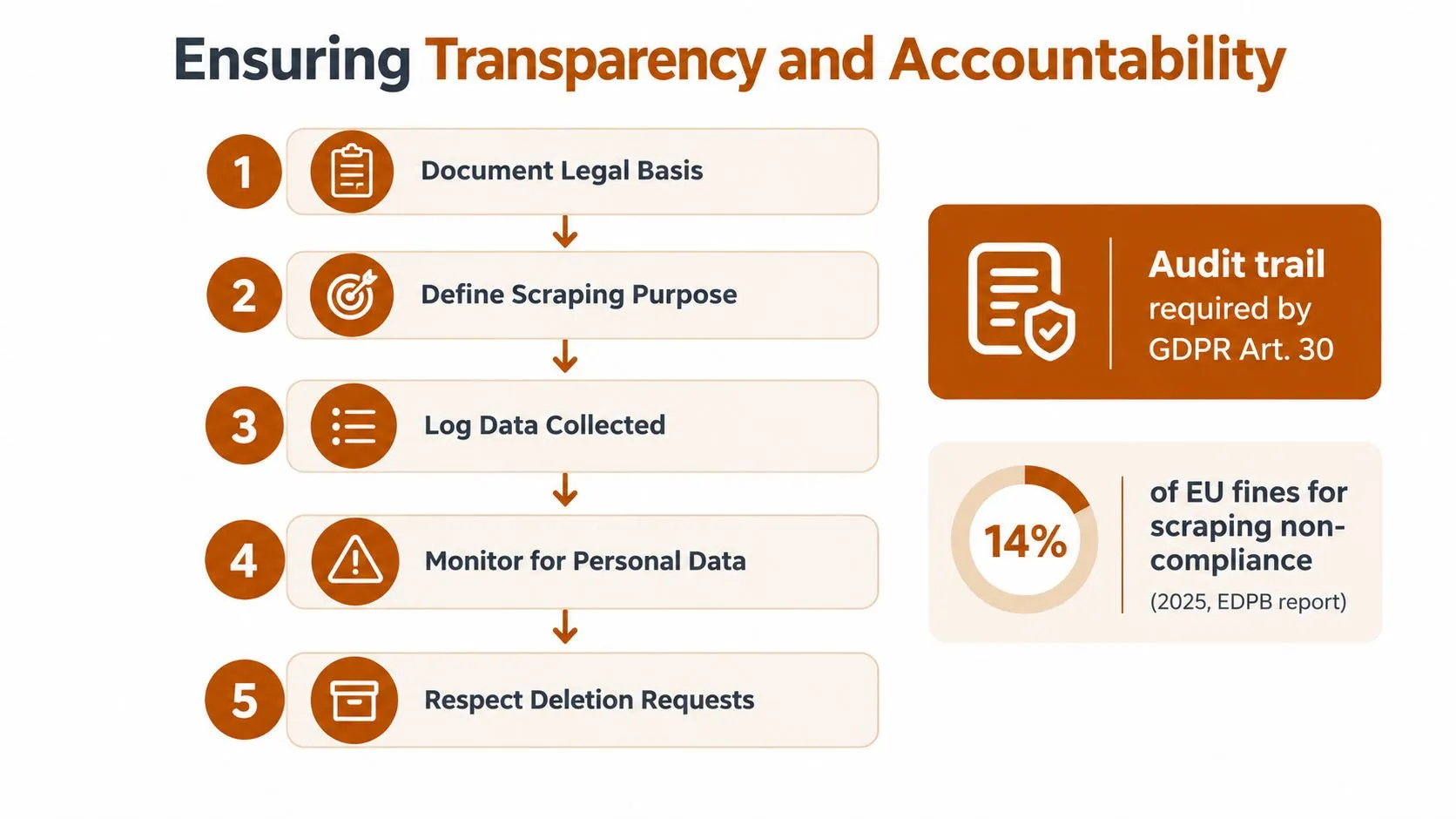
A working scraper gives you records. An accountable scraper gives you reasons, timestamps, decisions, and deletion paths. The difference appears when someone asks which source produced a value, why a field was retained, or whether a record was removed after an objection.
Create an evidence trail at collection time
The log should describe the collection event without becoming a second uncontrolled dataset. At minimum, record the source URL, collection timestamp, jurisdiction, parser version, fields retained, exclusion decisions, and error or retry events. Keep business output separate from operational logs so an engineer can troubleshoot without granting broad access to all extracted values.
A useful event record includes:
- Source reference: The page or endpoint that supplied the product record.
- Collection timestamp: When the system obtained the data.
- Schema version: The approved field contract in effect at collection.
- Parser version: The code and rules responsible for extraction.
- Retention decision: Which fields were kept, redacted, or discarded.
- Validation result: Whether values passed format and consistency checks.
- Exception status: Whether a human needs to review the record.
The EDPB recommends reliable sources, collection timestamps, and validation to support the GDPR accuracy principle. That matters for Amazon data because prices, availability, seller relationships, and product attributes change. A timestamped record lets the team distinguish a stale value from an extraction defect. (EDPB web scraping guidance)
Validate before publishing downstream
Validation should happen at several boundaries. First, confirm that the ASIN has the expected format and that the product URL maps to the intended record. Next, check that price and currency values parse consistently, that availability states belong to an approved vocabulary, and that duplicate records don’t multiply through pagination or retry behavior.
Personal-data checks need a different approach. Use detectors for email addresses, phone numbers, profile URLs, account identifiers, and high-risk terms. A detector isn’t proof that a record is lawful, but it can quarantine unexpected content before delivery. For borderline cases, route the record to human review rather than passing it into a warehouse or model-training dataset.
Don’t measure success by extraction yield alone. A high yield can indicate that the scraper is capturing more irrelevant page content, including personal information. Track false inclusions, false exclusions, schema violations, rejected records, and review outcomes as quality and governance indicators.
Set retention and rights workflows
Retention should operate at field and storage-layer level. Raw HTML often needs a shorter retention period than a minimized product record because it contains more incidental content. If raw material is retained for parser debugging, document the reason, restrict access, and configure automatic deletion rather than relying on manual cleanup.
Article 14 can require transparency when personal data is collected indirectly. Publishing information online doesn’t automatically mean that an individual manifestly made it public. The controller should therefore maintain a public-facing explanation where applicable, identify the purpose and categories of data, and provide a practical route for objections or deletion requests.
The rights workflow must reach every copy:
- Identify the person or record using available request information.
- Search the primary store, caches, exports, logs, review queues, and derived tables.
- Remove, suppress, or correct the affected data according to the documented policy.
- Record what action occurred, when it occurred, and which downstream recipients were notified.
- Confirm that future crawls don’t immediately reintroduce the same excluded content.
The ethical data collection guide provides a useful operational reference for connecting collection practices with accountability. For higher-risk processing, maintain a data-protection impact assessment or proportionality record covering purpose, schema, lawful-basis rationale, alternatives considered, impact, safeguards, and approval owner.
Building a Sustainable Scraping Strategy
A sustainable Amazon data operation treats compliance as part of system design, not as a document attached after deployment. Keep the approved schema narrow, version every change, and require review before adding seller, reviewer, contact, or free-text fields. If the business question can be answered with ASINs, prices, titles, and availability, don’t expand collection just because the page exposes more data.
The durable operating model has three connected disciplines:
- Legal discipline: Maintain the purpose, lawful-basis assessment, source decisions, transparency materials, and rights process.
- Engineering discipline: Enforce field allowlists, throttle requests, isolate raw material, validate outputs, and monitor parser changes.
- Operational discipline: Assign an owner, review exceptions, test deletion workflows, and revisit the assessment when the use case or source changes.
Common failure modes are predictable. Teams rely on robots.txt as if it were a GDPR decision, treat anonymization as automatic because a name was removed, retain raw HTML forever for convenience, or let a fallback parser capture entire pages after a selector breaks. Each shortcut weakens the evidence trail and increases the chance that product data becomes mixed with personal data.
Long-running systems also need maintenance. Use web scraper maintenance guidance to plan parser monitoring, schema regression tests, retry controls, and ownership. WebscrapingHQ provides managed extraction pipelines with schema-specific data delivery, monitoring, retries, proxy management, and recurring outputs, which can suit teams that don’t want to maintain this infrastructure internally.
WebscrapingHQ can help scope an Amazon product schema, implement field-level exclusions, and operate recurring extraction with monitoring and structured delivery. If you need ASIN, pricing, availability, or other product data without turning a broad page capture into an uncontrolled personal-data pipeline, visit WebscrapingHQ to discuss the workflow.
Want this done for you?
Send us the URLs. We'll quote it in 24 hours.
Paste the URL(s) you want scraped. We'll reply within 24 hours with a feasibility check and a ballpark quote.