Jump to section
- Why Late-Stage Compliance Fails in Web Data Pipelines
- Retrofitting creates operational debt
- The Origins and Evolution of Data Governance by Design
- From privacy controls to lifecycle governance
- Core Principles of Governance by Design in Web Pipelines
- Define the contract before extraction
- Make provenance travel with the record
- Integrating Privacy and AI Governance into Web Operations
- Use a field-level control matrix
- The Operational Gap - Why Policy Maturity Falls Short
- Why external data exposes the gap
- Practical Implementation - Schema Versioning and Quality Controls
- Build validation into every run
- Choose failure behavior deliberately
- Building Auditable Delivery Artifacts for Compliance
- Make evidence a normal output
- Conclusion - Embedding Governance for Scalable Data Operations
A web-data pipeline can look production-ready while remaining impossible to defend under scrutiny. The extraction runs, records arrive on schedule, and dashboards refresh, but nobody can answer which source produced a field, when the value changed, whether personal data was collected unnecessarily, or what happened to records that failed validation. Those questions usually surface during an audit, a source redesign, a customer request, or an AI review, when retrofitting answers is slow and expensive.
Data governance by design addresses that failure by making ownership, purpose, quality, provenance, privacy, and retention part of the pipeline itself. For external web data, governance isn’t a catalog entry added after delivery. It is a set of controls that runs while data is collected, transformed, stored, and shared.
Why Late-Stage Compliance Fails in Web Data Pipelines
A common failure starts with a reasonable business request: collect product information from several websites, normalize it, and deliver a feed to analytics. Engineers define selectors, add retries, solve source-specific parsing problems, and optimize throughput. Governance discussions wait because the team wants to prove technical feasibility first.
Months later, an audit asks for source provenance and retention evidence. The pipeline has raw HTML, parsed records, transformed outputs, and cached copies scattered across systems, but no consistent relationship between them. A product title can be traced manually on a good day. A changed price, translated description, or inferred category often cannot.

Retrofitting creates operational debt
Late controls usually become spreadsheets, ad hoc scripts, and manual sampling. Those mechanisms may demonstrate effort, but they rarely provide reliable enforcement. A team might document that an email field should be excluded, yet the extractor continues collecting it because the rule isn’t connected to the collection stage. Another team may record a source’s reuse conditions in a wiki while delivery jobs keep sending the data to every downstream consumer.
The cost isn’t limited to compliance work. Without clear provenance, analysts can’t distinguish a source correction from a parser regression. Without schema history, a new page layout can change field meaning without anyone noticing. Without retention jobs, old snapshots remain available long after their business purpose has ended.
Practical rule: If a governance requirement can’t stop, quarantine, label, or delete a record at the relevant pipeline stage, it remains guidance rather than a control.
A useful starting point is a source-level risk assessment that covers access method, permitted reuse, field sensitivity, geographic scope, and expected update behavior. Teams handling legal and compliance exposure should also document the risks described in this guide to legal risks in web scraping, then convert relevant conclusions into pipeline rules.
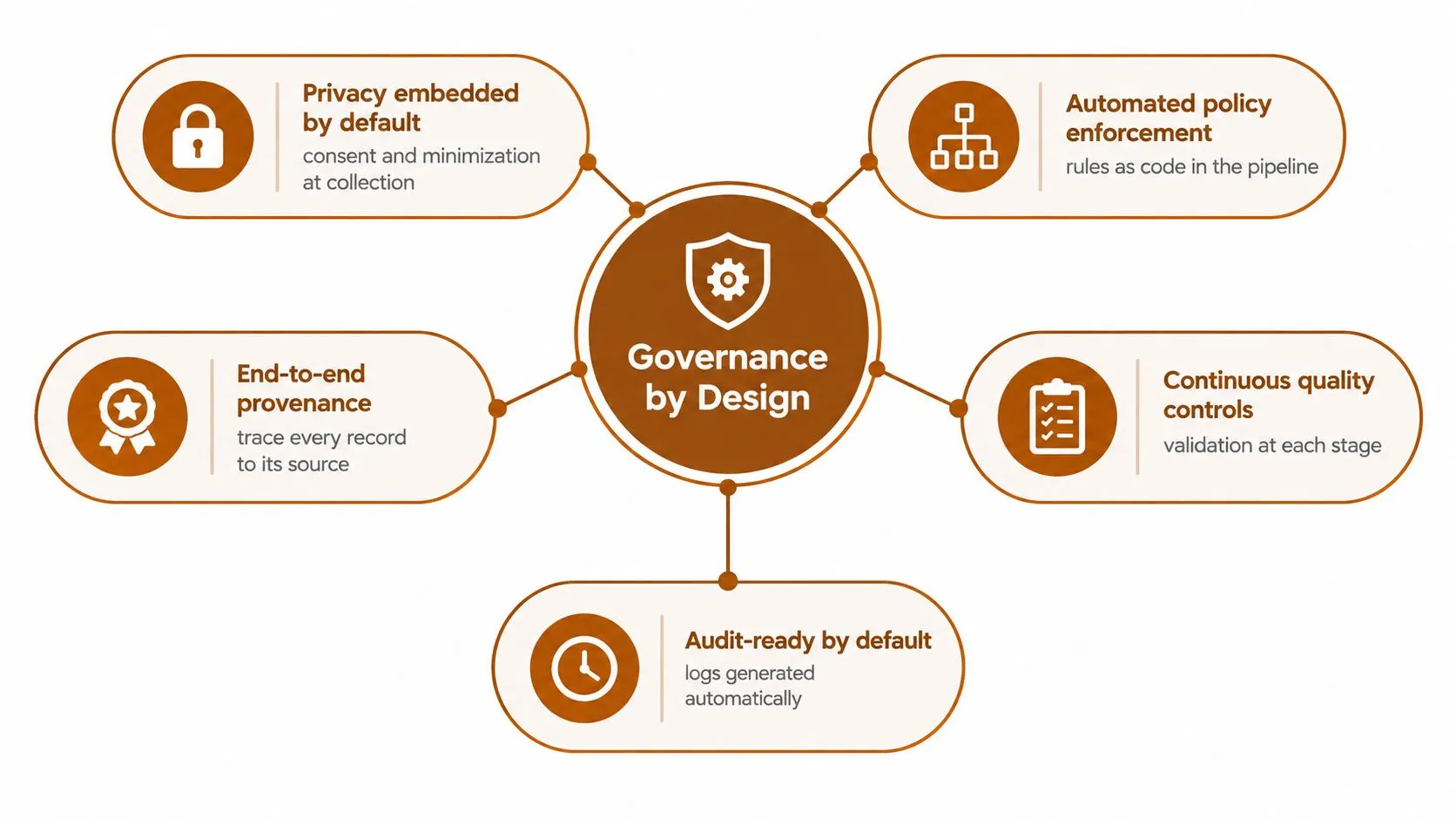
Governance by design changes the sequence. Before extraction begins, the team defines the data contract, approved fields, provenance requirements, validation behavior, access roles, and retention mechanism. The result is a pipeline that can produce evidence as part of normal delivery instead of reconstructing its history under pressure.
The Origins and Evolution of Data Governance by Design
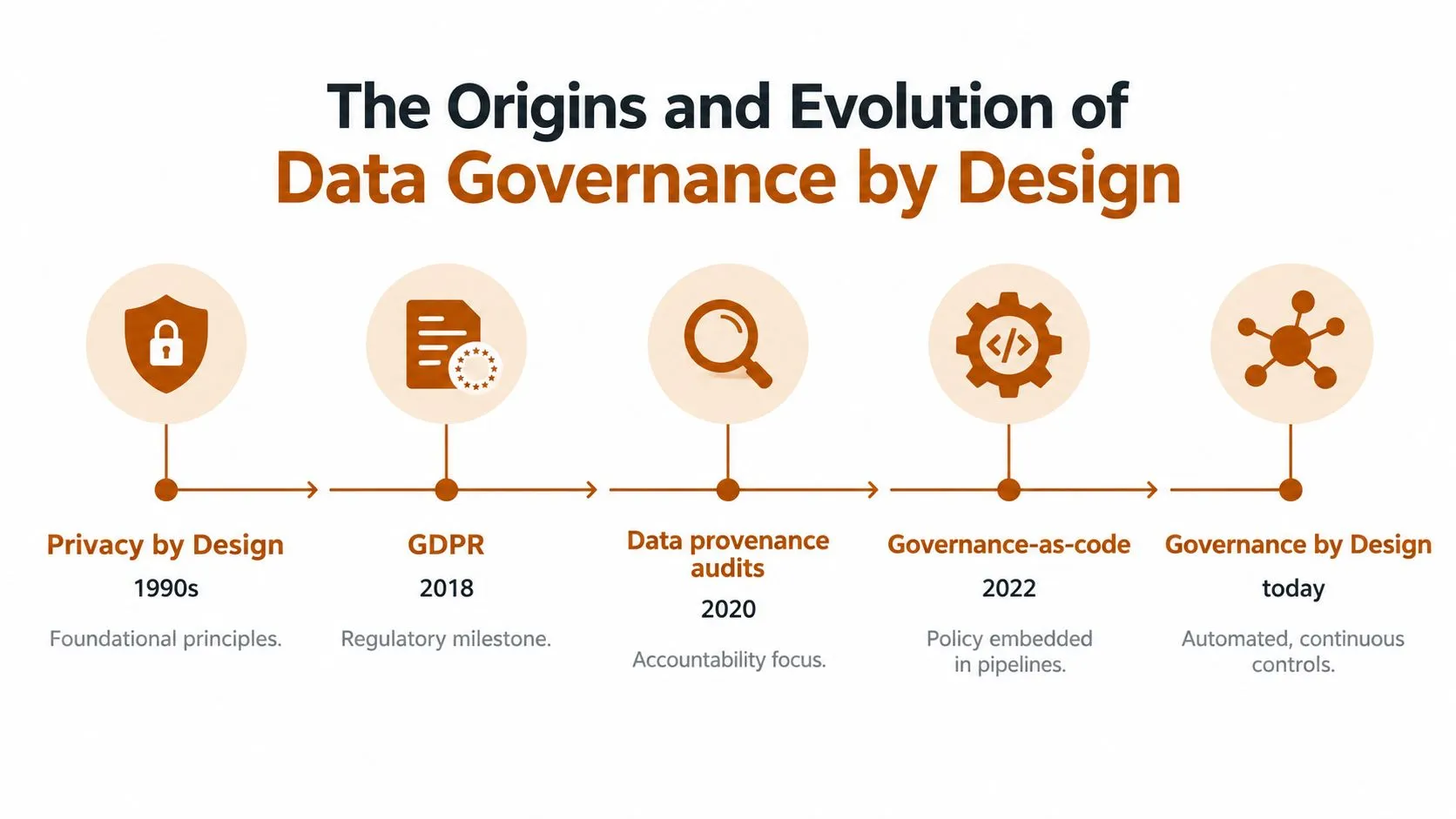
The idea began with privacy by design, then expanded into a broader operating model for controlling data throughout its lifecycle. The European Data Protection Supervisor’s history of the GDPR records that the European Union adopted the General Data Protection Regulation in 2016, replacing the 1995 Data Protection Directive. Member states then had two years to make the regulation fully implementable by May 2018.
Article 25 formalized “data protection by design and by default.” The important shift was architectural. Organizations were expected to build privacy and data protection into information systems from the earliest stages, rather than treating compliance as a review performed after implementation. The European Commission summarizes the practical objective as protecting privacy principles “right from the start.”
From privacy controls to lifecycle governance
Web-data operations make the upstream principle concrete. A team needs to decide what it may collect, why it needs each field, how long it will retain the record, who may access it, and how it will prove the source before the extractor runs. Those decisions belong in schemas, permissions, workflows, and deletion jobs, not solely in policy documents.
NIST’s Research Data Framework.pdf) defines governance through authority, control, shared decision-making, planning, monitoring, and enforcement. Its quality model includes accuracy, completeness, consistency, timeliness, relevance, reliability, and accessibility. It also treats quality assessment as activity performed throughout a dataset’s lifetime, not as a final inspection.
That lifecycle perspective matters because external sources are unstable. Pages change, languages vary, fields appear conditionally, and third-party content may carry uncertain lineage. NIST began developing a Data Governance and Management Profile in 2024, reflecting the growing need to consider privacy, cybersecurity, and artificial-intelligence risk through data governance.
The result is broader than privacy-by-design. Data governance by design assigns owners, defines fitness for purpose, records lineage, enforces quality, and monitors change from collection through disposal. AI governance adds another reason to work this way. A record that was acceptable for a public market report may require different controls when used for profiling, model training, or an automated decision.
Core Principles of Governance by Design in Web Pipelines
A scraper can collect valid HTML and still produce an unusable governed dataset. The operational test is whether each rule becomes an enforceable behavior as data enters, changes, moves, or leaves the system. “Maintain accurate product records” is too vague for production. A contract requiring a non-empty identifier, approved currency code, source timestamp, and freshness threshold can be evaluated automatically.
The European Commission’s data governance summary identifies accuracy, completeness, consistency, uniqueness, integrity, timeliness, provenance, and collection method as governance dimensions. Each can become a validation rule, a stored metadata field, or an exception requiring review.
Define the contract before extraction
A machine-readable contract should specify:
- Field behavior: Names, types, required and optional attributes, permitted vocabularies, and geographic or temporal scope.
- Lineage requirements: Source URL, source identifier, collection timestamp, parser version, transformation version, and relevant capture metadata.
- Quality thresholds: Completeness percentage, duplicate rate, schema-conformance rate, freshness lag, and anomaly conditions.
- Failure handling: Whether a failed record is rejected, quarantined, flagged for review, or delivered with an explicit quality status.
- Lifecycle rules: Approved purpose, access role, retention period, deletion method, and downstream sharing restrictions.
A policy that says “protect source quality” remains too vague for production. Teams needing concrete wording can review these data governance policy examples before translating policy into pipeline contracts.
Schema versioning matters when an external source changes. Version one might store a single price field. A later version may separate list price, sale price, currency, and availability. Keeping both versions with documented transformations protects comparability. Overwriting the old structure may be faster at first, but it weakens historical analysis and audit reconstruction.
Make provenance travel with the record
Provenance should not exist only in a separate catalog. Attach sufficient lineage metadata to each delivery, or use a stable record identifier that lets users retrieve it. If a parser infers a value from visible text, the pipeline should distinguish that transformation from a directly extracted value.
Resources on implementing governance frameworks can help organize ownership and policy domains. The pipeline still needs executable controls. Governance stops being operational when roles and definitions are recorded but extraction, validation, and delivery behavior remain unchanged.
A governed feed carries values and evidence about their origin, transformations, and validation results.
Log control outcomes with every delivery. The report should show the schema version used, validation rules passed, records quarantined, open exceptions, and whether freshness requirements were met. That evidence makes governance a property of routine web-data operations rather than a periodic review.
Integrating Privacy and AI Governance into Web Operations
Privacy, quality, and AI governance overlap at the field level. A pipeline can’t decide whether a record is safe merely by labeling the whole dataset “public.” The relevant questions concern purpose, association, sensitivity, jurisdiction, access, retention, and downstream use.
NIST’s privacy-engineering model describes manageability, disassociability, and predictability. In practice, manageability means the system can support alteration, deletion, and selective disclosure. Disassociability means it limits links to individuals or devices beyond operational need. Predictability means users and affected people can form reliable expectations about processing.
Use a field-level control matrix
Before extraction, classify each field and record its operational treatment:
- Purpose and lawful basis: Why the field is needed and the permitted use.
- Sensitivity and association: Whether it identifies a person, device, organization, or location, and whether separation is possible.
- Access and disclosure: Which roles may read it and which outputs may contain it.
- Retention and deletion: How long it remains in raw, transformed, cached, and delivered copies.
- Geography: Applicable jurisdiction, transfer constraints, residency requirement, and localized handling rules.
- Model relevance: Whether a later use could involve profiling, training, ranking, or automated decisions.
Minimization should happen during collection, not after a warehouse receives unnecessary data. Separating identifiers from analytical attributes can reduce exposure, while masking and role-based access limit routine visibility. Deletion must cover derived copies and delivery destinations, otherwise a successful removal from the primary store creates a misleading compliance record.
The same design supports AI governance. A reusable baseline can require provenance, owner assignment, access logging, quality validation, and retention enforcement. Context-specific controls then vary by geography, sensitivity, purpose, and model risk. A single universal policy is easier to publish, but it often becomes too broad to guide an actual extraction job.
For practical transparency work, teams can review what does with your data when assessing how a service describes collection and use. They should also define ethical collection expectations, source restrictions, and escalation paths as part of ethical data collection.
The most important operational trigger is a change in use. When a market-monitoring feed becomes model-training input, the owner should reassess purpose, permitted fields, retention, access, and jurisdiction rather than assuming the original approval still applies.
The Operational Gap - Why Policy Maturity Falls Short
A company can maintain a policy library, appoint data stewards, and catalogue its assets, yet still lack the controls needed for external ingestion. Web sources arrive in inconsistent structures, languages, and formats that can change without notice. Provenance may be uncertain, personal data may be embedded in content, and meaning can depend on context.
The 2025 DATAVERSITY Trends in Data Management survey found that 61% of organizations identified data quality as a top challenge, while 15% reported mature data governance (DATAVERSITY survey). Those figures describe a practical execution gap. Policy maturity does not, by itself, create validation, lineage, or exception handling inside distributed web-data pipelines.

Why external data exposes the gap
Centralized guidance often assumes that assets are known, structured, and controlled by internal teams. Web operations remove those assumptions. A source can alter its markup overnight, while a multilingual page may express the same commercial attribute in different ways. An LLM-assisted parser can also produce a plausible value without recording confidence, supporting evidence, or the transformation that generated it.
PwC’s 2026 Global Digital Trust Insights survey found that only 6% of organizations had implemented all surveyed data-risk controls enterprise-wide (PwC Global Digital Trust Insights). The finding covers gaps across lifecycle controls, discovery, classification, responsible AI, and loss prevention. Policy still has value; the operational requirement is to generate proof where the work occurs.
Each pipeline run should produce source-risk status, schema version, validation results, exception records, retention actions, and review decisions. These artifacts give auditors and downstream consumers a reliable account of what happened without requiring interviews with every engineer involved.
A policy defines expected behavior. An operational control records the behavior that occurred.
Practical Implementation - Schema Versioning and Quality Controls
The first implementation choice is whether to tolerate source variation in one flexible schema or preserve strict contracts for each delivery. Flexible schemas reduce short-term breakage, but they push ambiguity downstream. Strict schemas expose source changes early, though they require a deliberate compatibility process.
For enterprise feeds, a versioned contract usually provides the better trade-off. Define the canonical field set, keep source-specific mapping outside the consumer-facing contract, and introduce a new schema version when a change alters meaning, type, requiredness, or interpretation.
Build validation into every run
A useful run manifest records:
- Input scope: Approved sources, collection window, geographic scope, and source-policy status.
- Execution identity: Pipeline version, parser version, schema version, and configuration revision.
- Quality results: Completeness percentage, duplicate rate, schema-conformance rate, freshness lag, and anomaly counts.
- Exception action: Rejected records, quarantined records, warnings, manual reviews, and unresolved issues.
- Delivery decision: Released, partially released with warnings, or blocked pending review.
The metric names matter because they create shared expectations. Completeness can reveal missing fields after a page redesign. Duplicate rate can expose pagination or retry errors. Freshness lag can distinguish an on-time job from an on-time job delivering stale source content.
Choose failure behavior deliberately
Dropping invalid records without notice is convenient and dangerous. Delivering them without labels preserves volume but contaminates downstream analysis. Quarantine is often the sound middle path: preserve the record, attach the failure reason, prevent ordinary delivery, and route it to a review queue.
Automated checks should also distinguish recoverable transport failures from semantic failures. A temporary access problem may require a retry. A price parsed into the wrong currency requires a different response. That distinction prevents teams from masking data defects with operational retries.
A managed service can absorb source monitoring, retries, parser updates, and delivery scheduling, while the customer retains control over the contract and acceptance criteria. Teams evaluating that model can compare requirements against online web scraping services, especially where recurring operations would otherwise consume internal engineering time.
The scalable pattern is not “validate everything manually.” It is automate routine checks, quarantine uncertain records, and reserve human review for exceptions that affect meaning or risk.
Building Auditable Delivery Artifacts for Compliance
A governed delivery should include more than the requested CSV, JSON feed, report, webhook, or storage drop. It should carry a companion evidence package that explains what the asset is, who owns it, how it was collected, what restrictions apply, and whether it passed the required controls.
Start with metadata that downstream users can understand without consulting the extraction team. Record the asset owner, business purpose, source and access method, reuse conditions, jurisdiction, quality limitations, schema version, and retention rule. At field level, capture provenance and transformation details where the distinction affects interpretation.
Make evidence a normal output
A run-level package might contain:
- A schema manifest and change summary.
- Source and field lineage records.
- Validation results and threshold decisions.
- Quarantine counts with reason codes.
- Access, sharing, and retention status.
- Human review decisions and unresolved exceptions.
- Deletion or expiry evidence for material copies.
| Artifact | Purpose | Example |
|---|---|---|
| Schema manifest | Defines the delivered structure | Field names, types, required attributes, and schema version |
| Lineage record | Connects output to origin and transformation | Source URL, collection timestamp, parser version, and transformation step |
| Quality report | Shows whether acceptance criteria ran | Completeness, duplicate, conformance, freshness, and anomaly results |
| Exception register | Preserves reviewable failures | Quarantined record identifier, failure reason, disposition, and reviewer |
| Retention record | Demonstrates lifecycle enforcement | Expiry rule, deletion job status, and affected storage copy |
Consider data provenance in web pipelines, which becomes operational rather than descriptive at this point. A lineage record should help a consumer move from a questionable output value to its source evidence and transformation history.
Multi-geo operations need an additional layer. Store jurisdiction and transfer constraints with the dataset or field policy, then route, restrict, or redact according to those rules. Don’t assume that a single global retention setting is appropriate for every source and use.
WebscrapingHQ can provide managed extraction pipelines with schema versioning, quality controls, scheduled feeds, reports, and storage deliveries. The relevant design question is not whether an external provider is used, but whether its output includes the governance artifacts your reviewers and downstream systems require.
Conclusion - Embedding Governance for Scalable Data Operations
Data governance by design works because it moves decisions to the point where engineers and operators can enforce them. Source approval happens before collection. Field purpose and sensitivity shape extraction. Schemas define acceptable structure. Validation runs during ingestion and transformation. Provenance travels with the record. Retention and deletion operate across the lifecycle.
The operating model should remain continuous. Source pages change, business purposes evolve, jurisdictions impose different handling requirements, and AI use can alter the risk profile of an existing dataset. Monitoring therefore needs to cover source behavior, schema drift, freshness, quality exceptions, access, retention, and changes in downstream use.
A practical governance baseline contains five commitments:
- Define before collecting: Approve sources, purposes, fields, access methods, and retention rules.
- Enforce during processing: Apply schema, privacy, quality, and policy controls inside the pipeline.
- Preserve evidence: Generate lineage, run manifests, validation reports, and exception records automatically.
- Separate routine from judgment: Automate deterministic checks and route semantic or high-risk cases to people.
- Reassess on change: Trigger review when sources, schemas, jurisdictions, or downstream uses change.
Governance isn’t a document that a pipeline references. It is the behavior the pipeline performs and the evidence it leaves behind. Teams that build those controls early can make reliability, audit readiness, and lifecycle management part of ordinary delivery rather than emergency remediation.
WebscrapingHQ provides managed web data operations, custom extraction, monitoring, multi-language and multi-geo pipelines, and structured deliveries with governance-oriented controls such as schema versioning and quality checks. Visit WebscrapingHQ to discuss a recurring web-data pipeline designed around your fields, validation rules, provenance needs, and retention requirements.
Want this done for you?
Send us the URLs. We'll quote it in 24 hours.
Paste the URL(s) you want scraped. We'll reply within 24 hours with a feasibility check and a ballpark quote.