Jump to section
- The New Economics of Reddit Data Collection
- What changed for engineering teams
- Evaluating Official APIs Against Direct Extraction
- A practical decision matrix
- Engineering Resilient Authentication and Rate Limits
- Build the scheduler around server feedback
- Test failure paths before launch
- Mastering Comment Trees and Schema Versioning
- Define records that survive change
- Treat schema versions as compatibility contracts
- Designing Privacy-Preserving Data Operations
- Minimize fields at ingestion
- Scaling Multi-Geo Pipelines and Delivery Formats
- Make localization explicit
- Deliver data for the consumer
The popular advice is to start with a Python script, request Reddit pages, parse the HTML, and add a delay when the site responds with an error. That approach can produce a convincing demo, but it doesn’t produce a dependable data operation. Web scraping Reddit in production is an ingestion, governance, and delivery problem, not a selector-writing exercise.
A resilient pipeline authenticates through the official Data API where possible, treats quotas as architectural constraints, stores immutable identifiers, validates comment relationships, versions its schema, and limits personal data from the start. Direct extraction still has narrow uses, especially when a permitted source isn’t exposed through the API, but it should be an explicit exception rather than the default design.
The New Economics of Reddit Data Collection
Reddit’s API policy change on July 1, 2023 changed the cost model for large-scale collection. Before that date, the Data API was broadly available without the current high-volume pricing model. Afterward, free access became limited to 100 queries per minute per OAuth client ID, or 10 queries per minute without OAuth authentication, while applications needing higher limits were charged $0.24 per 1,000 API calls according to Reddit’s API policy announcement.
That distinction matters because a small authenticated collection job and a commercial monitoring platform have very different operating profiles. A modest volume of public data can remain within the free tier, while historical archiving, continuous brand monitoring, and machine-learning collection may require higher quotas, formal approval, or a different acquisition strategy. Reddit also said that more than 90% of applications could continue using the API for free, with another contemporaneous explanation referring to more than 98% of non-commercial apps below the usage threshold, so teams shouldn’t assume that every project immediately incurs API fees. They should scope the project realistically before writing the collector.
What changed for engineering teams
The policy shift moved several concerns into the first design review:
- Authentication: Unauthenticated requests have a lower ceiling and can be throttled or blocked. OAuth isn’t a convenience layer, it’s part of the operating contract.
- Quota planning: Request volume must be estimated from endpoints, pagination, retries, comment expansion, and refresh frequency.
- Commercial approval: A business using Reddit data for monitoring, research, or machine learning may need formal access arrangements rather than a higher concurrency limit alone.
- Data lifecycle: The team must define what it stores, for how long, and whether the intended use permits downstream sharing.
Reddit restricted third-party API access to mature content beginning July 5, 2023, another sign that the API isn’t a neutral transport pipe. The platform’s stated concerns included infrastructure costs and companies acquiring large amounts of Reddit content for AI training without compensation, so a pipeline’s business purpose belongs in the architecture documentation, not only in legal review.
Practical rule: Estimate requests before records. A request-capacity calculation isn’t a coverage guarantee because listing size, pagination depth, deleted content, private communities, and endpoint behavior determine the actual yield.
The historical side has its own economics. A foundational research dataset contains post-related information for all subreddits and users from January 2006 through December 2018, with 38 properties per post, as documented in the University of Pennsylvania repository record. That archive is valuable for longitudinal analysis, but it isn’t a substitute for current collection. Modern API responses and older records can differ in fields, deleted material, moderation state, community names, and permissions.
The sensible response is to preserve raw captures and metadata, document collection dates, and version the normalized schema. Teams that treat policy, quota, and provenance as afterthoughts often discover that their cheapest prototype becomes their most expensive system to replace.
Evaluating Official APIs Against Direct Extraction
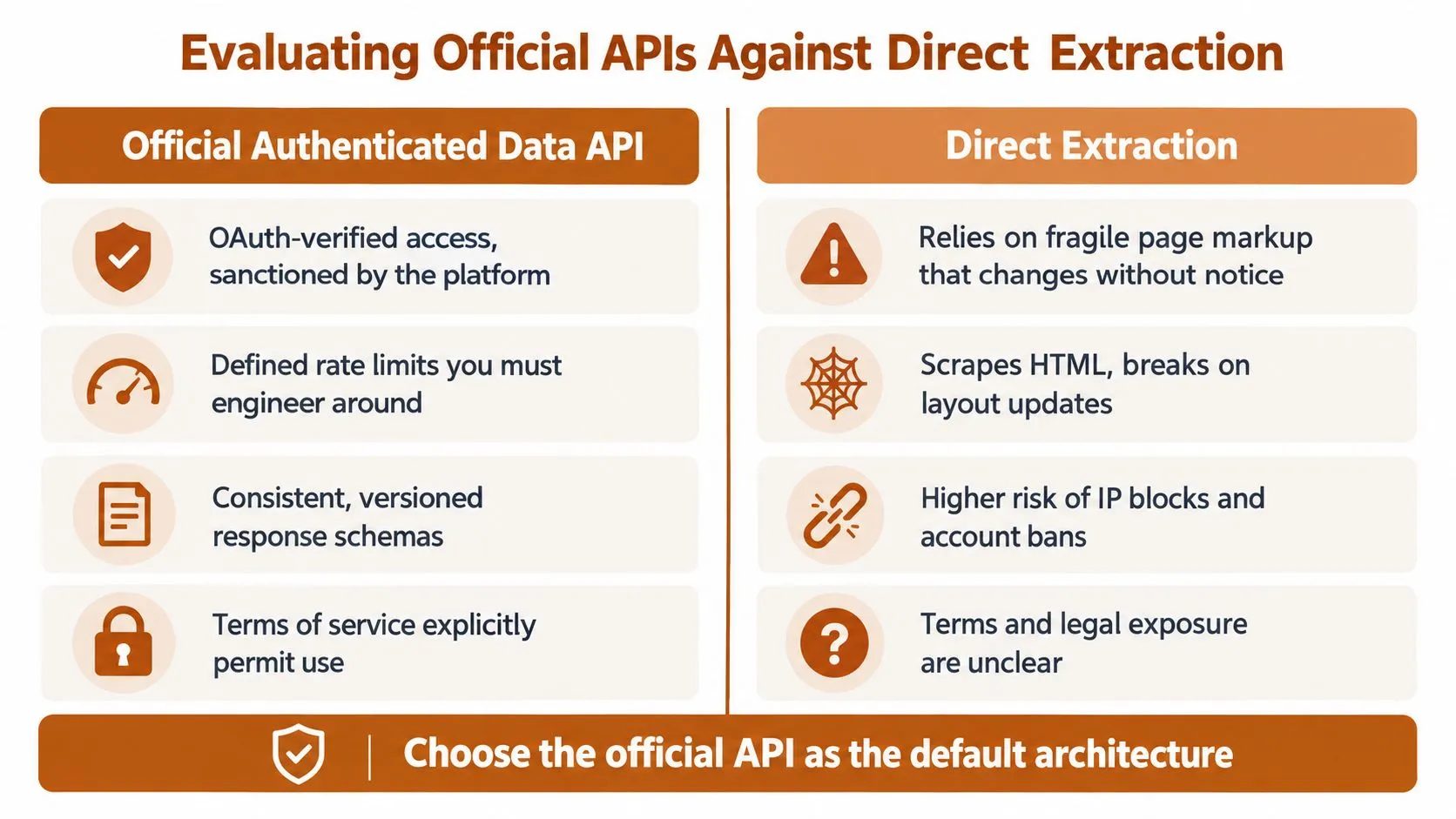
The official authenticated Data API should be the default ingestion method for production Reddit work. It gives the team a documented contract, identifiable application credentials, structured responses, and rate-limit signals that can be monitored. Direct HTML extraction has a different profile: it can expose rendered information that an API endpoint doesn’t provide, but it depends on markup and behavior that may change without notice.
Legacy archives occupy a third category. They can provide historical depth that a live API collection can’t recreate, but their provenance, freshness, permissions, and field definitions need separate validation. A historical corpus is useful only when the team can explain what it contains and how it differs from current observations.
A practical decision matrix
| Requirement | Authenticated Data API | Direct HTML extraction | Historical archive |
|---|---|---|---|
| Live monitoring | Strong fit when approved and quota is sufficient | Fragile, with markup and bot-defense exposure | Not suitable |
| Stable fields | Preferable because response structures can be normalized and versioned | Requires selectors, fixtures, and frequent maintenance | Depends on archive schema |
| Deep history | Limited by current access and endpoint behavior | Doesn’t create history that wasn’t captured | Stronger fit, subject to provenance |
| Rendered UI data | May not expose every presentation detail | Can capture visible elements when permitted | Usually unavailable |
| Compliance review | Terms, authentication, and quota are explicit | Access and reuse boundaries can be unclear | Must be assessed archive by archive |
| Operational recovery | Cursors, status codes, and headers support resumable jobs | Recovery often depends on page state and parser heuristics | Usually batch-oriented |
robots.txt doesn’t authorize API use. Reddit specifically says its robots.txt is intended for search engines rather than Data API users, while authenticated API access remains governed by rate limits and terms in the Reddit Data API Wiki. A crawler that reads a permissive robots file hasn’t established permission to call an API, reuse content commercially, or bypass a quota.
Direct extraction also creates a hidden observability problem. A request can return an apparently successful response while delivering incomplete or altered content. A parser that only checks HTTP status may report success even when the page has changed, pagination has disappeared, or a bot-defense response contains no useful records.
For teams weighing the broader architecture, web scraping versus APIs provides a useful comparison, but the decision should remain source-specific. Use direct extraction only when the use case is permitted, the API lacks a required field, and the team can maintain fixtures, completeness checks, and a controlled fallback. Don’t build a business-critical Reddit pipeline around undocumented page markup merely because the first request succeeded.
Engineering Resilient Authentication and Rate Limits
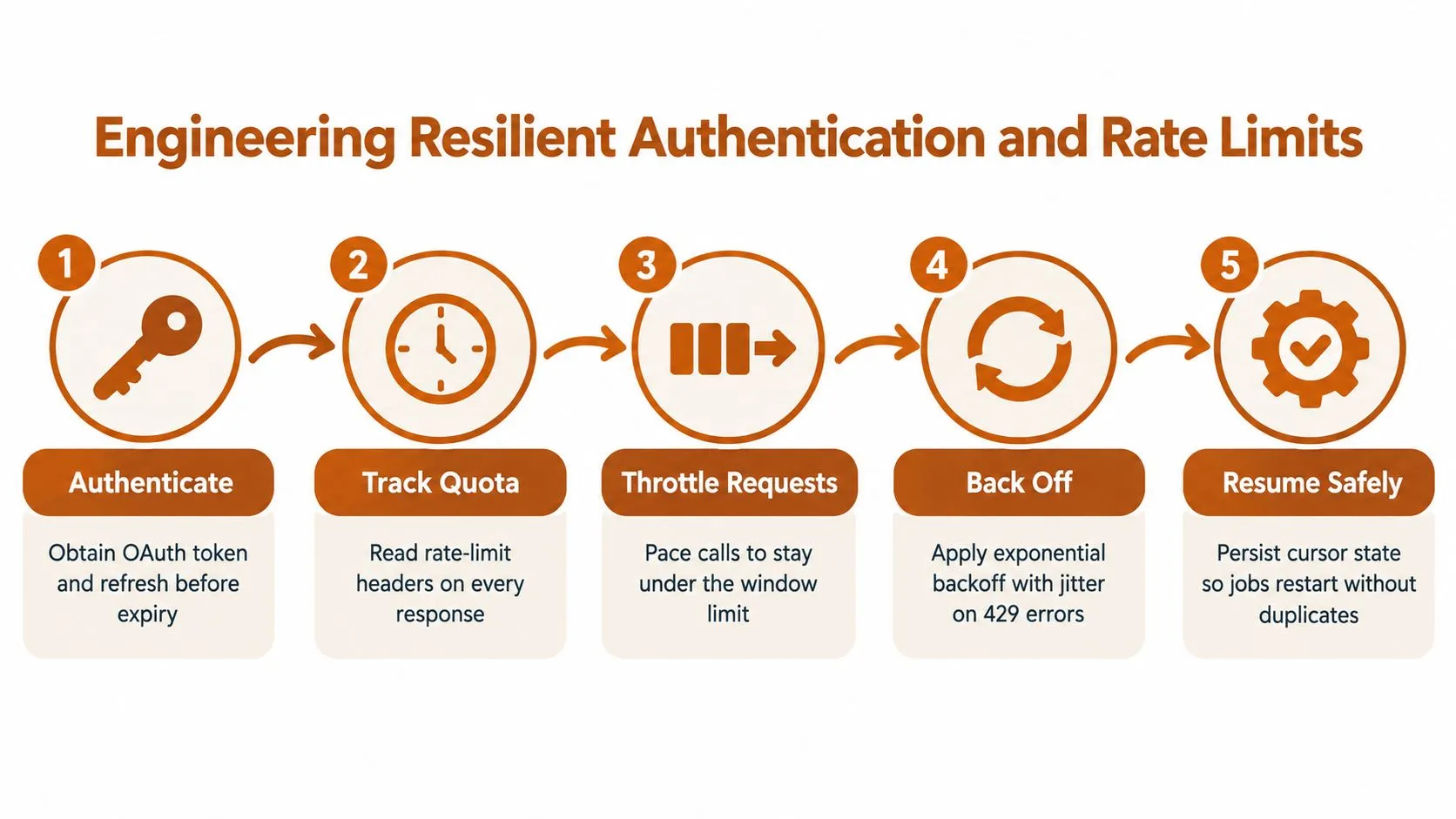
A production collector should fail slowly, preserve its place, and make quota consumption visible. The implementation begins with application registration and an OAuth token. Reddit states that unidentified API users may be throttled or blocked, so a unique, descriptive user agent and authenticated requests should be standard configuration rather than emergency fixes.
Build the scheduler around server feedback
Read X-Ratelimit-Used, X-Ratelimit-Remaining, and X-Ratelimit-Reset on every response. A fixed sleep interval can’t account for retries, variable endpoint cost, concurrent workers, or a quota window that is already partly consumed.
The documented free ceiling is 100 queries per minute per OAuth client ID, averaged over a 10-minute window, according to Reddit’s Data API terms. A safer operational target is below the nominal ceiling, such as 70 to 80 queries per minute, leaving room for latency variation, retries, and unexpected bursts. At 80 queries per minute, one client can theoretically issue about 4,800 requests per hour, but that is request capacity, not a guaranteed record yield.
A scheduler should own the following decisions:
- Token lifecycle: Refresh OAuth credentials before expiry and keep secrets outside source control.
- Quota state: Record the three rate-limit headers with request timestamps and endpoint metadata.
- Backpressure: Slow workers when remaining quota falls, rather than waiting for a cascade of 429 responses.
- Retry policy: Retry HTTP 429 with exponential backoff and jitter. Cap attempts, classify permanent failures, and send exhausted jobs to a durable dead-letter queue.
- Cursor persistence: Save listing and comment pagination state after successful pages, not only when the entire job finishes.
Don’t rotate identities to defeat a limit. Design the workload, quota request, and commercial agreement around the service constraint.
Concurrency needs special care for comment retrieval. An independent technical reference reports a two-request concurrency cap for deep comment search, which makes bounded concurrency safer than maximizing simultaneous calls. Even where an endpoint appears tolerant, a queue with explicit worker limits is easier to reason about than a pool that creates accidental bursts.
Test failure paths before launch
Automated API testing practices should cover expired tokens, malformed cursors, partial pages, duplicate deliveries, 429 responses, and schema drift. The API security testing guidance from ThreatExploit AI is a useful reference for turning those scenarios into repeatable checks rather than relying on manual inspection.
For login-dependent sources elsewhere in a broader collection estate, teams can also review web scraping for sites that require login, but Reddit jobs should not use browser credentials as a substitute for approved API authentication. The aim is recoverability, not cleverness. A job that restarts from a persisted cursor and deduplicates by immutable IDs is more valuable than one that runs quickly until the platform changes its response.
Mastering Comment Trees and Schema Versioning
A Reddit scraper that captures posts but loses reply structure produces incomplete evidence. Comment trees contain nested context, removed content, inconsistent Markdown, and relationships that may require multiple requests to reconstruct. Treat the collector as a data pipeline, not a parser wrapped around a script.
Define the record model before choosing extraction logic. Separate posts, comments, authorship state, relationships, and ingestion metadata so a change in one area does not force a redesign of every downstream table.
Define records that survive change
At minimum, retain:
- Post identity: Post ID, subreddit, permalink, UTC creation timestamp, title, body, score, and edit or deletion state.
- Comment identity: Comment ID, post ID, parent ID, body, UTC timestamp, score, and author state.
- Relationship fields: A nullable root marker, explicit parent-child references, and a field showing whether the parent was resolved.
- Provenance: Collection timestamp, endpoint, request or batch identifier, parser version, and schema version.
- Raw payload reference: A controlled pointer to the original response, governed by the retention policy.
Keep discovery, extraction, normalization, and validation as separate stages. Discovery obtains post IDs through approved listings or search endpoints. Extraction retrieves posts and comment trees. Normalization standardizes Markdown, Unicode, links, and timestamps while preserving the original input. Validation confirms that each non-root comment resolves to a parent or receives an explicit unresolved status.
This division makes operational failures easier to isolate. If listing discovery succeeds but comment expansion fails, extraction can retry without repeating discovery. If normalization rules change, retained payloads can be reprocessed without sending another request to Reddit.
Treat schema versions as compatibility contracts
A schema version records meaning, not just migration history. Downstream users need to know whether a field changed definition, whether a missing value indicates deletion, and whether timestamps use UTC rather than a prior local interpretation.
Use immutable IDs for incremental runs and consolidate repeated deliveries into one canonical record. A missing author or body may represent deletion, unavailable authorship, or moderation activity. Store that state explicitly instead of labeling every absence an extraction defect.
Older archives also lack fields that current captures may treat as standard, including modern authorship-state markers. Joining data across eras therefore requires a field-mapping table, source-period metadata, schema version, timezone convention, and collection method for every delivered dataset. The historical archive discussed earlier illustrates why field-level provenance matters.
Teams that delegate collection should require the same controls. Online web scraping services may reduce operational workload, but a managed collector still needs a canonical schema, referential-integrity checks, versioned transformations, and documented handling for deletions and unresolved parents.
Designing Privacy-Preserving Data Operations
More Reddit data isn’t automatically better data. A raw user-level archive can create compliance exposure, increase deletion work, and bury the signal under duplicated posts, repeated comments, and identifiers that the analysis never needed.
Reddit’s developer terms state that Reddit may monitor use of its services and data, and restrict sharing Reddit services and data with third parties except in specified circumstances. The Ads API terms also restrict accessing or transmitting personal data except as expressly permitted by the relevant terms and documentation. Public visibility therefore shouldn’t be treated as unrestricted permission for indefinite downstream reuse.
Minimize fields at ingestion
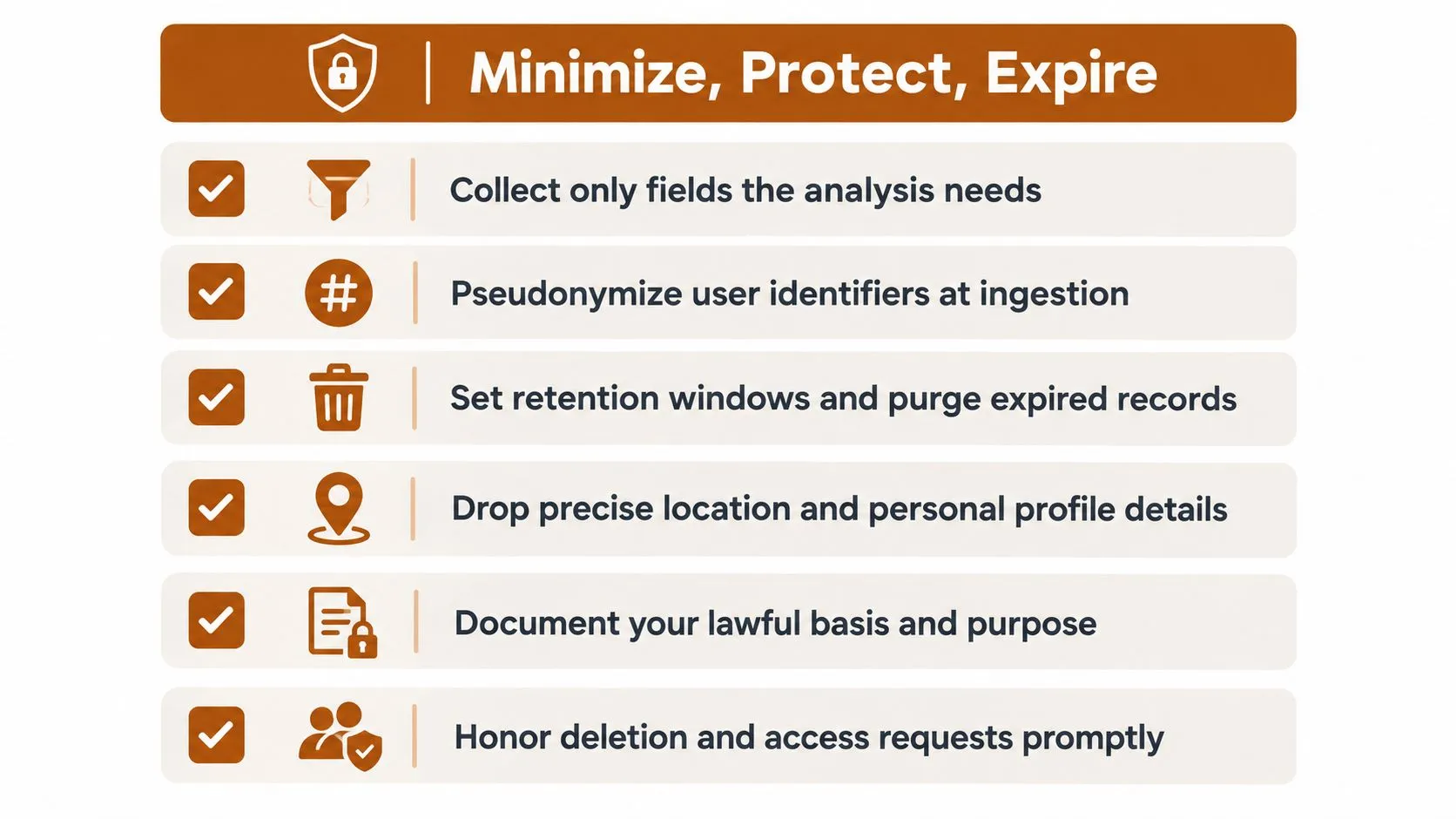
Field-level minimization works best when it happens before data enters the warehouse. Write a purpose statement beside each field in the schema and remove fields that don’t support that purpose.
- Collect only what the model needs: A sentiment project may need text, subreddit, and time bucket, but not a durable username.
- Separate identity from content: Keep account identifiers out of analytical tables. If continuity is necessary, pseudonymize them in a controlled boundary.
- Hash or discard usernames: Hashing reduces casual exposure, but it doesn’t make a person anonymous in every context. Treat the result as pseudonymous data.
- Drop unnecessary profile details: Don’t retain precise location, profile metadata, or links to personal information unless the approved use case requires them.
- Aggregate early: Convert individual observations into time-bounded, subreddit-level or topic-level signals when user-level detail adds no analytical value.
- Expire deliberately: Define retention windows, deletion workflows, suppression lists, and audit logs before the first scheduled run.
The strongest dataset is often the smallest dataset that can answer the approved question.
A privacy-preserving design also needs operational controls. Separate raw payload access from analyst access, encrypt sensitive stores, log exports, and make deletion propagation testable across caches, feature stores, backups, and derived aggregates. A deletion mechanism that only removes the source row leaves the same information exposed in downstream tables.
For teams developing AI products, practical AI governance insights can help connect dataset decisions to accountability, documentation, and model risk. Reddit-specific terms still control the use case, so governance guidance complements rather than replaces platform review.
The five steps for GDPR-compliant web scraping are useful as an implementation prompt, but privacy obligations vary by jurisdiction, purpose, and data type. Multilingual collection adds another complication because the same field may carry different cultural and regulatory expectations across markets. A time-bounded aggregate with documented provenance is usually easier to defend and more useful to decision-makers than an irreversible archive of every contributor.
Scaling Multi-Geo Pipelines and Delivery Formats
A collector isn’t finished when it writes JSON to a local directory. Enterprise users need predictable freshness, defined completeness, stable field meanings, and delivery formats that fit their warehouse, alerting system, or review workflow.
Multi-geo Reddit work starts with source configuration, not translation. Store the original text, detected or declared language, subreddit, UTC timestamp, and market mapping separately. Don’t overwrite source text with a translated version. Downstream NLP systems may need the original for auditing, while analysts may need normalized text for cross-market comparisons.
Make localization explicit
A reliable multi-language pipeline should define:
- Market identity: Map communities and collection scopes to a documented market taxonomy rather than inferring geography from usernames.
- Language handling: Preserve original Unicode and Markdown, then apply language detection and normalization in a separate stage.
- Time semantics: Store UTC timestamps and derive local reporting windows only at the presentation layer.
- Quality flags: Mark uncertain language detection, missing content, duplicate IDs, unresolved parents, and parser fallbacks.
- Schema parity: Keep shared fields consistent across markets, while placing market-specific attributes in controlled extensions.
A schema registry should publish field names, types, null meanings, enum values, and version history. That registry protects downstream consumers when Reddit changes a response field or a parser begins handling a new content state. It also lets a multilingual NLP team distinguish an empty body from text that was removed before collection.
Deliver data for the consumer
Raw JSON dumps are useful for replay, but they aren’t a complete delivery strategy. Use different products for different consumers:
| Consumer need | Suitable delivery | Operational purpose |
|---|---|---|
| Warehouse ingestion | Partitioned JSON or CSV in an S3 drop | Batch loading with reproducible files |
| Real-time alerting | Webhook events containing canonical IDs and changed fields | Trigger monitoring and review workflows |
| Analyst exploration | Structured CSV or queryable tables | Filtering, joining, and ad hoc analysis |
| Compliance review | PDF reports with quality and provenance metadata | Human sign-off and audit trails |
| Model pipelines | Versioned structured records with language and quality flags | Repeatable training or evaluation preparation |
Each delivery should include a manifest with schema version, extraction window, source scope, record counts, rejected-record counts, and checksum information. Avoid presenting record counts as a proxy for coverage. Pagination depth, deleted content, endpoint behavior, and duplicate collapse all affect what the final dataset represents.
For teams working across marketplaces and localized sources, a Mercado Libre scraper example illustrates why source-specific normalization and delivery design matter. The same principle applies to Reddit: a common downstream contract is valuable, but the ingestion adapter must respect each source’s fields, constraints, and update behavior.
WebscrapingHQ offers managed web data operations and a Reddit Scraper Pro product that handles Reddit posts, comments, users, subreddit activity, pagination, rate-limit handling, and filtering for use cases such as monitoring and structured research datasets. Treat that kind of service as an operational component to evaluate against your approved use case, schema, retention policy, and required delivery cadence, not as a replacement for governance.
WebscrapingHQ can scope and operate structured Reddit extraction with schema controls, monitoring, retries, privacy-aware field selection, and delivery through CSV, JSON, webhooks, S3 drops, or reports. If your team needs a maintainable multi-geo pipeline rather than a fragile script, visit WebscrapingHQ to discuss the source, fields, refresh schedule, and compliance requirements.
Want this done for you?
Send us the URLs. We'll quote it in 24 hours.
Paste the URL(s) you want scraped. We'll reply within 24 hours with a feasibility check and a ballpark quote.