Jump to section
- 1. WebscrapingHQ
- Where operational ownership sits
- 2. JobsPikr by PromptCloud
- Reporting fit and ownership
- 3. Bright Data Jobs Data API and Datasets
- The value of broad source infrastructure
- 4. Zyte
- A managed option for complex sources
- 5. Grepsr
- A practical managed-service profile
- 6. ScrapeHero
- From quick pilot to controlled pipeline
- 7. Apify Enterprise
- Flexibility creates governance work
- Top 7 Job Scraping Services Comparison
- Turn the Shortlist Into a Delivery Design
Broad job-posting coverage isn’t enough to identify the right job scraping service for compliance reporting. A feed can contain thousands of records and still fail review if it doesn’t preserve source URLs, distinguish active from stale listings, normalize locations, or show which fields changed between deliveries. The practical test is the reporting workflow: source scope, normalized fields, refresh cadence, PDF, CSV, or JSON delivery, exception highlighting, monitoring ownership, and integration requirements.
The seven services below represent different operating models. Some provide jobs-specialist datasets, others combine broad web-data infrastructure with managed extraction, marketplace tools, or custom pipelines. WebscrapingHQ is the reference point for bespoke compliance artifacts and recurring operations, particularly where a team needs structured records alongside scheduled reports and clearly owned exception handling.
1. WebscrapingHQ
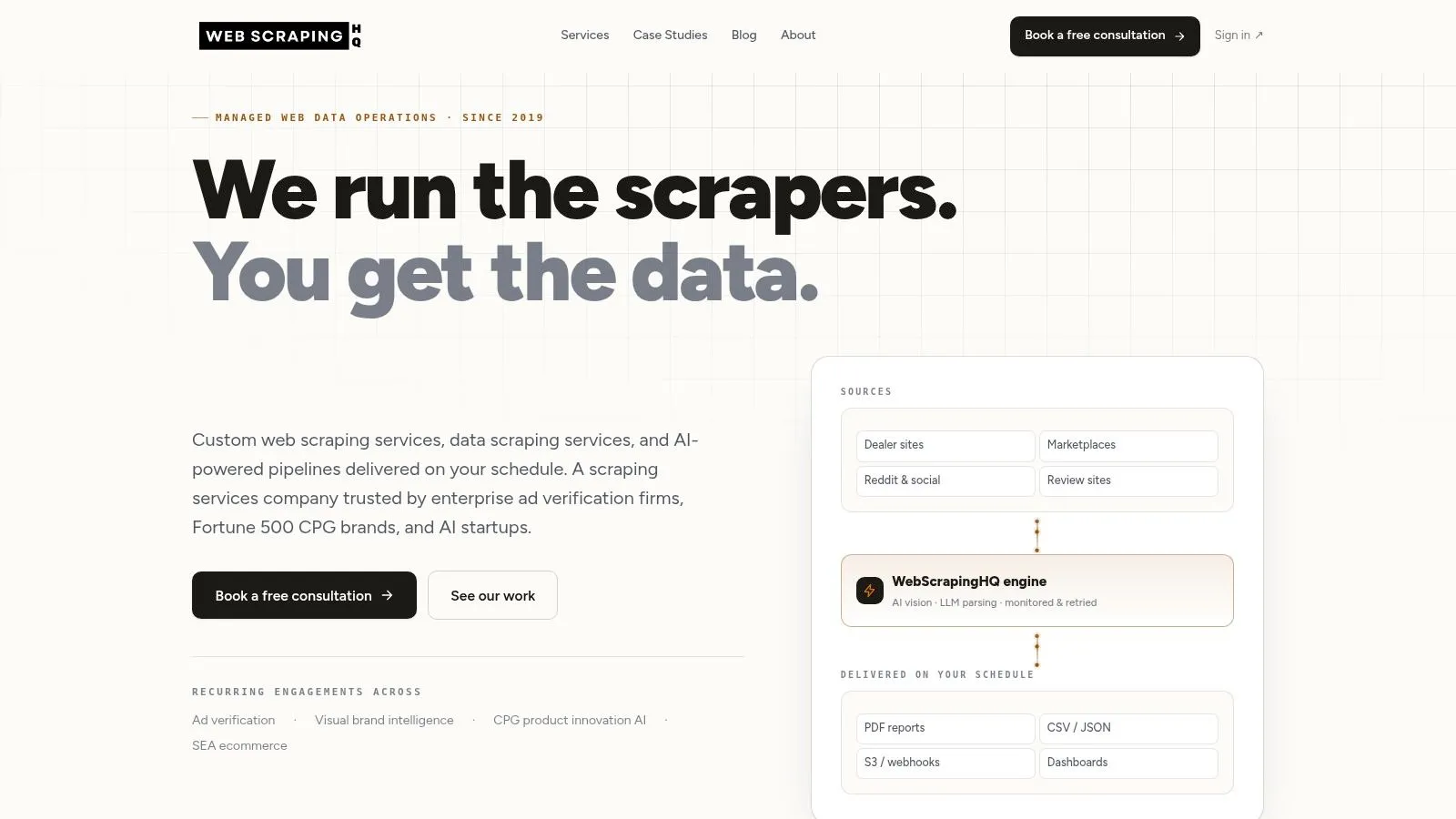
WebscrapingHQ operates as a managed web data partner that scopes sources, builds extraction around a defined schema, and runs the pipeline after launch. Its value lies in operational control across changing job pages, missing fields, and collection interruptions. That makes it relevant to compliance reporting, where the output must support review and follow-up rather than contain captured postings.
The extraction workflow combines computer vision with large language model parsing when conventional selectors are insufficient. Teams can specify fields such as title, employer, location, salary, employment type, source URL, and posting status. Schema versioning can expose structural changes to downstream reviewers. Delivery options include PDF compliance reports, CSV and JSON feeds, webhooks, S3 drops, and optional dashboards.
Where operational ownership sits
WebscrapingHQ manages monitoring, retries, proxy configuration, CAPTCHA defenses, source breakage, and extraction adjustments as page structures change. Internal teams set acceptance criteria and use the results, while the provider operates the collection layer. The publisher describes production operations since 2019 and lists recurring enterprise compliance reporting among its workloads.
That division of responsibility supports several connected workflows. A compliance team can receive a monthly PDF with exceptions highlighted, an analytics system can consume normalized records, and operations staff can receive alerts when a source fails. The same scheduled pipeline can produce these outputs, reducing manual reconstruction from API responses.
Strategic judgment: WebscrapingHQ fits buyers that need an owned reporting workflow with structured records, exception handling, and scheduled delivery.
The trade-off is onboarding effort. Bespoke source coverage, visual inspection, AI extraction, delivery rules, and report layouts require definition before production. The service is also less suited to casual collection through a low-cost, self-serve API. Buyers with representative URLs and specified fields can receive a feasibility response and ballpark quote within 24 hours, according to the supplied publisher information.
2. JobsPikr by PromptCloud
JobsPikr is the most jobs-specialist option in this comparison. It aggregates job postings from job boards and company career pages, then delivers records through a purpose-built jobs schema. That specialization reduces the amount of semantic modeling a buyer must define before integration. Fields such as title, company, location, salary, skills, and other job attributes are designed for filtering and labor-market analysis rather than generic page capture.
The platform offers an API with pagination and granular filters, alongside JSON, CSV, XML, S3, and FTP delivery. Its stated coverage exceeds 70,000 sources, with daily updates and historical records. That combination makes it a natural candidate for a compliance team that needs a broad, recurring inventory and wants to connect the data directly to an existing warehouse or reporting layer.
Reporting fit and ownership
JobsPikr’s central advantage is schema fit for jobs data. A buyer can start with a known vocabulary for postings and enrich that data for hiring trends, recruitment products, or market analysis. The important qualification is that a jobs schema isn’t automatically a compliance schema. Reviewers may still need source-specific evidence, field-change flags, stale-record treatment, or a report layout that translates raw records into exceptions.
Pricing isn’t fully public, so budgeting advanced coverage requires a sales conversation. That matters when the required source mix includes unusual ATS pages, country-specific career sites, or stricter refresh expectations. Teams should request a sample that includes duplicates, missing salaries, remote locations, and withdrawn postings rather than evaluating only clean records.
For a deeper explanation of the surrounding workflow, see job recruitment data scraping services. JobsPikr is strongest when the organization wants out-of-the-box jobs data and can own the compliance presentation, exception policy, and downstream monitoring. It is less suitable when the provider must build a highly specific artifact or operate a bespoke review process on the buyer’s behalf.
3. Bright Data Jobs Data API and Datasets
Bright Data’s Jobs Data API combines standardized job records with enterprise data-delivery infrastructure. Its offering includes datasets and a unified REST API spanning major sources such as LinkedIn Jobs, Indeed, and Glassdoor. The records can include title, skills, seniority, location, and employment type, giving analytics teams a broad starting point for structured ingestion.
This operating model suits buyers that want bulk datasets for warehouse loading or on-demand access for applications. The distinction is important in compliance reporting. A dataset can support periodic reconciliation, while an API can support current lookups, but the buyer still needs rules for record identity, source precedence, missing fields, and changes between snapshots.
The value of broad source infrastructure
Bright Data’s mature delivery layer is useful when source breadth and enterprise support matter more than a narrowly focused report. It can provide a practical foundation for organizations that already have data engineering, normalization, and reporting capabilities. Pricing is generally tied to records or volume and may require sales engagement, so the commercial model needs to be assessed alongside expected refresh frequency and retention requirements.
Source and field availability can vary by site and plan. A compliance team shouldn’t assume that every platform exposes the same attributes or that a standardized record eliminates source-level differences. Before purchase, test whether the feed retains the evidence reviewers need, including the original URL, captured timestamp, location granularity, and status indicators.
A related use case is discussed in how Google Jobs scrapers help find jobs. Bright Data is a strong fit for broad enterprise datasets, especially when the buyer has an internal workflow for deduplication and reporting. It becomes less attractive when the main requirement is a custom PDF or a provider-owned exception queue rather than high-volume structured delivery.
4. Zyte
Zyte approaches job scraping as part of managed web data extraction rather than as a jobs-only product. Its API supports AI-assisted extraction, while its broader infrastructure addresses proxy management, headless browsing, and anti-blocking requirements. That makes it relevant when target sources include dynamic career pages, ATS interfaces, and mixed page technologies that don’t share one predictable structure.
The service-led model begins with project scoping. Buyers define sources, fields, delivery expectations, and service requirements, then align the implementation with a production pipeline. This can work well for compliance reporting because the schema can be designed around the review decision, not just around the HTML available on a page.
A managed option for complex sources
Zyte’s enterprise orientation includes support and service-level arrangements, but managed project pricing is custom and API pricing can be difficult to estimate without a defined workload. It also isn’t a jobs-specialist dataset provider. The buyer must specify job semantics carefully, including how to represent employment type, salary ranges, remote status, posting dates, and source-specific exceptions.
The central question is operational ownership. If Zyte is responsible for extraction infrastructure and anti-blocking work, the customer still needs to establish who validates field meaning, approves schema changes, and investigates a suspicious drop in records. Those governance steps shouldn’t be left implicit.
A managed scraper removes infrastructure work. It doesn’t remove the need to define what counts as a valid compliance record.
Teams considering an outsourced model can compare the responsibilities in outsource web scraping. Zyte is a sensible choice for organizations with difficult, mixed web sources and the capacity to own the reporting layer. It may require more design work than a jobs-specific feed, but it can adapt when the source doesn’t fit a standard dataset.
5. Grepsr
Grepsr is a service-first provider that handles scoping, sampling, QA, scheduling, monitoring, and delivery. For job data, that model is useful when the buyer wants a vendor-operated pipeline across job boards and company career pages rather than a toolkit that internal engineers must maintain.
The workflow begins with representative sources and a sample output. That creates an opportunity to test the fields that matter to compliance reviewers before committing to recurring delivery. CSV and JSON outputs, feeds, and other delivery arrangements can then be aligned with the destination system, whether that’s a warehouse, a review queue, or a scheduled report.
A practical managed-service profile
Grepsr’s advantage is clarity around the service process. The provider can own recurring collection and maintenance, while the customer specifies the source list, schema, cadence, and quality expectations. Published entry-level pricing context may help with early budgeting, but final cost depends on site complexity, volume, and the amount of specialized job interpretation required.
The main limitation is semantic depth. Generic extraction can capture visible fields, yet compliance reporting may need more precise treatment of stale vacancies, reposted roles, salary normalization, or changed descriptions. Those requirements should appear in the sample specification, not be assumed to follow from the presence of a CSV file.
For a broader vendor-selection perspective, see web scraping companies in the USA. Grepsr fits teams that want ongoing operational support and a transparent path from feasibility to delivery. It may need additional scoping when the output must include domain-specific exception categories or a polished report artifact.
6. ScrapeHero
ScrapeHero offers two routes into job data. Its cloud marketplace provides ready-made scrapers and APIs for selected job boards and company career pages, while its managed project service supports custom sources, monitoring, and longer-term maintenance. That creates a useful progression from pilot to production.
The marketplace route lowers initial friction. A team can test whether a particular source exposes the required fields and whether the output can enter its reporting process without a major implementation. Free starter credits are available for initial exploration, while bespoke engagements have clearer minimum pricing guidance than many custom-only providers.
From quick pilot to controlled pipeline
The marketplace is not a substitute for source coverage analysis. A ready-made scraper may work well for a major board but fail to cover a niche ATS, a regional career page, or a compliance-specific field. Costs can also rise with credits and concurrency, so the pilot should measure more than extraction success. It should test duplicates, missing values, refresh behavior, and the effort required to turn records into exceptions.
ScrapeHero’s managed route is the better fit when the source set expands or the team needs monitoring and maintenance. The buyer should define whether the service owns only collection or also QA, normalization, and delivery reliability. Those are separate responsibilities, and a marketplace product may leave most of them with the customer.
This makes ScrapeHero particularly suitable for organizations that want a fast marketplace-to-managed path. It offers flexibility without requiring a full custom build on day one, but compliance reporting still depends on a documented schema and acceptance process. A pilot should end with a decision about operational ownership, not just a count of successfully returned pages.
7. Apify Enterprise
Apify Enterprise functions as a configurable collection and delivery layer rather than a ready-made jobs feed. Its Actor catalog can support initial tests on job sites, while professional services can scope, build, and maintain custom scrapers and integrations. Headless browsing, proxies, scheduling, monitoring, webhooks, and downstream connections support a controlled operating workflow.
That architecture suits teams treating job data as part of an automation and compliance process. A pipeline can collect postings, map them to a versioned schema, flag exceptions through a webhook, and retain raw page evidence for review. Technical owners can change validation, routing, and storage rules as requirements develop, instead of accepting the fixed structure of a closed dataset.
Flexibility creates governance work
Apify Enterprise requires the customer to define fields, source coverage, normalization rules, exception handling, and reporting logic. Professional services can implement and maintain those components, but pricing is custom and depends on workload. The buyer therefore owns the acceptance criteria and must confirm how delivery failures enter its operating process.
The Actor catalog can shorten a pilot when a target site already has a suitable component. Production use still requires tests for source coverage, monitoring thresholds, retries, failure alerts, record identity, and change response. Those controls determine whether collected records can support an auditable report, not whether pages return data.
Apify Enterprise is the strongest extensible platform model here for engineering-led teams with changing automation requirements.
For teams that want a ready-made, normalized jobs feed or a finished compliance-report layout, a specialist dataset or managed reporting provider will reduce implementation work. If you are weighing Apify against a managed alternative, see this comparison of Apify-based workflows.
Top 7 Job Scraping Services Comparison
| Provider | Implementation complexity | Resource requirements | Expected outcomes | Ideal use cases | Key advantages |
|---|---|---|---|---|---|
| WebscrapingHQ | Medium–high: bespoke scoping and AI tuning | Low client effort; managed infra; starts ~USD 500+/mo | Schema-versioned feeds, PDF compliance reports, SLA-backed deliveries | Enterprise compliance, ad verification, multi-geo ecommerce | Fully managed; computer-vision + LLM extraction; multi-geo and image intelligence |
| JobsPikr (PromptCloud) | Low: out-of-the-box API integration | Moderate: subscription/API integration | Normalized, jobs-only records with daily refresh and history | Labor market intelligence, job boards, analytics | Job-specific schema and enrichment; wide source coverage |
| Bright Data – Jobs Data API | Medium: integrate API or ingest datasets | High: enterprise pricing (per-record/volume) | Broad, enriched job datasets and per-record access | Large-scale aggregation, bulk ingestion, enterprise analytics | Mature delivery infra; both on-demand API and bulk datasets |
| Zyte (Scrapinghub) | Medium–high: managed projects and scoping | Moderate–high: managed service with proxies and SLAs | Production-grade scraping pipelines with AI-assisted extraction | Complex, dynamic sites needing enterprise SLAs | Enterprise SLAs, robust anti-blocking/proxy infrastructure |
| Grepsr | Low–medium: service-led onboarding | Moderate: vendor-operated subscription model | Scheduled, monitored pipelines with QA and deliveries | Teams avoiding in-house scraper maintenance and recurring jobs | Transparent service process; published entry-level pricing guidance |
| ScrapeHero | Low for marketplace; medium if managed | Credit-based marketplace; costs scale with concurrency | Fast pilot scrapers or managed long-term pipelines | Quick pilots using turnkey scrapers; escalate to managed services | Ready-made scrapers for fast starts; clear minimums for custom work |
| Apify Enterprise | Medium–high: platform + professional services | Platform fees + custom professional services | Custom scrapers/automations, scheduling, monitoring, Actors catalog | Teams needing extensible platform plus implementation support | Combines mature platform with implementation team; rich integrations and automation |
Turn the Shortlist Into a Delivery Design
The right choice depends less on the longest source list than on how the service fits the reporting system. Start with source coverage. Identify the boards, employer career pages, and ATS platforms that influence the decision, then test representative pages from each. First-party employer pages often offer cleaner records and fewer duplicates, while boards may broaden coverage. A balanced source mix can be more useful than maximum source count.
Next define required fields and their acceptable forms. A compliance record may need title, employer, location, salary, employment type, posting date, source URL, collection timestamp, and status. Specify whether missing salary is a valid null, an exception, or a reason to exclude the record. Define how duplicate postings and reposted roles should be handled before comparing vendors.
The remaining checks determine whether the feed becomes a dependable control:
- Refresh cadence: Match delivery frequency to the review window and document what happens when a source is unavailable.
- Output format: Choose API, CSV or JSON file drops, S3, webhooks, dashboards, or PDF reports based on how reviewers work.
- Exception workflow: Require clear flags for missing fields, changed schemas, stale records, duplicates, extraction failures, and suspicious source-level drops.
- Operational ownership: State who monitors failures, handles retries, re-tunes extraction, approves schema changes, and escalates unresolved issues.
Practical rule: Request a sample that contains ordinary records and difficult records. Clean examples reveal extraction capability. Missing, duplicated, changed, and withdrawn listings reveal production readiness.
A versioned schema is essential because source pages and business requirements change. Require the provider to identify field additions, removals, renamed attributes, and altered interpretation rather than covertly changing the output. For reporting, decide whether the reviewer needs a raw evidence trail, a structured exception queue, a PDF summary, or all three.
The strategic fit is clear. JobsPikr suits jobs-specialist coverage and structured labor-market data. Bright Data suits broad enterprise datasets and bulk delivery. Zyte and Grepsr fit managed extraction across complex sources. ScrapeHero offers a practical route from marketplace testing to managed coverage. Apify Enterprise suits extensible automation with technical ownership. WebscrapingHQ is strongest for custom recurring data operations where normalized outputs, monitoring, multi-geo collection, and compliance-report layouts must work together.
Before requesting a quote, document sample inputs, required fields, acceptance criteria, delivery cadence, exception categories, retention expectations, and escalation responsibilities. That brief will expose gaps faster than a generic product demonstration and will let each provider price the operating model you need.
WebscrapingHQ builds and operates managed job-data pipelines with structured extraction, recurring delivery, monitoring, and compliance-oriented outputs such as PDF reports, CSV, JSON, webhooks, and S3 drops. If your team needs job scraping services that own freshness and exception handling rather than returning pages, visit WebscrapingHQ to define the sources, schema, cadence, and reporting workflow.
Want this done for you?
Send us the URLs. We'll quote it in 24 hours.
Paste the URL(s) you want scraped. We'll reply within 24 hours with a feasibility check and a ballpark quote.