
Jump to section
- The Catalog Problem Most Ecommerce Teams Quietly Have
- What Computer Vision Actually Does in an Ecommerce Stack
- Embeddings create searchable visual fingerprints
- Detection locates objects inside an image
- Classification assigns controlled labels
- Image Attribute Extraction, Deduplication, and Visual Compliance
- Attribute extraction enriches the record
- Deduplication resolves visual repetition
- Compliance checks enforce visible rules
- Plugging Computer Vision Into a Scraping Pipeline
- Start with fetch and URL extraction
- Download bytes and remove exact duplicates
- Validate the content before inference
- Run inference with explicit outputs
- Persist enriched records
- Route failures through a dead-letter path
- Model and Throughput Tradeoffs for Ecommerce Workloads
- Where Computer Vision Pays Off and Where It Does Not
- Compliance, Privacy, and ROI Questions Before You Scale
- Build the ROI model around the whole pipeline
A retailer can ingest a clean-looking product feed and still publish a broken catalog. The HTML may contain the right title, price, and SKU, while the image points to a lifestyle shot, a duplicate asset, a watermarked supplier photo, or an entirely different product. Those failures rarely appear in the scraper’s logs. They surface later as poor search results, rejected marketplace listings, wasted advertising spend, and product pages that take too long to approve.
Computer vision in ecommerce is useful when it operates as an engineering control layer, not as a decorative visual-search feature. It can inspect image bytes, extract attributes, identify near-duplicates, detect logos and watermarks, and route uncertain records to human review. The hard part is choosing the right model for each workload, controlling throughput, and proving that automated decisions are accurate enough to trust.
The Catalog Problem Most Ecommerce Teams Quietly Have
Consider a mid-market retailer receiving supplier feeds and scraped product pages every day. Its pipeline collects roughly 50,000 product images daily, but the catalog team still can’t publish records quickly because every image requires manual inspection.
One supplier sends the same sneaker under several SKU records, each with a slightly different crop. Another uses a lifestyle image as the primary thumbnail, so shoppers see a model wearing the product rather than the product itself. A third sends stock photography with a visible watermark. Somewhere else, a page labeled as a running jacket displays a sneaker silhouette because the image URL was copied from a neighboring record.
These aren’t isolated design issues. Each one creates a different data problem:
- Duplicate visual assets make separate products look identical in search and recommendation systems.
- Incorrect hero images weaken marketplace compliance and reduce the usefulness of category pages.
- Watermarks and competitor logos can trigger listing rejection or create brand-safety problems.
- Category-image mismatches contaminate training data and cause shoppers to land on irrelevant product pages.
- Low-quality resolutions and broken formats delay publishing because downstream systems can’t render or transform the file reliably.
The catalog team usually discovers these errors after ingestion, not during extraction. Merchandisers then compare URLs, open image files one by one, and reconcile conflicting supplier data manually. That process becomes especially expensive when the same product appears across multiple marketplaces, regions, or update cycles.
Practical rule: Treat every product image as an input record with its own quality status, not as an unquestioned attachment to the SKU.
Computer vision provides the missing diagnostic layer. Image embeddings can identify visually similar records, classifiers can flag likely product categories, detectors can locate watermarks or logos, and image-quality checks can reject unsuitable assets before publication. The surrounding pipeline still needs deterministic validation and human review, but CV can prioritize the records that deserve attention.
Visual discovery is already operating at large consumer scale. Google Lens visual-query activity and Pinterest visual-search activity illustrate why image understanding now matters to product discovery, while the same market context connects visual retrieval with catalog enrichment, duplicate detection, and product matching.
The practical focus is broader than recommendations. The useful questions are: which image belongs to the SKU, what attributes can be extracted reliably, whether two assets represent the same product, whether an image meets marketplace rules, and how fast the system can process the incoming stream.
What Computer Vision Actually Does in an Ecommerce Stack
Most ecommerce teams don’t need to start with an explanation of model architectures. They need to know what a vision system returns and which catalog decision can consume that output. Three primitives cover much of the day-to-day engineering work.
Embeddings create searchable visual fingerprints
An image embedding converts an image into a vector of numbers that represents visual characteristics. The system doesn’t store the pixels inside that vector. It stores a mathematical representation that can be compared with other representations.
Think of an embedding as a visual fingerprint, or a barcode for appearance. If two supplier images show the same shoe from different angles, their vectors may sit close together in the search space. A pipeline can then retrieve likely matches, cluster near-duplicates, or compare a new image with an approved catalog asset.
Embeddings support:
- Product-image deduplication
- Similar-item retrieval
- Supplier-to-catalog matching
- Stock-photo detection
- Visual anomaly queues
Similarity isn’t identity, though. Two black running shoes may look close without being the same SKU. Production systems need thresholds, metadata checks, and human review for borderline pairs.
Detection locates objects inside an image
Object detection returns bounding boxes, labels, and confidence scores. A detector can identify where the product appears in a lifestyle image, locate a logo, or mark a watermark in a corner.
That output enables practical actions. The pipeline can crop the product for a thumbnail, reject an image containing a prohibited logo, or distinguish a product shot from a scene containing several unrelated objects. Detection becomes more difficult when objects overlap, appear at different scales, or sit in crowded retail scenes.
A packaged-product study found that transfer learning reached 90% image-classification accuracy with as few as six images per product class, while approximately 30 images per class were needed for 95% accuracy. The same study found that simultaneous detection in crowded retail scenes required at least 42 instances per product and well over 100 instances for consistent results, showing why detection needs more varied examples than classification. The ETH Zurich packaged-product study provides the underlying evidence.
Classification assigns controlled labels
Image classification assigns one or more labels to the entire image. Those labels might describe product category, image role, packaging type, background style, or likely presence of a person.
Classification resembles the SKU category in a product database. It can answer, “Does this image look like footwear, apparel, or packaging?” It can also answer, “Is this a hero image or a lifestyle image?” The result becomes structured data that feeds search filters, QA rules, or catalog enrichment.
The distinction matters because each primitive serves a different job. Embeddings compare, detection locates, and classification labels. A practical overview of visual extraction workflows is available in this computer vision feature extraction guide, while teams handling user-generated or safety-sensitive images may also benefit from this guide for trust and safety teams.
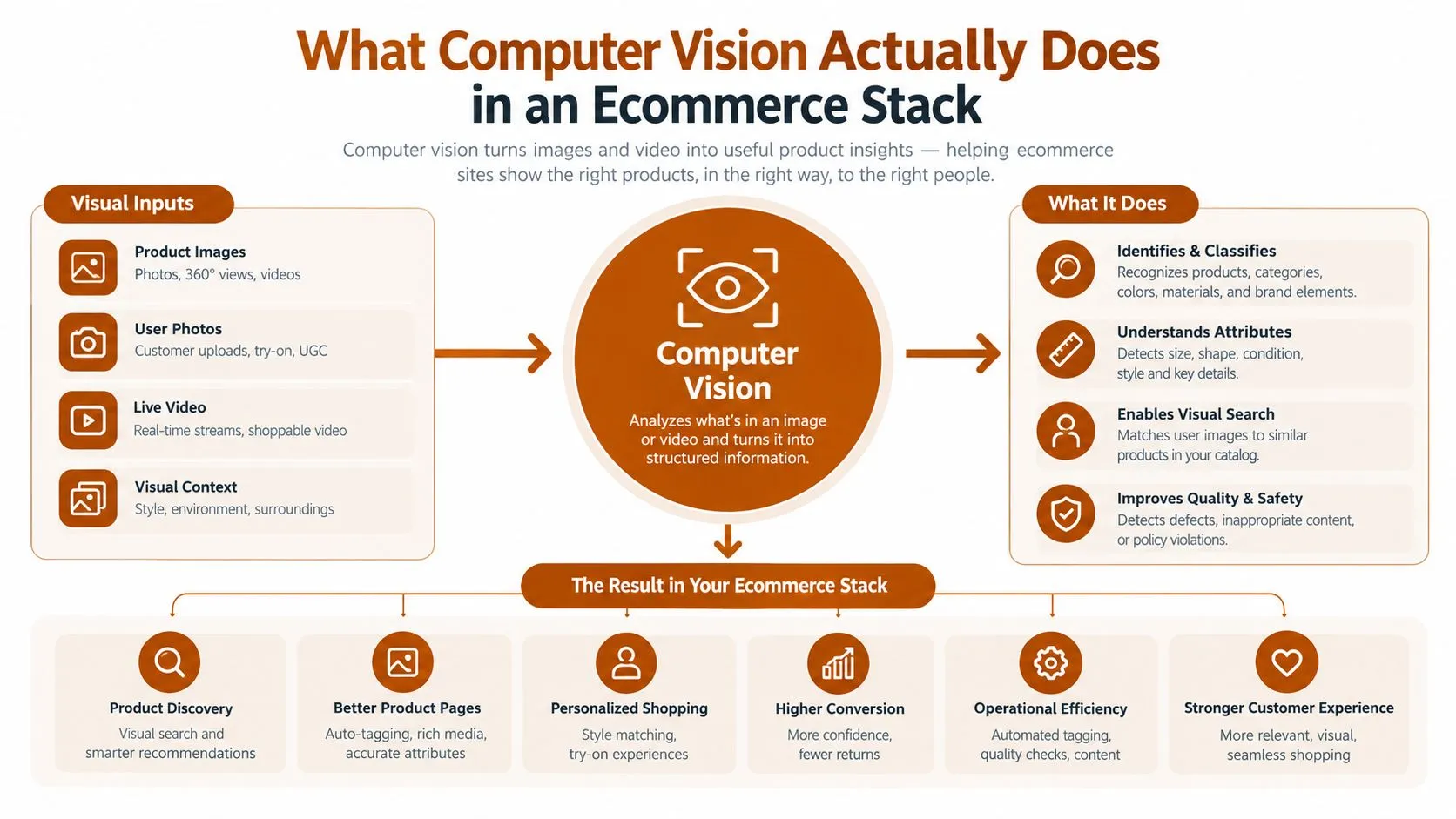
Image Attribute Extraction, Deduplication, and Visual Compliance
These workloads often get grouped under “image recognition,” but they have different inputs, outputs, and failure modes. Treating them as separate services makes the catalog pipeline easier to operate and audit.
Attribute extraction enriches the record
Attribute extraction starts with a product image and returns structured signals such as color, pattern, garment cut, packaging type, or image role. A fashion image might produce labels for “solid,” “long sleeve,” and “outerwear,” subject to the model’s training and confidence.
The downstream consumer is usually the product information management system, search index, or marketplace feed. The safest design preserves the original supplier value and adds vision-derived fields separately. That lets a merchandiser compare the source attribute with the inferred attribute rather than overwriting trusted data.
Deduplication resolves visual repetition
Deduplication begins with exact byte checks. If two downloaded files have identical content, a cryptographic hash can remove the obvious duplicate without invoking a model. Near-duplicates require embeddings, similarity thresholds, and clustering.
The output should not be a vague “duplicate” flag with no explanation. Store the candidate pair, similarity score, source URLs, SKU identifiers, and decision status. A catalog operator can then approve the merge, reject it, or mark the pair as a legitimate alternate view.
Image collection is closely tied to extraction quality, so teams building this layer should define URL capture, file handling, and normalization rules in advance. The web scraping images guide offers useful context for handling image assets as first-class pipeline data.
Compliance checks enforce visible rules
Visual compliance uses images to test explicit policies. Typical checks include minimum resolution, acceptable background treatment, watermark presence, competitor logos, and restricted human content. Some rules can be deterministic, such as dimensions or file type. Others need classification or detection.
| Workload | Input Image | CV Primitive | Structured Output | Downstream Consumer |
|---|---|---|---|---|
| Attribute extraction | Clean product or model image | Classification, embeddings | Color, pattern, category, garment or packaging attributes | Search, PIM, recommendations |
| Deduplication | Product images from multiple suppliers | Embeddings, exact hashes | Match candidates, clusters, confidence, review status | Catalog merge and SKU governance |
| Visual compliance | Hero, lifestyle, or marketplace image | Detection, classification, image QA | Watermark, logo, background, quality, and restriction flags | Publishing gate and exception queue |
The table also reveals why one universal model usually disappoints. Attribute extraction needs label consistency, deduplication needs calibrated similarity, and compliance needs explainable flags. A single confidence score cannot represent all three decisions.
Plugging Computer Vision Into a Scraping Pipeline
A production pipeline should make the dependency graph visible. Computer vision belongs after reliable image acquisition and basic validation, not directly after parsing an HTML tag.
Start with fetch and URL extraction
The scraper fetches the product page, identifies image URLs from structured markup, galleries, lazy-load attributes, and embedded data, then associates each asset with a product identifier and source context. Store the extraction event, because a later review needs to show where the image came from.
Download bytes and remove exact duplicates
The image worker downloads the asset, follows permitted redirects, records response metadata, and computes a content hash. Identical bytes should be collapsed before inference. This saves compute and prevents repeated assets from inflating the catalog.
Validate the content before inference
Check the response content type, file signature, dimensions, decode status, and aspect ratio. A URL ending in .jpg may return an error page, a redirect response, or an unsupported format. These checks are cheap and usually CPU-bound, so running them before GPU inference keeps bad inputs out of the expensive stage.
Run inference with explicit outputs
The CV stage can generate embeddings, classifications, detections, and compliance flags. Keep model version, preprocessing settings, confidence values, and inference timestamp with the result. Without that metadata, retraining and dispute resolution become guesswork.
Persist enriched records
Write the original asset reference, normalized image location, extracted attributes, duplicate candidates, and QA status into durable storage. The catalog should know whether a record passed automatically, passed with warnings, or requires review.
Route failures through a dead-letter path
Do not discard undecodable images, failed downloads, low-confidence predictions, or model exceptions. A dead-letter queue should retain the record and failure reason so operators can retry, correct source data, or update the rule.
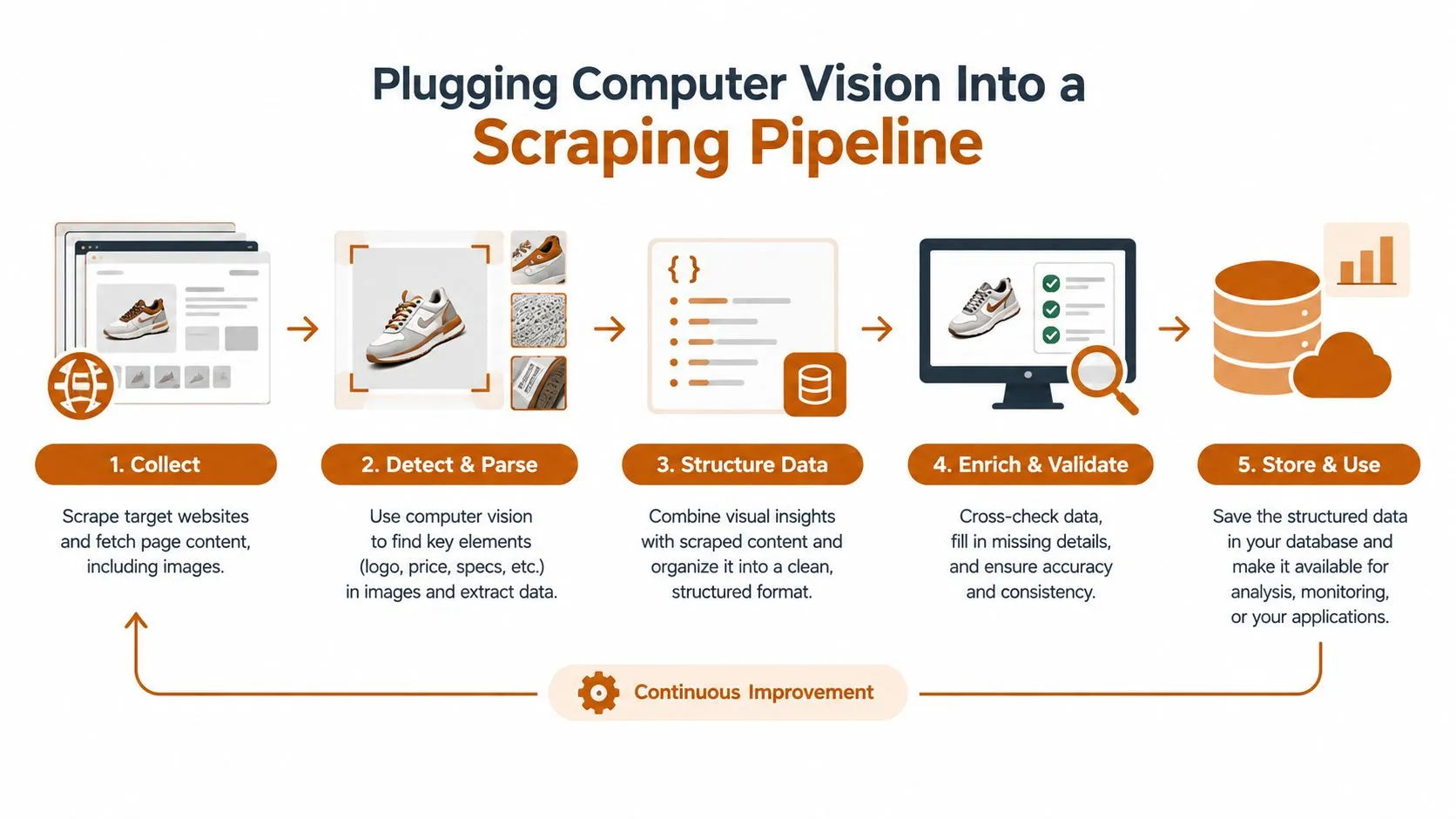
The architecture usually mixes execution modes. Fetching and decoding can run in distributed workers, lightweight rules can run synchronously, and expensive inference often works better in micro-batches. If the vision queue processes more slowly than the scraper produces images, backpressure will spread upstream until fetch workers exhaust memory or begin dropping tasks.
A resilient design uses bounded queues, retry limits, idempotent record keys, and separate scaling for acquisition and inference. The computer vision web scraping resource covers the broader connection between visual inspection and web extraction.
Model and Throughput Tradeoffs for Ecommerce Workloads
Model selection should follow the decision being made, not the most impressive benchmark in a notebook. A small classifier may be entirely adequate for image-role tagging, while a similarity encoder may justify lower throughput because deduplication quality protects the catalog from repeated manual work.
Lightweight CNN families such as MobileNet or EfficientNet-B0 are sensible for straightforward category and color tags. The planned operating range is roughly 30 to 80 FPS on a single GPU, but that range depends on image size, preprocessing, batch size, runtime, and hardware. It shouldn’t be treated as a promise for every deployment.
Mid-weight models such as ResNet-50 or ConvNeXt-Tiny can capture richer attributes when the distinction depends on cut, structure, or material. Heavier transformer or CLIP-style encoders are useful for semantic similarity and cross-source matching, but their lower throughput makes caching, batching, and selective inference important.
| Model family | Typical ecommerce task | Approx. FPS on a single GPU | Accuracy range | Best use case |
|---|---|---|---|---|
| MobileNet | Basic category, color, image-role tags | Roughly 30 to 80 | Workload-dependent | High-volume first-pass QA |
| EfficientNet-B0 | Category and visual attributes | Roughly 30 to 80 | Workload-dependent | Compact production classifiers |
| ResNet-50 | Richer attribute extraction | Lower than lightweight models | Workload-dependent | Moderate-complexity product labeling |
| ConvNeXt-Tiny | Fine-grained visual attributes | Lower than lightweight models | Workload-dependent | More detailed catalog enrichment |
| Transformer or CLIP-style encoder | Similarity and deduplication | Usually lower | Workload-dependent | Semantic matching and long-tail retrieval |
Independent retail benchmarks illustrate the tradeoff directly. One multimodal recognition system reported 94.6% recognition mAP while processing 50 to 60 items per second, whereas a lightweight detector reached 357.1 FPS on the Locount benchmark but delivered 72.2% mAP50 and 47.8% mAP50-95. The retail product-recognition evaluation shows why raw FPS can’t stand in for usable accuracy.
Batching improves hardware utilization, but excessive batches increase latency and memory pressure. ONNX Runtime can reduce deployment overhead, while quantization can lower inference cost at the risk of changing confidence behavior. Measure the entire path, including image decode, resize, transfer, inference, postprocessing, and persistence.
For recurring workloads, batch data processing practices matter as much as model choice. Cache embeddings, avoid rerunning inference on unchanged bytes, and use a cheap first pass to reserve expensive models for uncertain or high-value records.
Where Computer Vision Pays Off and Where It Does Not
Computer vision earns its keep when the decision repeats at scale and the image contains information that structured fields don’t capture. Near-duplicate detection across supplier feeds is a strong example. An embedding index can reduce a large comparison problem to candidate retrieval, after which metadata and human review resolve ambiguous matches.
Attribute extraction also becomes worthwhile when teams receive inconsistent descriptions across a large catalog. A model can create candidate labels for color, pattern, product type, or image role, then route low-confidence results to merchandisers. The value comes from reducing repetitive inspection while retaining a correction mechanism.
Visual compliance is another durable use case. Detecting watermarks, competitor marks, prohibited backgrounds, or unsuitable hero images can prevent a record from reaching a marketplace feed. The same approach can support returns inspection or fraud screening, but those workflows need stronger audit controls because an incorrect rejection can affect a customer or seller.
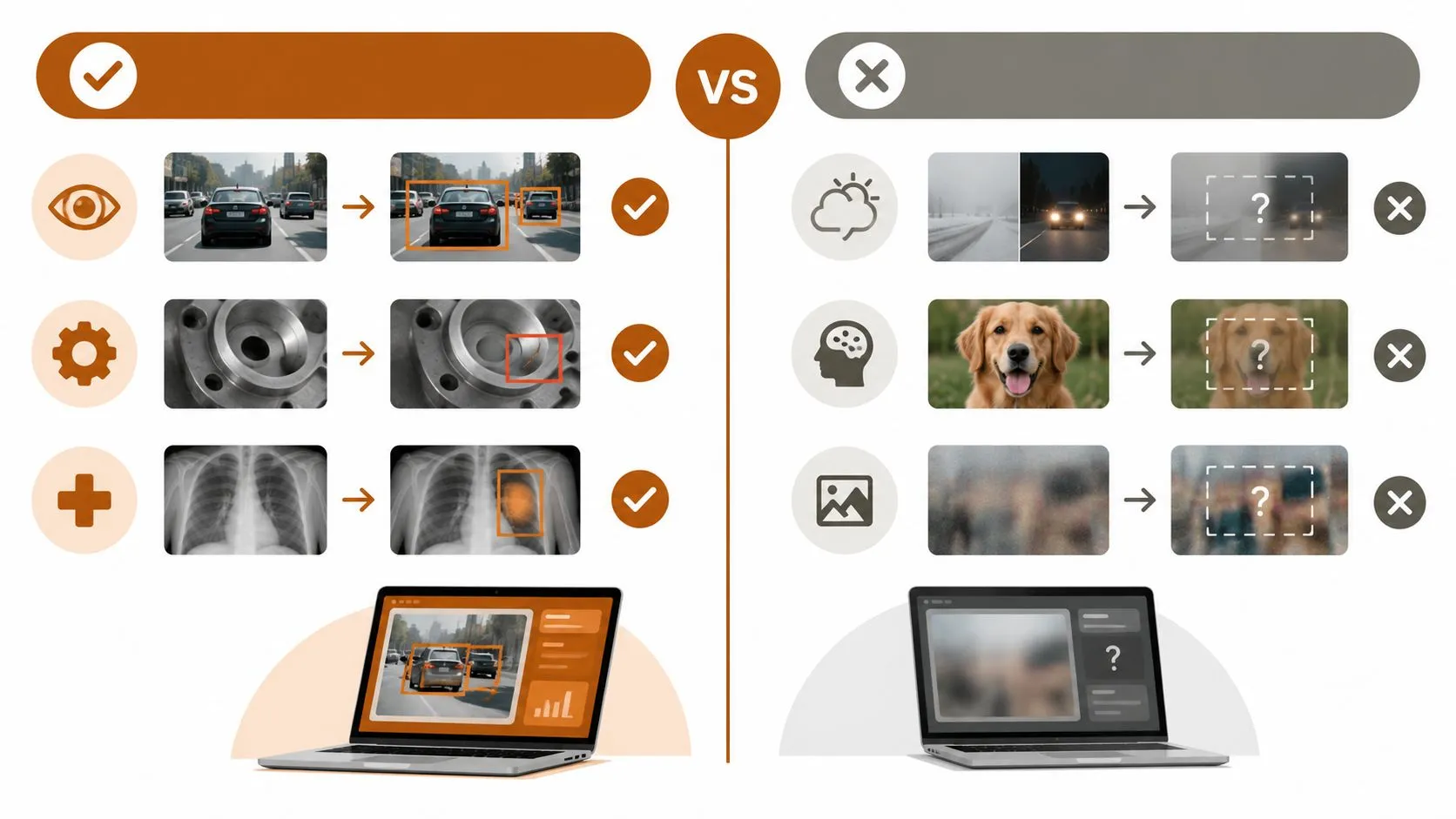
A simpler method is often better when the image isn’t the source of truth:
- Use rules for structured fields: If the feed already supplies a controlled color value, validate it against an allowed vocabulary before asking a model to infer color from pixels.
- Use deterministic checks for file quality: Dimensions, content type, decode status, and aspect ratio don’t need a neural network.
- Use humans for isolated audits: A reviewer may be faster and safer than building an inference service for a one-off investigation.
- Use CV for repeated ambiguity: Large catalogs with inconsistent imagery, repeated supplier changes, or persistent duplicate records justify automation.
- Use a staged design for uncertain decisions: Let rules reject obvious failures, let a lightweight model handle common cases, and reserve human review for exceptions.
Low-volume catalogs can make inference costs difficult to justify. So can stable catalogs where supplier data is already clean and image rules are simple. A model that adds operational complexity without removing enough manual work is still a cost center.
The strongest business case usually combines scale, repetition, and measurable downstream consequences. If an image error merely creates a minor cosmetic issue, automation may not break even. If it blocks publication, corrupts a marketplace feed, or creates recurring review work, CV has a clearer role.
Compliance, Privacy, and ROI Questions Before You Scale
More vision isn’t automatically better. Before storing images or derived representations, establish whether you have the right to collect, process, transform, and redistribute the assets. Scraped product photography may carry copyright restrictions, supplier limitations, or marketplace terms that prohibit automated catalog collection, even when the page is publicly accessible.
User-generated images introduce a different risk profile. Faces, body characteristics, and other identity-related signals can create privacy and biometric concerns. An embedding may not look like an image to an operator, but it remains derived data that should receive documented retention, access, deletion, and purpose controls.
Teams operating across major markets should review applicable privacy obligations, including GDPR and CCPA considerations, with legal counsel. They should also document whether a model makes a publishing, fraud, returns, or seller-enforcement decision, because higher-impact decisions require stronger explainability and appeal paths. The ecommerce data extraction compliance checklist is a useful starting point for organizing those controls.
Build the ROI model around the whole pipeline
A realistic business case includes more than GPU inference. Count image acquisition, storage, vector-index operation, annotation, model monitoring, retraining, review queues, incident handling, and the engineering time needed to maintain source connectors. Compare that total with the manual hours removed and the operational cost of errors prevented.
A useful decision sequence looks like this:
- Start with the consequence. Define whether the problem is blocked publishing, duplicate inventory, poor search quality, compliance exposure, or review volume.
- Test deterministic controls first. Remove failures that can be solved with hashes, metadata, schemas, or file validation.
- Pilot a narrow CV workload. Measure precision, recall, review rate, latency, and failure reasons on representative source images.
- Choose the least expensive model that meets the decision standard. A lightweight classifier plus rules may be sufficient.
- Keep manual escalation available. Don’t automate irreversible decisions until operators can inspect evidence and correct outcomes.
WebscrapingHQ builds managed extraction pipelines that combine image capture, visual inspection, deduplication, format conversion, schema controls, and structured delivery for ecommerce data workflows. That model fits teams that need recurring collection and quality operations without turning scraper maintenance, source changes, and visual QA into a permanent internal queue.
Start by selecting one catalog failure with a clear downstream cost, then test it against deterministic validation, a lightweight CV pass, and human review. If you need recurring product-image extraction, deduplication, compliance flags, or structured ecommerce feeds, visit WebscrapingHQ to discuss the source coverage, schema, cadence, and review workflow your pipeline requires.
Want this done for you?
Send us the URLs. We'll quote it in 24 hours.
Paste the URL(s) you want scraped. We'll reply within 24 hours with a feasibility check and a ballpark quote.