Jump to section
- Introduction to Mobile App Scraping in a Protected Ecosystem
- How Mobile App Scraping Services Actually Work
- Anti-Bot Protection Techniques That Block Data Collection
- Rate limiting controls the traffic shape
- Fingerprinting checks the client identity
- Challenges add a decision point
- WAFs and behavioral controls assess context
- Detection Signals and Why Your Requests Get Flagged
- Read the response as an operational symptom
- Monitor the signals that explain coverage
- Legitimate Mitigation Strategies for Reliable Collection
- Compare the main operating choices
- Build service-level controls around the dataset
- Real World Examples of Mobile App Data Gaps and Enrichment
- Choosing Compliant Mobile App Scraping Services With Confidence
Your product team has a competitor-monitoring feed that worked reliably last week. Then the target app released an update. The parser still runs, requests still leave your infrastructure, but the returned fields are incomplete, sessions fail, and rankings arrive late. Nothing is obviously broken from the outside, yet the data pipeline has stopped being dependable.
That experience captures the central challenge of mobile app scraping services. App-store listings, reviews, rankings, prices, screenshots, and in-app purchase information can support competitive intelligence, app-store optimization, and pricing research. However, mobile applications increasingly protect their APIs with several controls at once. A sustainable collection program must understand those controls, identify the signal causing a block, and use mitigation that fits the authorized scope.
Introduction to Mobile App Scraping in a Protected Ecosystem
Mobile app data matters because the app experience often differs from the public website. A product team may need to compare store rankings, review activity, displayed prices, promotional surfaces, or regional availability. A marketing team may want structured inputs for ASO research, while a commercial team may need a consistent view of competitor positioning. In each case, the useful data may be distributed across public listings and app-delivered responses.
The market context is substantial. One 2026 industry estimate projects the global app market at over $752.5 billion by 2027, while a separate estimate places software-only mobile and API scraping at $1.131 billion in 2024, with a projection of $6.848 billion by 2035. These figures come from the same mobile API scraping market analysis, and they help explain why automated collection has become a serious data-engineering concern rather than a niche experiment.
The first design question is access. Public app-store metadata can often be collected without interacting with a logged-in account, but the collection layer still faces throttling, changing schemas, regional differences, and anti-automation controls. Teams comparing web extraction with API-based collection can use this web scraping versus API guide to clarify where structured interfaces fit and where they still leave coverage gaps.
Practical rule: Treat app data as a governed data product. Define the fields, permitted sources, refresh needs, retention rules, and failure response before building extraction logic.
The most useful mental model is a layered defense system. Rate limits regulate volume. Fingerprinting evaluates whether the request resembles a known client. Web application firewalls and related controls inspect protocol and request patterns. CAPTCHAs or other challenges add friction when the system’s confidence falls. The sections that follow connect each layer to its observable signals and to legitimate responses, such as slower collection, bounded retries, provider-managed infrastructure, monitoring, and legal review.
How Mobile App Scraping Services Actually Work
A web page is often like a postcard. The content is visible, and a collector can read the document structure even if the layout changes. A mobile API request is closer to a sealed envelope. The server may expect proof that the message came from a particular app instance, device context, and session rather than from an ordinary HTTP client.
A basic mobile collection workflow usually has four conceptual stages:
- Define the permitted surface. Identify public listings, reviews, rankings, or other explicitly authorized data. Separate those fields from authenticated information, personal data, and functionality that requires bypassing a technical barrier.
- Observe the client-server exchange. Engineers study how a controlled app instance communicates with its backend, including request structure, response fields, pagination, and regional behavior.
- Reproduce only the approved interaction. A production system must preserve session state, respect service limits, validate responses, and avoid collecting unnecessary information.
- Normalize and monitor the output. Raw responses aren’t the final product. The pipeline needs stable identifiers, schema checks, completeness tests, retries, and alerts when an app update changes behavior.
The technical difficulty comes from the trust signals inside the envelope. Many mobile apps use request signing, device fingerprinting, and certificate pinning. A server may expect dynamic nonces, timestamps, device identifiers, and client-specific signing logic. Copying a captured request often fails because the signature has expired, the device context doesn’t match, or the app rejects the connection before the request reaches the API. The engineering challenge is documented in this explanation of mobile API scraping defenses.
Certificate pinning adds another boundary. Instead of accepting any certificate trusted by the operating system, the app can require a known certificate or public key. That makes ordinary traffic inspection unreliable, especially when engineers don’t control the app or the test environment. Reverse engineering and instrumentation may be technically possible in some authorized settings, but they also raise the legal, security, and maintenance stakes.
Teams working on adjacent collection problems can also benefit from the architecture discussion in this guide to LinkedIn scraping architecture. For app-specific projects, the same architectural discipline applies: isolate collection, normalization, quality checks, and delivery rather than treating a request script as the entire service.
For a concrete example of how a data product can be scoped around a consumer platform, see the Uber Eats scraper overview. The important lesson isn’t to copy a particular implementation. It’s to distinguish the target data contract from the access mechanism.
Anti-Bot Protection Techniques That Block Data Collection
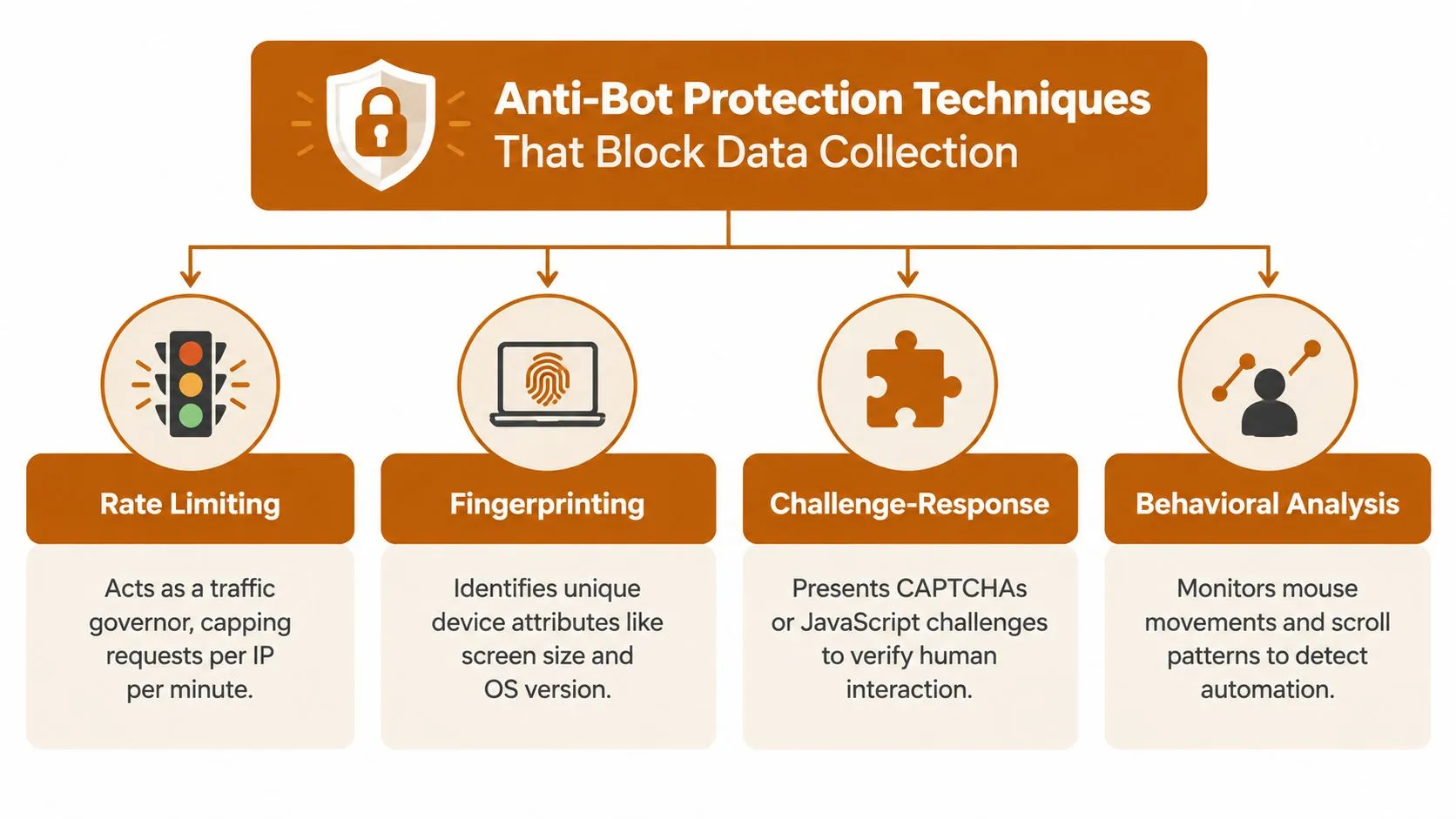
Protection works best when teams stop thinking about a single “bot blocker.” An app provider can combine multiple controls, and each one answers a different question. Is the client sending too many requests? Does the device look authentic? Does the request use the expected protocol? Does the session behave like a normal user flow?
Layered defense principle: No single signal has to prove automation. Several weak inconsistencies can combine into a strong reason to slow, challenge, or deny a request.
Rate limiting controls the traffic shape
Rate limiting acts as a traffic governor. The server can restrict how quickly a client, account, session, or network identity requests data. A collector that sends requests at a fixed, aggressive cadence may receive delayed responses, partial results, retry responses, or temporary denial.
The impact isn’t limited to speed. Excessive retries can amplify the original problem, creating a feedback loop in which failed requests generate more traffic and produce fewer usable records. Responsible services use conservative schedules, exponential backoff, caching, deduplication, and clear stop conditions instead of trying to force throughput.
Fingerprinting checks the client identity
Fingerprinting combines attributes that describe the request environment. In mobile contexts, those attributes can include operating-system details, device characteristics, application version, transport behavior, and session consistency. The server may compare the claimed client profile with what the connection looks like.
A mismatch can be subtle. A request may carry mobile-style headers while using a transport fingerprint or session sequence that doesn’t fit the claimed app. Legitimate mitigation means maintaining an accurate, authorized client profile and avoiding unnecessary variation. It doesn’t mean fabricating identities or attempting to defeat an app’s integrity controls.
Challenges add a decision point
CAPTCHAs and challenge-response systems appear when automated traffic crosses a provider’s risk threshold. The challenge may interrupt a workflow, return an interstitial response, or prevent access until the provider receives an acceptable interaction.
For a compliant pipeline, a challenge is an operational signal, not an invitation to automate around it. The service should record the event, pause the affected flow, apply the approved recovery path, and escalate when human review or provider authorization is required. A useful discussion of challenge handling is available in this guide to CAPTCHAs in web scraping.
WAFs and behavioral controls assess context
A WAF can evaluate request methods, paths, headers, payload patterns, and protocol characteristics. Behavioral analysis adds timing and sequence. A session that opens endpoints in an impossible order, repeats identical actions, or never produces expected interaction signals may receive a higher risk score.
These layers affect data quality in different ways. Rate limits reduce freshness. Fingerprint failures reduce session coverage. Challenges create gaps at specific workflow points. WAF rules can remove entire request classes. Monitoring must therefore track more than total requests. It should show which fields, regions, app versions, and workflows are failing.
A broader overview of anti-bot measures in Playwright is useful for understanding the same layered logic in browser environments. Mobile collection requires additional attention to device identity and app integrity, but the diagnostic principle remains consistent: identify the signal before selecting a response.
Detection Signals and Why Your Requests Get Flagged
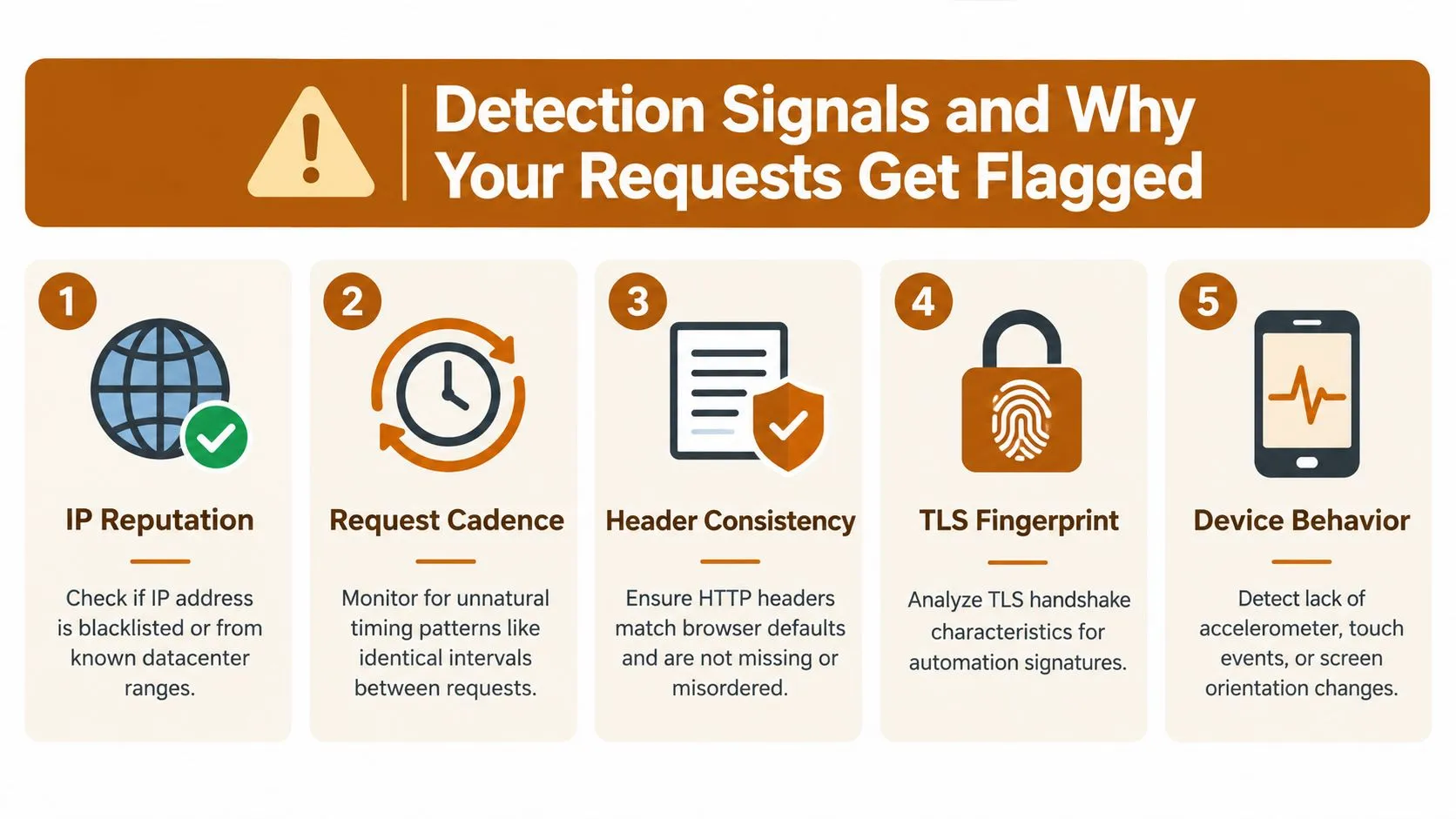
A server rarely labels a request “scraping” based on one observation. Instead, it can combine signals into a risk assessment. A datacenter network may carry a poor reputation, a session may request records at perfectly regular intervals, and the headers may conflict with the claimed mobile client. Each observation becomes more meaningful when it agrees with the others.
Read the response as an operational symptom
Soft blocks often look like ordinary reliability problems. Latency rises, pages or records arrive incomplete, a field disappears, or the service returns a smaller result set without an explicit denial. These symptoms can indicate throttling, a schema change, an upstream timeout, or a risk rule that is degrading access rather than terminating it.
Hard blocks are easier to recognize. The collector may receive an HTTP denial, a challenge page, an authentication failure, or a session that repeatedly loses access. A shadow-style restriction is harder to diagnose because requests appear successful while the returned data becomes stale, empty, or selectively incomplete.
Monitor the signals that explain coverage
That visual is a useful checklist, but production observability needs to connect signals to records. Track the following dimensions:
- Network reputation: Record whether failures cluster around a network class, region, or provider.
- Request cadence: Compare collection timing across jobs and detect rigid repetition or retry storms.
- Header consistency: Validate that the client profile remains internally coherent after app or library updates.
- TLS and transport behavior: Watch for handshake changes and connection failures that appear after a client revision.
- Device behavior: Check whether the workflow depends on device context that the collector isn’t reproducing consistently.
- Payload completeness: Measure required fields, not just HTTP success.
- Version and geography: Segment results by app version, operating-system family, locale, and market.
One independent benchmark tested 6,000 requests across 1,000 Apple App Store pages, measuring success rate, completion time, and field completeness. The app-store scraper benchmark shows why throughput alone is a weak service metric. A fast collector that omits ratings, prices, or regional fields can be less valuable than a slower one that delivers complete, validated records.
Diagnostic rule: A successful response is only successful if it passes schema, freshness, and completeness checks.
Teams should preserve request and response metadata without storing unnecessary personal information. A useful incident record identifies the first failing stage, the affected scope, and whether the problem followed an app release, infrastructure change, or traffic-pattern change. That evidence supports a measured fix instead of repeated blind retries.
Legitimate Mitigation Strategies for Reliable Collection
Reliable collection starts with restraint. A provider should know the approved target surface, establish a collection budget, and stop when the service responds with a challenge or clear denial. This approach protects data quality as well as compliance because repeated failed requests rarely improve the dataset.
Compare the main operating choices
| Mitigation Tactic | What It Solves | Trade Off to Consider |
|---|---|---|
| Rate management and backoff | Reduces bursts, retry storms, and avoidable throttling | Slower freshness and more scheduling complexity |
| Caching and deduplication | Prevents repeated retrieval of unchanged records | Requires cache invalidation and change detection |
| Regional collection | Captures market-specific listings and responses where access is authorized | Adds operational overhead and jurisdiction-specific review |
| Client-profile normalization | Reduces contradictions between headers, sessions, and declared device context | Needs maintenance when app versions or client libraries change |
| Session management | Preserves continuity for permitted workflows and limits unnecessary logins | Raises governance requirements around credentials and retention |
| Managed infrastructure | Absorbs monitoring, retries, schema changes, and operational maintenance | Creates vendor dependency and requires clear SLA and data controls |
Proxy infrastructure can be part of regional collection, but proxy choice doesn’t resolve authorization or privacy questions. Teams that need background on proxy interfaces can consult the ThirstySprout proxy server API guide, then evaluate providers against geography, logging, ownership, and permitted use rather than selecting a network solely for evasion.
Build service-level controls around the dataset
A production SLA should define coverage, field completeness, freshness, and recovery behavior. It should also specify what happens when an app update changes a response schema or an anti-bot control begins returning challenges. A run that returns partial data shouldn’t be marked healthy because the transport layer completed.
A practical operating model includes:
- Backoff policies: Increase the wait after throttling and cap retries.
- Change alerts: Flag new fields, missing required fields, altered types, and unexpected empty responses.
- Canary jobs: Test a small approved sample before launching a broader collection run.
- Version tracking: Associate records with app and collector versions so regressions are traceable.
- Escalation paths: Pause collection when rules, terms, or technical barriers change materially.
- Quality dashboards: Separate request success from usable-record success.
Compliance deserves equal weight. Public availability doesn’t automatically remove obligations involving terms, privacy, retention, or jurisdiction. This is especially important when data supports competitive intelligence or compliance workflows, because commercially sensitive signals may be accessible while still carrying meaningful legal and business risk. The Apple App Store scraping compliance guidance provides useful context, but counsel should make the final determination for each target and use case.
The right mitigation is usually the least invasive one that meets the data contract. If public listing data satisfies the decision, don’t expand into authenticated or device-bound surfaces. If enrichment is essential, document the purpose, minimize collection, and obtain explicit authorization before increasing technical complexity.
Real World Examples of Mobile App Data Gaps and Enrichment
Consider a market-research team tracking app-store rankings and reviews. The public listing surface may provide app names, ratings, review counts, categories, prices, and related metadata. A collector can normalize those fields into a comparison table, but large-scale jobs still need rate management, regional handling, deduplication, and completeness checks.
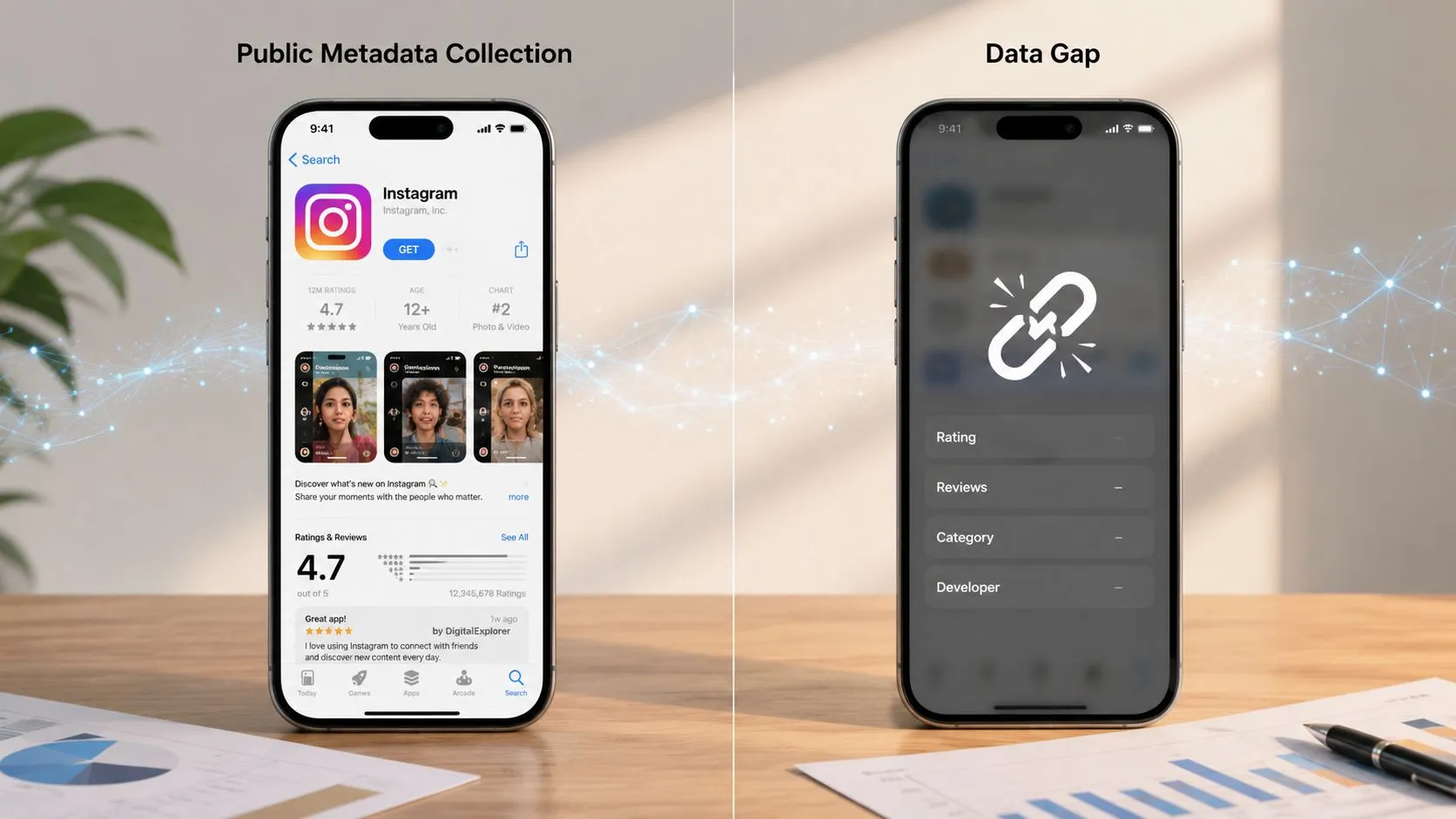
Now change the question. The product team wants to know whether a competitor changed its onboarding layout, which screenshots appeared for a particular device, or how its in-app purchase list is presented. Public APIs may center on listings and reviews, while those UI-level signals require enrichment and normalization beyond basic metadata.
That distinction changes the project scope. The team isn’t merely downloading fields. It may need controlled device capture, visual comparison, structured screenshot storage, and rules for associating a surface with a market, operating system, app version, and collection time. The more the question concerns what a user sees, the more important the capture method becomes.
The fragmentation challenge is substantial. AppTweak says its database covers 6 million apps and 17 million keywords across 100+ countries, as described in this Apple App Store scraper API resource. Those figures are a source-specific description of database coverage, not a claim that every project needs the same scale. They do show why normalization, localization, and entity resolution can become harder than initial access.
A good statement of work should separate three layers:
- Public metadata: Listings, reviews, rankings, categories, and prices where permitted.
- Enriched presentation data: Screenshots, purchase lists, and visual layout changes.
- Behavioral or authenticated data: Signals that may require stronger authorization and a more careful legal assessment.
This separation prevents teams from pricing a simple metadata feed as if it were a device-aware intelligence system, or from assuming that an API response represents the complete app experience.
Choosing Compliant Mobile App Scraping Services With Confidence
A provider evaluation should begin with the data contract, not a list of bypass features. Define the target fields, markets, refresh expectations, acceptable gaps, delivery format, retention period, and escalation rules. Then ask how the service handles app updates, schema drift, incomplete payloads, rate limits, and challenge responses.
The legal boundary also needs precision. In 2022, the U.S. Ninth Circuit ruled in hiQ Labs v. LinkedIn that scraping publicly accessible data without login or bypassing a technical barrier generally didn’t violate the Computer Fraud and Abuse Act, according to this app-store scraping legal overview. The ruling didn’t create blanket permission. Terms, privacy laws, jurisdiction, contractual restrictions, and the distinction between public listings and restricted data still matter.
Use this GDPR-compliant web scraping checklist as a starting point for governance discussions, then adapt it with legal counsel to the specific mobile sources and data fields.
Before signing with a mobile app scraping service, verify:
- Coverage definitions: Which stores, regions, versions, fields, and enrichment types are included?
- Quality measures: Does the SLA cover completeness and freshness, not only request delivery?
- Change management: Who responds when an app update alters schemas or defenses?
- Data governance: Are collection, retention, access, and deletion rules documented?
- Operational transparency: Can your team inspect errors, gaps, retries, and recovery status?
- Exit options: Can you export normalized data and switch providers if the scope changes?
Build when the target is narrow, authorized, stable, and strategically important to your platform. Buy managed operations when monitoring, multi-market delivery, and maintenance would distract your engineering team from core product work. WebscrapingHQ provides custom extraction and managed data operations, including monitoring, retries, schema updates, multi-geo collection, and structured delivery formats for recurring data needs.
If your team needs reliable app-store or mobile-facing data without maintaining every collector change internally, visit WebscrapingHQ to discuss a scoped extraction pipeline. Start with the fields, markets, compliance boundaries, and delivery SLA, and let the feasibility review determine whether a managed service fits your use case.
Want this done for you?
Send us the URLs. We'll quote it in 24 hours.
Paste the URL(s) you want scraped. We'll reply within 24 hours with a feasibility check and a ballpark quote.