Jump to section
- The Day Your Social Media Pipeline Quietly Stops Working
- Three failures hide inside one incident
- Design for the failure you can’t predict
- What Social Media Data Actually Looks Like at Scale
- Start with a platform-neutral record
- Never flatten meaning into a single score
- Choosing Between APIs, Browser Automation, and Managed Pipelines
- Match the method to the consequence
- Schema Versioning as the Backbone of a Trustworthy Pipeline
- Version the meaning, not only the shape
- Put version metadata in every layer
- Build governance into the pipeline
- Why Public Visibility Does Not Mean Free to Use
- Treat coverage as a measured limitation
- Minimize data before collection begins
- Putting It All Together on Monday Morning
A social-media dashboard can look healthy right up until the morning it stops telling the truth. A field disappears upstream, the collector still returns successful responses, and every chart falls to zero. The team spends hours debating audience behavior when the actual problem is a renamed attribute.
That failure is common because teams treat the decision to scrape social media data as a tooling choice. In production, the harder problem is continuity. Platforms change access rules, page structures, ranking systems, and field definitions without preserving the assumptions built into your pipeline.
The durable approach combines source resilience, versioned schemas, collection metadata, bias diagnostics, and documented governance. It also accepts an uncomfortable fact: a dataset isn’t trustworthy because it contains many records. It’s trustworthy when you can explain what was collected, what was missed, and whether an old result remains reproducible.
The Day Your Social Media Pipeline Quietly Stops Working
By day thirty, the incident rarely looks dramatic. There’s no outage page and no obvious exception. Your scheduled job completes, the warehouse receives rows, and the dashboard refreshes on time. Yet a platform has changed a field name or moved a value behind a different response path, so the newest records contain empty engagement fields.
The first symptom is usually a business question. Marketing asks why conversation volume collapsed. Research asks why a competitor vanished from the trend report. An engineer compares the raw payload with last week’s capture and discovers that the collector is technically succeeding while the meaning of its output has changed.
Practical rule: A successful request proves that data arrived. It doesn’t prove that the data still means what your downstream systems think it means.
Three failures hide inside one incident
The first is platform volatility. Social networks revise interfaces, access policies, ranking behavior, and response structures. A browser selector can break after a visual redesign. An API can continue responding while removing a field or changing its domain.
The second is schema drift. A source may return reaction_count in one period and omit it in another. A value may change from an integer to a nested object, or a timestamp may shift format. Without explicit validation, those changes pass through ingestion and become silent analytical errors.
The third is audit pressure. Six months later, someone asks why a report differs from the original result. If you retained only a cleaned table, you may not know the source URL, retrieval time, request status, parser version, or reason a record was excluded.
The global scale makes this harder. DataReportal estimated 5.24 billion active social-media user identities worldwide in January 2025, representing roughly 63.9% of the global population, and reported that the total had increased by 4.1% during the preceding twelve months (DataReportal’s global social-media analysis). The same source reported that 94.2% of internet users accessed social media at least monthly and that the typical internet user used or visited 6.83 platforms monthly. A collector aimed at one service captures only a fraction of the public conversation.
Design for the failure you can’t predict
Start by separating raw evidence from interpreted data. Store the original response or rendered capture, the normalized record, and the transformation metadata. When a parser changes, you should be able to rebuild the normalized layer without recollecting the source.
Authentication deserves the same discipline. Token expiry often looks like a collection outage, so document rotation, ownership, scopes, and failure states. Teams that need a practical reference can review guidance on managing social API tokens before they automate credential handling.
Resilience also means spreading failure across workers and sources rather than letting one blocked endpoint halt the entire run. The principles in distributed web scraping fault tolerance are useful here, especially for retries, queue isolation, and partial delivery.
Your real job isn’t to keep a scraper running indefinitely. It’s to keep the dataset defensible when the upstream platform changes without warning.
What Social Media Data Actually Looks Like at Scale
A social-media record isn’t just a post and a username. A useful multi-platform dataset combines several field families, then preserves the distinctions that prevent misleading comparisons.
The scale gives context. The cited global digital measurements place social-media identities at 5.24 billion in early 2025, with 259 million additional identities added over the preceding year (Brandwatch’s summary of 2025 social-media measurements). Those identities aren’t automatically unique people. One person can hold multiple accounts and use several services, so identity counts need clear definitions before anyone aggregates them.
Start with a platform-neutral record
A whiteboard schema usually needs these categories:
- Identity fields: platform account ID, public handle, display name, profile URL, and visibility state. Keep stable identifiers separate from names because users can change handles.
- Content fields: post ID, text or caption, media references, publication time, edit state, parent record, and language. A Reddit submission may center on a title and body, while a TikTok record may center on a video and caption.
- Engagement fields: reactions, comments, shares, saves, replies, and views where the source supplies them. Store the raw field name and source meaning alongside any normalized value.
- Collection metadata: retrieval timestamp, source endpoint or URL, query, crawler identity, response status, parser version, and missingness reason.
- Platform extensions: video duration, sound identifier, subreddit, job location, company identifier, or other fields that don’t belong in the universal core.
LinkedIn job listings illustrate why this matters. A listing may contain employer, role, location, publication status, and application metadata, while a TikTok video may contain views, likes, comments, shares, and sound information. Both can enter a shared dataset, but neither should be forced into an identical content model.
Never flatten meaning into a single score
A view on one service may count a playback, while another platform may define it through a different exposure or interaction rule. A reaction, like, repost, share, and comment also represent different behaviors. Renaming all of them as engagement creates a convenient column and an unreliable analysis.
Use a canonical layer for comparable concepts, but retain the source-level value and definition:
| Layer | Example | Purpose |
|---|---|---|
| Raw | play_count from the source | Preserve evidence |
| Normalized | views | Support common queries |
| Definition | Platform-specific counting rule | Prevent false equivalence |
| Quality state | observed, missing, estimated, inaccessible | Explain limitations |
Time and language require similar care. Normalize timestamps to a consistent representation while retaining the original value, and label language and geography explicitly. A multilingual query that stores only translated text loses the evidence needed to audit search coverage.
The dataset should also record what wasn’t available. Deleted content, private accounts, blocked requests, and fields excluded by the platform aren’t the same as zero. Treating “not accessible” as “none” turns collection limits into false behavior signals.
Choosing Between APIs, Browser Automation, and Managed Pipelines
The right extraction method depends on the required coverage, acceptable maintenance, legal basis, and tolerance for missing fields. No method wins across every use case.
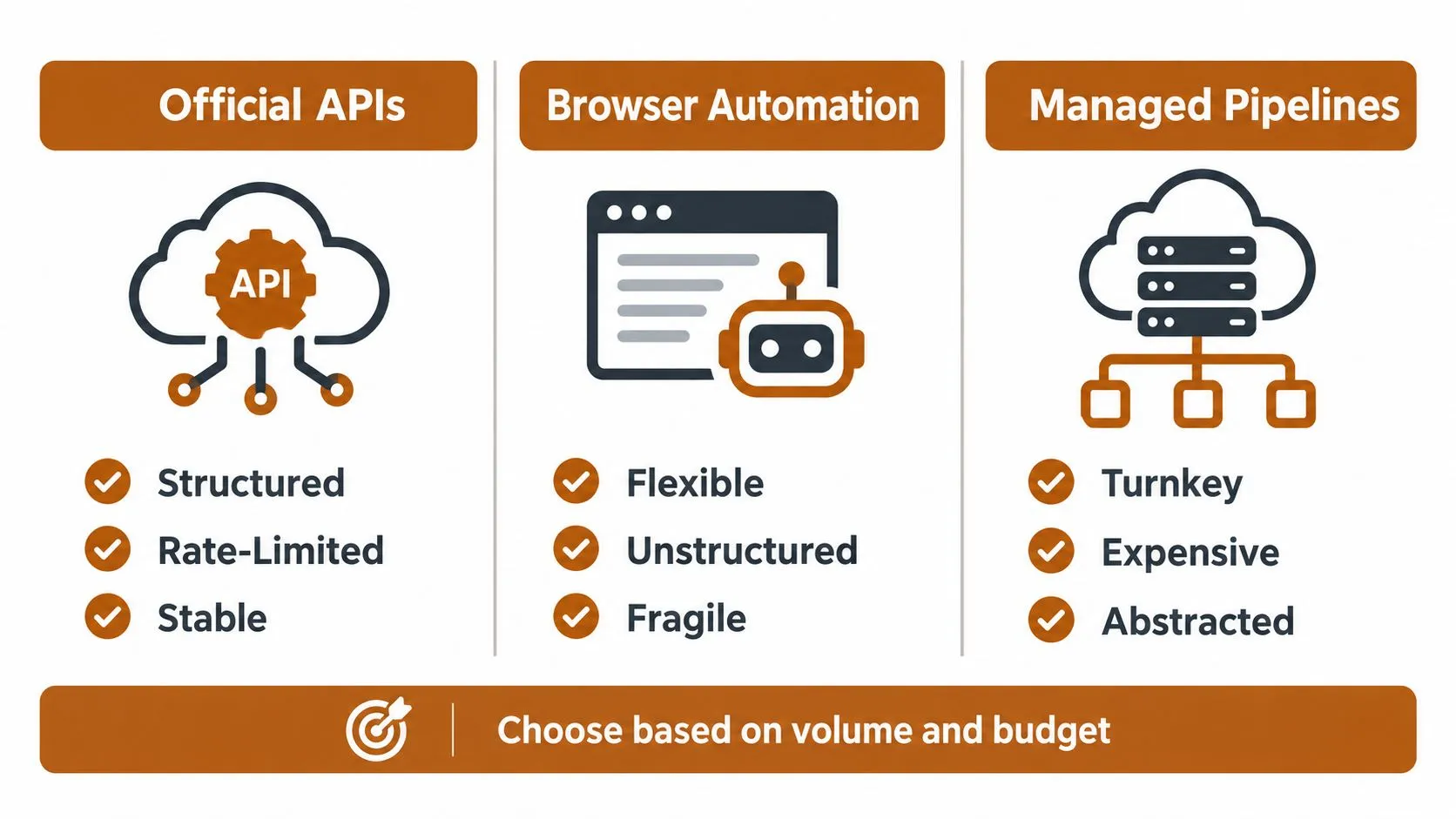
Official APIs generally provide structured responses and clearer access boundaries. They can still be incomplete, quota-constrained, or unstable for longitudinal work. Browser automation can reproduce what a public visitor sees, which helps when the required fields aren’t exposed through an API, but it couples your collector to page structure, rendering behavior, sessions, and anti-automation controls.
Managed pipelines shift operational responsibility. They can handle scheduling, retries, proxy management, parser maintenance, and delivery, but they introduce vendor dependency and ongoing cost. The important comparison isn’t “free versus paid.” It’s internal maintenance versus managed operating cost.
| Approach | Works well when | Common failure | Control you must add |
|---|---|---|---|
| Official API | You need structured, documented access | Missing fields, quotas, policy changes | Coverage tests and quota monitoring |
| Browser automation | Public rendering contains required data | Selectors, sessions, and layouts change | Visual and semantic regression checks |
| Managed pipeline | You need recurring delivery without scraper ownership | Source coverage or schema doesn’t match | Contract tests and vendor governance |
Research can require more than one route. A 2025 review of academic information-environment research found that 49% of analyzed studies used a platform API, while 34% relied on manual annotation or coding and 14% on crowdsourcing or surveys, with categories able to overlap (Research Accelerator’s information-environment review). The point isn’t to select a winning percentage. API access alone doesn’t create a dependable workflow.
Match the method to the consequence
Brand monitoring may prioritize repeatable access and timely delivery. Academic research may prioritize sampling transparency and evidence preservation. An AI training corpus may require language, geography, deduplication, and provenance controls that matter more than raw collection speed.
A source-resilient design assigns a primary route and a fallback route for every critical field. The fallback might be another official endpoint, a controlled browser capture, a licensed dataset, or a reduced schema that preserves the most important signals. Record the transition explicitly so a coverage change doesn’t look like a real-world trend.
For a deeper comparison of access patterns, web scraping versus APIs offers a useful decision frame. In practice, teams often combine methods rather than standardizing on one.
The expensive choice isn’t always the vendor. It’s building a pipeline that has to be redesigned from scratch after the first access change.
A managed service such as WebscrapingHQ can support recurring extraction, monitoring, retries, and structured delivery when a team doesn’t want to operate each source internally. That option still needs a defined schema contract, field-level coverage expectations, retention rules, and an escalation path when the source changes.
Schema Versioning as the Backbone of a Trustworthy Pipeline
Schema versioning is the difference between “the table has a new column” and “we know exactly what changed, when it changed, and which analyses are affected.” It belongs beside the data, not in a forgotten document.
Version the meaning, not only the shape
Teams often version field names while ignoring value semantics. A reliable contract versions at least four things:
- Names and types. Record whether
comment_countis an integer, nullable value, or nested object. - Value domains. Document allowed states such as observed, missing, inaccessible, and not applicable.
- Units and timestamps. State whether a duration uses seconds, whether a time is source-local or UTC, and how edits are represented.
- Engagement definitions. Preserve the platform’s original field and the interpretation used in normalized reporting.
Give each source its own schema version. A TikTok collector can move from tiktok.v1 to tiktok.v2 without forcing a Reddit parser to change. Downstream consumers should receive a governed common model that retains source-specific extensions rather than hiding them.
A semantic-style convention works well operationally. Increment a major version when a field is removed, its meaning changes, or a consumer must migrate. Increment a minor version when you add backward-compatible fields. Use a patch version for corrections that don’t alter the contract. The exact naming scheme matters less than consistent release notes and automated compatibility checks.
Put version metadata in every layer
Attach the schema version to raw captures, normalized records, exports, and delivery manifests. Store parser version, source version, retrieval time, and transformation status beside it. A warehouse table without this context can’t tell you whether two apparently similar values came from different contracts.
When a platform retires a field, don’t overwrite history. Mark the field as unavailable from the relevant retrieval point, preserve the last raw observations, and expose the change through a migration record. Consumers can then distinguish historical absence from current inaccessibility.
Retries need version awareness too. If a job fails after the source changes, replaying it with today’s parser may produce a different record from the one the original run would have created. Preserve the parser and schema used for each attempt, and make reprocessing an explicit operation rather than an invisible correction.
Build governance into the pipeline
A practical contract test should assert more than HTTP success. Check required fields, types, timestamp parseability, identifier stability, allowed null states, unexpected keys, and abrupt distribution changes. Send a review alert when the source returns a structurally valid but semantically implausible payload.
Keep a migration registry linked to data assets. It should answer:
- Which source changed?
- Which fields were added, removed, or redefined?
- Which jobs and reports consume them?
- Which historical records can be safely backfilled?
- Which conclusions now require a qualification?
A clear data governance policy example can help teams turn these decisions into ownership, retention, access, and review rules.
Engineering standard: If an analyst can’t identify the schema and parser that produced a metric, the metric isn’t ready for an important decision.
Why Public Visibility Does Not Mean Free to Use
Public visibility answers one question: a person could view the material under particular conditions. It doesn’t answer whether your organization may collect, retain, combine, republish, or infer from it.
Privacy risk is only one part of the problem. Public datasets can also be unrepresentative. APIs, search interfaces, deleted posts, private accounts, language differences, ranking systems, and anti-automation controls can exclude users and topics systematically. A large capture may therefore describe the access mechanism better than it describes the public.

Treat coverage as a measured limitation
Record collection geography, language, query strategy, account visibility, ranking context, and retrieval windows. Track deleted-item rates and distinguish “not present” from “not accessible.” If the source exposes only ranked results, preserve rank or retrieval position so later users understand how the sample was formed.
API output can be a biased subset rather than a complete record. In one COVID-19 Twitter study, researchers noted unknown sampling rules and a search limit of 450 requests per 15-minute window per crawler. They divided 86 keywords across four crawlers and compared API results with 200 random full-minute samples from the full archive (the study’s methods and sampling discussion). Those figures describe that study, not a universal platform rule. The operational lesson is to preserve endpoint, query, time window, crawler identity, failures, and rate-limit events.
Facebook research found another distortion after the Graph API capped retrieval at approximately 600 published posts per page per year. Highly engaged and photo or video posts were overrepresented, while link posts were underrepresented (the Facebook scraping study.) The practical response is to compare post types, engagement distributions, pagination boundaries, and API versions rather than assuming the feed is complete.
Minimize data before collection begins
Write a use-case-specific legal and ethical basis before the first request. Collect only the fields needed for that purpose, restrict raw text and usernames when they aren’t necessary, control access, and define deletion procedures. Don’t treat a public profile as permission to create an unrelated identity dossier.
The broader transparency problem includes data ownership, privacy, and commercial interests. The Social Media Scheduler explanation of how data is handled is a useful reminder that privacy practices should be explicit rather than implied by a public interface.
Also review the legal risks in web scraping and their mitigations with counsel for the relevant jurisdiction and use case. Terms, privacy obligations, research rules, and platform controls can all matter.
The most credible dataset isn’t necessarily the largest. It’s the one that discloses who couldn’t be observed, why they were excluded, and how that limitation affects the conclusion.
Putting It All Together on Monday Morning
A durable pipeline begins with a small contract, not a large crawl. Define the minimum fields needed for the decision, then add extensions only when a consumer can explain why they matter.
Use this operating checklist:
- Set the schema baseline: Define identity, content, engagement, timestamps, provenance, and explicit missingness states.
- Assign versions: Give every source and normalized output a schema version, parser version, and migration record.
- Instrument collection: Capture endpoint or URL, query, geography, language, retrieval time, crawler identity, failures, and rate-limit events.
- Prepare fallbacks: Decide what happens when the primary API, page, field, or platform becomes inaccessible. Preserve reduced but interpretable output where appropriate.
- Run bias diagnostics: Compare language, geography, content type, ranking position, engagement, and retrieval volume over time.
- Document the basis: Record purpose, permitted fields, retention, access controls, and review ownership before collection starts.
- Test the past: Re-run a historical question against the original snapshot, not today’s live source.
A source monitor can detect structural changes before business users discover them. Guidance on monitoring website changes is applicable to social platforms when paired with field-level validation and semantic checks.
The decisive question is simple: can your team answer a six-month-old question with six-month-old evidence and explain the limits of that answer? If not, collecting more posts won’t solve the problem. Schema history, raw evidence, fallback planning, and coverage diagnostics will.
WebscrapingHQ provides managed extraction pipelines with monitoring, retries, source maintenance, and structured delivery for recurring web and social-media data needs. If your team needs a governed schema and reliable collection without operating every scraper internally, visit WebscrapingHQ to discuss the sources, fields, and delivery schedule.
Want this done for you?
Send us the URLs. We'll quote it in 24 hours.
Paste the URL(s) you want scraped. We'll reply within 24 hours with a feasibility check and a ballpark quote.