Jump to section
- The Hidden Cost of Unmanaged Schema Drift
- Why static selectors become liabilities
- Schema versioning as a shock absorber
- Understanding Schema Versioning in Data Pipelines
- What a version records
- Why static extraction models fail at scale
- Workflows for Detecting and Managing Structural Changes
- A practical decision path
- When auto-healing is safe
- Compatibility Patterns and Migration Strategies
- Choosing the right migration pattern
- Protecting machine-learning consumers
- Governance and Compliance in Continuous Extraction
- Turning policy into pipeline controls
- The Role of Managed Infrastructure and AI Parsing
- Where AI parsing helps
- Evaluating the service boundary
- Rethinking Web Data as a Living Ecosystem
- A durable operating model
A pricing feed runs cleanly overnight. By breakfast, an e-commerce site has redesigned its product cards, moved availability into a client-rendered component, and renamed the element that held the seller field. The scraper still returns HTTP responses, the job still reports success, and the downstream model receives records. Only the values are wrong, incomplete, or missing.
That’s the operational trap with online web scraping services. The difficult question isn’t whether a page can be parsed once. It’s whether a managed extraction pipeline can absorb structural change without corrupting analytics, retraining an AI system on malformed records, or breaking a compliance workflow. Schema versioning is the control that turns inevitable website volatility into a governed engineering process.
The Hidden Cost of Unmanaged Schema Drift
A production failure caused by a redesign rarely announces itself as a failure. The crawler may complete normally while a selector returns an empty string. A price parser may capture a promotional label instead of the numeric value. A product variation may move from a flat card into a nested component, and the pipeline may flatten it incorrectly without raising an exception.
That creates a more expensive problem than a visible outage. An outage attracts an engineer. Silent schema drift contaminates the data that has already passed through validation, storage, dashboards, feature generation, and model training.
Why static selectors become liabilities
Static selectors work well when a site is stable and the extraction task is narrow. They become fragile when a publisher changes class names, introduces A/B templates, shifts content from server-rendered HTML to JavaScript, or serves different layouts by geography and device. The selector isn’t aware of business meaning. It only knows where a value used to appear.
A managed service should therefore monitor more than request status. It should compare field presence, data types, allowed ranges, nested relationships, and representative page renders. A product record with a missing title, a text value in a numeric field, or an unexpected number of variants deserves investigation even when the page loaded successfully.
Production rule: Treat a scraper’s output as a data product, not as a by-product of HTTP requests.
The operational cost also spreads across teams. Analysts lose confidence in historical comparisons. Data scientists must determine whether a model shift reflects customer behavior or a parser change. Compliance staff may find that newly collected fields bypass an existing minimization rule. Engineers then spend time reconstructing when the structure changed and which consumers received affected records.
Teams that already monitor freshness and completeness can extend those controls with data quality monitoring tools. The important design choice is to connect monitoring alerts to a specific schema version, target, and deployment, rather than sending a generic “scrape failed” notification.
Schema versioning as a shock absorber
A versioned pipeline preserves the old contract while introducing a new one deliberately. When a target changes, the service can route records to a quarantine path, run an alternate parser, compare outputs, and release a new schema only after downstream checks pass.
That approach protects consumers from surprise changes without pretending the web will remain static. It also preserves an audit trail. Teams can identify which parser generated each record, compare versions, replay historical pages where available, and communicate migration requirements before removing legacy fields.
Understanding Schema Versioning in Data Pipelines
A database schema usually changes through an explicit migration. An engineer adds a column, updates application code, runs tests, and deploys the change. A web extraction schema changes for less disciplined reasons. A site owner may alter markup, rename a label, split one field into several fields, or expose a new nested object without notifying any data consumer.
In this setting, a schema describes the output contract. It includes field names, data types, required and optional values, nesting, repeated objects, normalization rules, and provenance. For a catalog feed, that might mean a product identifier, title, price, currency, availability, seller, and an array of variants. The HTML is an implementation detail. The schema is what downstream systems rely on.
What a version records
A useful schema registry records more than a label such as v2. It should capture:
- Field definitions: Names, types, nullability, units, and accepted formats.
- Relationships: Whether variants belong to products, reviews belong to listings, or offers belong to sellers.
- Validation rules: Required identifiers, currency consistency, date parsing, and duplicate handling.
- Transformation history: The parser, normalization logic, and deployment that produced each record.
- Compatibility status: Which consumers can accept the version and which still require an older contract.
This ledger matters because raw pages aren’t reliable documentation. A version registry gives engineers and consumers a shared description of what the pipeline promised at a particular point in time.
Why static extraction models fail at scale
A static parser assumes that the same visual or structural cue will continue to identify the same business field. That assumption fails especially quickly on modern sites with dynamic rendering and multiple templates. Web scraping itself has evolved from early HTML crawling toward browser-based automation, with historical milestones including the World Wide Web Wanderer in 1993, WWW::Mechanize in 1998, BeautifulSoup in 1999, Selenium in 2004, and PhantomJS in 2009, as documented in this history of web scraping technology.
Versioning changes the failure mode. Instead of accepting malformed output, the pipeline can reject records that violate the active contract, tag them as structurally uncertain, and send them for alternate parsing. It can also publish both the old normalized view and the richer new representation for a transition period.
For teams collecting retail listings, e-commerce data scraping services should be evaluated by how they manage this contract, not by whether they return JSON. A clean sample from today says little about how the provider handles tomorrow’s layout change.
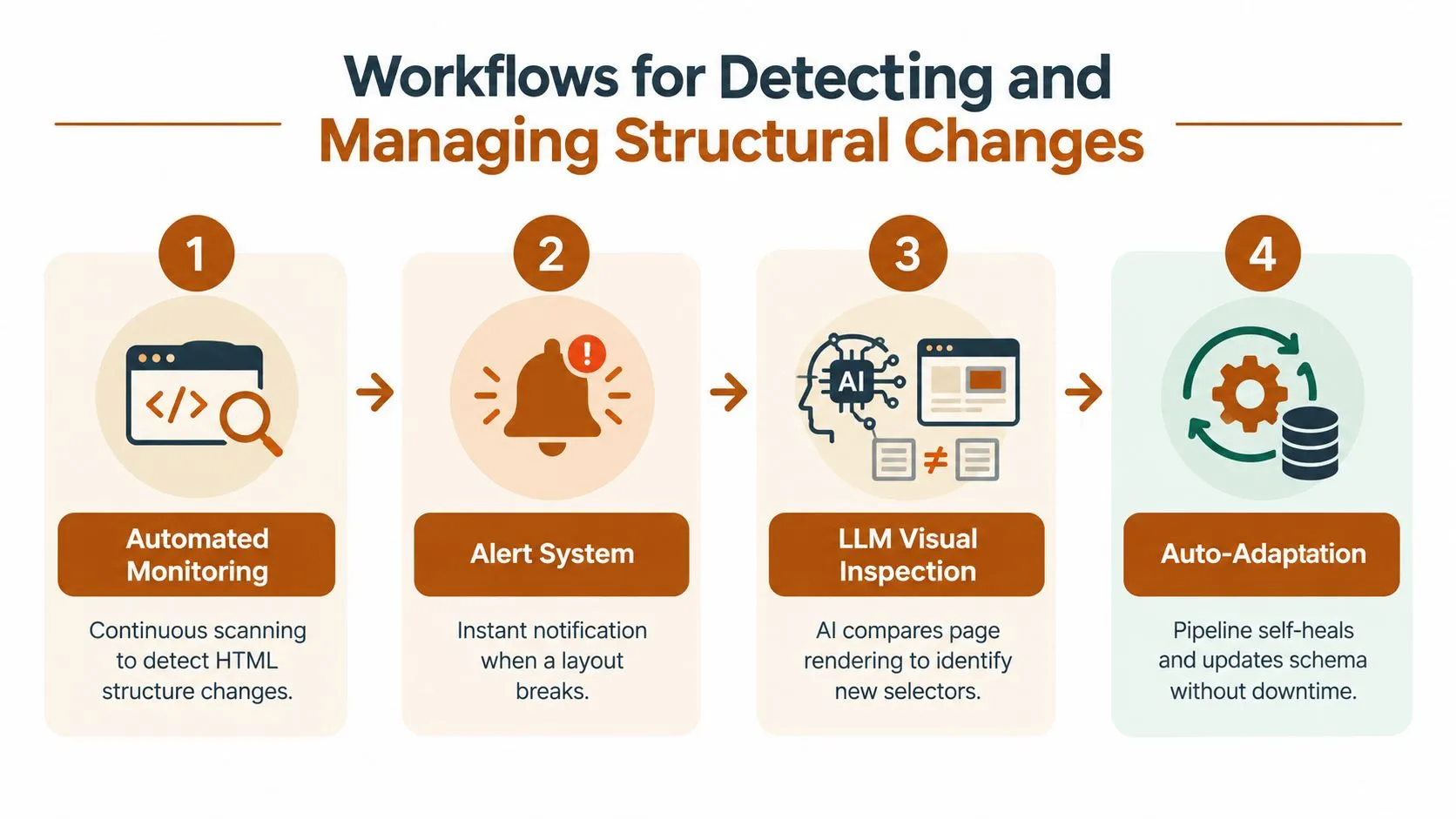
Workflows for Detecting and Managing Structural Changes
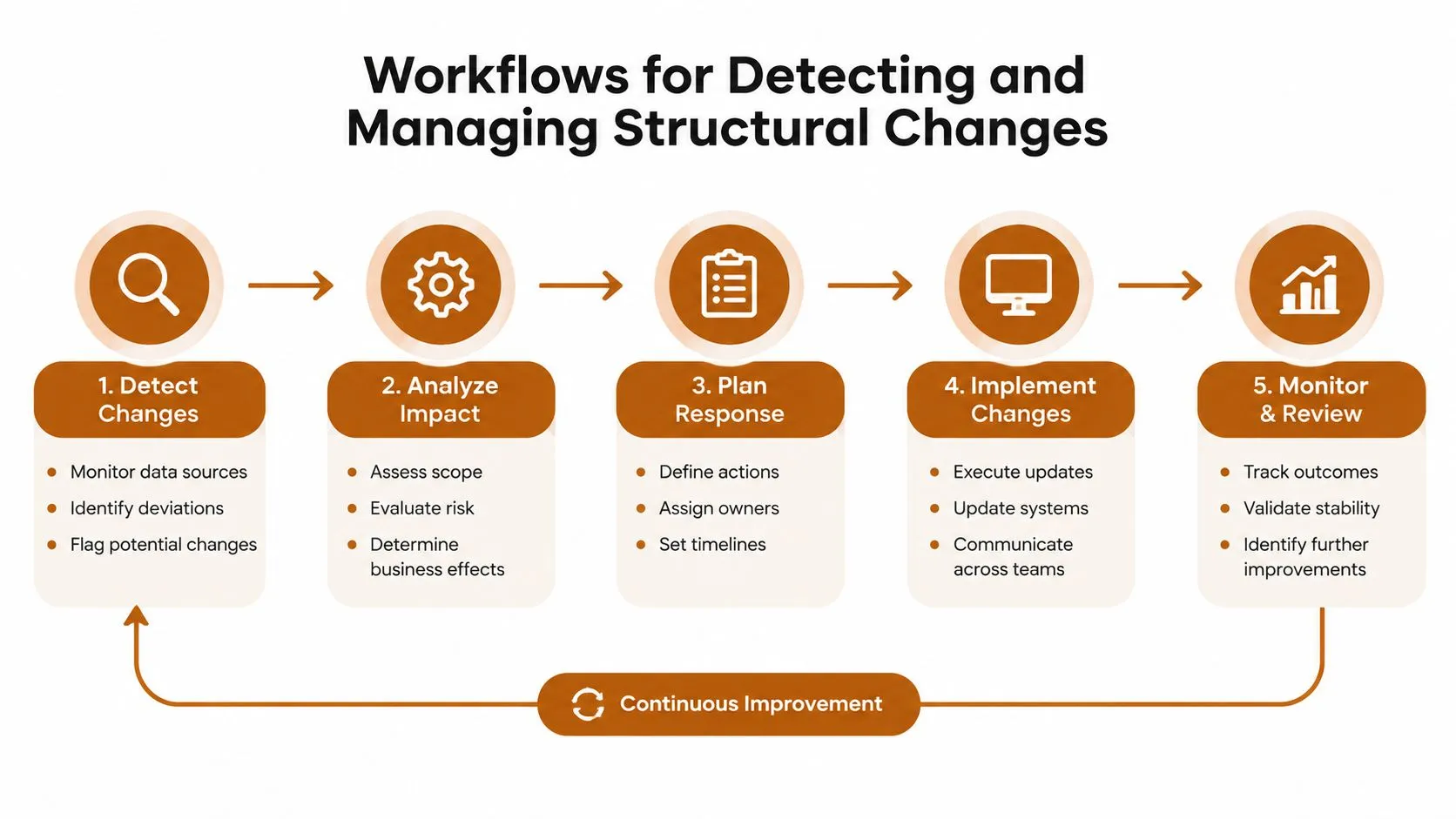
Reliable change management starts before a parser breaks. Select representative URLs for every important template, locale, device pattern, and content state. Capture expected fields and relationships, then run those pages through continuous checks. The monitor should compare both the rendered page and the structured output, because a visually minor change can have major downstream consequences.
A practical decision path
Detect: Compare field presence, selector matches, type distributions, page fingerprints, and render snapshots. A missing field across representative pages is stronger evidence than a single failed request.
Classify: Decide whether the event is transient, content-driven, or structural. A temporary empty inventory state shouldn’t create a schema release. A new product-card hierarchy might.
Inspect: Use a browser render or visual comparison to locate the new content region. An LLM can assist by matching labels, nearby text, repeated cards, and semantic relationships, but its proposed mapping must pass deterministic validation.
Branch: Create a candidate schema version when the business meaning has changed or the old parser can’t safely represent the new structure. Keep the candidate isolated until it produces acceptable records across the monitored sample.
Release: Deploy with explicit compatibility rules, record the parser version in the output, and retain a rollback path. Consumers should know whether they’ll receive the old contract, the new contract, or a transformed legacy view.
When auto-healing is safe
Auto-healing works best for local, low-risk changes. If a price label moves inside the same product card and the candidate value still passes currency and type checks, an automated parser can propose or apply the adjustment. The service should still log the decision and preserve the original evidence.
Auto-healing is unsafe when the page introduces ambiguity. A field that could represent a list price, sale price, financing amount, or per-unit price needs human review or a stricter rule. The same applies when a site combines multiple entities into a new nested structure.
A strong monitoring design gives operators context rather than noise. Website change monitoring guidance is useful when defining page samples, alert thresholds, screenshots, and escalation paths. The goal isn’t to eliminate every alert. It’s to distinguish a harmless content fluctuation from a contract-breaking structural event.
Compatibility Patterns and Migration Strategies
Schema migration becomes difficult when different consumers move at different speeds. A machine-learning pipeline may welcome additional attributes, while a relational table or partner API may reject an unexpected field. Treating every consumer as if it had the same tolerance creates avoidable outages.
The first choice is strict enforcement. The extractor rejects records that don’t match the active contract and places them in quarantine. This is appropriate for regulated reports, financial calculations, and systems where an incorrect value is worse than a missing record. The cost is operational friction. A legitimate site change can interrupt delivery until someone reviews and approves the new structure.
The second choice is an additive model. Existing fields remain stable, and new attributes appear as optional additions. This suits exploratory analytics and flexible feature stores, but it can hide semantic problems. Adding a field called availability_detail doesn’t help if the old availability field has changed from a boolean meaning to a free-text status.
Choosing the right migration pattern
| Pattern | Strength | Risk | Suitable use |
|---|---|---|---|
| Strict rejection | Prevents malformed records from reaching consumers | Can interrupt delivery | Compliance and financial outputs |
| Additive evolution | Preserves existing consumers while expanding detail | New fields may go unused or be misunderstood | Analytics and exploration |
| Transformation layer | Presents a stable legacy view over a richer source | Loses detail and increases maintenance | Older APIs and fixed databases |
| Dual publishing | Supports parallel migration and comparison | Requires extra storage and reconciliation | High-impact schema changes |
A transformation layer is often the most practical compromise. The extractor stores the new structure as the canonical representation, then maps it into a legacy shape for consumers that aren’t ready to migrate. That mapping must be explicit. If a new array of offers is reduced to one price, the rule should state whether the pipeline selects the lowest offer, the primary seller, or another defined value.
Protecting machine-learning consumers
AI and analytics systems need stable semantics more than stable field names. A field can retain its name while changing its meaning, unit, granularity, or missing-value behavior. Every version should therefore carry data contracts and feature documentation, including examples of valid and invalid records.
Before promotion, compare the candidate output with the previous version on the same page set. Review changes in nulls, duplicates, entity counts, categorical values, and nested relationships. Where the difference is intentional, document it as a migration. Where it isn’t, block the release.
Migration principle: Backward compatibility should preserve meaning, not merely preserve column names.
Governance and Compliance in Continuous Extraction
A schema registry can enforce governance at the point where data enters the system. That’s more effective than relying on a policy document that an engineer must remember while repairing a selector under time pressure. When a page layout changes, the pipeline should apply the same collection, filtering, anonymization, and retention rules to the new structure before the data reaches storage.
Legal risk depends on operational behavior, not only on whether a page was publicly reachable. Recent European guidance described by the CNIL and EDPB analysis of web scraping for AI development frames legitimate interest as dependent on a necessity-and-balance assessment, alongside controls such as precise collection criteria, exclusion of sensitive data, relevant signals such as robots.txt and CAPTCHA, and prompt deletion or anonymization of irrelevant information.
Turning policy into pipeline controls
A managed extraction service should encode governance decisions as executable constraints:
- Scope controls: Restrict collection to approved domains, paths, fields, and use cases.
- Sensitive-data filters: Remove or quarantine fields that aren’t necessary for the stated purpose.
- Retention rules: Attach expiry or deletion behavior to each schema field and dataset.
- Anonymization mappings: Apply stable, documented transformations before downstream delivery.
- Evidence records: Preserve source context, parser version, validation results, and approval history.
- Access boundaries: Separate raw captures, normalized data, reports, and model-ready datasets.
Versioning also supports audits. An operator can show which fields existed in a prior release, when a new field appeared, which rule filtered it, and which consumers received the resulting data. For AI teams, the same record helps answer a practical question: what exactly entered the training or evaluation corpus?
Teams building broader AI controls can use an essential AI governance guide to connect extraction controls with model risk, accountability, and review practices. The scraping pipeline still needs its own enforcement layer, but it shouldn’t operate as an isolated technical system.
For retailer-specific workflows, Amazon scraping services should be assessed against field governance, retention, and change approval requirements, not only extraction coverage. A provider that can’t explain how a new template is reviewed may leave the buyer with an undocumented compliance gap.
The Role of Managed Infrastructure and AI Parsing
Maintaining schema versions manually is expensive because the work spans several systems. Engineers must watch target behavior, manage browser execution, handle proxy rotation, inspect failed pages, update parsers, replay samples, validate output, and coordinate consumer migrations. Each task is manageable in isolation. Together, they become a permanent operational workload that competes with product development.
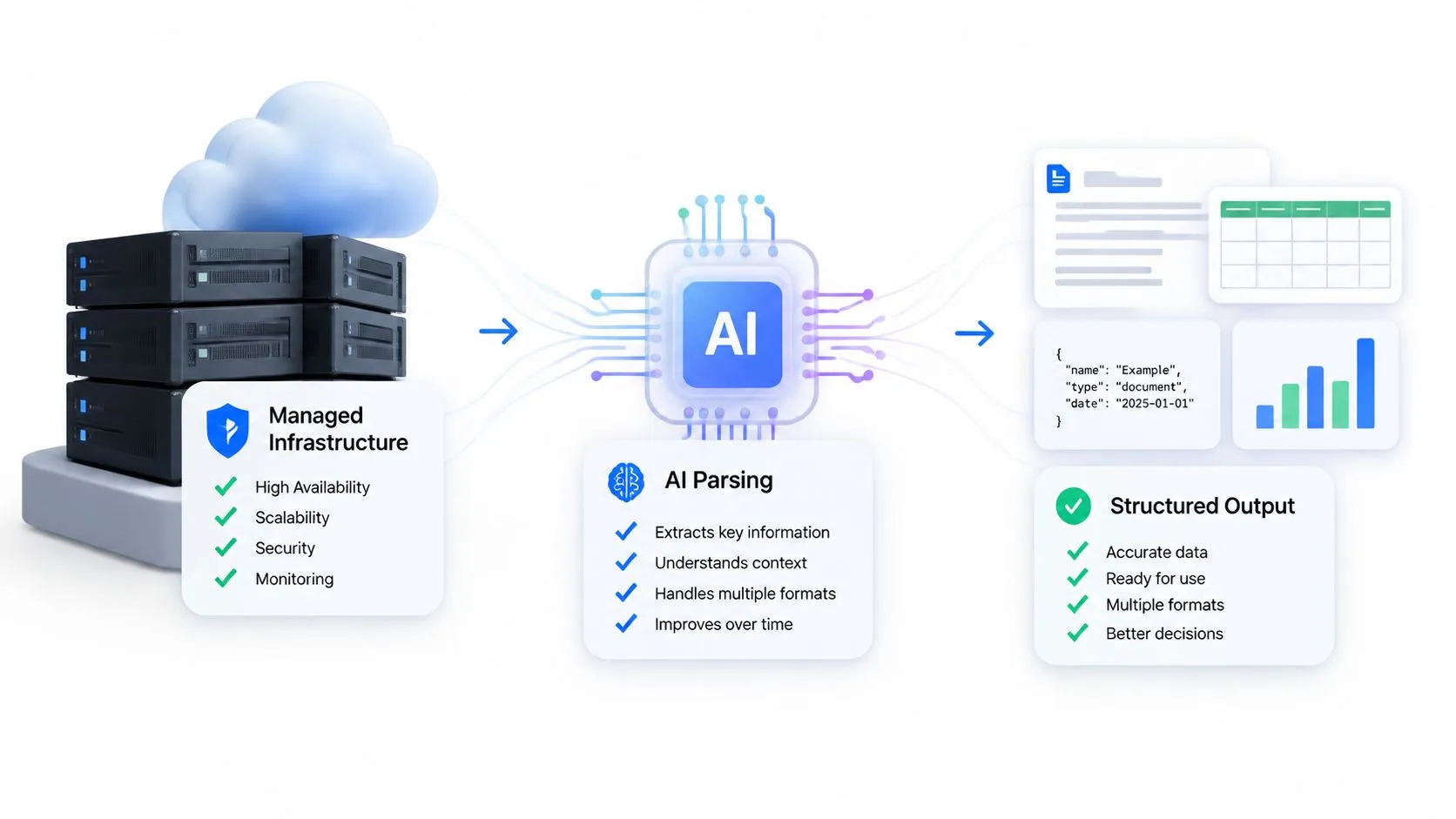
Managed infrastructure earns its place when it absorbs that recurring maintenance while keeping the data contract visible. The provider should own monitoring, retries, rendering, proxy strategy, anti-bot adaptation, parser deployment, quality checks, and delivery observability. The buyer should retain control over fields, purpose, retention, acceptance criteria, and release approval.
Where AI parsing helps
Computer vision and large language models can identify semantic regions when selectors no longer match. They can compare rendered layouts, recognize product cards, associate labels with values, and propose mappings from a changed page to an existing schema. That’s valuable during triage and candidate parser creation.
AI shouldn’t receive unrestricted authority to publish unvalidated data. Deterministic checks must still confirm types, required identifiers, units, relationships, and domain-specific rules. A useful pattern is AI-assisted discovery followed by rule-based acceptance, with uncertain records routed to review.
The same principle applies to data parsing methods. Parsing isn’t just converting HTML into JSON. It’s the controlled translation from changing source representations into a stable business contract.
Evaluating the service boundary
Ask a provider to demonstrate a simulated structural change, not just a successful initial crawl. Look for:
- Detection evidence: Does the system show what changed and which fields were affected?
- Version controls: Can it run a candidate parser beside the production version?
- Consumer protection: Can it preserve an older output while a client migrates?
- Human escalation: Are ambiguous AI decisions reviewed by an operator?
- Operational ownership: Who handles proxies, browser failures, retries, and rollback?
- Governance visibility: Can the provider document filtering, retention, and provenance?
WebscrapingHQ is one managed option that builds custom extraction pipelines using computer vision and large language model assistance, with scheduled structured outputs such as CSV, JSON, webhooks, S3 deliveries, and reports. Teams considering AI-assisted operational work can also review approaches to manage AI employees, especially where human approval and automated execution need clear boundaries.
Rethinking Web Data as a Living Ecosystem
The set-and-forget model of scraping assumes that a website is a static document. Production systems encounter something else: a changing application with multiple templates, dynamic content, browser-dependent behavior, defensive infrastructure, and business rules that evolve independently of the data consumer.
The infrastructure environment makes that assumption even less credible. A June 2026 scan of the Tranco top 1 million found 818,614 reachable sites, with 53.5% behind a managed anti-bot or WAF wall, and Cloudflare accounting for about 84% of protected sites, according to this 2026 web scraping infrastructure analysis. The operational implication is clear. A pipeline must adapt across the crawl path rather than depend on raw request volume.
Proxy selection adds another trade-off. In independent 2026 benchmarks, residential proxies achieved about 92.4% success on hard targets compared with 31.7% for datacenter proxies, while reported detection rates were 3.8% and 42% respectively, as described in these residential and datacenter proxy benchmarks. Residential traffic can blend more naturally with consumer patterns, while datacenter infrastructure may offer speed and cost advantages but face greater scrutiny on protected targets.
A durable operating model
A resilient program treats every source as a living dependency:
- Define the contract: Specify business fields, semantics, validation, provenance, and retention.
- Observe continuously: Monitor rendered pages, output quality, and infrastructure responses.
- Version deliberately: Branch on meaningful structural changes and retain release history.
- Protect consumers: Offer transformations or parallel outputs during migration.
- Govern by default: Apply minimization, filtering, anonymization, and deletion before delivery.
- Measure reliability: Track completeness and correctness, not only successful requests.
The web scraping market reflects growing demand for this kind of operational capability. It was valued at USD 1.34 billion in 2025 and is projected to reach USD 3.49 billion by 2031, implying a 17.39% CAGR, while software represented 58.35% of 2025 revenue, cloud deployments held 67.45% share, and North America led with 34.08% share, according to Mordor Intelligence’s web scraping market analysis. Those figures describe market direction, not a guarantee that any individual service will preserve your schema.
The better buying question is therefore operational: how does the provider detect structural change, prove that a new parser is correct, protect existing consumers, and document the result? A scraper that works today is a starting point. A governed, versioned data pipeline is what makes the output dependable over time.
If your team needs recurring web data without owning every parser repair, proxy decision, and schema migration, review WebscrapingHQ for managed extraction pipelines, monitoring, AI-assisted parsing, and scheduled structured delivery. Bring a target source and its downstream schema requirements, then ask for a workflow that demonstrates how structural changes are detected, versioned, validated, and released.
Want this done for you?
Send us the URLs. We'll quote it in 24 hours.
Paste the URL(s) you want scraped. We'll reply within 24 hours with a feasibility check and a ballpark quote.