Jump to section
- Table of Contents
- Why Web Scraping Services India Look Cheaper Than They Really Are
- The quote usually hides three cost buckets
- The Shape of the Indian Scraping Vendor Market
- Boutique, mid-sized, and enterprise tiers behave differently
- What to Evaluate Before You Sign Anything
- Ask for the six things that break recurring pipelines
- Indian Managed Services vs In-House vs Western Vendors
- Indian managed service
- In-house team
- Western managed service
- Proxy Architecture and Anti-Bot Strategy in Practice
- Choose the access path by page type
- What to ask about in a production review
- Calculating the True Cost of an Indian Scraping Engagement
- Build the TCO worksheet the vendor won’t give you
- Don’t ignore maintenance as a first-class cost
- Choosing the Right Path for Your Use Case
Most advice about Web Scraping Services India starts in the wrong place. Buyers are told to compare hourly rates, ask for a custom quote, and pick the cheapest team that says yes. That logic fails in production, because scraping cost isn’t just development time, it’s monitoring, retries, proxy overhead, anti-bot adaptation, and the rework that follows every site change.
If you buy this category like a one-off coding task, you’ll overpay later. If you buy it like an operating pipeline, you’ll ask the right questions up front and avoid the vendors who look inexpensive only because they’ve left the hard parts off the quote.
Table of Contents
Open Table of Contents
- Why Web Scraping Services India Look Cheaper Than They Really Are
- The Shape of the Indian Scraping Vendor Market
- What to Evaluate Before You Sign Anything
- Indian Managed Services vs In-House vs Western Vendors
- Proxy Architecture and Anti-Bot Strategy in Practice
- Calculating the True Cost of an Indian Scraping Engagement
- Choosing the Right Path for Your Use Case
Why Web Scraping Services India Look Cheaper Than They Really Are
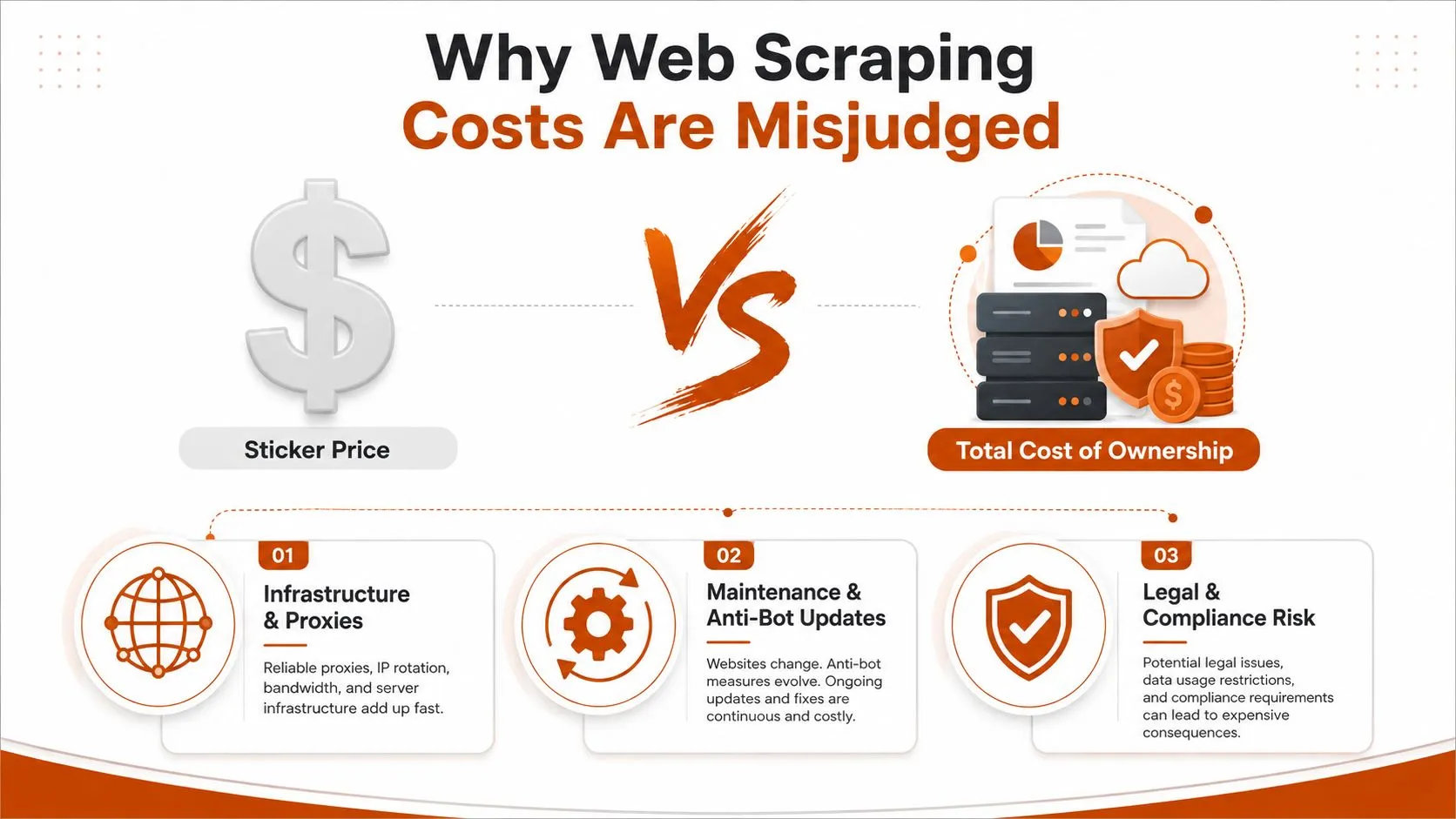
The sticker price is the trap. A vendor quote can look aggressive on paper, then expand once the buyer adds the things that keep data flowing, especially if the source changes often or pushes back with anti-bot controls. That is why the conversation should start with total cost of ownership, not the first month’s build fee.
The quote usually hides three cost buckets
The first bucket is infrastructure and access, which means proxies, bandwidth, and the systems needed to keep requests stable. The second is maintenance, which covers schema drift, parser fixes, retries, and updates after anti-bot changes. The third is operational risk, which shows up when the source data is compliance-sensitive or business-critical and somebody has to own the failures.
Most Indian provider pages lean on “custom quote” language and broad capability lists, but they rarely publish hard numbers for uptime, retry success, or maintenance SLAs. That makes direct price comparison misleading, because a low quote may mean the vendor hasn’t priced the recurring work that will show up later.
Practical rule: if a vendor can only talk about extraction, not ongoing recovery, you’re not buying a pipeline, you’re buying a future problem.
For buyers who keep paying engineers to babysit scrapers, the savings from a cheap build disappear fast. I’d rather see a vendor spell out what happens when a target site changes layout, blocks requests, or changes delivery format. The right procurement question is not “How much per scraper?” It’s “What does this cost after month three, when the target stops behaving?”
For a deeper internal framework on the build-versus-managed decision, see why teams choose web scraping services instead of doing it in-house.
The Shape of the Indian Scraping Vendor Market
The Indian vendor market is not one flat pool of interchangeable providers. It has at least three practical tiers, and buyers who ignore that structure end up misreading the pitch. Clutch’s July 2026 ranking of Top Web Scraping Services in India shows firms ranging from 101–150 employees to 2,001–5,000 employees, which confirms that this is already a serious delivery market, not a loose collection of freelancers. Clutch’s India web scraping directory also makes clear that the category now spans specialists and large IT-service organizations.
Boutique, mid-sized, and enterprise tiers behave differently
Boutique shops are usually the safest fit for narrow, technically messy targets where a single domain or a small family of sites needs careful hand-tuning. They move fast, and the good ones are excellent at problem-solving, but they’re vulnerable to single-point-of-failure risk if one engineer knows the whole stack.
Mid-sized firms are the most practical option for recurring multi-source pipelines. They’re big enough to handle monitoring and proxy operations, but still close enough to the work that the handoff between sales and delivery is not completely broken.
Large IT-service organizations are built for process, governance, and enterprise procurement. They can handle review layers, formal reporting, and heavier compliance expectations, but they often bring more account-management overhead than a smaller buyer needs.
A buyer should read the vendor’s company size as a proxy for delivery style, not just headcount. Small teams optimize for depth, mid-sized teams optimize for continuity, and large firms optimize for control.
That’s why it helps to compare Indian vendors with the same discipline you’d use when evaluating US providers. A useful benchmark for that mindset is this comparison of web scraping companies in the USA. The point isn’t geography, it’s matching the operating model to the job.
If the seller can’t tell you which tier they operate like, assume they’re improvising. The vendor might still be competent, but the burden of proving it shifts back to you.
What to Evaluate Before You Sign Anything
Start with proof, not promises. A credible scraping vendor should be able to discuss actual production work, the structure of their output, and how they handle changes when sources break. If the first call stays at the level of generic capability statements, the vendor is still selling, not delivering.
Ask for the six things that break recurring pipelines
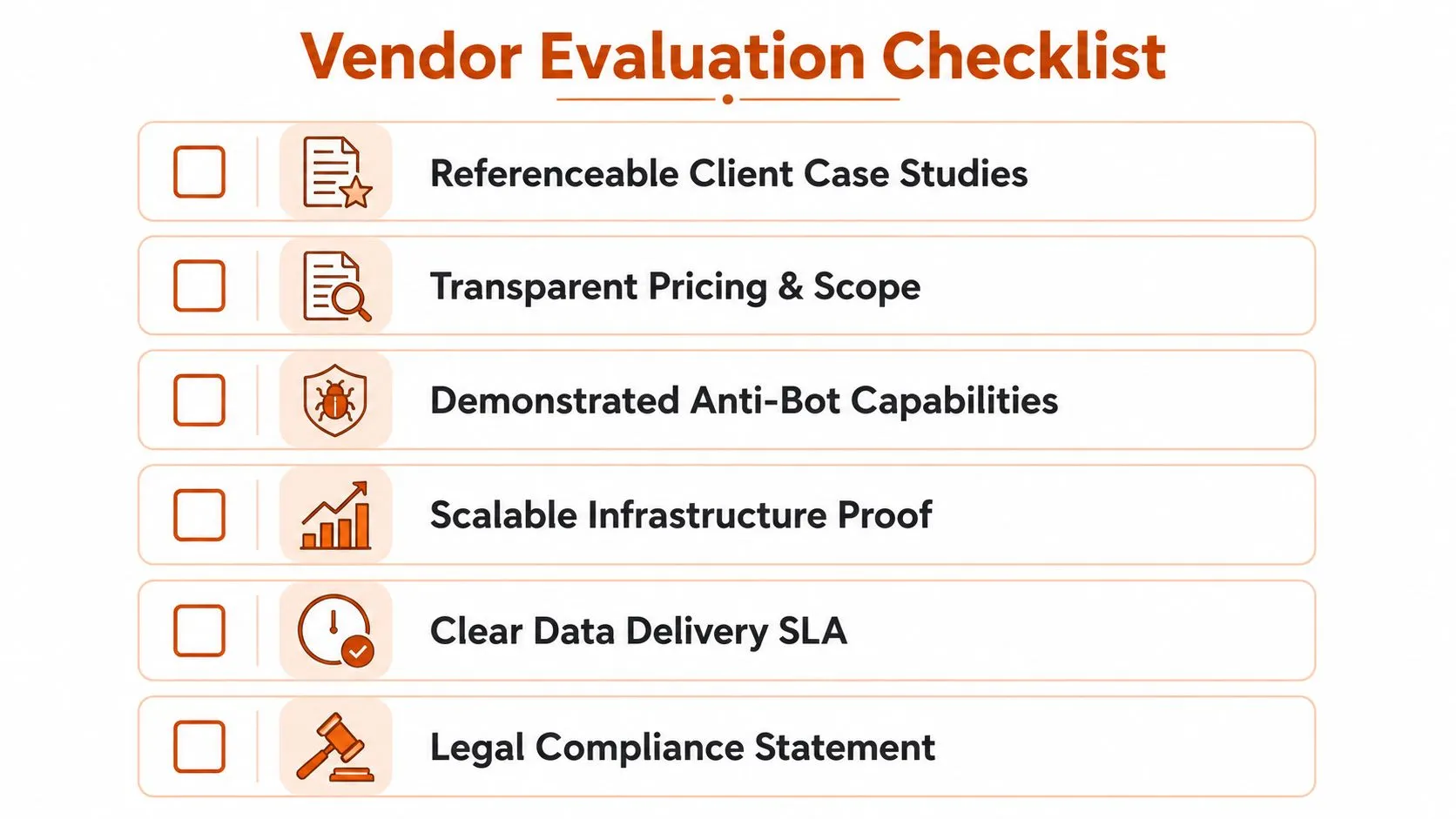
Referenceable production work. Ask what they run today, not what they “can do.” A good answer includes source types, delivery cadence, and how long the pipeline has survived real site changes.
Schema versioning and quality control. Ask how they handle field changes when a source reorders markup or renames labels. Good vendors track schema changes explicitly and can explain how downstream consumers are warned.
Monitoring and alerting. Ask who sees failures first and how they respond. If the answer is vague, expect avoidable gaps in delivery.
Proxy management. Ask whether they operate their own logic around proxy selection and retry behavior. For hard targets, this matters as much as parsing quality.
Legal posture. Ask what they will and won’t collect, and how they handle different jurisdictions. Buyers often underweight this until procurement or counsel gets involved.
Delivery format flexibility. Ask whether they can deliver CSV, JSON, PDFs, webhooks, or S3 drops depending on the consuming system. The best vendors adapt output to the business process, not the other way around.
For supplier vetting discipline, a useful external checklist is Rite NRG’s third-party supplier risk assessment. That kind of due diligence is especially useful when the vendor will touch regulated or business-critical data.
A clean evaluation call should end with one simple conclusion. Either the vendor can run a recurring pipeline with minimal supervision, or they can’t. For a practical framing on the difference between direct extraction and API-backed delivery, review web scraping versus API-based access.
Green flag: the vendor can describe failure handling before you ask.
Red flag: the vendor treats every source as a one-time build.
If the answer set is weak on monitoring, schema control, or legal boundaries, stop there. Low-cost providers become expensive when your team has to rescue every broken feed.
Indian Managed Services vs In-House vs Western Vendors
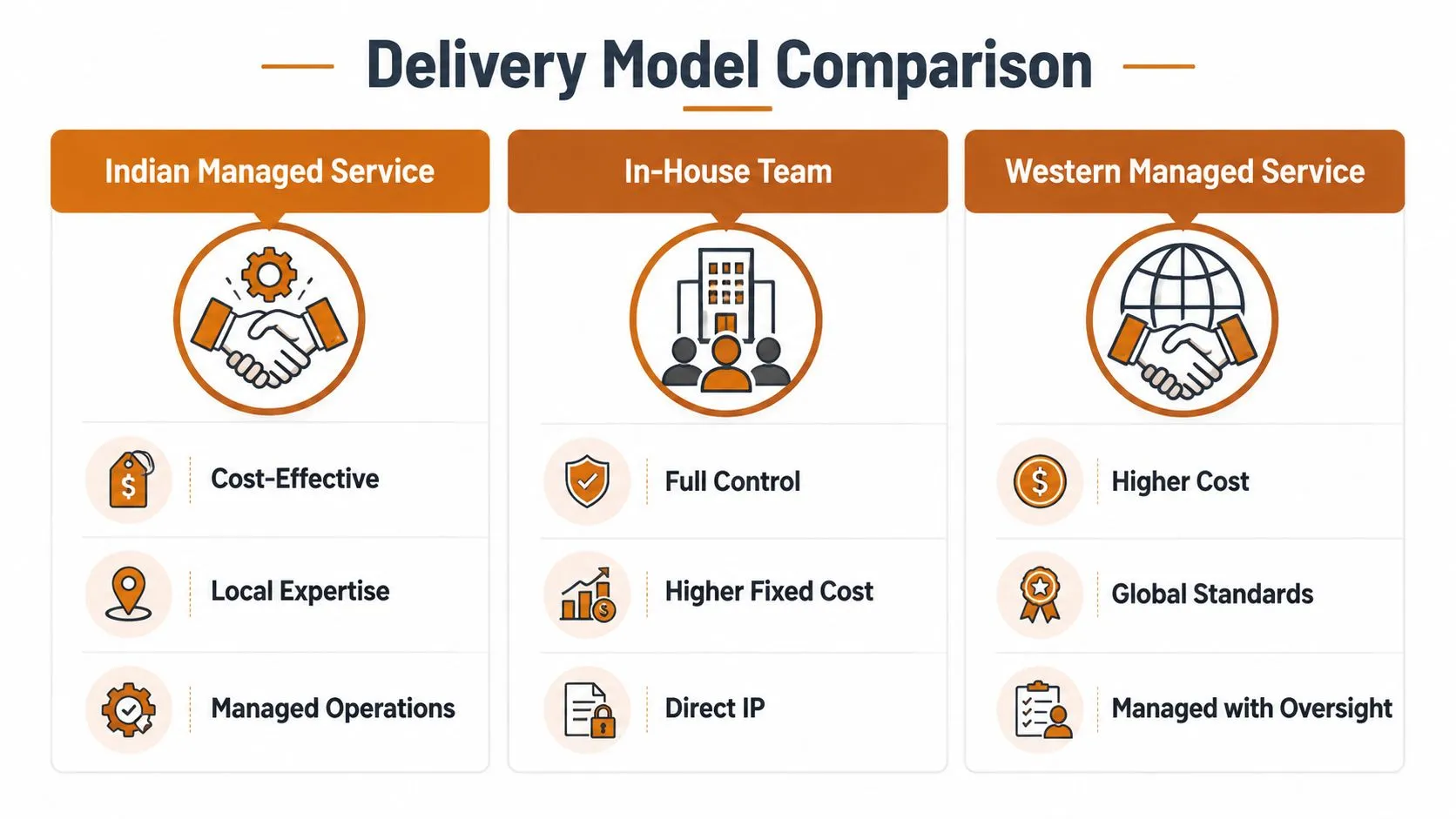
The right delivery model depends on what failure looks like for you. If the pipeline is low stakes, the cheapest workable path is fine. If the pipeline feeds pricing, compliance, or AI training, the model choice matters more than the raw build price.
Indian managed service
An Indian managed service is strongest when you need recurring delivery, flexible staffing, and practical operations around scraping rather than just code. It usually makes the most sense for compliance reports, retail intelligence, and structured feed delivery, especially when the buyer wants managed output in CSV, JSON, PDF reports, webhooks, or S3 drops.
The trade-off is simple. You get better operating efficiency than building everything in-house, but you still need to define what success looks like and hold the vendor to it. If you leave the scope vague, even a good provider will drift into “custom quote forever.”
In-house team
In-house wins when the data source is strategic, the scope is stable, and the company already has strong platform engineering. You get full control, direct IP ownership, and tighter alignment with internal systems. You also own every failure, every proxy decision, and every maintenance cycle.
That’s fine if the scraping workload is central to your product. It’s a bad fit if the work is commodity extraction that burns senior engineers away from more valuable tasks.
Western managed service
Western providers often bring stronger process language and easier procurement alignment for US or EU buyers. They can be a better fit when the buyer wants familiar commercial terms, formal governance, or tighter coordination across time zones and legal teams.
They’re usually not the first choice when cost sensitivity is high and the work is operational rather than strategic. In those cases, the premium buys process comfort, not necessarily better extraction economics.
A smart buyer maps the use case to the model, not the country. An AI startup needs pipeline stability and flexible structured feeds. A Fortune 500 retail verification program needs controlled cadence, reporting, and change management. Those are different buys.
Proxy Architecture and Anti-Bot Strategy in Practice
Proxy strategy is where many vendors separate strong delivery from fragile delivery. A team that understands target behavior will classify the page first, then decide whether a dedicated scraping API, unblocker, or proxy approach is appropriate. That order matters, because the wrong strategy inflates cost and lowers reliability at the same time.
Choose the access path by page type
A hard target should not be treated as a monolith. Product pages, search pages, job listings, and login-adjacent flows do not behave the same way, so the access method shouldn’t be the same either. The right team classifies pages first, then prefers a dedicated scraping API where it exists, and falls back to unblockers or residential proxies only where the API can’t serve the page type.
AIMultiple’s large-scale benchmarking shows why this discipline matters. In a 100,000-request scale test, Bright Data’s residential proxy success rate fell from 96.5% to 93.4% and response time increased from 1.0s to 3.6s, while Oxylabs dropped from 97.2% to 93.8% and slowed from 1.3s to 6.4s. At 5,000 parallel requests, all providers were reliable, which makes concurrency planning a live operational variable, not a theoretical one. AIMultiple’s large-scale web scraping benchmark is useful because it shows that scale changes behavior fast.
What to ask about in a production review
Ask whether the vendor uses rotating or sticky sessions, and why. Ask how they separate page classes. Ask what happens when a target starts rate-limiting, introducing CAPTCHA friction, or serving different markup by geography. Those answers tell you whether the team is reacting or operating.
If the vendor says “we use proxies” and stops there, they haven’t answered the question.
For a practical proxy decision framework, this guide to static versus rotating proxies is the right level of detail for internal review. You don’t need every technical knob, but you do need to know whether the vendor’s stack is designed for target behavior or just configured to hope for the best.
For additional context on operational risk in this space, I’d also point buyers to InsecureWeb’s coverage of the Oxylabs security breach. Security posture matters because proxy and access infrastructure are part of the trust boundary, not just a delivery detail.
The vendors that win on hard targets do one thing consistently. They control concurrency, watch failure patterns, and change access strategy before the pipeline dies.
Calculating the True Cost of an Indian Scraping Engagement
The cheapest quote is rarely the cheapest program. A vendor can make the initial build look attractive, then leave you with a recurring bill that includes support work the sales deck never priced. Indian provider pages often stress custom delivery and flexible execution, but they rarely break out the ongoing effort. That is where buyers get surprised.
Build the TCO worksheet the vendor won’t give you
Use a one-page worksheet with six line items. Scoping and feasibility covers the time needed to confirm target behavior and output shape. Development covers the actual scraper build. Monitoring and re-tuning covers maintenance when the source changes. Proxy and anti-bot overhead covers access costs. Compliance review covers legal and procurement checks. Failure reserve covers the time you will spend when the feed misses.
For pricing logic on recurring managed services, the pricing models for managed IT are a useful comparison point because they separate one-time implementation from ongoing operating cost. That same logic applies here, even if the category is different.
A procurement team should ask a vendor to price the work as a 12-month operating program, not as a one-time build. That is the only fair way to compare Indian teams with in-house staffing or Western managed services.
Don’t ignore maintenance as a first-class cost
The work that keeps a scraper alive is usually dull, repetitive, and easy to underestimate. It is also unavoidable on targets with dynamic markup, changing access rules, or layered anti-bot controls. If the vendor says maintenance is included, get the scope in writing. If they say it sits outside scope, assume the initial quote is incomplete.
Manual work is the same story with a different labor profile. For buyers comparing automation approaches, this cost comparison of automated versus manual data extraction is a sensible internal reference. Automation does not always win on headline cost, but recurring manual work burns time and budget in a different way.
The critical question is not whether a project starts cheap. It is whether you can keep it running without paying for the same failure twice.
Choosing the Right Path for Your Use Case
If you need a one-off extraction on a low-stakes target, pick a small Indian boutique with referenceable work and move on. If you’re running recurring pipelines on hard targets such as Amazon, Walmart, or job boards, choose a mid-sized Indian managed service with proven anti-bot handling and schema control. If the work feeds enterprise compliance or Fortune 500 retail intelligence, go with a large IT-service organization or a specialized managed provider that can document delivery volumes, output cadence, and operational controls.
The next move should be boring and disciplined. Define the target list, write a one-page requirements doc, run a pilot with clear success criteria, and contract on milestones rather than hours. That is how you stop buying promises and start buying delivery.
If you need a managed partner that runs extraction as an operating service, WebscrapingHQ builds and maintains recurring pipelines, including scoping, custom scraper development, monitoring, retries, proxy management, and structured delivery on fixed schedules. If your team is comparing Indian vendors, in-house builds, and Western managed services, visit WebscrapingHQ and compare the operating model against your target list and delivery requirements.
Want this done for you?
Send us the URLs. We'll quote it in 24 hours.
Paste the URL(s) you want scraped. We'll reply within 24 hours with a feasibility check and a ballpark quote.