Jump to section
- Table of Contents
- Why Web Scraping Is a Data Pipeline Problem
- Core Components of a Scraping Data Pipeline
- Ingestion Has to Survive the Web as It Exists
- Transformation Is Where Raw Pages Become Usable Data
- Storage and Delivery Need Versioning, Not Guesswork
- Batch vs Streaming and ETL vs ELT for Web Data
- The Right Pattern Depends on Freshness and Stability
- Decision Logic for Web Scraping Teams
- Technical and Legal Challenges in Singapore Operations
- Technical Reality on the Ground
- Compliance Questions Buyers Should Ask
- Monitoring Data Quality and Pipeline Reliability
- What to Watch in Production
- Reliability and Security Belong Together
- When to Build In-House vs Buying Managed Services
- Where In-House Makes Sense
- Where Managed Services Fit Better
- Real-World Delivery Models and Engagement Options
You can have a scraper that looks healthy in logs and still wake up to broken reporting the next morning. The target site changes a field name, a CAPTCHA appears on one path, or a page starts rendering content in JavaScript, and suddenly the feed that powers pricing, compliance, or research is wrong. In Web Scraping Services Singapore, the core question isn’t whether data can be pulled, it’s whether the pull can survive production pressure, legal scrutiny, and constant site change.
Table of Contents
Open Table of Contents
- Why Web Scraping Is a Data Pipeline Problem
- Core Components of a Scraping Data Pipeline
- Batch vs Streaming and ETL vs ELT for Web Data
- Technical and Legal Challenges in Singapore Operations
- Monitoring Data Quality and Pipeline Reliability
- When to Build In-House vs Buying Managed Services
- Real-World Delivery Models and Engagement Options
Why Web Scraping Is a Data Pipeline Problem
A retail team I worked with once had a scraper that ran every morning without failing. The logs were clean, the job scheduler stayed green, and the downstream dashboard kept updating. Then a source site moved one price field into a nested container, the parser kept reading the old location, and the business spent days making decisions on stale values before anyone noticed.
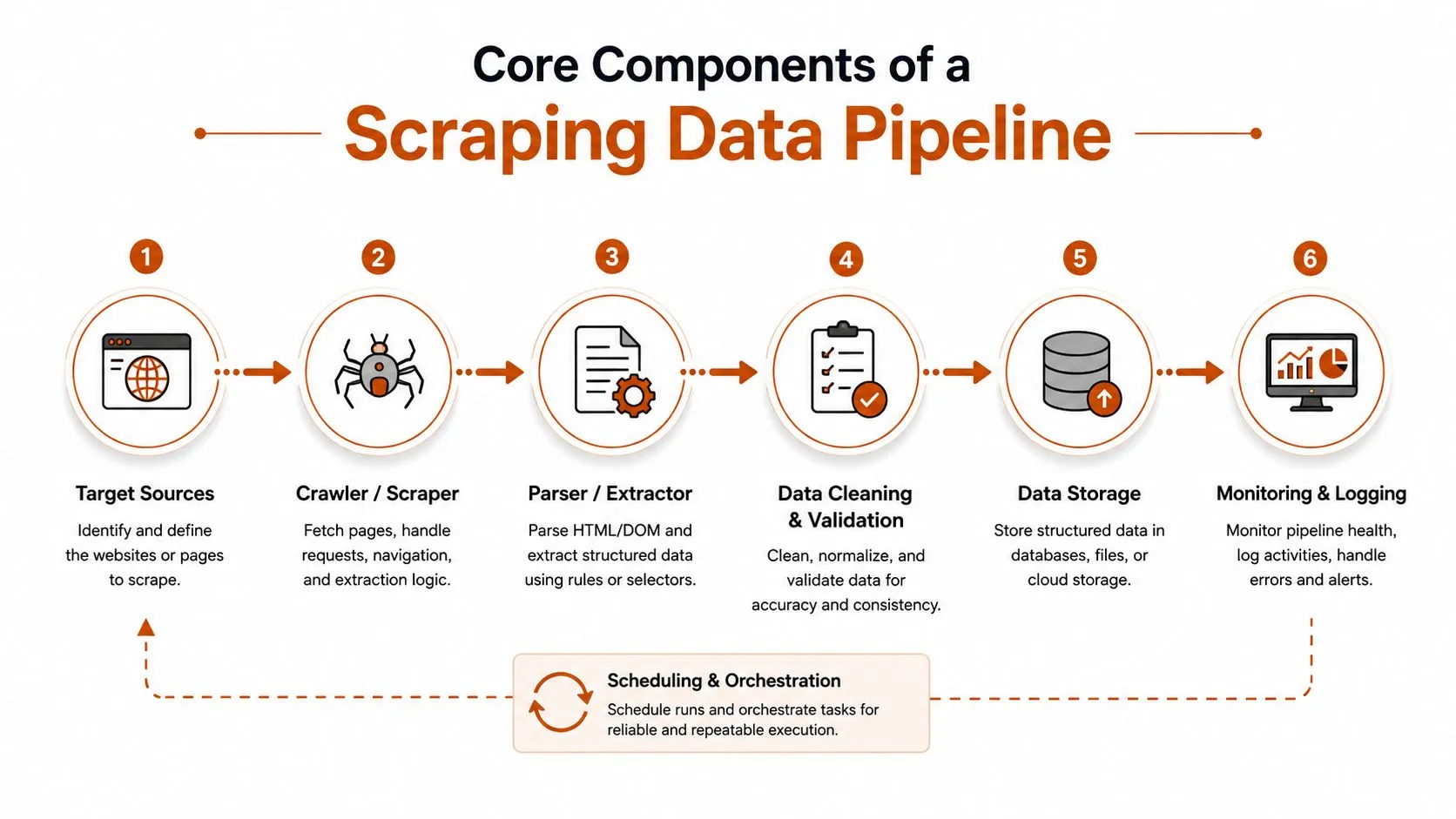
That’s the core trap. A scraping script is only the first stage of a data pipeline, and once a team depends on recurring extraction, the workflow stops being a utility and becomes infrastructure. The pipeline has ingestion, transformation, storage, validation, and delivery, and every one of those stages can fail in a different way without throwing an obvious error.
Singapore is a strong example of why that matters. The Singapore Department of Statistics said it began using web scraping in 2015 to reduce respondent burden and lower the manual fieldwork needed for CPI compilation, and it now collects prices for about 6,800 goods and services from 4,200 outlets using a mix of collection modes, including online prices (web scraping). That’s not hobby-scale extraction, it’s recurring statistical production governed by explicit rules on burden, identification, and statistical-only use, as described in the UN ESCAP material on online prices for CPI compilation.
Practical rule: if the output feeds a recurring decision, treat the scraper like a production data service, not a one-off script.
That mindset changes every design choice. You stop asking only whether a page can be parsed, and start asking what happens when HTML shifts, sessions expire, or the source adds anti-bot friction. For teams that are already thinking in systems, the better framing is close to building scalable data pipelines with Scrapy, not quick scraping hacks, and the same discipline applies whether the target is a price list, a SERP, or a compliance register. See the pipeline design approach in Scrapy-based systems for a useful mental model.
Core Components of a Scraping Data Pipeline
Ingestion Has to Survive the Web as It Exists
Ingestion is where most scraping projects get overconfident. Someone schedules requests, adds a proxy pool, and assumes the job is done. In reality, the crawler has to handle JavaScript rendering, session state, throttling, and route-specific failures before it ever reaches a clean response body.
The most reliable ingest layer is deliberate about cadence and entry points. A daily snapshot is a different system from a live monitor, and both need separate scheduling logic. For modern sites, rendering the page in a browser context is often mandatory, because the content you need may not be present in the initial HTML at all.
Transformation Is Where Raw Pages Become Usable Data
Once the raw page arrives, transformation turns messy markup into stable fields. That means parsing titles, prices, addresses, dates, and status values into a consistent schema, even when the source language changes or the layout shifts. Teams that do this well usually keep an extraction layer separate from the business schema, so one bad source template doesn’t contaminate the whole feed.
For unstructured pages, structured extraction can include visual parsing or LLM-assisted field identification, but the important part is still the same, normalizing to a fixed contract. The scrape is not finished when the HTML is downloaded, it’s finished when the downstream system can trust the field names and data types.
Storage and Delivery Need Versioning, Not Guesswork
Storage is where schema drift either gets controlled or becomes permanent damage. If a source changes from one layout to another and the pipeline overwrites the old shape without versioning, historical comparisons become unreliable. Strong teams keep schema versions, lineage, and validation rules close to the storage layer so they can tell whether a missing field is a real absence or a parsing failure.
Delivery should match the consumer. CSV and JSON feeds work well for analytics and internal tooling, while S3 drops, webhooks, and PDF reports fit different review or automation paths. Managed approaches often pair these with retry logic and fault-tolerant orchestration, which is why distributed design patterns matter in practice, not just in theory. The fault-tolerance basics for distributed scraping are worth keeping in mind when designing the architecture.
Batch vs Streaming and ETL vs ELT for Web Data
Not every scraping workload needs the same architecture. A compliance team checking weekly changes in product disclosures doesn’t need the same freshness model as a trading or alerting workflow. The first decision is whether the data can arrive in batch windows or needs streaming-style responsiveness.
The Right Pattern Depends on Freshness and Stability
Batch works well when the source changes on a predictable schedule, because the crawl can be rate-limited, validated, and rerun in a controlled way. Streaming makes more sense when the business cares about near-real-time change detection, but it also raises the difficulty of handling partial failures and source throttling.
The ETL versus ELT choice is equally contextual. ETL is cleaner when you need strong transformation before anything hits the warehouse, while ELT is often easier when source schemas shift often and you want the raw capture preserved before transformation rules settle. For a practical comparison that maps this decision to engineering realities, the ETL vs ELT comparison for CTOs is a helpful reference point.
| Criteria | Batch + ETL | Batch + ELT | Streaming + ELT |
|---|---|---|---|
| Data freshness needs | Best for scheduled snapshots | Best for scheduled raw capture | Best for near-real-time change capture |
| Source stability | Good when layouts are stable | Better when layouts drift | Better when rapid source change is expected |
| Operational load | Lower during runtime windows | Moderate, with more downstream transformation | Highest, because monitoring and retry logic must stay active |
| Downstream use | Clean reporting and warehouse loads | Flexible analytics and reprocessing | Alerting, triggers, and dynamic monitoring |
| Scraping fit | Recurring price checks, audits | Multi-source feeds with evolving fields | Event-style extraction and fast change detection |
Decision Logic for Web Scraping Teams
Keep the raw response if you expect the source to change faster than your transformation rules.
That one rule often saves teams from re-crawling the same source when a parser breaks. Batch + ELT is particularly useful when legal review, schema validation, or auditability matters, because the original capture stays intact while the downstream model evolves. Streaming + ELT is powerful, but it’s usually harder to maintain because both the extraction path and the transformation path have to stay reliable under constant pressure.
For real-time systems, the mechanics are closer to event delivery than classic crawl jobs, which is why websocket-based extraction patterns become relevant in some architectures. Many teams won’t need that complexity, but when they do, they need a design that accepts the maintenance cost up front instead of discovering it later.
Technical and Legal Challenges in Singapore Operations
A scraping project in Singapore can fail for two very different reasons. The crawler may break on a front end change, or the legal team may pause the work because the collection path crosses a boundary that was not reviewed early enough. Both failures are common in production, and both are expensive to clean up after the fact.
Technical Reality on the Ground
The first question is not whether a vendor says they can scrape. The useful question is whether they can keep JavaScript-heavy, anti-bot-protected extraction running without turning every source change into a firefight. Enchant.sg describes public-data extraction, JavaScript rendering, CAPTCHA and anti-bot bypass, and distributed scraping across “thousands to millions of pages,” which is the kind of capability production systems need. It also says responsible scraping includes delays so target servers are not overwhelmed, which is a control that matters in practice, not a polite afterthought. The source is Enchant’s web scraping service overview.
A scraper that defeats every block by force usually pays for it later through bans, retries, and more maintenance work. Rate limits, session handling, and schema drift need to be planned together. If a team only solves extraction, the pipeline still fails when the source changes page structure or starts challenging repeat traffic more aggressively.
Compliance Questions Buyers Should Ask
The legal question is not whether a page can be opened in a browser. It is whether the collection method touches personal data, bypasses authentication, violates site terms, or creates copyright issues in downstream use. Independent coverage notes that scraping publicly available data is generally legal in Singapore under the PDPA if scrapers do not collect personal data without consent, bypass authentication, or ignore site terms, while a Singapore law review points to the Copyright Act’s 2021 changes as adding nuance around computational data analysis in some cases. For a closer look at specific legal pitfalls, see our guide on 5 legal risks in web scraping and how to mitigate them. That makes the decision framework more useful than a simple yes-or-no answer, because legality depends on the data type, access method, and use case, not just on whether the information is visible.
A buyer should ask for three things before approving a project. First, the provider should explain what data is collected and what is intentionally excluded. Second, the provider should describe how it handles anti-bot escalation without crossing access boundaries. Third, the provider should define storage, retention, and re-use rules clearly enough that legal and engineering teams can sign off together.
A final check is operational, not just legal. Ask who owns incident response when a target site changes policy, how quickly crawl behavior gets reviewed, and what happens if a source starts serving different content to automated requests. Those answers tell you whether the service is built for production or only for a demo.
Monitoring Data Quality and Pipeline Reliability
A pipeline that runs on schedule but returns stale or malformed data is more dangerous than one that fails loudly. The failures don’t stay in the scraper, they show up later as bad pricing decisions, broken compliance summaries, or misleading market intelligence. Production scraping needs observability built in from the start, because silent corruption is the expensive failure mode.
What to Watch in Production
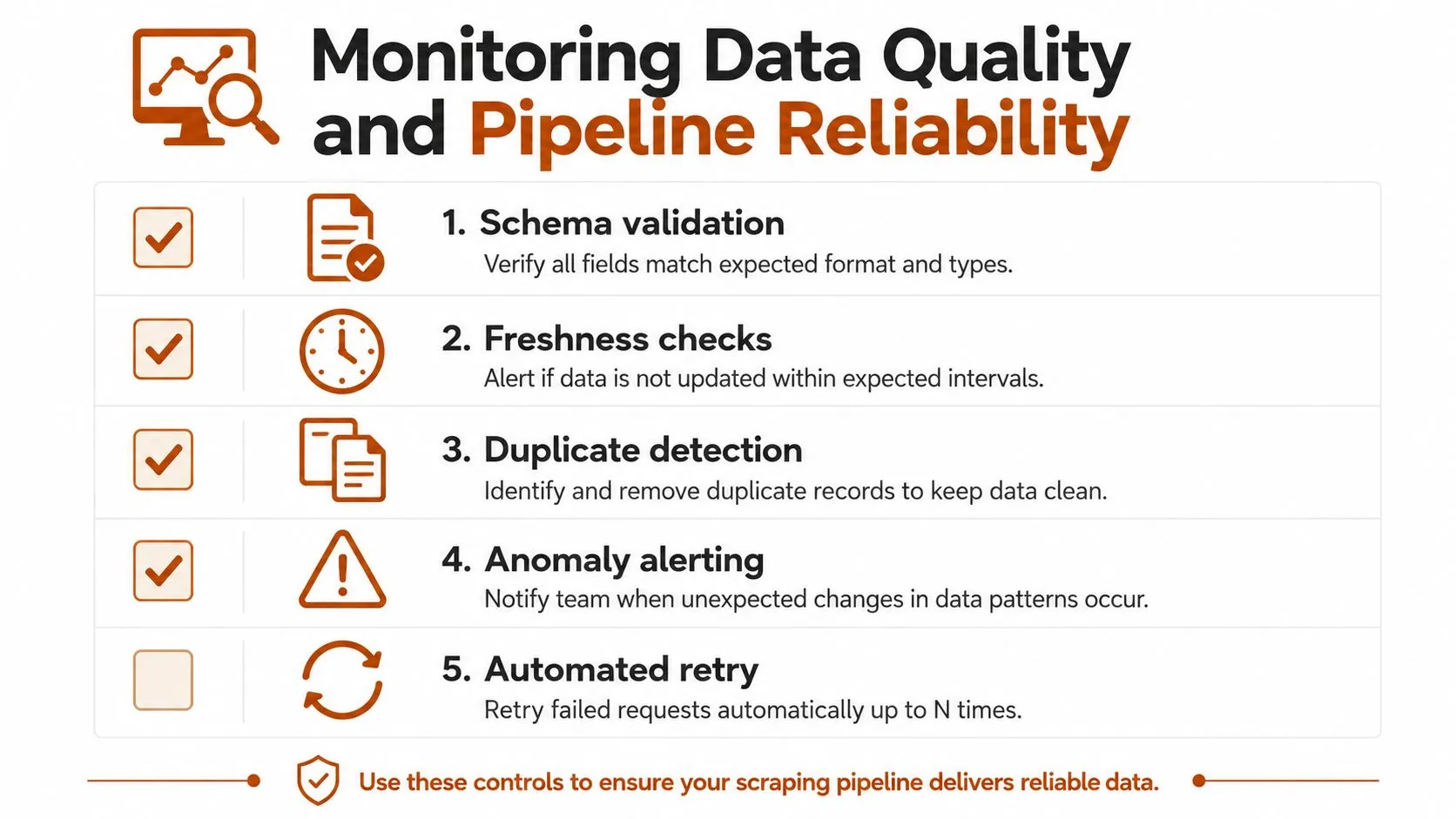
The minimum set of controls is straightforward. Alert when extraction fails, alert when a source goes stale, and validate that the schema still matches the expected structure before the data reaches the warehouse. Retry logic should exist, but it should not hide persistent faults, because a loop that retries forever can turn a source problem into an infrastructure problem.
If you already monitor infrastructure with Prometheus, the same mindset applies here. The relevant guidance on monitoring with Prometheus maps well to scraping because the key idea is identical, surface operational issues early, before they become business issues. Scrapers need counters for failed requests, checks for schema drift, and visibility into duplicate records and incomplete runs.
Reliability and Security Belong Together
Security is part of reliability, not a separate checklist. Proxy management helps reduce bans, but it also needs governance so the crawl doesn’t become noisy or unpredictable. Responsible delays matter because target servers have finite capacity, and stored data should be access-controlled so one extraction feed doesn’t become an internal leakage point.
Managed operations usually absorb a lot of this burden, which is why WebscrapingHQ is one option teams consider when they need monitoring, retries, and anti-bot handling as part of the service rather than as an internal build task. The advantage isn’t glamour, it’s that the failure surfaces move from hidden to visible.
Operational standard: if nobody owns alerting, schema checks, and rerun logic, the team doesn’t have a pipeline, it has a recurring guess.
When to Build In-House vs Buying Managed Services
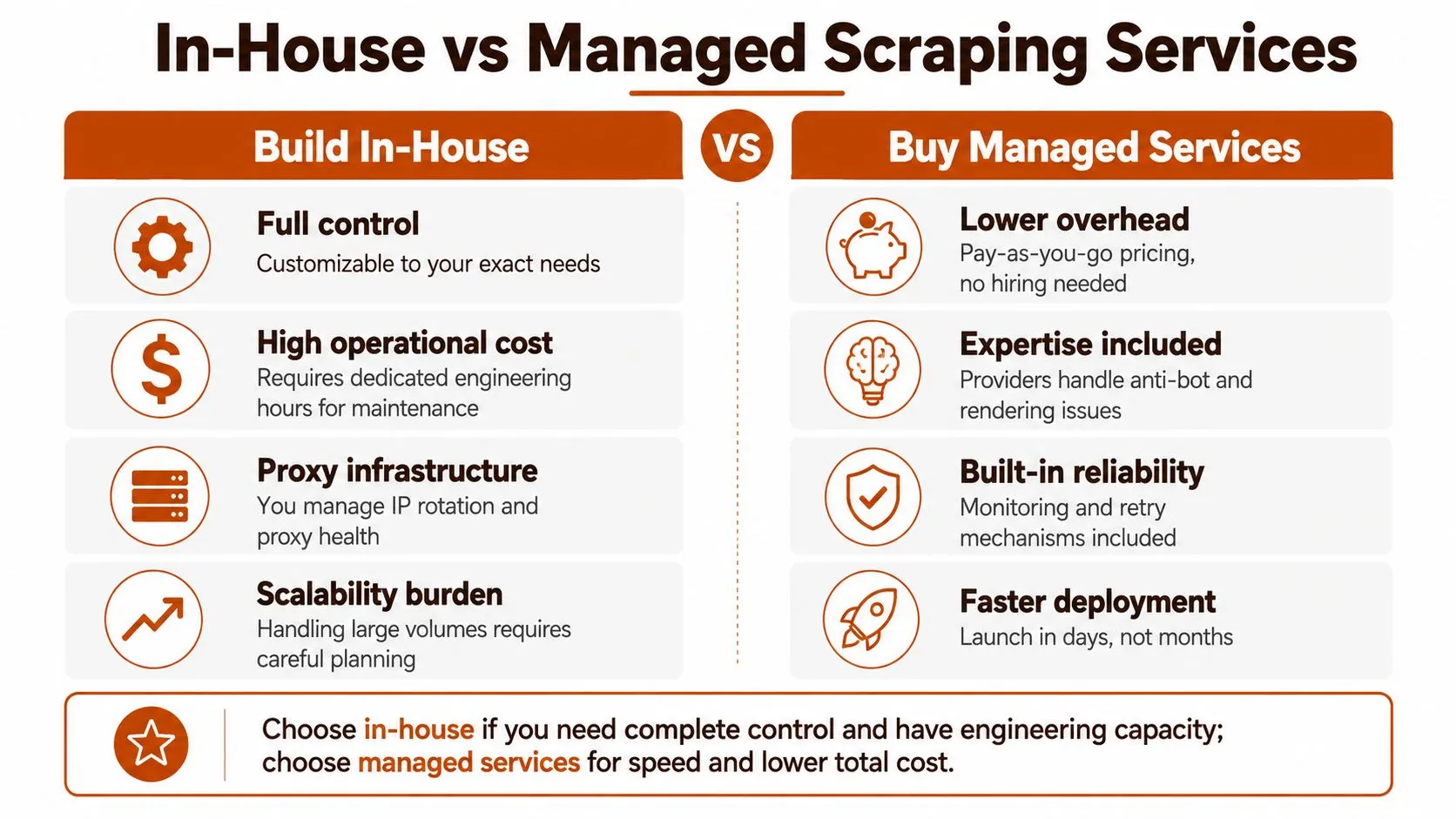
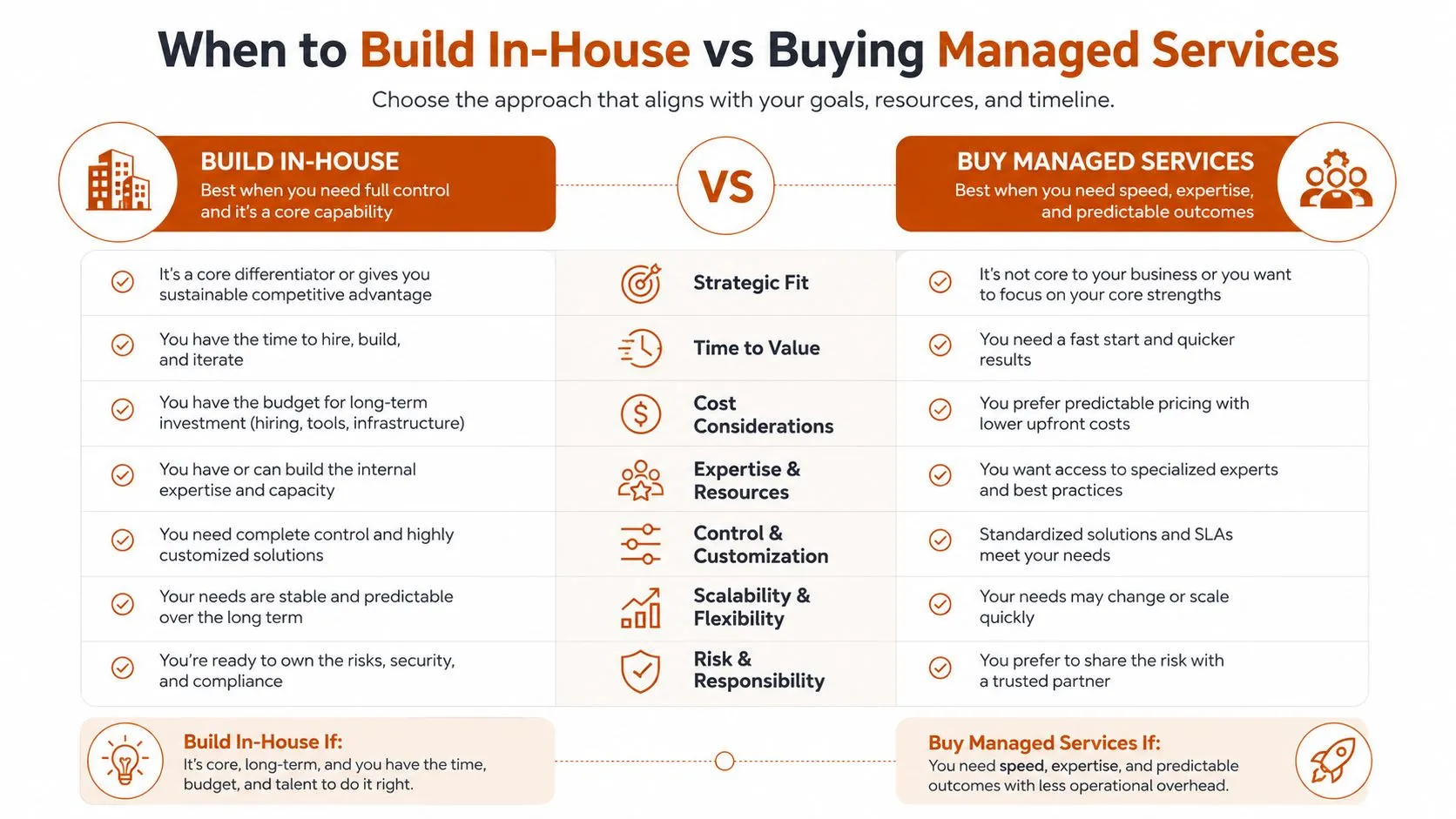
The build-versus-buy question gets answered poorly when teams talk only about control. Control matters, but so do engineering hours, proxy upkeep, anti-bot escalation, and the steady work of re-tuning jobs when sites change. The cost of in-house scraping is not the first parser, it’s the maintenance cycle that starts the week after launch.
Where In-House Makes Sense
In-house makes sense when the extraction logic is highly proprietary, the data is extremely sensitive, or the workflow is tightly coupled to internal systems that a vendor can’t reasonably own. It also makes sense when a company has enough engineering capacity to treat scraping as a core platform, not a side project.
That said, teams should read the trade-off. A self-hosted stack gives more control, but it also makes the company responsible for monitoring, retry policy, infrastructure, and every fix when a source changes. The self-hosted vs managed AI agents comparison is useful here, because the logic is similar, internal ownership buys flexibility, while managed operations buy time and reduce maintenance load.
Where Managed Services Fit Better
Managed services are stronger when the work is recurring, multi-source, or operationally noisy. That includes price tracking, compliance reporting, search monitoring, and multi-language feeds where rendering, normalization, and delivery all need to be handled consistently. A managed provider also tends to be a better fit when the buyer wants the output, not the mechanics.
The moment scraping becomes repetitive and business-critical, maintenance becomes the hidden product.
For teams comparing options, the question isn’t “can we build it?” It’s “do we want to staff the entire reliability stack ourselves?” If the answer is no, a managed model is usually the cleaner operating choice. The internal benchmark on outsourcing scraping work versus managing it alone is laid out well in why teams choose web scraping services instead of doing it all in-house.
Real-World Delivery Models and Engagement Options
In practice, a managed scraping engagement starts with scoping. The provider reviews the target sources, checks whether the fields are stable enough to extract, and decides whether the right output is a feed, a report, or an event-triggered pipeline. Good teams don’t sell a generic crawl, they define a deliverable that matches the buyer’s review process and systems.
Delivery formats vary because the consumer varies. A compliance team may want PDF reports with exceptions highlighted for manual review, while an analytics team may want CSV or JSON feeds that land in a warehouse or dashboard layer. Other workflows need S3 drops for lake integration or webhooks to trigger downstream jobs as soon as new data arrives.
Monthly recurring delivery fits ongoing intelligence needs, especially when the same sources need to be checked again and again. Campaign-based work fits one-time collection projects, migration support, or a finite market study where the output window is fixed. The best engagements make the cadence explicit, because recurring extraction is really an operating service, not a one-off scrape.
That’s where the value proposition becomes concrete. A team might use structured extraction for dealer compliance reporting, SERP snapshots for competitive intelligence, or multi-geo consumer signal collection for model training. The work only becomes useful once the pipeline produces a reliable artifact the business can consume.
If you need a managed pipeline that handles scoping, extraction, monitoring, and delivery without forcing your team to maintain the whole stack, visit WebscrapingHQ and discuss the sources you want to operationalize. They build and run custom web data operations for recurring feeds, compliance outputs, and structured delivery formats, so you can focus on the analysis instead of the scraper maintenance.
Want this done for you?
Send us the URLs. We'll quote it in 24 hours.
Paste the URL(s) you want scraped. We'll reply within 24 hours with a feasibility check and a ballpark quote.