
Jump to section
- Table of Contents
- Why a Chewy Scraper Is a Data Quality Problem
- Three trust zones
- Core Categories of Validation Rules
- Format rules
- Range rules
- Uniqueness rules
- Presence rules
- Referential integrity rules
- Timeliness rules
- Detailed Rule Entries for Chewy Data
- Format and range
- Identity and relationships
- Rule comparison
- Implementation Patterns in Scraping Pipelines
- Ingest without assumptions
- Transform cheaply first
- Validate and load deliberately
- Respecting Robots and Targeting Public Pages
- Regex and Schema Snippets You Can Reuse
- Field patterns
- Schema enforcement
- Versioning Rules When the Site Changes
- Cross-References Between Rules and Fields
- Quick Reference Table for Rule Lookup
You’ve built a Chewy extraction job that appears healthy. Requests return successfully, product pages produce records, and the warehouse is filling. Then an analyst notices that sale prices no longer reconcile, unavailable products still appear in assortment reports, and review metrics have unexpectedly reset. The crawler didn’t fail. The data contract failed.
Chewy is a useful benchmark because its concentrated pet-supplies catalog creates strong demand for product, pricing, assortment, nutrition, and review signals. One scrape-focused account says Chewy was founded in 2011 and generated $2 billion in revenue, representing 51% of online pet food sales by 2017 (ParseHub’s Chewy scraping overview). That scale makes a Chewy scraper valuable, but it also raises the cost of trusting an unvalidated record.
Table of Contents
Open Table of Contents
- Why a Chewy Scraper Is a Data Quality Problem
- Core Categories of Validation Rules
- Detailed Rule Entries for Chewy Data
- Implementation Patterns in Scraping Pipelines
- Respecting Robots and Targeting Public Pages
- Regex and Schema Snippets You Can Reuse
- Versioning Rules When the Site Changes
- Cross-References Between Rules and Fields
- Quick Reference Table for Rule Lookup
Why a Chewy Scraper Is a Data Quality Problem
A production Chewy scraper rarely fails because an HTTP request failed. It fails because a price parser accepts a changed string, a discontinued SKU returns through a different listing path, or a review count is interpreted as zero after the page structure changes. The extraction layer may report success while the business dataset becomes less reliable.
Treat the scraper as a data-quality system first and a fetcher second. Every field entering the warehouse needs an owner, a declared type, a validation rule, and a fallback. Product detail pages generally offer more stable signals than category grids, particularly when the scraper reads server-rendered product and offer data. Category pages remain more exposed to merchandising changes, sorting behavior, pagination changes, and volatile availability.
Three trust zones
Use three explicit boundaries:
- Ingest: Preserve the raw response, source URL, retrieval metadata, and unmodified field candidates. Don’t make business assumptions here.
- Transform: Parse currency, normalize identifiers, convert review counts and ratings, and apply field-level checks.
- Store: Enforce keys, required fields, referential integrity, and the declared record schema before persistence.
This separation gives engineers a precise failure location. If a price is missing in ingest, investigate the response. If it exists but fails transformation, inspect parsing. If it passes transformation but cannot be stored, review uniqueness or schema constraints.
Practical rule: A successful fetch should mean only that content was retrieved. It shouldn’t mean the record is fit for analytics.
The same discipline applies to source selection. Chewy’s scale and frequent catalog, price, and inventory changes make public product and listing data useful for competitive intelligence, assortment tracking, and price monitoring, but those use cases depend on stable identifiers and historical validation. For a broader operational checklist, the Market Edge data quality tips provide useful context, while this guide to data quality monitoring tools helps map the checks to ongoing operations.
Core Categories of Validation Rules
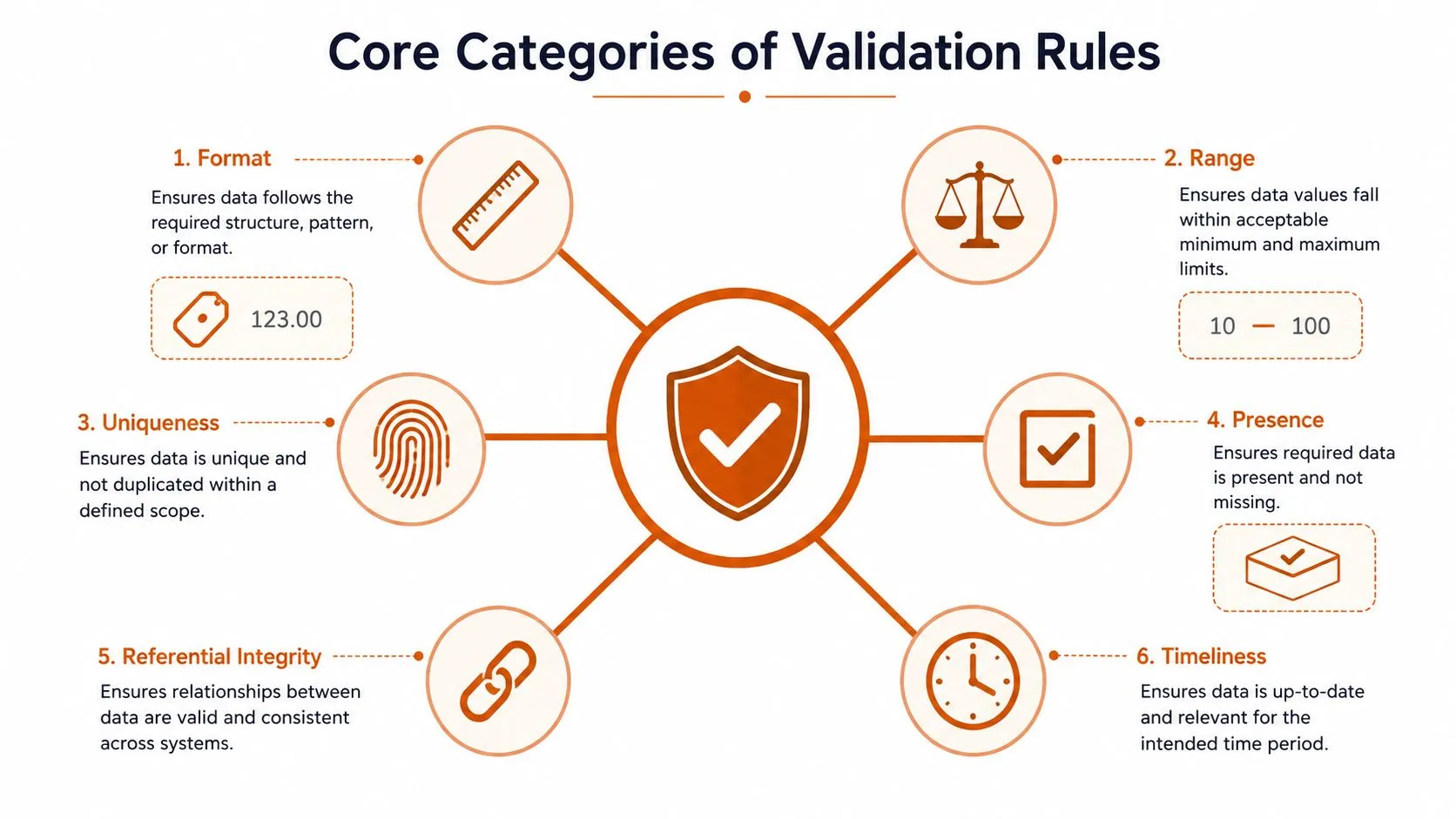
Six rule families cover most Chewy fields. Each one blocks a different failure mode, so combining them is more reliable than adding increasingly complex selectors.
Format rules
Format rules verify structural shape. A price should parse into a decimal representation, a review count should become an integer, and an identifier should retain the expected character pattern. They belong primarily in transform, before normalization hides the original defect.
Range rules
Range rules reject values that are structurally valid but implausible. A rating outside the platform’s rating scale, a negative review count, or an impossible product weight should be quarantined rather than loaded. Range checks protect downstream calculations from values that look clean to a parser.
Uniqueness rules
Uniqueness rules prevent duplicate products and duplicate child records. A canonical product URL, SKU, or GTIN can act as a business key, but variant handling needs care. Two records may share a parent product while representing different purchasable variants.
Presence rules
Presence rules confirm that required fields exist. A page can contain a title while losing its price selector, or preserve a product URL while omitting availability. Presence checks expose partial extraction after a DOM rotation.
Referential integrity rules
Referential integrity rules ensure that child records point to valid parents. Reviews, variants, and images should reference a product key that exists in the product table. This prevents orphaned rows from corrupting joins.
Timeliness rules
Timeliness rules test whether a record is recent enough for its use case and whether retrieval timestamps are present. Pricing and availability require clear observation times, while static ingredients may tolerate a different refresh policy. A practical reference for designing these controls is the ultimate guide to data validation.
The strongest systems log each rule outcome, not only pass or fail. That audit trail helps distinguish a genuine catalog change from a parser regression.
Detailed Rule Entries for Chewy Data
Chewy fields need both syntactic checks and semantic checks. A value can match a pattern and still be unusable, so the pipeline should validate in layers.
Format and range
For product.price.current, first retain the raw currency string, then parse it into a positive decimal. Don’t calculate a sale-price delta until both list and sale prices have parsed successfully. For weight, read the specification value and normalize its unit before applying a category-aware plausibility rule. A universal bound can catch obvious corruption, but category context is safer than assuming every pet product shares the same physical profile.
Ratings and review counts are simpler but still need explicit rules. product.rating.average should remain within the platform’s rating scale and preserve its precision, while product.review.count should be an integer that isn’t negative. product.availability.in_stock should be a Boolean, not a mixture of strings such as “yes,” “available,” and empty values.
Identity and relationships
Use a canonical product URL built from the product slug, while also retaining the observed URL for traceability. Deduplicate primarily on SKU where it is present, then use the canonical URL as a secondary identity check. GTIN collisions shouldn’t automatically merge records, because a shared identifier can expose a variant or upstream mapping problem rather than a true duplicate.
Every review record needs a parent product key that resolves in the products table. Variant rows should reference a parent product identifier, and image rows should use the same stable relationship. If the parent isn’t present, quarantine the child instead of inserting an orphan.
Rule comparison
| Rule Family | Chewy Field Example | Failure Mode Prevented |
|---|---|---|
| Format | price.current | Currency text that cannot be parsed consistently |
| Range | rating.average | Ratings outside the permitted scale |
| Uniqueness | sku, canonical URL | Duplicate product rows |
| Presence | name, price, url | Partial records after selector changes |
| Referential integrity | review.parent_sku | Orphaned reviews |
| Schema | Complete product object | Records missing required fields |
Regex should enforce shape, not decide business meaning. For example, a SKU pattern can reject spaces and unexpected punctuation, but only a product-key lookup can establish whether the identifier is known. For practical normalization patterns, see this guide to normalizing web-scraped data with Python.
Implementation Patterns in Scraping Pipelines
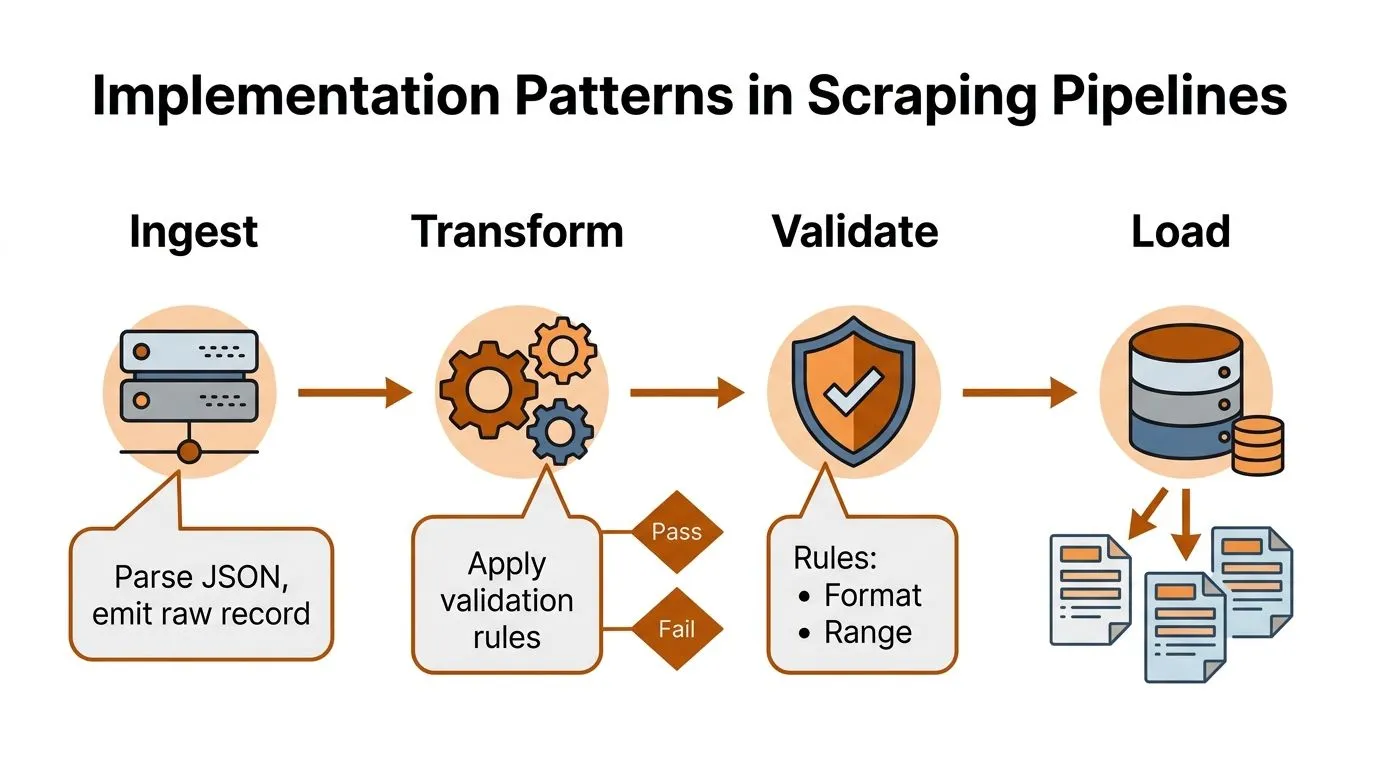
A resilient pipeline makes the stage responsible for each decision explicit. The fetcher should not coerce missing values, and the loader shouldn’t discover basic parsing defects after records have already entered analytical tables.
Ingest without assumptions
At ingest, parse the server-rendered payload and emit a raw record. Store the source URL, retrieval time, parser version, and raw candidates for price, rating, availability, SKU, and review count. Avoid converting an absent field into zero, because zero is a business value while absence is an extraction state.
A useful raw record keeps both representations:
- Raw value: The exact text or structured value found in the response.
- Parsed value: The normalized value intended for downstream use.
- Rule result: Pass, fail, or review, with a rule identifier and reason.
Transform cheaply first
Apply inexpensive presence and type checks before regex or full schema validation. Then normalize currency, units, whitespace, identifiers, and URL forms. Regex rules should be anchored to stable attributes or structured fields rather than positional DOM indexes, which are vulnerable to experiments and merchandising changes.
Represent rules declaratively so an engineer can change a selector, threshold, or required-field list without rewriting pipeline control flow:
| Field | Rule | Stage | Failure action |
|---|---|---|---|
sku | Identifier pattern and presence | Transform | Quarantine |
price.current | Currency parse and positivity | Transform | Review |
rating.average | Numeric range | Validate | Null with audit flag |
product_id | Unique key | Load | Deduplicate |
review.parent_sku | Parent exists | Load | Hold child record |
Validate and load deliberately
Schema validation should happen before persistence, after fields have been normalized. Store rejected records separately with the original payload reference, because dropping them removes the evidence needed to repair the parser.
Proxy and request management should support compliant access rather than bypassing restricted paths. If infrastructure choices require a background reference, Evoproxy’s material on avoiding CAPTCHAs with mobile IPs discusses proxy considerations, but the scraper should still honor robots rules, rate limits, and site terms. For pipeline architecture, this guide to building scalable data pipelines with Scrapy offers a useful implementation complement.
Respecting Robots and Targeting Public Pages
Chewy’s robots.txt is a direct design input, not a suggestion. It disallows several transaction and account paths, including /app/buy, /app/checkout, /app/account, /app/login, /app/register, and /app/api, while allowing the /*lp=* pattern (Chewy’s robots.txt).
A compliant Chewy scraper should build an allowlist of public product and listing URL templates, then reject every URL outside that allowlist before making a request. Product detail pages, public category pages, and other permitted catalog surfaces are the appropriate targets. Authenticated pages, checkout flows, cart operations, and API routes should remain outside the crawl.
| Path Category | robots.txt Status | Scraper Behavior |
|---|---|---|
| Product detail pages | Target only when permitted | Add to explicit public-page allowlist |
| Category and listing pages | Target only when permitted | Crawl cautiously and revalidate pagination |
/app/api | Disallowed | Reject before request |
/app/buy and /app/checkout | Disallowed | Never fetch |
| Account and authentication paths | Disallowed | Never fetch |
Use a descriptive user agent and keep request behavior proportionate to the data need. A public URL is not permission to access private account data or circumvent access controls. Teams that operate across different ecommerce platforms can also consult this Shopify robots.txt guide, then apply the same principle of translating directives into an enforceable URL policy. Legal and operational review should accompany the technical design, especially when the output supports commercial monitoring. The website terms of service guide is a useful reference for that review.
Regex and Schema Snippets You Can Reuse
Regex works best as a narrow gate around stable, server-rendered fields. It should extract candidate values and expose malformed content, while JSON Schema verifies the complete record.
Field patterns
These patterns are deliberately conservative and should be tested against captured Chewy responses before deployment:
- Price:
(?P<currency>\$)(?P<amount>\d{1,5}(?:\.\d{2})?) - SKU:
(?P<sku>[A-Z0-9-]{6,20}) - GTIN:
(?P<gtin>\d{12}) - Rating:
(?P<rating>1-5?)\s*(?:out of|/)\s*5 - Review count:
\((?P<review_count>\d[\d,]*)\)
The price pattern accepts an optional decimal portion at extraction time, but the transform stage should normalize the result to a decimal representation and apply the project’s required precision. Don’t use a regex alone to infer availability. That field should come from a structured Boolean or a controlled mapping with an audit flag for unknown values.
Schema enforcement
A compact product schema can look like this conceptually:
| Object | Required fields | Type checks |
|---|---|---|
| Product | sku, name, price, url | Strings, object, URI |
| Price | current, currency | Positive number, enum |
| Review summary | average, count | Number in rating range, nonnegative integer |
Apply regex before schema validation, but don’t stop there. A format-correct SKU can still be empty in business terms, a valid URI can point to the wrong page type, and a syntactically valid price can conflict with visible page content.
Google’s product-data guidance says structured data should be present in the HTML response rather than generated only after page load, and it emphasizes consistent offer and SKU or GTIN mappings when multiple offers exist (Google Merchant Center product-data requirements). That supports prioritizing server-rendered Product and Offer fields, then comparing parsed price and availability with visible content before storage.
Versioning Rules When the Site Changes
A scraper’s validation rules are production code. Store selectors, parsers, schemas, thresholds, and URL policies in version control, and tie every scraped batch to the exact rule bundle that processed it.
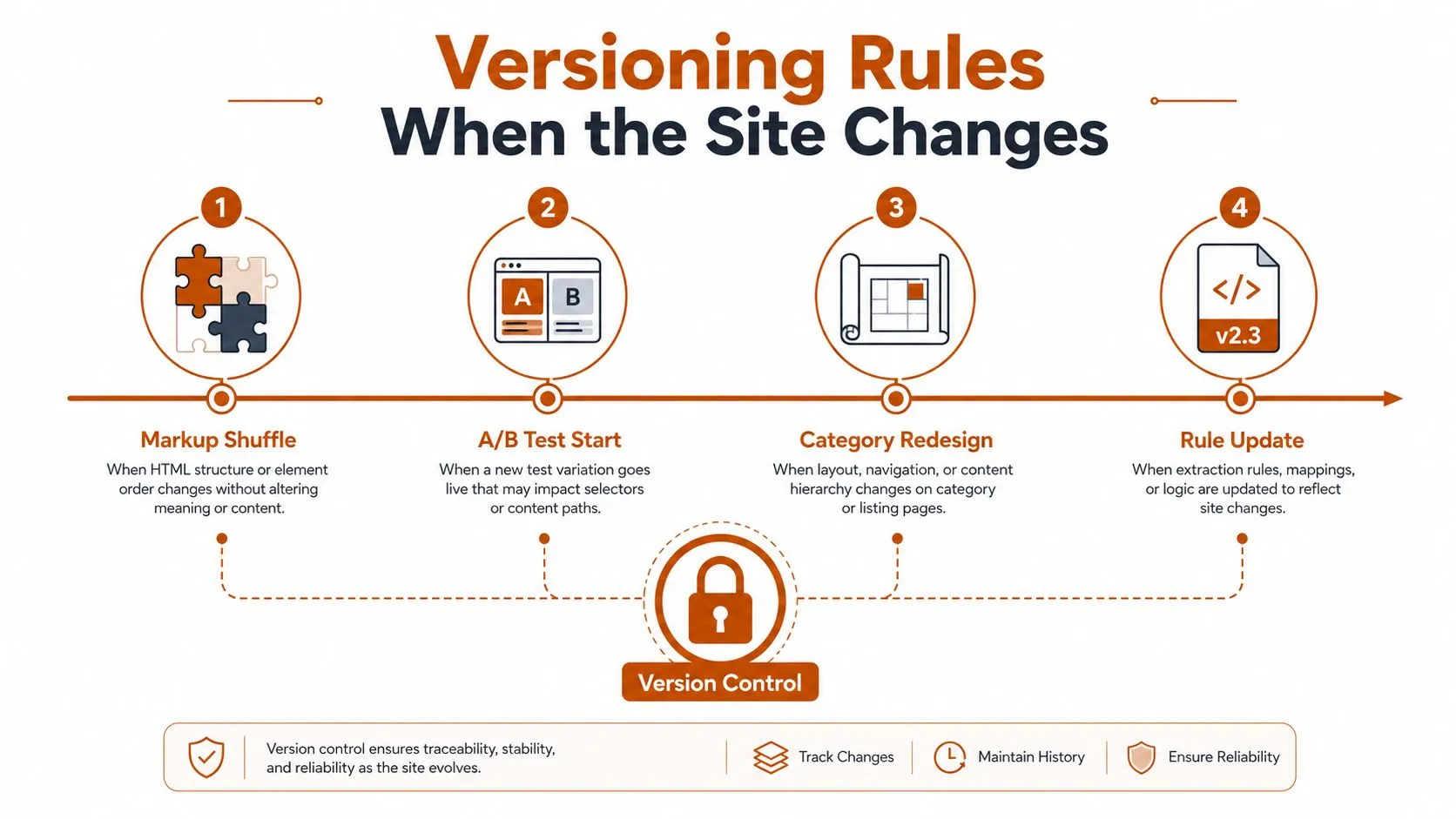
Use semantic schema versions and maintain a changelog with four details:
- Affected field: For example,
price.currentorreview.count. - Observed trigger: A changed wrapper, new review block, or category redesign.
- Rule action: Selector update, parser adjustment, or stricter validation.
- Operational date: When the change was observed and deployed.
Don’t delete the previous rule immediately. Deprecate it, retain it for historical validation, and preserve a rollback target. Historical records may have been produced under an earlier schema, and removing that context makes later comparisons difficult.
A coverage drop is a diagnostic signal. It isn’t proof that the source changed.
Tag every batch with the schema version, parser version, and rule bundle. If price coverage falls, replay a captured response against the previous and current bundles. That comparison separates a front-end change from an overly strict rule and gives the team a reversible deployment path instead of forcing a blind hotfix.
Cross-References Between Rules and Fields
A validation rule has operational value only when engineers can identify the field it protects and the stage where it runs. Create an audit matrix that links each field to its format, range, uniqueness, presence, integrity, and timeliness controls.
For example, a SKU format rule belongs at ingest or early transform. A sale-price range rule protects the pricing table during validation. A review uniqueness rule prevents duplicate sentiment rows at load, while a product-to-category relationship protects taxonomy joins.
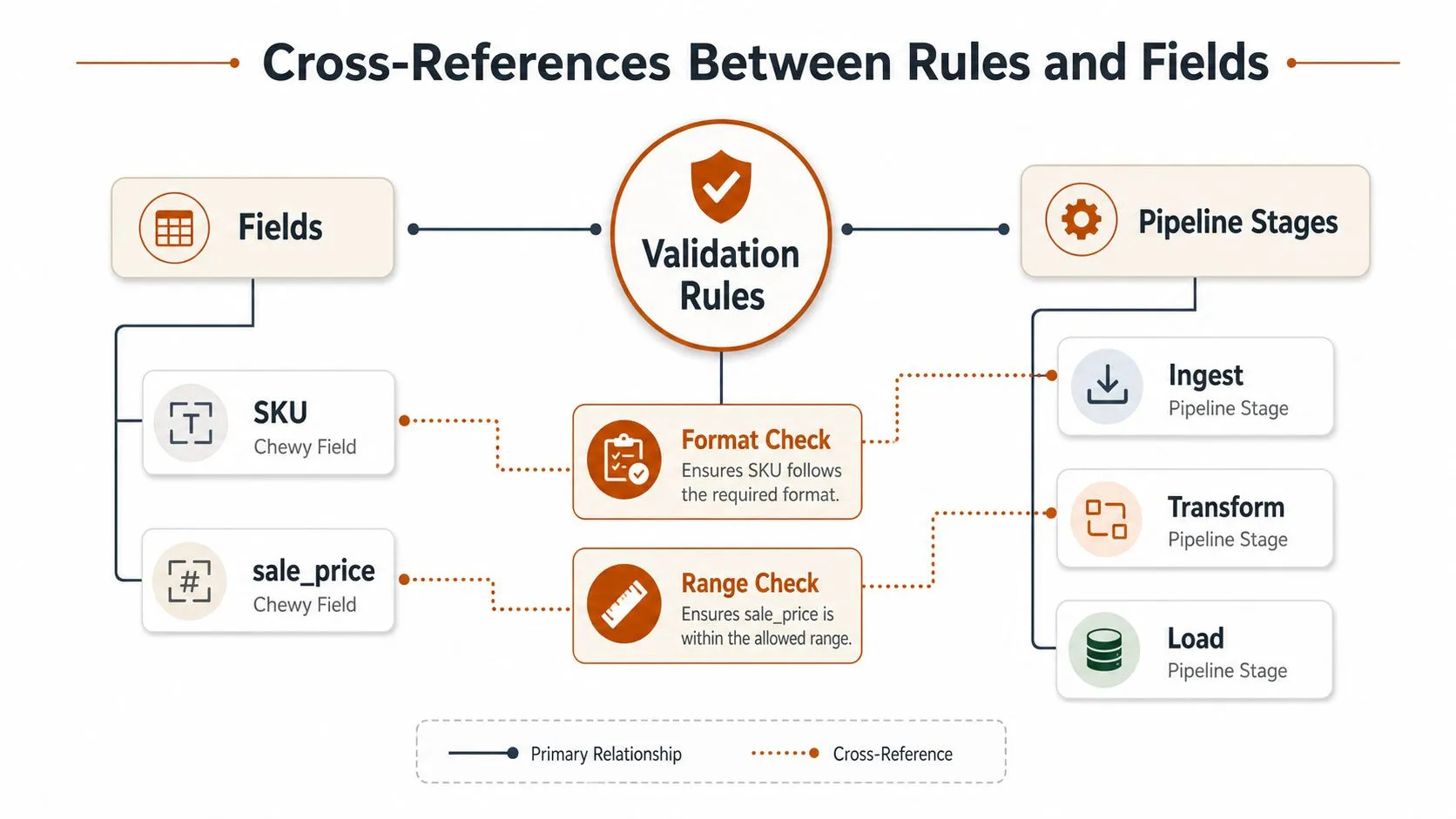
The matrix exposes gaps, such as an identifier with no regex, and overlaps, such as two schemas checking the same weight field differently. It also gives new engineers a direct starting point when production records fail.
Quick Reference Table for Rule Lookup
Use this field-to-stage map during parser reviews and incident triage. It assigns each Chewy field to the pipeline stage and owner responsible for its contract.
| Chewy Field | Responsible Stage | Owner | Checkpoint |
|---|---|---|---|
sku | Ingest | Collector | Preserve the source identifier |
name, url | Transform | Normalization | Reject incomplete product records |
price.current | Transform | Pricing | Parse currency and retain the observed value |
rating.average | Validate | Quality control | Flag values outside the accepted range |
gtin | Transform | Identity | Apply the identifier pattern |
review.parent_sku | Load | Review model | Confirm the parent product exists |
| Product object | Store | Schema owner | Require the approved field set |
| Retrieval timestamp | Ingest | Freshness monitor | Record observation time for later review |
Treat this map as an ownership contract, not a substitute for captured-response tests. Category pages can change structure, and product, price, and review fields may fail independently, so stage-level alerts should identify the affected contract and schema version. Record each rule change with its version and test fixture before releasing it.
Teams that need recurring Chewy data can discuss a schema, validation workflow, and delivery format with WebscrapingHQ, then choose the operational components to maintain internally.
Want this done for you?
Send us the URLs. We'll quote it in 24 hours.
Paste the URL(s) you want scraped. We'll reply within 24 hours with a feasibility check and a ballpark quote.