
Jump to section
- Why eBay Scraping Breaks and What Good Extraction Looks Like
- The success contract you should enforce
- What good looks like in production
- Handling eBay Pagination Without Missing or Duplicating Items
- Walk the catalog like a state machine
- Deduplicate on identity, not appearance
- Proxy Strategy Rate Limits and Anti-Bot Defenses That Work
- Match the route to the failure signal
- Rate limits and retry discipline
- Anti-bot testing should not count challenge pages as success
- Compliance Checks Before You Collect eBay Data at Scale
- Build the compliance screen before the crawl
- Don’t confuse public with risk-free
- Choosing Among Top Web Scraping Companies for eBay Delivery
- Score vendors on accepted records, not request counts
- Compare managed delivery against DIY operations
- Ask for evidence before you sign
You’re staring at an eBay tracker that looked fine in staging, then fell apart in production. Search pages still load, but some cards are missing price, some variation fields vanish after a layout tweak, and a handful of requests come back with challenge pages that your parser happily treats as “successful” because the status code was 200.
That’s the filter for the top web scraping companies for eBay data. Not how many proxies they advertise, but whether they can keep a defensible pipeline alive when selectors drift, pagination changes, and the target starts pushing back.
Why eBay Scraping Breaks and What Good Extraction Looks Like
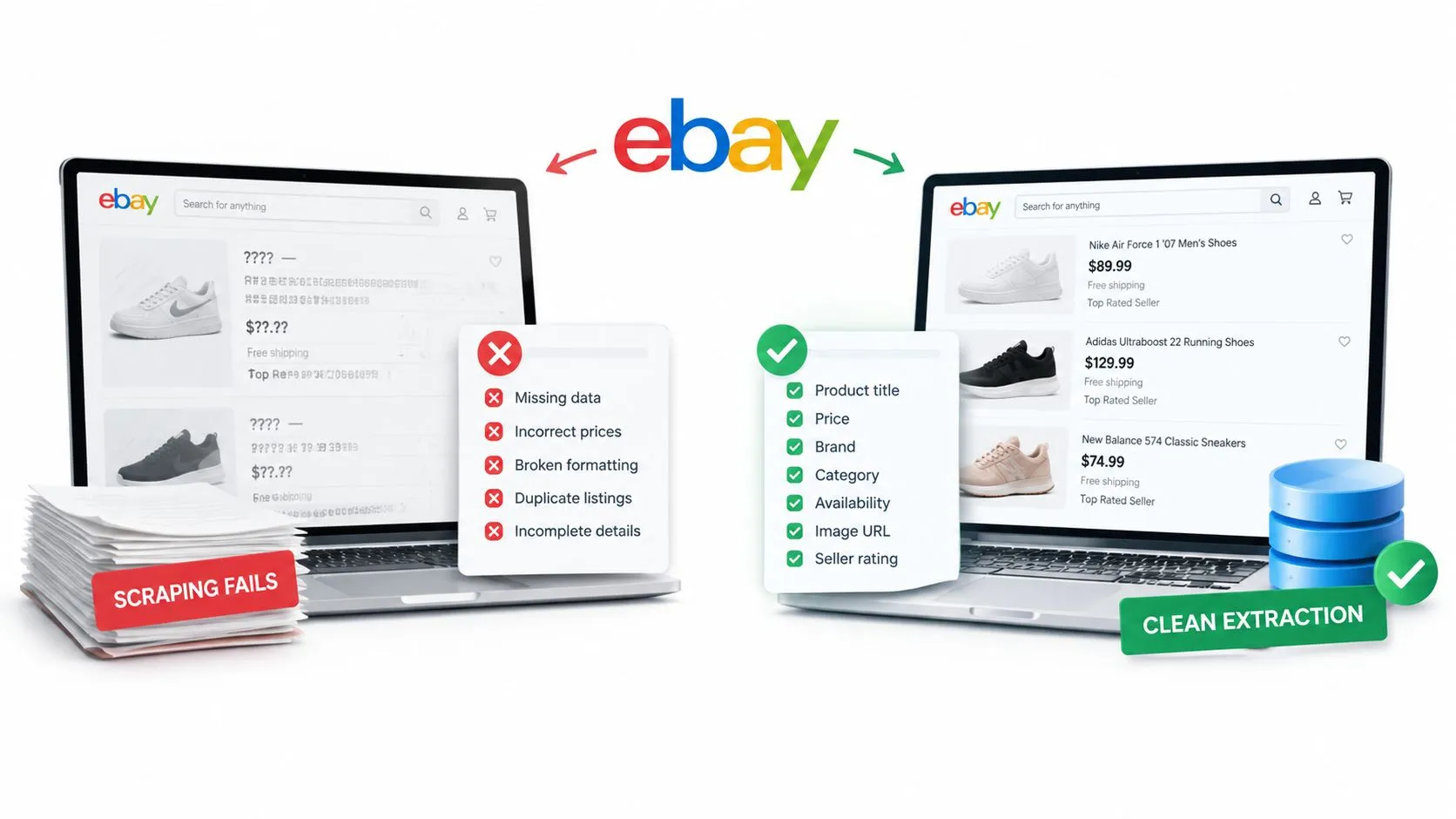
A broken eBay job usually doesn’t fail loudly. It drifts. One morning, the search result page still renders, but the price sits behind a nested element you weren’t targeting, the item ID moves into a different node, and variation data only appears after a client-side render. A good scraper notices that before your dashboard starts telling bad stories to buyers and merchandisers.
The success contract you should enforce
A useful extraction run is not “the request worked.” It is correct HTTP response, rendered content present, required fields populated, and evidence captured for audit. If any one of those is missing, the row should be treated as incomplete rather than accepted and stored.
That matters on eBay because page-level success can hide field-level failure. A search page may render, but a variant SKU, shipping value, or seller signal can be absent unless the browser executes the page and your selector logic reaches the right node. A pipeline that only checks reachability will overstate coverage and understate risk.
The cleanest way to think about this is to separate what the page returned from what your downstream system can trust. If the item card is present but the price is blank, that record is not ready for pricing intelligence. If the product page loads but your evidence capture doesn’t show the rendered state, you’ll struggle to debug drift later.
A practical resource for sellers who want to understand the economics behind the listing side is gastos de eBay para vendedores. It’s useful context when scraped price data has to be interpreted alongside fees and margins.
For teams building a recurring tracker, an internal reference like eBay price tracker workflows is more useful than a generic scraping checklist because it keeps the goal tied to product monitoring, not raw collection.
Practical rule: if you can’t explain why a row is complete, you shouldn’t count it as complete.
What good looks like in production
Good extraction is boring in the right way. You know which selectors are primary, which ones are fallback, and what happens when the page structure shifts. You also know when to stop trusting the page, because a scrape that returns a lot of rows with missing fields is often worse than a smaller, verified crawl.
One thing many teams miss is the difference between search pages and product pages. Search pages help you discover candidates, but product pages often carry the stable details you need for validation, normalization, and variance checks. Managed services and infrastructure vendors should be judged on whether they can keep both layers consistent, not just one of them.
The rest of the stack follows from that standard. Pagination should be deterministic, anti-bot handling should be explicit, and compliance should be visible in logs rather than implied by marketing language. If a vendor can’t show those things, they’re selling access, not evidence.
Handling eBay Pagination Without Missing or Duplicating Items
Pagination is where many eBay pipelines lose integrity. The page count looks finite, but filters, sort order, promoted placements, and lazy-loaded results can all alter what appears as you move through the corpus. If you crawl without a stable plan, you’ll miss items on one run and duplicate them on the next.
Walk the catalog like a state machine
Start with seed URL discipline. Keep each query shape fixed, then vary one parameter at a time so you can tell whether a change came from the source or from your crawler. Stable sort order matters here because pagination is only meaningful when the result set doesn’t reshuffle underneath you.
Use stable selectors for listing cards, pagination controls, and variation links, then add fallback logic when one selector fails. For example, a primary card selector can target the main result container, while a secondary path checks for an alternate anchor pattern if the page template changes. That fallback should be deliberate, not a pile of guesses.
A useful crawl loop usually looks like this:
- Fetch page one and capture the query signature, timestamp, and rendered DOM state.
- Extract item IDs and variation keys before any deduplication.
- Advance using the page control that the site exposes, not a guessed URL pattern.
- Stop when the next page yields no new unique item IDs or when the result set becomes clearly stale.
- Store freshness timestamps so you can tell when a row was first seen versus last verified.
Deduplicate on identity, not appearance
eBay listings can recur through different entry points, which means visual similarity isn’t enough. Deduplicate by item ID plus variation key, then compare titles and prices as supporting fields, not as the identity itself. If your system only deduplicates on title, you’ll collapse distinct offers into one record and lose useful variation data.
You also need a policy for stop conditions. An infinite crawl often happens when the same cards recur because of a bad cursor, a filter reset, or a page transition that never really advanced. When that happens, the job should stop, flag the query, and preserve evidence instead of hammering the site until the schedule window closes.
If pagination can’t prove forward progress, it’s not a crawl, it’s a loop.
The best operators also track change detection. If page two returns the same unique items as page one, or if the field distribution changes sharply, that’s a strong signal to quarantine the run and inspect the query shape. A good internal reference on this kind of workflow is best methods to scrape eBay listings, especially if your team is deciding how much logic belongs in search traversal versus product-level verification.
That discipline is what keeps price intelligence credible. You’re not trying to count pages, you’re trying to guarantee that the dataset reflects the catalog as it moved through time.
Proxy Strategy Rate Limits and Anti-Bot Defenses That Work
An eBay job can return HTTP 200 responses while missing prices, delivery details, variations, or client-rendered availability. That makes proxy selection a data-quality decision, not just an access decision. A route that produces pages but leaves fields blank is failing the pipeline.
Match the route to the failure signal
Use datacenter traffic for lightweight pages and initial test passes, residential routing when access becomes unstable, and real-browser rendering when the page depends on client-side state or challenge behavior. Choose the route by page behavior and freshness requirements, not by the size of a proxy pool.
Run the same URL corpus across several vantage points and classify failures separately: timeout, DNS or TLS error, soft block, missing JavaScript content, parser failure, and stale data. A study on multi-vantage-point web failure patterns reported failure shares of approximately 19.84% for cloud, 28.75% for residential, 30.05% for Tor, and 21.36% for university networks. Navigation timeouts led aborted visits, while Tor produced the highest error rates. The result is a useful warning: route performance varies by failure type, so a vendor’s overall request-success figure is not enough.
| Failure signal | Likely cause | Recommended route | Retry rule |
|---|---|---|---|
| 200 response, missing rendered fields | Client-side content not captured | Real browser with full render | Retry once with browser state capture |
| Slow load, aborted navigation | Timeout or overloaded route | Lower concurrency, same route first | Retry with exponential backoff |
| Challenge page or soft block | Bot detection or fingerprint mismatch | Rotate to residential, then browser | Retry only after fingerprint change |
| Empty page state, but URL looks valid | Stale or filtered result set | Re-seed query with stable sort | Retry from a fresh seed URL |
| Schema mismatch after page load | Selector drift | Same route, updated parser | Retry after selector fallback |
Rate limits and retry discipline
Per-domain concurrency limits matter more than raw throughput. Bound requests so one query family cannot starve the rest of the system. Add exponential backoff after block signals, and use conditional requests where the site and workflow support them. This avoids repeatedly processing pages that have not changed.
Retrying every failed URL blindly wastes proxy capacity and obscures the underlying defect. A bounded retry should exist only when it can improve field-level completeness, not merely prove that the URL is reachable. If a route keeps returning challenge pages, another identical attempt adds cost without adding evidence.
Set separate limits for search pages, item pages, and browser sessions. Search results often tolerate lighter handling, while item pages may require rendered state to capture variations, shipping details, or availability. Record the route, response class, parser version, and fields present on every attempt. Those records let you distinguish a proxy problem from selector drift.
For setup decisions, Clearcote Labs proxy configuration tips provide practical guidance on configuring proxy behavior. The best proxy servers for web scraping guide is useful when comparing route types and operational features. Judge vendors by monitoring, failure classification, and usable fields, not by IP rotation alone.
Anti-bot testing should not count challenge pages as success
Browser automation needs its own acceptance test. The same multi-vantage-point research cited above found a 15% soft-block rate, with 82% of observed blocks attributable to bot detection. A browser profile can therefore appear successful in logs while returning a challenge or incomplete document.
Exclude challenge pages, CAPTCHAs, and partially rendered documents from success totals. Validate required selectors such as item ID, title, price, condition, seller, and shipping fields before accepting a response. A provider that reports raw request success but hides rendered-state failure is optimizing the wrong metric.
Measure median and tail latency against the freshness SLA you actually need. A fast response with missing fields is not a successful extraction.
Compliance Checks Before You Collect eBay Data at Scale
Technical access is only half the decision. The other half is whether the collection is defensible when someone asks who authorized it, what was collected, and why those fields were necessary. That question matters more when the data touches personal information, AI training, or EU-origin content.
Build the compliance screen before the crawl
Start with the obvious sources of policy friction, robots.txt, terms of service, authentication boundaries, geographic restrictions, and permitted crawl rate. AWS guidance recommends checking robots.txt for the relevant user agent before crawling, while the University of Chicago Booth standard uses no more than one request every 10 seconds when a site provides no rate limit and requires authorization where policies prohibit scraping AWS crawling guidance.
That doesn’t mean robots.txt is a magic shield. It’s a signal, not a guarantee, and it should be logged alongside your own authorization decision. If a vendor says they can access everything but can’t explain their source controls, they’re asking you to inherit the risk without the evidence.
A defensible compliance screen should cover:
- Purpose definition so the collection has a narrow, documented use case.
- Necessity and proportionality so you can explain why each field exists.
- Source refusal signals like CAPTCHAs, access limits, and explicit disallow rules.
- Provenance logs that show where each field came from and when it was captured.
- Allowlists and denylists that keep collection inside approved boundaries.
- Retention and deletion controls so old or disputed data can be removed.
- Escalation paths for blocked sources, policy disputes, and legal review.
Don’t confuse public with risk-free
European guidance has made the buyer’s job harder in a useful way. Publicly accessible data isn’t automatically safe to collect, because legitimate-interest processing still requires a documented balancing test and a clear view of user expectations in context CNIL and EDPB-oriented guidance. That pushes teams to think about source-level necessity rather than raw availability.
The most valuable vendor is often the one that declines some sources or fields.
That sounds counterintuitive until you’ve dealt with downstream cleanup, user complaints, or a data request that can’t be answered because provenance was never captured. A provider that limits collection, documents refusal signals, and keeps auditable logs gives you a much easier story to defend.
For teams needing a practical checklist to match technical controls with policy steps, the internal e-commerce data extraction compliance checklist is the kind of artifact that keeps operations and legal review aligned. The point is to make exclusions deliberate, not accidental.
The strongest anti-bot programs also separate recovery from success. If the site returns a challenge page, that is evidence of control pressure, not an acceptable row. Recovery should only count when the rendered page contains the required fields and the audit trail proves what was captured.
Choosing Among Top Web Scraping Companies for eBay Delivery
An eBay pipeline can return thousands of rows and still fail the business test. A blocked page, stale listing, missing seller field, or duplicated item can make an apparently successful run unusable. Choose vendors by accepted records, field-level completeness, proxy discipline, and compliance controls, not by proxy counts or request volume.
Bright Data illustrates one form of long-term scale. The company began in 2014, gained its first Fortune 500 customer in 2015, and reported growth to more than 20,000 customers in 2023, alongside more than 5,500 granted patent claims by that year Bright Data about page. Apify represents a different operating model, with a 2015 founding, reported €6.7 million in revenue and nearly €1 million in profit in 2023, about €500,000 in seed investment through 2019, later bootstrapping, and a €2.8 million round in April 2024 Apify about page.
These figures show that serious data businesses can develop in different ways. For eBay delivery, the practical question is whether a vendor can handle selector drift, changing block behavior, schema validation, and proxy rotation without shifting daily maintenance onto your team.
Score vendors on accepted records, not request counts
Start procurement with coverage rate, valid-record rate, duplicate rate, freshness SLA, median and tail latency, retry amplification, and cost per accepted record. Request success is only an intermediate signal. A result counts when it contains the required fields, passes validation, and can be traced to the intended source state.
Run the pilot against your own eBay queries, categories, and schema. Ask each provider to process the same corpus and report field-level completeness, rejected rows, duplicate handling, retry counts, and proxy or route changes. For example, a pilot on 5,000 eBay search results could report a 96% accepted-record rate after field validation, a 0.4% duplicate rate, and a 12-minute median freshness lag. The example is useful because it defines acceptance in operational terms, rather than treating every returned response as success.
Compare managed delivery against DIY operations
Managed services take responsibility for monitoring, proxy configuration, selector retuning, and recurring delivery. That suits teams judged on the quality of a product feed or market report. DIY operations can work when you have engineers available to inspect block rates, update selectors, test retries, and review failures before they reach downstream systems.
| Option | Strength | Operational burden | Best fit |
|---|---|---|---|
| Infrastructure-heavy vendor | Large-scale access and route diversity | Higher internal QA load | Teams with in-house scraping engineering |
| Managed data service | Ongoing monitoring and delivery | Lower internal maintenance | Teams that want recurring feeds |
| API-first extraction partner | Structured output and simpler integration | Moderate, depending on schema complexity | Teams that need direct pipeline output |
WebScrapingHQ is one option in this comparison. It provides managed web data operations, custom recurring extraction pipelines, and delivery through CSV, JSON, webhooks, and cloud storage. That model fits recurring eBay reporting more closely than a one-off access project.
The web scraping companies in USA overview can help compare infrastructure-focused vendors with managed delivery providers. If you also sell on eBay, review the platform from the seller side through these eBay selling tips for catalog sellers before defining the fields your extraction pipeline must support.
Ask for evidence before you sign
Request a sample run on the exact eBay sources you plan to collect. Require rendered-state evidence, field-level validation results, duplicate treatment, failure logs, and a clear explanation of how proxies are selected and rotated. Ask who owns selector changes when eBay modifies a page.
A vendor that discusses only IP volume is selling capacity. A vendor that can demonstrate accepted records, controlled retries, provenance, and compliance checks is showing a delivery process.
WebScrapingHQ provides managed pipelines, monitoring, and structured recurring outputs for production web data operations. Visit WebScrapingHQ to discuss your eBay sources, schema, and delivery cadence.
Want this done for you?
Send us the URLs. We'll quote it in 24 hours.
Paste the URL(s) you want scraped. We'll reply within 24 hours with a feasibility check and a ballpark quote.