Jump to section
- Why Competitive Intelligence Gathering Is Now an Engineering Problem
- Build the operating contract first
- Origins of Competitive Intelligence and Why They Still Matter
- Tactical and strategic signals remain different workloads
- The Five Signal Categories You Actually Need to Watch
- SERP features reveal visibility mechanics
- Product listings need field-level structure
- Prices and reviews move at different speeds
- Choosing the Right Collection Methods and Data Sources
- APIs provide clarity, not completeness
- Scraping fills the disclosed-data gap
- Designing a Production Pipeline with Cadence and Diffs
- Discovery maintains the target universe
- Collection assigns work to cadence buckets
- Diffs should create alerts
- Legal and Ethical Guardrails Every CI Program Should Enforce
- Use a four-point release checklist
- KPIs, Use Cases, and Operational Requirements
- Connect each KPI to an owner
A pricing team notices a margin problem on a top-selling SKU during its Tuesday review. A competitor reduced its price the previous week, but the internal dashboard never raised an alert because nobody owned the refresh job. The team isn’t looking at bad analysis. It’s looking at stale data.
That failure captures the central problem in competitive intelligence gathering today. Prices, product pages, search results, advertisements, and customer reviews change continuously. A quarterly spreadsheet can’t provide dependable operational coverage when commercial signals move throughout the day.
Competitive intelligence needs to be treated as a data product. It requires defined sources, collection schedules, schema contracts, monitoring, change detection, error handling, and clear ownership. The research still matters, but the pipeline determines whether decision-makers see a useful signal or a late anecdote.
Why Competitive Intelligence Gathering Is Now an Engineering Problem
Traditional competitor research often ends with a report. Production competitive intelligence gathering starts with a system that can repeatedly answer the same questions: what changed, when did it change, how confident are we, and which team needs to act?
That shift matters because the business consequences are operational. A pricing group needs a current competitor price, not a screenshot from last month. A merchandising team needs to know whether a product has disappeared, gone out of stock, or gained new promotional copy. A media team needs evidence that an advertisement appeared in the intended placement. Each requirement implies a source, a field definition, a refresh cadence, and a response when collection fails.
Build the operating contract first
Before choosing a scraper or API, document the data contract:
- Target scope: Define competitor domains, marketplaces, keywords, product identifiers, ad surfaces, and review sources.
- Required fields: Separate essential fields, such as sale price and stock state, from optional fields, such as image metadata.
- Freshness expectation: Assign faster collection to volatile fields and slower collection to relatively stable content.
- Failure behavior: Decide whether a missed cycle produces an incident, a warning, or no action.
- Downstream owner: Name the pricing, product, SEO, merchandising, or media team responsible for each signal.
A practical pipeline also needs uptime expectations and schema versioning. If a competitor redesigns its pricing component, the collector may still return a successful HTTP response while producing empty values. Technical success isn’t data success.
Practical rule: Treat an empty field, a malformed response, and a missing page as different failure classes. They require different alerts and different remediation.
Teams building their own stack can use established crawler architecture patterns, including the approaches outlined in scalable data pipelines with Scrapy. The implementation matters, but ownership matters more. A technically capable collector without an on-call path becomes another unattended job.
The useful mental model is telemetry. Raw pages are observations, normalized fields are measurements, and field-level diffs are events. Once CI is designed that way, analysts can spend less time checking whether the feed ran and more time interpreting what a competitor’s move means.
Origins of Competitive Intelligence and Why They Still Matter
A competitor’s page changes overnight, but the operating model behind competitive intelligence was built over decades. The discipline became a recognizable business practice in the United States during the 1970s. Michael Porter’s Competitive Strategy, published in 1980, and the founding of the Society of Competitive Intelligence Professionals in 1986 helped establish CI as a defined business capability. These milestones are documented in the history of competitive intelligence.
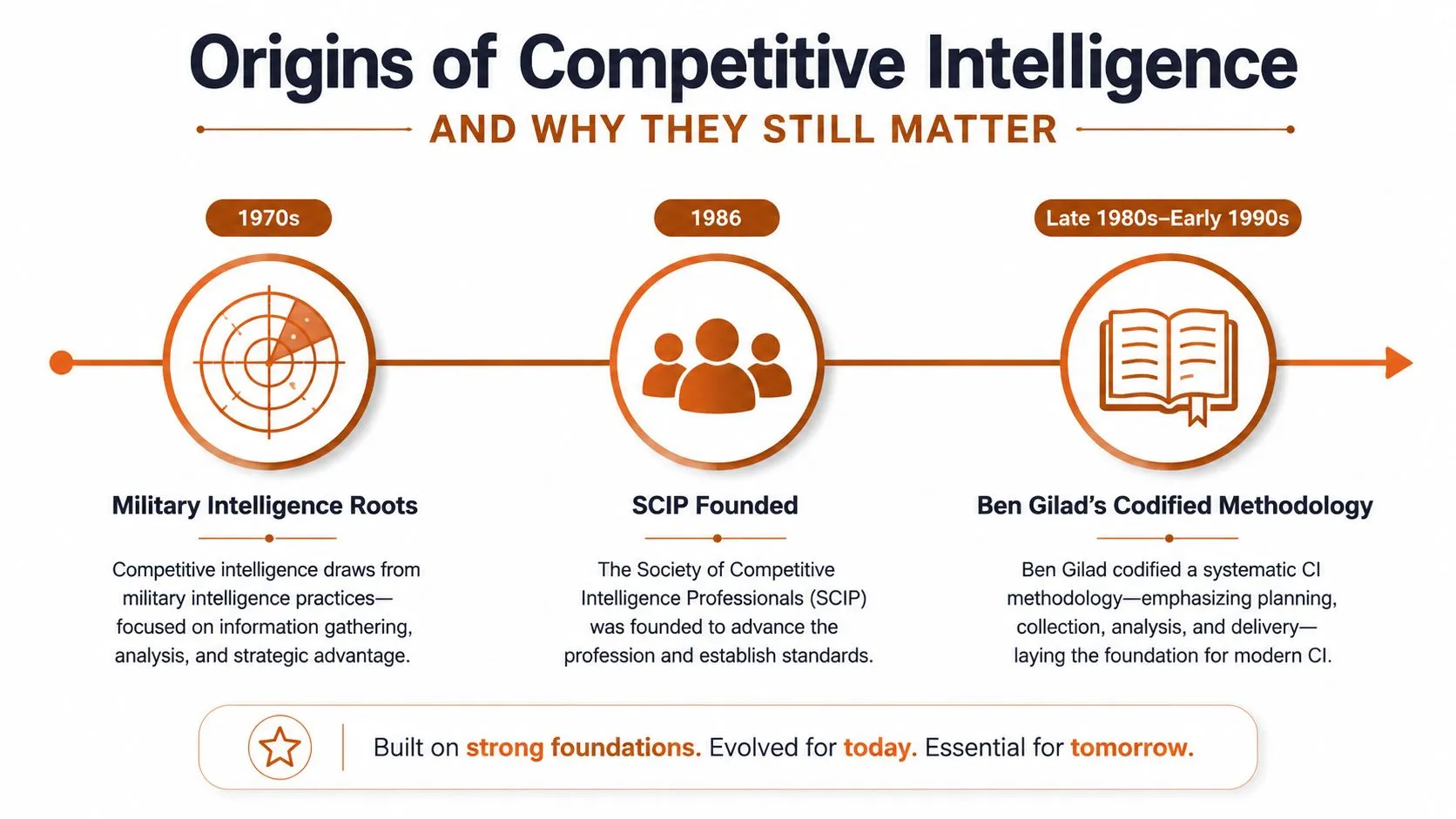
Ben and Tamar Gilad published the first organizational model for a formal corporate competitive intelligence function in 1988. That work separated repeatable intelligence operations from informal competitor watching. The field developed further in 1996, when the Fuld-Gilad-Herring Academy of Competitive Intelligence created its first professional certification program. The progression matters for modern data teams: CI moved from ad hoc information collection toward defined ownership, repeatable methods, and retained history.
Tactical and strategic signals remain different workloads
The distinction between tactical and strategic intelligence still determines how a production pipeline should be configured.
Tactical signals include pricing, bids, promotions, hiring activity, product availability, and advertising changes. Their value often decays quickly, so collection frequency must match the field. A price change may feed a pricing workflow, while a new landing page can start a media or positioning review. Field-level diffs are more useful than storing another unchanged copy of the page.
Strategic signals include market structure, partnerships, product direction, acquisitions, and shifts in competitive positioning. They usually need source triangulation and human interpretation instead of constant automated alerts. Analysts use them in planning and leadership reviews, where context and confidence matter more than immediate delivery.
By 1998, more than 80% of companies with over $10 billion in annual revenue were estimated to have an organized intelligence system combining internal teams with outsourced research support, according to the competitive intelligence statistics reference. The same source estimates that the broader CI market reached about $50.87 billion in 2024 and could reach $122.77 billion by 2033, with a projected 9.1% CAGR. The scale has changed, while the operating requirements remain familiar: define the fields, validate sources, preserve history, and detect meaningful change without treating every page response as a reliable signal.
The Five Signal Categories You Actually Need to Watch
A useful CI program doesn’t monitor every available page. It instruments the fields that support a decision. The five categories below cover the core surfaces for digital commerce and go-to-market teams.
| Signal Category | Refresh Cadence | Primary Business Use |
|---|---|---|
| SERP feature shifts | Weekly | SEO planning and category management |
| Product listing fields | Daily | Merchandising and product development |
| Pricing and availability | Every 15 minutes during business hours | Pricing engines and margin protection |
| Ad creative and placements | Twice daily | Brand bidding and media verification |
| Review velocity and sentiment | Hourly | Product development and customer experience |
SERP features reveal visibility mechanics
Rank alone is too narrow. Track People Also Ask, featured snippets, local packs, image packs, and other result features alongside organic positions. A competitor can gain attention without taking the first traditional ranking if it appears in a prominent feature that changes how users scan the page.
Weekly collection is appropriate for many strategic SERP comparisons, but the query set must be deliberate. Tie each query to a category, product, use case, or commercial intent. Teams that collect broad rankings without recording feature ownership usually create a large archive with limited decision value. The market trend analysis guidance is useful when translating search movement into category questions rather than treating rankings as isolated scores.
Product listings need field-level structure
A product page isn’t one signal. Capture the title, bullet copy, images, A+ content, stock state, and visible claims as separate fields. That structure lets a merchandising team see whether a competitor changed positioning, added proof points, or altered the visual hierarchy without treating every page rewrite as a major event.
Daily snapshots work for ordinary listing monitoring. Higher-value products may justify more frequent checks when stock or promotional copy directly affects sales.
Prices and reviews move at different speeds
Pricing and availability deserve the fastest cadence because they can affect an immediate commercial response. Record MSRP, sale price, promotional window, shipping date, and stock state separately. A single “current price” field hides whether the change is permanent, promotional, or caused by availability.
Reviews provide a different kind of signal. Hourly collection can identify rating drift, volume spikes, and complaint clusters, but automated sentiment should support, not replace, review sampling. The useful output isn’t a generic sentiment score. It’s a grouped explanation of what customers repeatedly praise or criticize.
Choosing the Right Collection Methods and Data Sources
No single collection method delivers complete coverage, ideal freshness, low cost, and minimal legal or operational friction. Production teams usually combine channels according to the surface being monitored.
| Method | Cost per 1M fields | Typical freshness | Coverage ceiling | ToS risk |
|---|---|---|---|---|
| First-party APIs | Usage-dependent | Near real time where supported | Limited to exposed fields and endpoints | Usually clearer, subject to provider rules |
| Partner feeds | Contract-dependent | Often delayed | Broad benchmarking coverage | Governed by agreement |
| Managed scraping services | Contract-dependent | Scheduled to requirement | Strong for public residual surfaces | Requires source-specific review |
| Public datasets | Low or negligible access cost | Irregular | Poor for live operational decisions | Depends on license and provenance |
APIs provide clarity, not completeness
First-party APIs such as Google Shopping surfaces, the Meta Ad Library, and Amazon’s Product Advertising API can offer structured data and clearer usage conditions. They also impose rate limits and expose only the fields the provider chooses to make available. An API response may be clean while still omitting competitor landing-page copy, regional presentation, or an unindexed promotional module.
Partner feeds from providers such as Crayon, Similarweb, and Nielsen can help with benchmarking and market context. Their trade-off is latency and dependence on the provider’s coverage model. A feed that is useful for a planning review may be too slow for a pricing response.
Scraping fills the disclosed-data gap
Managed scraping is most useful when competitors leave valuable information on public pages but don’t publish it through a convenient structured interface. That commonly includes landing-page copy, promotional modules, product detail changes, and localized presentation. It generally carries a higher unit cost and requires ongoing maintenance when page structures or bot defenses change.
Public datasets, including Common Crawl and academic collections, can support historical research or exploratory analysis. They aren’t a dependable substitute for current operational collection because freshness and target coverage are inconsistent.
Source selection principle: Choose the method that matches the decision’s required freshness and field precision, then document the gaps it leaves behind.
For teams assessing lawful public-source research before automating collection, Digital Footprint Check’s OSINT guide offers useful context on source discovery and responsible intelligence practices. A separate comparison of web scraping and APIs can help engineering and compliance stakeholders evaluate the implementation trade-offs.
The default architecture should be blended: sanctioned APIs for structured surfaces, partner feeds for benchmarks, and managed collection for the residual signals that matter but aren’t published elsewhere. Don’t force one channel to solve every coverage problem.
Designing a Production Pipeline with Cadence and Diffs
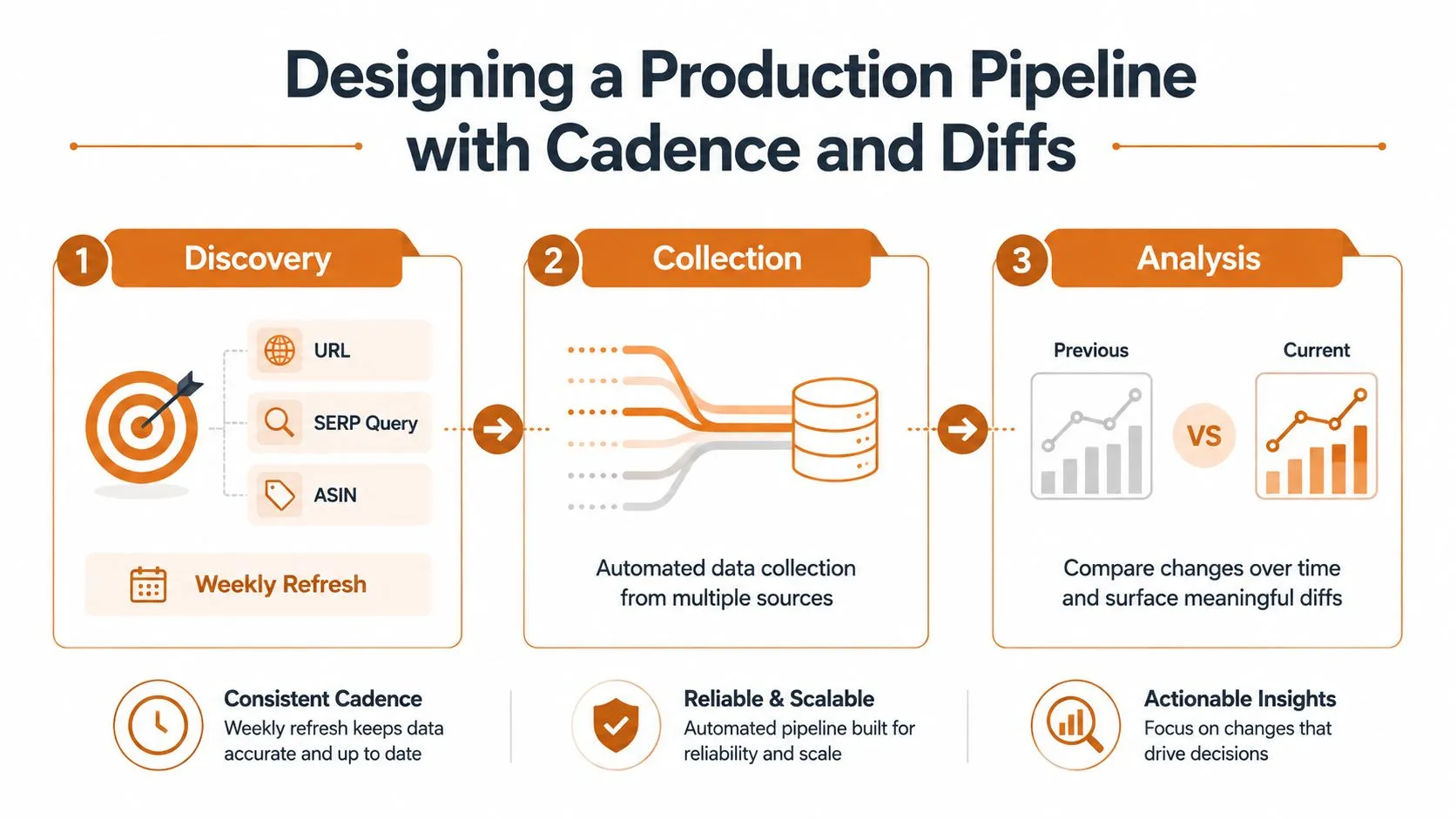
A reliable pipeline has three distinct blocks. Mixing them creates blind spots because the system can’t tell whether it failed to discover a target, failed to collect it, or collected it without recognizing the change.
Discovery maintains the target universe
Start with a target register containing competitor URLs, SERP queries, marketplace product identifiers, and ad slots. Refresh it weekly to find new products, detect newly promoted pages, and retire discontinued targets. A static URL list quickly becomes incomplete as competitors add products and reorganize navigation.
Discovery should preserve provenance. Record when a target was found, why it was included, which business owner requested it, and when it was last validated. This prevents accidental expansion from turning a focused CI program into an uncontrolled crawl.
Collection assigns work to cadence buckets
After discovery, assign each target to a schedule based on volatility and business impact:
- High-priority pricing and ad targets: Collect hourly or more frequently where the decision requires it.
- SERP rank and review counts: Collect daily when movement needs prompt detection.
- Full-page snapshots and historical pricing: Collect weekly for context and forensic comparison.
The verified production pattern described in scheduled competitive intelligence collection separates discovery, scheduled collection, and change detection. It describes monthly domain mapping, URL caching for 30 days, and different cadences for pricing, feature pages, and blog content. The important design choice is separation, not a universal schedule.
Diffs should create alerts
Normalize the response into structured fields, hash those fields, and compare the latest version with the prior accepted version. Preserve raw HTML or the equivalent source artifact so an analyst can replay the extraction when a change looks suspicious.
Alert design rule: A scrape is an observation. A meaningful field-level diff is an event.
Don’t send every text mutation to Slack. Cosmetic edits, reordered markup, rotating recommendation modules, and tracking parameters will overwhelm the team. Alert on business-defined conditions such as a price or tier change, a material feature-list update, a significant search movement, or a newly detected complaint cluster.
Teams building broader monitoring and alerting systems can also review instrumentation patterns for LLMs, especially where model-assisted parsing is part of the extraction path. For practical website monitoring patterns, monitoring website changes provides a relevant implementation reference.
Legal and Ethical Guardrails Every CI Program Should Enforce
Public visibility doesn’t automatically grant unlimited collection rights. A page may be accessible in a browser while the site’s terms, technical controls, copyright conditions, privacy obligations, or regional law restrict how an organization may access, store, and reuse its contents.
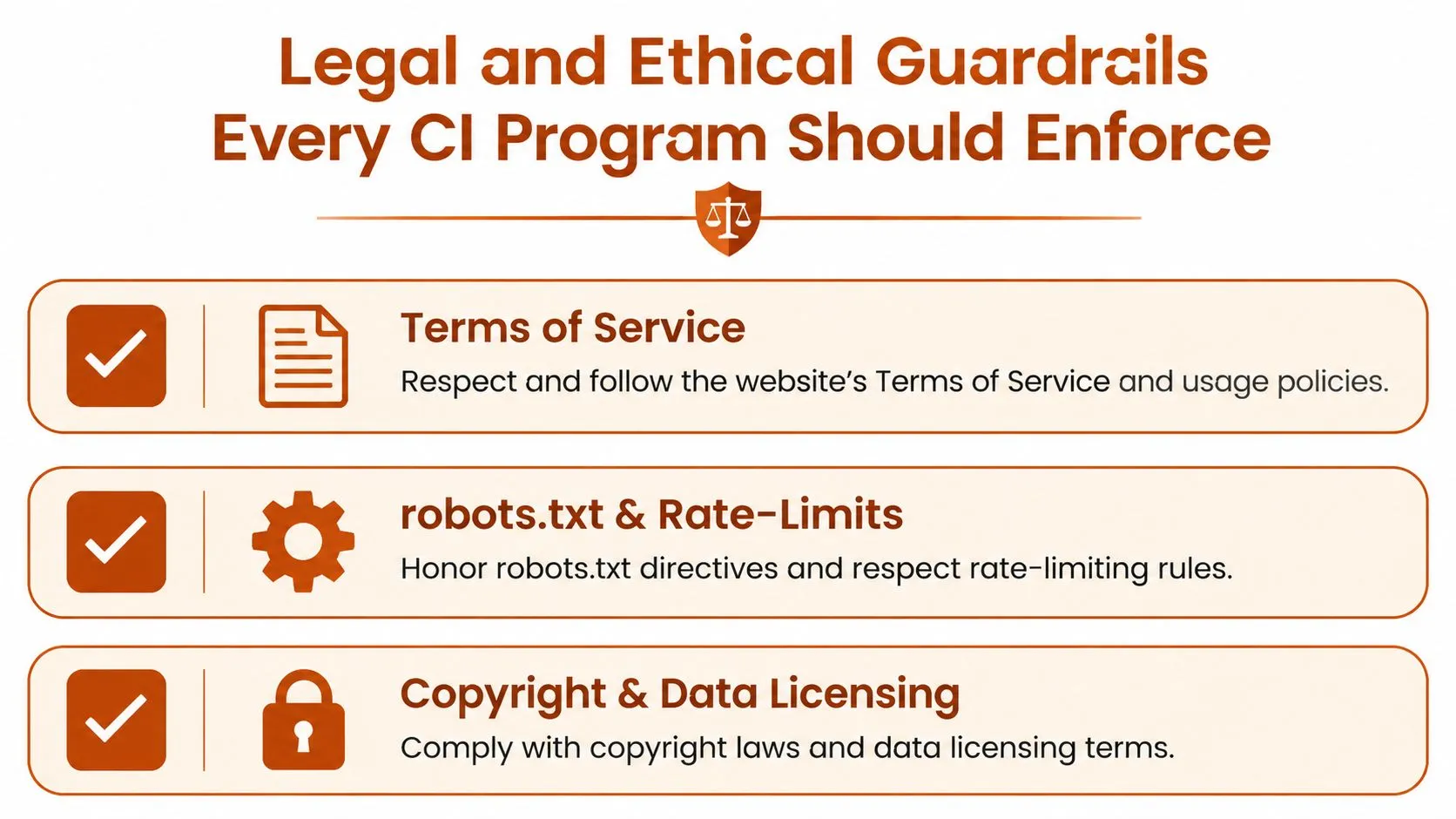
Three checks belong in every source review. First, read the terms of service and identify restrictions on automated access, reuse, and redistribution. Second, inspect robots.txt, rate-limit signals, and other technical instructions. Third, assess applicable privacy and cybersecurity rules, including the CFAA, GDPR, the EU Digital Services Act, and Singapore’s PDPA where relevant to the organization and data involved.
Legal outcomes are fact-specific. The hiQ v. LinkedIn litigation narrowed one interpretation of unauthorized access under the CFAA, but that doesn’t erase contractual claims, privacy obligations, access controls, or other causes of action. Court disputes involving automated collection have also shown that aggressive source practices can lead to injunctions and damages. A responsible program avoids treating a public page as an unrestricted data license.
Use a four-point release checklist
Before a new source enters production, require documented approval for:
- Lawful basis: Identify the legal basis for personal-data processing, the purpose of collection, retention rules, and access controls.
- Host instructions: Review terms,
robots.txt, stated limits, and provider documentation for the specific host. - Request behavior: Keep collection respectful, use retries and backoff, and avoid patterns that create unnecessary load or attempt to defeat explicit access restrictions.
- Response ownership: Assign a named owner for takedown requests, complaints, cease-and-desist letters, and source suspension.
Security should be a default property, not a late review. The principles in DevArmor’s security-by-default approach are applicable when designing credentials, logs, access permissions, and incident handling around CI infrastructure. Teams can also use ethical data collection guidance to formalize source review and responsible operating practices.
A defensible CI system stores only what it needs, limits internal access, documents decisions, and can stop a source quickly. Ethical discipline protects the data product’s continuity as much as it protects the organization.
KPIs, Use Cases, and Operational Requirements
A CI pipeline earns credibility through measurable behavior, not dashboard volume. Three KPIs provide a practical operating view: time-to-detect, coverage completeness, and alert precision.
| KPI | Target | Use Case | Proving Metric |
|---|---|---|---|
| Time-to-detect | Defined by decision urgency | Pricing | Median elapsed time between competitor change and alert |
| Coverage completeness | Set against the approved target register | Assortment tracking | Share of target SKUs, keywords, and placements captured per cycle |
| Alert precision | Above 80% as a production target | Ad verification | True positives divided by total alerts |
The right target depends on the decision. Pricing teams may define an internal threshold of under four hours because delayed detection can leave a margin response exposed. Assortment teams may set coverage completeness above 95% to limit blind spots across approved targets. Those are operating targets, not universal industry benchmarks, and they should be validated against the business’s cost of missing a signal.
Connect each KPI to an owner
For pricing, time-to-detect is meaningful only if an alert reaches someone who can review and act. For assortment tracking, coverage completeness needs a denominator that includes retired, unavailable, and newly discovered products, not just successful requests. For ad verification, alert precision determines whether media teams trust the feed or start ignoring it.
The operational layer makes those measurements real:
- Scheduled collectors: Run jobs through a controlled scheduler rather than personal scripts.
- Retry and backoff logic: Distinguish transient failures from blocked or structurally changed pages.
- Schema versioning: Preserve field definitions when extraction logic changes.
- Lineage logs: Record source, collection time, parser version, and transformation history.
- On-call ownership: Route crawl failures to a named technical responder.
- Benchmark reconciliation: Compare the feed with audited samples on a quarterly basis.
WebscrapingHQ can support this model with managed web data operations, custom extraction schemas, scheduled feeds, retries, monitoring, proxy management, and structured delivery formats such as CSV, JSON, webhooks, or S3 drops. The service fits teams that need recurring competitor pricing, SERP, marketplace, or landing-page data without assigning internal engineers to continuous scraper maintenance.
If your team needs dependable competitor pricing, SERP, listing, advertising, or review data, WebscrapingHQ can scope the sources, fields, cadence, and delivery format for a managed pipeline. Visit the site to discuss a production design that uses field-level change detection and operational monitoring instead of another manually refreshed spreadsheet.
Want this done for you?
Send us the URLs. We'll quote it in 24 hours.
Paste the URL(s) you want scraped. We'll reply within 24 hours with a feasibility check and a ballpark quote.