Jump to section
- Introduction Why Untangling Data Origins Matters Now
- Who needs provenance
- What a useful record makes possible
- What Data Provenance Really Means in Plain Terms
- The three building blocks
- Why structure matters
- Data Provenance vs Data Lineage and Related Concepts
- Provenance is the wider record
- A web scraping example
- Why Data Provenance Builds Trust Compliance and Better Models
- Trust and reproducibility
- Compliance and licensing
- AI reliability
- How Provenance Is Captured Across Web Data Operations
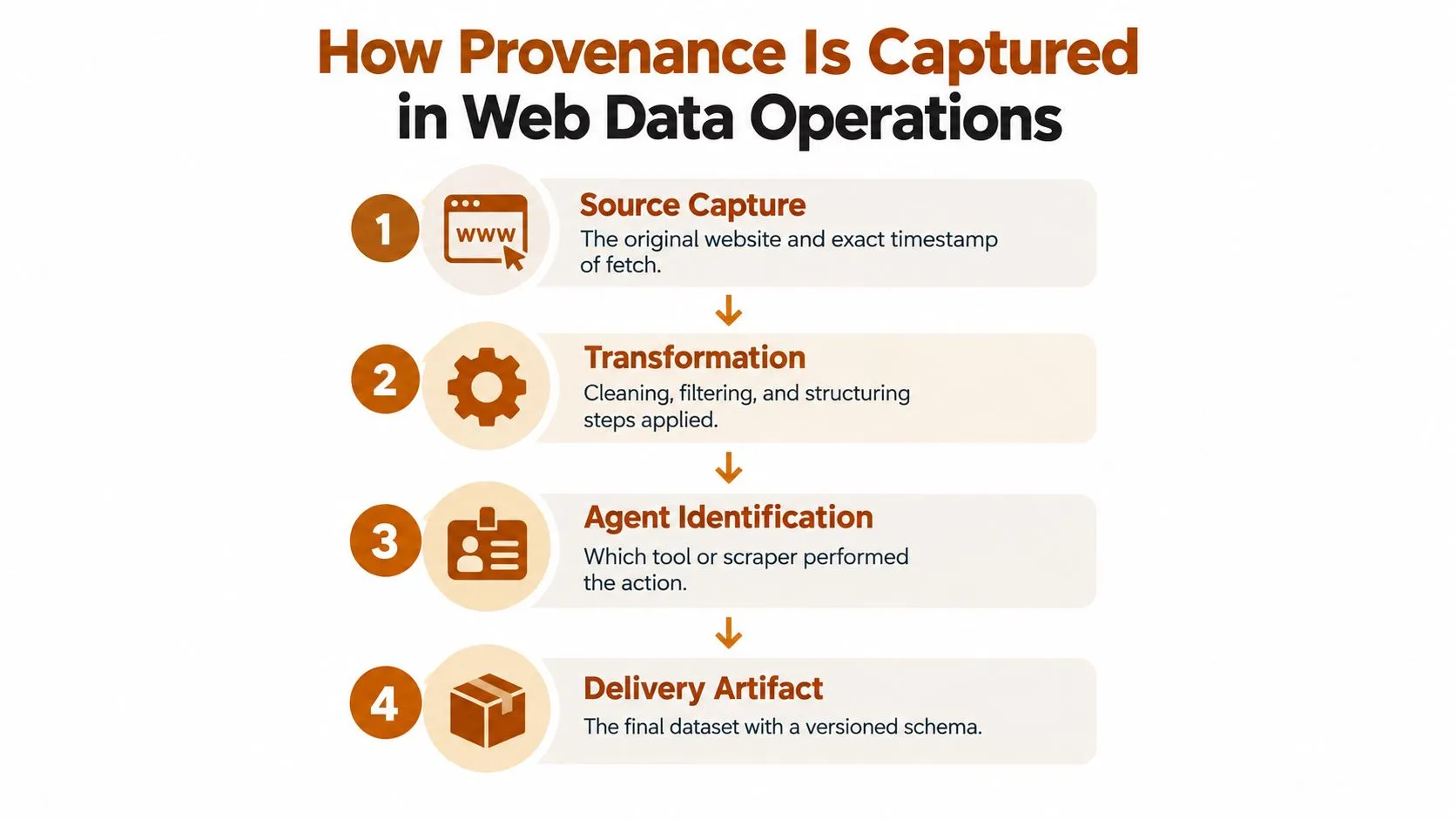
- Source capture
- Transformation history
- Agent identification
- Delivery artifacts
- Real World Examples and Use Cases That Show Provenance in Action
- Multilingual consumer signals
- Multimodal training data
- When source pages disappear
- Recommended Practices for Reliable and Audit Ready Provenance
Data provenance is the structured record of the entities, activities, and agents that produced, transformed, or delivered a dataset, enabling trust and auditability. The field has more than two decades of research behind it, and modern organizations now apply it to large-scale dataset auditing, licensing, and derivation tracking.
You may have encountered the problem without having a name for it. A dashboard shows two different prices for the same product. An ad verification report flags a dealer page, but the page has since changed. An AI model cites a statement that nobody on the team can trace back to its source.
The data may look polished. It may arrive in a clean CSV, a JSON feed, an S3 delivery, or a PDF report. Yet a clean output doesn’t prove that the underlying record is accurate, legally usable, or reproducible. Without a history of where the data came from and what happened to it, your team is forced to rely on assumptions.
That gap affects product managers, data engineers, compliance teams, analysts, and machine learning specialists. It also affects anyone operating managed web data pipelines, where websites change layouts, content disappears, languages vary, and text, images, audio, and video may be assembled into the same dataset.
This guide starts with the plain-language meaning of provenance, separates it from related concepts such as lineage and metadata, and then moves into practical capture methods. It also examines licensing, AI training data, multilingual sources, mixed media, schema versioning, and audit-ready delivery. A sound data governance policy gives those records a home, but provenance supplies the evidence inside them.
Provenance is trust infrastructure. It turns an unexplained data result into a result that a person can inspect, question, and reproduce.
Introduction Why Untangling Data Origins Matters Now
A product manager usually sees the final symptom first. A competitor’s price appears to have dropped, but the source page may have served a regional variant. A compliance team receives a monthly report with an exception, but nobody can tell whether the page was captured before or after a dealer corrected its content. A machine learning team discovers that a training record contains a claim it can’t verify because the original page no longer exists.
In each case, the immediate question is simple: Where did this value come from? The harder questions follow quickly. Which page supplied it? When was it retrieved? Which parser interpreted it? Did someone normalize the currency, translate the text, remove duplicates, or merge it with another source? Which version of the schema shaped the delivered record?
A provenance record answers those questions as an operational history rather than as a guess. The W3C PROV overview describes provenance through the entities, activities, and agents involved in producing or changing data. That structure applies equally well to a scientific workflow, a warehouse transformation, or a managed scraper that collects product information from changing websites.
Who needs provenance
Engineers need it to investigate broken fields and unexpected changes. Product teams need it to explain metrics to stakeholders. Compliance teams need evidence of source, processing, and responsibility. AI teams need a defensible account of what entered a training or evaluation corpus.
Web data adds operational difficulty because the source isn’t static. A page can change its price, language, layout, embedded media, or licensing statement after retrieval. A provenance system therefore needs more than a source domain. It needs a record of the specific retrieval event and the transformations applied afterward.
What a useful record makes possible
With sufficient provenance, a reviewer can distinguish a source change from a parser error. An engineer can compare schema versions and identify when a field changed meaning. A governance team can inspect whether a dataset was assembled from permitted sources and whether downstream reuse preserved the relevant rights information.
The rest of this guide builds that understanding progressively. It begins with a mental model, clarifies neighboring terms, examines the value for trust and compliance, then follows provenance through a managed web data operation before applying the ideas to concrete use cases.
What Data Provenance Really Means in Plain Terms
Start with a familiar object, such as a parcel. A tracking history may show where the parcel originated, which facilities handled it, when it changed direction, and which carrier delivered it. That history doesn’t guarantee the parcel contains what the label claims. It does give you a structured account that helps you investigate delays, responsibility, and handling.
Data provenance works similarly. It records the history surrounding a dataset or data value. For a web collection, the history might begin with a product page, continue through retrieval and parsing, include normalization and validation, and end with a versioned file delivered to a customer.
Data provenance is an asserted history of the entities, activities, and agents involved in creating, transforming, or delivering data.
The word asserted matters. Provenance records an account of what a system or responsible party says happened. It isn’t absolute truth by itself. If a scraper records that a page was fetched and parsed, the record supports that account. It doesn’t independently prove that the page was truthful or that the parser behaved correctly. Teams still need quality checks, validation rules, and review processes.
The three building blocks
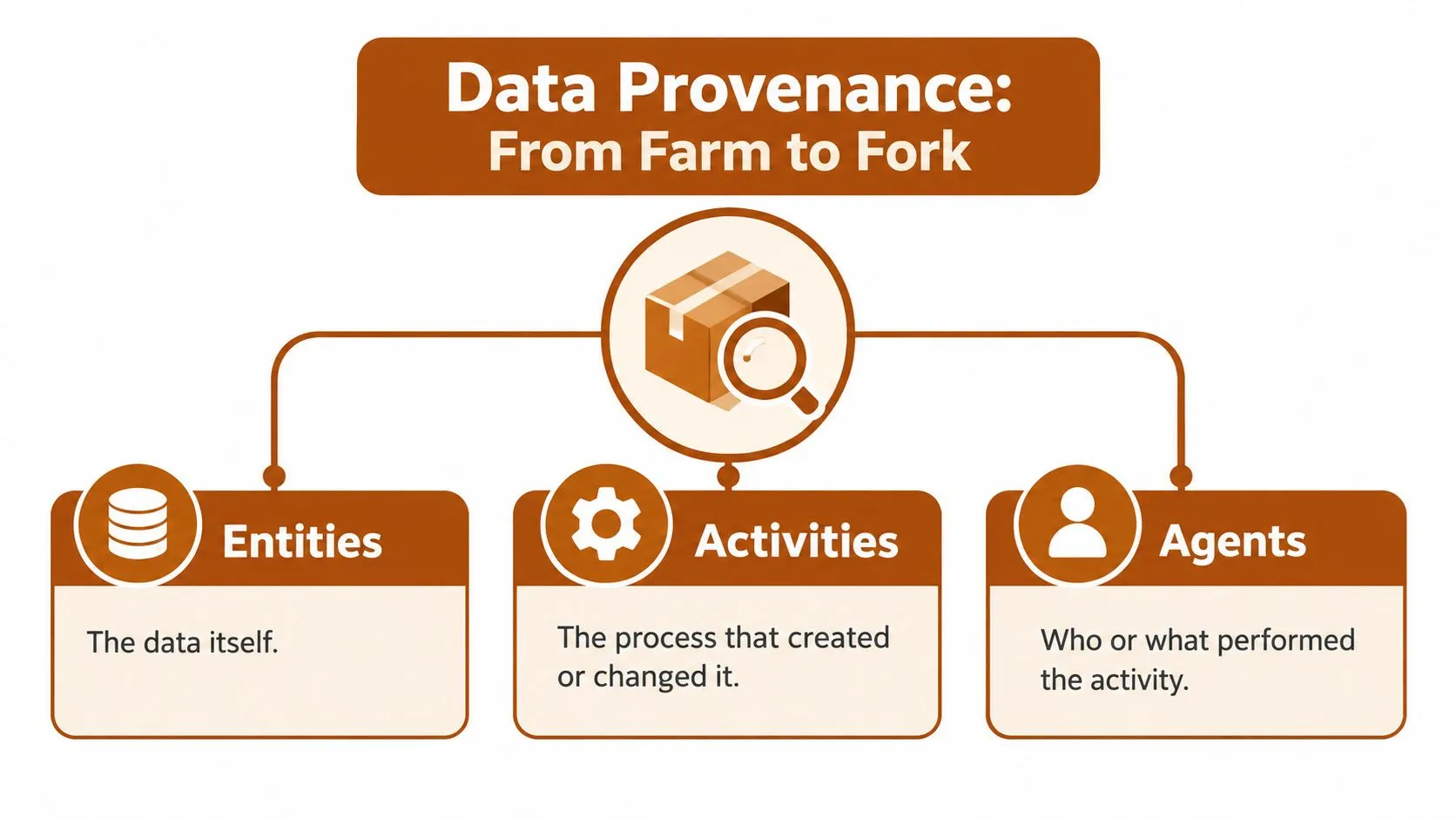
The W3C model uses three core categories:
- Entities: The data objects involved. These could be a source HTML document, an extracted product record, an image, a translated text segment, or a final report.
- Activities: The operations that create or change those entities. Examples include fetching, parsing, filtering, deduplicating, translating, joining, validating, and exporting.
- Agents: The people, services, or tools responsible for activities. An agent might be a scraper version, a scheduled workflow, an external translation service, or a human reviewer.
Together, these categories answer more than “what file did we receive?” They help answer which source files contributed to a report, which process transformed a field, who or what performed the work, and whether the output changed after publication.
Why structure matters
A structured record can travel across systems more reliably than an informal note in a spreadsheet. The W3C explains that provenance can be exchanged across representations such as RDF and XML, which supports interoperability even when internal platforms store data differently.
That principle is relevant to web data teams. A managed pipeline may retrieve pages, place raw captures in object storage, process records in a transformation service, and deliver JSON or CSV to a customer. If each stage records compatible provenance, the history can follow the data instead of stopping at the extraction server.
Parsing itself is only one activity in that chain. A reader learning what data parsing means should distinguish interpreting structure from documenting the history of that interpretation. Parsing produces a structured record. Provenance records how that record came to exist.
Data Provenance vs Data Lineage and Related Concepts
Teams often use provenance, lineage, metadata, and chain of custody as if they were interchangeable. They overlap, but they answer different questions. The distinction becomes important when a product manager asks why a value changed, an engineer investigates a failed field, or a compliance reviewer asks who handled a source.
| Concept | What It Records | Typical Question Answered |
|---|---|---|
| Provenance | The broader history of entities, activities, agents, transformations, and delivery | Where did this data originate, what happened to it, and who or what was involved? |
| Lineage | The path data follows through systems, datasets, fields, and transformations | Which source and processing steps led to this output value? |
| Metadata | Descriptive information about a data asset, such as schema, owner, format, or creation context | What is this dataset, how is it structured, and who manages it? |
| Chain of custody | Evidence of possession, handling, transfer, and control | Who had responsibility for this artifact at each point? |
Provenance is the wider record
Lineage is usually part of provenance, especially when it describes how a value moved and changed. For example, lineage might show that a product price moved from a captured page into a normalized table and then into a dashboard. Provenance can add the retrieval timestamp, parser identity, source license information, validation activity, delivery version, and responsible reviewer.
Metadata can describe the final table as containing a price field formatted as a decimal. Provenance can explain which page supplied the field, which parser extracted it, which normalization rule applied, and which schema version delivered it.
A web scraping example
Suppose a retail pipeline produces a record with a product name, price, currency, availability, and image URL.
- The metadata describes field names, data types, ownership, and update expectations.
- The lineage connects the delivered price to a source page and the transformations that shaped it.
- The provenance connects the source page, fetch activity, scraper agent, parser release, quality checks, license observations, and delivery artifact.
- The chain of custody helps establish how the raw capture and derived file were stored, transferred, and protected from untracked alteration.
A data quality system then checks whether the output satisfies expectations. That makes data quality monitoring tools complementary to provenance, not substitutes for it. Monitoring can tell you that a field is missing or has changed unexpectedly. Provenance helps explain why.
Use lineage to follow the path. Use provenance to understand the full history. Use metadata to describe the asset. Use custody records to establish controlled handling.
Keeping these boundaries clear prevents a common implementation mistake: recording only a diagram of system movement and calling it complete provenance.
Why Data Provenance Builds Trust Compliance and Better Models
Trust depends on the ability to inspect a result. A stakeholder doesn’t need a philosophical promise that a dataset is reliable. They need to know where a value came from, which process changed it, and whether the organization can defend its use.
The governance risk is visible in dataset ecosystems. A Data Provenance Initiative reports that more than 4,000 datasets have been audited, while separate research traces 3,713 text datasets across 108 collections. Those figures show that provenance has moved beyond small research notebooks into large-scale auditing, licensing, and derivation tracking. The figures and their context are documented by the National Network of Libraries of Medicine data provenance glossary.
Trust and reproducibility
A result is reproducible when another authorized person can reconstruct the relevant inputs and operations. In web data operations, that might require the captured source, retrieval context, parser version, transformation logic, validation outcome, and delivery schema.
Without those records, teams often re-run a scraper and receive a different page. The new result may reflect a legitimate source update, a regional variation, a temporary error, or a changed parser. Provenance gives the investigator a way to separate those possibilities.
Compliance and licensing
License information is often incomplete or inaccurate across dataset hosting environments. Independent MIT research found license omission rates above 68% and license error rates above 50% across widely used dataset hosting sites, as summarized in the verified provenance research materials. That doesn’t mean every dataset is unusable. It does mean teams shouldn’t treat a missing or copied license field as sufficient evidence of permitted use.
The same concern appears in scraped and assembled datasets. A source register should preserve observed rights information, collection context, and derivation relationships. For regulated workflows, teams can also consult practical guidance on GDPR-compliant web scraping, while remembering that provenance supports compliance evidence but doesn’t replace legal judgment.
AI reliability
AI systems inherit weaknesses from their inputs. If a model produces an unsupported answer, the team needs to trace the relevant training, retrieval, or evaluation data back to its source and processing history. Multimodal datasets make this harder because provenance may need to cover creators, licenses, languages, geographies, modalities, and derivation chains, not just text URLs. The Data Provenance Initiative publications document this broader direction.
Provenance is a measurable control for transparency, accountability, compliance, and data quality. It doesn’t make data true, but it makes claims about data inspectable.
How Provenance Is Captured Across Web Data Operations
A useful provenance system captures events as the pipeline runs. It shouldn’t depend on someone reconstructing the history after a customer asks a difficult question.
Source capture
The first record identifies the source precisely. For a web pipeline, capture the source URL, page or asset identity, retrieval timestamp, locale or geographic context when relevant, and the retrieval method. Preserve the raw response or an appropriate immutable reference where policy permits.
The timestamp is essential because websites are moving targets. A price, advertisement, product description, or compliance statement can change after collection. A source URL without retrieval context tells only part of the story.
Transformation history
Next, record each meaningful operation. Fetching, parsing, cleaning, filtering, translation, deduplication, image processing, field mapping, and joining should be represented as activities with identifiable versions.
A transformation record doesn’t need to capture every internal implementation detail in a way no person can read. It does need to identify the rule, code release, configuration, or service that changed the data. If a parser began treating a localized decimal separator differently, the record should make the responsible version discoverable.
Agent identification
An agent is the actor behind an activity. In managed operations, that may be a crawler configuration, a parser release, an OCR component, a language model, a translation service, or a human reviewer.
Record enough identity to distinguish one execution path from another. “Automation” isn’t useful if the team operates several scrapers or parser versions. Agent records should connect to execution IDs, configuration versions, and exception handling decisions.
Delivery artifacts
The final file should carry a relationship to the records that produced it. Store the delivery format, schema version, generation event, validation results, and destination. A CSV feed, JSON payload, S3 object, webhook, or PDF report should be identifiable as a particular artifact, not just as “the monthly export.”
Schema versioning deserves special attention. If a field changes from a raw string to a normalized value, or if a source adds a new multilingual field, the schema version should make that change explicit. Teams exploring structured machine learning data collection need this history because downstream feature logic can depend on field meaning, not merely field names.
Managed operations also need records for monitoring, retries, re-tuning, and site-change response. A failed fetch and a successful retry are different activities. A parser adjustment after a layout change is a new transformation event. Provenance remains useful only when it follows those changes rather than describing an idealized pipeline.
Real World Examples and Use Cases That Show Provenance in Action
Consider an ad verification bureau reviewing dealer websites. A report might identify whether required creative, offer language, or location information appeared on a page. If the dealer updates the page later, the reviewer needs the original retrieval context, captured evidence, extraction method, and exception notes. Provenance turns a disputed result into an inspectable record.
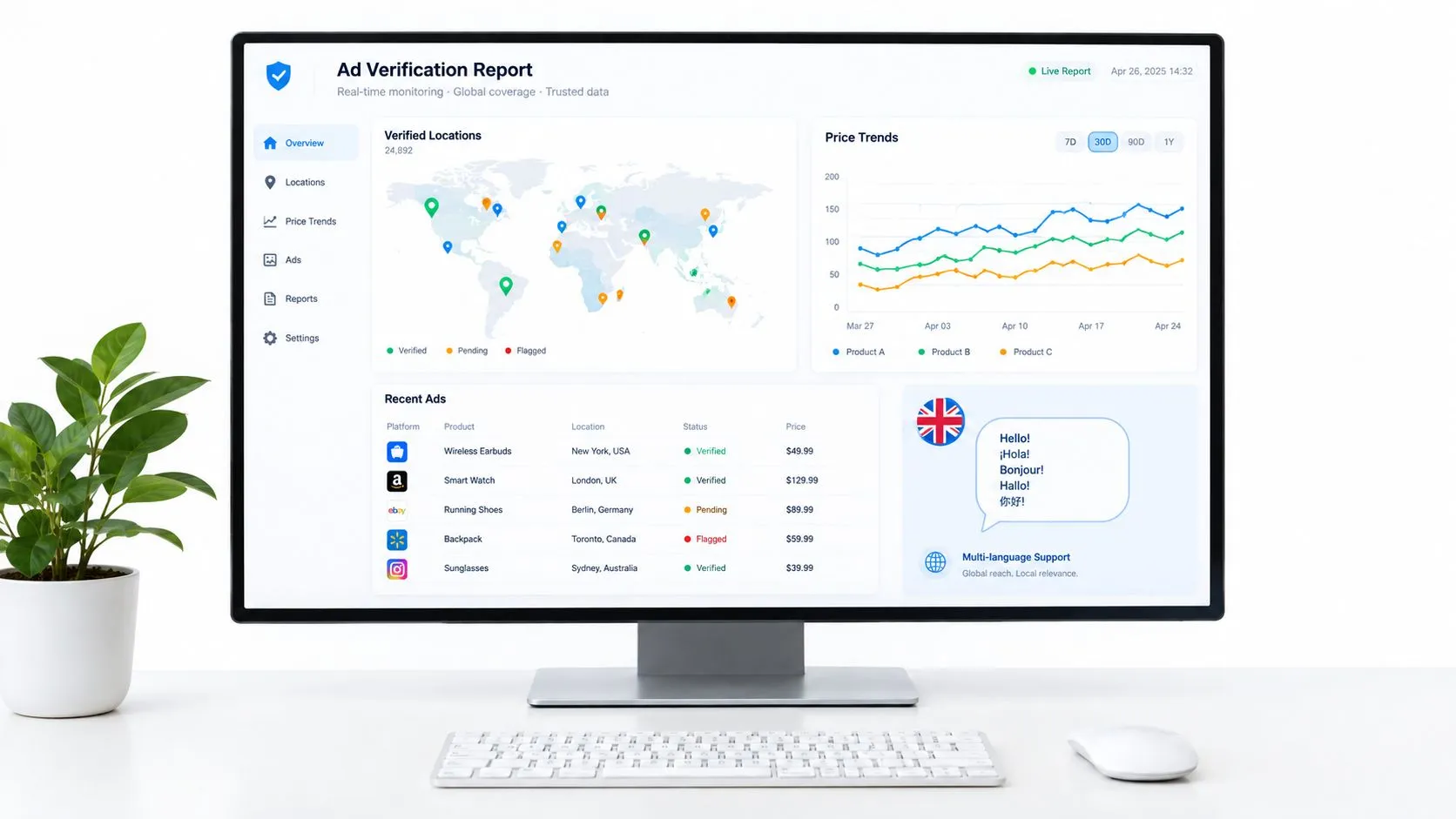
Retail price monitoring presents a different problem. A price can vary by country, language, seller, membership state, or time of retrieval. A delivered record should link the normalized value to the source representation, locale, retrieval event, currency handling, and parser version. When a stakeholder asks why two observations differ, the team can investigate the source context instead of arguing over the final spreadsheet.
Multilingual consumer signals
Natural language pipelines often combine reviews, news, product descriptions, and public comments from multiple languages. Translation and normalization can introduce new derived entities, so the provenance record should preserve the original language, source text reference, translation activity, and model or service identity.
This is especially important when an analyst wants to distinguish a genuine consumer signal from a translation artifact. The output may be standardized for an NLP model, but the original source and transformation path must remain available for review.
Multimodal training data
A multimodal dataset may combine text, speech, images, and video. Provenance must connect each asset to its creator or source, rights information, language or geography, modality, processing steps, and later derivatives.
The difficult question is not only whether an image was downloaded. It is whether the image was cropped, resized, captioned, paired with text, or included in a training collection under terms that permit the intended use. A provenance graph can preserve those relationships even when the final training manifest contains only compact identifiers.
When source pages disappear
Source change is normal in web operations. A page can be removed, redesigned, translated, redirected, or populated dynamically. Audit-ready delivery therefore benefits from retaining source references alongside permitted captures, content fingerprints, retrieval timestamps, and exception records.
Good provenance doesn’t freeze the web. It preserves what the pipeline observed and how the organization converted that observation into a delivered artifact.
Recommended Practices for Reliable and Audit Ready Provenance
Reliable provenance starts with a small set of records applied consistently. Capture the event at the point where it happens, not weeks later during an audit.
- Record source identity: Preserve the URL or source identifier, retrieval context, timestamp, locale, and relevant access method.
- Version transformations: Identify parser, extractor, translator, OCR, vision, and normalization versions that affect output.
- Link agents to executions: Store the workflow, tool, service, or reviewer responsible for each activity.
- Track schema changes: Give delivered datasets explicit schema versions and document changes in field meaning or representation.
- Preserve quality evidence: Connect validation results, rejected records, retries, and exception handling to the affected execution.
- Keep rights metadata: Record observed licensing, attribution, creator, and permitted-use information alongside source and derivation relationships.
- Protect delivery history: Relate each CSV, JSON feed, S3 object, webhook payload, or PDF report to its generating event and validation state.
A practical audit record should be readable by both engineers and reviewers. Use interoperable representations where possible, and ensure that identifiers remain stable across storage and delivery systems. The audit logging best practices guide offers useful context for designing event records that support investigation rather than merely filling a log store.
Governance teams should also test the record itself. Can a reviewer trace a field to its source? Can an engineer identify the parser version? Can the organization explain how a multilingual or mixed-media input was transformed? If the answer is no, the provenance system is incomplete.
Provenance isn’t a one-time documentation project. It is an operating discipline that grows with every source change, schema revision, retry, transformation, and delivery.
WebscrapingHQ provides managed web data operations that can capture source context, run custom extraction pipelines, monitor site changes, apply schema versioning and quality controls, and deliver structured feeds or reports. Visit WebscrapingHQ to discuss a web data workflow that leaves your team with traceable, audit-ready records rather than unexplained outputs.
Want this done for you?
Send us the URLs. We'll quote it in 24 hours.
Paste the URL(s) you want scraped. We'll reply within 24 hours with a feasibility check and a ballpark quote.