
Jump to section
- The Critical Need for Accurate Hotel Data in the USA
- From manual checks to structured observations
- Navigating the Legal Landscape of Hotel Data Scraping
- A practical decision framework
- Why Generic Scrapers Fail at Hotel Data Collection
- Where the apparent savings disappear
- Building a Robust Hotel Data Pipeline
- Four layers that keep the feed usable
- Operate the pipeline as a service
- Understanding Hotel Rate Data Sources and Structures
- Par rates versus booked rates
- Best Practices for Compliance and Data Governance
- Controls that belong in the operating model
- The Future of Hotel Data Intelligence Services
- Live intelligence needs dependable foundations
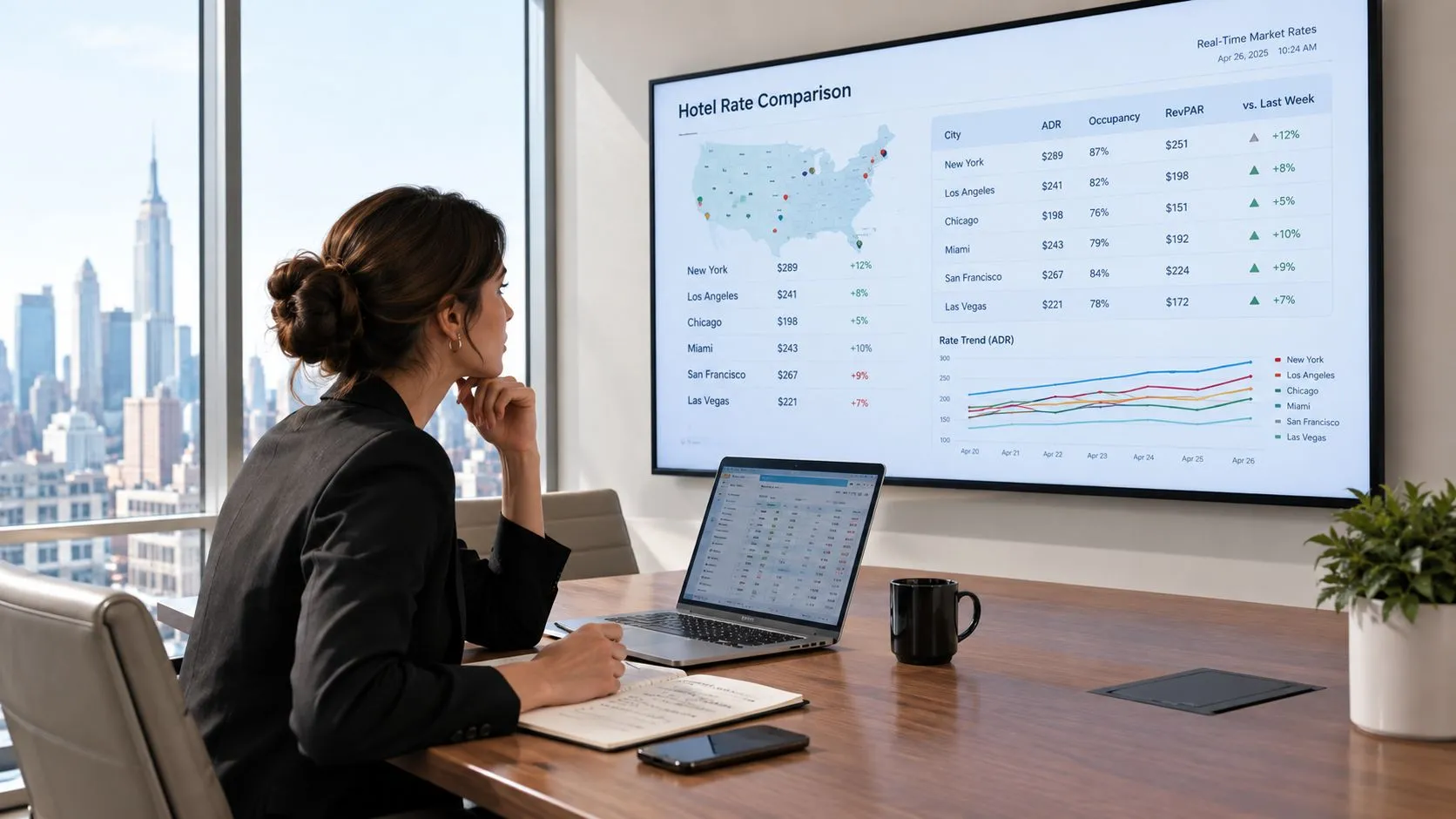
A revenue manager starts the morning by checking rate changes across a competitive set. One property has introduced a short-term promotion, another has changed its room inventory, and a third now displays a different price depending on dates and occupancy. By the time the analyst has recorded the findings, the first observations may already be outdated.
That problem becomes unmanageable when the team needs consistent coverage across an entire U.S. market. Manual review can’t provide the frequency, structure, or auditability required for revenue management, competitive benchmarking, and compliance monitoring. Hotel data scraping services in the USA exist to turn scattered public observations into usable feeds, but the service must solve more than page extraction. It must also address legal boundaries, changing schemas, data quality, and operational continuity.
The Critical Need for Accurate Hotel Data in the USA
A market analyst responsible for a regional hotel portfolio rarely needs another spreadsheet filled with isolated prices. The analyst needs comparable observations, tied to property identities, room types, occupancy conditions, dates, and source context. Without that structure, a rate change can look like a pricing decision when it may reflect a different cancellation policy, a different room category, or a different search window.
The scale of the U.S. market makes manual collection unrealistic. The industry includes nearly 55,900 properties and 5.3 million guest rooms, counting properties with 15 or more rooms, according to this overview of hotel data providers and collection requirements. Every property may update its own website, while major chains and online travel agencies present overlapping but not identical information.
From manual checks to structured observations
A specialist service typically collects public fields such as:
- Property identity: Name, address, location identifiers, and source-specific listing IDs.
- Commercial conditions: Public room rates, availability signals, promotions, and cancellation terms.
- Descriptive information: Room categories, amenities, policies, ratings, and review content where collection is permitted.
- Observation context: Search dates, stay dates, retrieval time, currency, occupancy inputs, and source.
That context matters because a price without its query conditions is not a dependable benchmark. A structured feed lets an analyst compare like with like, identify changes, and send normalized records into a revenue or business intelligence system. Guidance on organizing this work appears in competitive intelligence gathering for structured market monitoring.
Practical rule: Treat every rate as an observation with conditions, not as a universal property of the hotel.
Automation also improves operational focus. Instead of assigning staff to repeat the same searches, a business can direct them toward exception review, source validation, and commercial decisions. The value isn’t just faster crawling. It is the creation of a repeatable evidence layer that supports decisions across properties that change independently.
Navigating the Legal Landscape of Hotel Data Scraping
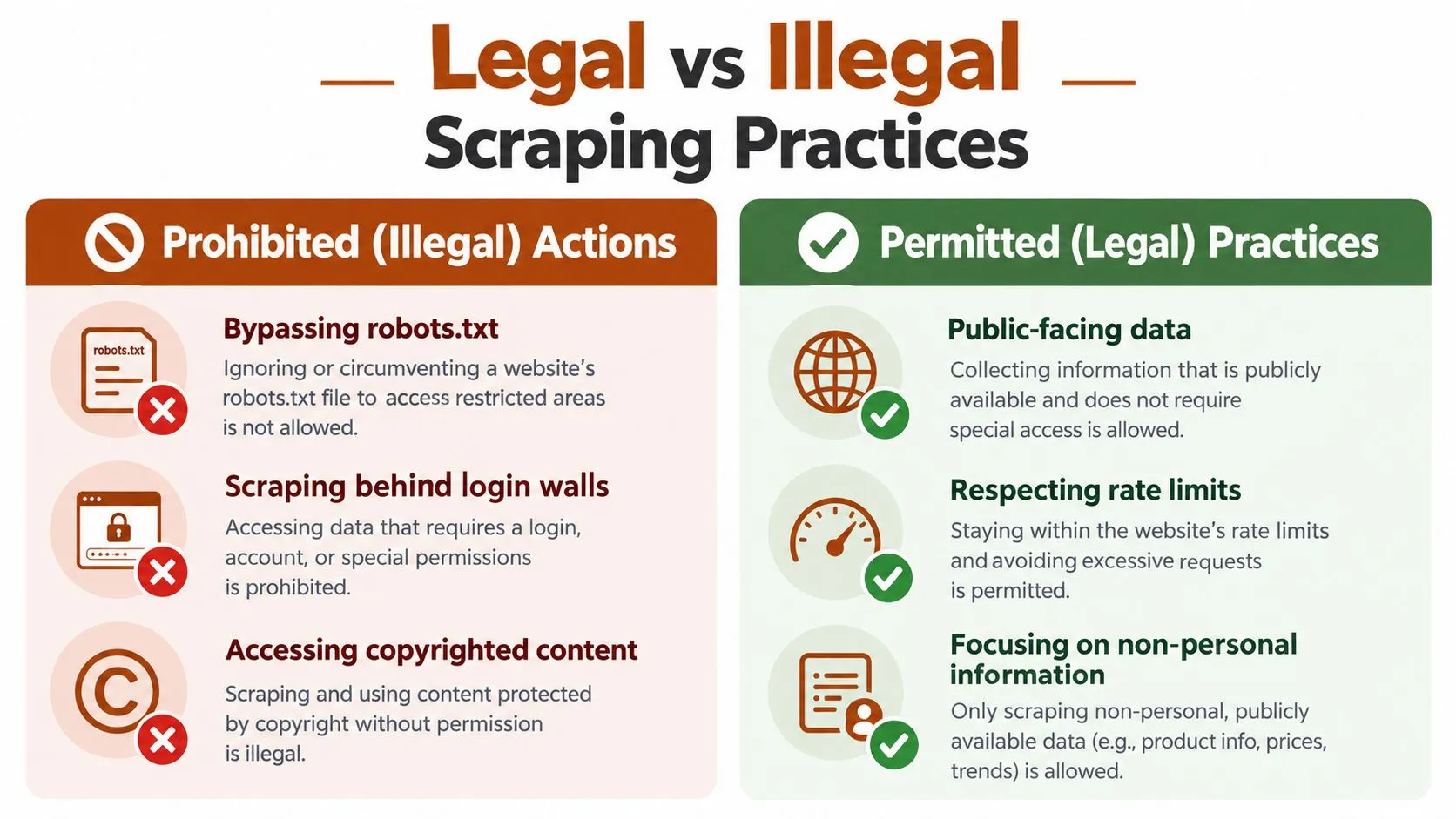
The common claim that publicly visible hotel pricing is automatically safe to scrape is too broad. Public accessibility and permission to automate access are related questions, but they aren’t identical. A page can be visible to an ordinary visitor while the site’s terms of service restrict automated collection, impose access conditions, or prohibit particular uses.
The legal discussion around public web data in the United States was shaped by the Ninth Circuit’s view, summarized in hospitality-data commentary, that scraping publicly accessible websites likely doesn’t violate the federal Computer Fraud and Abuse Act when the activity doesn’t interfere with the site. The later 2022 Ninth Circuit ruling in hiQ Labs v. LinkedIn strengthened confidence that publicly accessible data doesn’t necessarily fall within the CFAA’s access restrictions, as discussed in this analysis of hotel data scraping and public access.
That precedent doesn’t create a blanket authorization for every hotel workflow. Terms of service can still prohibit automated access, and a platform may respond to collection with account restrictions or a civil dispute. The risk also changes when a workflow moves from public pages to logged-in areas, personal data, restricted endpoints, or methods designed to defeat technical controls.
A practical decision framework
Before production collection begins, the team should document:
- Source status: Is the target information publicly accessible without an account or special authorization?
- Contract terms: Do the relevant terms of service restrict automated access, reuse, or commercial extraction?
- Collection behavior: Does the system respect published directives, use controlled request rates, and avoid interference?
- Data scope: Is the workflow limited to commercial and non-personal information, or might it capture guest details and account data?
- Output purpose: Will the records support internal benchmarking, a customer-facing product, or a competitive service that creates additional legal considerations?
The right response to uncertainty isn’t to hide the collector. It is to pause, document the use case, and obtain legal advice appropriate to the source and business model. A useful companion is this guide to legal risks in web scraping and mitigation practices.
A compliant design should also include a stop mechanism. If a source changes its access rules, begins returning restricted content, or shows signs of operational strain, the pipeline should reduce activity or stop rather than repeatedly retrying. Legal review belongs in the operating process, not only in the initial project plan.
Why Generic Scrapers Fail at Hotel Data Collection
A generic scraper usually succeeds on the first page and fails on the business requirement. It can retrieve visible HTML from a stable page, but hotel workflows often involve date selectors, occupancy inputs, client-side rendering, changing room cards, localized currencies, and results that appear only after interaction. A selector that extracts a rate today may return an empty field after a layout release.
The difference between a script and a production service is visible in the failure modes:
| Generic DIY scraper | Managed hotel collection service |
|---|---|
| Assumes a stable page structure | Monitors source changes and updates parsers |
| Often treats an empty response as valid | Uses validation rules and anomaly alerts |
| Leaves proxy and retry behavior to the developer | Operates controlled routing, retries, and throttling |
| Produces source-specific output | Maps records into a documented schema |
| Requires internal maintenance | Absorbs recurring operational work |
Where the apparent savings disappear
Anti-bot measures are only one challenge. A collector may receive a challenge page, an incomplete result, a regional variant, or a response that looks successful but contains no room data. Blind retries increase load without improving coverage, while aggressive automation can create account blocks and new compliance concerns.
Dynamic content creates another trap. A parser may capture the property name and headline price but miss the rate plan, taxes, cancellation policy, or room type loaded through a later interaction. Image capture can matter too, especially when a business needs to verify property presentation or compare visual content. A low-resolution or inconsistent capture isn’t equivalent to a validated property record.
A scraper that returns malformed data with a successful HTTP response is still failing.
Generic tools remain useful for a narrow prototype, a single stable source, or a short exploratory exercise. They become a poor fit when the buyer needs recurring delivery, multiple geographies, source-specific logic, and dependable downstream fields. At that point, the engineering cost isn’t the initial parser. It is the maintenance system around the parser.
Building a Robust Hotel Data Pipeline
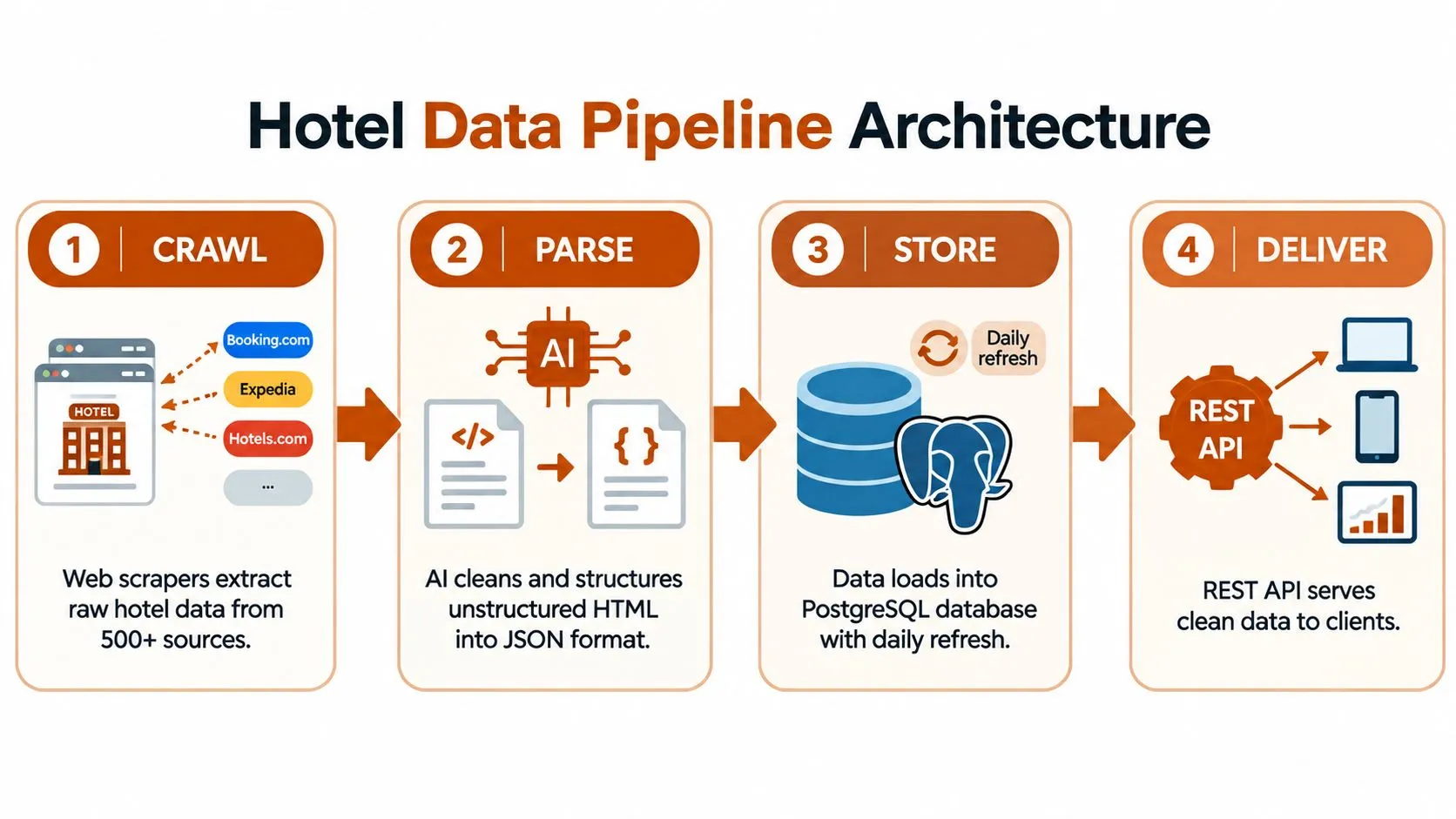
A production pipeline starts with a contract for the data, not with a browser script. Define the target properties, source pages, search parameters, fields, update cadence, acceptable latency, and failure behavior. Separate required fields from optional enrichment so a missing review count doesn’t invalidate a usable rate record.
Four layers that keep the feed usable
-
Collection should preserve evidence. Store the source, retrieval timestamp, query inputs, response status, and raw artifact where retention and rights permit. A raw snapshot helps engineers explain why a normalized value changed and helps reviewers distinguish a source change from a parser defect.
-
Parsing should be source-aware. Use selectors, structured data, browser interaction, and language-model-assisted extraction where appropriate, but validate every result against field rules. A rate should have a currency and relevant stay conditions. A room should map to a known category or be flagged for review.
-
Normalization should resolve meaning. Standardize property identities, addresses, currencies, room labels, amenities, policies, and date formats. Keep the original source value alongside the normalized value. That dual representation preserves traceability without forcing every downstream user to understand each source’s vocabulary.
-
Delivery should match the consumer. An analytics team may need files or warehouse loads, while an application may require an API or webhook. Define freshness indicators, error states, schema versions, and record identifiers so consumers can handle changes without guessing.
Schema versioning is the safeguard many teams omit. When an OTA changes a field or moves a room card, publish a new schema version, test it against fixtures, and keep the previous contract available during migration. A practical overview of scalable data architecture is this data pipeline guide for proptech, which is useful beyond property data because the same concerns apply to extraction, validation, storage, and delivery.
Operate the pipeline as a service
Monitoring should measure more than job completion. Track field completeness, unexpected value distributions, duplicate rates, source response types, and freshness. Use retries only for transient failures, with bounded backoff and a clear dead-letter path for records that need investigation.
Teams evaluating implementation patterns can also consult this hotel data scraper guide. The central design principle remains simple: a successful crawl is not the same as a trustworthy feed.
Understanding Hotel Rate Data Sources and Structures
Hotel rate data is often misunderstood because the displayed price looks more definitive than it is. A public search observation usually records the cheapest publicly available price returned for the query at that moment. It isn’t necessarily the price a guest ultimately booked, and it shouldn’t be treated as realized transaction revenue.
One U.S. benchmarking dataset illustrates the scale and structure of this distinction. It contains 128,536,941 public rate observations across 50 major markets, collected from May 2024 to April 2026, with each observation defined as a par rate and searched 10 to 180 days before check-in, as described in the hotel prices dataset methodology. Those figures are useful because they show how a large observation set can be made comparable through consistent search definitions, but they also expose the limits of the result.
Par rates versus booked rates
A par rate is an observed public offer under specified conditions. A booked rate is the realized commercial outcome after a guest selects a room and completes a transaction. The two can diverge because of inventory changes, taxes, restrictions, member pricing, package conditions, cancellation rules, or a different room category.
A useful record therefore includes more than price. It should retain:
- Stay parameters: Check-in and check-out dates, occupancy inputs, and query timestamp.
- Offer identity: Room type, rate plan, cancellation terms, inclusions, and restrictions.
- Price context: Currency, displayed total or nightly basis, taxes where shown, and source label.
- Availability state: Whether the result was bookable, unavailable, sold out, or ambiguous.
- Provenance: Source URL or identifier, parser version, and collection status.
Search-window bias needs explicit treatment. A property observed close to check-in may have a different inventory position from the same property observed much earlier. Time sensitivity also means that two collectors running at different moments can produce different but valid observations. Normalization can align dates, currencies, occupancy, and field names, but it can’t turn a public search observation into a booked-rate record.
For teams working with Priceline-style sources, this guide to a Priceline hotel scraper provides useful context on the range of property and offer fields that may need mapping. The engineering lesson is to preserve query conditions instead of flattening every result into an unexplained average.
Best Practices for Compliance and Data Governance
Compliance isn’t a document that sits beside the pipeline. It is a set of controls that determines what the collector requests, what the system stores, who can access it, and when it stops. That matters commercially because a feed that depends on repeated rule violations is not a durable asset. A platform may change its terms, block access, or challenge the business even when the original fields were publicly visible.
Controls that belong in the operating model
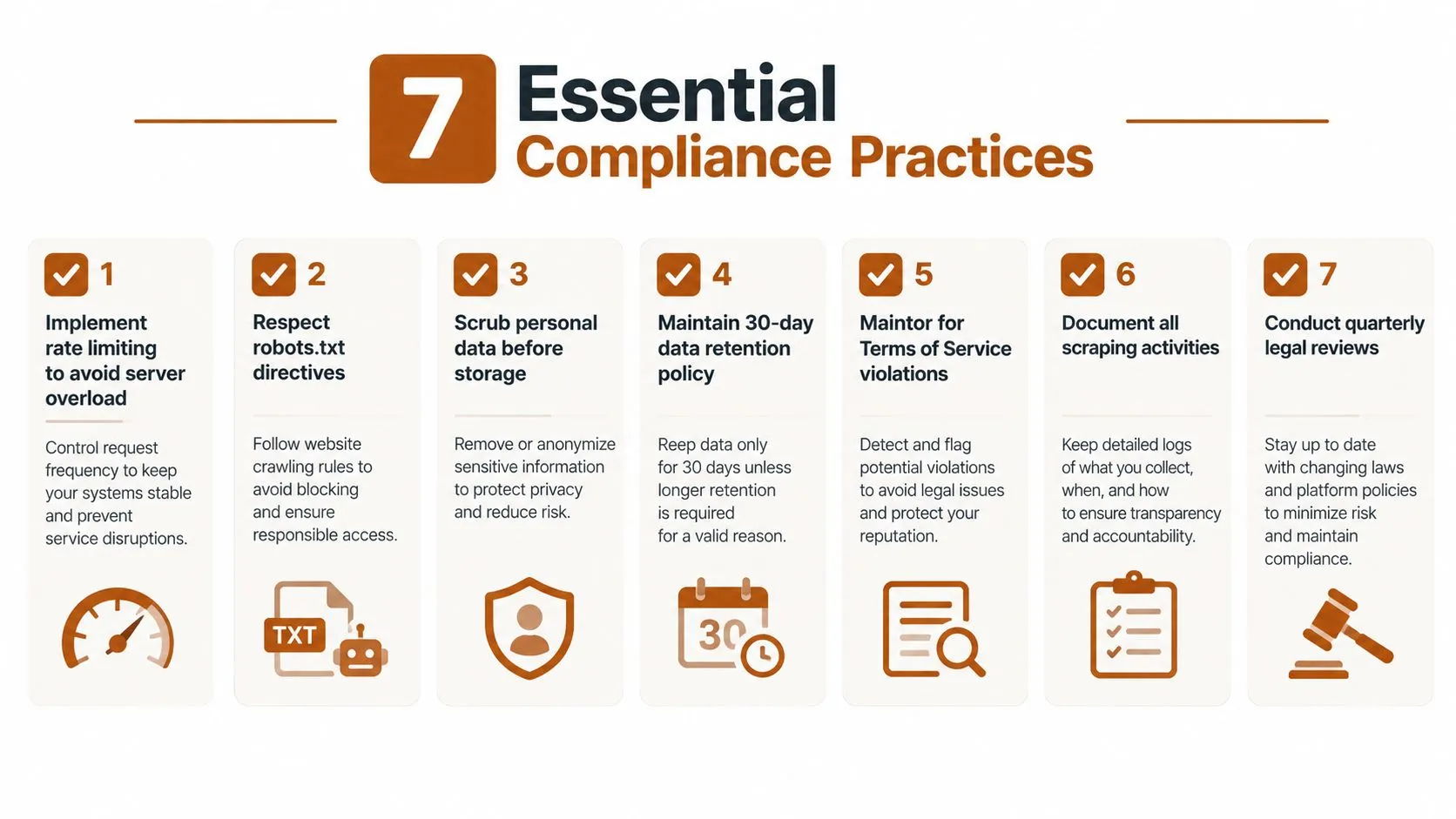
- Minimize collection: Request only the fields required for the approved use case. Don’t retain guest names, contact details, account information, or other personal data when commercial rate intelligence is sufficient.
- Set retention rules: Define how long raw pages, screenshots, normalized records, and logs remain available. The required compliance practice shown in the operational checklist is a 30-day data retention policy, but the appropriate period should be confirmed for the specific use case and legal environment.
- Respect source signals: Check robots.txt and terms of service before launch, then monitor for changes. A robots.txt directive isn’t a complete legal analysis, but ignoring it is a poor governance decision.
- Control request behavior: Use rate limits, bounded concurrency, sensible scheduling, and a backoff strategy. The collector should avoid unnecessary load and stop when the source signals a problem.
- Document decisions: Record source approvals, field purpose, collection dates, parser versions, exceptions, and review outcomes.
- Review access: Restrict raw artifacts and logs to staff who need them. Apply deletion workflows rather than relying on engineers to remove data manually.
- Escalate uncertainty: Send new source types, personal-data exposure, and changes in commercial use to legal or privacy review.
A governance policy should connect each field to a purpose and owner. It should also explain how the business handles deletion requests, source complaints, accidental personal-data capture, and suspected terms violations. Teams that manage sensitive operational records may find these trust accounting compliance tips helpful as a broader governance reference, even though hotel scraping has its own source-specific issues.
Governance test: If nobody can explain why a field was collected, how long it is retained, and who approved its use, the field doesn’t belong in the production feed.
A detailed data governance policy examples resource can help translate those principles into reviewable procedures. The objective isn’t to eliminate every operational risk. It is to make decisions visible, repeatable, and correctable before a small collection issue becomes a business-wide incident.
The Future of Hotel Data Intelligence Services
Hotel data operations are moving toward a model in which collection, interpretation, and governance work together. A future revenue workflow won’t receive just a list of prices. It will receive normalized observations with source context, confidence signals, change history, and an explanation of whether a difference comes from price, inventory, room type, or policy.
Artificial intelligence can support that workflow by helping classify inconsistent room labels, detect layout changes, identify duplicate properties, and map multilingual descriptions into a common schema. It shouldn’t be treated as an unchecked replacement for validation. A model can extract a plausible value from the wrong card, infer a room type incorrectly, or normalize two similar properties into one. Human review remains important for low-confidence records and new source patterns.
Live intelligence needs dependable foundations
Near-real-time monitoring will increase demand for systems that can respond to changes without turning every source into a maintenance project. The important capabilities won’t be limited to crawling speed. Buyers will look for:
- Change detection: Alerts when a layout, field, access rule, or response pattern changes.
- Schema continuity: Versioned contracts that protect downstream revenue and analytics systems.
- Contextual records: Search conditions and provenance preserved with each observation.
- Flexible delivery: APIs, files, webhooks, warehouse loads, and review dashboards aligned to different consumers.
- Responsible collection: Rate controls, data minimization, retention enforcement, and documented source decisions.
- Geographic and language handling: Localized searches and normalization that preserve market differences instead of erasing them.
The market already points toward live, near-real-time, and multi-language collection across broad source networks, but advertised coverage isn’t the same as operational reliability. The buyer’s real question is whether the provider can maintain a production feed when layouts change, responses fail, fields drift, and legal requirements differ by source.
The strongest hotel data strategy will combine narrow scope with disciplined expansion. Start with a defined set of properties, fields, query conditions, and delivery expectations. Measure completeness and stability, investigate anomalies, then add sources only when the team can govern them. That approach produces a smaller feed people can trust rather than a larger feed that mixes incomparable observations.
Technical sophistication matters, but it can’t compensate for weak controls. A dependable hotel intelligence service joins careful public-data collection with schema stability, traceability, monitoring, and a clear response to uncertainty. Those are the foundations that let revenue teams and analysts use automated observations without confusing scraped data with ground truth.
For teams that need recurring hotel rates, availability, reviews, or competitive records, WebscrapingHQ designs and operates managed extraction pipelines with monitoring, retries, schema controls, and scheduled delivery. Visit the site to discuss a source-specific feed that matches your fields, compliance requirements, and downstream system.
Want this done for you?
Send us the URLs. We'll quote it in 24 hours.
Paste the URL(s) you want scraped. We'll reply within 24 hours with a feasibility check and a ballpark quote.