Jump to section
- Table of Contents
- Why Mercado Libre Demands Production-Grade Scraping
- Scale changes the architecture
- API coverage should come first
- Choosing the Right Extraction Technique
- A field-by-field decision
- Extraction Technique Comparison for Mercado Libre Data
- Engineering Around Anti-Bot Defenses
- Build an adaptive request layer
- Data Quality Failures That Hide in Plain Sight
- What silent corruption looks like
- Separate extraction from acceptance
- Scaling Across Latin American Markets
- Abstract the stable parts
- Preserve localization at ingestion
- Schema Design and Delivery Pipelines
- Make change survivable
- Match delivery to the consumer
- Deciding Between In-House and Managed Operations
Mercado Libre’s e-commerce revenue was estimated at US$65,037 million in 2025, up from US$51,467 million in 2024, while monthly e-commerce sales reached US$6,528 million in July 2026. That scale creates a valuable target for a Mercado Libre scraper, but it also exposes the weakness of page-level scripts that appear to work while returning stale prices, incomplete variants, or the wrong country’s shipping data. ECDB’s Mercado Libre market data makes the operational point clearly: this isn’t a one-time extraction problem. It’s a continuously changing data system.
Table of Contents
Open Table of Contents
Why Mercado Libre Demands Production-Grade Scraping
A marketplace serving about 100 million unique active buyers in 2024 and selling about 1.7 billion items in the same year produces a moving data target. ECDB’s retailer analysis places those figures in context: prices, inventory, fulfillment, promotions, and seller offers can all change between collection runs.
A script that requests a page, selects a price element, and writes a CSV row may look successful for weeks. It can still capture a stale cached response, miss attributes loaded asynchronously, treat a promotional label as a permanent property, or report stock that has already changed. Silent failures are the expensive ones. The record remains syntactically valid, so downstream systems accept bad data without raising an error.
Scale changes the architecture
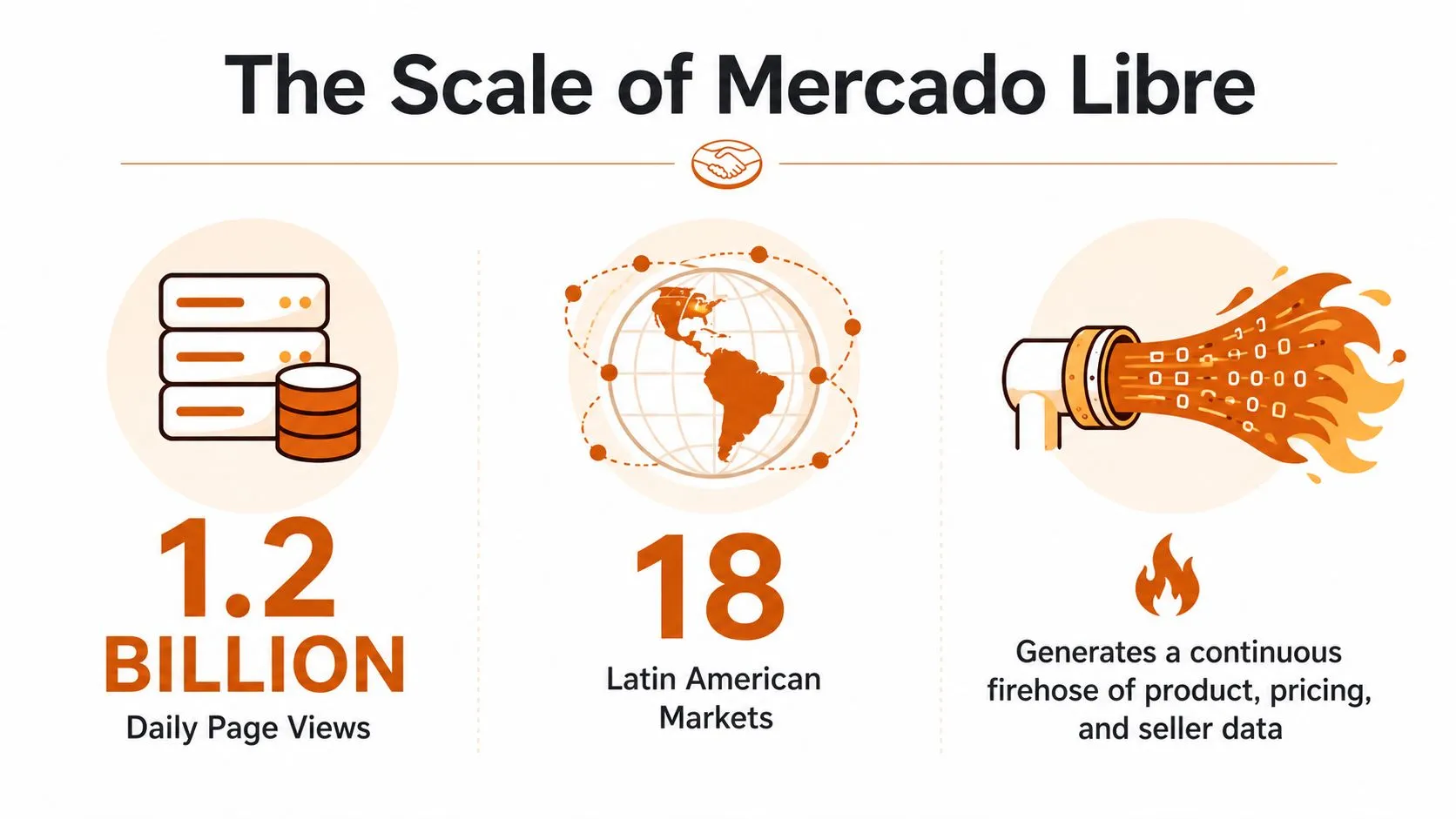
Mercado Libre operates across 18 or more countries, with one industry summary citing more than 218 million users across the region and a market capitalization above US$70 billion in 2025. Miracuves’ overview of Mercado Libre’s regional footprint also reports 2025 GMV of about US$32,299 million in Brazil, US$12,894 million in Mexico, and US$12,335 million in Argentina.
These markets are separate operating environments, not one storefront with translated text. A production pipeline must handle localized domains, currency formats, language, category taxonomies, availability rules, shipping messages, and market-specific defenses. Schema drift is common: the same business concept may appear under different labels, nesting, or value formats by country. A parser built around one layout will eventually fail after a frontend release or a location-based rendering change.
Operational rule: Treat every extracted field as a measurement with a timestamp, country context, source URL, and validation status, not as an unquestionable fact.
Commercial outputs often support price monitoring, assortment analysis, seller intelligence, replenishment workflows, and compliance checks. e-commerce price monitoring for structured competitive data provides a useful reference for this type of workflow. Freshness must be measured directly. High uptime does not help if a cached price reaches the dashboard after the offer has changed.
API coverage should come first
Mercado Libre provides an official developer API for item retrieval. Its documentation includes calls such as GET /items/$ITEM_ID with a Bearer access token, as shown in the Mercado Libre item and listing services documentation. Use that layer first when it exposes the required fields and the access model fits the use case.
API extraction reduces dependence on volatile HTML and gives product-level data a clearer contract. It does not cover every requirement. Search results, rendered merchandising elements, localized shipping messages, and unsupported page resources may still require HTTP or browser extraction.
A reliable design combines API-first collection with targeted page extraction, then monitors coverage, freshness, schema changes, and validation failures. Without those checks, a scraper can stay operational while returning incomplete or wrong-country data.
Choosing the Right Extraction Technique
No single extraction method handles every Mercado Libre field well. Product identifiers, prices, seller names, and availability indicators usually benefit from structured API responses or stable DOM selectors. Free-text specifications, bundled products, and seller descriptions require more interpretation, while image-heavy content may need visual processing.
The practical mistake is choosing a technique because it’s fashionable rather than matching it to the field’s behavior. A low-latency selector is valuable for repeated price checks. An LLM can normalize inconsistent descriptions, but sending every listing through a model adds cost, latency, and another layer of uncertainty.
A field-by-field decision
API extraction is the preferred route when the official endpoint provides the required item fields and the access model fits the use case. It avoids unnecessary markup parsing and gives engineers a clearer contract. It won’t solve page-only requirements, and teams still need to map API fields to their own schema.
DOM or XPath parsing remains the workhorse for visible product data. It works well when the target appears consistently in server-rendered or post-render markup, especially for titles, displayed prices, links, and listing-card metadata. It becomes fragile when selectors depend on presentation classes, and it can return empty or default values for review, shipping, or variant content loaded later by JavaScript.
Computer vision earns its place when meaning exists primarily in images, such as packaging text, badges embedded in creative assets, or visual deduplication. It’s not an efficient first choice for ordinary price and stock fields that already exist as structured text.
LLM extraction helps with unstructured descriptions, Q&A text, warranty language, and normalization of product specifications. It should sit behind deterministic extraction, not replace it. Real-time pricing systems generally need predictable latency and reproducible values, while language models can interpret the same ambiguous text differently unless teams constrain prompts and validate outputs.
Extraction Technique Comparison for Mercado Libre Data
| Technique | Best For | Latency | Cost/1K Requests | Maintenance Burden | Accuracy on Edge Cases |
|---|---|---|---|---|---|
| Official API | Item fields covered by the endpoint | Low | Usually lower than browser extraction | Lower | High for supported fields |
| DOM/XPath | Visible titles, prices, links, and cards | Low to medium | Low to medium | Medium to high | Moderate when markup or variants change |
| Browser rendering | JavaScript-loaded content and interaction-dependent fields | Medium to high | Higher compute cost | High | Better for rendered states |
| Computer vision | Image-based text, badges, and visual matching | Medium to high | Model and processing dependent | Medium | Useful when visual context is essential |
| LLM extraction | Free text, descriptions, Q&A, and normalization | Medium to high | Model dependent | Medium | Strong for interpretation, weaker without validation |
The comparison between web scraping and APIs captures the central trade-off. Use the least complex method that reliably returns the required field, then add browser, vision, or language processing only where the source data demands it.
A practical pipeline may collect search-card prices with selectors, enrich item details through the official API, render a page only for missing asynchronous fields, and send a narrow subset of descriptions to an LLM. That layered design limits expense and makes failures easier to isolate.
Engineering Around Anti-Bot Defenses
Mercado Libre pages that aren’t covered by the official API can present rate limiting, IP blocking, and challenge flows. Independent technical guidance on scraping Mercado Libre under anti-bot friction recommends request spacing, retry and backoff logic, and proxy rotation. Those controls help, but they aren’t a complete architecture.
A static HTTP requester often fails because it treats every response as a page. A production collector treats responses as states, such as success, throttled, challenged, incomplete, redirected, or structurally changed. Each state should influence the next action, the retry policy, and the quality status of the resulting record.
Build an adaptive request layer
Start with conservative concurrency and request spacing. Add exponential backoff for throttling responses, cap retries, and send failed records to a queue rather than repeatedly hammering the same URL. A retry without state awareness can turn a temporary block into a broader access problem.
Geo-routing matters for two reasons. It can affect access, and it can affect the content returned. A Brazil-targeted request should carry the correct country context through the proxy, URL, language expectations, currency parser, and downstream record. Rotating a proxy without preserving that context can create mixed-market data that looks legitimate but is operationally wrong.
Browser automation should be reserved for pages that need it. A browser can execute JavaScript and expose content that an HTTP client never sees, but it consumes more resources and introduces session, rendering, and browser-fingerprint concerns. Request randomization and realistic navigation can reduce obvious automation patterns, yet no tactic guarantees uninterrupted access.
Practical rule: Don’t measure anti-bot performance only by successful HTTP responses. Measure usable records, challenge frequency, field completeness, and recovery time by country.
CAPTCHA-solving services also have failure modes. They can struggle during traffic spikes, return a token that expires before submission, or solve a challenge while the underlying session remains suspicious. Teams should decide which fields can tolerate delayed collection and which require a stronger browser and proxy path. For some workloads, accepting a controlled portion of missing records is safer than increasing request pressure until the entire run becomes unreliable.
The Playwright CAPTCHA guidance is useful for understanding browser-based challenge handling, but the broader engineering principle is more important: respect access constraints, collect only permitted public data, and make the pipeline degrade gracefully instead of pretending every request must succeed.
Data Quality Failures That Hide in Plain Sight
A scraper can pass a basic test suite and still deliver unusable marketplace intelligence. The most damaging errors don’t always create exceptions. They create valid-looking records with the wrong freshness, context, or interpretation.
A technical guide on Mercado Libre marketplace intelligence and data freshness highlights stale cached data, asynchronously loaded seller identifiers, live shipping timelines, and product variations as recurring problems. Those fields matter because a price snapshot without the correct variant or shipping context can lead an analyst to compare different offers as if they were equivalent.
What silent corruption looks like
A cached page may show an earlier price while a backend response contains the current value. A JavaScript-disabled run may record zero reviews because the review module never resolved. A promotional badge may be parsed as a permanent attribute, and a product with multiple sizes or colors may be stored as one generic item without the selected variant.
Seller metadata can also arrive from a different response or cache layer than the main product content. That creates temporal inconsistency. The product price may represent one observation, while the seller status reflects another.
Quality gates should test relationships, not merely field presence:
- Price consistency: Compare current and original price fields when both exist, and flag impossible discount relationships instead of accepting them.
- Variant completeness: Record selected options and available option values separately, so a parent product doesn’t conceal missing child offers.
- Freshness evidence: Store collection time, response type, and relevant backend timestamps where available.
- Cross-source comparison: Use a controlled shadow request or API comparison to identify disagreements between rendered content and structured responses.
- Change monitoring: Alert when a field’s null rate, format, or distribution shifts sharply for one country or category.
The data quality monitoring tools guide provides useful context for monitoring these controls. In practice, the most valuable alert is often not “the scraper failed.” It’s “the scraper succeeded, but the price, stock, or seller field changed shape.”
Separate extraction from acceptance
Every record should carry an extraction status. A page can be reachable but rejected because the title exists while the price is missing, or because the country inferred from the URL conflicts with the currency returned. Store rejected records in a dead-letter path with the raw response, parser version, and reason.
That separation protects downstream systems. Analysts receive accepted data, engineers receive diagnosable failures, and neither group has to infer reliability from row counts alone.
Scaling Across Latin American Markets
Mercado Libre’s regional footprint makes localization an architectural requirement, not a translation exercise. Market differences affect currency parsing, category structure, condition labels, installment wording, shipping promises, warranty text, and even the fields returned by similar pages. A scraper that works reliably in one country can produce malformed or incomplete records in another.
Build a shared model around concepts, while preserving each market’s original representation. Store raw values beside normalized values, and record the mapping version used for every conversion. That gives analysts an auditable path when a translation, currency conversion, or category assignment is questioned.
Abstract the stable parts
A country-aware pipeline commonly includes:
- Shared identifiers: Listing IDs, product IDs, seller IDs, canonical URLs, and collection timestamps.
- Localized adapters: Currency parsing, decimal conventions, language normalization, condition mappings, and shipping terminology.
- Market configuration: Domain, expected locale, proxy geography, request policy, category mapping, and parser version.
- Drift detection: Fixture pages and field-level alerts maintained separately for each market.
The operational risk grows when one parser assumes that equivalent fields have identical shapes. A response may be served from a stale cache, return a different currency format, or omit a field without causing an HTTP error. Validate the country inferred from the domain, locale, currency, and content before accepting the record.
A single adaptive parser reduces duplicated code, but excessive abstraction produces unreadable conditional logic. Country-specific parsers cost more to maintain, yet failures are easier to isolate when Brazil changes its layout without affecting Mexico. A shared interface with localized implementations usually provides the better boundary than one universal selector tree.
| Market | Currency Format | Category Taxonomy Depth | Condition Labels | Shipping Metadata | UI Layout Version |
|---|---|---|---|---|---|
| Brazil | Localized currency and numeric conventions | Market-specific hierarchy | Portuguese labels | Localized delivery and fulfillment text | Track independently |
| Mexico | Localized currency and numeric conventions | Market-specific hierarchy | Spanish labels | Localized delivery and fulfillment text | Track independently |
| Argentina | Localized currency and numeric conventions | Market-specific hierarchy | Spanish labels | Localized delivery and fulfillment text | Track independently |
| Colombia | Localized currency and numeric conventions | Market-specific hierarchy | Spanish labels | Localized delivery and fulfillment text | Track independently |
| Other regional markets | Market-specific formats | Localized hierarchies | Localized labels | Country-specific metadata | Version by market |
Teams building commerce intelligence should also monitor adjacent product development and investment activity. This overview of e-commerce AI funding in Latin America provides context for the regional demand surrounding marketplace data systems.
Preserve localization at ingestion
Do not translate away the evidence. Store raw titles, condition text, shipping text, and category labels alongside normalized fields. Keep the Portuguese or Spanish source value linked to its analytical equivalent, with the mapping version recorded.
This also protects against stale cached data and later schema changes. If a taxonomy mapping or language rule changes, the team can rebuild normalized values from retained source text instead of recollecting every listing. A record that passes extraction but carries an unexpected market, currency, or field shape should be quarantined for review rather than delivered as valid data.
Schema Design and Delivery Pipelines
A Mercado Libre scraper becomes dependable only when extraction, validation, transformation, and delivery share an explicit contract. The raw page is not the product. The product is a versioned record that downstream systems can query, compare, reject, and audit.
Start with a canonical item schema. Include stable identifiers, market, URL, observation time, raw values, normalized values, source method, parser version, and confidence or validation status. Price should carry both numeric value and currency. Availability should distinguish explicit stock state from an inference made because a button or message appeared.
Make change survivable
Version the schema independently from the parser. If a field is renamed, deprecate the old field gradually and publish a migration note. If a field changes meaning, create a new field rather than changing the interpretation of historical data.
Validation should happen before delivery:
- Type checks: Prices must be numeric, timestamps must be parseable, and identifiers must follow expected patterns.
- Completeness checks: Required fields vary by endpoint and use case. A search-card record may not require review data, while a product-detail record may.
- Business rules: Currency must match the market configuration, discount relationships must be plausible, and an out-of-stock state should not coexist with an accepted “available” flag.
- Referential checks: Seller and product identifiers should remain consistent across repeated observations.
- Drift checks: Selector changes, new null patterns, and unexpected language values should create alerts.
Design principle: A missing value is safer than an invented value, but an unexplained missing value still needs an operational path.
Match delivery to the consumer
Batch CSV or JSON files work well for analytics teams and archive workflows. Object storage drops can preserve raw payloads, normalized records, and rejected rows separately. Webhooks suit pricing systems that need event-driven updates, while a streaming topic can feed inventory dashboards and alerting services.
Use dead-letter queues for records that fail validation. Include the URL, market, parser version, response classification, and error reason so engineers can replay the record after a fix. Define SLAs around freshness and completeness, not uptime alone. A service that runs continuously but delivers old prices has met an infrastructure metric and missed the business requirement.
The schema pipeline infographic should not be treated as a substitute for these controls. The operational detail lives in versioning, replayability, validation, and consumer notifications.
Deciding Between In-House and Managed Operations
The build-versus-buy decision depends less on whether a team can write a parser and more on whether it wants to operate a changing regional data service. In-house ownership means maintaining request policies, browser workers, proxy strategy, parsers, country adapters, validation, storage, alerts, and recovery procedures. Managed operations shift much of that maintenance outside the product team, but they can constrain customization and create dependency on a vendor’s schema and delivery model.
| Decision Factor | In-House Build | Managed Service | Hybrid Approach |
|---|---|---|---|
| Control | Full control over code, storage, and scheduling | Provider controls extraction layer | Split control by data domain |
| Engineering burden | High ongoing maintenance | Lower internal maintenance | Focused maintenance for proprietary logic |
| Multi-geo support | Built and maintained internally | Included according to provider coverage | Commodity markets managed, special markets custom |
| Custom fields | Maximum flexibility | Depends on provider configuration | Custom signals remain internal |
| Freshness and recovery | Team defines and operates SLAs | Provider defines available SLAs | Shared responsibility |
| Vendor dependency | Low | Higher | Moderate |
| Best fit | Specialized, strategic data products | Standard recurring fields | Mixed workloads with differentiated signals |
A managed provider makes sense when the required fields are conventional, the team needs recurring delivery, and scraper maintenance would distract from a core product. In-house work is more defensible when the signals are proprietary, the target schema changes frequently, or the organization already operates browser and data infrastructure.
The hybrid model is often practical. A provider can collect commodity fields such as title, displayed price, and availability, while an internal service calculates seller trend features, category-specific attributes, or proprietary matching scores. That split keeps custom business logic close to the team that owns it without forcing that team to maintain every access layer.
Mercado Libre’s official API should replace page scraping wherever it covers the required fields. For unsupported data, teams should test a small production-shaped sample across the target markets before committing to a full build. The test should measure accepted-record quality, freshness, field completeness, recovery from blocks, and the effort required to investigate failures.
For teams comparing external operations with internal ownership, the case for web scraping services instead of self-management provides a useful framework. WebscrapingHQ offers managed web data operations, custom extraction, monitoring, proxy and anti-bot management, multi-language and multi-geo pipelines, and delivery through formats such as CSV, JSON, webhooks, and S3 drops.
If your Mercado Libre project needs reliable price, inventory, seller, or catalog data across multiple markets, start with a schema and freshness assessment rather than a quick page parser. Visit WebscrapingHQ to discuss a managed or hybrid pipeline with validation, monitoring, and delivery designed around your downstream systems.
Want this done for you?
Send us the URLs. We'll quote it in 24 hours.
Paste the URL(s) you want scraped. We'll reply within 24 hours with a feasibility check and a ballpark quote.