
Jump to section
- What Computer Vision Feature Extraction Looks Like in Practice
- The Core Idea Behind a Visual Feature
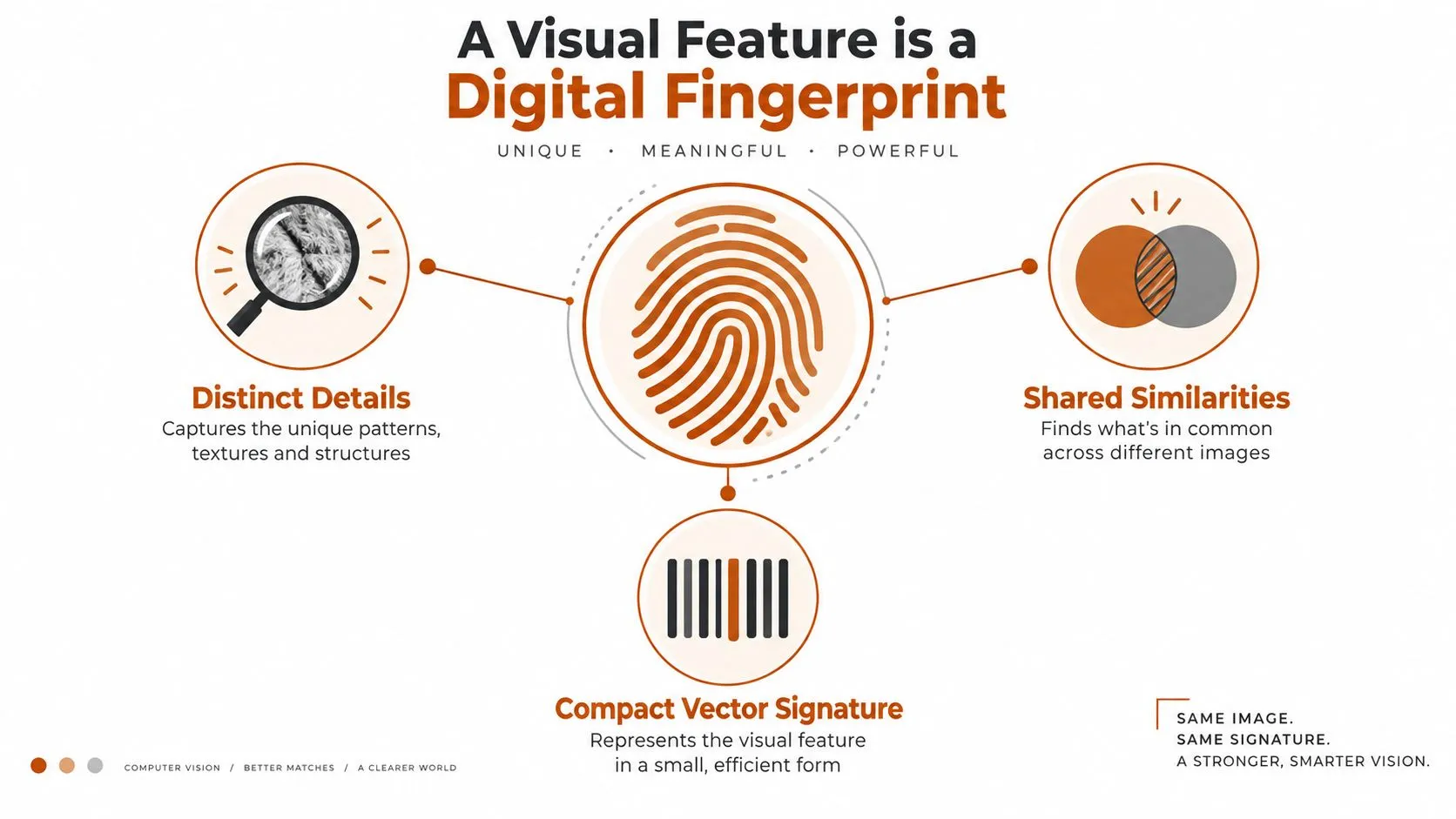
- Three fingerprints for three jobs
- Four Main Approaches and When to Use Each
- Keypoints for correspondence
- Embeddings for global similarity
- Detection and segmentation for structured catalog data
- From Handcrafted Detectors to Deep Backbones
- Practical Considerations for Ecommerce and Compliance Pipelines
- Normalize before extracting
- Deduplicate with layered evidence
- Make compliance reproducible
- Connecting Extracted Features to Downstream Systems
- Version the representation
- Turn visual evidence into typed fields
- Why Reliability Beats Raw Accuracy in Production
- A Pre-Flight Checklist Before You Build the Pipeline
A fashion retailer is moving 2 million product images from a legacy product information management system into a new enrichment pipeline. Merchandising wants automatic category tags, while compliance teams need safety labels that can be reproduced and audited later. The difficult part isn’t choosing a fashionable model. It’s making sure every image is normalized, represented consistently, connected to the right SKU, and delivered in a form that search, analytics, and review systems can trust.
That’s the practical role of computer vision feature extraction. It converts visual content into structured representations, from local keypoint descriptors and global embeddings to bounding boxes, masks, and typed attributes. The right representation depends on what the business needs to do next, not only on which architecture performs best on a benchmark.
What Computer Vision Feature Extraction Looks Like in Practice
The retailer’s migration starts with raw files. Some images show a single garment against a plain background, others contain models, packaging, labels, or multiple views of the same product. A feature extraction pipeline turns each image into machine-readable evidence that downstream systems can compare, filter, classify, and retain as part of an audit trail.
That process has four connected parts.
First, choose the extraction method. Keypoint descriptors such as SIFT or ORB capture distinctive local details. CNN or transformer embeddings summarize broader visual content. Object detectors return classes and bounding boxes, while segmentation models identify the pixels belonging to an object or attribute.
Second, prepare the image. Resolution, orientation, color handling, compression, and file format affect the representation produced by the model. A pipeline that accepts inconsistent inputs can create differences that look like product variation even when the images are visually equivalent.
Third, maintain pipeline hygiene. Deduplication prevents repeated product shots from distorting search results and analytics. Hashes, source identifiers, asset versions, preprocessing records, and model versions provide the lineage needed to explain where a feature came from.
Finally, hand the result to another system. Embeddings may enter a vector index. Detection outputs may become catalog fields. Segmentation masks may support background removal or apparel parsing. OCR and captions can be converted into structured attributes for an API, warehouse, or compliance report.
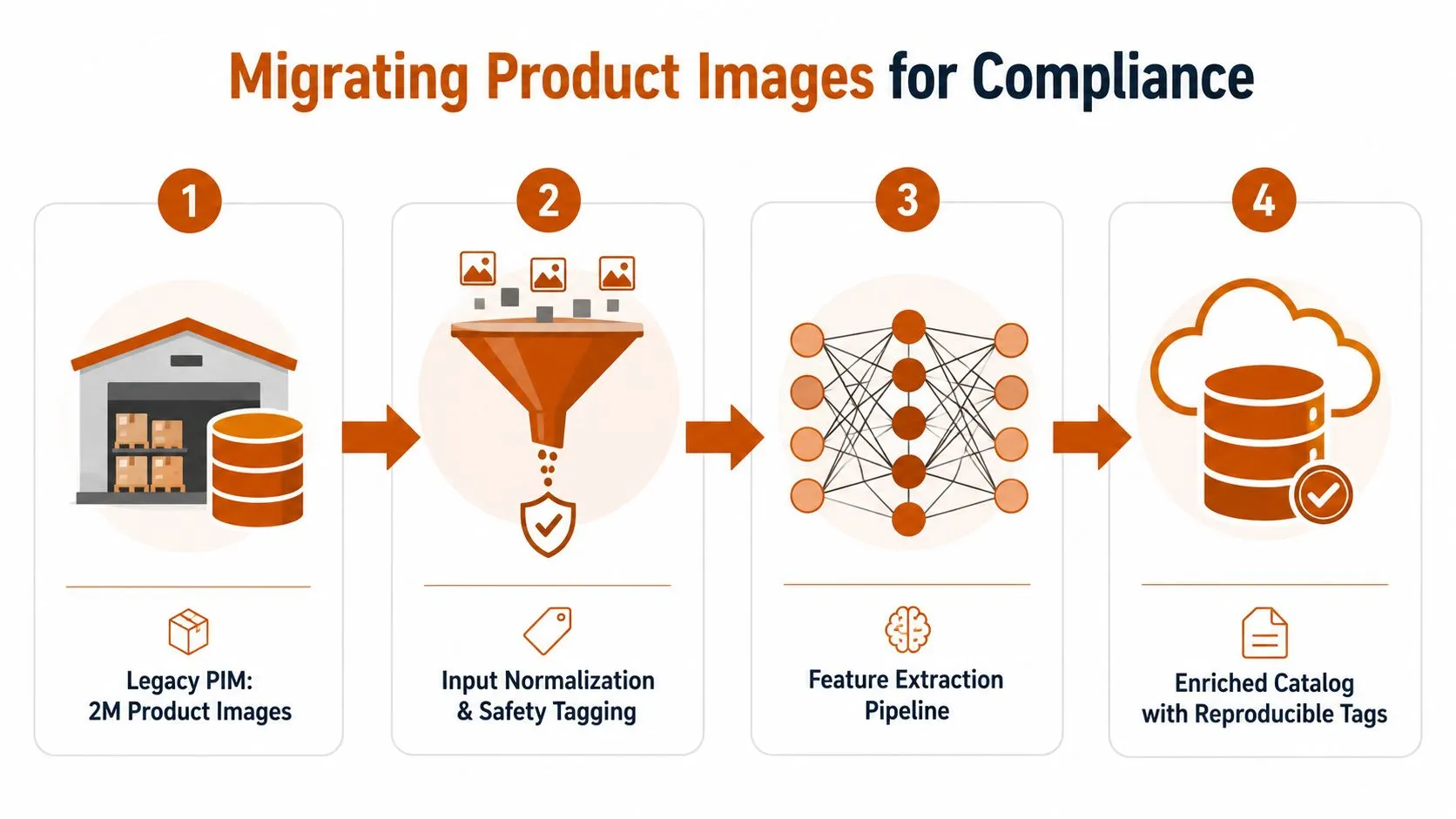
A visual inspection workflow becomes more useful when teams treat the extracted output as a governed data product rather than an isolated model result. For a broader view of screenshot-based inspection and structured visual flags, see visual inspection automation.
The compliance requirement changes the engineering choices. A tag isn’t sufficient if nobody can identify the source image, preprocessing path, model version, confidence, and decision time. Similarly, a similarity score isn’t enough for merchandising if the team can’t determine whether the result reflects the same SKU, a different colorway, or merely a similar texture.
Production rule: Extracted features should be searchable, reproducible, and traceable to a specific asset version.
The Core Idea Behind a Visual Feature
A product team receives two catalog photos of a handbag. One shows the bag against a white background, while the other includes a model and different lighting. An image feature helps the system compare them without treating every pixel as equally important.
A feature is usually a numeric vector, or a group of vectors, that summarizes an image or a selected region. A downstream system compares these representations with distance or similarity functions. Close vectors indicate visual similarity under the conditions the extractor was designed or trained to handle.
The representation is intentionally lossy. A feature vector usually cannot reconstruct the original image, so it is a poor substitute for the source asset. For finding similar products, grouping repeated imagery, or identifying a safety label, however, a compact representation can be easier to search and store than the full pixel data.
Three fingerprints for three jobs
A local keypoint descriptor acts like a fingerprint for one small visual detail. SIFT identifies keypoints across scale space and describes each point with a 128-dimensional vector, according to David Lowe’s reference material on scale-invariant feature extraction. In an ecommerce catalog, these descriptors can help determine whether two images contain the same logo, buckle, printed pattern, or packaging detail.
A CNN embedding acts more like a signature for the entire image. A backbone such as ResNet or EfficientNet converts the image into a dense vector representing broader properties, including composition, shape, and visual style. Teams can use that representation for visual search, clustering, and recommendation candidates. The result is useful for ranking related assets, but it does not by itself explain which object caused the similarity.
An object detector creates a structured representation. Rather than returning one vector for the whole image, it can produce a class label and bounding box for each detected item. A product image containing a model, handbag, and warning label can therefore yield separate records tied to separate regions. That structure supports decisions that require location, not only overall resemblance.
The choice depends on what the next system must compare or understand. Similarity search needs related images to sit near one another in vector space. Compliance tagging needs evidence connected to a region and a decision. Attribute extraction may need pixel-level boundaries. A production pipeline can also combine these outputs with deduplication, format conversion, and model metadata instead of forcing one representation to serve every task.
Workflows involving manipulated or synthetic media may require specialized resources such as deepfake detection for computer vision. A general-purpose image embedding is not automatically a reliable authenticity signal, especially when the decision requires an explanation or audit trail.
Four Main Approaches and When to Use Each
Production teams typically choose among four approaches, each with a different output and operating profile. The common mistake is asking one extractor to handle global similarity, object localization, fine-grained boundaries, and duplicate detection at the same time.
| Method | Output Type | Best For | Typical Latency | Relative Cost |
|---|---|---|---|---|
| Keypoint detection | Sparse keypoints and local descriptors | Matching, alignment, near-duplicate filtering | Low to moderate, depending on image size and keypoint count | Low to moderate |
| CNN embeddings | Dense vector for an image or crop | Visual search, clustering, recommendation candidates | Moderate | Moderate |
| Object detection | Classes, confidence scores, and bounding boxes | Catalog metadata, safety filtering, object presence | Low to high, depending on model and hardware | Moderate to high |
| Segmentation | Pixel masks or per-pixel labels | Background removal, apparel parsing, attribute-level extraction | Moderate to high | High |
Keypoints for correspondence
Keypoint methods are strongest when the system must match particular visual details across images. They can support alignment, image stitching, and near-duplicate detection, especially when the same object appears with changes in scale or rotation. ORB can be appropriate when a team needs a lighter classical baseline, while learned local methods such as SuperPoint are useful when hand-designed descriptors don’t handle the visual conditions well.
Embeddings for global similarity
Embeddings fit visual search and clustering because they compress the broader appearance of an image into a comparable vector. CNN backbones remain practical when teams have limited labeled data or constrained deployment hardware. DINOv2 and CLIP-style extractors can offer stronger semantic or self-supervised representations, but their usefulness still depends on the domain and the quality of the similarity objective.
Detection and segmentation for structured catalog data
Detection answers, “What is present, and where?” That suits safety filtering, product composition, and category enrichment. Segmentation answers a finer question, “Which pixels belong to this object or attribute?” It’s the better choice when a retailer needs to isolate a garment, remove a background, separate overlapping items, or inspect a visual feature at object boundaries.
For a catalog team evaluating managed visual checks, AI image inspection provides a relevant comparison point. The implementation still needs a clear contract for confidence, failure handling, and output schema.
Decision rule: Use embeddings for similarity, detectors for localized metadata, segmentation for boundaries, and keypoints for inexpensive correspondence checks.
From Handcrafted Detectors to Deep Backbones
A product team matching catalog images may start with keypoints, switch to embeddings for semantic search, then convert the result into a schema that downstream systems can consume. That progression reflects feature extraction’s history: manually designed measurements remain useful, while learned representations handle broader visual variation.
In 1999, David Lowe introduced SIFT at ICCV as a method for producing local image features that remain stable across changes in scale and rotation. SIFT finds keypoints across multiple image scales and represents each point with a 128-dimensional vector. This made it useful for object recognition, image matching, and 3D reconstruction. Its original U.S. patent expired on March 7, 2020, which also affected when teams could adopt it without the earlier licensing constraint.
Classical descriptors encode explicit visual properties. Engineers can inspect matched points, trace local evidence, and diagnose why an image pair failed. They work especially well for repeated textures, geometric alignment, and edge devices with tight compute or memory budgets. In an ecommerce pipeline, that can make them practical for a fast duplicate-screening pass before a larger model processes the catalog.
Deep extractors learn representations from data. CNNs build in locality and translation bias, so they can match or outperform vision transformers when labeled data is limited, according to this comparative CNN and vision transformer study. The study lists ResNet-152 at about 60M parameters and DINO-ViT-B/16 at about 85.8M parameters, illustrating the capacity and deployment tradeoff between common backbone families.
| Descriptor | Typical Output | Compute Cost | Best Fit |
|---|---|---|---|
| SIFT | Local 128-dimensional descriptors | High among classical options | Robust matching and geometric correspondence |
| ORB | Compact binary local descriptors | Low | Fast edge matching and duplicate screening |
| CNN backbone | Dense image embedding | Moderate | Catalog similarity and retrieval |
| Transformer backbone | Dense, high-capacity embedding | Moderate to high | Large-scale or self-supervised representation learning |
The speed tradeoff still matters. An OpenCV-focused paper reports that SIFT extraction became approximately 1.5 times faster between OpenCV 2.x and 3.x, while memory use stayed basically unchanged. It nevertheless describes SIFT as computationally heavy for many real-time settings. The OpenCV feature extraction analysis provides that implementation context.
Engineering choice: Use handcrafted features when interpretable matches and very low edge latency matter. Use deep embeddings when semantic retrieval and catalog-scale recall justify added compute, storage, and model operations.
Practical Considerations for Ecommerce and Compliance Pipelines
A model can be accurate and still fail inside a product catalog. Input contracts, duplicate assets, provenance, and operational monitoring often determine whether the extracted data remains useful after launch.
Normalize before extracting
Choose a stable image contract before selecting a model. Resizing images to a consistent long-edge target, such as 1024 pixels, can simplify compute planning and reduce variation between sources. Because that value is an implementation recommendation rather than a universal standard, validate it against the smallest objects and text that the workflow must detect.
Convert unsupported or inconsistent formats such as HEIC and TIFF into an agreed delivery format such as JPEG or WebP. Preserve the original asset separately when retention rules permit it. Apply consistent orientation handling and color profiles, because a change in preprocessing can alter feature values even when the underlying product hasn’t changed.
Deduplicate with layered evidence
A perceptual hash provides a fast first pass for visually similar files. Embedding similarity can then catch edits that preserve the same product view while changing compression, crop, or minor background details. Keep the canonical asset decision separate from the similarity result, since two visually similar images may still represent different colorways or legally distinct packaging.
Make compliance reproducible
Store the source identifier, asset version, preprocessing configuration, extractor version, output schema, confidence values, and review status alongside each result. Redact faces or other personally identifiable information when the business purpose doesn’t require them, and define retention windows for source imagery and derived features.
Teams working on product transparency and explainability can use resources such as AI transparency from DPP Grid to inform governance discussions. The practical requirement is simple: a reviewer should be able to reproduce why a safety tag or attribute was assigned.
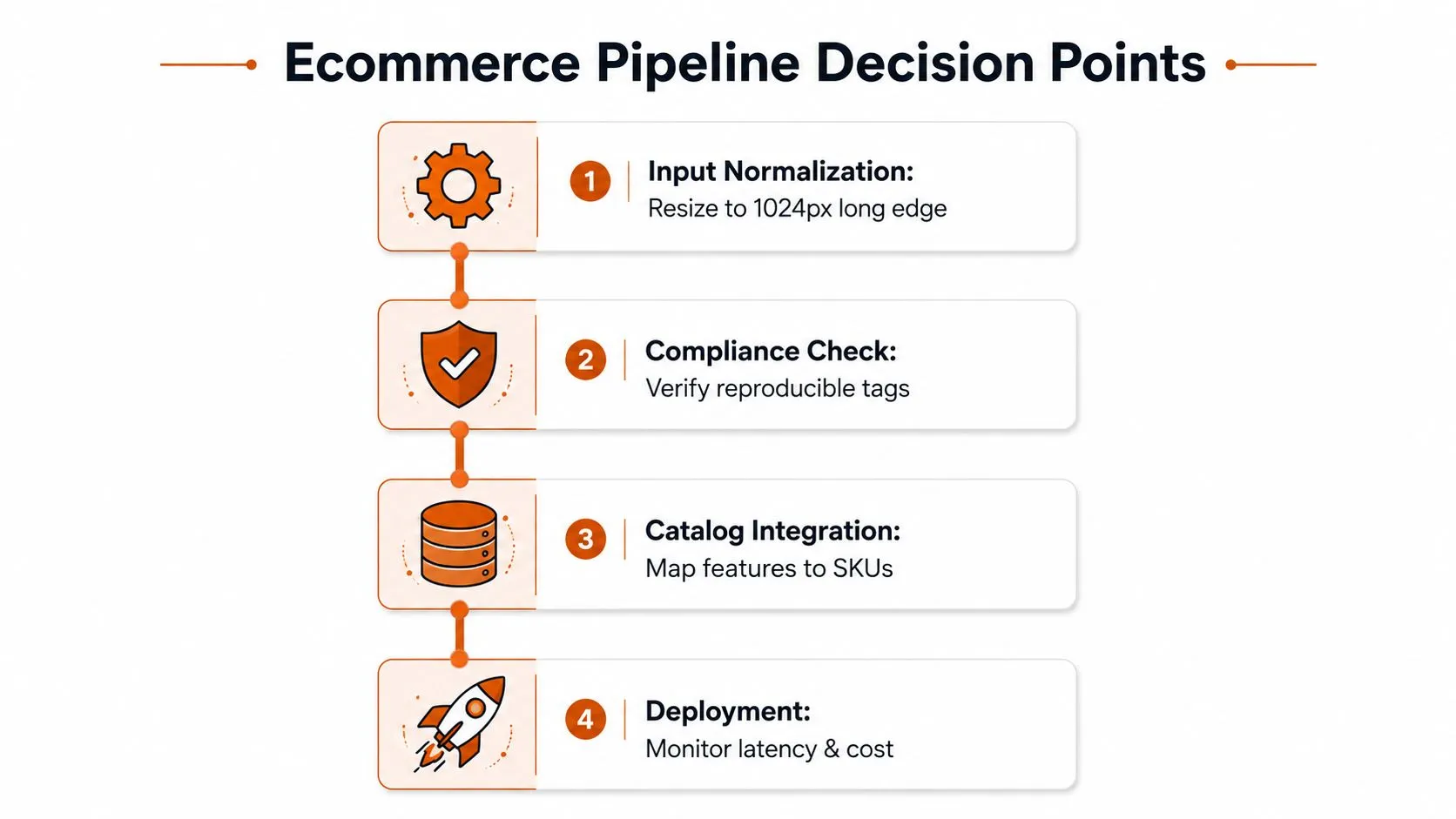
Monitoring should include throughput, failure categories, confidence distributions, and embedding drift. For teams building broader image collection and enrichment workflows, why image data scraping matters for modern businesses offers useful operational context.
Connecting Extracted Features to Downstream Systems
An extracted vector becomes valuable only after another system can use it. Store embeddings in a vector database such as pgvector, Milvus, or Pinecone, and keep structured metadata in a relational store such as Postgres. A hybrid query can then combine vector similarity with filters for SKU, brand, availability, region, or compliance status.
Detection and segmentation outputs need a different path. A detector may produce a record containing a class, confidence, and bounding box. A segmentation model may produce a mask reference, polygon, or serialized pixel representation. Teams can store these outputs as JSON or Parquet and expose them through an API, warehouse table, or scheduled delivery.
Version the representation
Every extractor update should create a distinguishable feature version. The record should identify the model family, model revision, preprocessing settings, and schema version. Keep old and new vectors separate during migration so the team can compare retrieval behavior and reindex deliberately instead of mixing incompatible representations.
Vector dimensions, normalization rules, and semantic behavior can change between model revisions. A downstream index may accept the new data while returning unusable comparisons if the migration doesn’t enforce compatibility.
Turn visual evidence into typed fields
OCR can extract visible text, while captions or vision-language models can provide descriptive context. An LLM-based parser can transform those outputs into typed fields such as material, color, warning text, or packaging attributes, provided the pipeline validates the result against an explicit schema.
Analytics teams can join those fields to revenue, returns, inventory, and compliance records. A visual match can therefore become a business measurement rather than a detached similarity score. Teams planning the collection and preparation layer can also review machine learning data collection for related pipeline considerations.
Schema discipline: A vector index stores similarity evidence. Your operational database still needs the identity, provenance, and business meaning.
The strongest architecture treats images, extracted features, model decisions, and review outcomes as related records. That structure supports reprocessing, audits, model evaluation, and closed-loop improvement without forcing the product team to rebuild the entire catalog each time the extractor changes.
Why Reliability Beats Raw Accuracy in Production
A production pipeline rarely fails because a benchmark score is slightly lower. It fails because a worker receives a corrupt JPEG, a retry creates duplicate records, or a model upgrade produces vectors that no longer match the existing index.
Leaderboard metrics still matter, but they aren’t the product requirement. The team needs deterministic outputs, graceful handling of malformed inputs, idempotent processing, observable failures, and predictable operating cost. A model with strong benchmark performance can be a poor production choice if it requires constant intervention or makes reprocessing difficult.
| Criterion | Benchmark Mindset | Production Mindset |
|---|---|---|
| Model score | Maximize a headline metric | Meet the task threshold under real inputs |
| Runtime | Report average inference time | Track tail latency, retries, and queue behavior |
| Input quality | Assume curated images | Quarantine, repair, or reject malformed files |
| Version changes | Replace the previous model | Preserve versions and support controlled reindexing |
| Cost | Optimize accuracy first | Balance compute, storage, review, and maintenance |
| Failure handling | Count only prediction errors | Record every operational failure and recovery |
The same principle applies to model size. Using a large transformer for every product image can be wasteful if a tuned CNN already meets retrieval needs. Conversely, a lightweight model may create expensive manual review when the catalog contains small objects, occlusion, or difficult reflective surfaces.
A 2025 FEFP-Net paper describes a multi-level extraction and fusion design for handling scale variation, with extraction, fusion, and prediction stages that combine coarse and fine information. Its reported MS-COCO comparison reinforces a practical point: feature quality affects localization and class confusion, but the production choice still has to account for throughput, maintainability, and failure recovery.
For monitoring design, data quality monitoring tools can help teams think beyond model metrics and inspect the health of the full data flow.
A Pre-Flight Checklist Before You Build the Pipeline
Start with the consumer, not the model. Search needs comparable vectors and filtering metadata. Safety review needs localized evidence and reproducible decisions. An LLM needs clean, typed inputs with clear provenance.
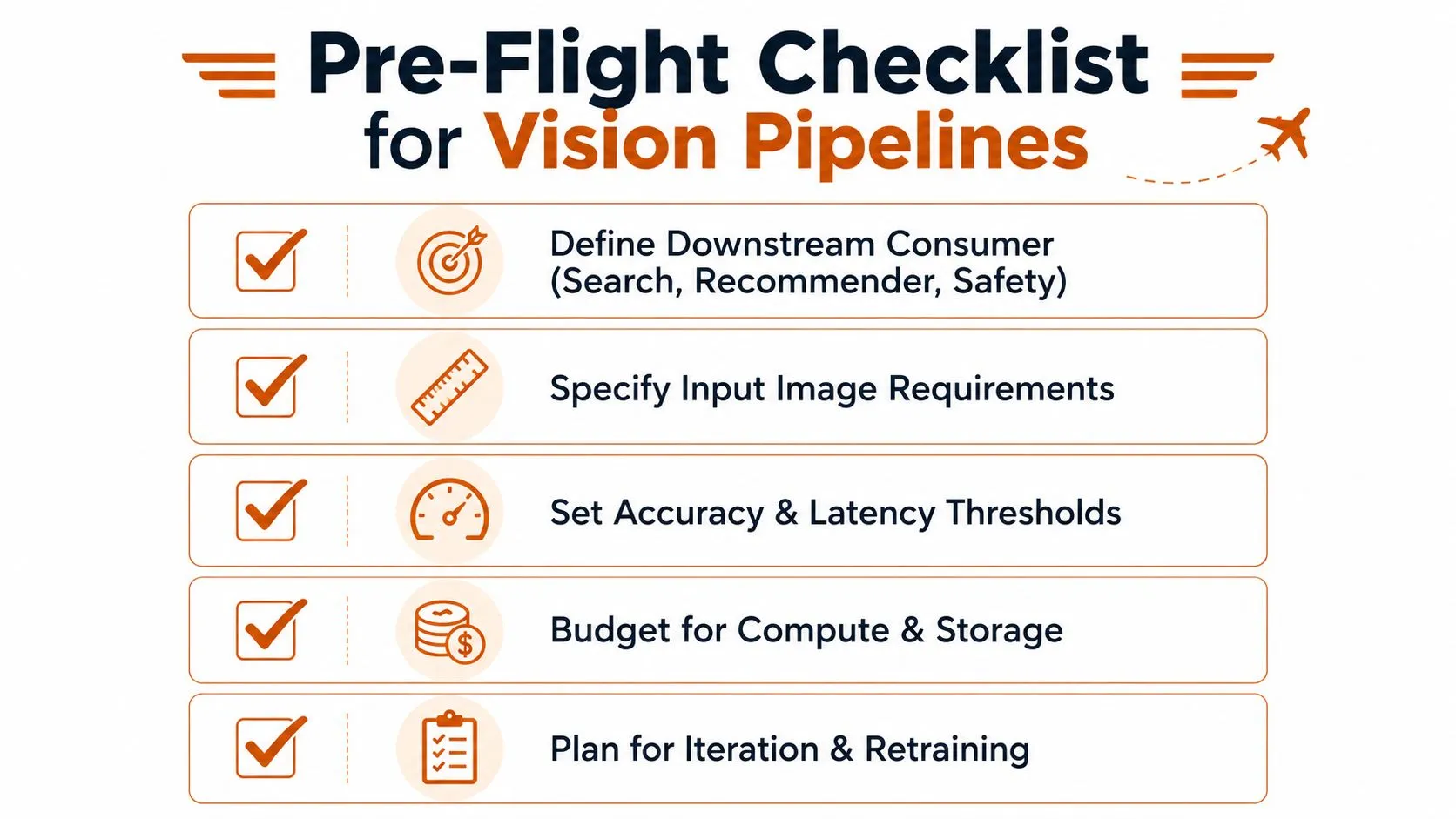
Use this checklist before implementation:
- Define the output contract. Specify whether the system emits embeddings, detections, masks, attributes, reports, or several of these together.
- Pin image requirements. Document accepted formats, orientation rules, minimum useful resolution, corruption handling, and the deduplication key.
- Match the feature family to the job. Establish a classical keypoint baseline where correspondence or near-duplicate filtering matters, then compare it with a deep backbone for semantic retrieval.
- Plan versioning and storage. Record model, preprocessing, schema, and asset versions so the team can reprocess historical images without losing lineage.
- Define operational thresholds. Monitor throughput, failures, latency, confidence distributions, review volume, and embedding drift before launch.
Choose one ecommerce workflow and run a focused pilot with a classical baseline and a deep backbone side by side. Let operational telemetry, duplicate rates, review effort, schema stability, and retrieval usefulness guide the final decision, rather than relying on a benchmark score alone.
WebscrapingHQ provides managed web data operations and custom extraction pipelines that combine image capture, visual inspection, deduplication, format conversion, schema versioning, and LLM-based parsing. Visit WebscrapingHQ to discuss a production-ready workflow for ecommerce enrichment, compliance reporting, or machine learning data delivery.
Want this done for you?
Send us the URLs. We'll quote it in 24 hours.
Paste the URL(s) you want scraped. We'll reply within 24 hours with a feasibility check and a ballpark quote.