Jump to section
- Table of Contents
- What Visual Inspection Automation Actually Means
- From manual review to structured decisions
- What makes it operationally different
- The Technical Stack Behind Reliable Inspection
- Image capture and preprocessing come first
- Models, parsers, and deduplication each have a job
- Rule-Based Inspection Versus Deep Learning Models
- Where rules win
- Where deep learning wins
- The middle ground
- Business Use Cases That Already Pay Off
- Ecommerce image QA and marketplace hygiene
- Dealer compliance and cooperative advertising review
- Ad verification and brand safety
- Training data collection for AI teams
- Why Production Pipelines Fail and How to Stabilize Them
- Image quality is the real dependency
- Maintenance has to be planned, not hoped for
- The discipline that keeps systems alive
- Implementation Roadmap From Scoping to Scale
- Start with feasibility, not enthusiasm
- Build the data intake path before the model
- Pilot with a scorecard, then scale
- Common Pitfalls and the Use Cases That Should Stay Manual
- Bad targets sink good models
- Metrics need to be operational, not decorative
- Keep some work manual on purpose
- KPIs, Quality Controls, and the Managed-Service Advantage
- The metrics that actually matter
- Why managed operations beat a pure build in many cases
Your team probably has the same problem in a different costume. Maybe it’s dealer listings arriving in a flood, maybe it’s product imagery that keeps slipping through brand review, or maybe it’s compliance screenshots that analysts have to eyeball one by one. The work looks “visual,” but the bottleneck is operational, too many files, too many variants, too much manual judgment, and not enough consistency.
Visual inspection automation is the discipline of turning that mess into a controlled pipeline. In production, that means capturing images, running them through computer vision models, parsing the results into structured fields, deduplicating repeated findings, and pushing decisions to the right workflow on a schedule. In other words, it’s not a single model, it’s a data operations system for anything people currently review with their eyes.
The reason this matters is simple. Manual inspection is still common, and it’s still expensive, inconsistent, and slow to scale. In a survey summarized by Landing AI, AI-powered inspection was already moving into real use by 2020, with 26% of businesses using AI for visual inspection and more than 60% using some form of automation, while 40% still relied on inspection that was completely or mostly manual. The same report notes manual inspection error rates of 20% to 30%, and McKinsey research cited there says AI-powered quality inspection can raise productivity by up to 50% and defect detection by up to 90% versus manual inspection (Landing AI survey summary).
Table of Contents
Open Table of Contents
- What Visual Inspection Automation Actually Means
- The Technical Stack Behind Reliable Inspection
- Rule-Based Inspection Versus Deep Learning Models
- Business Use Cases That Already Pay Off
- Why Production Pipelines Fail and How to Stabilize Them
- Implementation Roadmap From Scoping to Scale
- Common Pitfalls and the Use Cases That Should Stay Manual
- KPIs, Quality Controls, and the Managed-Service Advantage
What Visual Inspection Automation Actually Means
A marketplace team gets 800 new listings before lunch. A compliance analyst opens a queue of dealer images, some cropped badly, some reused, some obviously off-brand. A human can handle a few dozen reviews before fatigue sets in, but the queue doesn’t care. It keeps growing, and every extra pass adds delay, inconsistency, and more room for missable errors.
From manual review to structured decisions
Visual inspection automation is the replacement for that human queue, not with one clever model, but with a workflow. A camera or screenshot capture grabs the asset, a vision model evaluates what’s present, an LLM parser can convert visual findings into structured labels or report fields, and downstream logic decides whether to pass, reject, flag, or route to manual review. That is the difference between automation and a one-off OCR script.
This is why the term spans so many environments. In factories, it checks parts. In ecommerce, it checks listing imagery. In ad verification, it checks whether creatives match policy. In scraping-driven training data pipelines, it checks whether captured images are complete, relevant, and deduplicated before they ever reach a model.
A useful way to think about it is as inspection as a data product. The output is not just “good” or “bad.” The output is a structured decision with evidence, tags, and a place in the workflow.
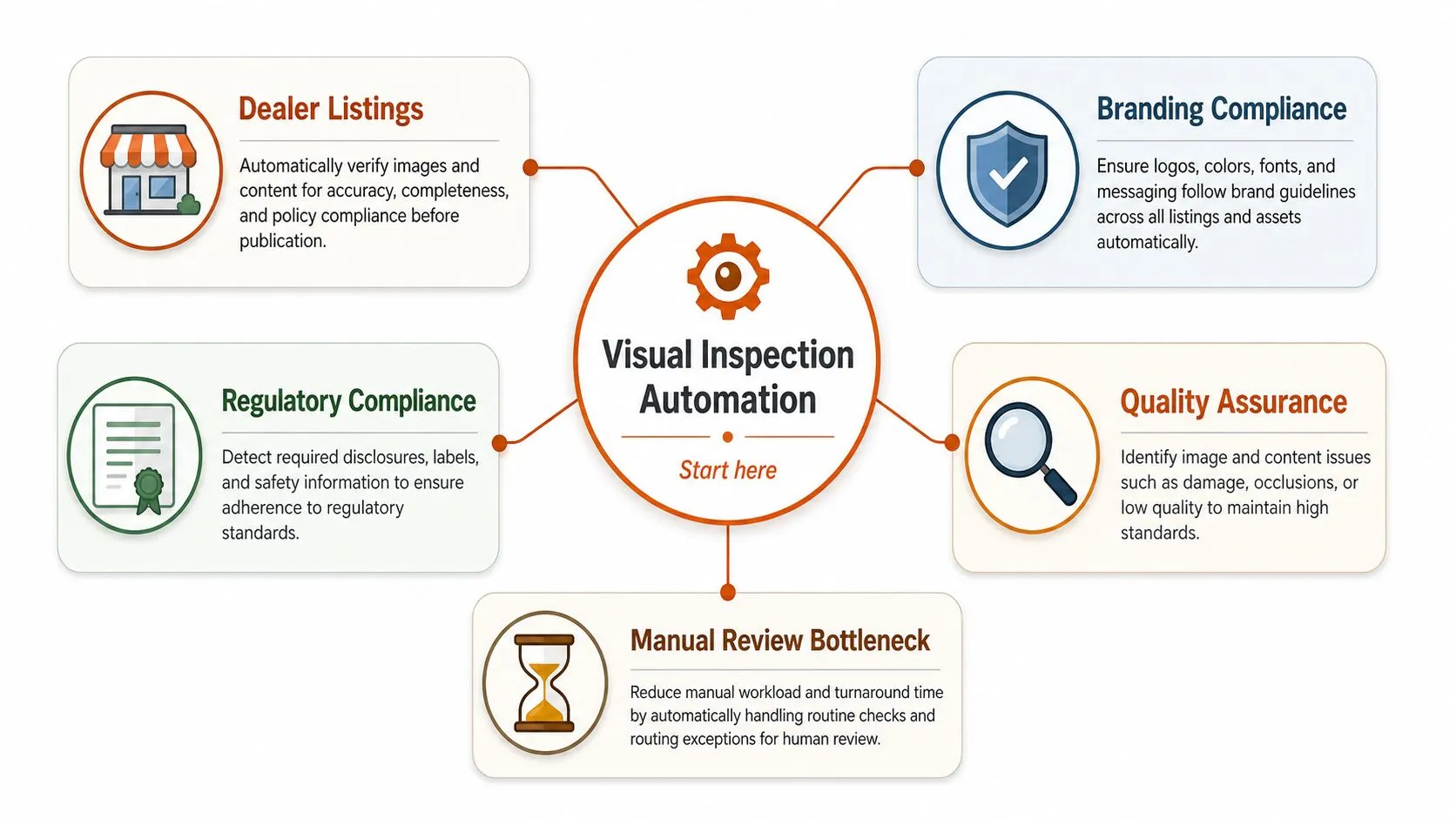
If you want another practical framing, the overview of automated verification technologies is useful because it shows how screenshot-based checks, visual similarity thresholds, and structured exception handling fit together. That’s the right mental model, not “AI looks at pictures.”
What makes it operationally different
The strongest systems do three things well. They inspect every item, they preserve the evidence, and they create a repeatable audit trail. That matters because the goal is not to admire model accuracy in a demo, it’s to remove ambiguity from a production queue.
Practical rule: if the output can’t be turned into a workflow decision, you don’t have an inspection system yet. You have an experiment.
The Technical Stack Behind Reliable Inspection
The most common mistake is treating AI vision as a single block of software. It isn’t. Reliable inspection is a stack, and each layer fails in a different way.
Image capture and preprocessing come first
The capture layer decides whether the rest of the system has usable evidence. If framing shifts, glare blooms, shadows move, or the part sits differently each time, the model inherits that noise. Production-oriented guidance keeps coming back to controlled lighting, camera placement, glare suppression, and part presentation, and one production study recommends saving images continuously and tuning each model separately because different training conditions need different settings.
That same logic applies outside factories. Screenshot capture for ecommerce, compliance, and ad review has its own failure modes, page state changes, browser differences, lazy loading, and layout drift. If you scrape without stabilizing capture, the result is random noise with a label attached, which is why teams that depend on scraping-driven training data should read the machine learning data collection guide before they build a pipeline that looks fine in a demo and falls apart in production. The practical lesson is simple, image acquisition is a data operations problem first.
Models, parsers, and deduplication each have a job
The model layer is where CNN-based classification and segmentation still do the heavy lifting. A technical review notes that CNNs remain the standard choice for image classification, object recognition, and segmentation in automated inspection, while vision transformers are emerging but usually require more compute. After the model, an LLM parser can map findings into structured fields, for example, defect type, placement, severity, or policy category.
Then comes deduplication. Many pipelines leak money here. If the same defect or the same visual violation gets counted multiple times across captures, angles, or retries, the report becomes misleading. The system needs entity resolution for images, not just for text.
For teams that collect training data or monitor hostile pages, the capture layer also needs anti-bot-aware scraping. The stack only works if it can survive source changes, rate limits, and page structure shifts. The guide from Forge Reliability makes the same point from a different angle. Production inspection depends on disciplined data collection, not casual file dumps.
Reliable inspection systems are built from boring parts, not magic ones. Capture, model, parse, dedupe, route. If any layer is sloppy, the whole chain gets noisy.
Rule-Based Inspection Versus Deep Learning Models
Teams still ask the wrong question here. They ask whether rule-based inspection is “older” and deep learning is “newer.” That frame misses the point. The question is which failure mode you can tolerate in production.
Where rules win
Rule-based checks work best when the environment is tight, the threshold is clear, and the output has to be easy to explain. If you are validating a known dimension, checking a fixed template, or enforcing a narrow regulatory image rule, hard-coded logic is the right tool. It is simpler to audit, easier to freeze, and less dependent on training data.
Rules also make sense when image conditions stay stable. If the part geometry does not move, the camera does not move, and the definition of failure does not move, rules are efficient and predictable. In those cases, “smart” is not better just because it sounds modern.
Where deep learning wins
CNN-based inspection wins when the catalog is messy, the defects vary, or the visual presentation changes too often for templates to hold. That is why the industry keeps using classification and segmentation models. They learn what good looks like from examples, then generalize to defect patterns that were never explicitly programmed.
The cost is maintenance. The model needs representative training data, and it needs ongoing care as defect distributions shift. That is the trade. You give up rule brittleness, but you take on data discipline. For teams building inspection datasets from large image libraries or scraped sources, why image data scraping matters for modern businesses explains why capture quality and source consistency shape everything downstream.
My rule: use rules for fixed thresholds and deep learning for variation. If you do not know which side of that line you are on, your use case probably is not ready for full automation.
The middle ground
Vision transformers are showing up more often, but the practical reality is still compute and data governance. They are promising, not universal. In most operating environments, a CNN-backed pipeline with strong capture control beats a fancy model built on weak data.
The same operational logic shows up in the guide from Forge Reliability. Pick the method that matches the operational constraint. Do not pick the one that sounds most advanced.
Business Use Cases That Already Pay Off
The strongest deployments don’t start with “factory automation.” They start with a pain point that already has an analyst queue attached to it. The same inspection stack can serve very different teams if the outputs are structured correctly.
Ecommerce image QA and marketplace hygiene
Retail and marketplace teams use visual inspection automation to review listing imagery for consistency, image presence, and visual similarity to brand standards. The workflow is straightforward. Capture the asset, compare it against the policy set, flag exceptions, and send only the odd cases to a human.
That matters because marketplace scale turns image review into a throughput problem. The same system can also dedupe near-identical images, which keeps repetitive catalog assets from clogging review queues.
For teams working on the retail-intelligence side of that problem, the visual brand intelligence case study is relevant because it shows how image analysis supports structured brand oversight across large portfolios.
Dealer compliance and cooperative advertising review
Ad verification bureaus and dealer networks need something else entirely. They need proof that what was published matches the policy or cooperative agreement. Here, inspection isn’t about a pretty image. It’s about whether the right brand elements, disclaimers, or visual rules are present in the captured page or creative.
This is one of the clearest fits for managed visual inspection, because the pipeline can render pages, capture screenshots, and produce exception reports in a format compliance teams can use. The output needs to be audit-ready, not just machine-readable.
Ad verification and brand safety
Creative review is where people underestimate the value of automation. Brand teams don’t want a model to make taste judgments. They want it to catch obvious violations, isolate exceptions, and preserve evidence. That’s a triage problem, and triage is exactly where the stack shines.
The best systems here don’t replace human approval. They remove the need for human eyes on every asset. That’s a different business case.
Training data collection for AI teams
Machine learning teams need visual corpora that are clean, deduplicated, and standardized before labeling starts. If the intake layer is messy, the dataset inherits every problem in the source. That’s why visual inspection automation is just as relevant to data operations as it is to quality control.
For teams building that kind of pipeline, the real-time vision in robotics piece is a helpful reminder that the inspection problem is often about immediate interpretation of live visual input, not static archive review.
In every one of these use cases, the winning move is the same, capture, classify, structure, and route exceptions. The industry label changes. The operational pattern doesn’t.
Why Production Pipelines Fail and How to Stabilize Them
A demo can look clean and still collapse in week two. That is the normal failure mode. The model looked strong in a controlled set, then the light shifted, the camera moved, the page layout changed, or the product line introduced a new visual variant.
Image quality is the real dependency
The benchmark that matters in production is system stability under consistent imaging conditions, not model elegance. One industry guide reports deep-learning-based inspection systems achieving defect detection accuracy above 98% under production conditions, but that result depends on tight control over lighting, optics, and reference standards. That is a system outcome, not a model-only win.
Budget for image-quality engineering up front. A weak capture setup forces the model to compensate for noise it should never see. When source pages or assets drift, the pipeline starts producing false exceptions and the queue loses trust.
Maintenance has to be planned, not hoped for
The hardest part is usually not the first detection pass. It is keeping the pipeline stable as conditions change. Lighting drift, glare, camera placement changes, and source layout changes all surface as model problems even when the fault sits upstream.
The same applies to scraping-driven pipelines. A source can change overnight, and without retry logic, schema versioning, and monitoring, the inspection layer starts to look unreliable. The support layer is under-built.
The distributed web scraping fault tolerance basics guide fits here because production inspection runs on the same operating reality. Sources fail, partial data arrives, and the pipeline needs to degrade gracefully instead of breaking loudly.
The discipline that keeps systems alive
Use continuous image capture where it makes sense. Tune each model for the specific source or line. Do not copy settings across product lines or page types and expect the same result.
Keep humans in the loop for ambiguous cases. Retrain when defect distributions shift. That is the difference between a pilot and an operating system. One is a demo. The other is a living process.
Implementation Roadmap From Scoping to Scale
Implementation failures usually start with scope that’s too broad. Teams try to automate every review path, every source, and every exception at once. That burns time and makes it impossible to tell whether the system is working.
Start with feasibility, not enthusiasm
The first deliverable should be a feasibility memo. Pick one inspection target where mistakes are expensive or manual checks are slow, and define what success means in plain terms. If the team can’t name the failure mode, the target isn’t ready.
Target selection should be blunt. Choose a source or workflow with enough repeatability and enough examples to train against. If the data is too sparse or the visual pattern is too subjective, leave it manual for now.
Build the data intake path before the model
The acquisition step matters more than many admit. If pages, screenshots, or images can’t be captured consistently, the model won’t rescue you. Anti-bot-aware scraping, browser rendering, and image normalization belong in the inspection budget, not as cleanup work after the pilot fails.
That same discipline applies outside the factory floor. Ecommerce imagery, compliance review, and scraping-driven training data all break for the same reason, bad intake produces bad decisions. A managed service can be the right move when the problem is operating the pipeline, not designing the model. WebscrapingHQ, for example, builds and runs extraction pipelines that combine visual inspection and LLM-based parsing, then delivers structured outputs on recurring schedules.
Pilot with a scorecard, then scale
The pilot should use explicit metrics, not vague praise from users. Track defect catch rate, false call rate, cycle time, and coverage. If the pilot can’t show that it catches the right exceptions with acceptable noise, stop and fix the pipeline before scaling.
A scale-up plan should include monitoring, retries, and a retraining rhythm. Do not treat model refresh as a one-time milestone. It is part of the service.
For an adjacent view of the acquisition and validation side, the machine learning data validation guide is worth reading because it reinforces the same idea, trust comes from checks, not assumptions.
Implementation rule: do not scale a noisy pilot. Fix capture, tighten labels, and prove the workflow on one source before you add another.
Common Pitfalls and the Use Cases That Should Stay Manual
A lot of automation advice is too optimistic. It assumes every visual problem is a candidate for full automation if you just collect enough data. That’s wrong.
Bad targets sink good models
Some use cases are poor fits unless the process is repeatable and the data is representative. Low-volume defect classes rarely justify the engineering burden. Highly creative or subjective judgments usually don’t either. If a human review is mostly interpretation, not inspection, a model will create more work than it removes.
The other common mistake is choosing targets where mistakes are not expensive or where reviews aren’t slow. That sounds obvious, but teams do it all the time because the data is easy to access. Easy data is not the same as meaningful data.
Metrics need to be operational, not decorative
Headline accuracy is the wrong finish line. You need defect catch rate, false call rate, and cycle time. Those metrics show different failures. A model that looks accurate on paper can still annoy analysts with false alarms or miss defects that matter most.
The 2023 global survey noted by Research and Markets found that organizations averaged 41.7 inspectors conducting daily inspection activity at a single site, while only 1% of respondents said they perform daily visual inspections and 88% said inspections happen only weekly (Research and Markets survey summary). That’s a reminder that cadence matters. If inspections are weekly, automation may be about consistency and backlog reduction. If they’re daily, it may be about throughput and triage.
Keep some work manual on purpose
Not everything should be automated. One-off reviews, rare edge cases, and highly subjective decisions often belong with people. The right pattern is a triage layer, not a total replacement. Humans handle the ambiguous cases, and the system handles the repetitive ones.
For a separate angle on source variability and recurring change, the image-data scraping guide is helpful because it reinforces the same operational truth, not all visual sources are stable enough for hard automation.
KPIs, Quality Controls, and the Managed-Service Advantage
A good inspection program starts with measurement. If you cannot quantify the output, you are funding a polished workflow with no proof it helps.
The metrics that actually matter
Defect catch rate shows whether the system finds the problems it was hired to find. False call rate shows whether it is creating noise that will frustrate reviewers. Cycle time shows whether the pipeline is faster than manual handling. Coverage shows whether you are inspecting enough of the stream to matter. Analyst hours reclaimed is the business metric executives understand fastest.
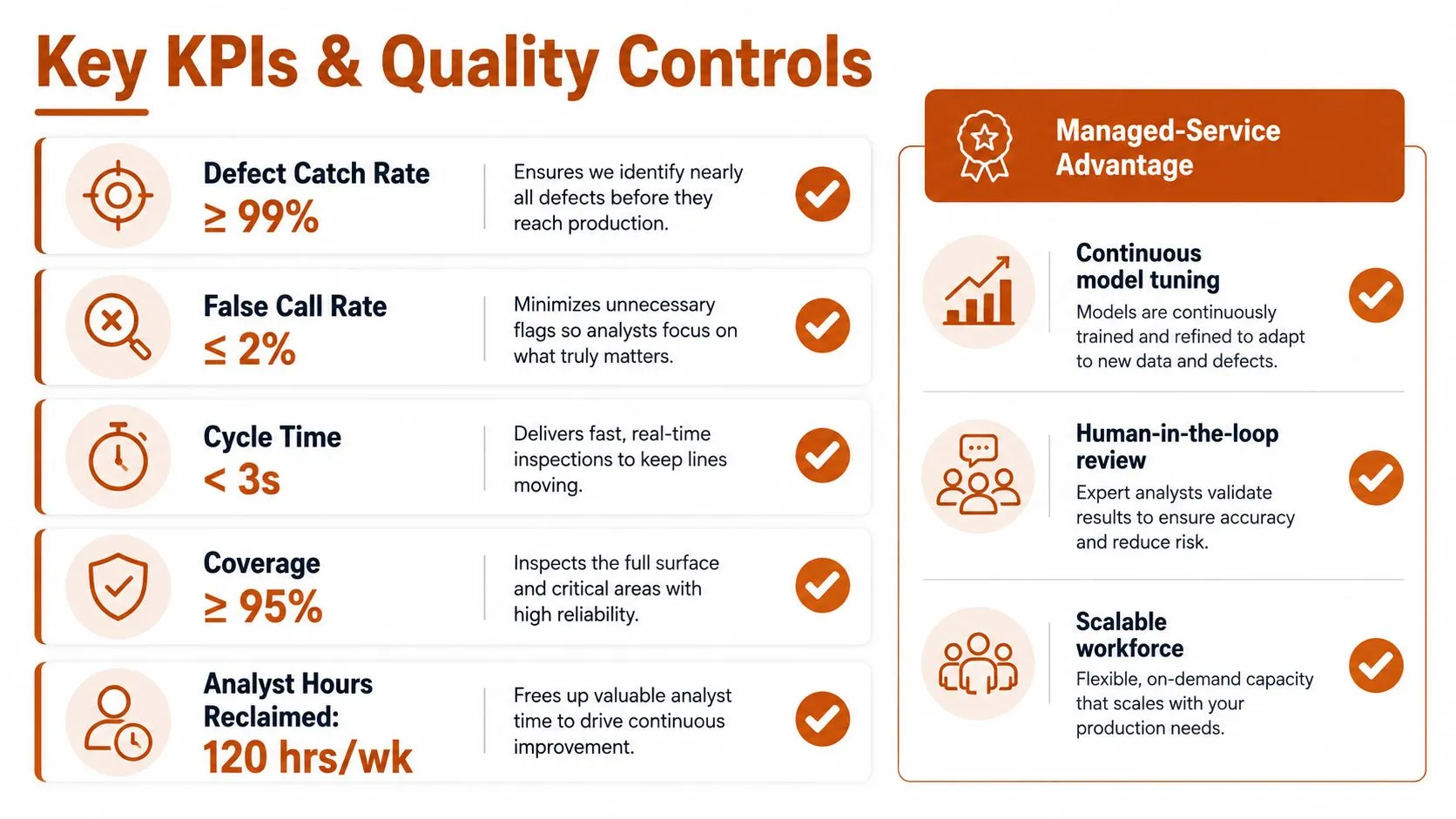
The KPI set needs balance. A high catch rate means little if the false call rate overwhelms the team. Fast cycle time means little if you are not covering enough of the stream. Track all of them together, and tie the outputs to data validation practices so you know the inspection results are trustworthy before anyone acts on them.
Why managed operations beat a pure build in many cases
The managed-service advantage is straightforward. It removes recurring operational burden. When the source changes, someone has to handle it. When proxy behavior shifts, someone has to fix it. When CAPTCHA defenses appear or schemas drift, someone has to keep the pipeline alive.
That is why a managed provider makes sense for compliance and image-heavy workflows. The service absorbs the recurring work, then delivers outputs in the format the downstream team wants, such as PDF compliance reports, CSV or JSON feeds, webhooks, or S3 drops. In practical terms, that lets analysts stay on review and decisioning instead of spending their day nursing infrastructure.
The same operating model has already supported large recurring deliveries, including 1,680 dealer compliance reports per month for a U.S. verification bureau, which shows the scale a dedicated operations layer can sustain.
Use this checklist if you are evaluating a vendor or an internal build. The system should handle source volatility, preserve evidence, expose structured outputs, support human review, and make retraining routine instead of heroic.
WebscrapingHQ designs and runs managed web data operations for teams that need visual inspection automation without owning every maintenance burden in-house. If your workflow depends on screenshots, compliance artifacts, or recurring image review, talk to them about a pipeline that captures, verifies, and delivers structured outputs on schedule.
Want this done for you?
Send us the URLs. We'll quote it in 24 hours.
Paste the URL(s) you want scraped. We'll reply within 24 hours with a feasibility check and a ballpark quote.